Fire in the Heart: A Characterization of the High Kinetic Temperatures and Heating Sources in the Nucleus of NGC253
Jeffrey G. Mangum, Adam G. Ginsburg, Christian Henkel, Karl M. Menten,, Susanne Aalto, and Paul van der Werf

TL;DR
This study uses ALMA observations to map dense gas, kinetic temperatures, and heating sources in the nucleus of NGC253, revealing high temperatures and cosmic ray influence in the starburst region.
Contribution
First detailed ALMA-based analysis of dense gas structure, temperatures, and heating mechanisms in NGC253's nucleus, linking molecular data with star formation and cosmic ray activity.
Findings
Kinetic temperatures exceed 50 K on 5'' scales and 300 K on sub-1'' scales.
Molecular abundances decrease radially, indicating cosmic ray and mechanical heating influence.
Higher cosmic ray activity is confirmed by radio spectral index and supernova remnants.
Abstract
The nuclear starburst within the central ( pc; pc) of NGC253 has been extensively studied as a prototype for the starburst phase in galactic evolution. Atacama Large Millimeter/submillimeter Array (ALMA) imaging within receiver Bands 6 and 7 have been used to investigate the dense gas structure, kinetic temperature, and heating processes which drive the NGC253 starburst. Twenty-nine transitions from fifteen molecular species/isotopologues have been identified and imaged at to resolution, allowing for the identification of five of the previously-studied giant molecular clouds (GMCs) within the central molecular zone (CMZ) of NGC253. Ten transitions from the formaldehyde (HCO) molecule have been used to derive the kinetic temperature within the to…
Click any figure to enlarge with its caption.
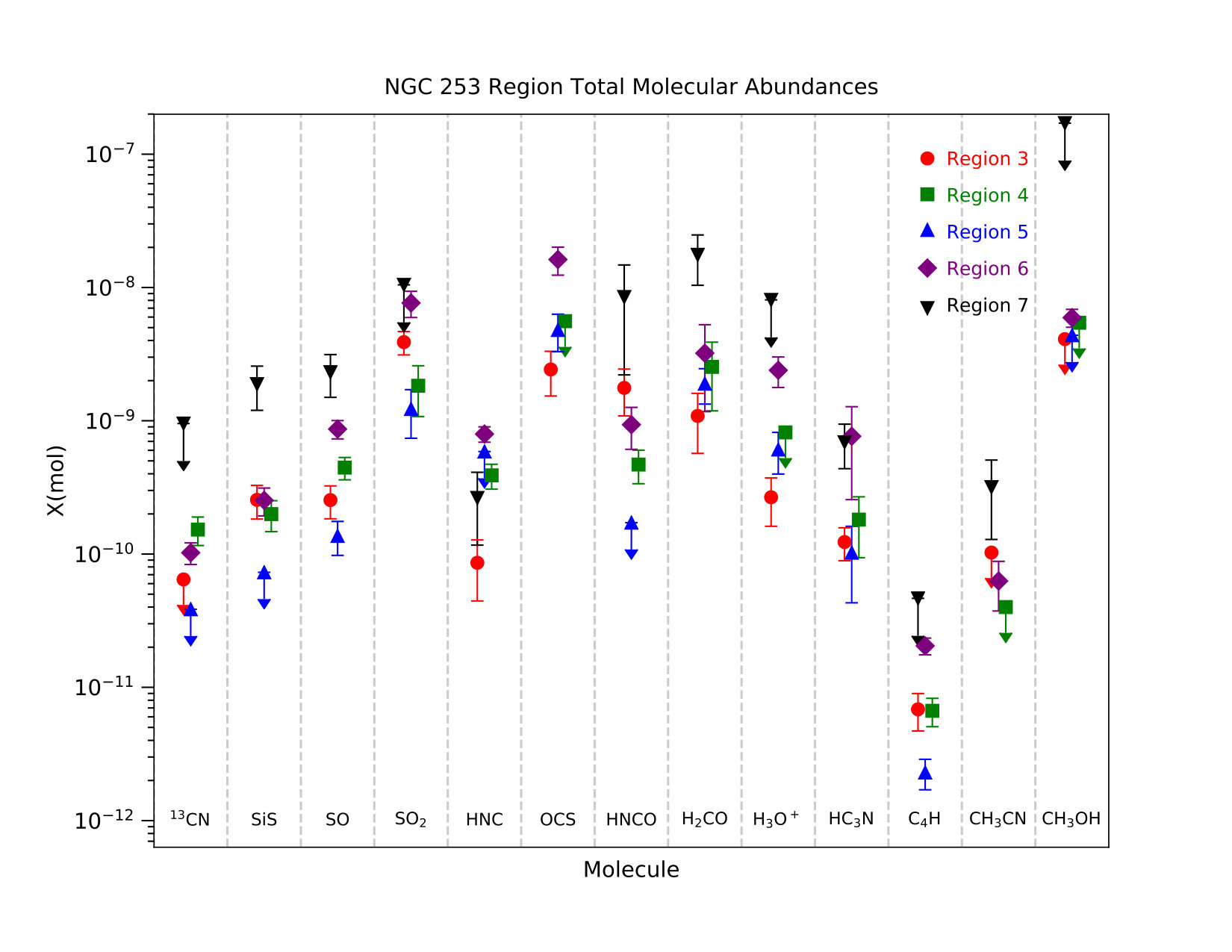 Figure 1
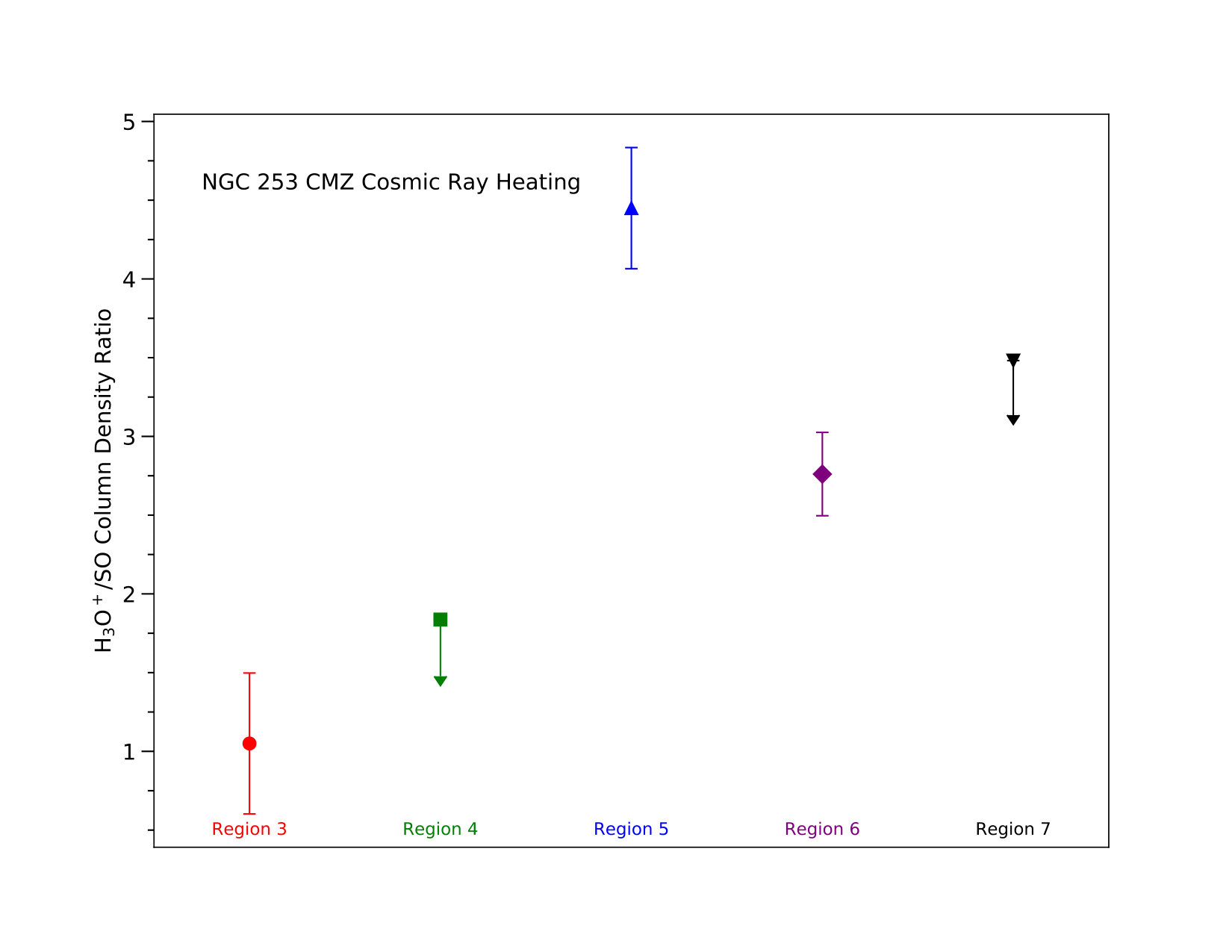 Figure 2
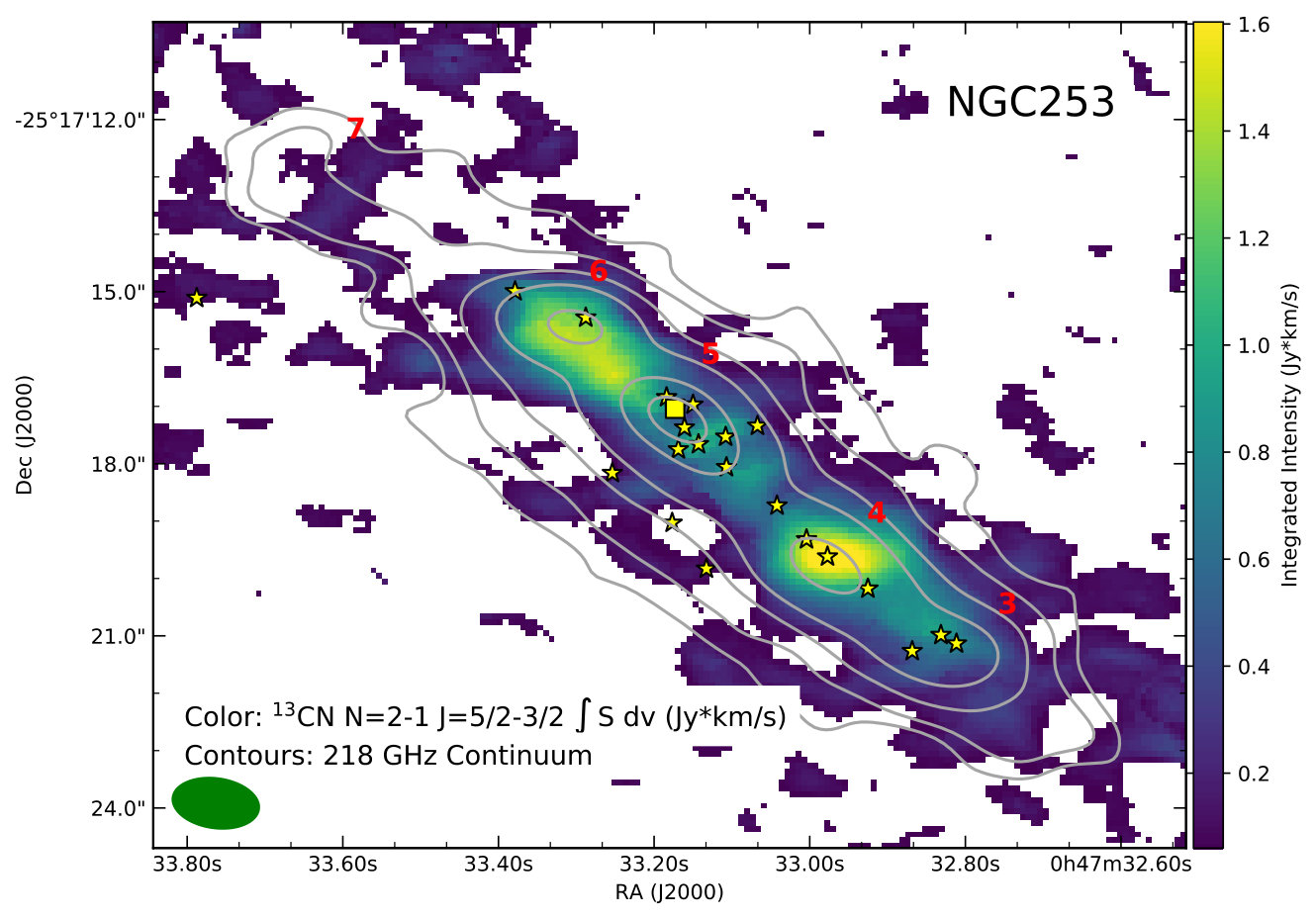 Figure 3
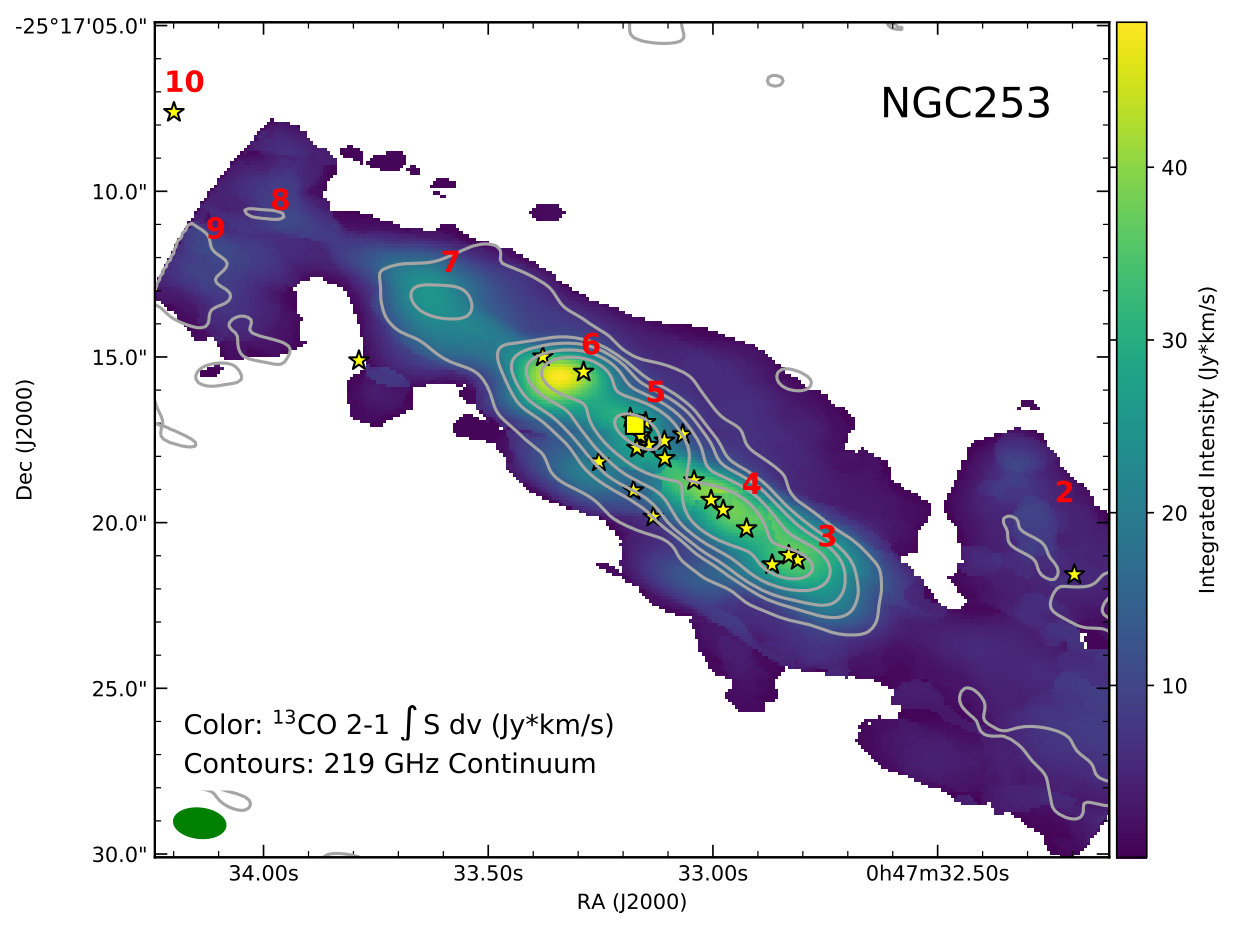 Figure 4
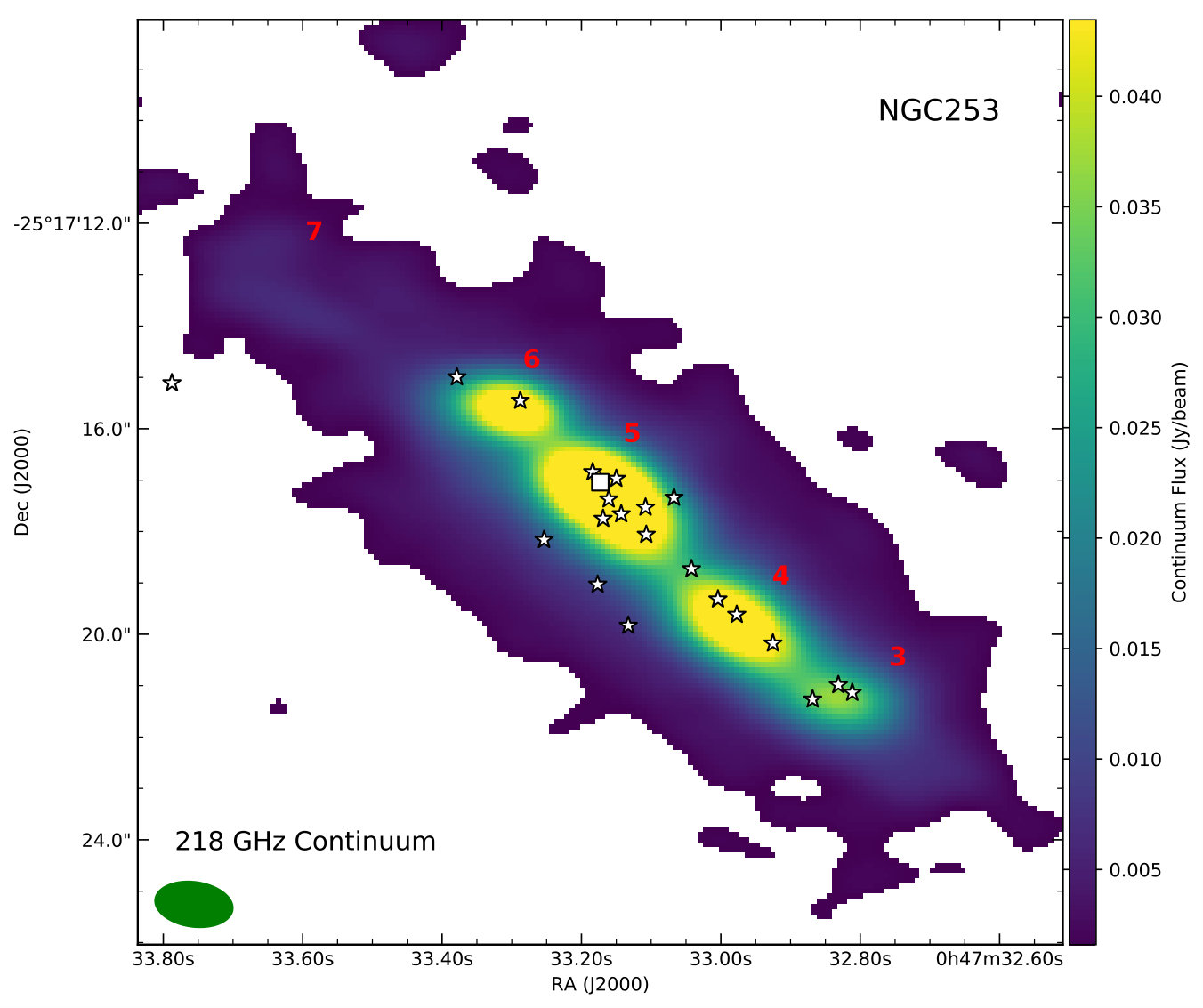 Figure 5
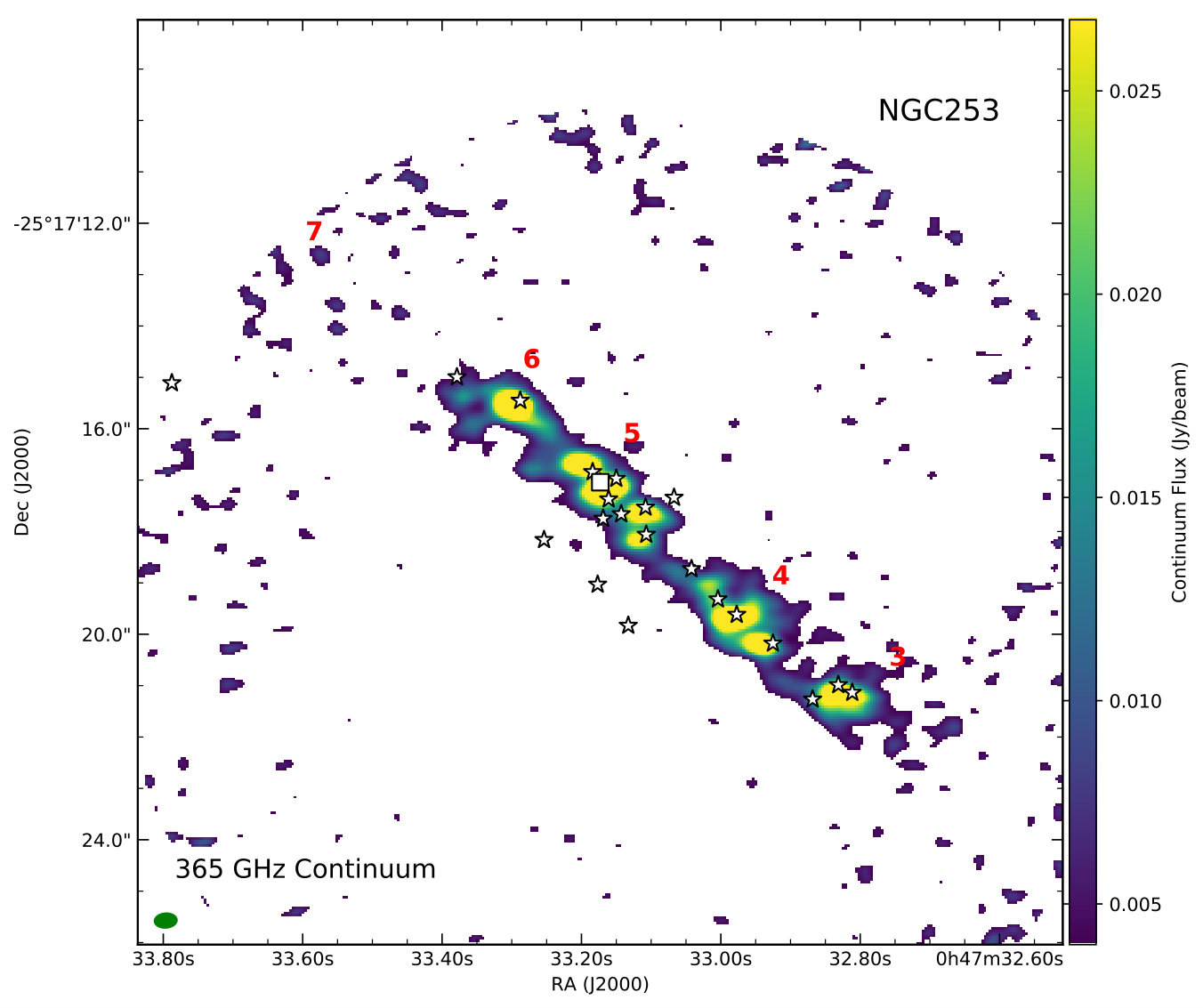 Figure 6
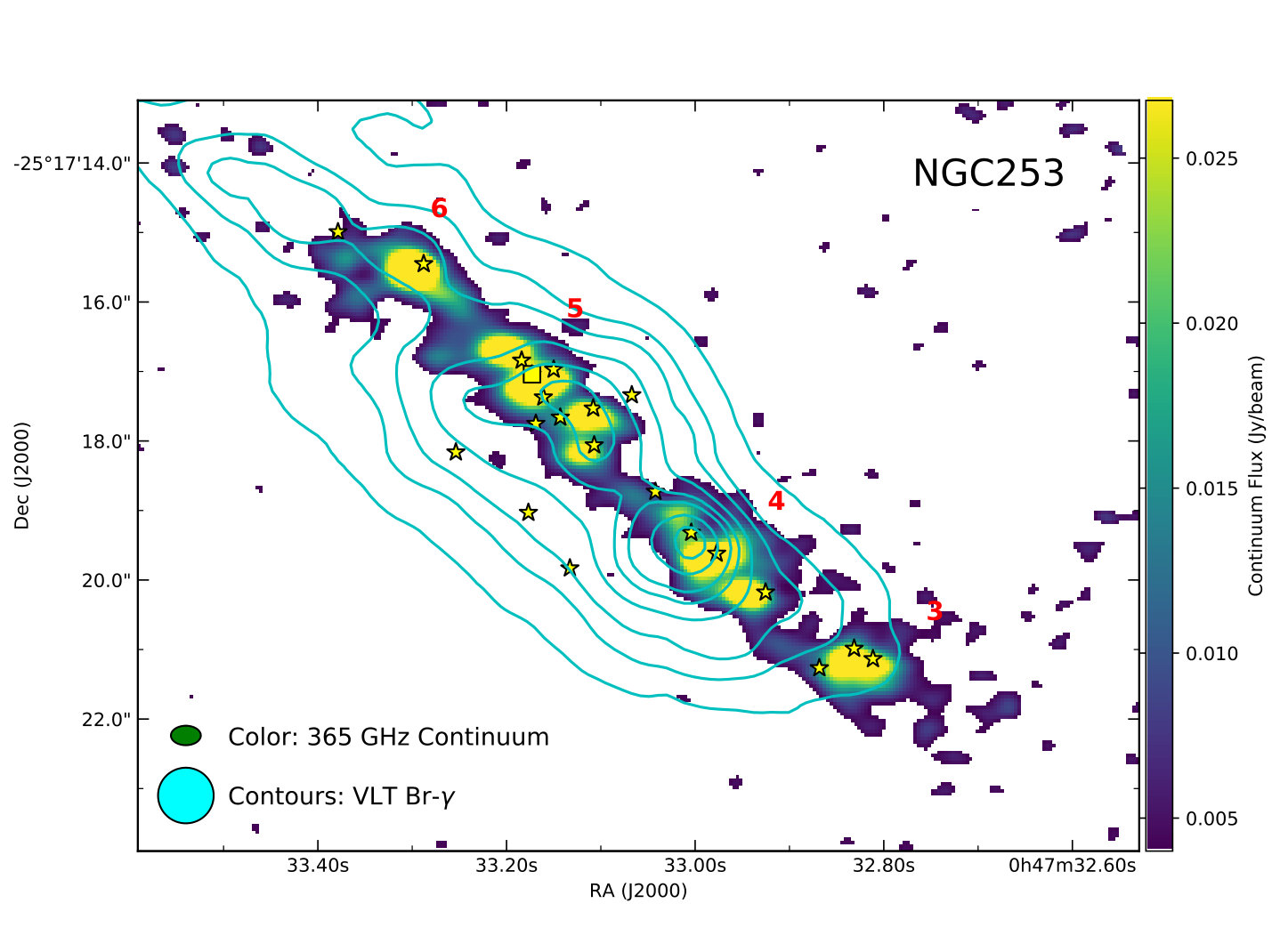 Figure 7
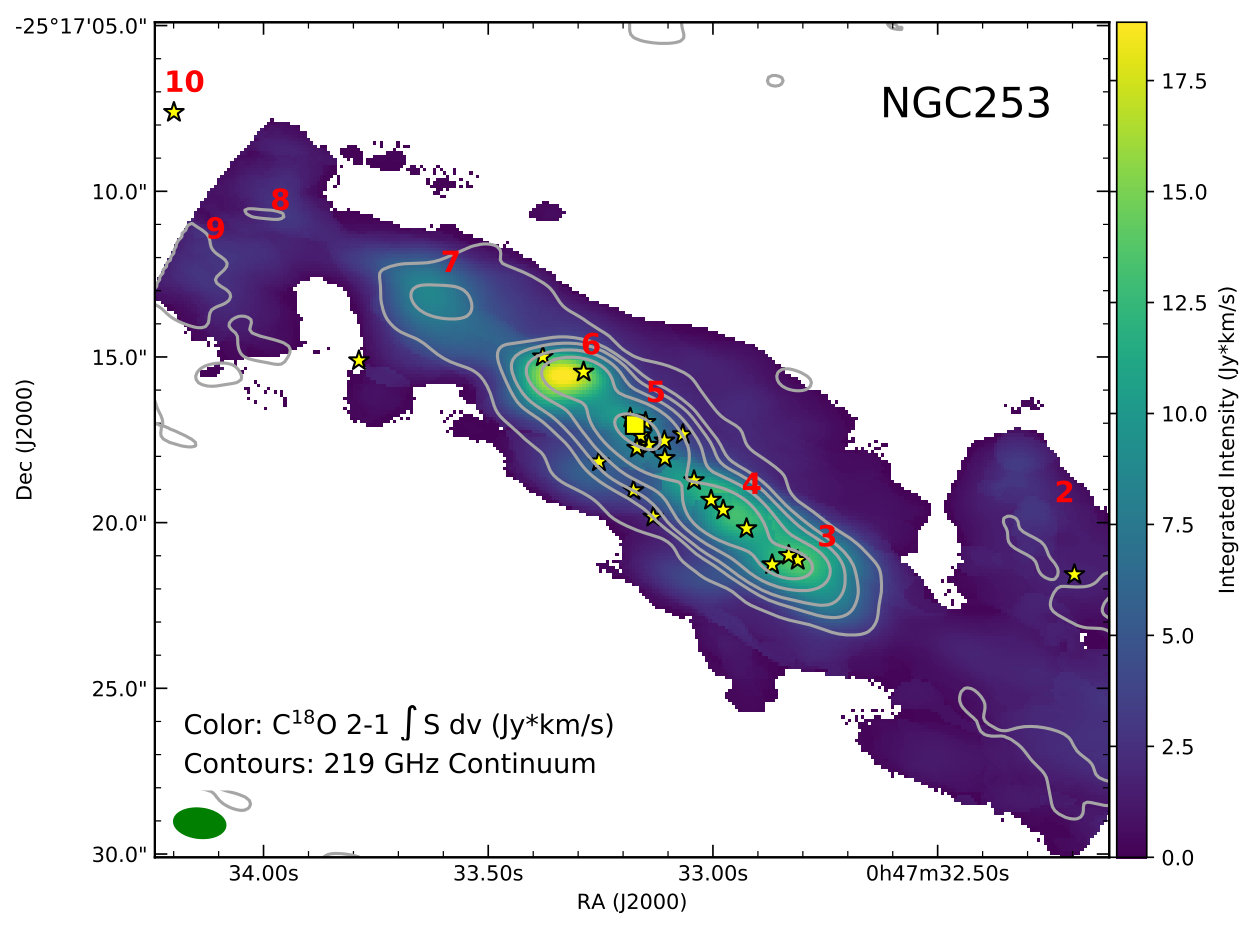 Figure 8
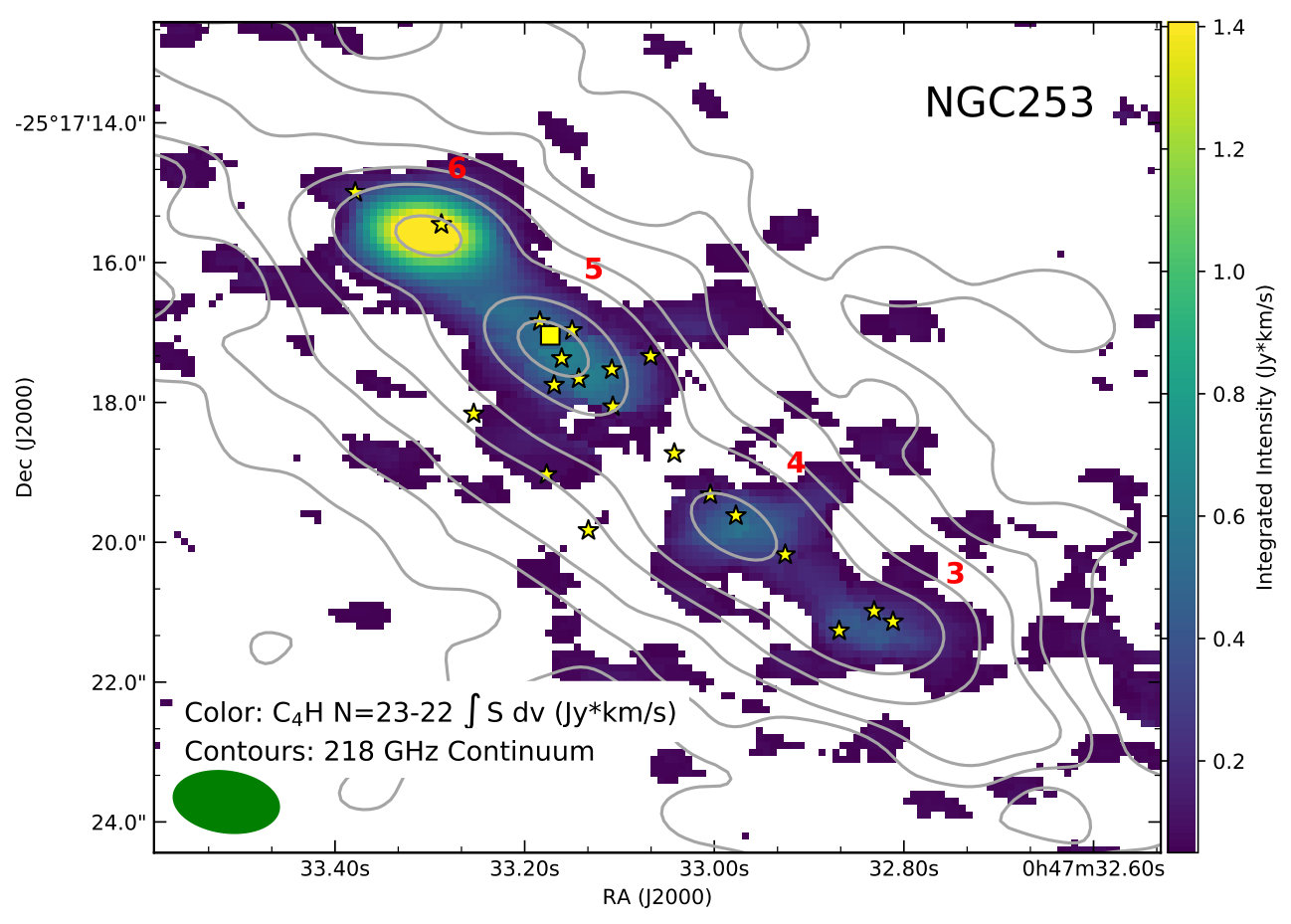 Figure 9
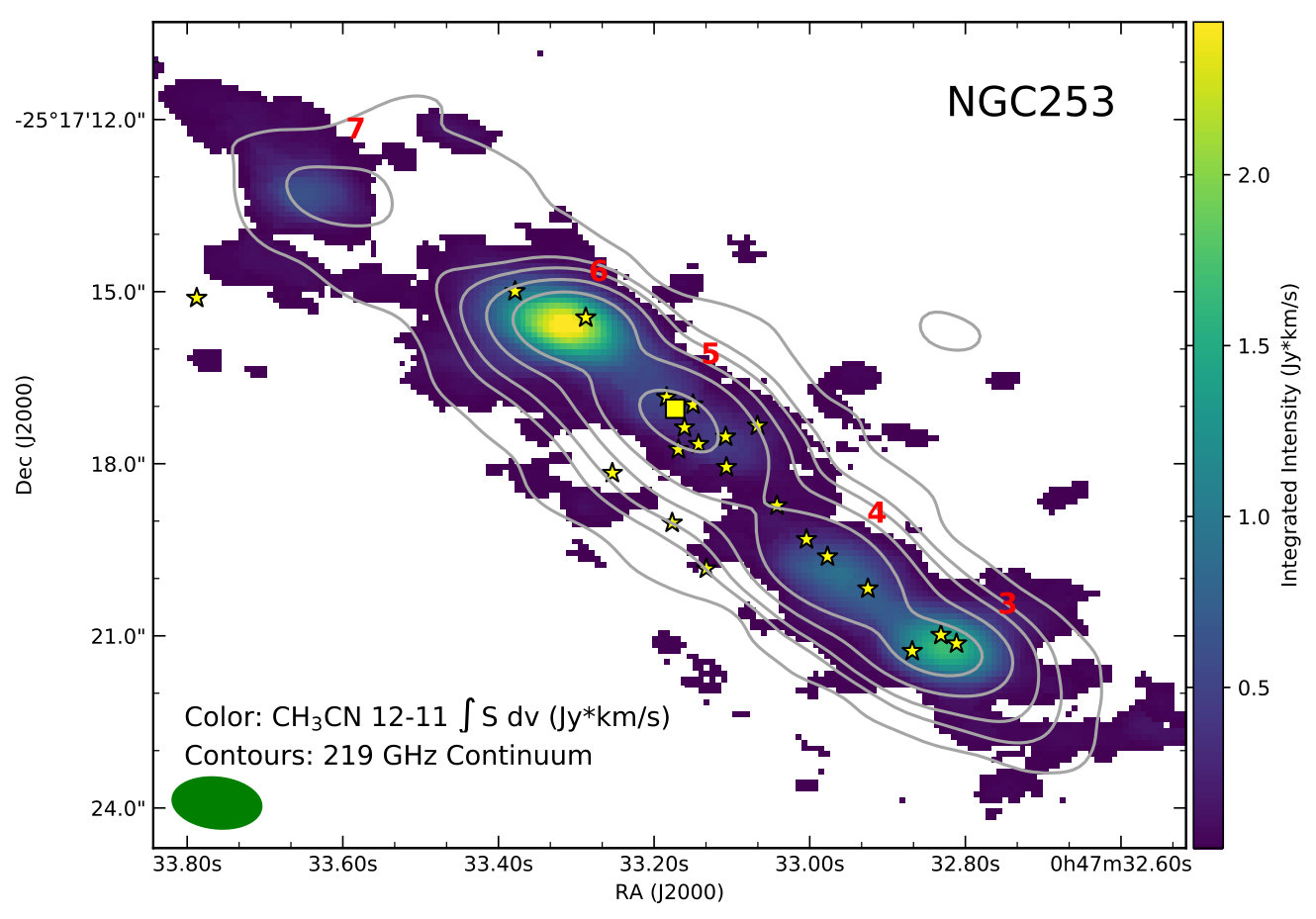 Figure 10
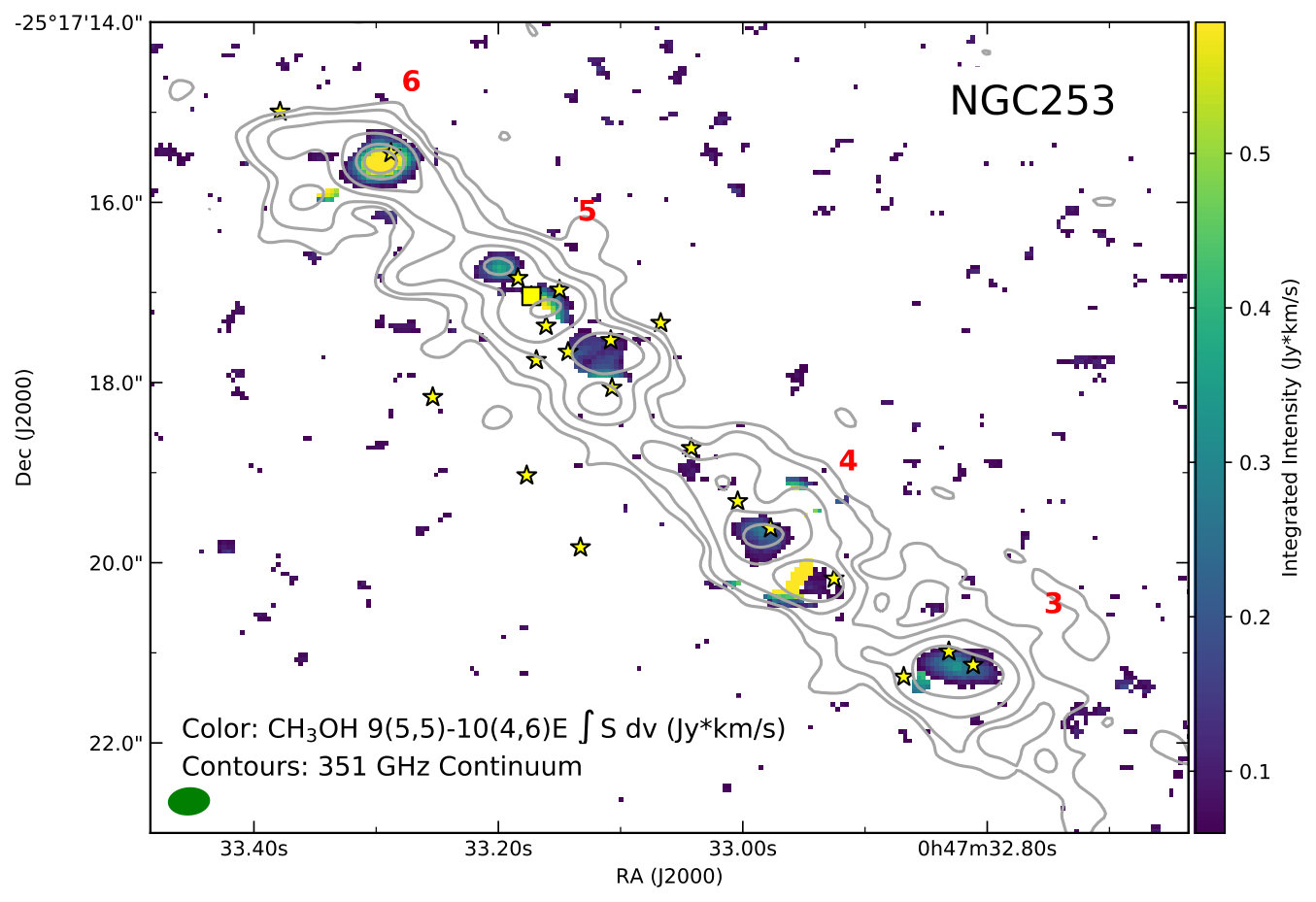 Figure 11
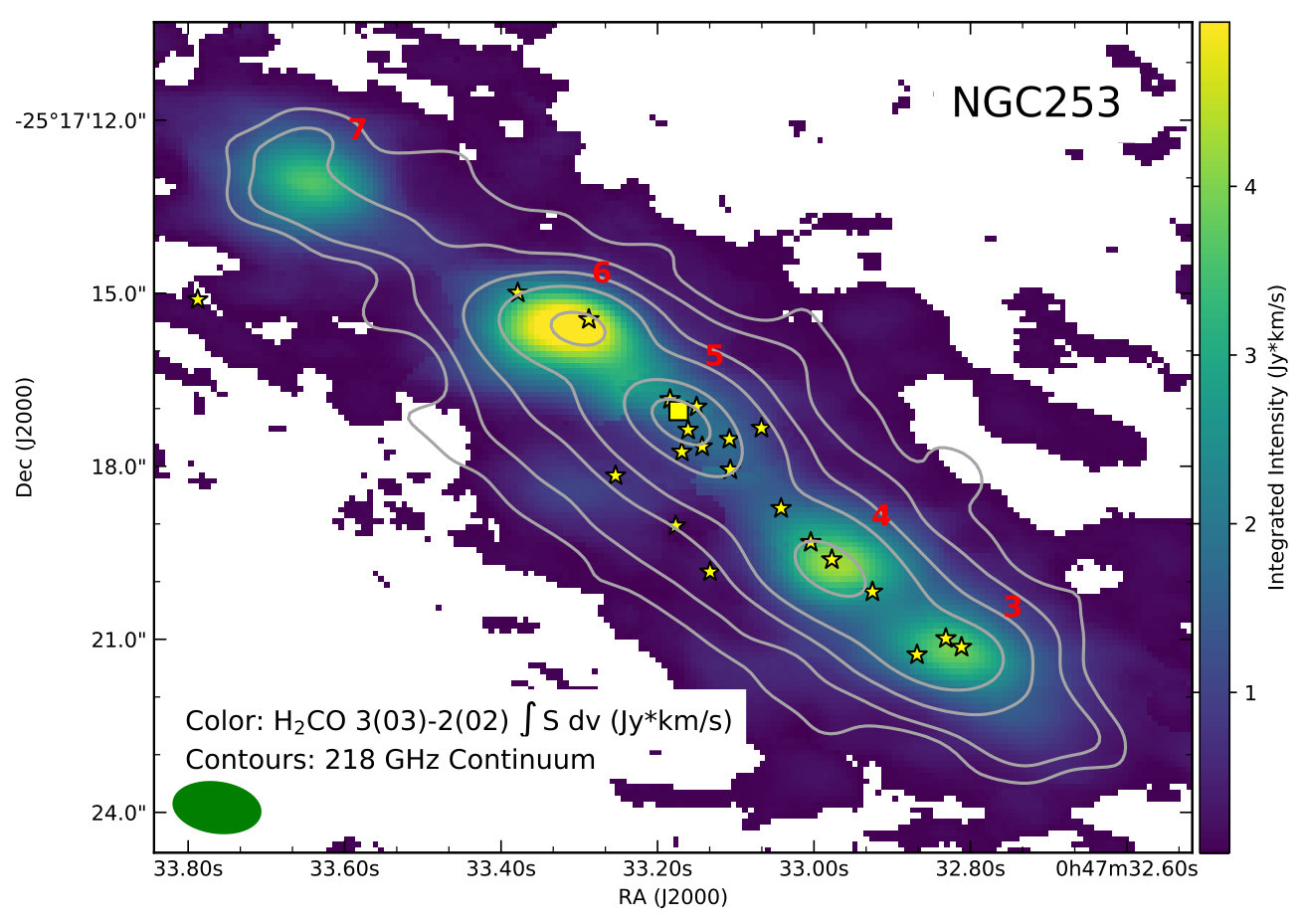 Figure 12
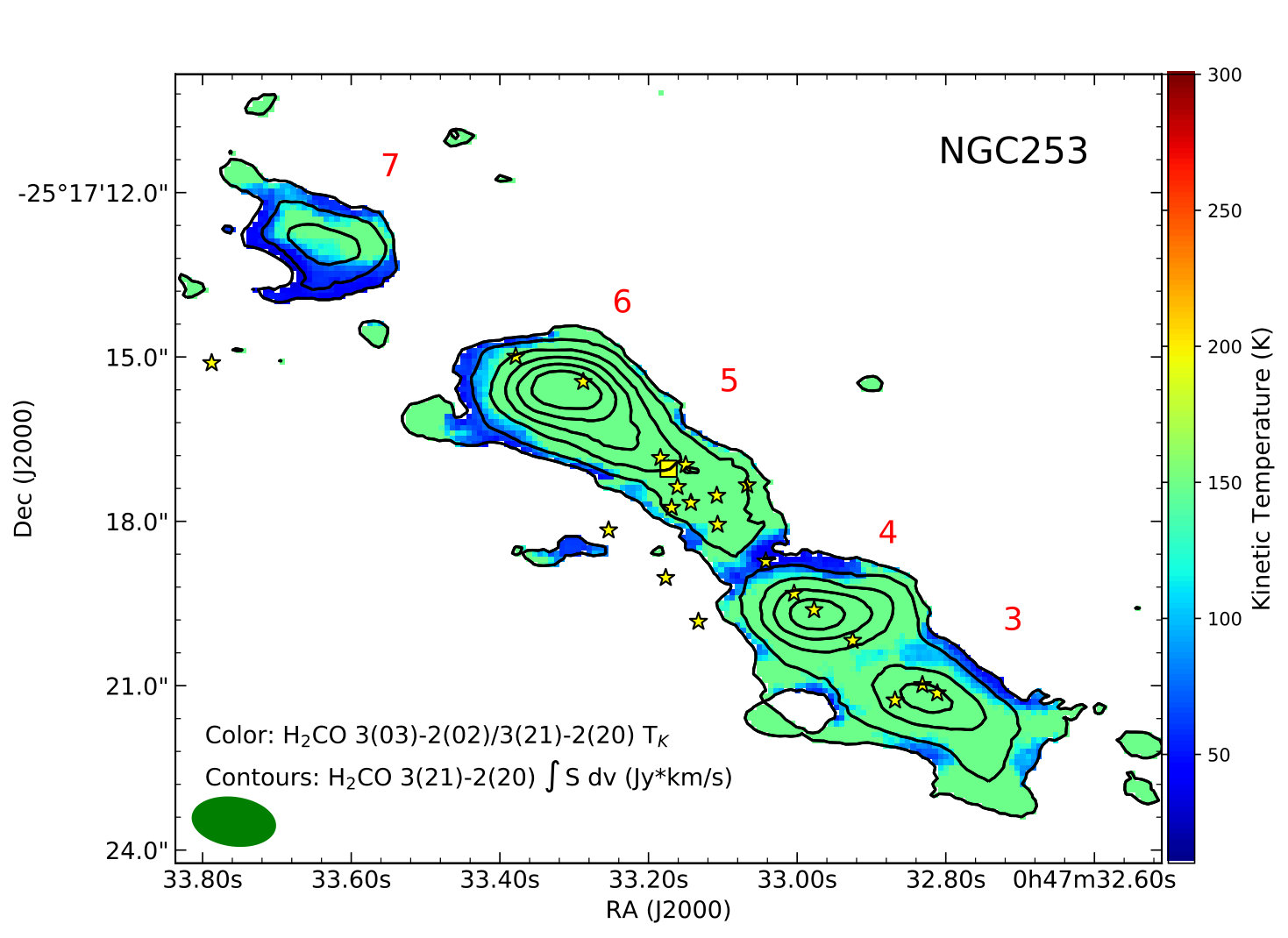 Figure 13
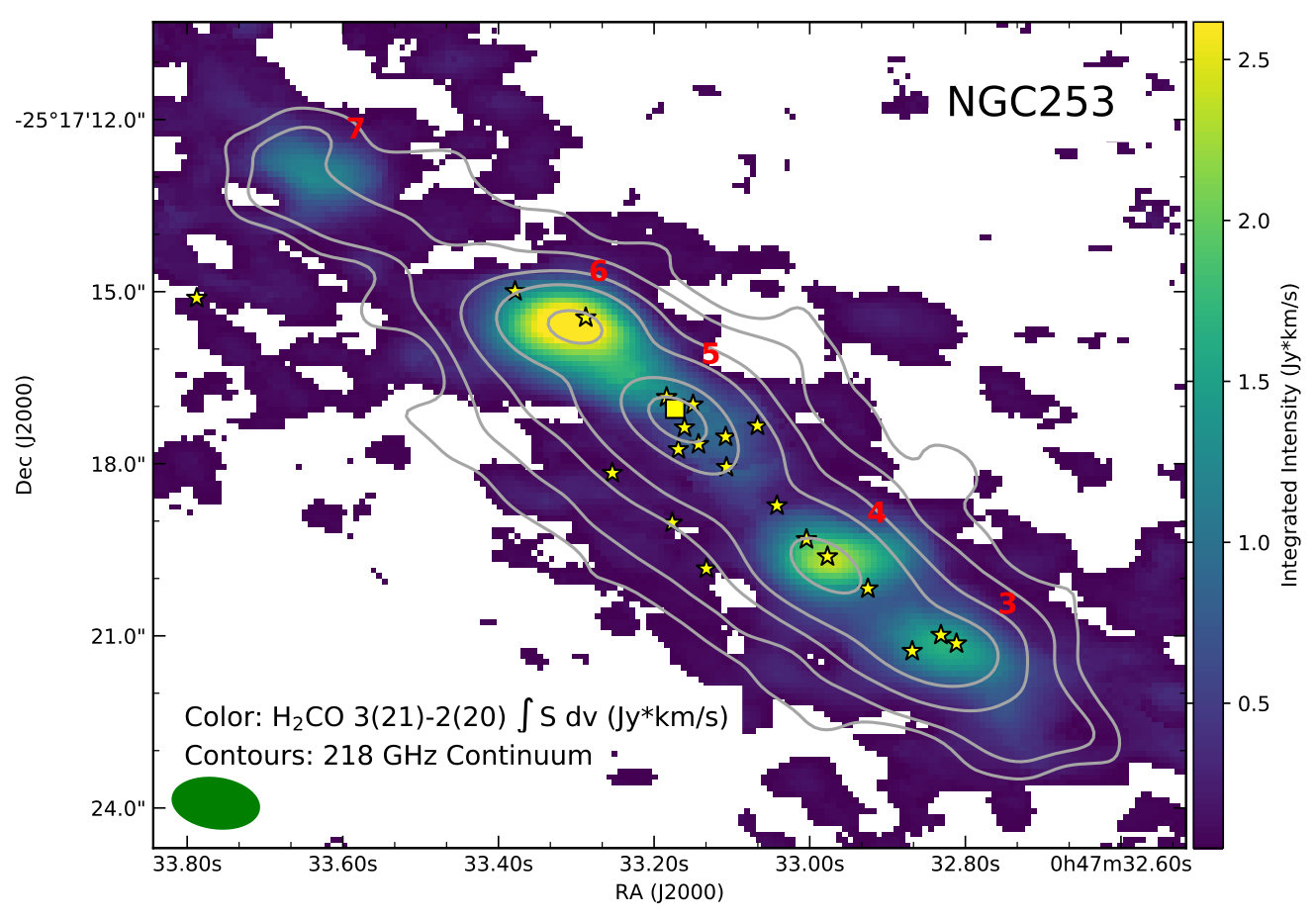 Figure 14
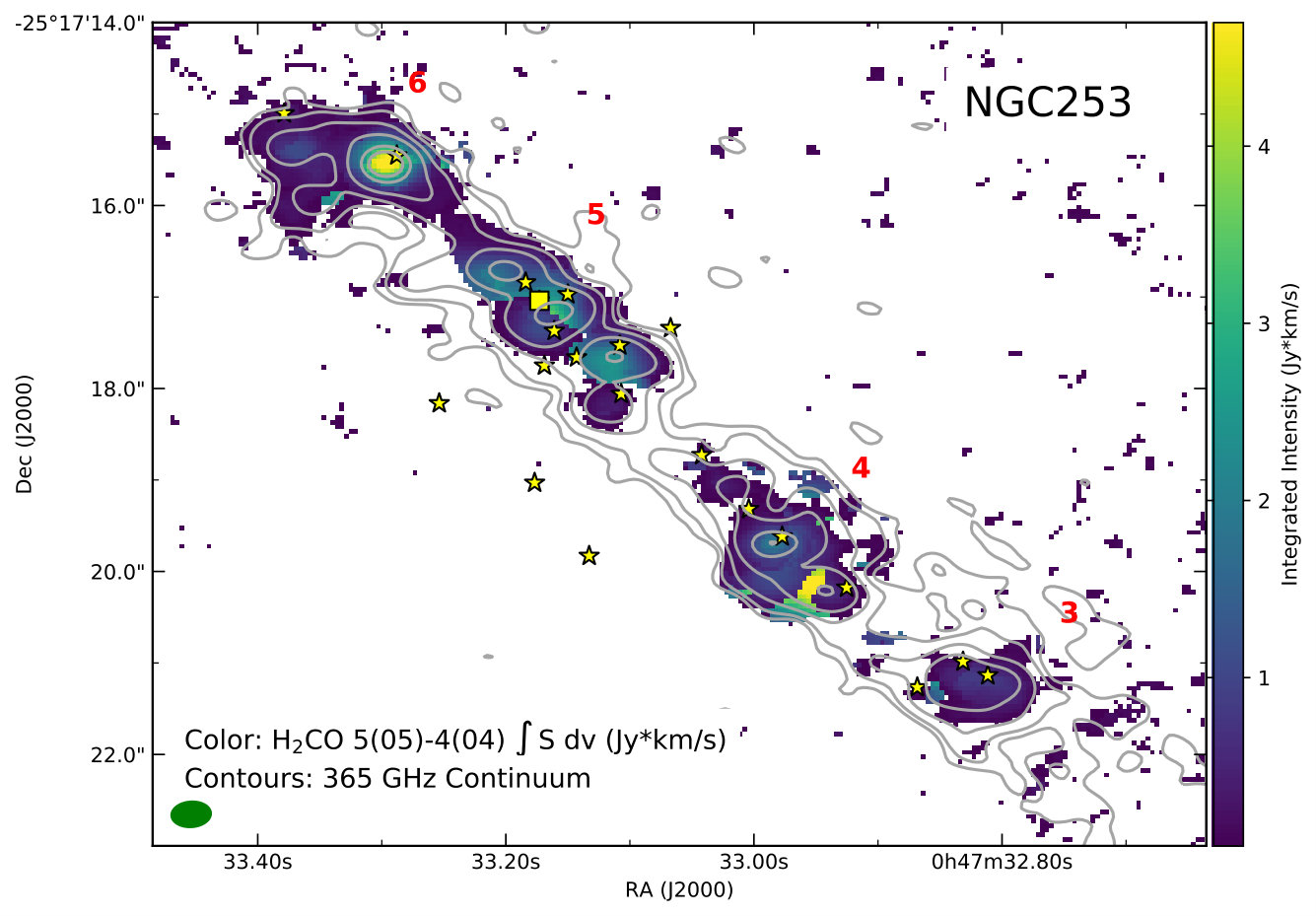 Figure 15
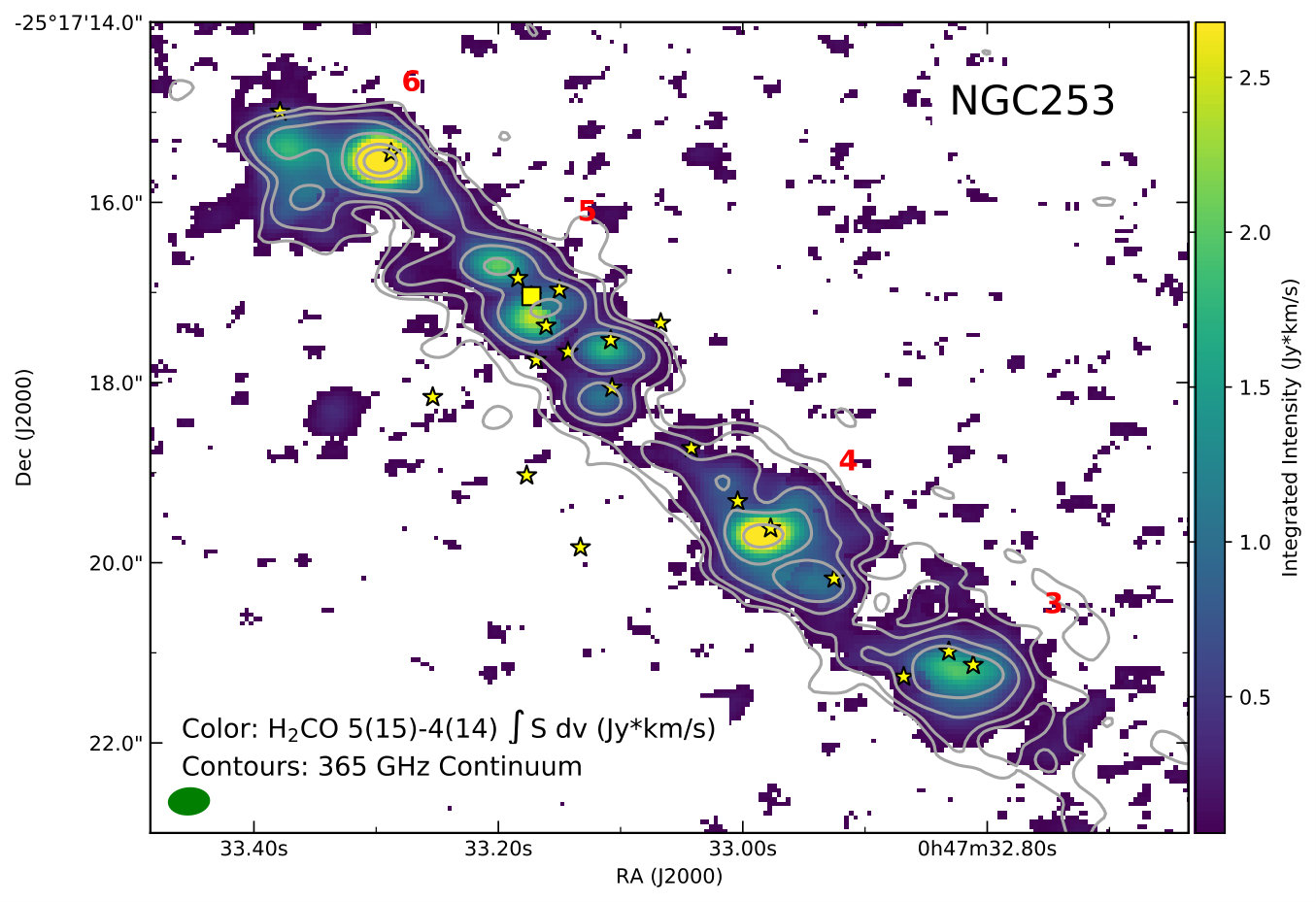 Figure 16
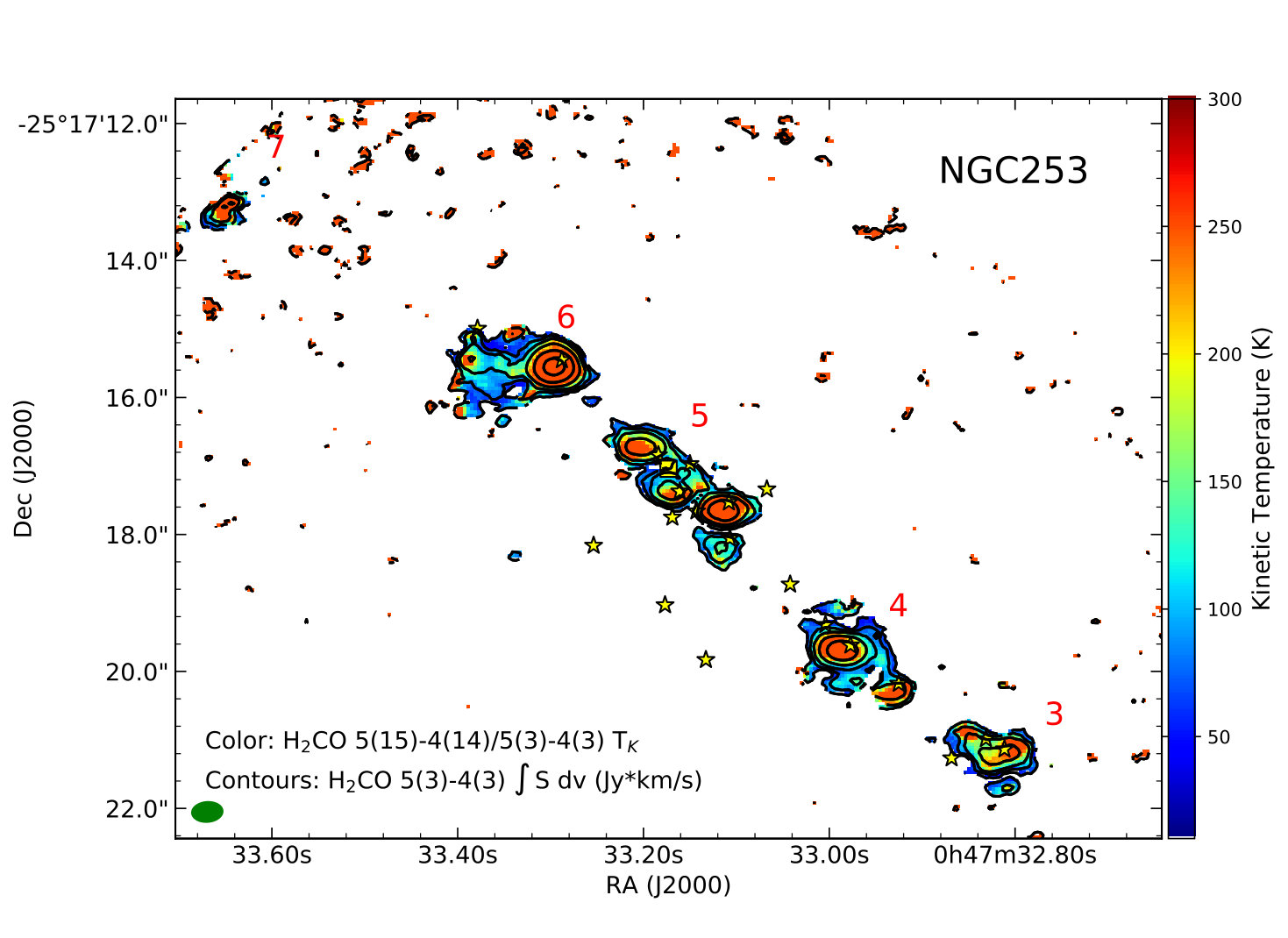 Figure 17
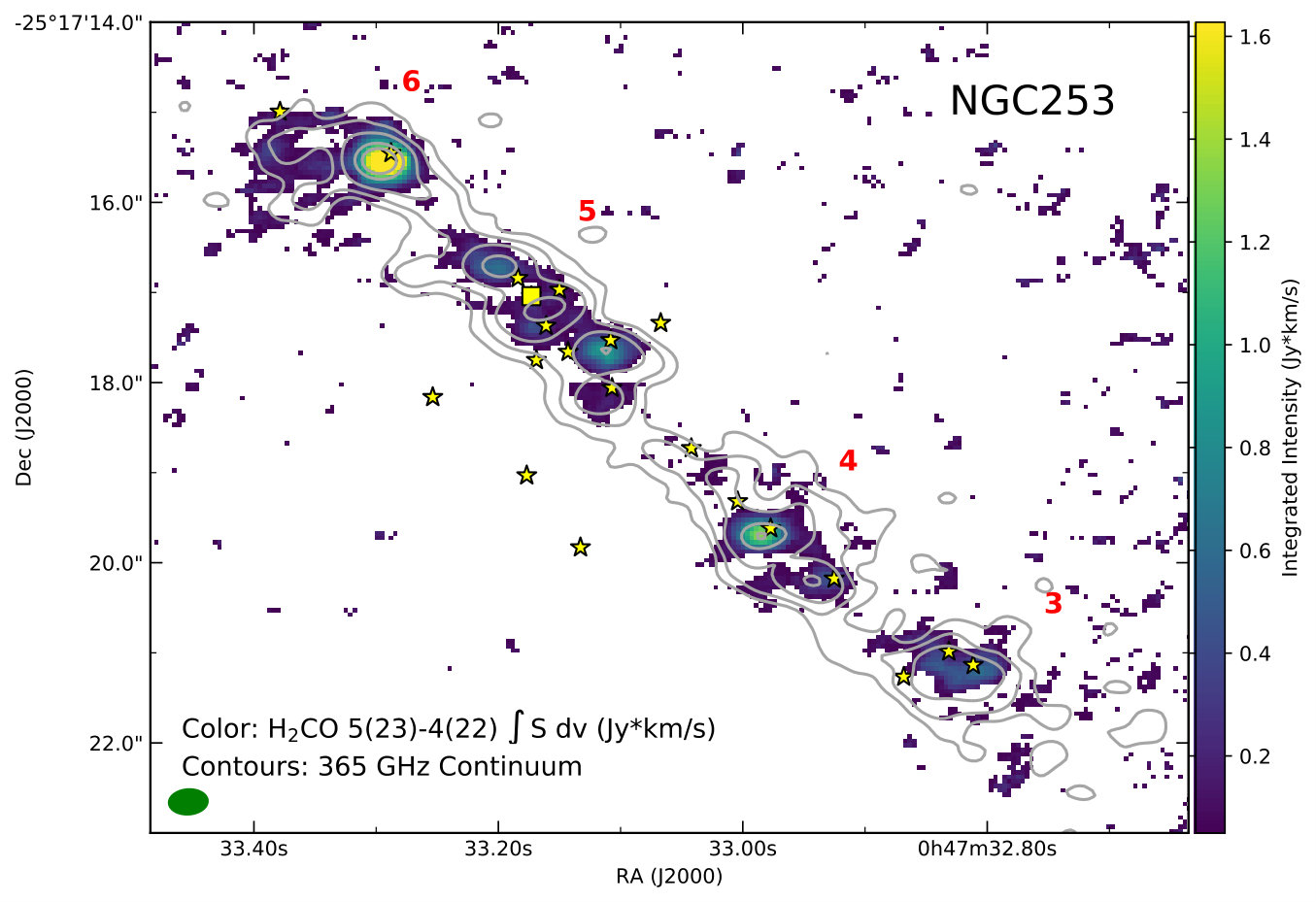 Figure 18
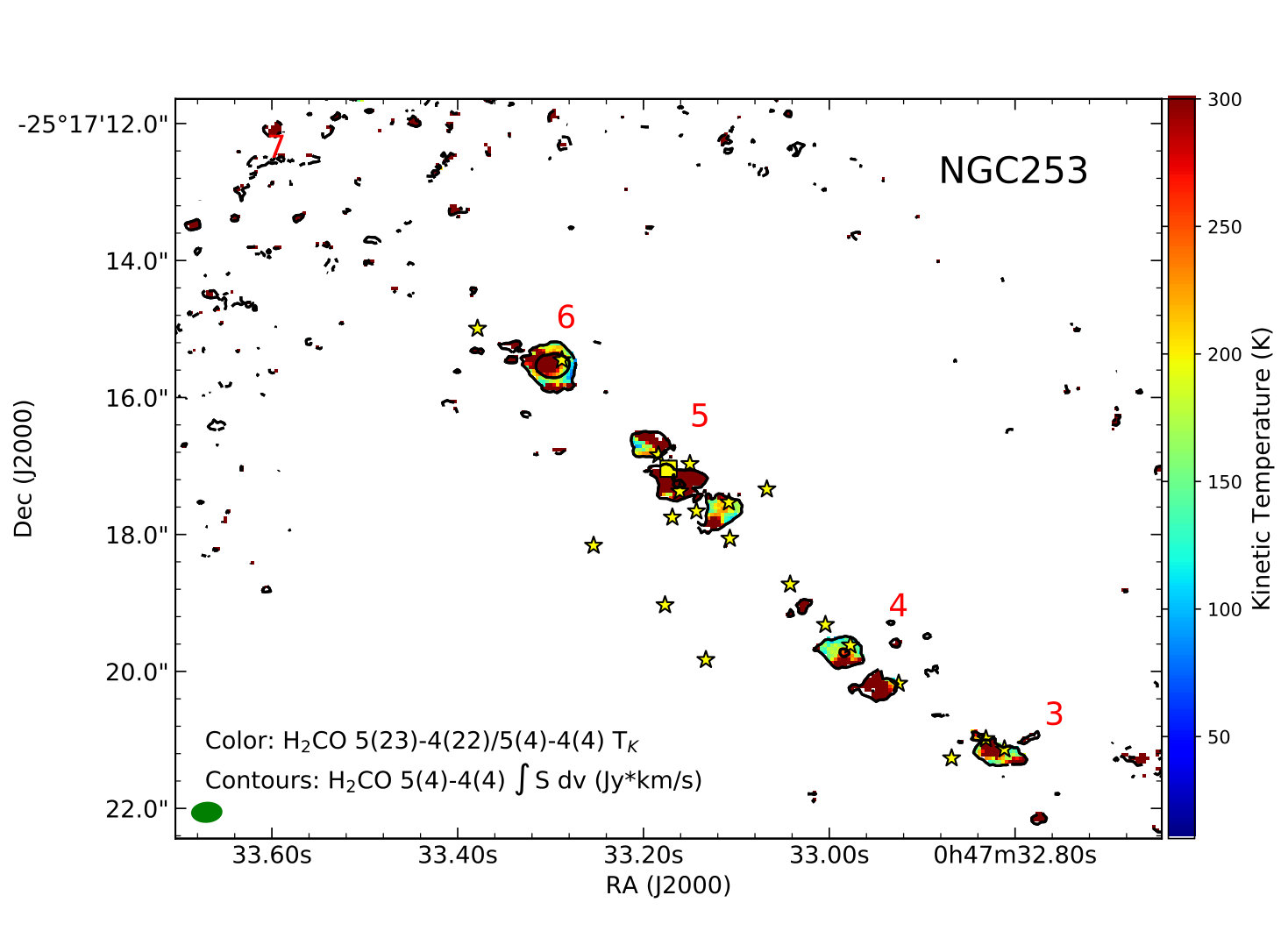 Figure 19
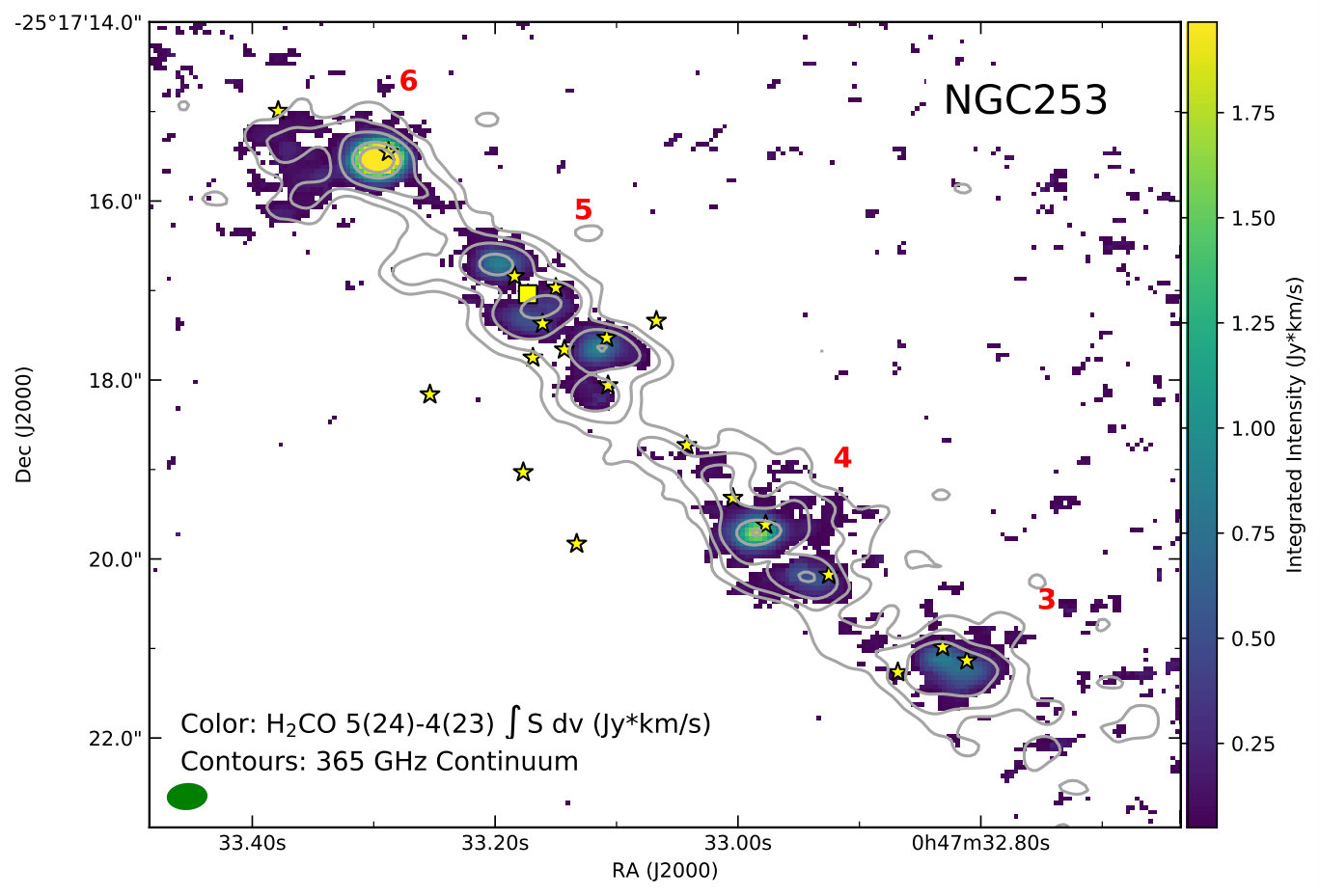 Figure 20
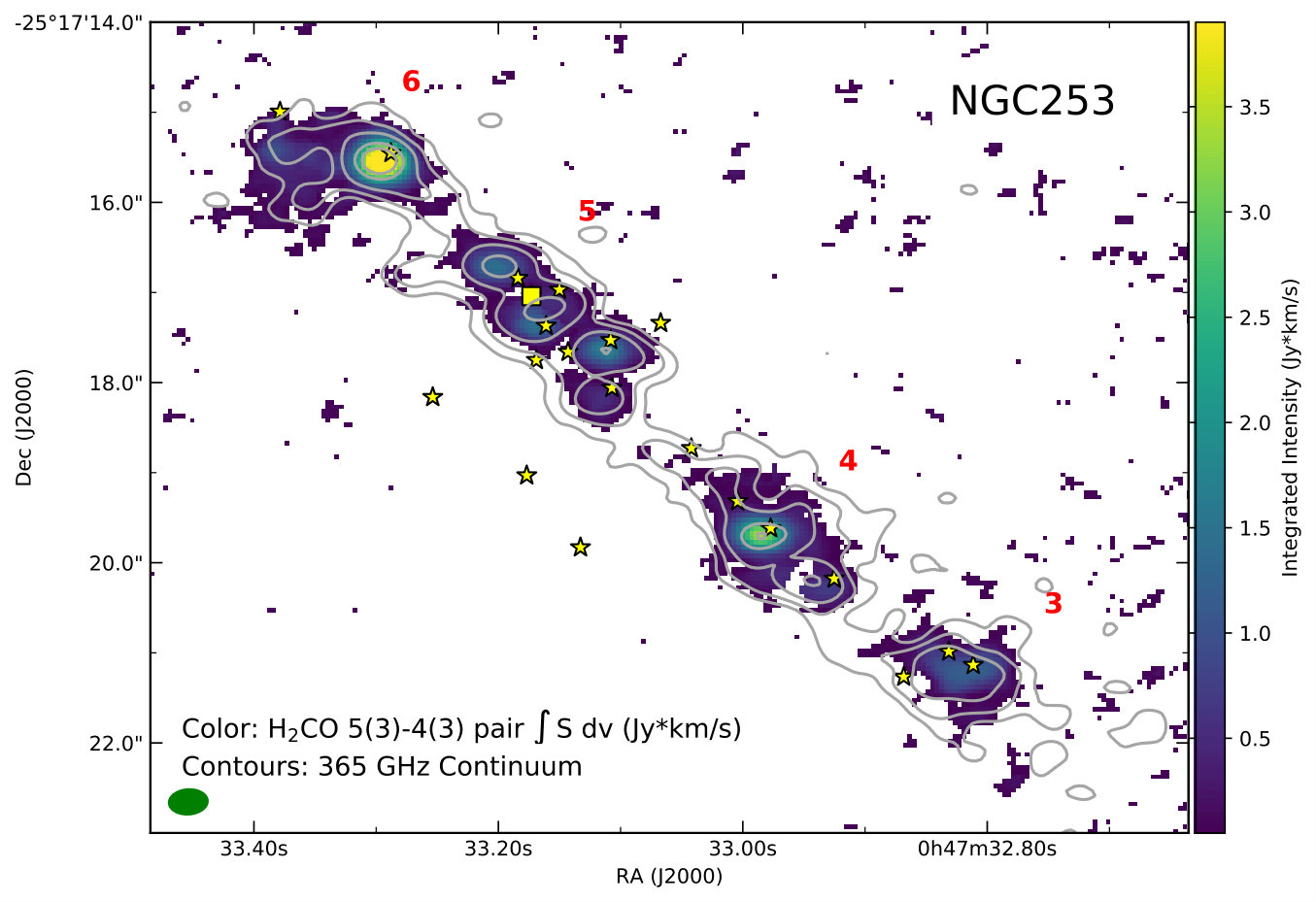 Figure 21
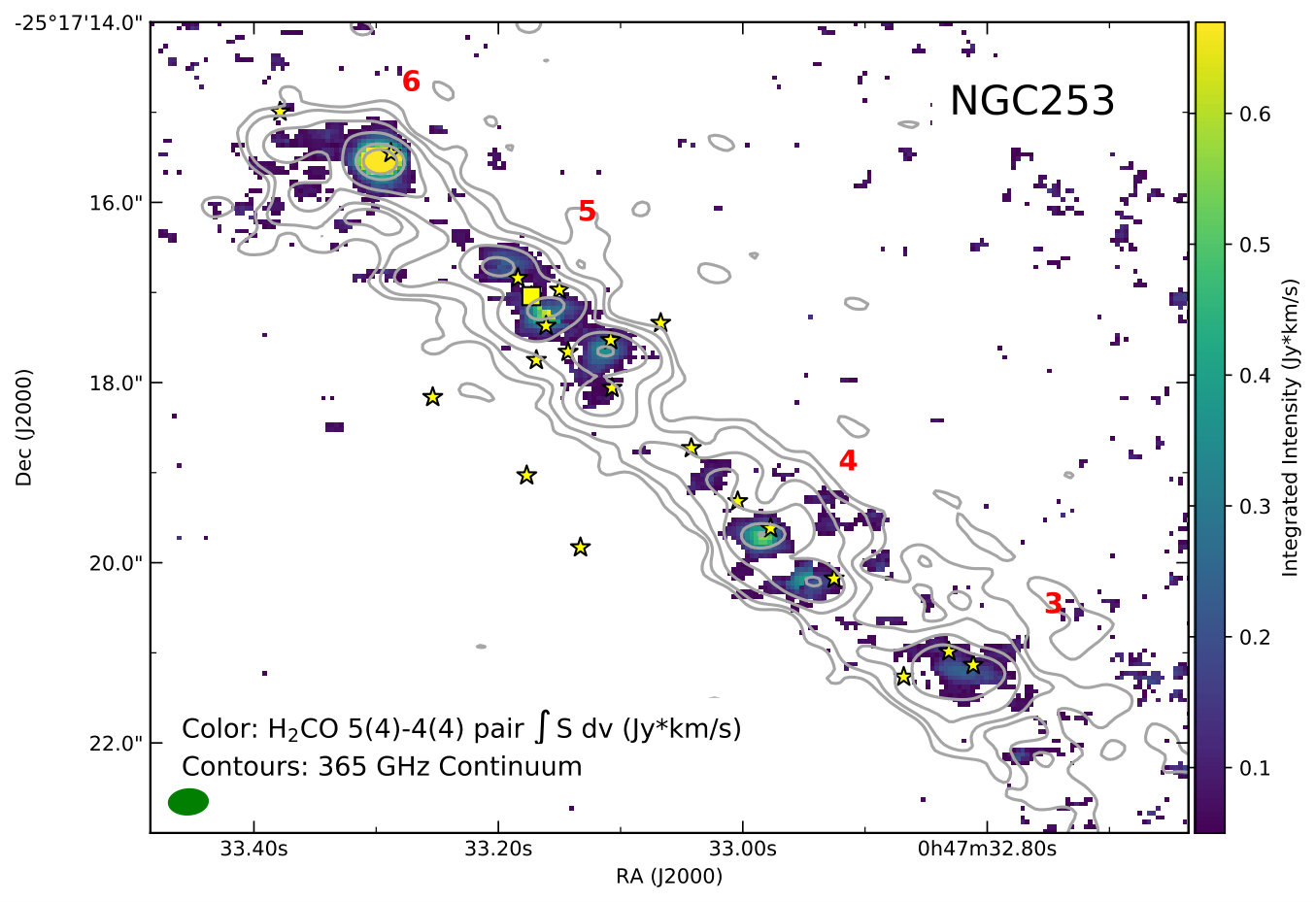 Figure 22
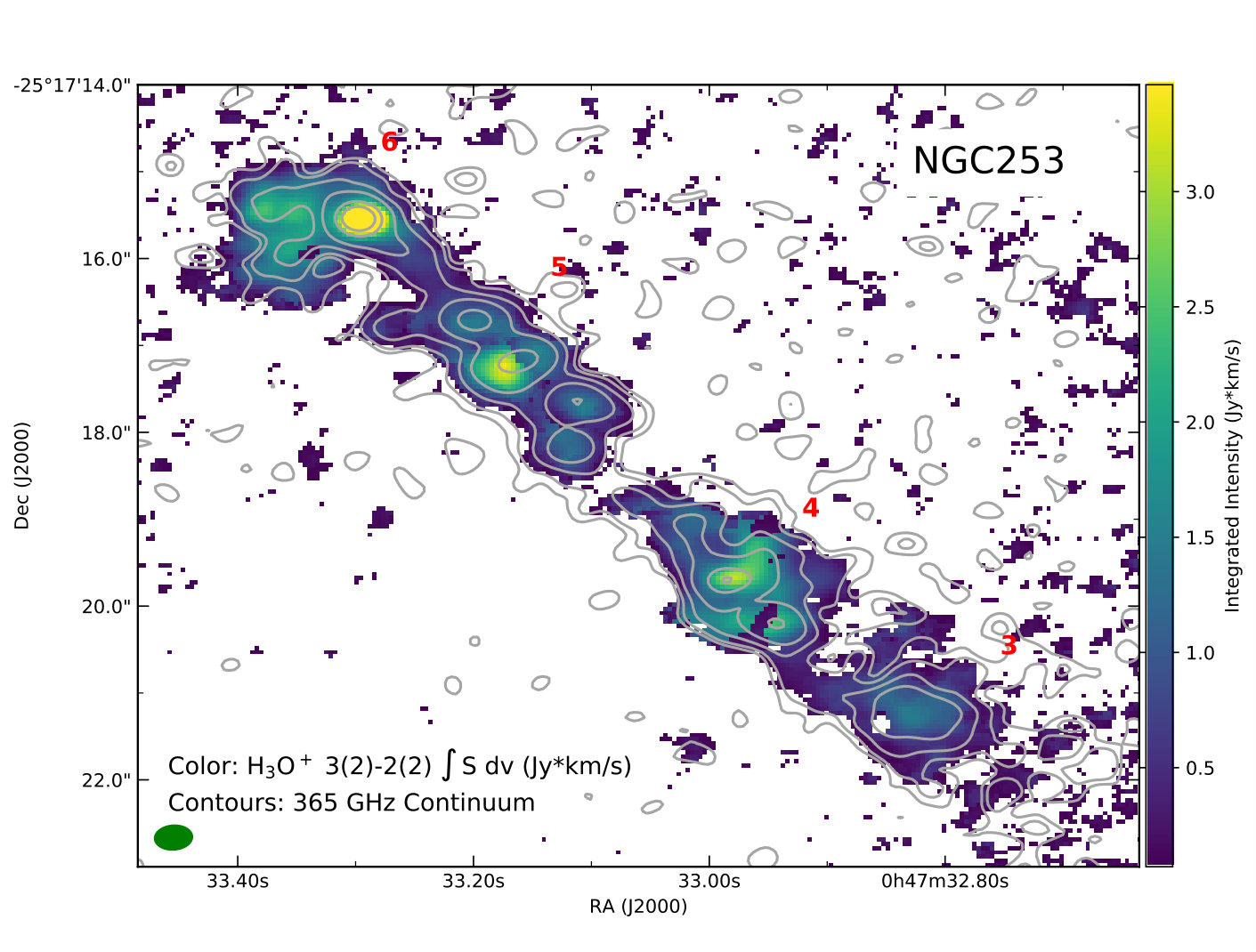 Figure 23
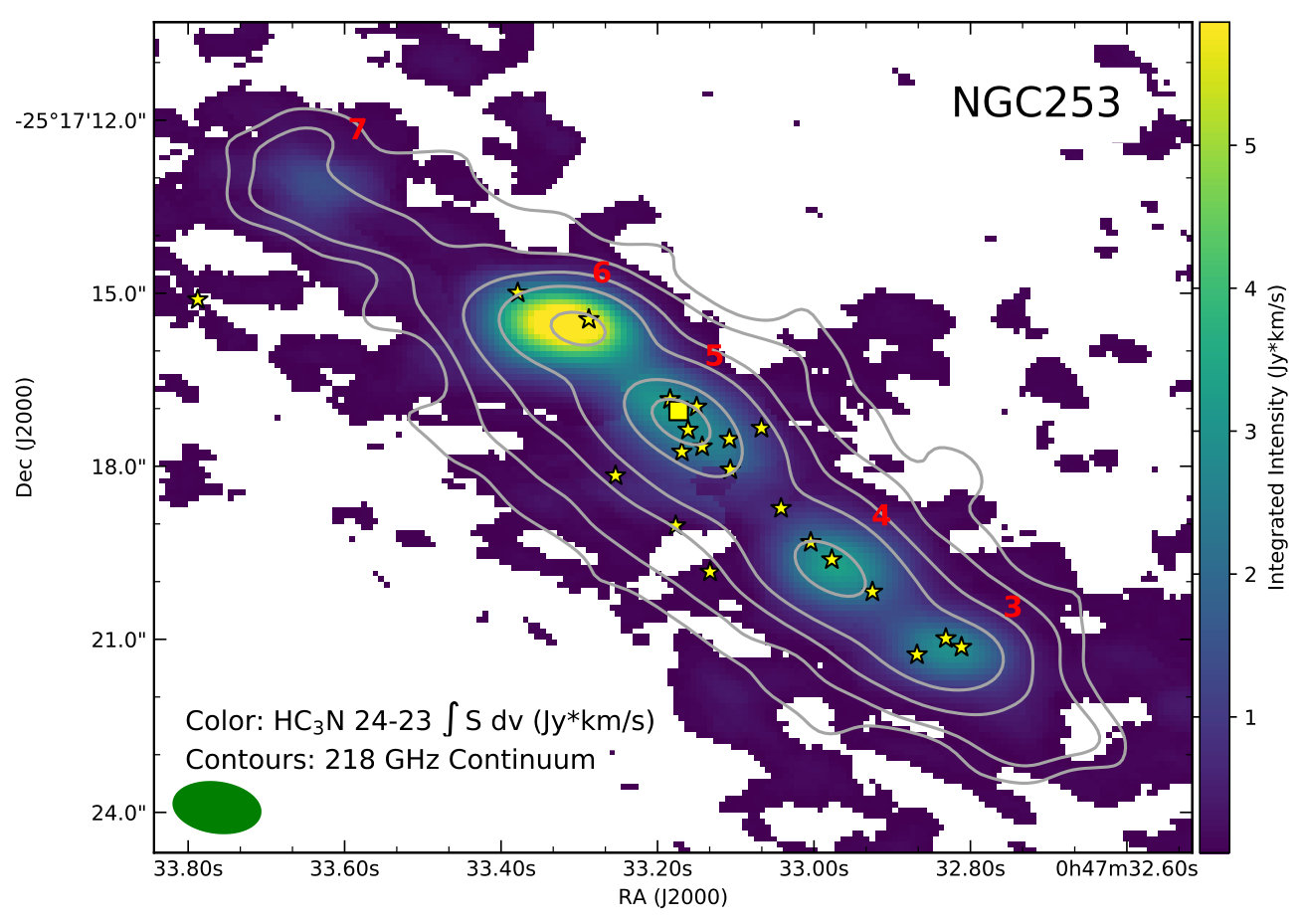 Figure 24
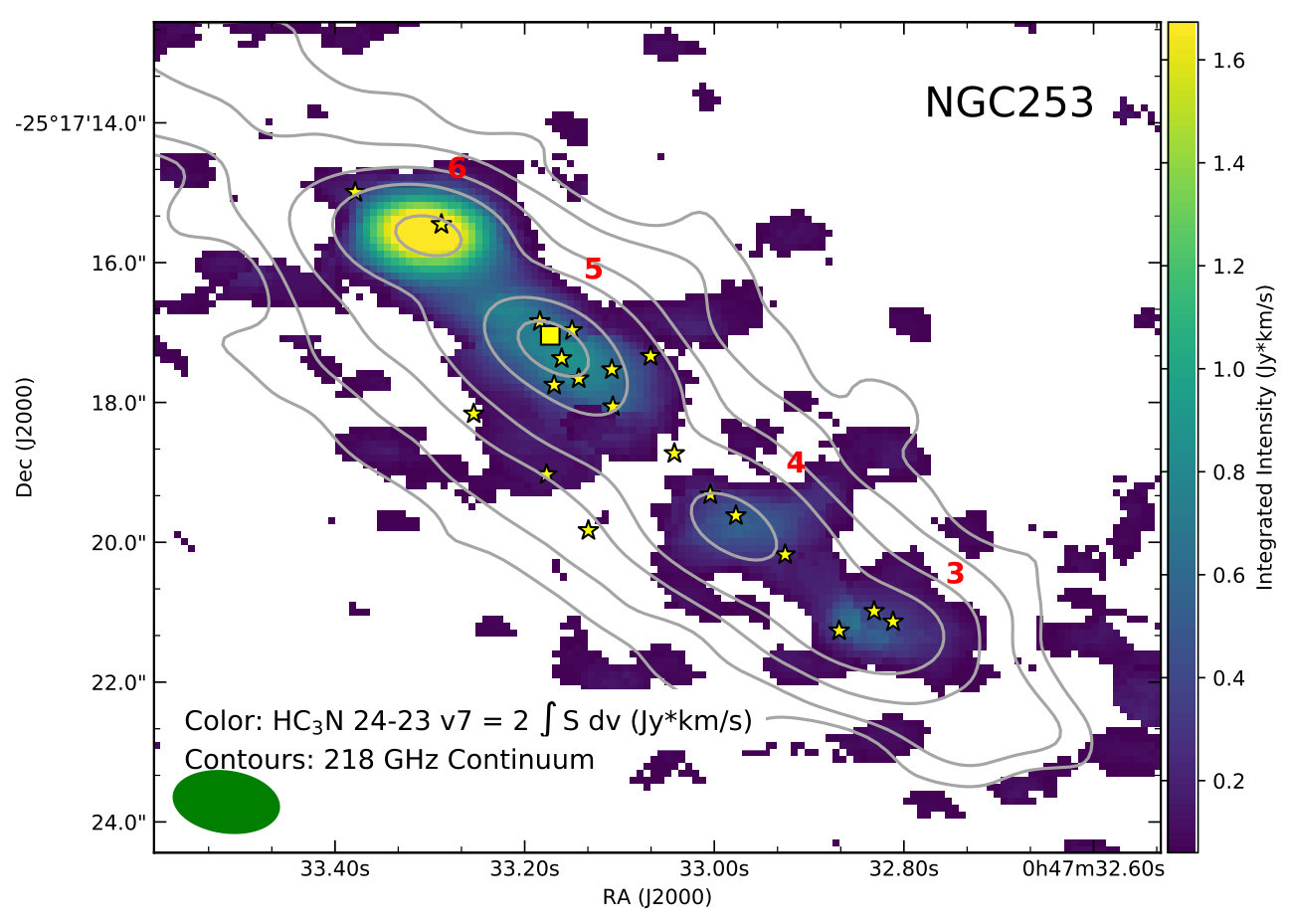 Figure 25
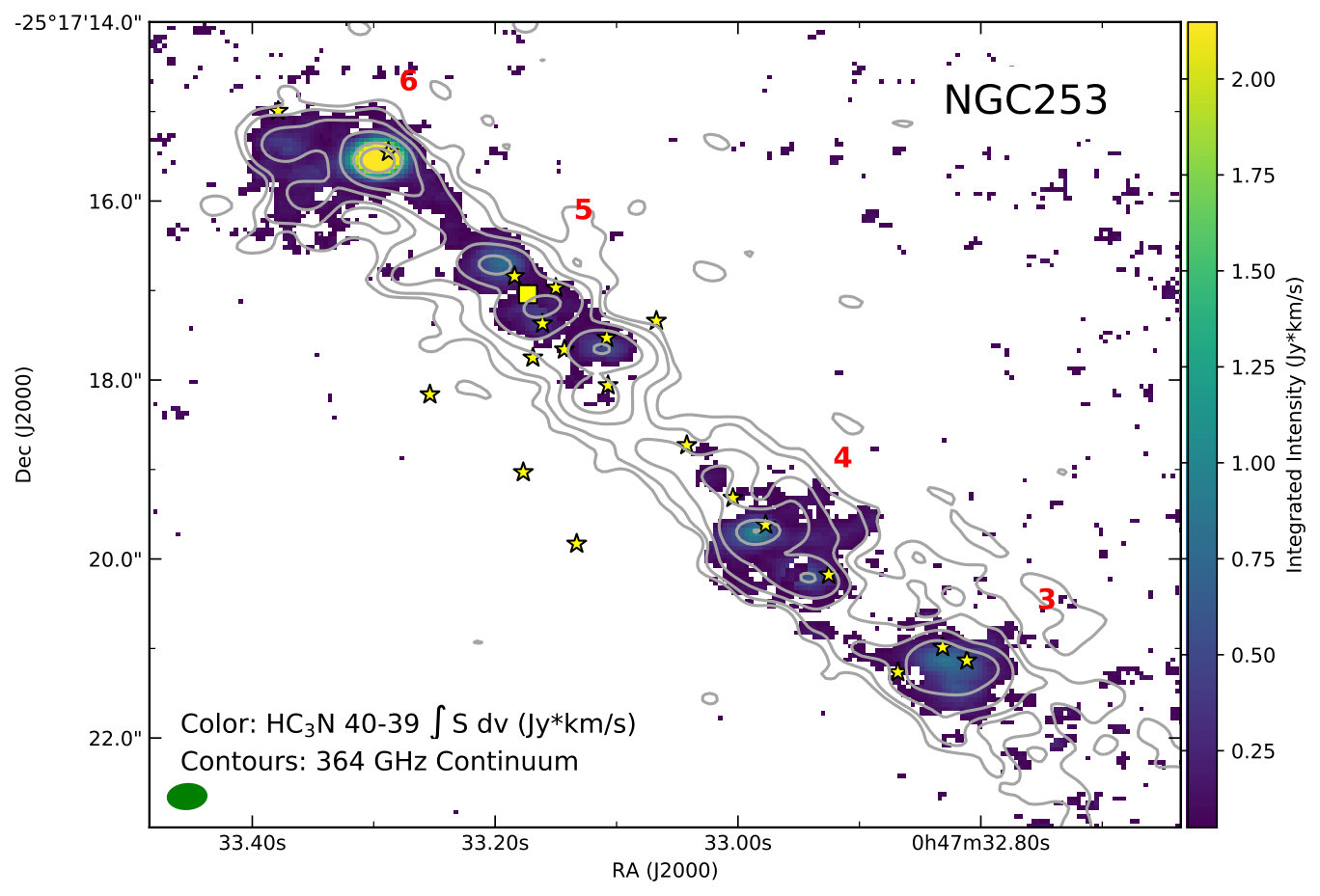 Figure 26
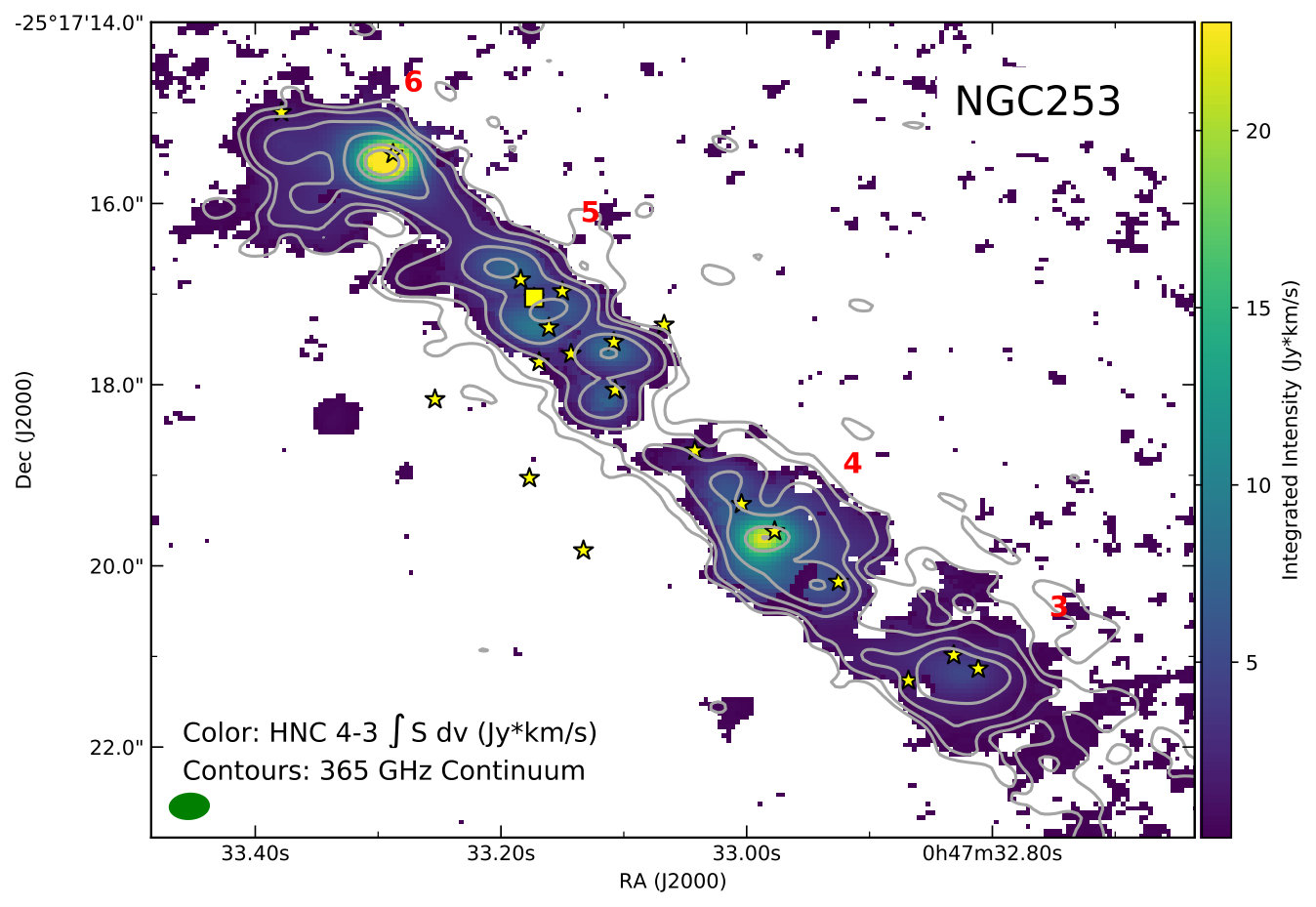 Figure 27
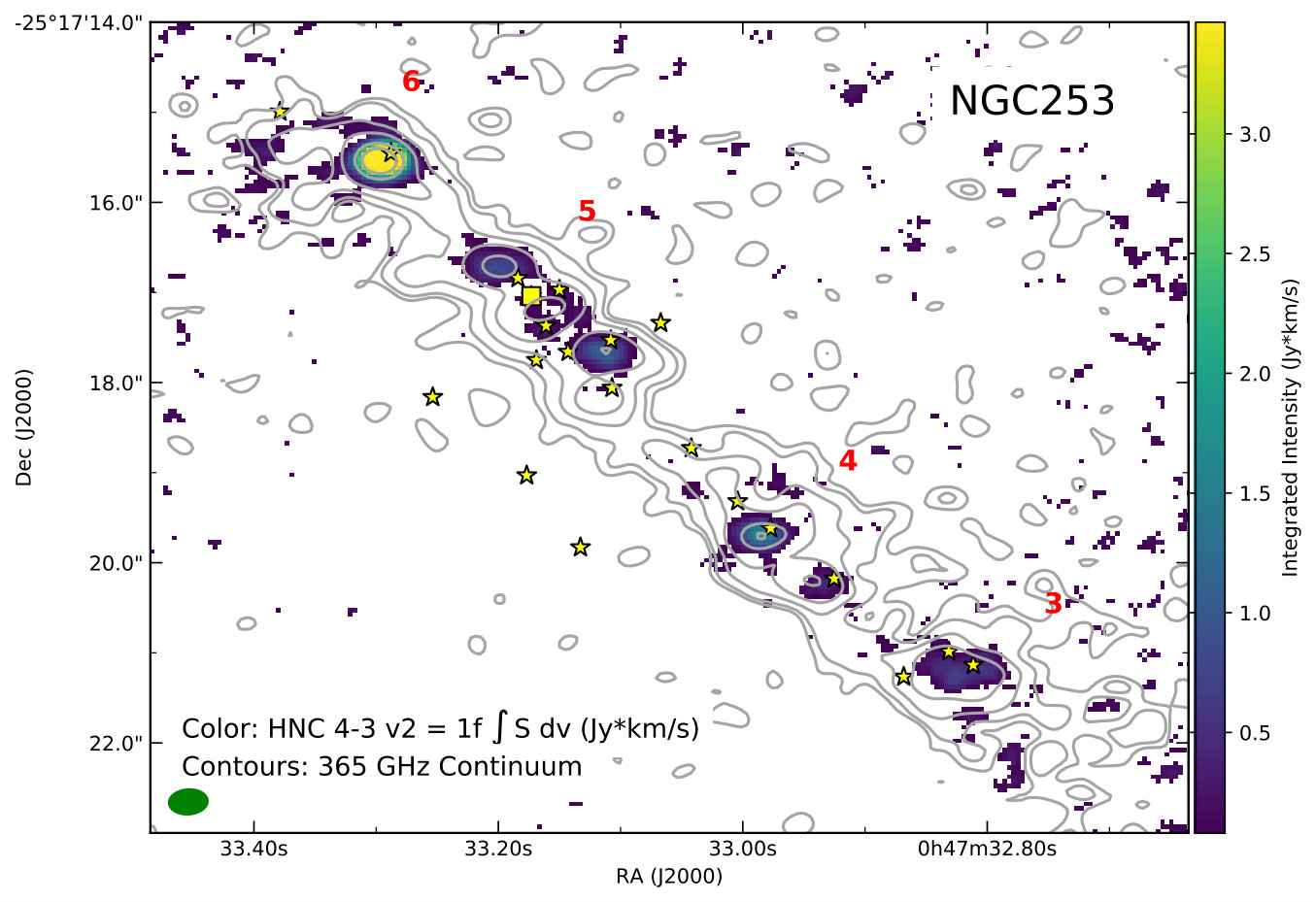 Figure 28
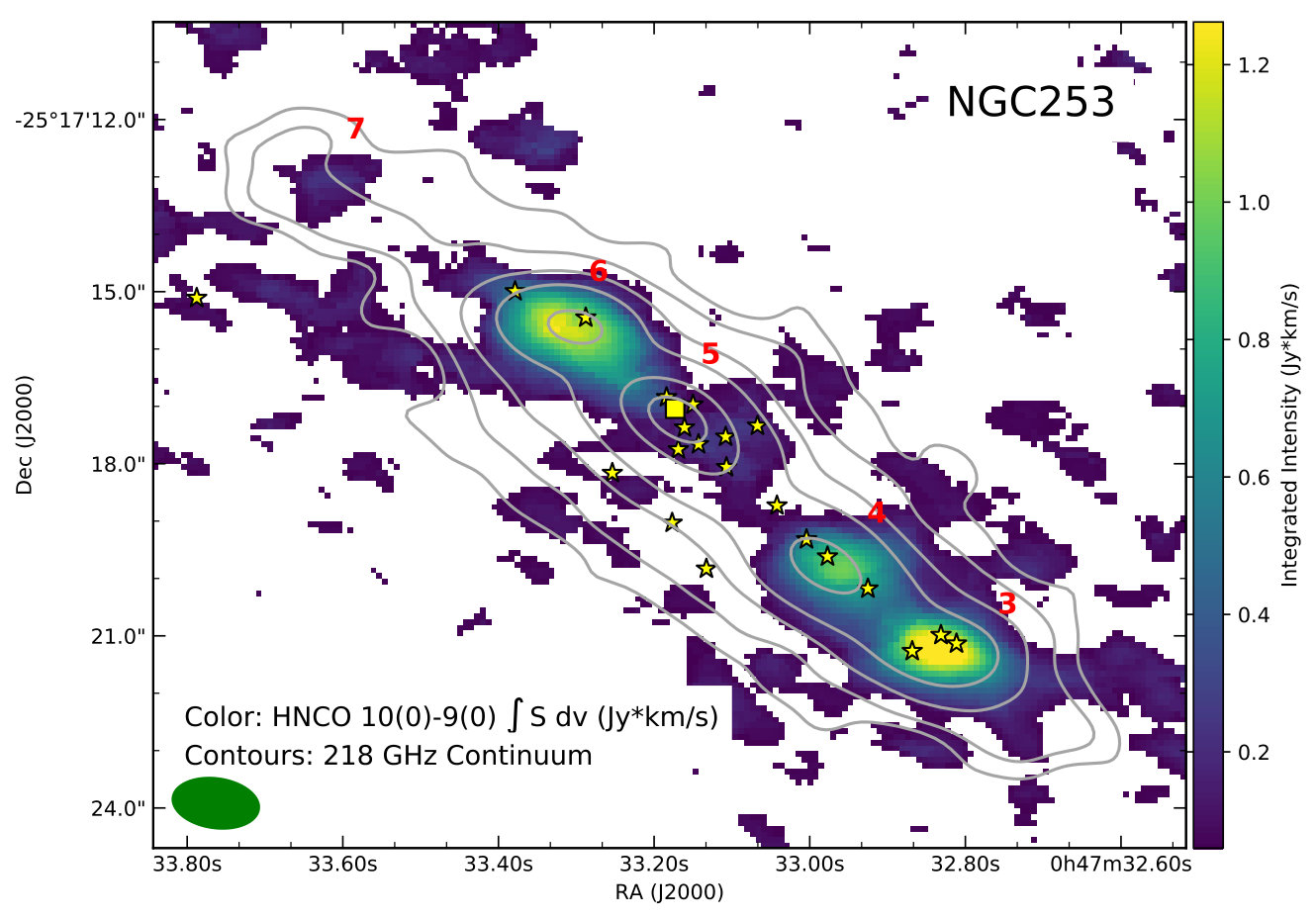 Figure 29
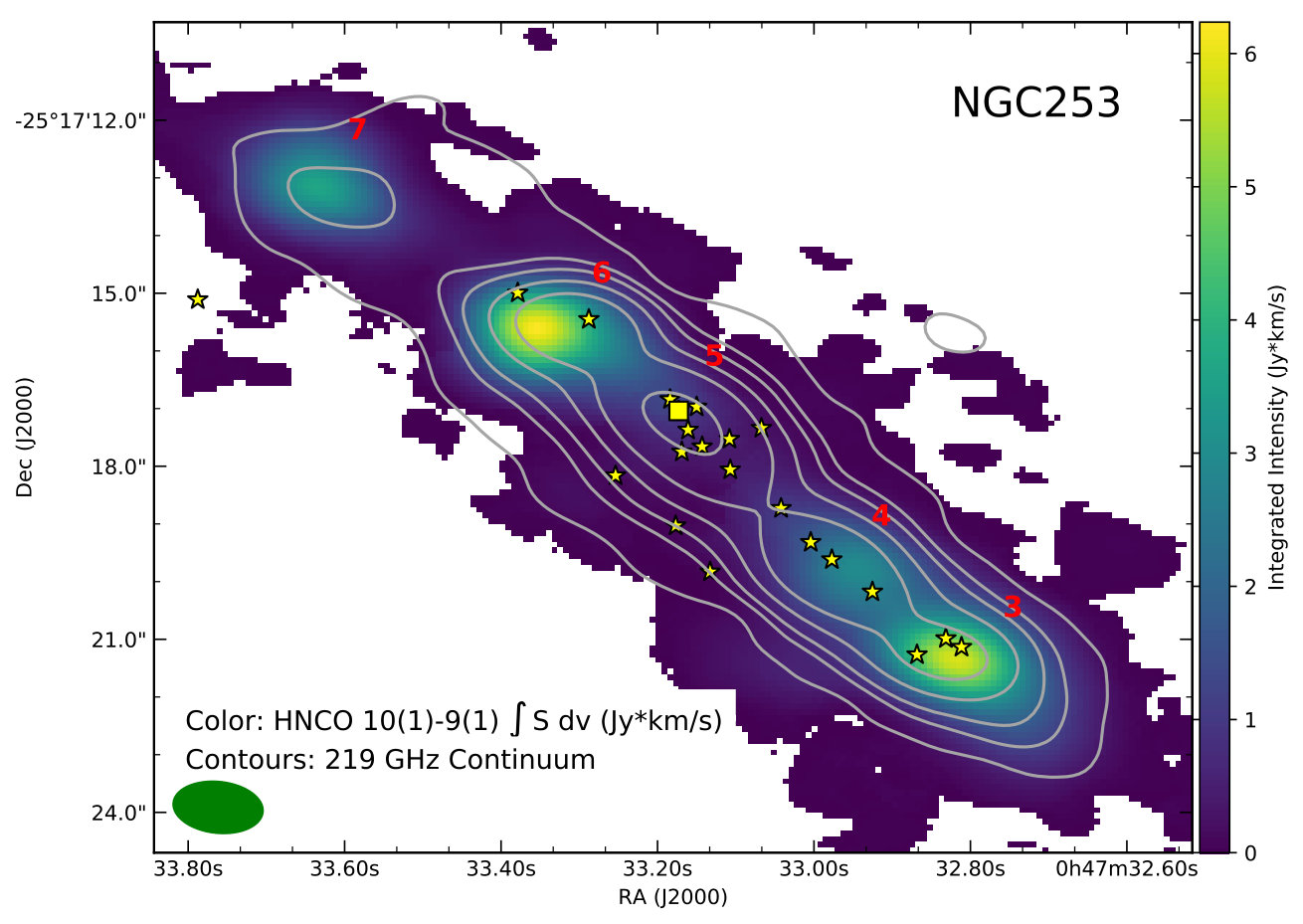 Figure 30
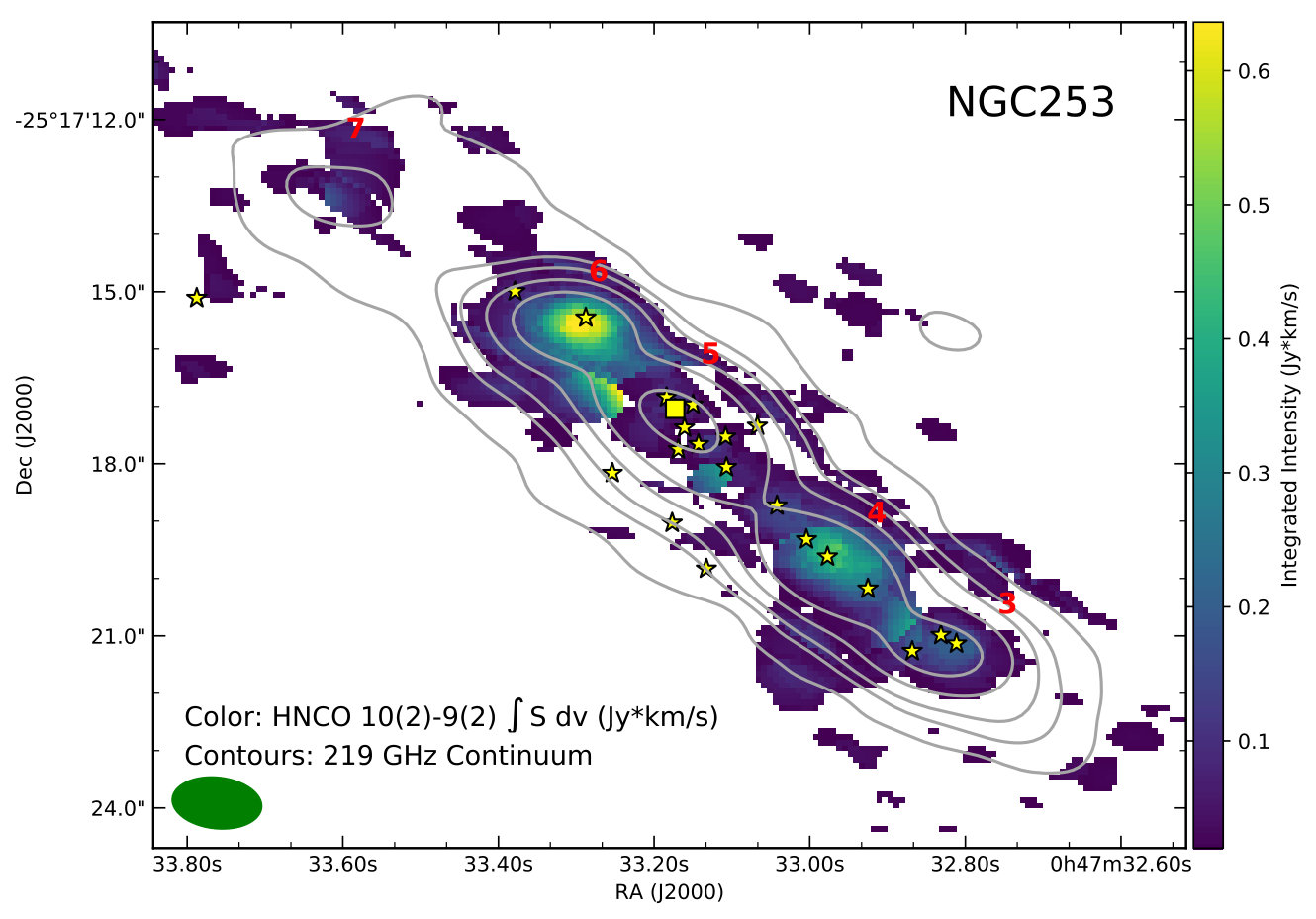 Figure 31
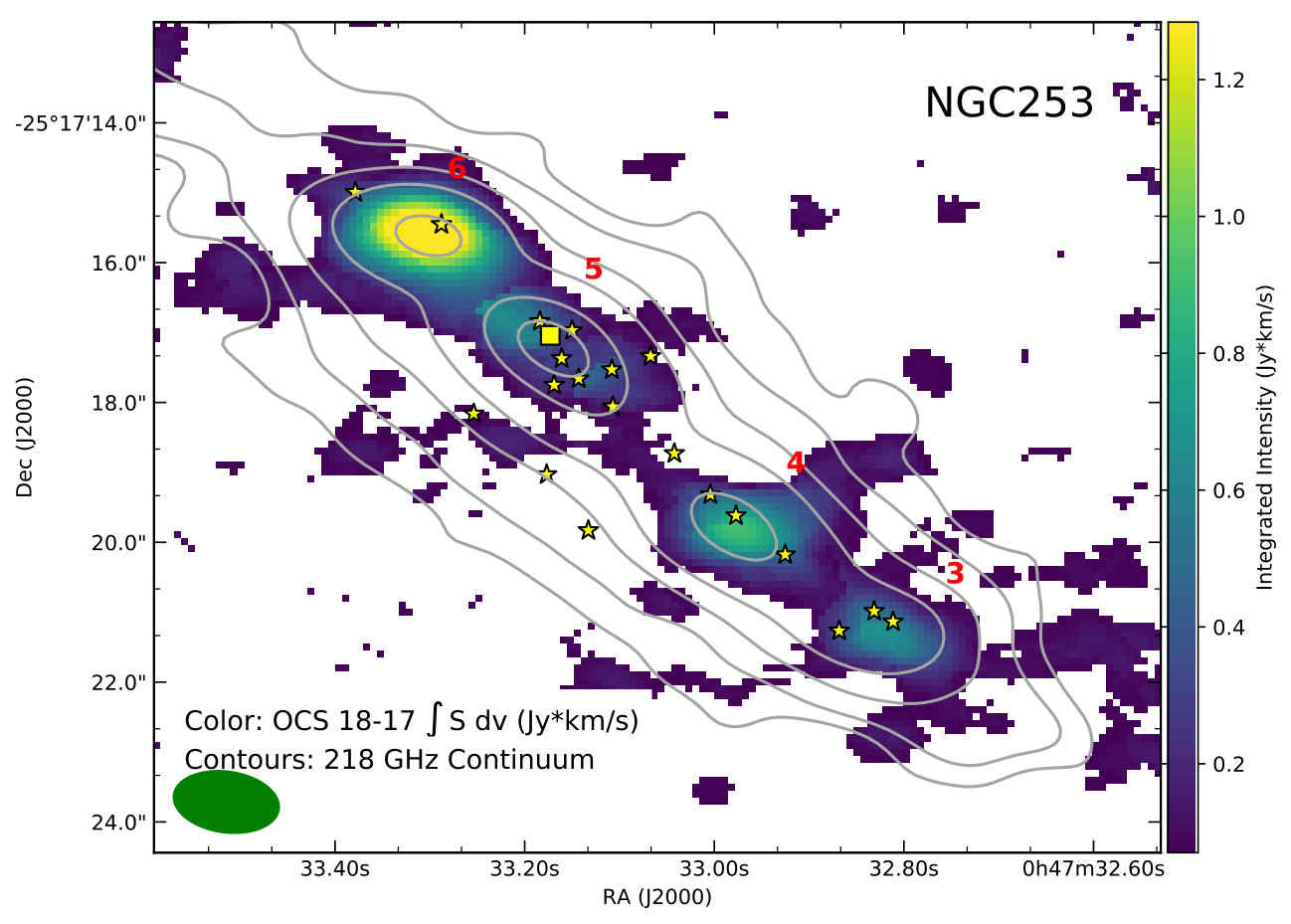 Figure 32
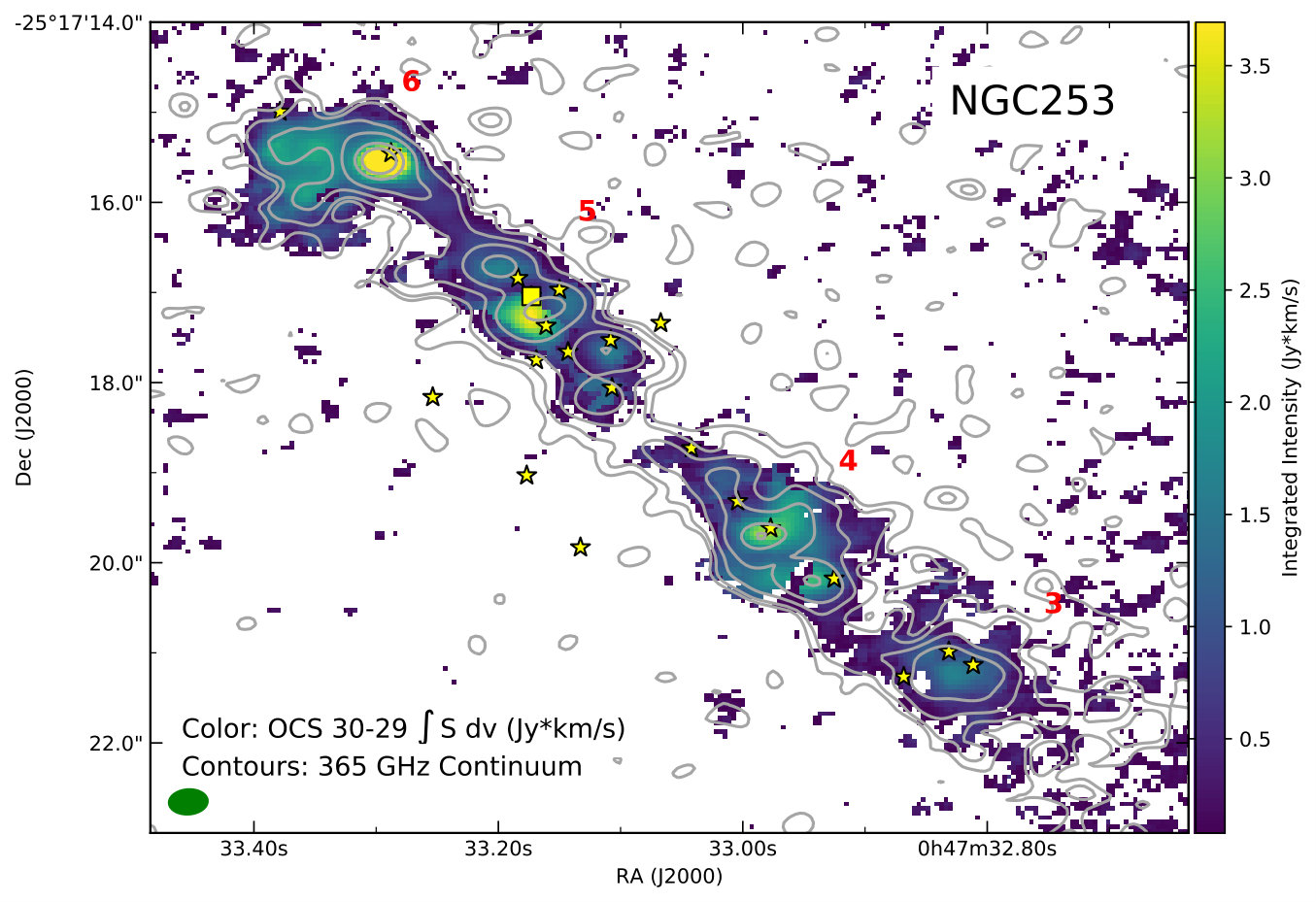 Figure 33
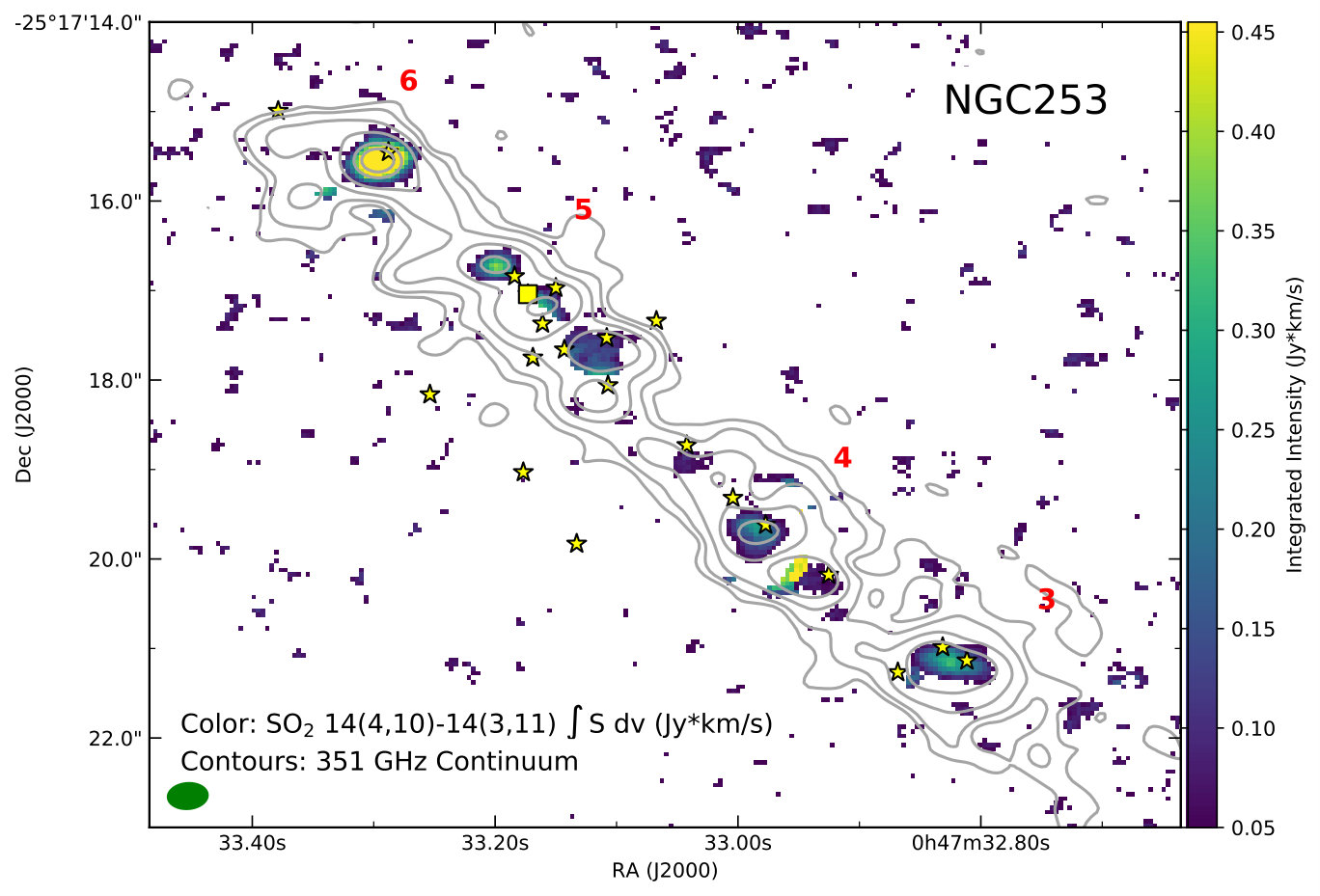 Figure 34
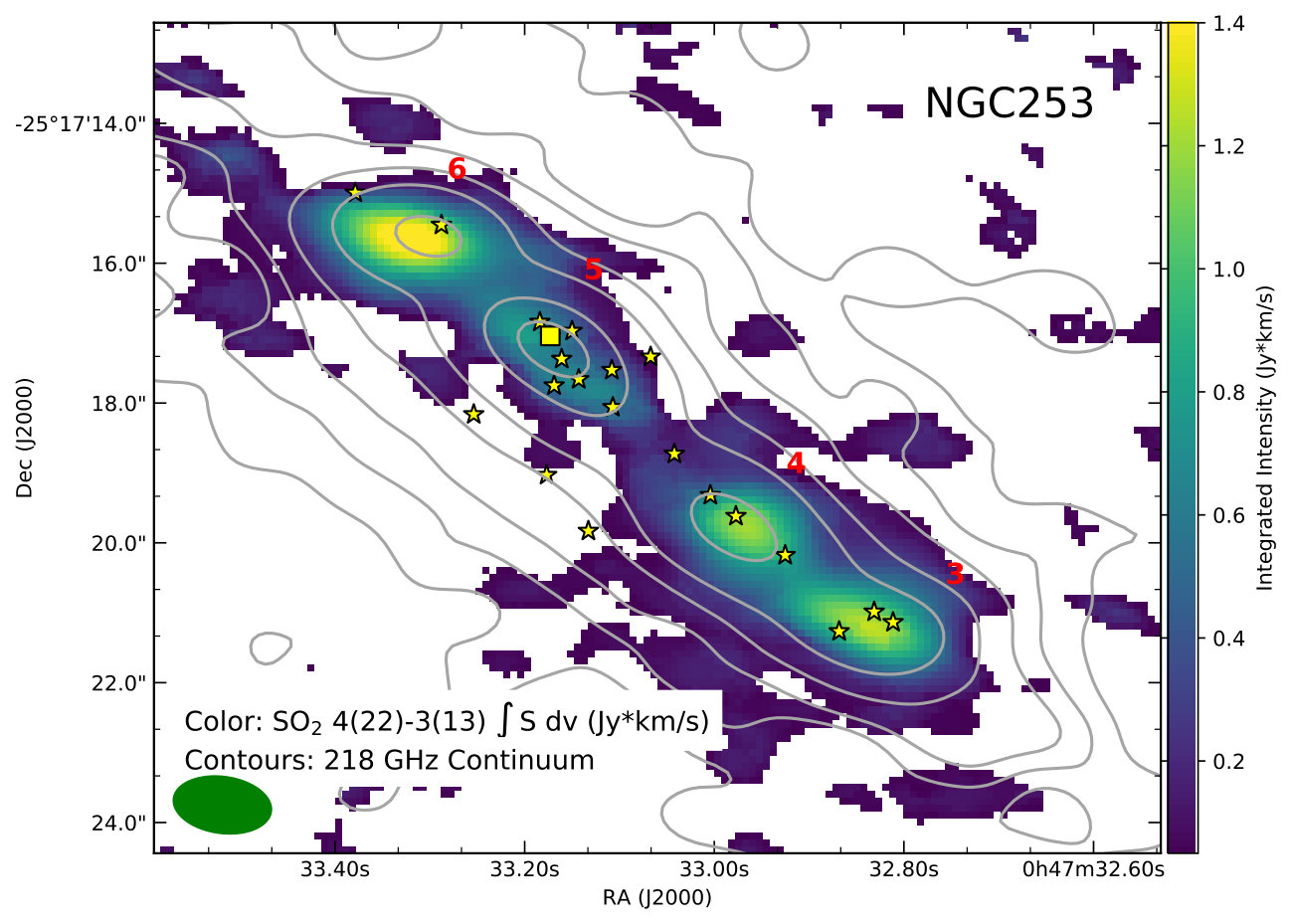 Figure 35
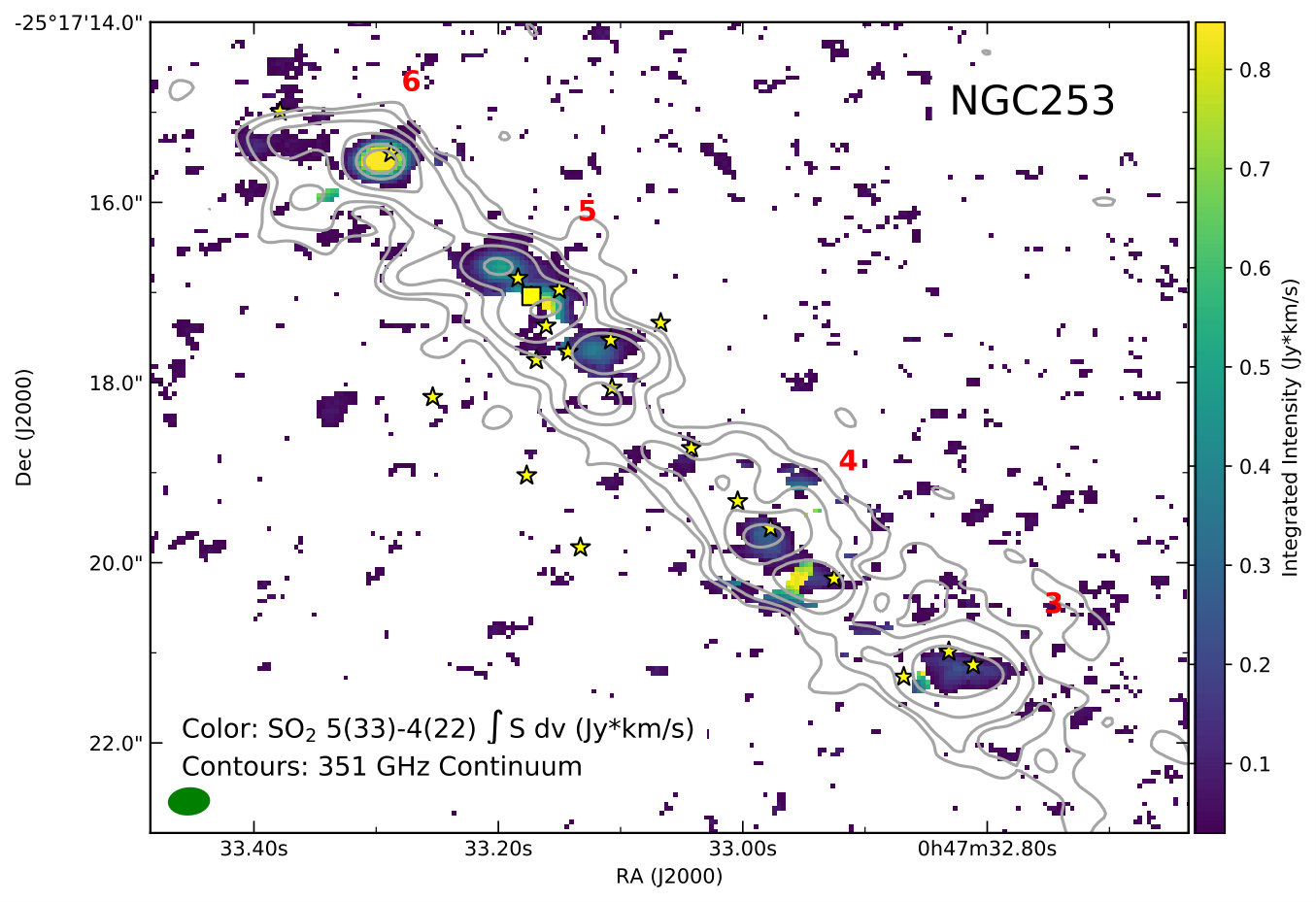 Figure 36
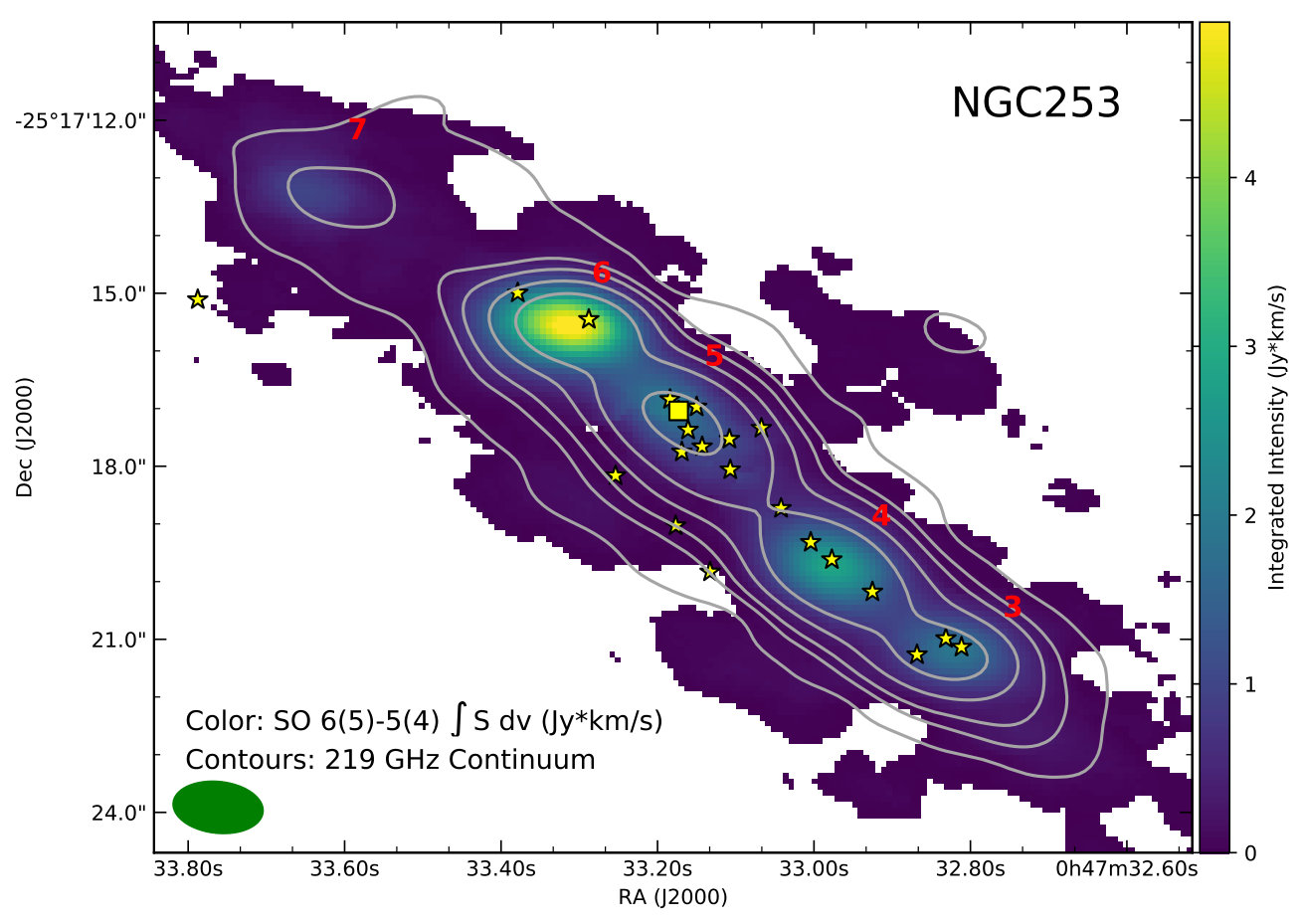 Figure 37
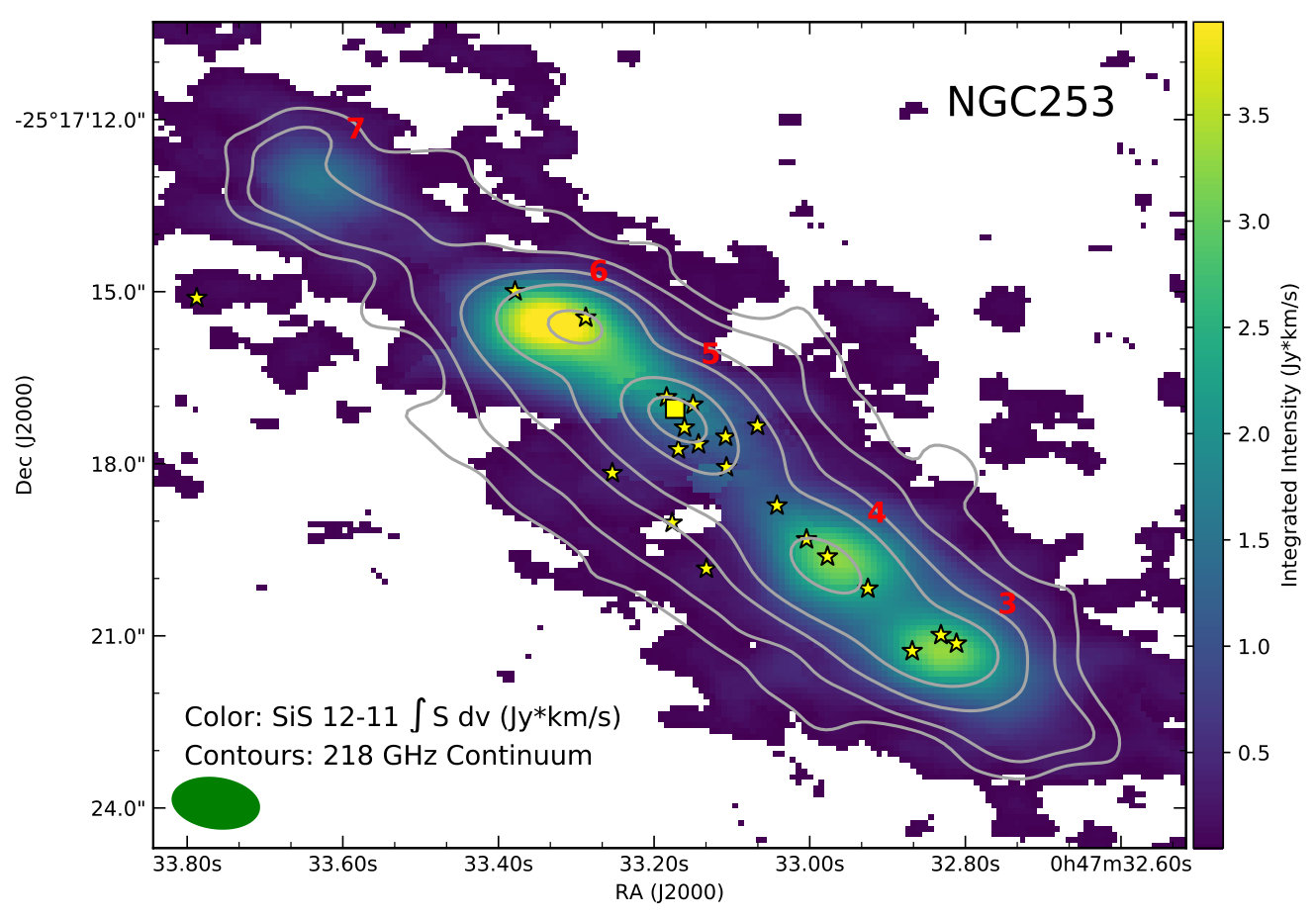 Figure 38
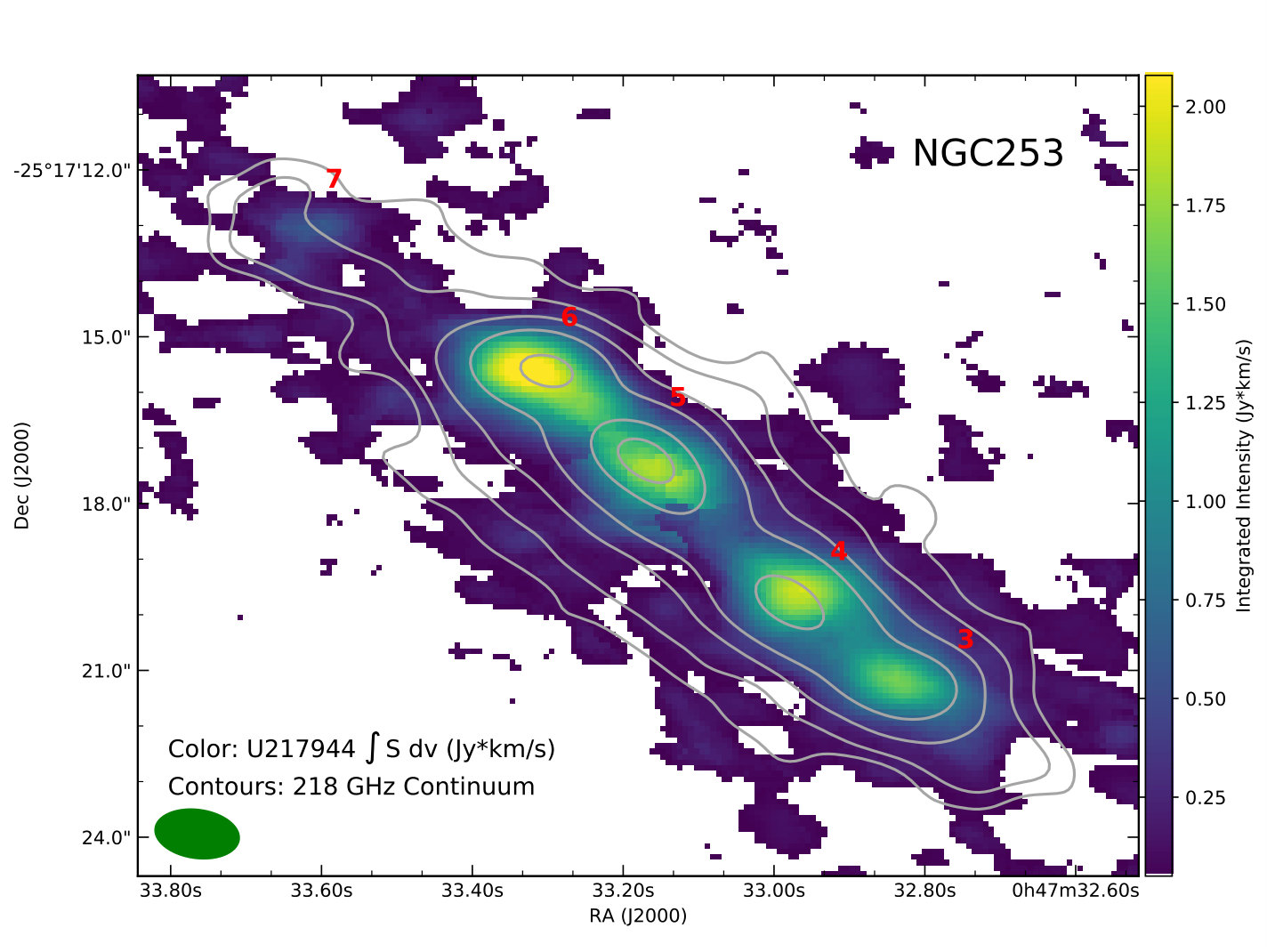 Figure 39
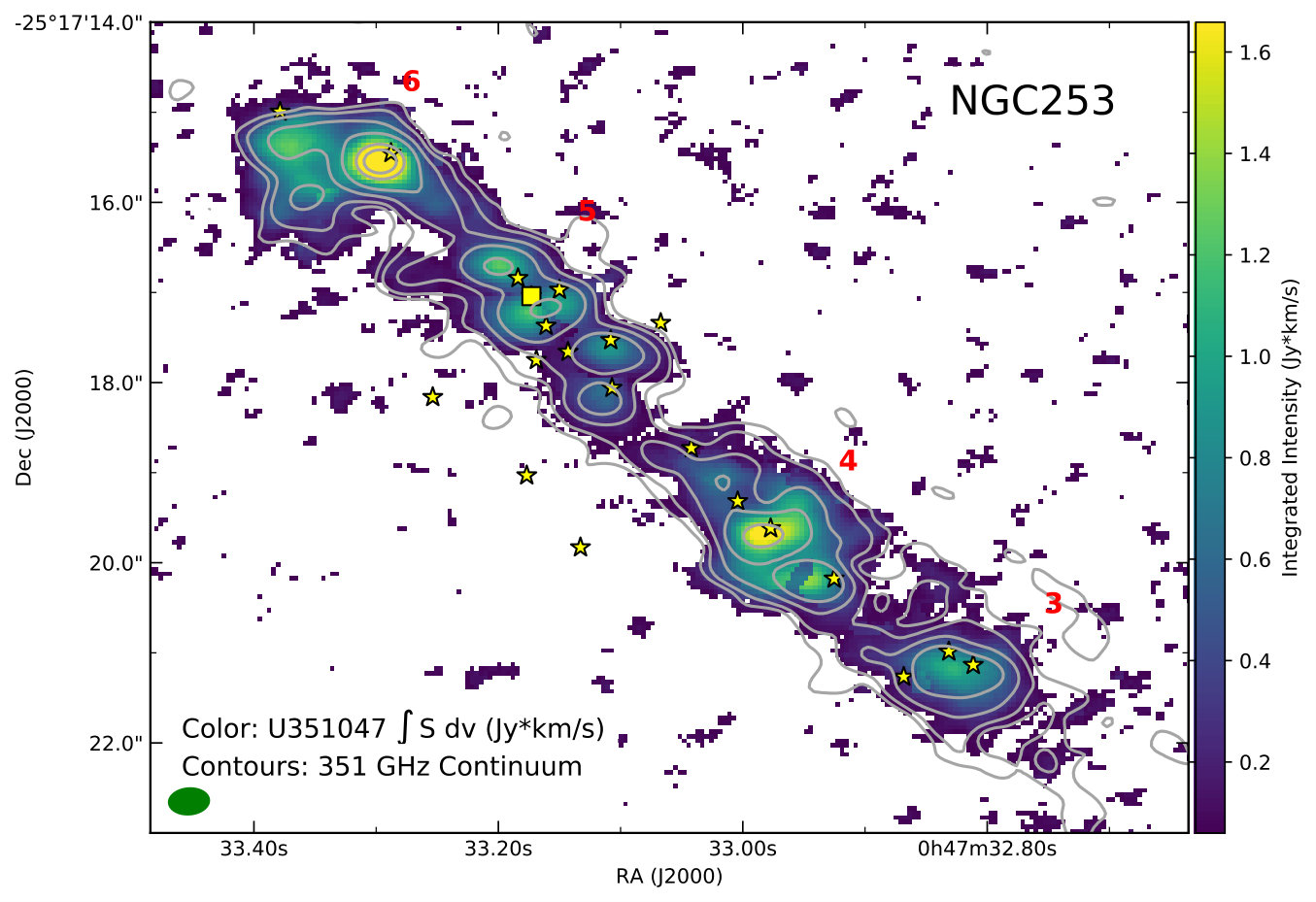 Figure 40
| Band | Array | Obs Date/Start Time | ton (minutes) | Nant | Baselines |
|---|---|---|---|---|---|
| (Min,Max) (m) | |||||
| NGC 253, RA(J2000)=00:47:33.1339, Dec(J2000)=:17:19.68, Vhel=258.8 km/s | |||||
| 6 | 12m | 2014-12-28 23:57:24 | 6.8 | 38 | (15,349) |
| 6 | 12m | 2015-05-02 16:18:28 | 38.1 | 34 | (15,349) |
| 6 | ACA | 2014-06-04 09:12:16 | 24.2 | 9 | (9,49) |
| 6 | ACA | 2014-06-04 10:17:53 | 24.2 | 9 | (9,49) |
| 6 | ACA | 2014-06-04 11:25:14 | 24.2 | 9 | (9,49) |
| 7 | 12m | 2014-05-19 09:15:59 | 34.3 | 34 | (21,650) |
| 7 | ACA | 2014-05-19 10:20:02 | 32.8 | 8 | (9,49) |
| 7 | ACA | 2014-06-08 09:49:14 | 32.8 | 10 | (9,49) |
| Rest Frequency | Bandwidth | Nchan | Channel Width |
|---|---|---|---|
| (GHz) | (GHz) | (MHz and km/s) | |
| ALMA Band 6 12m Array Correlator | |||
| 218.222192 | 1.875 | 960 | 1.953/2.686 |
| 219.908525 | 1.875 | 960 | 1.953/2.665 |
| 234.700 | 2.000 | 122 | 15.625/19.978 |
| ALMA Band 6 ACA Correlator | |||
| 218.222192 | 1.992 | 1024 | 1.992/2.67 |
| 219.908525 | 1.992 | 1024 | 1.992/2.65 |
| 234.700 | 1.938 | 128 | 15.625/20.05 |
| ALMA Band 7 12m Array Correlator | |||
| 351.768645 | 1.875 | 480 | 3.906/3.33 |
| 363.419649 | 1.875 | 480 | 3.906/3.33 |
| 364.819285 | 1.875 | 480 | 3.906/3.33 |
| ALMA Band 7 ACA Correlator | |||
| 351.768645 | 1.992 | 510 | 3.906/3.33 |
| 363.419649 | 1.992 | 510 | 3.906/3.33 |
| 364.819285 | 1.992 | 510 | 3.906/3.33 |
| Rest Frequency | v | @PAaa Continuum beam parameters are the same as their corresponding spectral line cubes, thus have been omitted. | RMS per Channel |
|---|---|---|---|
| (GHz) | (km/s) | (arcsec,arcsec,deg) | (mJy/beam) |
| NGC 253 Band 6 12m Array | |||
| 218.222192 | 5.5 | @ | 2.5 |
| 219.908525 | 5.5 | @ | 2.0 |
| 234.700 | 25.0 | @ | 0.9 |
| NGC 253 Band 6 ACA | |||
| 218.222192 | 5.5 | @ | 12.5 |
| 219.908525 | 5.5 | @ | 10.0 |
| 234.700 | 25.0 | @ | 6.0 |
| NGC 253 Band 6 12m Array and ACA Feather | |||
| 218.222192 | 5.5 | @ | 2.5 |
| 55 (cont) | 0.8 | ||
| 219.908525 | 5.5 | @ | 1.8 |
| 385 (cont) | 0.3 | ||
| 234.700 | 25.0 | @ | 0.9 |
| 250 (cont) | 0.4 | ||
| NGC 253 Band 7 12m Array | |||
| 351.768645 | 3.5 | @ | 2.0 |
| 363.419649 | 3.5 | @ | 2.8 |
| 364.819285 | 3.5 | @ | 3.0 |
| NGC 253 Band 7 ACA | |||
| 351.768645 | 3.5 | @ | 13.5 |
| 363.419649 | 3.5 | @ | 13.5 |
| 364.819285 | 3.5 | @ | 22.0 |
| NGC 253 Band 7 12m Array and ACA Feather | |||
| 351.768645 | 3.5 | @ | 2.0 |
| 35 (cont) | 0.9 | ||
| 363.419649 | 3.5 | @ | 3.0 |
| 35 (cont) | 0.8 | ||
| 364.819285 | 3.5 | @ | 3.2 |
| 35 (cont) | 1.5 | ||
| Regionaa Nomenclature adopts Leroy et al. (2015) component numbering. | RA(J2000)bb Position errors are all . | Dec(J2000)bb Position errors are all . | M2015cc M2015:Meier et al. (2015), S2011:Sakamoto et al. (2011), A2017:Ando et al. (2017), TH1985:Turner & Ho (1985). | S2011cc M2015:Meier et al. (2015), S2011:Sakamoto et al. (2011), A2017:Ando et al. (2017), TH1985:Turner & Ho (1985). | A2017cc M2015:Meier et al. (2015), S2011:Sakamoto et al. (2011), A2017:Ando et al. (2017), TH1985:Turner & Ho (1985). | TH1985cc M2015:Meier et al. (2015), S2011:Sakamoto et al. (2011), A2017:Ando et al. (2017), TH1985:Turner & Ho (1985). |
|---|---|---|---|---|---|---|
| (00h 47m) | ( 17′) | |||||
| 3 | 32.s848 | 21.′′05 | 4 | S1 | 8 | 9 |
| 4 | 32.s976 | 19.′′79 | 5 | S2 | 8 | |
| 4a | 32.s982 | 19.′′70 | 5 (subcomponent) | 6 | 8 | |
| 4b | 32.s950 | 20.′′00 | 5 (subcomponent) | 7 | ||
| 5 | 33.s166 | 17.′′29 | 6 | 2–6 | ||
| 5a | 33.s118 | 17.′′63 | 6 (subcomponent) | 4 | 6 | |
| 5b | 33.s129 | 17.′′89 | 6 (subcomponent) | 5 | 6 | |
| 5c | 33.s165 | 17.′′18 | 6 (subcomponent) | 2 | 2–5 | |
| 5d | 33.s196 | 16.′′80 | 6 (subcomponent) | 3 | 2 | |
| 6 | 33.s297 | 15.′′56 | 7 | S4 | 1 | 1 |
| 7 | 33.s637 | 13.′′01 | 8 | S5 |
| Regionaa Nomenclature adopts Leroy et al. (2015) component numbering. | Sν (mJy) | N(H2) ( cm-2)bb Assuming R, T K, , , and D = 3.5 Mpc. | M(H2) ( M☉)bb Assuming R, T K, , , and D = 3.5 Mpc. |
|---|---|---|---|
| 218 GHz Continuum; arcsec | |||
| 3 | |||
| 4 | |||
| 5 | |||
| 6 | |||
| 7 | |||
| 220 GHz Continuum; arcsec | |||
| 3 | |||
| 4 | |||
| 5 | |||
| 6 | |||
| 7 | |||
| 351 GHz Continuum; arcsec | |||
| 3 | |||
| 4a | |||
| 4b | |||
| 5a | |||
| 5b | |||
| 5c | |||
| 5d | |||
| 6 | |||
| 7 | |||
| 363 GHz Continuum; arcsec | |||
| 3 | |||
| 4a | |||
| 4b | |||
| 5a | |||
| 5b | |||
| 5c | |||
| 5d | |||
| 6 | |||
| 7 | |||
| 365 GHz Continuum; arcsec | |||
| 3 | |||
| 4a | |||
| 4b | |||
| 5a | |||
| 5b | |||
| 5c | |||
| 5d | |||
| 6 | |||
| 7 | |||
| Regionaa Nomenclature adopts Leroy et al. (2015) component numbering. | N(H2) ( cm-2)bb Assuming R, T K, , , and D = 3.5 Mpc. | M(H2) ( M☉)bb Assuming R, T K, , , and D = 3.5 Mpc. |
|---|---|---|
| 220 GHz Continuum; arcsec | ||
| 3 | ||
| 4 | ||
| 5 | ||
| 6 | ||
| 7 | ||
| 360 GHz Continuum; arcsec | ||
| 3 | ||
| 4 | ||
| 5 | ||
| 6 | ||
| 7 | ||
| Region | RA(J2000) | Dec(J2000) | FWHM (arcsec,deg) |
|---|---|---|---|
| (00h 47m) | ( 17′) | ( @ PA) | |
| 3 | 32.82580.0077 | 21.16760.0671 | @ |
| 4 | 32.96440.0004 | 19.73540.0231 | @ |
| 4a | 32.98330.0048 | 19.75540.1313 | @ |
| 4b | 32.95370.0059 | 20.05950.1917 | @ |
| 5 | 33.21290.0094 | 16.59540.0619 | @ |
| 5a | 33.1130.0014 | 17.62370.0173 | @ |
| 5b | 33.12980.0004 | 17.89310.0624 | @ |
| 5c | 33.16660.0044 | 17.25510.0819 | @ |
| 5d | 33.19790.0043 | 16.75850.0709 | @ |
| 6 | 33.29940.0063 | 15.59520.0869 | @ |
| 7 | 33.63780.0063 | 13.09690.1072 | @ |
| Transition | Region 3 | Region 4 | Region 5 | Region 6 | Region 7 |
|---|---|---|---|---|---|
| 13CO | 16.154.11 | 19.514.00 | (3.30) | 26.534.55 | 11.923.20 |
| C18O | 6.801.60 | 7.171.34 | (1.07) | 11.911.67 | 4.481.09 |
| 13CN, F1=3-2 | (0.12) | 1.420.17 | (0.15) | 1.290.13 | (0.04) |
| SiS | 2.220.32 | 2.370.30 | (0.29) | 3.270.37 | 1.420.11 |
| SO 65-54 | 1.460.19 | 2.490.20 | 1.700.22 | 4.680.32 | 0.940.05 |
| SO2 | 1.050.11 | 0.940.10 | 0.540.09 | 1.320.15 | 0.200.07 |
| SO2 | 0.310.05 | 4a:0.250.06, 4b:0.660.12 | 5a:0.150.03, 5b:0.250.04, 5c:0.280.08, 5d:0.380.13 | 0.900.04 | (0.04) |
| SO2 | 0.210.07 | 4a:0.300.07, 4b:0.800.24 | 5a:0.370.10, 5b:(0.09), 5c:0.990.12, 5d:0.440.08 | 1.340.08 | (0.03) |
| HNC | 3.900.81 | 4a:17.991.27, 4b:(1.61) | 5a:6.032.22, 5b:3.622.16, 5c:6.051.47, 5d:(3.45) | 28.771.38 | 1.540.22 |
| HNC | 0.680.07 | 4a:1.810.07, 4b:(0.07) | 5a:1.210.13, 5b:(0.17), 5c:(0.09), 5d:(0.56) | 0.540.13 | 0.090.04 |
| OCS | 1.300.25 | 4a:2.550.31, 4b:(0.38) | 5a:1.080.10, 5b:(0.78), 5c:2.970.35, 5d:(0.46) | 5.740.68 | 0.710.17 |
| HNCO bb All three HNCO transitions are blended with nearby species, making these HNCO integrated intensities uncertain. | 4.580.52 | 2.450.32 | (0.27) | 4.700.38 | 3.430.20 |
| HNCO bb All three HNCO transitions are blended with nearby species, making these HNCO integrated intensities uncertain. | 1.290.12 | 0.820.10 | (0.14) | 1.140.09 | 0.180.05 |
| HNCO bb All three HNCO transitions are blended with nearby species, making these HNCO integrated intensities uncertain. | 0.390.04 | (0.06) | 0.550.07 | (0.03) | |
| H2CO | 2.520.37 | 2.990.39 | (0.35) | 4.220.49 | 2.960.27 |
| H2CO | 1.180.19 | 2.010.20 | (0.19) | 2.740.20 | 1.200.08 |
| H2CO cc Blend with HNC , making H2CO integrated intensities unrecoverable. | |||||
| H2CO | 0.850.08 | 4a:1.730.10, 4b:0.500.12 | 5a:0.910.15, 5b:(0.16), 5c:0.450.10, 5d:0.910.34 | 3.830.10 | 0.210.07 |
| H2CO | 0.460.06 | 4a:1.410.07, 4b:0.280.09 | 5a:0.920.10, 5b:(0.13), 5c:0.330.09, 5d:0.600.28 | 2.520.11 | 0.640.12 |
| H2CO dd Since this is a blend of two transitions whose intensities should be equal, the measured intensity from Table 8 has been divided by 2 to calculate the column density. | 0.200.04 | 4a:0.540.06, 4b:0.340.17 | 5a:0.350.08, 5b:(0.12), 5c:0.560.05, 5d:0.200.10 | (0.04) | (0.07) |
| H2CO | 1.730.14 | 4a:3.740.24, 4b:1.230.28 | 5a:1.620.29, 5b:1.260.42, 5c:2.180.30, 5d:1.800.38 | 4.710.42 | 0.630.10 |
| H2CO dd Since this is a blend of two transitions whose intensities should be equal, the measured intensity from Table 8 has been divided by 2 to calculate the column density. | 1.290.11 | 4a:3.300.13, 4b:0.370.15 | 5a:1.750.32, 5b:(0.32), 5c:1.250.24, 5d:1.450.59 | 5.180.23 | 0.930.10 |
| H3O+ | 1.080.23 | 4a:2.350.30, 4b:(0.37) | 5a: , 5b:0.640.58, 5c:2.630.33, 5d:1.090.41 | 5.460.68 | 0.650.15 |
| HC3N | 2.380.27 | 2.850.27 | 2.660.35 | 6.630.54 | 1.290.10 |
| HC3N | (0.01) | 0.060.02 | 2.440.39 | 0.550.14 | 0.090.04 |
| HC3N | 0.770.07 | 4a:0.900.09, 4b:0.460.10 | 5a:0.520.14, 5b:(0.14), 5c:0.310.11, 5d:0.780.30 | 4.290.13 | (0.13) |
| C4H N=23-22ee Composed of the blended (J=47/2-45/2,F=23-22), (J=47/2-45/2,F=24-23), (J=45/2-43/2,F=22-21), and (J=45/2-43/2,F=23-22) multiplet at 218837.00950 MHz. | 0.360.06 | 0.510.05 | 0.560.09 | 1.710.10 | 0.0450.03 |
| CH3CN | 1.580.12 | 0.880.09 | 2.390.11 | 0.650.04 | |
| CH3OH -E | 0.280.08 | 4a:0.250.14, 4b:1.090.03 | 5a:0.170.04, 5b:0.320.06, 5c:0.580.09, 5d:0.380.12 | 0.890.06 | (0.03) |
| U217944ff May be assigned as CH3OCHO J=34-33 (U365185), CH3OCHO (U352199), and CH3OCHO (U217944) | 1.170.15 | 2.100.20 | 0.470.06 | ||
| U351047 | 0.960.13 | 4a:1.610.12, 4b: | 5a:0.770.12, 5b:0.550.23, 5c:1.070.16, 5d:1.060.20 | 2.370.20 | |
| U352199ff May be assigned as CH3OCHO J=34-33 (U365185), CH3OCHO (U352199), and CH3OCHO (U217944) | 0.190.04 | 4a:0.360.04, 4b:(0.04) | 5a:0.160.05, 5b:(0.04), 5c:0.360.05, 5d:0.240.08 | 0.870.04 | |
| U365185ff May be assigned as CH3OCHO J=34-33 (U365185), CH3OCHO (U352199), and CH3OCHO (U217944) | 0.660.07 | 4a:1.840.07, 4b:(0.07) | 5a:1.220.12, 5b:(0.17), 5c:0.200.09, 5d:0.910.59 | 7.410.12 |
| cm-2 at TK = 150 K | ||||||
|---|---|---|---|---|---|---|
| Molecule | Ntrans | Region 3 | Region 4 | Region 5 | Region 6 | Region 7 |
| 13CO | 1 | (840) | ||||
| C18O | 1 | (288) | ||||
| 13CN | 1 | (0.22) | (0.28) | (0.41) | ||
| SiS | 1 | (0.53) | ||||
| SO | 1 | |||||
| SO2 | 3 | (4.50) | ||||
| HNC | 1 | (4.27) | ||||
| OCS | 1 | (27.94) | (969.61) | |||
| HNCO | 3 | (1.25) | ||||
| H2CO | 7 | |||||
| H3O+ | 1 | (4.09) | (3.47) | |||
| HC3N | 2 | |||||
| C4H | 1 | (0.02) | ||||
| CH3CNbbSince the CH3CN transition is a combination of the K=0 through 3 levels, the column density has been scaled by a factor of (using Sections 5 and 9 in Mangum & Shirley (2015)) to account for spin degeneracy and line strength differences. | 1 | (0.35) | (0.20) | |||
| CH3OH | 1 | (13.98) | (27.20) | (31.84) | (73.57) | |
| Molecule | Region 3 | Region 4 | Region 5 | Region 6 | Region 7 |
|---|---|---|---|---|---|
| 13CN | (0.65) | (0.38) | (9.53) | ||
| SiS | (0.73) | ||||
| SO | |||||
| SO2 | (104.65) | ||||
| HNC | (5.88) | ||||
| OCS | (55.88) | (22549.07) | |||
| HNCO | |||||
| H2CO | |||||
| H3O+ | (80.70) | ||||
| HC3N | |||||
| C4H | (0.47) | ||||
| CH3CN | (1.03) | (0.4) | … | ||
| CH3OH | (41.00) | (54.40) | (43.82) | (1710.93) | |
| Measurement | Calibrator | Derived/Assumed Flux aaDerived (GA and BP) or assumed (FL and PT) flux, where GA gain amplitude, BP bandpass, FL flux, and PT pointing calibration. | Flux Uncertainty (%) |
|---|---|---|---|
| (GA,BP:mJy; FL,PT:Jy) | |||
| NGC 253 | |||
| Band 6 12m Array Measurement on 2014-12-28 | |||
| GA | J00382459 | 341.11.8, 339.61.9, 330.42.1 | 0.5, 0.6, 0.6 |
| BP | J22582758 | 453.41.7, 449.51.7, 424.22.0 | 0.4, 0.4, 0.5 |
| FL | Uranus | 30.9, 31.3, 34.8 | 5bbSee discussion in Section 2. |
| PT | J01080135 | 900130 | 14 |
| Band 6 12m Array Measurement on 2015-05-02 | |||
| GA | J00382459 | 263.83.9, 262.43.9, 252.54.3 | 1.5, 1.5, 1.7 |
| BP | J03344008 | 688.24.8, 685.85.5, 653.36.5 | 0.7 0.8, 1.0 |
| FL | Mars | 78.5, 79.7, 89.5 | 10bbSee discussion in Section 2. |
| PT | J02381636 | 155050 | 3 |
| Band 6 ACA Measurement on 2014-06-04 | |||
| GA | J00382459 | 458.44.6, 453.54.6, 422.45.2 | 1.0, 1.0, 1.2 |
| BP | J22582758 | 570.72.3, 569.32.6, 521.53.4 | 0.4, 0.4, 0.6 |
| FL | Neptune | 13.0, 13.1, 13.6 | 10bbSee discussion in Section 2. |
| Band 6 ACA Measurement on 2014-06-04 | |||
| GA | J00382459 | 450.64.0, 448.05.8, 425.14.8 | 0.9, 1.3, 1.1 |
| BP | J22582758 | 570.72.4, 567.72.7, 538.63.0 | 0.4, 0.5, 0.5 |
| FL | Uranus | 28.9, 29.3, 32.6 | 5bbSee discussion in Section 2. |
| Band 6 ACA Measurement on 2014-06-04 | |||
| GA | J00382459 | 445.54.6, 442.45.3, 427.74.0 | 1.0, 1.0, 1.2 |
| BP | J22582758 | 559.42.7, 554.22.6, 528.32.4 | 0.4, 0.4, 0.6 |
| FL | Uranus | 28.9, 29.3, 32.6 | 5bbSee discussion in Section 2. |
| Band 7 12m Array Measurement on 2014-05-19 | |||
| GA | J00382459 | 290.012.5, 287.516.6, 289.218.5 | 4.3, 5.8, 6.4 |
| BP | J00060623 | 2092.4734.6, 2074.545.7, 2066.648.4 | 1.7, 2.2, 2.3 |
| FL | J22582758 | 0.40.1ccAssumed flux from ALMA calibrator catalog. | 15ccAssumed flux from ALMA calibrator catalog. |
| Band 7 ACA Measurement on 2014-05-19 | |||
| GA | J00382459 | 274.78.2, 279.97.5, 284.111.2 | 3.0, 2.7, 3.9 |
| BP | J00060623 | 2045.214.0, 2080.710.6, 2066.010.8 | 0.7, 0.5, 0.5 |
| FL | Neptune | 25.8, 27.7, 27.8 | 10bbSee discussion in Section 2. |
| Band 7 ACA Measurement on 2014-06-08 | |||
| GA | J00382459 | 324.37.7, 324.99.3, 320.36.1 | 3.0, 2.7, 3.9 |
| BP | J00060623 | 2243.815.4, 2214.217.5, 2226.315.6 | 0.7, 0.8, 0.7 |
| FL | Uranus | 63.8, 66.3, 66.6 | 5bbSee discussion in Section 2. |
| Molecule | Transition | Frequency (MHz) | (K) | (Debye) | SaaLine strengths calculated using Mangum & Shirley (2015) excluding the following: (SO: Tiemann, 1974), (SO2: Lovas, 1985), (CH3OH: Xu & Lovas, 1997). | // | Qrot(50/150/300) |
|---|---|---|---|---|---|---|---|
| 13CO | 220398.684 | 15.8662 | 0.11046 | 5/1/1 | 19.22/56.97/113.86 | ||
| C18O | 219560.358 | 15.8059 | 0.11079 | 5/1/1 | 19.31/57.19/114.29 | ||
| 13CNbbStrongest component of the hyperfine group with N=, J=. | F | 217467.150 | 15.684 | 1.45 | 5/1/1 | 19.47/57.74/115.42 | |
| SiS | 217817.663 | 67.954 | 1.730 | 25/1/1 | 114.99/344.17/689.59 | ||
| SO | 219949.442 | 34.9847 | 1.55 | 13/1/0.5 | 41.83/137.83/283.33 | ||
| SO2 | 235151.72 | 19.0298 | 1.6331 | 0.1906 | 9/1/1 | 401.17/2084.56/5896.02 | |
| SO2 | 351257.224 | 35.88646 | 1.6331 | 0.2495 | 11/1/1 | 401.17/2084.56/5896.02 | |
| SO2 | 351873.873 | 135.87076 | 1.6331 | 0.2538 | 29/1/1 | 401.17/2084.56/5896.02 | |
| HNC | 362630.30 | 43.5097 | 3.05 | 9/1/1 | 23.29/69.18/138.31 | ||
| OCS | 364748.960 | 271.379 | 0.7152 | 61/1/1 | 171.46/513.44/1028.60 | ||
| HNCO | 219798.27 | 58.0194 | 1.602 | 21/1/1 | 181.60/945.23/2695.60 | ||
| HNCO | 218981.02 | 101.079 | 1.602 | 21/1/1 | 181.60/945.23/2695.60 | ||
| HNCO | 219737.19 | 228.2851 | 1.602 | 21/1/1 | 181.60/945.23/2695.60 | ||
| H2CO | 218222.192 | 20.957 | 2.332 | 7/1/0.25 | 50.14/258.97/731.44 | ||
| H2CO | 218760.071 | 68.112 | 2.332 | 7/1/0.25 | 50.14/258.97/731.44 | ||
| H2CO | 362736.048 | 52.313 | 2.332 | 11/1/0.25 | 50.14/258.97/731.44 | ||
| H2CO | 363945.894 | 99.539 | 2.332 | 11/1/0.25 | 50.14/258.97/731.44 | ||
| H2CO | 365363.428 | 99.658 | 2.332 | 11/1/0.25 | 50.14/258.97/731.44 | ||
| H2CO | 364103.249 | 240.730 | 2.332 | 11/1/0.25 | 50.14/258.97/731.44 | ||
| H2CO | 351768.645 | 64.453 | 2.332 | 11/1/0.75 | 50.14/258.97/731.44 | ||
| H2CO | 364288.884 | 158.424 | 2.332 | 11/1/0.75 | 50.14/258.97/731.44 | ||
| H3O+ | 364797.427 | 139.338 | 1.44 | 7/2/0.25 | 4.39/22.79/64.46 | ||
| HC3N | v0 | 218324.72 | 130.982 | 3.73172 | 49/1/1 | 229.10/686.25/1374.92 | |
| HC3N | 363785.40 | 357.9731 | 3.73172 | 81/1/1 | 229.10/686.25/1374.92 | ||
| C4H | N=23-22 | 218857.0 | 126.05 | 0.90 | 23.0 | 47/1/1 | 221.05/439.60/1315.80 |
| CH3CN | 220747.259 | 68.8657 | 3.92197 | 25/1/0.5 | 167.17/876.86/2500.55 | ||
| CH3OH | -E | 351236.343 | 240.50455 | 1.412 | 0.6908 | 19/1/0.25 | 72.65/377.50/1067.74 |
Peer Reviews
No public reviews on file for this paper yet. If you reviewed it on a platform where reviews are public (OpenReview, ICLR, NeurIPS, ICML), you can paste yours below so the community can read it here.
Videos
No videos yet. Explain this paper in a talk, walkthrough, or lecture? Add one.
Fire in the Heart: A Characterization of the High Kinetic
Temperatures and Heating Sources in the Nucleus of NGC 253
National Radio Astronomy Observatory, 520 Edgemont Road, Charlottesville, VA 22903-2475, USA
National Radio Astronomy Observatory Jansky Fellow
National Radio Astronomy Observatory, P.O. Box O, 1003 Lopezville Road, Socorro, NM 87801-0387, USA
Max-Planck-Institut für Radioastronomie, Auf dem Hügel 69, 53121 Bonn, Germany
Astronomy Department, Faculty of Science, King Abdulaziz University, P. O. Box 80203, Jeddah, Saudi Arabia
Max-Planck-Institut für Radioastronomie, Auf dem Hügel 69, 53121 Bonn, Germany
Susanne Aalto
Department of Earth and Space Sciences, Chalmers University of Technology, Onsala Observatory, SE-439 92 Onsala, Sweden
Leiden Observatory, Leiden University, 2300 RA, Leiden, The Netherlands Jeff Mangum [email protected]
Abstract
The nuclear starburst within the central ( pc; pc) of NGC 253 has been extensively studied as a prototype for the starburst phase in galactic evolution. Atacama Large Millimeter/submillimeter Array (ALMA) imaging within receiver Bands 6 and 7 have been used to investigate the dense gas structure, kinetic temperature, and heating processes that drive the NGC 253 starburst. A total of 29 transitions from 15 molecular species/isotopologues have been identified and imaged at – resolution, allowing for the identification of five of the previously studied giant molecular clouds (GMCs) within the central molecular zone (CMZ) of NGC 253. Ten transitions from the formaldehyde (H2CO) molecule have been used to derive the kinetic temperature within the – dense gas structures imaged. On scales we measure K, while on size scales we measure K. These kinetic temperature measurements further delineate the association between potential sources of dense gas heating. We have investigated potential heating sources by comparing our measurements to models that predict the physical conditions associated with dense molecular clouds that possess a variety of heating mechanisms. This comparison has been supplemented with tracers of recently formed massive stars (Br) and shocks ([FeII]). Derived molecular column densities point to a radially decreasing abundance of molecules with sensitivity to cosmic-ray and mechanical heating within the NGC 253 CMZ. These measurements are consistent with radio spectral index calculations that suggest a higher concentration of cosmic-ray-producing supernova remnants within the central 10 pc of NGC 253.
galaxies: starbursts, ISM: molecules, galaxies: individual: NGC 253, galaxies: active, galaxies: nuclei, galaxies: spiral
††journal: The Astrophysical Journal††software: CASA, spectral-cube (Robitaille et al., 2016), PySpecKit (Ginsburg & Mirocha, 2011), Astropy (Astropy Collaboration et al., 2018)
1 Introduction
The comparison between the properties of the star formation process in our Galaxy and that found in galaxies that appear to be producing a plethora of stars over a relatively short time period is dramatic. Taking NGC 253 as the prototype for a starburst galaxy, the giant molecular clouds (GMCs) are % larger, are times more massive, have velocity dispersions that are times larger, and have freefall times times shorter than GMCs in the Milky Way disk111See Table 4 in Leroy et al. (2015) for an excellent comparison of physical properties in Milky Way disk and NGC 253 GMCs.. With its relative proximity ( Mpc; Rekola et al., 2005) and optimal disk orientation of (McCormick et al., 2013), which presents disk velocity excursions running from to km/s, NGC 253 provides an excellent perspective to earthly observers of the extragalactic star formation process. As higher-resolution and more sensitive infrared through millimeter measurements have become available, the spectral and structural complexity of the central kiloparsec of the NGC 253 molecular disk has become more apparent. Structures that are reminiscent of Milky Way massive star formation regions with spectral richness rivaling those measured toward hot core sources and our own Galactic center region can now be measured and analyzed, providing valuable clues to the burst mode of star formation in external galaxies.
Using the millimeter/submillimeter spatial and spectral properties measured toward NGC 253, we have endeavored to understand some basic properties of the star formation process in this galaxy. Specifically, what is the kinetic temperature within the dense gas that is in the process of forming stars, and what are the heating processes that drive those kinetic temperatures? Section 2 presents our Atacama Large Millimeter/submillimeter Array (ALMA) frequency Band 6 and 7 spectral line emission measurements, from which the spatial (Section 3.2) and spectral (Section 4.1) properties have been derived. Molecular spectral line integrated intensities have been extracted using a python-based script (Section 4.2), from which molecular column densities have been derived (Section 6). Section 5 presents our analysis of the imaged transitions from the formaldehyde (H2CO) molecule that have been used to derive the kinetic temperature within the identified GMCs that inhabit the NGC 253 nucleus. With this information, we then use the molecular abundances inferred from our measurements, in corporation with infrared through radio studies of the NGC 253 nuclear disk, to constrain chemical models that trace the influence of photon-dominated region (PDR), X-ray-dominated region (XDR), cosmic-ray-dominated (CRDR), and mechanical heating within the dense molecular gas (Section 7). In Section 8 we discuss the anomalous spatial distributions presented by our measured CH3OH and vibrationally excited HC3N and HNC transitions and their association with infrared and radio emission sources. We conclude with a discussion of the connection between potential sources of heating and the measured molecular abundances in the NGC 253 CMZ.
2 Observations
A single field was observed toward NGC 253 using the Atacama Large Millimeter Array (ALMA) 12m Array, Atacama Compact Array (ACA), and Total Power (TP) antennas at Bands 6 and 7 (ALMA projects 2013.1.00099.S and 2015.1.00476.S). The phase center was at RA(J2000)=00:47:33.1339, Dec(J2000)=:17:19.68, Vhel=258.8 km/s. ALMA standard observing routines were used for all three types of measurements, which included pointing, flux, and phase calibration measurements. The TP measurements have proven to be unusable owing to incomplete telluric line removal encountered during processing in the Common Astronomy Software Applications (CASA) data reduction package. As we have not included these measurements in our analysis, we provide no further information on them.
Tables 1 and 2 summarize the general observational characteristics of the ALMA Band 6 and 7 measurements of NGC 253 presented. Three separate spectral windows for each frequency band in these 12m Array and ACA measurements were employed. For the Band 6 measurements each spectral window spanned frequencies from 217.284692 to 219.159692 GHz, from 218.971025 to 220.846025 GHz, and from 233.7 to 235.7 GHz. For Band 7 the three separate spectral windows spanned frequencies from 350.831145 to 352.706145 GHz, from 362.482149 to 364.357149 GHz, and from 363.881785 to 365.756785 GHz. For the Band 6 measurements of NGC 253 the total on-source integration time (ton) for each type of measurement was 44.9 minutes (12m Array) and 72.6 min (ACA), for a 12m:ACA on-source integration time ratio of 1:1.6. At Band 7 the total on-source integration time toward NGC 253 for each type of measurement was 34.3 min (12m Array) and 65.6 minutes (ACA), for a 12m:ACA on-source integration time ratio of 1:1.9. Both on-source integration time ratios are consistent with the standard integration time ratio for ALMA observations acquired in Cycle 2 of 12m Array:ACA:TP = 1:2:4 (Mason & Brogan, 2013).
Amplitude, bandpass, phase, and pointing calibration information for these measurements are listed in Appendix A (Table 11). For Band 6 gain and bandpass calibrator fluxes ranged from 253 to 688 mJy. Uncertainties in the Band 6 gain and bandpass calibrator measurements are in the range 0.4–1.7%. For Band 7 gain and bandpass calibrator fluxes ranged from 274 to 2244 mJy. Uncertainties in the Band 7 gain and bandpass calibrator measurements are with one exception in the range of 0.1–3.9%. The Band 7 12m Array measurements on 2014-05-19 have higher gain calibration uncertainties that are in the range of 4.3–6.4%.
At Band 6 flux calibration was effected using Uranus (28.9–34.8 Jy), Mars (78.5–89.5 Jy), and Neptune (13.0–13.6 Jy). Band 6 flux calibrator uncertainties are estimated to be 5% for Uranus (Orton et al., 2014), 10% for Mars (Weiland et al., 2011; Perley & Butler, 2013), and 10% for Neptune (Müller et al., 2016). For Mars our estimate of the absolute flux uncertainty derives from the 1–50 GHz absolute flux (Perley & Butler, 2013) and 23–93 GHz absolute brightness temperature (Weiland et al., 2011) measurements of Mars. For our absolute flux uncertainty estimate for Neptune we have increased the nominal 5% uncertainty quoted by Müller et al. (2016) owing to the presence of a CO absorption transition at 230.538 GHz present in the atmosphere of Neptune to 10%.
At Band 7 flux calibration was effected using J22582758 (390 mJy), Neptune (25.8–27.8 Jy), and Uranus (63.8–66.6 Jy). Band 7 flux calibrator uncertainties are estimated to be 10% for Neptune (Müller et al., 2016) and 5% for Uranus (Orton et al., 2014). As was done for our Band 6 measurements, for our absolute flux uncertainty estimate for Neptune we have increased the nominal 5% uncertainty quoted by Müller et al. (2016) owing to the presence of a CO absorption transition at 345.796 GHz present in the atmosphere of Neptune. For unknown reasons the 12m Array measurements of NGC 253 at Band 7 employed a nonstandard flux calibrator (J22582758). The ALMA Calibration Catalog lists the flux uncertainty for this quasar as 15%, but no further information regarding the time period over which this uncertainty applies is provided.
All measurements were either manually or pipeline calibrated by ALMA North American Regional Center staff using the CASA reduction package. Following delivery of each calibrated interferometric measurement group (12m Array and ACA), self-calibration was attempted to correct for residual phase errors. For all measurement groups at both Bands 6 and 7 one iteration of phase-only self-calibration utilizing a 60 second averaging time was used. The bright NGC 253 continuum source at Bands 6 and 7 was used as a self-calibration source, which resulted in signal-to-noise improvement by factors of 2.9 and 1.9 in the Band 6 continuum of our 12m Array and ACA data, respectively, and by factors of 3.0 and 3.5 in the Band 7 continuum of our 12m Array and ACA data, respectively.
3 Results
3.1 Imaging and Spectral Baseline Fitting
Spectral cube imaging was performed using the CASA package. Images of each self-calibrated spectral window image cube for NGC 253 were created using the clean task within CASA. An image may be characterized by the spatial frequencies that are well represented in it; these correspond to the regions in the Fourier transform (“uv” space) of the image that were well measured by the instrument. Interferometers generally cover a range of spatial frequencies that are limited by the longest and shortest baselines used in the interferometric measurement (see Table 1). Single antennas, in principle, measure all spatial frequencies down to those corresponding to the instrument reflector diameter. Ideally, images with overlapping, well-sampled spatial frequencies can be combined to derive an image that represents all the sampled spatial frequencies. “Feathering” is a technique by which images are combined in the uv-plane to recover the spatial frequencies in the input images (Cotton, 2017). Combination of the 12m Array and ACA measurements for each spectral window was done by employing the CASA implementation of the feathering technique, using the task feather. Table 3 lists the properties of each 12m Array, ACA, and feathered image cube for each spectral window from our measurements of NGC 253.
\startlongtable
To assess the relative import of each contributing image cube to the combined (feathered) spectral image cube, we have plotted the uv data weights averaged over 5 m annuli in the uv-plane as a function of baseline length for corresponding 12m Array and ACA data sets from our measurements. Figure 1 shows the annularly averaged uv data weights for the 12m Array and ACA measurements of our Band 7 spectral window near 351 GHz. This comparison shows that the ACA measurements contribute minimally to the overall spatial frequency sensitivity in our imaging measurements.
Due to the density of spectral lines in all of the spectral image cubes for NGC 253 (Figure 2 presents an example spectrum), spectral baseline fitting was an iterative process using the CASA task imcontsub. Almost all baselines were fit with zeroth-order polynomials, with only a few exceptions requiring the use of first-order polynomials. Visual inspections of the quality of the baseline removal for all spectral windows indicate good quality overall. For all but one spectral window, only 10 spectral channels are believed to be line-free (the Band 6 spectral window near 219 GHz is estimated to have 70 line-free channels). Following baseline subtraction, the line-free channels from each spectral window were collapsed to form a pseudo-continuum image of NGC 253 in each spectral window. The properties of these pseudo-continuum images are listed in Table 3 and displayed in Figure 3. Note that the RMS noise values listed for these continuum images are in most cases slightly larger than a statistical averaging of the chosen individual line-free channels would suggest, likely as a result of low-level line contamination and imaging artifacts.
As it will be convenient to interchange between flux and brightness temperature, we will use the general relation between the flux density of a source (Sν) with solid angle and its brightness temperature (TB):
[TABLE]
Note that Equation 1 assumes that the Rayleigh-Jeans approximation () applies. Assuming with equal to the synthesized gaussian beam solid angle in Equation 1 results in the following general relation between flux density and measured brightness temperature for a point source:
[TABLE]
3.2 Spatial Component Identification
Using the continuum images described in Section 3.1, we have fit single-component elliptical Gaussians to each of the continuum peaks in these images. Table 4 lists the regions identified in our measurements and also lists the corresponding components noted by Leroy et al. (2015), Meier et al. (2015), Sakamoto et al. (2011), Ando et al. (2017), and Turner & Ho (1985). Note that components 4 and 5 split into multiple components in our higher-resolution Band 7 measurements, as previously noted by Ando et al. (2017). In the following we will use the regions noted in Table 4 as spatial reference positions for further analysis of the spectral emission properties within the nuclear disk of NGC 253.
3.3 Spatial Component Hydrogen Column Density and Mass
Using the peak continuum flux measurements derived from our spatial gaussian fits to our continuum images (Section 3.2), and assuming that the continuum emission is dominated by thermal dust emission, we have calculated the hydrogen column densities and masses using the well-worn dust emission assumptions elucidated by Hildebrand (1983). Assuming that the hydrogen column densities and masses are dominated by molecular hydrogen, the total column density and mass of hydrogen are given by
[TABLE]
where we have assumed optically thin dust emission () and parameterized the gas-to-dust mass ratio as . The assumption of optically thin dust emission appears to be justified given the moderate continuum brightness temperatures of K that we measure. This optically thin assumption is also consistent with the submillimeter through infrared dust continuum measurements presented in Pérez-Beaupuits et al. (2018). The other variables are the wavelength of observation () in millimeters, the dust emissivity power law (), the radiation temperature corresponding to the measured continuum flux in kelvin (), and the dust temperature (), also in Kelvin. We also use Equation 2 to convert our measured continuum fluxes () to radiation temperatures () assuming the spatial resolutions associated with each continuum image. Assuming then that , , and K (see discussion in Leroy et al., 2015, Section 3.1.1), with the associated region dust continuum fluxes, we derive the hydrogen column densities and masses listed in Table 5. The GMC hydrogen masses we derive are consistent with those measured by Leroy et al. (2015), and the sum of our GMC hydrogen masses is consistent with the total CMZ hydrogen mass of M☉ measured by Pérez-Beaupuits et al. (2018).
Our assumption of follows that of Leroy et al. (2015) and Weiß et al. (2008), which leverages the elemental (carbon through nickel) depletion analysis presented in Draine (2011), which itself uses the Milky Way elemental depletion analysis presented in Jenkins (2009). The average depletion of all sight lines analyzed by Jenkins (2009) is , which implies a value for the gas-to-dust mass ratio of the diffuse Milky Way of . Even though it is not clear whether a diffuse gas Milky Way value for is appropriate to the dense CMZ of NGC 253, it is the only properly calibrated (through line-of-sight UV absorption measurements) value for this quantity.
In order to calculate molecular abundances using our total molecular column densities (Section 6), we average our GMC-specific hydrogen column densities per receiver band over any subcomponents that compose a main GMC in Table 5. These averaged hydrogen column densities (and masses) are listed in Table 6. As will be done for our calculations of the total molecular column density (Section 6), the uncertainties associated with each hydrogen column density and mass represent the larger of the statistical uncertainty and the standard deviation of the individual column densities or masses derived. These averaged hydrogen column densities will be used to derive molecular abundances within the GMCs of NGC 253.
4 Analysis
4.1 Spectral Line Identification
Molecular spectral line identification within each spectral window of our NGC 253 measurements was done in two steps. In a first step the ALMA Data-Mining Toolkit (ADMIT; Teuben et al., 2015) was used to search for the most appropriate identification of spectral features based on the known velocity structure within the nucleus of NGC 253. Once an initial set of molecular species was identified, residual species within each spectral window were identified by eye using lists of line rest frequencies (Lovas, 1992; Müller et al., 2001) and anticipated general abundances for potential species. Table 12 in Appendix B lists the molecular transitions and frequencies measured toward NGC 253.
The Band 6 low spectral resolution spectral window centered at a rest frequency of 234.7 GHz was anticipated to be line free, and thus would have served as a sensitive continuum measurement. It was determined, though, that spectral lines existed in this spectral window with rest frequencies near 234.69 and 235.15 GHz. These spectral line frequencies are consistent with CH3OH A at 234683.39 MHz and/or CH3OH E at 234698.45 MHz.
4.2 Spectral Line Signal Extraction and Spatial Component Fitting
In order to extract integrated spectral line intensities from our measurements, we have developed a python script, called CubeLineMoment222https://github.com/keflavich/mangum_galaxies/blob/master/CubeLineMoment.py, which uses a series of spectral and spatial masks to extract integrated intensities for a defined list of target spectral frequencies. CubeLineMoment makes extensive use of spectral-cube333https://zenodo.org/record/1213217.
The masking process begins by selecting a bright spectral line whose velocity structure is representative of the emission across the galaxy. Preferably, it should be maximally inclusive, such that all other lines emit over a smaller area in position-position-velocity (PPV) space, which here has right ascension, declination and heliocentric velocity as axes. Various images are computed based on this line, including noise, peak intensity, position of peak intensity, and second moment (velocity dispersion). The C18O and H2CO transitions were found to be appropriate choices for the bright “tracer” transitions in our Band 6 and 7 spectral windows, respectively.
These maps are then converted into a PPV mask cube by producing Gaussian profiles at each spatial pixel with peak intensity, centroid, and width defined by the appropriate masks. The Gaussians are sampled onto the PPV grid defined by the target emission line. For each spatial pixel, spectral pixels are masked out below the 1- level evaluated on the model Gaussian. By evaluating only on the model Gaussian, we exclude pixels above 1- at other parts of the spectrum, which otherwise would contribute significantly to the included region. The mask is then applied to the target emission-line data cube, and moment 0, 1, and 2 maps are produced.
Integrated spectral line intensity images derived from our CubeLineMoment analysis are listed in Appendix C. In order to associate spectral line integrated intensities with each of the spatial components noted in both previous and the current measurements, we have used the gaussfit_catalog444https://github.com/radio-astro-tools/gaussfit_catalog application, which uses pyspeckit555https://pyspeckit.readthedocs.io/ to perform gaussian fits of the spatial molecular spectral line components associated with the regions listed in Table 4. As a characterization of the high-density component structure within the NGC 253 nucleus, and to provide an example of the spatial gaussian fits performed, Table 7 lists the derived averaged peak position and size for the nuclear regions derived from our H2CO , , , , , , and integrated666Since the and transition pair, and the and transition pair are both spectrally blended, we use the shorthand notation which drops the K*+1* quantum number. intensity images. We have compared the derived peak position for each H2CO component to those that correspond to positions derived from our Band 6 and 7 dust continuum and the spectral line measurements of Leroy et al. (2015), Meier et al. (2015), Sakamoto et al. (2011), Ando et al. (2017), and Turner & Ho (1985) (Table 4). We find that with but one exception, all peak H2CO positions are consistent within respective measurement uncertainties with their corresponding ALMA Band 6 and 7 continuum positions and with component positions derived from the earlier works listed. For the one exception, Region 5, the H2CO position differs by (RA,Dec) = arcsec ((11,12) pc) from its reference position. The position for Region 5 is derived from our Band 6 measurements, whose spatial resolution is arcsec). Region 5 is also known to have substructure in higher-resolution measurements (including our Band 7 imaging) and has been suggested as a component that suffers from self-absorption in lower-excitation molecular spectral line measurements (Meier et al., 2015). Even though real molecular abundance gradients within Region 5 cannot be excluded, the currently most plausible explanation for this position shift between our H2CO and dust continuum plus previous low-excitation molecular emission measurements is a complex emission structure below the spatial resolution and sensitivity of our measurements.
\startlongtable
Table 8 lists the spectral line integrated intensities derived from the CubeLineMoment output and gaussfit_catalog gaussian fit analysis from all detected transitions that are not significantly blended and whose derived integrated intensity is larger than . Full-width half-maximum (FWHM) line widths derived from this analysis range from to km/s for most of our unblended spectral line measurements. Furthermore, these line widths show little variation over the Regions that compose the NGC 253 CMZ. In the following sections we will use these integrated intensities to derive molecular column densities that we will subsequently use to study the kinetic temperature and molecular abundance ratios within the starburst nuclear components of NGC 253.
5 Kinetic Temperature Derivation Using Formaldehyde
As described by Mangum & Wootten (1993), the formaldehyde molecule possesses structural properties that allow for its rotational transitions to be used as probes of the kinetic temperature in dense molecular gas environs. H2CO is a slightly asymmetric rotor molecule, so that its energy levels are defined by three quantum numbers: total angular momentum J, the projection of J along the symmetry axis for a limiting prolate symmetric top, K*-1*, and the projection of J along the symmetry axis for a limiting oblate symmetric top, K*+1*. The H2CO energy level diagram that shows all energy levels below 300 K is shown in Figure 12 of Mangum & Wootten (1993).
For radiative excitation in a symmetric rotor molecule, dipole selection rules dictate that K = 0. Transitions between energy levels when K0 can only occur via collisional excitation. This, then, is the fundamental reason why symmetric rotor molecules are tracers of kinetic temperature in dense molecular clouds. A comparison between the energy level populations from different K-levels within the same molecular symmetry species (ortho or para) should allow a direct measure of the kinetic temperature in the gas. The asymmetry in H2CO () makes it structurally similar to a prolate symmetric rotor molecule (). Therefore, measurements of the relative intensities of two transitions whose K-levels originate from the same J = 1 transition provide a direct measure of the kinetic temperature.
To connect the kinetic temperature in the dense nuclear gas in starburst galaxies to the intensity of molecular transitions which originate from these nuclei, one needs to solve for the coupled statistical equilibrium and radiative transfer equations. A simple solution to these coupled equations is afforded by the large velocity gradient (LVG) approximation (Sobolev, 1960). The detailed properties of our implementation of the LVG approximation are described in Mangum & Wootten (1993). From the Mangum & Wootten (1993) summary of the uncertainties associated with LVG model results, we note that uncertainties in the collisional excitation rates (Green, 1991), which can be as high as 50% for state-to-state rates, are not included in our analysis uncertainties. This contribution to the uncertainties of our derived physical conditions is traditionally ignored, and we only mention it here to provide context to our analysis. The simplified solution to the radiative transfer equation that the LVG approximation provides allows for a calculation of the global dense gas properties in a range of environments.
We have applied our LVG model formalism to the unblended H2CO transitions measured toward NGC 253. With the nine transitions for which we have measured integrated intensities (Table 8) we can form five unique H2CO transition ratios that can be used to derive the kinetic temperature in the dense nuclear regions of NGC 253. The analysis of the limits in kinetic temperature, volume density, and H2CO column density to our measured H2CO kinetic temperature sensitive ratios derived by Mangum & Wootten (1993) are directly applicable to our NGC 253 measurements. That analysis concluded that, over a volume density range of n(H2) = cm*-3* in a molecular cloud core, the following integrated intensity ratios measure kinetic temperature to an uncertainty of %:
when T K and N(para-H2CO)/v cm*-2*/(km s*-1*). This rule also applies to the same ratio involving the transition; 2. 2.
when T K and N(para-H2CO)/v cm*-2*/(km s*-1*). This rule also applies to the same ratio involving the transition; 3. 3.
when T K and N(para-H2CO)/v cm*-2*/(km s*-1*); 4. 4.
when T K and N(ortho-H2CO)/v cm*-2*/(km s*-1*);
and to an upper limit, defined as the point at which the uncertainty in TK becomes 50%, of the following:
T K for (this rule also applies to the same ratio involving the transition); 2. 2.
T K (this rule also applies to the same ratio involving the transition); 3. 3.
T K (this rule also applies to the same ratio involving the transition); 4. 4.
T K ;
for the limits to the column densities per line width (FWZI) listed.
Due to velocity blending with the HNC transition, the H2CO transition cannot be used as a reliable kinetic temperature diagnostic in NGC 253. We rely then on the , , , and ratios to derive kinetic temperature images of the NGC 253 CMZ.
Over the range of H2CO volume densities and kinetic temperatures appropriate to our NGC 253 measurements our measured kinetic-temperature-sensitive integrated intensity ratios are relatively insensitive to changes in H2CO column density (Mangum & Wootten, 1993). Therefore, we have interpolated our measured integrated intensity ratios onto our LVG model grid assuming cm*-2*/(km s*-1*) and (Mangum et al., 2013a), where “species” is ortho or para. We have also applied the sensitivity limits listed above to properly identify the upper limit to the kinetic temperature sensitivity for each H2CO transition ratio. This then allows us to convert our measured H2CO integrated intensity ratios to kinetic temperatures. Figure 4 shows the results deduced from the above-mentioned ratios and the resulting LVG model interpolation.
From our NGC 253 kinetic temperature images shown in Figure 4 we can conclude the following:
Based on the and ratios, the kinetic temperature ranges from 50 to K over dense gas regions as large as arcsec ( pc). 2. 2.
On smaller physical scales, arcsec ( pc), our and or ratios indicate that the kinetic temperature is greater than 300 K.
An analysis of the H2CO and emission toward NGC 253 (Mangum et al., 2013a) measured volume densities n(H2) cm*-3*. Furthermore, the effective critical density (Shirley, 2015) for the H2CO transitions considered in the current analysis is n(H2) cm*-3*. Our dense gas imaging of NGC 253 has therefore revealed volume densities that are greater than cm*-3*, as well as the existence of very high kinetic temperatures within the dense star-forming gas that encompasses a large area within the starburst nucleus of NGC 253. In Section 7 we will investigate the potential sources for these high dense gas kinetic temperatures.
5.1 Comparison to Previous Kinetic Temperature Measurements
As was summarized in Mangum et al. (2008), Mangum et al. (2013a), and Mangum et al. (2013b) numerous measurements of dense gas molecular tracers have pointed to the existence of multiple temperature components in NGC 253. Three of the more recent studies of the nuclear kinetic temperature structure within NGC 253 (Mangum et al., 2013b; Gorski et al., 2017; Pérez-Beaupuits et al., 2018) suggest the existence of at least two kinetic temperature components:
A warm component with T K 2. 2.
A hot component with T K
A third cooler component with T K is also required by the dust and gas spectral energy distribution (SED) fits of Pérez-Beaupuits et al. (2018), though it may be difficult to distinguish this component from the cooler wings of a 75 K component in many of the previous high-excitation molecular spectral line measurements. These previous dense molecular gas kinetic temperature measurements are consistent with our H2CO-derived kinetic temperatures in NGC 253. The warm component measured in previous low spatial resolution studies is associated with dense gas on pc scales, while the hot component appears to originate in dense gas on pc scales.
6 Molecular Spectral Line Column Density
In order to measure the relative abundances of the molecular species sampled by our ALMA imaging of NGC 253 we need to calculate the molecular column density for each species. In all but a handful of species we have sampled only one transition, which dictates that we perform a rather simplistic analysis of the molecular column density. With little information beyond the intensity and spatial distribution of each measured transition, to calculate molecular column densities we assume a kinetic temperature derived from our H2CO measurements (see Section 5) in the optically thin limit. With the additional assumptions that the excitation temperature of the measured position is much larger than the background temperature and equal to the kinetic temperature and that the source filling factor is unity, from Mangum & Shirley (2015) we adopt the total molecular column density in the optically thin limit with given by
[TABLE]
where is the transition line strength; is the molecular dipole moment in Debye; is the transition frequency in GHz; is the relative transition intensity (for hyperfine transitions); , , and are the rotational, nuclear spin, and K degeneracies; is the transition upper energy level in kelvin; is the kinetic temperature in kelvin, TB is the measured transition brightness temperature; and is the rotational partition function,
[TABLE]
for linear (where the summation over K is removed), symmetric, and slightly asymmetric rotor molecules. represents the energy above the ground state in kelvin for a transition with quantum numbers (J,K). We assume that the rotational temperature, , is equal to the kinetic temperature. Inserting Equation 2 for into Equation 5 results in the following:
[TABLE]
To check whether our assumption of optically thin emission is reasonable, we compared our measured spectral line peak intensities to those derived from an LVG model prediction of those intensities. For example, our measured 13CO and C18O integrated intensities are Jy km/s (Table 8), with FWHM of km/s. For an LVG model that assumes T K (Section 5), n(H2) = , and N(13CO or C18O) = cm*-2* (Table 9), we find that for both 13CO and C18O , with predicted brightness temperatures similar to those that we measure. Furthermore, if one assumes a lower kinetic temperature of 50 K in these LVG calculations, increases modestly to . Similar estimates using LVG model calculations that use our measured peak brightness temperatures and column densities to estimate transition optical depths indicate that most of our measurements are well within the optically thin regime, and only reach moderate optical depths in a few cases. Two such moderate optical depth cases are the H2CO and transitions, for which and 0.4, respectively. As the H2CO column density is based on a sample of seven transitions (Table 9), the moderate optical depths within these two transitions are unlikely to significantly affect the total H2CO column density derived.
Using , , and from Table 8 and the spectral line frequencies (), upper-state energies above ground (), dipole moments (), line strengths (), transition degeneracies (, , ), and partition function values at representative kinetic temperatures (; Table 12), we calculate in Table 9 using the indicated variable values and assuming T K. We have chosen T K as the representative kinetic temperature for our molecular column density calculations, as it accounts for both the warm gas measured on GMC ( pc) spatial scales and the hot gas measured on smaller ( pc) scales (see Section 5).
Note that to scale these total optically thin molecular column densities to an assumed kinetic temperature other than 150 K, one simply needs to apply Equation 8 to the total molecular column densities listed in Table 9:
[TABLE]
where we have used the fact that, to a very good approximation, , where for linear molecules and for symmetric and slightly asymmetric rotor molecules (see Mangum & Shirley, 2015, Section 7).
When multiple transitions are available (indicated by the Ntrans column in Table 9), a spatially averaged molecular column density is listed whose uncertainty is the larger of the statistical uncertainty and the standard deviation of the individual transition column densities derived. Spatial averaging is done in order to include measurements from both Bands 6 and 7, in that we have averaged over the Band 7 subcomponents within Regions 4 and 5. In Section 7.2 we will compare the relative abundances of the molecular species identified in our column density analysis with a goal of using these abundance ratios as a diagnostic of the heating processes in the NGC 253 starburst nuclear subcomponents.
7 What Drives the High Kinetic Temperatures in NGC 253?
As was shown in Section 5 the kinetic temperature within the starburst nucleus of NGC 253 is to K on pc scales and rises to kinetic temperatures greater than 300 K on pc scales. NH3 measurements yield similar values (Mangum et al., 2013b). Furthermore, note that the Galactic CMZ possesses similarly high kinetic temperatures over GMC ( pc) size scales (Ao et al., 2013; Ginsburg et al., 2016). Mills & Morris (2013), from observations of high energy level NH3 absorption, find evidence for an even hotter gas component ( K) that is widespread in the Galactic CMZ. This component most likely originates in a lower-density gas component that is not sampled by our H2CO data, which exclusively trace dense gas. Our K gas thus is not a counterpart of the Galactic CMZ dilute gas component. What physical processes can maintain such high kinetic temperatures?
As we discussed previously in the context of the high dense gas kinetic temperatures measured using NH3 emission within a sample of starburst galaxies (Mangum et al., 2013b), high kinetic temperatures can be generated by cosmic-ray (CR) and/or mechanical heating. CR heating can be effective at high column densities owing to the small ( cm*-2*) H2 CR dissociation cross section (Pérez-Beaupuits et al., 2018). As noted in Mangum et al. (2013b), adapted chemical PDR models have been used by a number of groups (e.g. Bayet et al., 2011; Meijerink et al., 2011) to study the effects of CR and mechanical heating on the chemical abundances within starburst galaxies. In these models, kinetic temperatures ranging up to 150 K can be generated by injecting varying amounts of CR and/or mechanical energy. For example, in the CR plus mechanical heating models of Meijerink et al. (2011), T K is attained for a mechanical heating rate of erg cm*-3* s*-1* in a high-density (n(H2) = cm*-3*) high column density (N(H2) cm*-2*) environment with CR rates ranging from s*-1*. In order to distinguish between different physical processes that can produce the signatures of CR and/or mechanical energy, in the following we evaluate the radiative and chemical diagnostics of energy input within starburst galaxies.
7.1 Radio, Near-Infrared, and X-Ray Diagnostics of Dense Gas Heating
Radio wavelength measurements (Turner & Ho, 1985; Ulvestad & Antonucci, 1997; Brunthaler et al., 2009) ranging from 1.3 to 20 cm have identified over 60 individual compact continuum sources within the NGC 253 CMZ. Figures 3 through 25 show the locations of the compact 2 cm continuum sources identified by Ulvestad & Antonucci (1997). The brightest of these radio continuum sources (S(2 cm) mJy/beam within arcsec) is located at the dynamical center of NGC 253 and has been suspected to be either a low-luminosity active galactic nucleus (LLAGN) or a compact supernova remnant (Turner & Ho, 1985; Ulvestad & Antonucci, 1997; Brunthaler et al., 2009). This nuclear continuum source (designated “TH2” in this article and indicated by a filled square in the figures presented) has a cm brightness temperature of K and a size pc (Turner & Ho, 1985; Ulvestad & Antonucci, 1997). This brightness temperature over such a compact region would suggest that the emission is due to synchrotron radiation from a LLAGN (Condon, 1992). There are several additional observations, though, which argue against the LLAGN explanation for TH2:
Over the 2 to 6 cm wavelength range the spectral index is to (S; Turner & Ho, 1985; Ulvestad & Antonucci, 1997), which is more consistent with bremsstrahlung emission from HII regions than that from optically thin synchrotron emission (). 2. 2.
Brunthaler et al. (2009) failed to detect subparsec-scale structure at 22 GHz toward TH2, suggesting that TH2 is a radio supernova or young supernova remnant. 3. 3.
Even though Chandra X-ray observations of the nuclear region within NGC 253 (Weaver et al., 2002) suggest the presence of a LLAGN, the spatial resolution is not sufficient to distinguish between TH2 and TH4. The X-ray source detected by Chandra is in fact consistent with emission from ultraluminous X-ray sources (i.e., X-ray binaries) in other galaxies (Brunthaler et al., 2009). 4. 4.
Fernández-Ontiveros et al. (2009) found no IR or optical counterpart to TH2, suggesting that there is no AGN associated with TH2. 5. 5.
Over an 8 year period Ulvestad & Antonucci (1997) monitored the stability of the fluxes of the compact continuum sources within NGC 253 at wavelengths from 20 to 1.3 cm. They found no compelling evidence for variability in any of the compact source fluxes, variability that one might expect to see from an LLAGN. This flux constancy timescale of 8 years also helps to constrain the radio supernova rate to yr*-1*, consistent with other estimates (e.g. Rieke et al., 1980, 1988).
Existing evidence suggests, then, that the radio wavelength emission from NGC 253 is dominated by that from HII regions, radio supernovae, and supernova remnants, and that the central source TH2 does not appear to contain an LLAGN.
Ulvestad & Antonucci (1997) classify the radio structure of the 2 cm continuum sources TH1, TH3, TH4, and TH6 as structurally resolved with spectral indices in the 1.3 to 6 cm wavelength range of to . Each of these radio continuum sources is associated with the dense gas GMC Regions 6, 5c, 5c, and 5a/5b, respectively. These sources have 2 cm fluxes of 4 to 13 mJy (Ulvestad & Antonucci, 1997), and are prototypes of what appear to be HII regions ionized by hot young stars. Analyzing just the radio emission properties of TH6, Ulvestad & Antonucci (1997) calculate that there are at least ionizing photons per second produced from a region arsec in size. This ionizing photon flux is equivalent to the emission produced by O5 stars in this HII region, and corresponds to the upper end of the incident UV fields modeled by Meijerink et al. (2011); , where erg cm*-2* s*-1* (= one Habing). This would make TH6 a slightly more powerful version of the R136 cluster in the 30 Doradus region in the Large Magellanic Cloud (Kalari et al., 2018).
Further evidence for a variety of heating processes is provided by near-infrared diagnostic probes such as Br, H2, and [FeII]. Rosenberg et al. (2013) imaged the Br, H2, and [FeII] emission toward NGC 253, finding that all three trace the CMZ of NGC 253, but with variations in intensity that suggest dominance of specific heating processes within specific regions of the NGC 253 CMZ. An example of the correlation between the millimeter continuum (dust) emission distribution from our Band 7 measurements and the Br emission imaged by Rosenberg et al. (2013) is shown in Figure 5. Br traces the emission from young massive stars and peaks near Region 4 in the dust and molecular emission. This region also corresponds to the “Infrared Core”, a region that dominates the emission at infrared wavelengths (see Section 8). The [FeII] emission, on the other hand, is stronger toward Regions 5, 6, and 7. As [FeII] is a tracer of strong, grain-destroying, shocks (v km/s, the [FeII] distribution suggests that shock heating is more prevalent toward Regions 5, 6, and 7.
It seems clear from these examples that active massive star formation can provide the energy necessary to heat the dense gas in the nucleus of NGC 253 through a variety of physical processes.
7.2 Chemical Diagnostics of Dense Gas Heating
In order to compare our molecular spectral line measurements of the GMCs of NGC 253 with molecular abundance predictions from galactic starburst chemical models, we need to calculate the measured molecular abundances () using the total hydrogen and molecular column densities listed in Tables 6 and 9. Table 10 lists these calculated abundances, which are displayed in Figure 6. Recall that in the calculations of the hydrogen column density and mass presented in this section we have adopted the dust temperature assumed by Leroy et al. (2015); T K.
Some trends in our measured molecular abundances are apparent in Figure 6:
For 13CN, SiS, SO, SO2, HNCO, HC3N, and C4H, Region 5, the region associated with the central source, TH2, possesses the lowest abundance of the five regions studied. 2. 2.
For SiS, SO, HNCO, and HC3N, in addition to Region 5 possessing the lowest abundance, Region 7, the region studied in this work that is the farthest from the NGC 253 nucleus, possesses the highest abundance. 3. 3.
For those molecular species common to both studies, our derived molecular abundances are within the same range of to as those derived by Martín et al. (2006).
These molecular abundance patterns could be related to the spatial distribution of energy sources, such as sources of CRs and mechanical energy, within the NGC 253 CMZ. Past surveys designed to sample the dominant chemical processes in NGC 253 (e.g. Martín et al., 2006; Aladro et al., 2015) have noted the influence of the burst of star formation on the energetics within NGC 253. To tease out the relative dominance of different dense gas heating processes, models that predict the variation in molecular abundances within starburst environments have been developed. In general, these models characterize the changes in molecular abundances as a function of metallicity (z), volume density (n(H2)), radiation field intensity (G0), CR rate (), and mechanical heating (). These physical processes are then coupled to chemical model networks to allow for the prediction of molecular abundances as a function of varying physical conditions. These molecular abundance predictions can then be used to guide our understanding of the abundance distributions measured in Galactic and extragalactic star formation regions. The adapted chemical PDR models of Meijerink et al. (2011) and Bayet et al. (2011) are of this type and have been specifically designed to predict molecular abundances in extreme star formation environments such as starburst galaxies and very high star formation rate ultraluminous infrared galaxies (ULIRGs). Even though these two models have been used to predict molecular abundances within somewhat different sets of physical conditions, in general these models predict that when the CR ionization rate is increased, the abundances of molecular species other than simple ions such as OH+, CO+, CH+, and H2O+ (none of which are part of this study) decrease. The range of modeled in these studies runs from the canonical Milky Way value of s*-1* (van der Tak & van Dishoeck, 2000) to s*-1*. This upper limit to is roughly 10 times the CR ionization rate determined for NGC 253 from ultra-high-energy CR observations, which is s*-1* (Acero et al., 2009), and is believed to be consistent with cosmic ray densities in ULIRGs (Papadopoulos, 2010). The supernova rate that corresponds to the measured gamma-ray flux from NGC 253 is yr*-1* (Acero et al., 2009), which is most pronounced toward its nucleus777Note, though, that the H. E. S. S. measurements from which the gamma-ray flux is derived have a spatial resolution of arcmin..
Given the existence of strong IR radiation fields in the NGC 253 CMZ, a note of caution is in order regarding the interpretation of rotational transition intensities for molecules that might be affected by radiative pumping of vibrational states that subsequently experience radiative decay. HCN, HNC, and HC3N (Section 8) show vibrationally excited emission in NGC 253. Rotational energy levels in other molecules, including H2CO (Mangum & Wootten, 1993), can also be excited by far-infrared emission, representing a potential unaccounted-for source of excitation of these molecules. Physical scenarios that attempt to describe infrared excitation of molecular rotational energy levels in molecules (Carroll & Goldsmith, 1981; Mangum & Wootten, 1993) tend to require that the sources of infrared emission be cospatial with the molecular distribution. Our measurements of vibrationally excited HNC and HC3N emission (Section 8) suggest that this emission could possess similar spatial distributions to their rotationally excited counterparts. We would expect that if infrared excitation through vibrational transitions was significantly contributing to the purely rotationally excited transitions that we measure, we would expect to see local maxima in their spatial distributions that correspond to peaks in the vibrationally excited emission from a given molecule. We have found that Region 6 represents a local maximum in vibrationally excited HNC and HC3N emission (Section 8), suggesting caution when interpreting the rotationally excited emission from these molecules toward Region 6.
Comparing our molecular abundance measurements to the model predictions of Meijerink et al. (2011) and Bayet et al. (2011):
Bayet et al. (2011) and Meijerink et al. (2011) modeled H3O+ and found that its abundance maintains a high level (of about to , respectively) under a wide range of conditions, peaking at CR rates of to s*-1* at solar metallicity when the H2 column density becomes high. Our measured abundance of H3O+ () seems to be consistent with both the Bayet and Meijerink predictions. 2. 2.
Bayet et al. (2011) modeled SO and found that it is destroyed by CRs starting at s*-1*. The regional SO abundance pattern we measure, with Region 5 showing the lowest abundance and Region 7 showing the highest, seems to be consistent with a higher concentration of CRs at the center of the NGC 253 CMZ than in its outskirts. 3. 3.
As H3O+ abundances are enhanced by CRs, while SO is destroyed by CRs, we have made a direct comparison of the abundances of these two direct CR tracers for the different regions (Figure 7). Region 5 has an H3O+/SO abundance ratio more than 30% larger than that in Regions 3, 4, 6, and 7, suggestive of enhanced CR heating near the center of NGC 253. Note, though, that this abundance ratio assumes optically thin emission from both molecules. Variations in the relative optical depth within the transitions measured to calculate this abundance ratio could at least partially explain this difference. Furthermore, our H3O+ and SO measurements were made with different tunings of the ALMA receiver system, making their abundance ratio susceptible to our estimated absolute amplitude calibration uncertainties of 10% and 15% at Bands 6 and 7, respectively (Appendix A). Factor of two differences could be explained by these two effects. 4. 4.
Meijerink et al. (2011) noted no obvious trends in HNC abundance as a function of CR rates. We see no significant variation in X(HNC) amongst the various regions. 5. 5.
The abundance of H2CO has been modeled by Bayet et al. (2011) and Meijerink et al. (2011). The changes in H2CO abundance predicted by these models are largely consistent with those of other complex molecules and with our measurements. H2CO is destroyed by CRs at low densities. 6. 6.
Meier & Turner (2012) investigated shock chemistry influence on CH3OH, HNCO, and SiO abundances. They noted that CH3OH and HNCO are possibly formed on grain mantles and hence simply require enough energy to liberate them into the gas phase. This can be done with a shock that has km/s (grain destruction happens for km/s). Meier & Turner (2012) also noted that the photodissociation rate for HNCO is twice that for CH3OH and times that of SiO. There are also large numbers of HII regions in Region 5 (Ulvestad & Antonucci, 1997). Leroy et al. (2018), referring to the Gorski et al. (2017, 2019) imaging of the relatively unattenuated 36 GHz free-free emission from the GMCs in NGC 253, have noted the utility of these continuum measurements as a sensitive measure of the free-free emission from young heavily embedded massive stars in NGC 253. Region 5 is the most intense source of 36 GHz continuum emission in the NGC 253 CMZ. These embedded HII regions could explain our nondetection of HNCO in Region 5. 7. 7.
Note also that CRs are toxic to many molecules (Bayet et al., 2011; Meijerink et al., 2011), where abundances of molecules such as e.g.CN, SO, HNC, HCN, OCS, and H2CO are shown to decrease by upward of when the CR rate increases from to s*-1*. Low abundances of many molecules in Region 5 might be due to a higher CR rate in this Region. 8. 8.
Region 7 is the farthest away from the main source of CRs. Its higher level of complex molecular abundances relative to regions closer to the center of the galaxy is consistent with a lower level of CR heating.
To identify possible sources of CRs, we note that Ulvestad & Antonucci (1997) calculated spectral indices for all of the radio sources they detected. In those measurements spectral indices in the range are more common in the Region 5 area (where TH2 through TH6 are located) than elsewhere in the NGC 253 CMZ. Since spectral indices in this range would imply synchrotron emission, which can be generated by supernova remnants, and which produce CRs, one might expect a larger flux of CRs in Region 5 than within the other regions. CR heating, then, appears to be a plausible mechanism by which the GMCs in the CMZ of NGC 253 are heated to the high kinetic temperatures that we measure. Variations in the molecular abundances in these GMCs support this CR-heating-dominated scenario, but they also do not rule out a significant influence due to mechanical heating.
The recent dust and molecular spectral line study of the arcsec-scale structures within the NGC 253 CMZ by Pérez-Beaupuits et al. (2018) concludes that mechanical heating is responsible for the highest kinetic temperatures measured within NGC 253. Analysis of the submillimeter dust and CO SEDs indicates that mechanical heating drives the high kinetic temperatures for the higher-excitation (J) CO transitions, but not the lower-excitation transitions. Pérez-Beaupuits et al. (2018) note also that the effects and role of CRs in the dense gas heating process within the NGC 253 CMZ cannot be assessed through their measurements.
While we conclude that CRs may be responsible for the high observed temperatures in NGC 253’s CMZ, Ginsburg et al. (2016) reached a somewhat different conclusion for the Milky Way’s CMZ. Their inference was based on the mismatch between dust and gas temperature at moderately high density (), which is difficult to explain by CR heating and is better explained by mechanical (turbulent) heating. Ginsburg et al. (2016) notably found no regional variance, instead finding that the elevated Tgas/Tdust was relatively uniform across the CMZ. By contrast, we have found that there are significant regional variations in molecular abundances and that these variations are correlated with the locations of likely supernova remnants. It therefore seems that the temperature structure in NGC 253 is more heavily influenced by CRs than the Milky Way CMZ because of its higher star formation (and therefore supernova) rate.
8 Vibrationally Excited Molecules and Possible Non-LTE Methanol Emission
The molecular emission from vibrationally excited HC3N and HNC transitions at 219675.114 and 365147.495 GHz, respectively, are detected toward Regions 3 through 7 (see Figure 8). With the exception of Region 3 in the HC3N transition, vibrationally excited integrated intensities are at greater than twice the integrated intensity RMS noise levels in our measurements. Contrary to the integrated emission from transitions within the vibrational ground states of the molecules we study, though, the spatial distribution for HC3N and HNC is strongly peaked toward Region 6. As noted by Ando et al. (2017), who also reported the detection of HNC , this is the third detection of vibrationally excited HNC toward an external galaxy, the others being the luminous infrared galaxies (LIRGs) NGC 4418 (Costagliola et al., 2013, 2015) and IRAS 205514250 (Imanishi et al., 2016).
A similar spatial distribution is measured from the CH3OH transition at 351.236 GHz (Figure 8) and the CH3OH transition near 355.6 GHz (Ando et al., 2017). For both transitions the strongest emission emanates from Region 6. For reference, the 36.2 GHz CH3OH maser emission sources in NGC 253 (Ellingsen et al., 2014; Chen et al., 2018) emanate from Leroy et al. (2015) Regions 1, 7, and 8, on the far edges of the CMZ imaged in our measurements. Region 1 is also the source of HC3N maser emission (Ellingsen et al., 2017). As the emission distributions for vibrationally-exited HNC, HC3N, and the CH3OH (this work) and (Ando et al., 2017) transitions show such spatial similarities, and the CH3OH molecule possesses numerous inverted (potentially masing) transitions (Müller et al., 2004), we have investigated the possibility that the excitation of these transitions shares a common origin.
To investigate the potential for inverted level populations in the CH3OH and transitions, we have run LVG models (RADEX888http://var.sron.nl/radex/radex.php; van der Tak et al., 2007) over representative ranges in n(H2), N(CH3OH), and TK:
n(H2) = to cm*-3* 2. 2.
N(CH3OH) = to cm*-2* 3. 3.
TK = 50 to 300 K 4. 4.
FWHM line width = 50 km/s (typical value from our spectral extraction process (Section 4.2))
Over these ranges in volume density, CH3OH column density, and kinetic temperature we could not find any set of physical conditions where the populations of the CH3OH and transitions were not inverted. Excitation temperatures for these two transitions range from Tex(CH3OH-A) = to K and from Tex(CH3OH-E) = to K within our LVG models. It appears that amplification of a background continuum source through these two CH3OH transitions is a plausible explanation for the anomalous spatial distributions measured.
Region 6 contains a rather strong (S(2 cm) = 5.59 mJy; Ulvestad & Antonucci, 1997) radio continuum source. As the vibrational transitions from HNC and HC3N are excited by mid-infrared emission at 21 m (HNC ; Aalto et al., 2007) and 34 m for (HC3N ; Wyrowski et al., 1999), we have investigated the potential sources of mid-infrared emission from Region 6. Günthardt et al. (2015) imaged the mid-infrared emission from NGC 253, finding numerous compact sources along the circumnuclear disk. Region 6 corresponds to source A3 in Table 2 of Günthardt et al. (2015), which has a flux of 45 mJy in the infrared Qa band ( m). In the infrared Q-band ( m) images of Fernández-Ontiveros et al. (2009), a strong unnamed infrared source exists that is within (RA,Dec) = (1.0,0.2) arcsec of Region 6. Finally, note that the Qa-band sources A2 and A4 in Günthardt et al. (2015), the brightest mid-infrared sources in NGC 253 with about 1.2 Jy of Qa-band flux (called the “Infrared Core”, or “IRC” in many references that describe the infrared properties of NGC 253), are about (RA,Dec) = (,) arcsec away from Region 6, located near Regions 3 and 4.
As there is a strong source of mid-infrared emission associated with the submillimeter continuum and molecular spectral line peaks of Region 6, it seems plausible to suggest that the source(s) of these radio, millimeter, submillimeter, and infrared continuum components may provide the sources of amplification for the vibrationally excited HC3N and HNC and rotational level inverted CH3OH and transitions. This suggests that caution is in order when using these CH3OH transitions to investigate molecular abundance variations within the NGC 253 CMZ.
9 Conclusions
Combined ALMA 12m Array and ACA imaging at ALMA frequency Band 6 (217.3 to 220.8 GHz) and Band 7 (350.8 to 352.7 GHz; 362.5 to 364.4 and 363.9 to 365.8 GHz) of the CMZ within NGC 253 have been used to characterize the dense gas kinetic temperature structure and its relationship to potential sources of heating in the GMCs within the NGC 253 nucleus. These measurements have yielded the following conclusions:
Continuum images extracted from our spectral imaging have been used to identify five continuum/gas structures, two with identifiable substructure, within the NGC 253 CMZ. The components identified within our measurements correspond to those identified previously (Turner & Ho, 1985; Sakamoto et al., 2011; Leroy et al., 2015; Meier et al., 2015; Ando et al., 2017), and appear to be analogs to GMCs in our Galaxy. 2. 2.
Our dust continuum measurements have been used to calculate H2 column densities and masses for all measured GMCs. N(H2) and M(H2) range from cm*-2* and M⊙, respectively. 3. 3.
Using the selected continuum component positions, we have identified 15 molecular species/isotopologues represented by a total of 29 molecular transitions. Integrated intensities have been extracted from our spectral imaging, which were subsequently used to derive molecular column densities and abundances within the GMCs that compose the NGC 253 CMZ. 4. 4.
Using 10 transitions from the H2CO molecule, we derive the kinetic temperature within the to GMCs. On ( pc) scales we measure K, while on size scales ( pc) we measure K, which surpasses the limits of our H2CO kinetic temperature measurement technique. These kinetic temperature measurements are consistent with those derived from previous lower spatial resolution studies (Mangum et al., 2008, 2013a, 2013b; Gorski et al., 2017). 5. 5.
Further evidence for the influence of different heating mechanisms within the GMCs of NGC 253 has been identified by comparing the relative abundances of 13 molecular species within these GMCs to those derived from modified PDR model predictions (Bayet et al., 2011; Meijerink et al., 2011). A general gradient with increasing abundances of CR- and mechanical-heating-sensitive molecules from the nucleus of NGC 253 to GMCs farther out in the nuclear disk is observed. These variations in the molecular abundances among the GMCs in NGC 253 support a CR-heating-dominated scenario, but also do not rule out a significant influence due to mechanical heating. 6. 6.
The simultaneous use of a number of molecular species, as opposed to a single chemical diagnostic, has proven to be an effective indicator of heating processes within the NGC 253 CMZ. These chemical indicators point to CR and/or mechanical heating as plausible mechanisms by which the GMCs in the CMZ of NGC 253 are heated to the high kinetic temperatures that we measure. 7. 7.
While investigating the spatial variations among our derived GMC molecular column densities, we noted that vibrationally excited transitions from HNC and HC3N are strongly peaked toward an off-nuclear (Region 6) GMC with an associated strong mid-infrared source. 8. 8.
The Region 6 GMC is also the source of the strongest CH3OH emission within the NGC 253 CMZ. As numerous CH3OH transitions are known to have inverted energy level populations, which present as maser emission (i.e. 36.2 GHz ), we investigated the potential for our measurements of the CH3OH and the Ando et al. (2017) measurements of the CH3OH transition to possess inverted level populations for physical conditions that are representative of the NGC 253 CMZ. LVG models over representative ranges of n(H2), N(CH3OH), and TK indicate that all investigated physical conditions produced inverted CH3OH level populations. Amplification of a background continuum source through these two CH3OH transitions is a plausible explanation for the anomalous spatial distributions measured. 9. 9.
A review of the radio through infrared measurements of the center of the NGC 253 nucleus suggests that there is insufficient evidence to support the existence of a low-luminosity AGN at the center of NGC 253. The radio wavelength emission from NGC 253 is dominated by that from HII regions, radio supernovae, and supernova remnants. 10. 10.
A search for the sources of the high kinetic temperatures in the NGC 253 GMCs encompassed a study of existing high spatial resolution radio through infrared imaging. Potential sources of CRs and mechanical heating were determined by noting the radio spectral indices from sources in each NGC 253 GMC (Ulvestad & Antonucci, 1997). Radio sources with spectral indices in the range are more numerous in the central GMC (Region 5, which contains the Turner & Ho (1985) sources TH2 through TH6) than elsewhere in the NGC 253 CMZ. Radio spectral indices in this range are indicative of synchrotron emission, which can be generated by supernova remnants, which produce CRs and inject mechanical energy into dense gas.
J.G.M. thanks Ed Fomalont and Bill Cotton for providing invaluable insight into the physical underpinnings of the ALMA 12m Array and ACA data combination. Adam Leroy also provided valuable insight regarding the gas-to-dust ratio in star formation regions. This research has made use of NASA’s Astrophysics Data System. This research has also made use of the NASA/IPAC Extragalactic Database (NED), which is operated by the Jet Propulsion Laboratory, California Institute of Technology, under contract with the National Aeronautics and Space Administration. This article makes use of the following ALMA data: ADS/JAO.ALMA#2013.1.00099.S and ADS/JAO.ALMA#2015.1.00476.S. ALMA is a partnership of ESO (representing its member states), NSF (USA) and NINS (Japan), together with NRC (Canada), NSC and ASIAA (Taiwan), and KASI (Republic of Korea), in cooperation with the Republic of Chile. The Joint ALMA Observatory is operated by ESO, AUI/NRAO, and NAOJ. The National Radio Astronomy Observatory is a facility of the National Science Foundation operated under cooperative agreement by Associated Universities, Inc. ALMA
Appendix A Data Calibration Details
Table 11 lists the measured and assumed fluxes and uncertainties associated with all of the calibration measurements acquired with our NGC 253 Band 6 and 7 ALMA data. This information is meant to support our estimates of the flux uncertainties associated with the measurements presented.
\startlongtable
Appendix B Spectral Properties
Table 12 lists the frequency, upper-state energy, dipole moment, line strength, transition degeneracies, and rotational partition function values at kinetic temperatures of 50, 150, and 300 K for each measured transition.
Appendix C Spectral Line Integrated Intensity Images
Figures 9 through 25 show the spectral line integrated intensities derived from our ALMA Band 6 and 7 imaging of NGC 253. As was shown in the other integrated intensity figures in this article, red numbers indicate the locations of the dense molecular transition regions identified by Leroy et al. (2015, Table 4), while yellow markers locate the positions of the 2 cm radio continuum emission peaks (with a square indicating the position of the strongest radio continuum peak) identified by Turner & Ho (1985) (TH2: RA(J2000) = 00h 47m 33s.18, Dec(J2000) = 17′ 16*′′.93). Contour levels shown are 3, 5, 10, 20, 50, and 75 mJy/beam (218 GHz continuum); 1, 3, 5, 10, 20, 50, and 75 mJy/beam (219 GHz continuum); 3, 5, 10, 20, 50, and 75 mJy/beam (351 GHz continuum); and 5, 10, 20, 50, and 75 mJy/beam (365 GHz continuum). Note that the spatial distribution is limited by the primary beam of our measurements for our 13CO and C18O integrated intensity images (Figure 9). For this reason we consider our measurements of these two integrated intensity distributions to not be a completely accurate representation of the spatial distribution of the 13CO and C18*O distributions in NGC 253.
The reference list from the paper itself. Each links out to its DOI / PubMed record.
- 1Aalto et al. (2007) Aalto, S., Spaans, M., Wiedner, M. C., & Hüttemeister, S. 2007, A&A, 464, 193
- 2Acero et al. (2009) Acero, F., Aharonian, F., Akhperjanian, A. G., et al. 2009, Science, 326, 1080
- 3Aladro et al. (2015) Aladro, R., Martín, S., Riquelme, D., et al. 2015, A&A, 579, A 101
- 4Ando et al. (2017) Ando, R., Nakanishi, K., Kohno, K., et al. 2017, Ap J, 849, 81
- 5Ao et al. (2013) Ao, Y., Henkel, C., Menten, K. M., et al. 2013, A&A, 550, A 135
- 6Astropy Collaboration et al. (2018) Astropy Collaboration, Price-Whelan, A. M., Sipócz, B. M., et al. 2018, AJ, 156, 123
- 7Bayet et al. (2011) Bayet, E., Williams, D. A., Hartquist, T. W., & Viti, S. 2011, MNRAS, 414, 1583
- 8Brunthaler et al. (2009) Brunthaler, A., Castangia, P., Tarchi, A., et al. 2009, A&A, 497, 103