Quantifying quantum resources with conic programming
Roope Uola, Tristan Kraft, Jiangwei Shang, Xiao-Dong Yu, Otfried, G\"uhne

TL;DR
This paper demonstrates how conic programming can be used to quantify quantum resources by linking robustness measures to performance in discrimination tasks, with applications to various resource theories.
Contribution
It introduces a general method to interpret robustness measures as performance quantifiers in discrimination tasks using conic programming.
Findings
Robustness measures can be seen as quantifiers of outperformance in discrimination tasks.
The technique applies to resource theories like joint measurability, POVMs, and Schmidt number.
Conic programming provides a unified framework for resource quantification.
Abstract
Resource theories can be used to formalize the quantification and manipulation of resources in quantum information processing such as entanglement, asymmetry and coherence of quantum states, and incompatibility of quantum measurements. Given a certain state or measurement, one can ask whether there is a task in which it performs better than any resourceless state or measurement. Using conic programming, we prove that any general robustness measure (with respect to a convex set of free states or measurements) can be seen as a quantifier of such outperformance in some discrimination task. We apply the technique to various examples, e.g. joint measurability, POVMs simulable by projective measurements, and state assemblages preparable with a given Schmidt number.
Click any figure to enlarge with its caption.
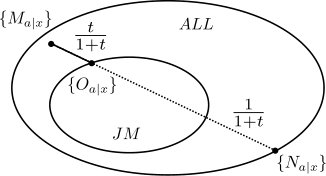 Figure 1
Peer Reviews
No public reviews on file for this paper yet. If you reviewed it on a platform where reviews are public (OpenReview, ICLR, NeurIPS, ICML), you can paste yours below so the community can read it here.
Videos
No videos yet. Explain this paper in a talk, walkthrough, or lecture? Add one.
Quantifying quantum resources with conic programming
Roope Uola
Naturwissenschaftlich-Technische Fakultät, Universität Siegen, Walter-Flex-Str. 3, D-57068 Siegen, Germany
Département de Physique Appliquée, Université de Genève, CH-1211 Genève, Switzerland
Tristan Kraft
Naturwissenschaftlich-Technische Fakultät, Universität Siegen, Walter-Flex-Str. 3, D-57068 Siegen, Germany
SUPA and Department of Physics, University of Strathclyde, G40NG Glasgow, United Kingdom
Jiangwei Shang
Beijing Key Laboratory of Nanophotonics and Ultrafine Optoelectronic Systems, School of Physics, Beijing Institute of Technology, Beijing 100081, China
Xiao-Dong Yu
Naturwissenschaftlich-Technische Fakultät, Universität Siegen, Walter-Flex-Str. 3, D-57068 Siegen, Germany
Otfried Gühne
Naturwissenschaftlich-Technische Fakultät, Universität Siegen, Walter-Flex-Str. 3, D-57068 Siegen, Germany
(16th March 2024)
Abstract
Resource theories can be used to formalize the quantification and manipulation of resources in quantum information processing such as entanglement, asymmetry and coherence of quantum states, and incompatibility of quantum measurements. Given a certain state or measurement, one can ask whether there is a task in which it performs better than any resourceless state or measurement. Using conic programming, we prove that any general robustness measure (with respect to a convex set of free states or measurements) can be seen as a quantifier of such outperformance in some discrimination task. We apply the technique to various examples, e.g. joint measurability, POVMs simulable by projective measurements, and state assemblages preparable with a given Schmidt number.
Introduction.— In recent years it has become evident that quantum mechanical devices can outperform classical ones in tasks like computation, cryptography or metrology. Still, it is not entirely clear which quantum mechanical effects are responsible for the quantum advantage, and several candidates, such as quantum entanglement, Bell nonlocality, quantum contextuality and quantum coherence have been discussed Vidal (2003); Brukner et al. (2004); Curty et al. (2004); Howard et al. (2014); Streltsov et al. (2017). Many phenomena play a role and one cannot expect a single phenomenon to be responsible for all applications. So, it is more precise to consider a given quantum resource, such as a certain quantum state or measurement, and ask: Is there a task in which this resource outperforms all classical strategies? A general treatment of this question leads to the notion of resource theories Brandão and Gour (2015); Gour (2017); Chitambar and Gour ; Regula (2018); Liu et al. (2017), where a certain set of states and operations are free and then one can ask for the usefulness of the non-free states and operations.
In this paper we present a general method to find tasks in which certain properties of quantum states and measurements provide an advantage. We start by discussing the incompatibility of measurements as a resource, and identify a corresponding task in terms of a state discrimination problem. Motivated by this, we recognize that this result is not limited to quantum incompatibility, as it can be identified as a manifestation of a much more general theory, namely, the duality theory of conic programming Gärtner and Matoušek (2012).
Conic programming is a branch of convex optimization that includes linear and semi-definite programming (SDP) as special cases. The power of introducing this method in our framework lies in the fact that, whereas examples such as incompatibility of observables could be treated with SDPs with specific linear constraints, conic programming applies to more general structures. This leads to task-oriented formulations for various measures of quantumness in cases where the linear or semidefinite constraints are harder to write down (e.g., coexistence) or even when the constraints are not known (e.g., simulability and assemblages related to certain Schmidt number states). As a consequence, finding task-oriented characterizations for non-classical sets of measurements or assemblages is possible in one go.
To demonstrate the general applicability of our approach, we consider four different scenarios. First, in Ref. Carmeli et al. (2018) it was shown that incompatibility of measurements is necessary in order to gain advantage from prior information in state assemblage discrimination tasks. We show that also the reverse implication holds, namely that for any set of incompatible measurements there exists an instance of state assemblage discrimination in which prior information provides an advantage.
Second, we discuss the outperformance of projective or von Neumann measurements (PVMs) by generalized measurements or positive operator valued measures (POVMs). More precisely we show that for any POVM that is not simulable by PVMs there exists a state discrimination task in which the outperformance becomes evident.
Third, it was shown in Ref. Piani and Watrous (2009) that all entangled states provide an advantage in channel discrimination. This result was refined in Ref. Bae et al. where it was shown that higher Schmidt number implies better performance in channel discrimination tasks, see also Ref. Piani and Watrous (2015). Our approach implies that preparation of state assemblages from states with higher Schmidt number also leads to better performance in tailored subchannel discrimination tasks. Such tasks for Schmidt number one, i.e. steering, have been experimentally implemented Sun et al. (2018). Specifically, this results in semi-device independent Schmidt number witnesses.
Fourth, we connect state robustnesses with state ensemble robustnesses. This gives observable measures for state resources that can be implemented using basic phase estimation protocols as has been done experimentally in the case of coherence Zheng et al. (2018). In fact, such experimental consequences are generic in our approach: The dual of a conic program results in observable witnesses, making an experimental verification of the resource character feasible.
Minimum-error state discrimination.— A fundamental task in quantum information theory is that of minimum-error state discrimination. Suppose we are given a quantum state from some ensemble with prior probabilities . Our task is to find a POVM , i.e. a set of positive operators summing up to identity, that gives the best probability of guessing the index correctly. Here we interpret the outcomes of the measurement as our guesses. In other words, we are interested in maximizing the quantity over all measurements .
A typical instance of this problem is called state discrimination with post-measurement information Ballester et al. (2008); Gopal and Wehner (2010). The ensemble can be partitioned into nonempty disjoint ensembles , where . The label is revealed after performing the measurement , as it is the case in the BB84 protocol in quantum key distribution. This additional information cannot decrease the probability of guessing correctly. The success probability can be increased even more by providing this information prior to the measurement, since then one can tailor a separate measurement for each label individually. Hence, in general it holds that . It was proven in Ref. Carmeli et al. (2018) that if and only if there exist compatible measurements that maximize the success probabilities in these tasks.
Incompatibility provides an advantage in state discrimination with prior information.— To illustrate our main idea we start by showing that the connection found in Ref. Carmeli et al. (2018) can be refined in the sense that for every set of incompatible measurements there exists a state discrimination task in which it performs better than any compatible set. A measurement assemblage, i.e. a collection of POVMs, is called compatible or jointly measurable (JM), if there exist probability distributions and a joint POVM such that . Otherwise, the collection is called non-jointly measurable or incompatible. This definition has a clear operational interpretation. One can collect the statistics of the POVM and obtain the statistics of the by classical post-processing.
A natural quantifier of incompatibility is the so-called incompatibility robustness () Uola et al. (2015)
[TABLE]
where the optimization is performed over all POVMs , see also Fig. 1. The incompatibility robustness can be cast as the following SDP Uola et al. (2015)
[TABLE]
The dimension of the space is , are deterministic post-processings Ali et al. (2009), and is a joint POVM of . As strong duality holds Uola et al. (2015), the solutions of the primal and dual problems coincide. Computing the dual and picking an optimal choice for the dual variables (see Appendix) one gets
[TABLE]
Denoting a state ensemble as , where is the probability of being in the sub-ensemble and denotes the probability of the label within the sub-ensemble , allows us to upper bound the success probability for the set of POVMs as
[TABLE]
The maximization is taken over jointly measurable sets of POVMs . For the inequality we have used Eq. (1). Rewriting this gives
[TABLE]
The dual variables in Eq. (3) are positive semi-definite matrices and one can obtain , where . Hence, the left hand side of Eq. (3) is, up to a factor, the success probability in a state discrimination task with prior information. Inserting the optimal into Eq. (5) and noting that for jointly measurable sets the denominator in Eq. (5) is less than or equal to one we arrive at the following observation.
Observation 1**.**
For any set of incompatible POVMs there exists a state discrimination task with prior information such that
[TABLE]
The above Observation can be seen as a semi-device independent statement about measurement incompatibility. Namely, if we can trust the preparation device, i.e. trust , then we can certify the incompatibility of measurements without assuming anything about their specific form.
In the following sections we show that statements similar to Observation 1 can be made for any convex and compact subset of POVMs using conic programming.
Conic programming.— A subset of a vector space is called a convex cone if it is convex and for any one has for all . The dual cone is defined as . Consider a cone program Gärtner and Matoušek (2012)
[TABLE]
where is a linear operator and denotes the partial order in the positive semi-definite cone of operators. Using Lagrange duality the dual cone program reads
[TABLE]
As in the case of SDPs, strong duality holds if and only if Slater’s conditions are fulfilled and the primal problem is finite Gärtner and Matoušek (2012). In our scenarios Slater’s conditions reduce to .
Generic robustness measures and state discrimination.— Label the set of measurement assemblages with a fixed number of inputs and outputs by . In our discussion a free set of POVMs is a convex and closed subset of . For a set of POVMs in we can define a generalized robustness with respect to as
[TABLE]
A crucial difference to incompatibility robustness is that is a generic convex and compact subset of , and does not need to be characterizable by an SDP. The generalized robustness can be cast as the following optimization problem
[TABLE]
Defining new variables allows writing the above problem as a cone program
[TABLE]
where is the number of inputs and is the conic hull of . The detailed derivation can be found in the Appendix. The dual program reads
[TABLE]
where the dual variable is block-diagonal.
Note that any point in with full rank either fulfils Slater’s conditions or it can be scaled up, i.e. multiplied with a sufficiently large positive number, to a point that does. In our examples all cones have a full rank point. Hence, from here on our results have the implicit assumption that the set is such that the related cone programs fulfil Slater’s conditions.
Similar reasoning as before results in our main theorem.
Theorem 1**.**
Let be a convex and compact set of measurement assemblages. For any collection of POVMs that is not in there exists an instance of state discrimination, where strictly outperforms all sets of POVMs in . The outperformance is exactly quantified by the generalized robustness with respect to , i.e.,
[TABLE]
Similarly to the case of incompatibility robustness the above result can be seen as a semi-device independent statement about the properties of the measurements.
As our result applies to any convex and compact set of free POVMs, the question remains to characterize some interesting sets. To give an example, one could go along the lines of joint measurability and take the slightly more general set of coexistent POVMs Reeb et al. (2013). Note that coexistence is equivalent to the joint measurability of all binarizations and, hence, it can be formulated as an SDP. However, the cone formulation allows one to prove the connection to state discrimination without specifying this SDP. To fulfil Slater’s conditions one can take uniform POVMs and scale them up to operators that are larger than identity.
To give an example of a situation where an SDP formulation is not known we consider simulability of POVMs. Recall that state discrmination provides a celebrated example of a task in which POVMs can perform better than PVMs Ivanovic (1987); Peres (1988). This statement can be hardened by considering the subset of POVMs that is simulable with all PVMs as the free set in Theorem 1. This set is defined as those POVMs that can be written in the form , where and are probability distributions, and exhaust the set of projective measurements. In Ref. Oszmaniec et al. (2017) this set was shown to coincide with the convex hull of PVMs and in Ref. Oszmaniec et al. (2018) it was shown that one can reach all measurements by allowing postselection. Note that for a fixed set of simulators, e.g. all PVMs or all binary POVMs, the set is convex. Concerning compactness, one can argue that if a simulable set were not compact, then one could close it as this set can approximate arbitrarily well its own closure. It is worth noting that simulability can also be defined for measurement assemblages Guerini et al. (2017) and that our formalism applies to this scenario given that the free set is convex and compact, which can be achieved by taking the convex hull and the closure if necessary.
Robustness of state assemblages and subchannel discrimination.— In Ref. Piani and Watrous (2015) it was shown that for any steerable state assemblage there exists a one-way LOCC assisted subchannel discrimination task in which the assemblage outperforms all unsteerable ones. Here we show that such behaviour is not specific to the case of steering, but it is rather a generic feature of convex and closed sets of assemblages.
In a subchannel discrimination task one aims at discriminating between different elements of an instrument , i.e. a collection of completely positive maps that sums up to a trace preserving map, with some POVM . For a given quantum state the success probability reads
[TABLE]
For a state assemblage we define similarly the success probability as . This can be seen as the probability of correctly guessing the subchannel with the assistance of one-way LOCC. Namely, Bob performs a measurement , communicates the outcome to Alice, she then performs the corresponding measurement and reports the outcome as the guess. Note that we assume Alice’s measurements and the shared state to be such that they prepare the assemblage .
One can define generalized robustnesses for state assemblages and formulate them through conic programming as in the case of measurement assamblages. The only difference is the normalization and, hence, the interpretation of the dual program. For measurement assemblages the dual can be identified as a state disrcimination problem and for state assemblages the dual corresponds to a subchannel discrimination task (see Appendix). We arrive at the following Theorem.
Theorem 2**.**
Let be a convex and compact set of state assemblages. For any state assemblage that is not in there exists an instance of (one-way LOCC assisted) subchannel discrimination, where strictly outperforms all assemblages in . The outperformance is exactly quantified by the generalized robustness with respect to , i.e.,
[TABLE]
To give a physically motivated example of the free set , we consider assemblages that can be prepared using states with Schmidt number or smaller. As in the case of measurement simulability, an SDP formulation for such scenario is not known. For the proof of convexity and compactness of these free sets, we refer to the Appendix. Slater’s conditions are fulfilled as the cones include a full rank point (e.g. the uniform assemblage). It is worth mentioning that the inclusion of the free set for the case of Schmidt number is proper to that of Schmidt number Hulpke et al. (2004). This example is in the spirit of Ref. Bae et al. , where it was shown that higher Schmidt number provides an advantage in channel discrimination tasks. Moreover, the example refines the characterization of steerable assemblages given in Ref. Piani and Watrous (2015), hence, leading to a semi-device independent approach to Schmidt number verification.
State ensembles.— The connection between robustness and discrimination in the case of state ensembles follows from the discussion on state assemblages by setting . This corresponds to the case in Eq. (14). To give a physically motivated example, we consider ensembles that are created through a given instrument .
To make a connection to the robustness of a given state denoted as (may it be, e.g., entanglement, coherence, asymmetry or coherence number robustness), we note that when operating only within the set of ensembles [here denotes the set of positive unit trace operators], we can define the robustness of an ensemble as , where is the set of ensembles preparable with the given instrument and resourceless states, and is any ensemble preparable with the given instrument. The techniques presented in the previous section give a subchannel discrimination problem as the dual of the robustness, with the dual variables being POVMs.
To fulfil Slater’s conditions we need a full rank point in . Typical free sets include the maximally mixed state or the maximally mixed ensemble and, hence, the set has a full rank point.
The ensemble robustness is always less than or equal to the state robustness as one can input an optimal solution of the state robustness to the instrument. We have , where is a POVM. Whenever the instrument is a bijection from the set of states to the set of ensembles, e.g. in phase discrimination, the ensemble robustness coincides with the corresponding state robustness. Therefore, maximizing over all instruments and POVMs saturates the bound (see also Theorem 2).
We have recovered the result of Ref. Takagi et al. stating that robustnesses of state resources are connected to subchannel discrimination. In contrast to the former result in which a witness was split into an instrument and a POVM, our construction can use, for example, any phase estimation protocol as the instrument and the witness is simply a POVM. It is worth mentioning that phase discrimination has been used to measure the robustness of coherence Zheng et al. (2018) in a recent experiment.
Conclusions.— In this work we have shown how various optimal and non-optimal witnesses for the classical to quantum border can be written in an observable form using conic programming. These witnesses arise from generalized robustnesses and as such the results open up the possibility to define observable quantifiers for the quantum properties that are within the reach of current experiments Zheng et al. (2018); Sun et al. (2018).
In comparison to earlier efforts in this direction, our techniques apply to any properties of measurement and state assemblages that form a convex and compact subset, whereas former techniques have dealt with single properties such as quantum steering Piani and Watrous (2015) or with sets of properties related to single states Takagi et al. . This allowed us not only to answer open questions Bae et al. and to push forward earlier works Carmeli et al. (2018), but also to develop novel methods in the field of semi-device independent quantum information processing and to attack the question whether POVMs provide an advantage over PVMs in a quantitative way.
For future research it will be interesting to identify other properties than the ones discussed here as the free set. Also, the question of generalizing the results to the level of quantum channels and instrument assemblages might provide new insights to the properties of these notions, e.g. in the resource theory of quantum memories Rosset et al. (2018). Finally, the operations that do not generate resources from the free set cannot increase the robustness measure. Thus, it would be interesting to characterize the physical interpretation of these operations and the properties of the robustness measure under time evolutions or classical pre- and post-processing.
Acknowledgements.
We would like to thank Marco Piani and Leonardo Guerini for discussions. This work was supported by the DFG and the ERC (Consolidator Grant 683107/TempoQ). J.S. acknowledges support by the Beijing Institute of Technology Research Fund Program for Young Scholars and the National Natural Science Foundation of China through Grant No. 11805010. X.D.Y. acknowledges funding from a CSC-DAAD scholarship. R.U. is thankful for the support from the Finnish Cultural Foundation. Note added.— During the preparation of the manuscript we became aware of some related works. In Ref. Carmeli et al. (2019) Carmeli et al. show, using a different method, that incompatibility can always be detected by a state discrimination task with partial intermediate information. In particular they prove that any linear incompatibility witness can be implemented by some state discrimination task. In Ref. Skrzypczyk et al. (2019) Skrzypczyk et al. also prove the quantitative connection between the incompatibility robustness and the outperformance of compatible measurements by incompatible ones in tailored state discrimination tasks. Moreover, they show the completeness of state discrimination games as resource monotones, thus completely characterizing the partial order in a resource theoretical sense. Furthermore we became aware of two other related works, one by Oszmaniec and Biswas Oszmaniec and Biswas (2019), and another one by Takagi and Regula Takagi and Regula (2019).
Appendix A Appendix A: Incompatibility robustness SDP and its dual
The incompatibility robustness , can be cast as the following SDP
[TABLE]
where is the dimension of the space of the such that . The number of labels we denote by , and similarly denotes the number of labels . The number of constraints in Eq. (A) is and in Eq. (A) it is . This SDP has both, equalities and inequalities as constraints and it is of the general form
[TABLE]
We choose , which is a block diagnoal matrix with the submatrices . The objective function then reads . For the equality constraint we choose and define a mapping by
[TABLE]
For the inequality constraint we choose and we define by
[TABLE]
The dual problem then reads Watrous (2018)
[TABLE]
The dual is straight forward Piani and Watrous (2015), that is
[TABLE]
To find we write
[TABLE]
From this we directly obtain the dual of the robustness SDP as
[TABLE]
Appendix B Appendix B: Upper bound on the success probability for sets on compatible POVMs
Next, we show that whenever a set of jointly measurable POVMs is used to discriminate the optimal state assemblage , we find that
[TABLE]
From the first constraint of the dual program in Eq. (25) we obtain (from each block labeled by ) that . This leads to
[TABLE]
Hence, for any set of jointly measurable POVMs it holds that
[TABLE]
Appendix C Appendix C: Construction of the state discrimination task with prior information from the optimal dual variable
From the optimal solution of the dual we also construct a state discrimination task with prior information in the following way. First observe that
[TABLE]
Inserting this into the objective function of the dual in Eq. (25) yields
[TABLE]
Then, using Eq. (29) the ratio of success probabilities in Eq. (5) is lower bounded by
[TABLE]
The inequality follows from Eq. (29). From this, Observation 1 follows.
Appendix D Appendix D: Robustness of sets of measurements and conic programming
Denote any set of free POVMs by . Let be the number of POVMs. The generalized robustness is defined by
[TABLE]
This can be cast as the following conic program
[TABLE]
Solving for one obtains
[TABLE]
By defining this can be written as
[TABLE]
where is a cone with basis . This can be brought into the form of Eq. (7) by choosing , , , . Then, the dual cone program reads
[TABLE]
The first constraint translates to . Hence, for all or equivalently for all . The final form of the dual then reads
[TABLE]
Note that the last constraint is a typical property of a witness. Similar results hold for state assemblages by simply dropping the factor , since the operators have a unit trace.
Appendix E Appendix E: Robustness of state assemblages and conic programming
For a given free set of assemblages , an assemblage , and an subchannel discrimination task we have
[TABLE]
To formulate the statement of Theorem 1 for state assemblages we note that the primal problem for the robustness of an assemblage with respect to a free set of assemblages is given as
[TABLE]
where . The dual program can be written as
[TABLE]
We have again denoted by the direct sum of the operators . Note that Slater’s conditions can be verified similarly to the case of measurements for the free sets we are interested in.
Using the techniques introduced in Ref. Piani and Watrous (2015) it is clear that any witness of the above form can be cast as a subchannel discrimination task with one-way LOCC measurements. Namely, define subchannels and a POVM as and , where and is an orthonormal basis. If these subchannels do not form an instrument, i.e. , the set can be completed into one by defining an extra subchannel as , where is some quantum state. It is worth noting that we have one more subchannel in the discrimination problem than we have outputs.
Appendix F Appendix F: Convexity and compactness of the set of assemblages that can be prepared from states with a fixed Schmidt number
Convex combinations of such assemblages can be prepared by increasing the size of Alice’s system. To be more precise, given that Alice’s dimension is and that one assemblage is prepared with measurements on the state and another assemblage with measurements on the state , we can consider the convex combination and the measurements , where is the basis of an auxiliary qubit of Alice.
To prove the compactness of the desired set of assemblages, we first notice that the extremal points are obtained by pure states and that every extremal point can be reached with a finite dimensional Alice. As Bob is assumed to be finite dimensional, any assemblage that is preparable by a Schmidt number (or smaller) state can be expressed as a finite convex combination of extremal assemblages. Hence, any sequence of assemblages preparable with a Schmidt number (or smaller) state can be written as
[TABLE]
where is some fixed finite number depending on the number of dimension (Carathéodory’s theorem), is a probability distribution for every , and are assemblages preparable with a pure Schmidt rank or less state. The set of assemblages preparable with pure states is clearly compact (as it is the image of a cartesian product of compact sets in a continuous mapping) and, therefore, for every we can pick a converging subsequence of . Picking the subsequences for different indices sequentially (i.e. subsequences of subsequences) results in a subsequence in which convergence is guaranteed for every . Repeating the procedure once more to pick a converging sequence of probability distributions gives a subsequence of that converges. Hence, the set of Schmidt number (or smaller) preparable assemblages is compact.
The reference list from the paper itself. Each links out to its DOI / PubMed record.
- 1Vidal (2003) G. Vidal, Phys. Rev. Lett. 91 , 147902 (2003) . · doi ↗
- 2Brukner et al. (2004) C. Brukner, M. Żukowski, J.-W. Pan, and A. Zeilinger, Phys. Rev. Lett. 92 , 127901 (2004) . · doi ↗
- 3Curty et al. (2004) M. Curty, M. Lewenstein, and N. Lütkenhaus, Phys. Rev. Lett. 92 , 217903 (2004) . · doi ↗
- 4Howard et al. (2014) M. Howard, J. Wallman, V. Veitch, and J. Emerson, Nature 510 , 351 (2014) . · doi ↗
- 5Streltsov et al. (2017) A. Streltsov, G. Adesso, and M. B. Plenio, Rev. Mod. Phys. 89 , 041003 (2017) . · doi ↗
- 6Brandão and Gour (2015) F. G. S. L. Brandão and G. Gour, Phys. Rev. Lett. 115 , 070503 (2015) . · doi ↗
- 7Gour (2017) G. Gour, Phys. Rev. A 95 , 062314 (2017) . · doi ↗
- 8(8) E. Chitambar and G. Gour, ar Xiv:1806.06107 .