Collisions of self-bound quantum droplets
Giovanni Ferioli, Giulia Semeghini, Leonardo Masi, Giovanni Giusti,, Giovanni Modugno, Massimo Inguscio, Albert Gallem\`i, Alessio Recati and, Marco Fattori

TL;DR
This study investigates binary collisions of quantum droplets, revealing how their outcomes depend on velocity and size, and demonstrating their liquid-like properties in the large atom number limit.
Contribution
It provides the first experimental evidence of the liquid-like behavior of quantum droplets and elucidates the dependence of critical velocity on droplet size and regime crossover.
Findings
Critical velocity varies with droplet size and regime.
Collision outcomes are merging or separation.
Quantum droplets exhibit liquid-like behavior at large atom numbers.
Abstract
We report on the study of binary collisions between quantum droplets formed by an attractive mixture of ultracold atoms. We distinguish two main outcomes of the collision, i.e. merging and separation, depending on the velocity of the colliding pair. The critical velocity that discriminates between the two cases displays a different dependence on the atom number for small and large droplets. By comparing our experimental results with numerical simulations, we show that the non-monotonic behavior of is due to the crossover from a compressible to an incompressible regime, where the collisional dynamics is governed by different energy scales, i.e. the droplet binding energy and the surface tension. These results also provide the first evidence of the liquid-like nature of quantum droplets in the large limit, where their behavior closely resembles that of classical…
Click any figure to enlarge with its caption.
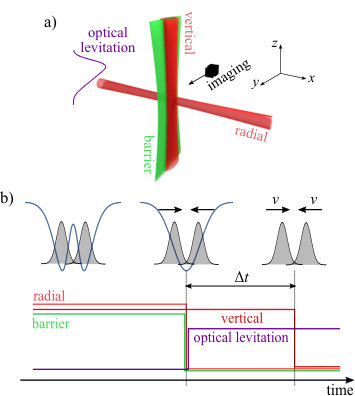 Figure 1
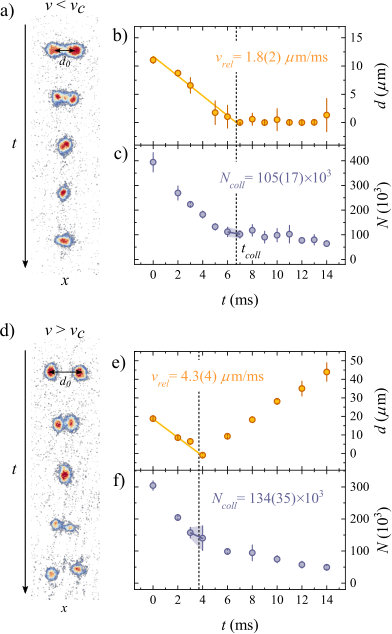 Figure 2
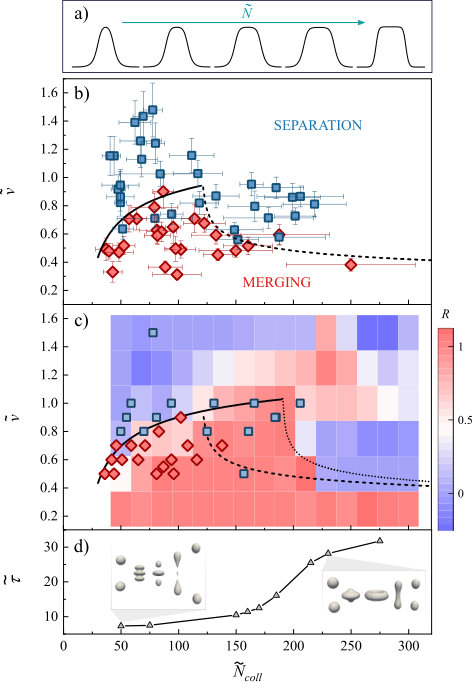 Figure 3
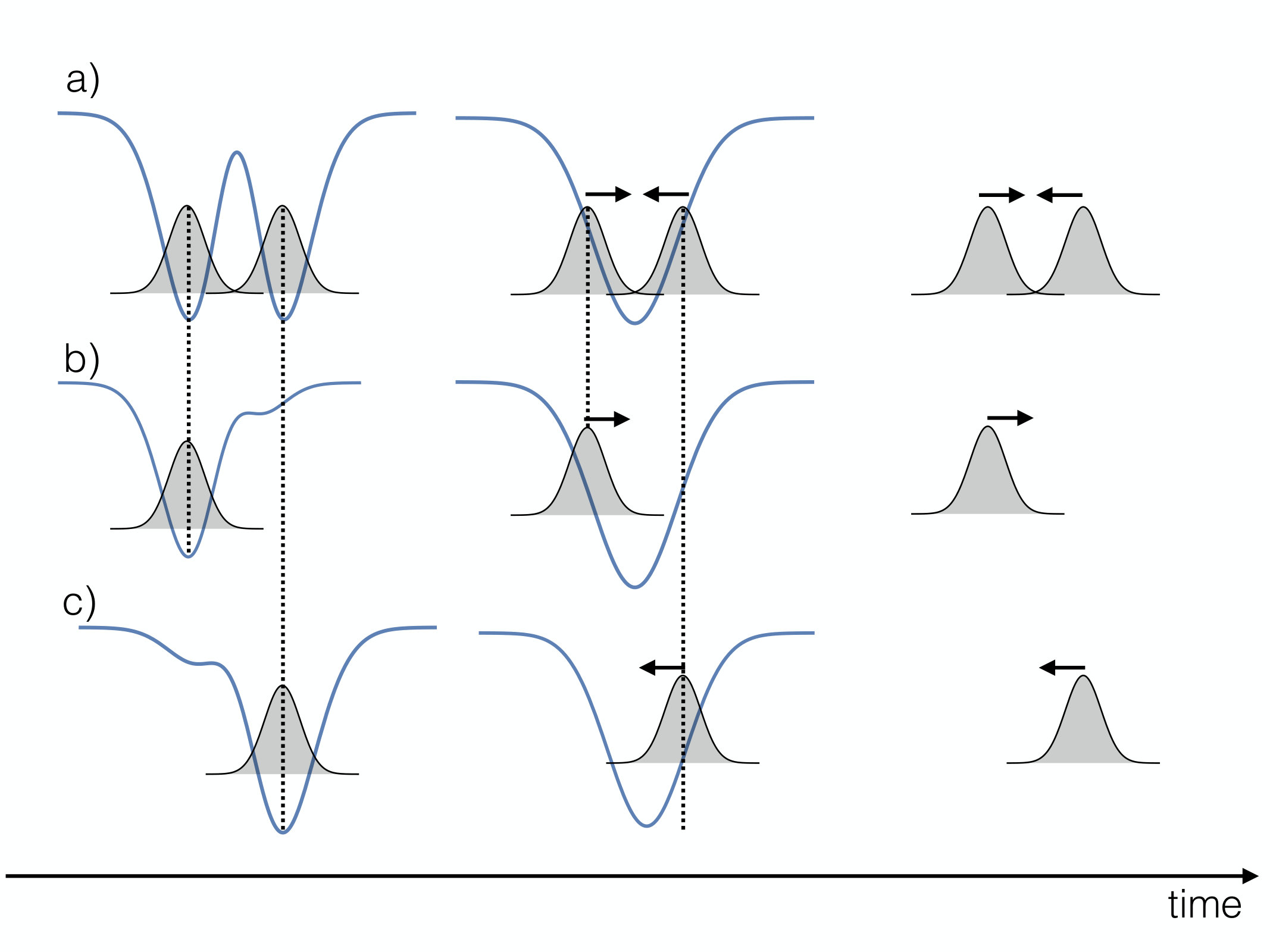 Figure 4
Peer Reviews
No public reviews on file for this paper yet. If you reviewed it on a platform where reviews are public (OpenReview, ICLR, NeurIPS, ICML), you can paste yours below so the community can read it here.
Videos
No videos yet. Explain this paper in a talk, walkthrough, or lecture? Add one.
Collisions of self-bound quantum droplets
Giovanni Ferioli
Giulia Semeghini
LENS and Dipartimento di Fisica e Astronomia, Universitá di Firenze, 50019 Sesto Fiorentino, Italy
CNR Istituto Nazionale Ottica, 50019 Sesto Fiorentino, Italy
Leonardo Masi
LENS and Dipartimento di Fisica e Astronomia, Universitá di Firenze, 50019 Sesto Fiorentino, Italy
CNR Istituto Nazionale Ottica, 50019 Sesto Fiorentino, Italy
Giovanni Giusti
LENS and Dipartimento di Fisica e Astronomia, Universitá di Firenze, 50019 Sesto Fiorentino, Italy
Giovanni Modugno
Massimo Inguscio
LENS and Dipartimento di Fisica e Astronomia, Universitá di Firenze, 50019 Sesto Fiorentino, Italy
CNR Istituto Nazionale Ottica, 50019 Sesto Fiorentino, Italy
Albert Gallemí
Alessio Recati
INO-CNR BEC Center and Dipartimento di Fisica, Università di Trento, 38123 Povo, Italy
Trento Institute for Fundamental Physics and Applications, INFN, 38123, Trento, Italy
Marco Fattori
LENS and Dipartimento di Fisica e Astronomia, Universitá di Firenze, 50019 Sesto Fiorentino, Italy
CNR Istituto Nazionale Ottica, 50019 Sesto Fiorentino, Italy
Abstract
We report on the study of binary collisions between quantum droplets formed by an attractive mixture of ultracold atoms. We distinguish two main outcomes of the collision, i.e. merging and separation, depending on the velocity of the colliding pair. The critical velocity that discriminates between the two cases displays a different dependence on the atom number for small and large droplets. By comparing our experimental results with numerical simulations, we show that the non-monotonic behavior of is due to the crossover from a compressible to an incompressible regime, where the collisional dynamics is governed by different energy scales, i.e. the droplet binding energy and the surface tension. These results also provide the first evidence of the liquid-like nature of quantum droplets in the large limit, where their behavior closely resembles that of classical liquid droplets.
Collisions between self-bound objects have been studied in the most diverse physical systems. The best known example is that of classical liquids. When they approach each other with a certain relative velocity, liquid drops can either merge in a single droplet (coalescence) or separate into two or more drops after collision, depending on whether or not the surface tension is sufficient to counteract the kinetic energy of the colliding pair ashgriz_poo_1990 ; qian_law_1997 ; pan_2005 . Analogous studies have been carried out in the context of atomic nuclei to understand the dynamics of nuclear reactions and fission andreyev_2018 ; bulgac_2016 ; magierski_2017 ; bulgac_2017 . In the latter, for example, the transition from a single compound nucleus to the formation of two separate nuclei is governed by the interplay of collective macroscopic effects, described by the so-called liquid-drop model, and single-particle microscopic effects, related to shell corrections and pairing. Quantum effects in the collision of liquid droplets have been observed in the coalescence of helium clusters, where the merging dynamics occurs on a faster timescale with respect to classical fluids, due to the vanishing viscosity in their superfluid bulk vicente_2000 ; maris_2003 ; ishiguro_2004 . In all of these cases the study of binary collisions has proved to be a powerful tool to probe the dynamical properties of self-bound systems.
In this Letter, we consider a new entry in this class of self-bound objects, i.e. quantum droplets formed by a mixture of ultracold atoms. They consist in dilute samples of bosonic atoms with attractive interactions, stabilized against collapse by the repulsive effect of quantum fluctuations lhy_1957 ; petrov_2015 ; arlt_2018 . This novel quantum phase was first predicted few years ago petrov_2015 and it has drawn increasing attention in the community since then. Besides being a macroscopic manifestation of quantum fluctuations, quantum droplets are predicted to display a number of interesting features. Despite being extremely dilute, for large number of atoms they enter a liquid-like incompressible phase, highlighted by a uniform bulk density. Another exotic property is related to their excitation spectrum in the small atom number regime, where the discrete collective excitations are much higher in energy than the particle emission threshold petrov_2015 , which gives rise to a self-evaporation mechanism that continuously cools the droplet, in close analogy with the decay of giant resonances in nuclei (see, e.g., chomaz_1987 and references therein).
The first experimental observations of quantum droplets in atomic mixtures have been reported recently cabrera_2018 ; cheiney_2018 ; semeghini_2018 . Besides proving the existence of a self-bound phase in a mixture of 39K atoms, they also presented a first characterization of its phase diagram and equilibrium properties. In order to further look into its peculiar nature, in this work we study collisions between two quantum droplets. Analogous experimental studies in the context of ultracold atoms have been performed on bright solitons khaykovich_2002 ; strecker_2002 and dipolar quantum droplets schmitt_2016 ; igor_2016 ; chomaz_2016 . While in the latter case the result of collisions is mainly determined by dipolar interactions and the droplets repel each other igor_coll_2016 , collisions of bright solitons in one-dimensional waveguides directly probe their intrinsic properties, being influenced by their relative phase or by deviations from one dimensionality nguyen_2014 ; khaykovic_2006 . Theoretical studies about collisions of self-bound atomic clouds have been carried out in astrakharchik_2018 and malomed_2D for one and two-dimensional mixture droplets and in adhikari_2017 for analogous self-bound quantum balls stabilized by repulsive three-body interactions. In this Letter we show how the study of collisions between Bose-Bose mixture droplets is a powerful tool to verify the existence of a liquid regime at large atom numbers and to gain information about the energy scales of the system.
The experimental setup is analogous to the one described in Ref. semeghini_2018 , with a modified trap geometry adapted to the creation of two colliding droplets. We first create two separate Bose-Einstein condensates (BECs) of 39K atoms in the hyperfine state (state 2) in a double-well potential, created by the superposition of a crossed dipole trap with a repulsive thin barrier that splits the BEC along the direction (Fig.1a). By applying a radio-frequency (RF) pulse of 10 s, we transfer 50 of the atoms in the state (state 1), so as to create the desired attractive mixture. As already shown in Ref. cabrera_2018 and Ref. semeghini_2018 , in a specific range of magnetic fields , the Feshbach resonances of these two hyperfine states are such that the intraspecies scattering lengths and are positive, while the interspecies is negative. When the effective scattering length becomes negative, for G, the attractive mean-field energy would lead to a collapse of the BEC, while the repulsive energy provided by quantum fluctuations, the so-called Lee-Huang-Yang energy lhy_1957 , stabilizes the mixture and leads to the formation of self-bound atomic clouds. At the end of the RF pulse we thus have two quantum droplets separated by the repulsive barrier. In order to provide them a controlled and tunable velocity, we apply the following strategy (sequence sketched in Fig.1b). We first switch off the radial dipole trap and the repulsive barrier, leaving the atoms in the vertical dipole trap plus the optical levitating potential introduced in semeghini_2018 . Due to the harmonic confinement provided by the vertical beam along the direction ( Hz), the droplets move towards the center of the trap, acquiring an increasing velocity. After a time interval we switch off the vertical beam and the two clouds keep moving towards each other along the direction, at a constant velocity . The value of is tuned by changing : for , increasing corresponds to a larger . Via absorption imaging along the direction, we record the density profiles after a variable waiting time and observe the collisional dynamics.
We distinguish two different outcomes of the collision, as reported in Fig.2a,d. When the droplets collide with velocities smaller than a critical value , they merge in a single droplet, while for they separate after collision and keep moving in opposite directions. To measure the velocity of the collision, we fit the density profiles as a function of time , using either a two-dimensional (2D) double-gaussian or a single-gaussian function, depending on whether there are two or one visible density peaks. In the former case we measure the distance between the droplets as , where and are the centers of the left and right gaussians along the direction. In the single gaussian case, we define . In Fig.2b,e we plot for the two experimental sequences reported in Fig.2a,d: in the merging case stabilizes to zero after collision, while it linearly increases with time when the droplets separate. Performing a linear fit of in the early stages of the collision, when the droplets are approaching each other, we can measure the relative velocity and thus the velocity of each droplet (Fig.2b,e). Another relevant parameter to characterize the observed collisional dynamics is the total atom number at collision . We estimate the collision time as , where , and then we determine by performing a linear interpolation between the two closest data points, as in Fig.2c,f.
We take several datasets as a function of and . Note that, due to strong three-body losses in the system (as visible in Fig.2c,f and already described in semeghini_2018 ), we can tune by changing the initial distance between the droplets and thus the collision time . In the sequences reported in Fig.2, for example, in order to have a similar in spite of the different , was increased proportionally to . In order to explore a broader range of atom numbers, we can also tune an additional parameter, i.e. the magnetic field . As shown in petrov_2015 , the proper variable for the description of quantum droplets is indeed the rescaled atom number
[TABLE]
where , and is the equilibrium density for the atoms in state 1, whose definition is reported in SI . defines the shape of the droplet wavefunction, thus distinguishing between a compressible regime, where there is no distinction between the bulk and the surface, and an incompressible regime, where the wavefunction displays a clear flat-top at the center, indicating the existence of a bulk with a fixed saturation density (Fig.3a). depends on via the scattering lengths , so that we can control by tuning in a range between 56.23 G and 56.44 G. Using the same rescaled units introduced in Eq.(1), the velocity of each droplet becomes . In Fig.3b we report the results of the collision measurements as a function of and , distinguishing between the two different outcomes: merging (red diamonds) and separation (blue squares). We observe a non-monotonic behavior of the critical velocity , setting the threshold between the two regimes: for small droplets, increases with , while for larger droplets the trend is inverted.
In order to get a deeper insight in the physics of the collision and understand the observed behavior, we simulate numerically the dynamics of the collision by means of a modified Gross-Pitaevskii equation (GPE), equivalent to a time-dependent density functional theory within local density approximation ancilotto_2018 . Similar approaches have been recently used to study both dipolar and mixture droplets chomaz_2016 ; baillie_2016 ; semeghini_2018 . Their validity for the ground state was also tested against Monte-Carlo simulations macia_2016 ; cikojevic_2018 . In our case, we assume the density ratio to be frozen, which is justified by the experimental results reported in semeghini_2018 , where a fast stabilization of to its equilibrium value was observed. We can then write an equation for a single macroscopic wavefunction petrov_2015 . Using the rescaled units and , the modified GPE reads simply
[TABLE]
The initial state is represented by two quantum droplets with atoms each, separated by a certain distance to ensure that no overlap exists between them. We provide them a certain velocity , so that they move towards each other, and then we observe the result of the collision. In order to distinguish between merging and separation, we measure, at large times after the collision, the ratio , where is the density at the center of mass and is the peak density of the outgoing clouds. The results are reported in Fig.3c. We observe a qualitative agreement with the experimental outcomes of Fig.3b, but a quantitative difference in the position of the maximum of , which is here shifted to . To understand the origin of this discrepancy, we perform a new set of simulations including the effect of three-body losses (3BL). They are inserted in Eq. (2) as an imaginary term , where the parameter is determined by fitting the experimental atom number decay. In Fig.3c we compare the new results (red diamonds and blue squares) with those obtained for the ideal case of no losses. While at small the position of is basically unaffected by losses, at larger , 3BL shift the maximum of to , in good agreement with the experimental results.
We can qualitatively understand the two opposite trends of at small and large and the effect of losses, by drawing a simple argument. The possibility of forming a single droplet during the collision is related to the capability of the resulting merged droplet to absorb the excess kinetic energy . In the liquid regime at large , we can decompose the energy of the droplet using the so-called liquid-drop model boronat_2009 : , where the three terms represent the bulk, surface and curvature energies respectively. The first and the last term can be neglected, since the bulk energy scales linearly with , and is thus conserved during the collision, and the curvature energy is negligible for large . The only relevant energy scale is thus provided by the surface, which can also host discrete excitations to absorb the collision kinetic energy. Analogously to the Weber number criterion for classical liquid droplets qian_law_1997 , we can thus conclude that the condition for merging should be given by , which means . In the opposite case of small , there is no distinction between the bulk and the surface and one would expect the whole binding energy of the droplet to be the relevant energy scale. By imposing one gets a critical velocity . In Fig.3c we compare these expected trends with the numerical simulations performed in the absence of 3BL and we find that these simple energetic considerations reproduce pretty well the observed behavior. The crossover from compressible to incompressible droplets, governed by the two different energy scales, is highlighted by the timescales of the collision. In the simulations without 3BL, we consider collisions with slightly above and we estimate the time interval between and the time when the distance between the two density peaks along becomes larger than the radial size of the droplets, for different (Fig.3d). We observe a clear slowing down of the collisional dynamics as the droplet enters the liquid regime, where the surface tension dominates. In that limit, our simulations show a behavior closely analogous to the reflexive separation known in the context of classical drops (see e.g. (ashgriz_poo_1990, )): after colliding, the two droplets form a single excited cloud for a certain time interval, but they eventually separate when the surface tension is not sufficient to compensate for the kinetic energy of the internal flow (right inset of Fig.3d). In the compressible case, instead, the separation occurs on a much shorter timescale, since the two droplets basically pass through each other (left inset of Fig.3d). The reason for the different importance of 3BL in the two regimes lies exactly in the different timescale of the collision. The longer in the incompressible regime implies that, in the presence of 3BL, the atom number decreases significantly during the relevant time interval, so that the final surface tension is reduced. This corresponds to a smaller and thus to a shift in the position of the backbending, as highlighted by the dashed lines in Fig.3b,c, used in this case as a simple guide to the eye, since a proper scaling in the presence of 3BL is harder to deduce.
As a final remark, it is worth mentioning that the experimental procedure used to prepare the two initial droplets is such that there is no definite relative phase between them. In order to reproduce the incoherent preparation of the experiment, in the numerical simulations we set the initial phase difference to zero, which corresponds to minimizing the effects of phase gradients during the collision, thus recovering the proper hydrodynamic equations. Studying the effect of a finite relative phase is an interesting perspective of this work and it is the subject of ongoing investigations.
In conclusion we have shown that binary collisions are a good probe of the dynamical properties of 3D mixture droplets. By comparing our experimental results with the outcomes of numerical simulations, we found evidence of a crossover from compressible to incompressible quantum droplets driven by . This is highlighted by the different trend of , which is well justified by simple energetic considerations. In the future it would be interesting to study the coalescence dynamics of two droplets colliding at very small velocities, which, in analogy to previous studies on helium clusters vicente_2000 ; maris_2003 ; ishiguro_2004 , could be a probe of their superfluid properties. One could also investigate the formation of vortices during the collision and characterize the collective excitations of the merged droplets.
Acknowledgements.
We acknowledge insightful discussions with F. Ancilotto, F. Dalfovo, S. Stringari and our colleagues of the Quantum Gases group at LENS. A.G. and A.R. acknowledge funding by the Provincia Autonoma di Trento and by the FIS project of the Istituto Nazionale di Fisica Nucleare. This work was supported by EC-H2020 Grant QUIC No. 641122 and by the project TAIOL of QuantERA ERA-NET Cofund in Quantum Technologies (Grant Agreement N. 731473) implemented within the European Union’s Horizon 2020 Programme.
I SUPPLEMENTARY INFORMATION
I.1 Rescaled units and droplet equilibrium densities
The rescaled units , and used in the paper were first introduced in petrov_2015 . They depend on the interatomic scattering legths , and and on the equilibrium density of the atoms in state 1 in the droplet . This was also derived in petrov_2015 as:
[TABLE]
The density corresponding to the other hyperfine state is then determined at equilibrium by the minimization of the hard modes, which locks the ratio to .
I.2 Double-well potential
The double-well potential used to create two separate droplets is generated by the superposition of an infrared elliptical laser beam at 1064 nm and a thin green barrier at 532 nm. The infrared beam has an aspect ratio , while the green barrier is tightly focused along , with m, and large along ( mm) to ensure the homogeneity of the repulsive potential along that direction. The intensity of the infrared beam is always set to the same value, so that Hz. The height of the green barrier is instead changed in the different measurements, in order to tune the initial distance between the droplets . The corresponding trapping frequencies in the single wells vary between 100 and 150 Hz.
I.3 Measurement of the droplet velocity
The relative velocity during the collision is measured, as explained in the main paper, by performing a linear fit of when the droplets are approaching each other. In order to have an independent measurement of , where the trajectory followed by each droplet is not influenced by the presence of the other, we use the following strategy (sketched in Fig.4). The basic idea is to repeat the sequence of Fig.1b, but having a single droplet at a time. In order to load the BEC in a single well, we increase the barrier height and we move it away from the center of the infrared beam, so that the resulting double-well potential is imbalanced and all the atoms occupy a single well, placed at the same position of the corresponding left or right well of the collision measurement (left column of Fig.4). We then follow the same sequence as in Fig.1b and measure and independently. We evaluate the distance and we deduce from a linear fit to the data. We compare the results of this independent measurement with those obtained from the collision measurements and we observe that there is no systematic deviation between the two. We then conclude that measuring the droplets velocity from the initial dynamics of the collision, as we describe in the main paper, is a reliable strategy, since, before colliding, the trajectory of each droplet is not significantly affected by the presence of the other.
I.4 Error bars in Fig.3
The vertical error bars in Fig.3b of the paper are estimated considering two main sources of errors in the estimation of , i.e. the uncertainty coming from the linear fit of in Fig.2b,e and the uncertainty on the magnetic field , which enters the definition of . The horizontal error bars take into account the uncertainty coming from the linear interpolation used to determine (Fig.2c,f), the uncertainty on the magnetic field which enters the definition of (Eq.1) and the uncertainty on the calibration of the atom number . All the error bars correspond to one standard deviation.
The reference list from the paper itself. Each links out to its DOI / PubMed record.
- 1(1) N. Ashgriz and J. Y. Poo, Journal of Fluid Mechanics 221 , 183-204 (1990).
- 2(2) J. Qian and C. K. Law, Journal of Fluid Mechanics 331 , 59-80 (1997).
- 3(3) Y. Pan and K. Suga, Physics of Fluids 17 , 082105 (2005).
- 4(4) A. N. Andreyev, K. Nishio, and K.-H. Schmidt, Reports on Progress in Physics 81 , 016301 (2018).
- 5(5) A. Bulgac, P. Magierski, K. J. Roche, and I. Stetcu, Phys. Rev. Lett. 116 , 122504 (2016).
- 6(6) P. Magierski, K. Sekizawa, and Gabriel Wlazłowski, Phys. Rev. Lett. 119 , 042501 (2017).
- 7(7) A. Bulgac, and S. Jin, Phys. Rev. Lett. 119 , 052501 (2017)
- 8(8) C. L. Vicente, C. Kim, H. J. Maris, and G. M. Seidel, Journal of Low Temperature Physics 121 , 627 (2000).