Top-quark effects in diphoton production through gluon fusion at NLO in QCD
Fabio Maltoni, Manoj K. Mandal, Xiaoran Zhao

TL;DR
This paper presents the first complete NLO QCD calculation of top-quark effects in gluon-fusion diphoton production, revealing significant corrections near the top-antitop threshold and at high invariant masses.
Contribution
It provides the first full NLO computation including top-quark contributions with numerical evaluation of complex two-loop diagrams.
Findings
Large NLO corrections near the $t\bar{t}$ threshold.
Pronounced change in the diphoton mass distribution slope at threshold.
Enhanced high-mass diphoton production compared to massless approximation.
Abstract
At hadron colliders, the leading production mechanism for a pair of photons is from quark-anti-quark annihilation at the tree level. However, due to large gluon-gluon luminosity, the loop-induced process provides a substantial contribution. In particular, the amplitudes mediated by the top quark become important at the threshold and above. In this letter we present the first complete computation of the next-to-leading order (NLO) corrections (up to ) to this process, including contributions from the top quark. These entail two-loop diagrams with massive propagators whose analytic expressions are unknown and have been evaluated numerically. We find that the NLO corrections to the top-quark induced terms are very large at low diphoton invariant mass and close to the threshold. The full result including five…
Click any figure to enlarge with its caption.
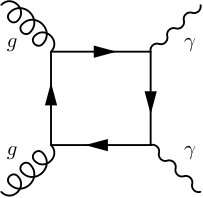 Figure 1
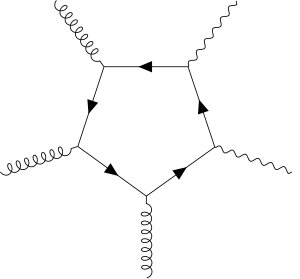 Figure 2
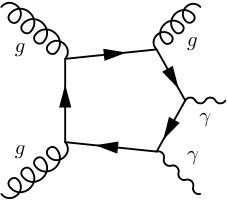 Figure 3
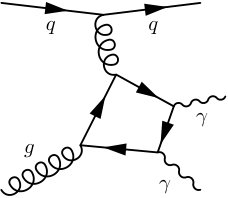 Figure 4
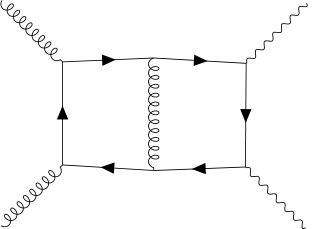 Figure 5
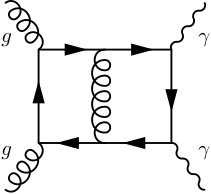 Figure 6
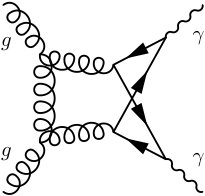 Figure 7
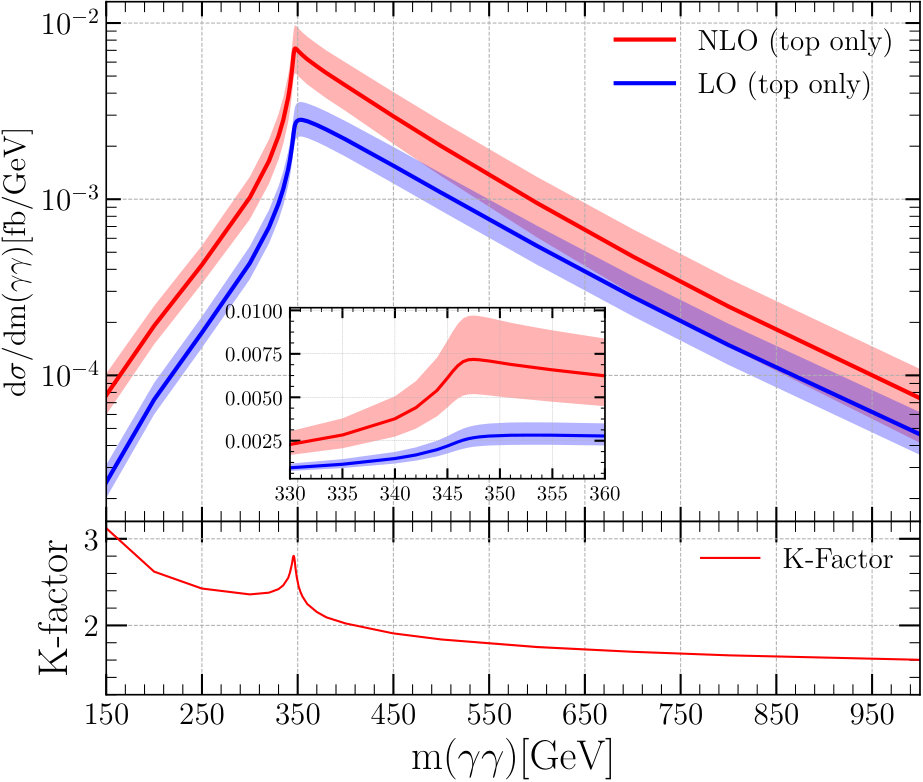 Figure 8
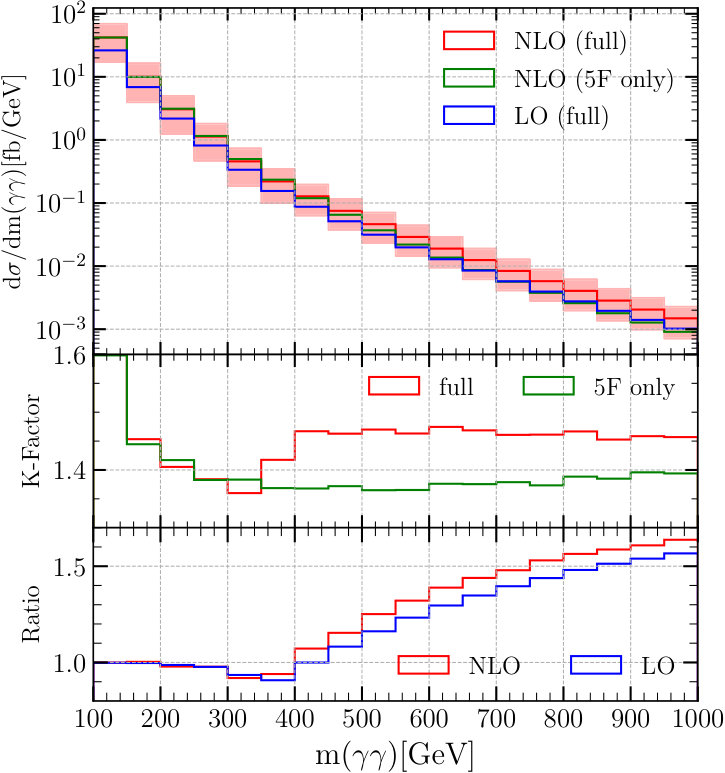 Figure 9
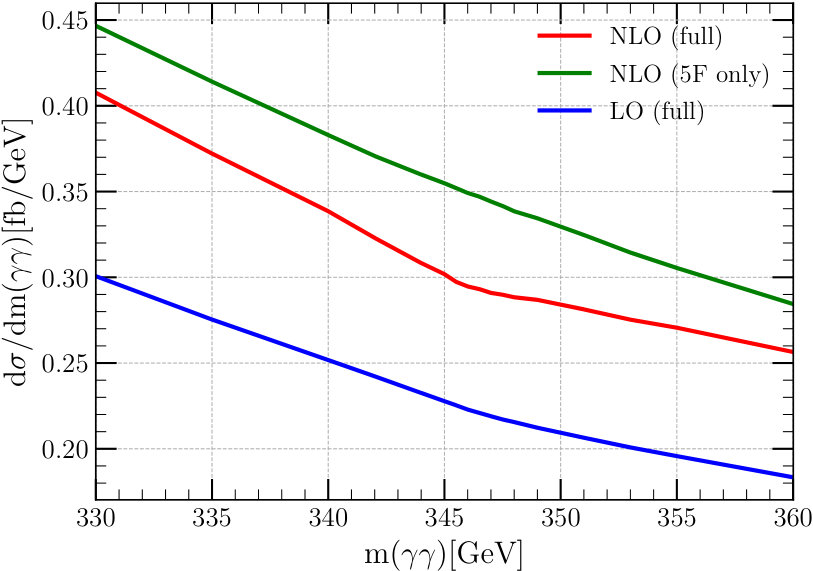 Figure 10
| fb/GeV | LO | NLO | ||||||
|---|---|---|---|---|---|---|---|---|
| [GeV] | full | 5F only | top only | interference | full | 5F only | top only | interference |
| 125 | 24.26(1) | 100.1% | -0.1% | 37.3(1) | 100.1% | -0.1% | ||
| 400 | 0.11342(5) | 104.6% | 1.9% | -6.5% | 0.1628(5) | 99.3% | 2.7% | -2.0% |
| 500 | 0.03951(7) | 88.7% | 2.8% | 8.6% | 0.0582(2) | 82.7% | 3.5% | 13.9% |
| 1000 | 63.2% | 5.3% | 31.5% | 60.5% | 5.8% | 33.6% | ||
Peer Reviews
No public reviews on file for this paper yet. If you reviewed it on a platform where reviews are public (OpenReview, ICLR, NeurIPS, ICML), you can paste yours below so the community can read it here.
Videos
No videos yet. Explain this paper in a talk, walkthrough, or lecture? Add one.
Top-quark effects in diphoton production through gluon fusion at NLO in QCD
Fabio Maltoni
[email protected], [email protected]
Centre for Cosmology, Particle Physics and Phenomenology (CP3), Université catholique de Louvain, 1348 Louvain-la-Neuve, Belgium
Dipartimento di Fisica e Astronomia, Università di Bologna and INFN, Sezione di Bologna, via Irnerio 46, 40126 Bologna, Italy
Manoj K. Mandal
Dipartimento di Fisica e Astronomia, Università di Padova and INFN, Sezione di Padova, Via Marzolo 8, 35131 Padova, Italy
Xiaoran Zhao
Centre for Cosmology, Particle Physics and Phenomenology (CP3), Université catholique de Louvain, 1348 Louvain-la-Neuve, Belgium
Abstract
At hadron colliders, the leading production mechanism for a pair of photons is from quark-anti-quark annihilation at the tree level. However, due to large gluon-gluon luminosity, the loop-induced process provides a substantial contribution. In particular, the amplitudes mediated by the top quark become important at the threshold and above. In this letter we present the first complete computation of the next-to-leading order (NLO) corrections (up to ) to this process, including contributions from the top quark. These entail two-loop diagrams with massive propagators whose analytic expressions are unknown and have been evaluated numerically. We find that the NLO corrections to the top-quark induced terms are very large at low diphoton invariant mass and close to the threshold. The full result including five massless quarks and top quark contributions at NLO displays a much more pronounced change of slope in the distribution at threshold than at LO and an enhancement at high invariant mass with respect to the massless calculation.
Introduction – The production of a pair of photons (diphoton) is one of the most important processes at hadron colliders. Not only because the final state signature is experimentally very clean, but also because of the great phenomenological relevance for Standard Model (SM) physics and beyond. Its differential cross section has been precisely measured at the Tevatron Aaltonen et al. (2013); Abazov et al. (2013) and the LHC Chatrchyan et al. (2012a, 2014). The signature has provided one of the two golden channels (the other being ) for the discovery of the Higgs boson Aad et al. (2012); Chatrchyan et al. (2012b). Currently, the decay remains one of the cleanest final states to study the properties of the Higgs boson and its production mechanisms. Being so experimentally neat, the diphoton spectrum is also scrutinized in the search of new physics at the LHC, see e.g. Khachatryan et al. (2017); Aaboud et al. (2017) , such as peak/dip structures coming from new scalar or spin-2 resonances decays and the interference with the standard model background or more exotic features, such as multiple resonances as predicted by extra-dimensional Antoniadis et al. (2012); Baryakhtar (2012); Cox and Gherghetta (2012) or clockwork models Giudice et al. (2018).
At hadron colliders, the Leading Order (LO) contribution to diphoton final states, comes from quark-antiquark annihilation . Next-to-Leading Order (NLO) corrections (at order ) to this process have been calculated many years ago Binoth et al. (2000). Next-to-Next-to-Leading Order (NNLO) corrections (at order ) have also obtained Catani et al. (2012); Campbell et al. (2016) and are available in public codes such as NNLO Catani et al. (2012), MCFM Campbell et al. (2016) and Matrix Grazzini et al. (2018). At this order, a new channel arises, i.e., gluons can fuse into diphoton, a quantum process induced by loops of quarks (Fig. 1(a)). This contribution, while being formally part of the NNLO corrections, is not only finite and gauge-invariant per se but also anomalously large, due to the gluon-gluon luminosity. It is common, therefore, to consider loop-induced gluon fusion production which starts at order as an independent diphoton production mechanism. NLO corrections of this process (), which include two-loop contributions, were calculated some time ago but only in the case of massless internal quarks Bern et al. (2002); Campbell et al. (2016).
The top-quark contribution has been known only at one loop so far. In the low energy region, it is strongly suppressed due to the large top-quark mass, the amplitude scaling as . Once the energy becomes comparable to the top mass and in particular close and above the top pair threshold, it becomes enhanced due to the opening of an imaginary part due to rescattering. This transition region is particularly interesting, because it is very sensitive to the top mass and could provide a handle on a top quark mass that is free from the usual hadronic systematic uncertainties. In the ultra-high energy limit the top quark contribution can be estimated by treating it as a massless quark: naively summing over the electric charges, the inclusion of the top quark increases the gluon fusion contribution by .
The diphoton spectrum also provides a privileged observatory to search for new physics. While the resonant production of new physics particles decaying into diphoton can be searched with theory-independent side-band method, the non-resonant or interference cases, require a precise prediction of the SM contribution. Interference of the resonant contribution with the SM continuum, provides an important method to extract properties of the resonance, such as the width. The case of Higgs boson has been extensively investigated, see e.g., Dixon and Li (2013); Campbell et al. (2017). When new physics resonances are produced mostly via gluon fusion, such as for example scalars and spin-2 particles, the SM contribution can interfere determining non-trivial structures like peak-dip (or dip-peak) or just dip structures Chway et al. (2016), depending on the couplings and properties of the resonance. As these new physics searches are particularly motivated above the top pair threshold, including the top-quark contribution is essential.
The computation of NLO corrections of the top-quark induced contributions, requires the knowledge of highly non-trivial two-loop amplitudes. While in the massless quark limit the corresponding amplitudes have been known for a long time Bern et al. (2001), the computation of massive ones, is still a challenge. Analytical results have become available in closed form for some of the relevant Feynman integrals (planar) yet the full set is unknown. On the other hand, numerical methods have been introduced Mandal and Zhao (2018) that allow to perform this calculation. In this letter, we compute the complete NLO corrections to the gluon fusion channel , including the top-quark contribution for the first time.
Calculation – The cross section at NLO accuracy can be written as
[TABLE]
where is the leading order one-loop contribution, denotes the virtual (two-loop) contributions, is the real (one-loop, 23 contribution), and represents the collinear singularity to absorbed into the parton distribution functions. The representative Feynman diagrams for the Born, virtual and real contributions are shown in Fig. 1. Each of the three terms at NLO are infrared/collinear divergent. Their sum, however, is free of infrared/collinear divergences. To handle this cancellation, we employ an in-house implementation of the dipole subtraction method Catani and Seymour (1997), which introduces counterterms for each term with The subtraction terms are carefully chosen such that they cancel locally the infrared/collinear divergences of each term, and sum up to zero Catani and Seymour (1997).
Once the subtraction method is in place, one is left with the calculation of the matrix elements for the virtual and real contributions. The latter corrections require the computation of one-loop five point amplitudes, which can be done automatically. In particular, the matrix element for subprocess, as well as and subprocesses are needed. To this aim, we adopt Recola2 Denner et al. (2018) and Madgraph5_aMC@NLOAlwall et al. (2014), as well as analytical expression for the light-quark contributions Bern et al. (1993); de Florian and Kunszt (1999); Balazs et al. (2000).
We have implemented the light quark contribution from ref. Bern et al. (2001) in our code. We have then considered the calculation of the top-quark contribution. Two-loop diagrams have been generated by QGRAF Nogueira (1993), and processed by Form Vermaseren (2000); Kuipers et al. (2013), to generate corresponding amplitudes. They are fed into Reduze von Manteuffel and Studerus (2012) to perform the corresponding loop momentum redefinition and to classify them into 33 integral families according to the propagator structure. We then adopt a projection method to decompose the amplitudes into 10 independent tensor structures, reducing the computation into that of scalar integrals with irreducible numerators. Employing the C++ version of FIRE5 Smirnov (2015) with LiteRed Lee (2012); *Lee:2013mka to perform the integration-by-part reduction, we finally obtain the corresponding form factors as a linear combination of 1180 master integrals, distributed into the 33 integral families. We evaluate the master integrals family by family, not considering the relations among the master integrals of different families. The calculation of the master integrals is based on numerical integration of differential equations, with initial condition provided by an in-house implementation of sector decomposition method Binoth and Heinrich (2000).The numerical integration of differential equation is done with Odeint Ahnert and Mulansky (2011). Starting from the original initial conditions, several points in the physical region are pre-computed and results are stored. During the phase space integration, the closest point in the pre-computed set is adopted as the new initial condition. The average time to evaluate the amplitude is around second, with at least precision at the master integral level. The one-loop amplitude up to order is computed within the same method. We refer the reader to ref. Mandal and Zhao (2018) for the details of our method and its extensive validation. Here we stress that, whenever available, we have compared the numerical value of the master integrals with those in the literature Caron-Huot and Henn (2014); von Manteuffel and Tancredi (2017); Becchetti and Bonciani (2018), and found excellent agreement.
We renormalize in the scheme with five flavors. The top-quark mass is renormalized on shell. We have checked that UV divergences are cancelled by the corresponding counter terms, and IR and collinear divergences cancel with the dipole subtraction terms. We have also checked that our implementation for the massless contribution at NLO agrees with that of MCFM Campbell et al. (2016)not To monitor the numerical accuracy during the evaluation, we exploit the symmetry and calculate two independent yet equivalent values of the integral in each point of the phase space. With the uncertainties estimated through adopting different initial conditions, as well as exchanging and , we conclude that the uncertainty arising from the numerical evaluation is smaller than 0.4% times LO contribution, at both inclusive and differential level.
Results – We adopt the following input parameters Tanabashi et al. (2018). We adopt the complex mass scheme for the top quark, e.g., the top quark mass is replaced by the complex quantity everywhere. The renormalization scale and factorization scale are set to , and we vary them by a factor of two around the central scale to assess scale uncertainties. We choose PDF4LHC15 Butterworth et al. (2016), and the results are presented for 13 TeV LHC. We apply the following cuts . No photon isolation is applied.
In Fig. 2, we show the differential cross section for the case where only the top-quark contribution is taken into account, at LO and NLO, as well as corresponding scale uncertainties. Both LO and NLO cross sections peak around the top-quark pair threshold. The NLO corrections lead to a large -factor (), especially in the low invariant mass region. Even when the invariant mass is low, the total center of mass energy in the real correction can be above the top pair threshold, and thus the top-quark loop can get resolved, leading to such enhancement. Furthermore, the photon cuts enhance the real corrections since at LO photons are back-to-back and therefore have both , while at NLO the second photon can be softer. As increases, the -factor decreases, reaching a local maximum of value around at the top-quark pair threshold. In such a region, the top quarks in the loop are produced on shell and almost at rest, and can exchange a Coulomb gluon leading to an enhancement (tamed by the top-quark width). Such corrections are well known and universal. They can be resummed by employing bound state techniques, see e.g. Kawabata and Yokoya (2017), though we present only fixed-order results here.
For a better view of the top-quark contribution, in Fig. 3 we show the differential cross section close to the top pair threshold region. Here, the top-quark and the five massless quarks contributions have a different phase, leading to a destructive interference that decreases the cross section. As already mentioned, the exchange of a Coulomb gluon leads to large NLO corrections at the top-quark pair threshold. Thus, the destructive interference decreases the cross section further and the change of slope below and above twice the top mass is more visible at NLO than at LO. Our results provide a key ingredient for improving the resummed predictions in the threshold region and also reinforce the hope that such slope change could be exploited to extract a short-distance (potential) mass for the top quark Dugad et al. (2018).
In the top inset of Fig. 4, we show the differential cross section at LO and NLO for the full result, i.e., including five massless quarks along with the top quark (full) and the NLO result for the massless quarks only (5F only) averaged over 50 GeV wide bins. In the middle inset, we plot the -factor (), which shows that NLO corrections for the top quark contribution in the high invariant mass regions are more important than those for the light quarks. Moreover, we plot the ratio between the “full” and “5F only” contributions at LO and NLO, in the lower inset. It clearly shows that the effect of the top quark mass is negligible in the low energy region both at LO and NLO as the top-quark contribution is parametrically suppressed as . As the energy increases towards the top-quark pair threshold, the inclusion of the top-quark contribution leads to destructive interference, thus decreases the cross section. This behaviour is not affected by NLO corrections. However, as evident from the ratio as well as the -factor plots, above threshold NLO corrections become large. Starting at about 400 GeV, the interference between light and top-quark contributions becomes constructive and since the NLO corrections for the top only case is larger than the light quark case, the full result displays a larger -factor. As a consequence, at NLO the ratio between the full and 5F only results is larger, slowly approaching the predictions from the 6F (massless) calculation ().
In Table 1, we provide benchmark values for the differential cross section. As discussed before, in the low invariant mass region the top-quark contribution is tiny. For example, at the Higgs mass region GeV, it is around . Going above top-quark pair threshold the top-quark contribution decreases the cross section at LO, but the NLO cross section is almost unchanged. Far above threshold, the interference turns to be constructive, and very slowly approaching the 6F (massless) limit.
Conclusions – In this letter, we have presented the first complete computation of the NLO corrections to in the standard model, including both light-quarks and top-quark contributions. We have studied the top-quark effects in the total cross section and differentially, focusing on the invariant mass spectrum of the photons. We find that the NLO corrections are important everywhere, but especially in the vicinity of the top-quark pair threshold, where indeed an enhancement is expected on general grounds. A remarkable feature of the NLO spectrum is that the change of slope at the threshold becomes much more evident. Our calculation paves the way to improving the treatment of the threshold region at NLO including (pseudo-) bound state effects, with the goal to extract a short-distance top-quark mass, and to include background-signal interference effects at NLO accuracy in the production of new physics heavy scalar resonances decaying to diphoton final states.
Acknowledgements – We thank Matteo Becchetti and Roberto Bonciani for providing us results of two-loop integrals for cross checks. We thank Claude Duhr and Pierpaolo Mastrolia for their advise. We are grateful to John Campbell for his help in comparing our code to the massless NLO computation in MCFM. This work has received funding by the Marie Skłodowska-Curie MCnetITN3 (grant agreement no. 722104) and by the F.R.S.-FNRS with the EOS - be.h project n. 30820817. The work of M.K.M is funded by the UniPD STARS Grant 2017 “Diagrammalgebra”. Computational resources have been provided by the CISM at UCLouvain and the CÉCI funded by the F.R.S.-FNRS under convention 2.5020.11.
The reference list from the paper itself. Each links out to its DOI / PubMed record.
- 1Aaltonen et al. (2013) T. Aaltonen et al. (CDF), “Measurement of the Cross Section for Prompt Isolated Diphoton Production Using the Full CDF Run II Data Sample,” Phys. Rev. Lett. 110 , 101801 (2013) , ar Xiv:1212.4204 [hep-ex] . · doi ↗
- 2Abazov et al. (2013) V. M. Abazov et al. (D 0), “Measurement of the differential cross sections for isolated direct photon pair production in p p ¯ 𝑝 ¯ 𝑝 p\bar{p} collisions at s = 1.96 𝑠 1.96 \sqrt{s}=1.96 Te V,” Phys. Lett. B 725 , 6–14 (2013) , ar Xiv:1301.4536 [hep-ex] . · doi ↗
- 3Chatrchyan et al. (2012 a) S. Chatrchyan et al. (CMS), “Measurement of the Production Cross Section for Pairs of Isolated Photons in p p 𝑝 𝑝 pp collisions at s = 7 𝑠 7 \sqrt{s}=7 Te V,” JHEP 01 , 133 (2012 a) , ar Xiv:1110.6461 [hep-ex] . · doi ↗
- 4Chatrchyan et al. (2014) S. Chatrchyan et al. (CMS), “Measurement of differential cross sections for the production of a pair of isolated photons in pp collisions at s = 7 Te V 𝑠 7 Te V \sqrt{s}=7\,\text{Te V} ,” Eur. Phys. J. C 74 , 3129 (2014) , ar Xiv:1405.7225 [hep-ex] . · doi ↗
- 5Aad et al. (2012) G. Aad et al. (ATLAS), “Observation of a new particle in the search for the Standard Model Higgs boson with the ATLAS detector at the LHC,” Phys. Lett. B 716 , 1–29 (2012) , ar Xiv:1207.7214 [hep-ex] . · doi ↗
- 6Chatrchyan et al. (2012 b) S. Chatrchyan et al. (CMS), “Observation of a new boson at a mass of 125 Ge V with the CMS experiment at the LHC,” Phys. Lett. B 716 , 30–61 (2012 b) , ar Xiv:1207.7235 [hep-ex] . · doi ↗
- 7Khachatryan et al. (2017) V. Khachatryan et al. (CMS), “Search for high-mass diphoton resonances in proton–proton collisions at 13 Te V and combination with 8 Te V search,” Phys. Lett. B 767 , 147–170 (2017) , ar Xiv:1609.02507 [hep-ex] . · doi ↗
- 8Aaboud et al. (2017) M. Aaboud et al. (ATLAS), “Search for new phenomena in high-mass diphoton final states using 37 fb -1 of proton–proton collisions collected at s = 13 𝑠 13 \sqrt{s}=13 Te V with the ATLAS detector,” Phys. Lett. B 775 , 105–125 (2017) , ar Xiv:1707.04147 [hep-ex] . · doi ↗