Field-induced quantum magnetism in the verdazyl-based charge-transfer salt $[$$o$-MePy-V-($p$-Br)$_2]$FeCl$_4$
Y. Iwasaki, T. Kida, M. Hagiwara, T. Kawakami, Y. Kono, S. Kittaka, T., Sakakibara, Y. Hosokoshi, and H. Yamaguchi

TL;DR
This study synthesizes and characterizes a verdazyl-based charge-transfer salt exhibiting complex magnetic behaviors, including a gapped singlet state, antiferromagnetic order, and an unconventional 5/6 magnetization plateau under high magnetic fields.
Contribution
The paper reports the synthesis and detailed magnetic analysis of a new verdazyl-based salt, revealing unique field-induced quantum magnetic phenomena and the interplay of different spin interactions.
Findings
Identification of a honeycomb lattice of $S_{V}=1/2$ spins with inequivalent sites.
Observation of a 5/6 magnetization plateau at high magnetic fields.
Explanation of magnetic behaviors using mean-field and dimer models.
Abstract
We successfully synthesized a verdazyl-based charge-transfer salt -MePy-V-(-Br)FeCl, which has an =1/2 on the radical -MePy-V-(-Br) and an =5/2 on the FeCl anion. molecular orbital calculations indicate the formation of an =1/2 honeycomb lattice composed of three types of exchange interaction with two types of inequivalent site. Further, the =1/2 at one site is sandwiched by =5/2 spins through antiferromagnetic (AF) interactions. The magnetic properties indicate that the dominant AF interactions between the = 1/2 spins form a gapped singlet state, and the remaining = 5/2 spins cause an AF order. The magnetization curve exhibits a linear increase up to approximately 7 T, and an unconventional 5/6 magnetization plateau appears between 7 T and 40 T. We…
Click any figure to enlarge with its caption.
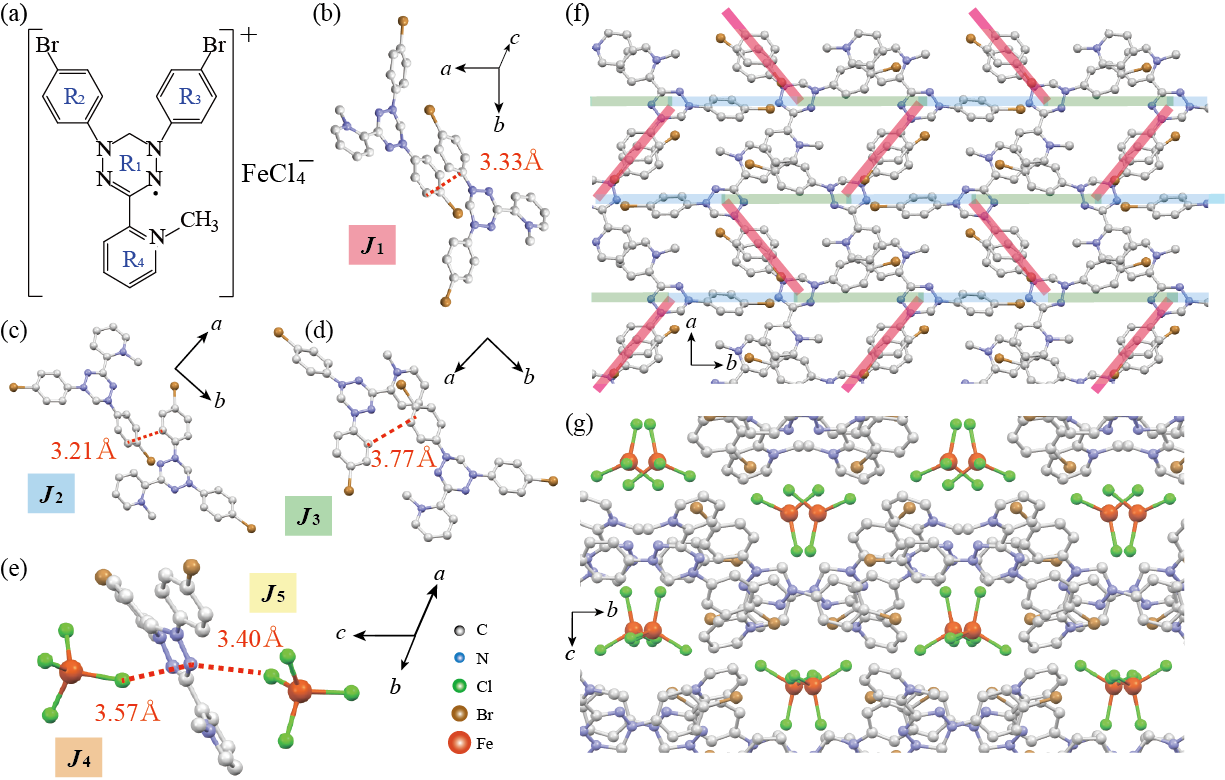 Figure 1
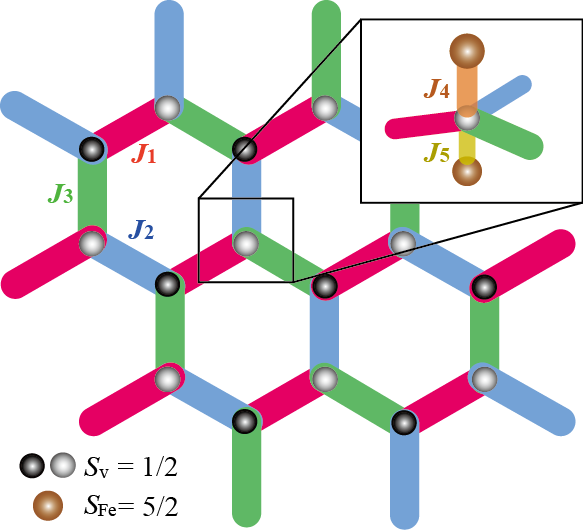 Figure 2
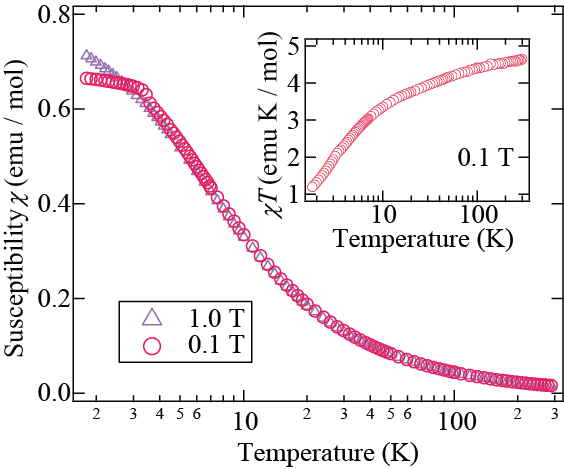 Figure 3
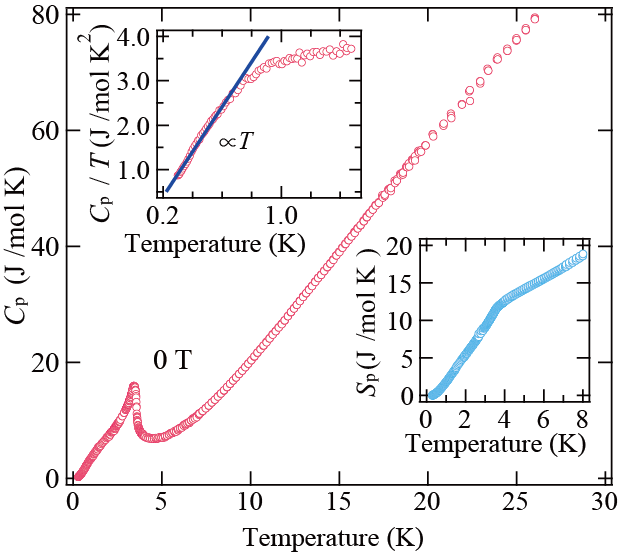 Figure 4
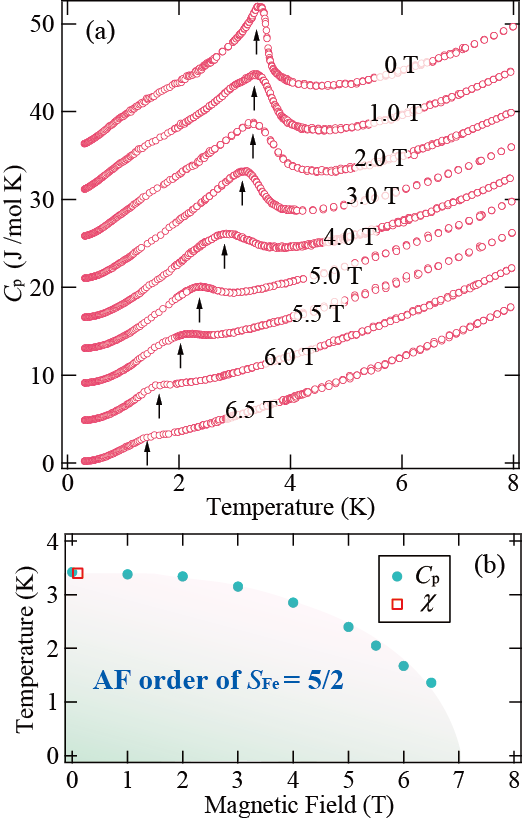 Figure 5
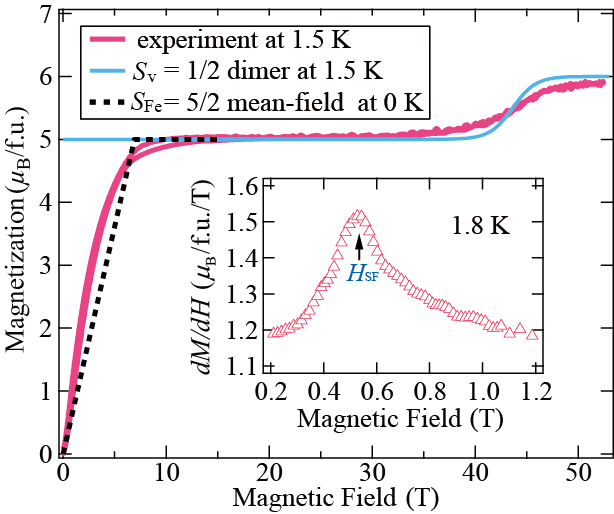 Figure 6
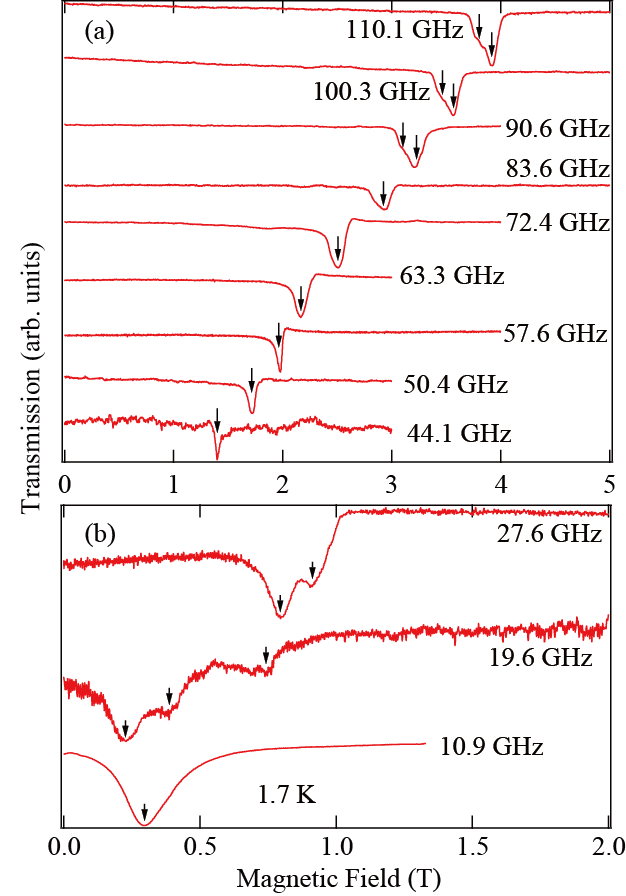 Figure 7
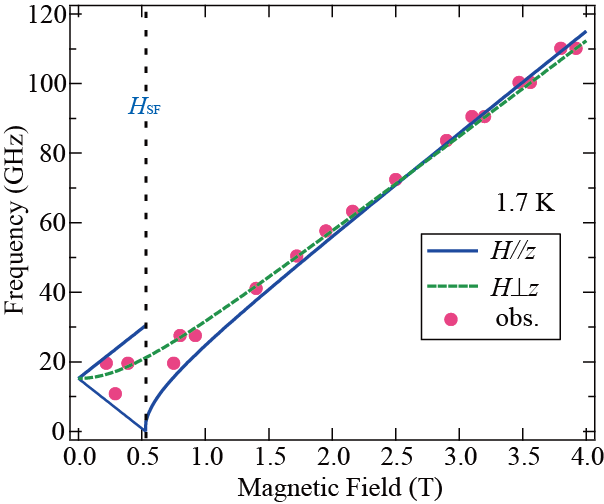 Figure 8
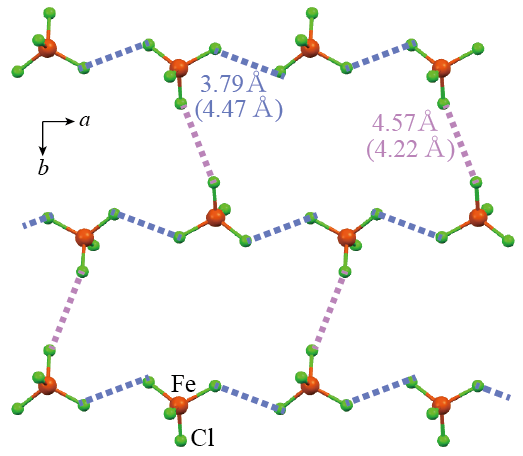 Figure 9
| Formula | C20H17Br2Cl4FeN5 | |
|---|---|---|
| Crystal system | Monoclinic | |
| Space group | 21/ | |
| Temperature (K) | RT | 25(2) |
| Wavelength () | 0.7107 | |
| ) | 14.830(5) | 14.36(7) |
| ) | 17.848(6) | 17.95(8) |
| ) | 20.218(8) | 19.70(9) |
| (degrees) | 105.391(7) | 103.71(6) |
| () | 5160(3) | 4933(40) |
| 4 | ||
| (g cm-3) | 1.763 | 1.844 |
| Total reflections | 8508 | 8142 |
| Reflection used | 4245 | 6459 |
| Parameters refined | 579 | |
| [] | 0.0812 | 0.0501 |
| [] | 0.2354 | 0.1031 |
| Goodness of fit | 1.083 | 0.972 |
| CCDC | 1865093 | 1865094 |
Peer Reviews
No public reviews on file for this paper yet. If you reviewed it on a platform where reviews are public (OpenReview, ICLR, NeurIPS, ICML), you can paste yours below so the community can read it here.
Videos
No videos yet. Explain this paper in a talk, walkthrough, or lecture? Add one.
Second institution and/or address
This line break forced
Field-induced quantum magnetism in the verdazyl-based charge-transfer salt [$$o-MePy-V-(-Br)FeCl4
Y. Iwasaki1, T. Kida2, M. Hagiwara2, T. Kawakami3, Y. Kono4, S. Kittaka4, T. Sakakibara4, Y. Hosokoshi1, and H. Yamaguchi1
1Department of Physical Science, Osaka Prefecture University, Osaka 599-8531, Japan
2Center for Advanced High Magnetic Field Science (AHMF), Graduate School of Science, Osaka University, Osaka 560-0043, Japan
3Department of Chemistry, Osaka University, Toyonaka, Osaka 560-0043, Japan
4Institute for Solid State Physics, the University of Tokyo, Chiba 277-8581, Japan
Abstract
We successfully synthesized a verdazyl-based charge-transfer salt [$$o-MePy-V-(-Br)FeCl4, which has an =1/2 on the radical -MePy-V-(-Br)2 and an =5/2 on the FeCl4 anion. molecular orbital calculations indicate the formation of an =1/2 honeycomb lattice composed of three types of exchange interaction with two types of inequivalent site. Further, the =1/2 at one site is sandwiched by =5/2 spins through antiferromagnetic (AF) interactions. The magnetic properties indicate that the dominant AF interactions between the = 1/2 spins form a gapped singlet state, and the remaining = 5/2 spins cause an AF order. The magnetization curve exhibits a linear increase up to approximately 7 T, and an unconventional 5/6 magnetization plateau appears between 7 T and 40 T. We discuss the differences between the effective interactions associated with the magnetic properties of the present compound and (-MePy-V)FeCl4. We explain the low-field linear magnetization curve through a mean-field approximation of an = 5/2 spin model. At higher field regions, the 5/6 magnetization plateau and subsequent nonlinear increase are reproduced by the = 1/2 AF dimer, in which a particular internal field is applied to one of the spin sites. The ESR resonance signals in the low-temperature and low-field regime are explained by conventional two-sublattice AF resonance modes with easy-axis anisotropy. These results demonstrate that exchange interactions between = 1/2 and = 5/2 spins in [$$o-MePy-V-(-Br)FeCl4 realize unconventional magnetic properties with low-field classical behavior and field-induced quantum behavior.
pacs:
75.10.Jm,
††preprint: APS/123-QED
I INTRODUCTION
In recent decades, composite magnetic materials composed of organic radical and inorganic molecules have been studied extensively because these materials have the potential to realize a unique crystal, magnetic, and electronic structure that cannot be seen in conventional organic or inorganic materials Lahti1999 ; Miller2001 ; Yamaguchi1990 ; Masuda2009_1 . For instance, in the organic conductor -(BETS)2FeCl4, the magnetic-field-induced superconductivity is realized through the interaction between electron in the organic molecule and the electron in the FeCl4 anion uji_nature . In -(BETS)2FeBr4 with similar crystal structure, the zero-field ground state is superconducting, and magnetic fields induce another superconducting phase Kobayashi_2000 ; Konoike_2004 . The organic salts -(BDH-TTP)2FeX4 (X = Br, Cl) in the low-field and low-temperature regions exhibit a steep negative magnetoresistance caused by a spin-canting transition via the - interaction Sugii_2013_1 ; Sugii_2013_2 ; Sugii_2014 . Magnetic studies on the salt (NNDPP)FeBr4 have demonstrated that the interactions between spins on the organic radical NNDPP and FeBr4 anion induce ferrimagnetic behavior Masuda2009_2 .
In our previous work, we demonstrated that the verdazyl radical can form a variety of unconventional spin systems, including the ferromagnetic-leg ladder, quantum pentagon, and random honeycomb, which have not been realized in conventional inorganic materials 3Cl4FV ; fine-tune ; b26Cl2V ; a26Cl2V ; random . Furthermore, molecular-based complexes with verdazyl radical and transition metals demonstrated that the strong coupling between the metal and verdazyl radical spins results in the formation of a hybrid spin in low-temperature regions Zn ; Mn . Recently, we succeeded in synthesizing verdazyl-based charge-transfer salts by combining cationized verdazyl radicals with anions square_TCNQ ; PF6 ; FeCl4 . In the salt (-MePy-V)FeCl4, metal-radical hybrid spin is formed through the dominant intermolecular interactions between the =1/2 and =5/2 spins, which are located on the verdazyl radical and the FeCl4 anion, respectively FeCl4 . Its magnetic properties indicated that the hybrid spins that are stabilized in low-temperature regions form an effective = 2 antiferromagnetic (AF) chain. Furthermore, because the intermolecular interactions between the radical and anion in (-MePy-V)FeCl4 are much smaller than the intramolecular ones in coordinated complexes Mn ; Vcomp1 ; Vcomp2 ; Vcomp3 , the experimental magnetic fields can modulate the coupled spin state between the verdazyl radical and the FeCl4 anion. As a result, the effective =1/2 quantum honeycomb lattice accompanied by the quantum magnetism is realized at high-field regions FeCl4 These results demonstrate that verdazyl-based salts with magnetic anions can make various forms of field-induced quantum magnetism observable at laboratory level, owing to the moderate energy scale of intermolecular interactions between spins on the radical and magnetic anion.
In this paper, we present a new verdazyl-based charge-transfer salt with a magnetic anion. We successfully synthesized single crystals of [$$o-MePy-V-(-Br)FeCl4 [-MePy-V-(-Br)2 = 3-(2-methylpyridyl)-1,5-bis(4-bromophenyl)-verdazyl]. molecular orbital calculations indicate the formation of an =1/2 honeycomb lattice composed of three types of exchange interactions with two types of inequivalent sites. Further, the =1/2 at one spin site is sandwiched by =5/2 spins through antiferromagnetic (AF) interactions. The magnetic properties indicate that the dominant AF interactions between the = 1/2 spins form a gapped singlet state, and the remaining = 5/2 spins cause an AF order. As a result, the magnetization curve exhibits a linear increase up to approximately 7 T, and an unconventional 5/6 magnetization plateau appears between 7 T and 40 T. The ESR resonance signals in the low-temperature and low-field regime are explained by conventional two-sublattice AF resonance modes with easy-axis anisotropy.
II EXPERIMENTAL AND NUMERICAL METHOD
The synthesis of [$$o-MePy-V-(-Br)FeCl4, whose molecular structure is shown in Fig. 1(a), was performed using a procedure similar to that for (-MePy-V)FeCl4 FeCl4 . The recrystallization in acetonitrile yielded dark-red crystals.
Single crystal X-ray diffraction (XRD) experiment was performed by using a Rigaku AFC-8R Mercury CCD RA-Micro7 diffractometer with Japan Thermal Engineering XR-HR10K. The single crystal XRD data are refined by using the SHELX software Xray . The structural refinement was carried out using anisotropic and isotropic thermal parameters for the nonhydrogen atoms and the hydrogen atoms, respectively. All the hydrogen atoms were placed at the calculated ideal positions.
The magnetizations were measured using a commercial SQUID magnetometer (MPMS-XL, Quantum Design) down to 1.8 K. High-field magnetization measurement in pulsed magnetic fields of up to approximately 52 T was conducted using a non-destructive pulse magnet. The experimental results were corrected for the diamagnetic contribution of emu mol*-1* calculated by the Pascal method. The specific heat was measured with a commercial calorimeter (PPMS, Quantum Design) using a thermal relaxation method above 1.9 K and a handmade apparatus by a standard adiabatic heat-pulse method with a 3He refrigerator down to about 0.3 K. The ESR measurements were performed utilizing a vector network analyzer (ABmm) and a superconducting magnet (Oxford Instruments). At approximately 10.9, 19.6, and 27.6 GHz, we used laboratory-built cylindrical high-sensitivity cavities. All above the experiments were performed using small, randomly oriented single crystals with typical dimensions of 1.00.60.3 mm3.
MO calculations were performed using the UB3LYP method with the basis set 6-31G(d,p) in the Gaussian 09 program package. The convergence criterion was set at 10*-8* hartree. For the estimation of intermolecular magnetic interaction, we applied our evaluation scheme that have been studied previously MOcal .
III RESULTS
III.1 Crystal structure and magnetic model
The crystallographic data for the synthesized [$$o-MePy-V-(-Br)FeCl4 are summarized in Table I. The verdazyl ring (which includes four N atoms), the upper two phenyl rings, and the bottom methylpyridyl ring are labeled , , , and , respectively. The crystals contain two crystallographically independent molecules. The results of the MO calculations for each -MePy-V-(-Br)2 molecule indicate that approximately 60 of the total spin density is present on . Further, while and each account for approximately 19 and 17 of the relatively large total spin density, accounts for less than 4 of the total spin density. Therefore, the intermolecular interactions are caused by the short contacts related to the , , and rings. Note that, because this study focuses on the low-temperature magnetic properties, the crystallographic data obtained at 25 K are used hereafter.
The -MePy-V-(-Br)2 and FeCl4 molecules have =1/2 and =5/2, respectively. The MO calculations were performed in order to evaluate the exchange interaction between the spins, and five types of dominant interactions were found, as shown in Figs. 1(b)-(e). They are evaluated as = 25.1 K, = K, = K, = K, and = K, which are defined in the Heisenberg spin Hamiltonian given by , where denotes the sum over the neighboring spin pairs. The molecular pairs associated with the , , and are between crystallographically independent -MePy-V-(-Br)2 molecules and have C-C short contacts of 3.33, 3.21, and 3.77 , respectively, as shown in Figs. 1(b), (c), and (d). The and describe the couplings between one of the -MePy-V-(-Br)2 molecules and FeCl4 molecules, as shown in Figs. 1(e). The -MePy-V-(-Br)2 molecules couple two-dimensionally through the , , and in the plane, as shown in Fig. 1(f), and FeCl4 molecules are located between the two-dimensional (2D) layers, as shown in Fig. 1(g). Figure 2 shows the 2D honeycomb lattice composed of , , and with =1/2 in the plane, where the on the site indicated by the gray ball is connected with two =5/2 through and . Considering the symmetry of the crystal structure, there is another honeycomb lattice with a slightly different pattern, in which and are inversely connected to . The two different lattices stack alternately along the axis. The difference between two lattices does not affect the energy state of the spins, which gives rise to the same ground state. Therefore, those honeycomb lattices are considered to be topologically equivalent, and we regard them as the same system hereafter.
III.2 Magnetic susceptibility
@ Figure 3 shows the temperature dependence of the magnetic susceptibility () at 0.1 and 1.0 T. We observe an anomalous change in the temperature dependence at 3.4 K, below which a significant difference between 0.1 and 1.0 T appears. This behavior indicates that an AF phase transition to a three-dimensional (3D) long-range order (LRO) occurs at = 3.4 K. The decreases with decreasing temperature, indicating dominant contributions of AF interactions, as shown in the inset of Fig. 3. In the high-temperature region, the value of approaches 4.7 emu K/mol, which is close to the expected value for the noninteracting =1/2 and =5/2 spins. The temperature dependence of is dramatically different from that of (-MePy-V)FeCl4, in which exhibits a constant of 3.0 emu K/mol for an = 2 hybrid spin through the strong coupling between =1/2 and =5/2 spins FeCl4 . Accordingly, the experimental result of in the present compound indicates that the exchange interactions between =1/2 and =5/2 spins (i.e., and ) are relatively weak compared to the dominant interaction between =1/2 spins.
III.3 Specific heat
The experimental results for the specific heat at zero-field clearly exhibit a -type sharp peak at , which is associated with the AF phase transition to the LRO, as shown in Fig. 4. Although the lattice contribution is not subtracted from the experimental results for specific heat, the magnetic contribution is expected to be dominant in low-temperature regions below , as seen in other verdazyl-based materials 3Cl4FV ; b26Cl2V ; Zn ; 2Cl6FV . The entropy obtained through integration of / shows that the change associated with the phase transition is close to the total magnetic entropy of = 5/2 (ln6 14.9), as shown in the lower inset of Fig. 4. Therefore, the observed phase transition should originate from the LRO of an effective spin model composed of the =5/2. Because the magnetic entropy of =1/2 is not associated with the phase transition, it is deduced that the strongest AF interaction forms an =1/2 AF dimer with a nonmagnetic singlet state in higher temperature regions.
As shown in the upper inset of Fig.4, in the low-temperature region below 0.8 K, shows clear -linear behavior, which suggests the existence of a linear dispersive mode in a 2D AF system. Thus, we expect that the effective = 5/2 model associated with the phase transition has a quasi-2D character. A higher-temperature small shoulder observed at approximately 1.0 K is considered to originate from contributions of some higher-energy dispersive modes. In magnetic fields, the phase transition temperature decreases with increasing fields, as shown in Fig. 5(a), and the obtained magnetic field dependence of is shown in Fig. 5(b). The disappearance of the phase transition at approximately 7 T is considered to correspond to a fully polarized state of the effective = 5/2 model in the low-temperature region, which is consistent with an appearance of a 5/6 magnetization plateau in the following magnetization curve.
III.4 Magnetization curve
Figure 6 shows the magnetization curve at 1.5 K, which exhibits an almost linear increase with increasing fields up to approximately 7 T. In terms of the field derivative of the magnetization, we observe a distinct peak at approximately 0.54 T, as shown in the inset of Fig. 6. This indicates a spin-flop transition that is caused by a small magnetic anisotropy, which we discuss in the following ESR section. The magnetization assumes a 5/6-plateau for fields between 7 and 40 T and then increases again towards saturation at approximately 50 T. The linear increase observed in the low-field region indicates that the magnetic behavior can be described by a classical system with a large spin size. Furthermore, the magnetic moment of /f.u. at the 5/6-plateau phase corresponds to the fully polarized =5/2 spins along the field direction. These characteristics are consistent with the formation of the effective = 5/2 model in the low-temperature and low-field regions. In the case of higher-field regions, the observed 5/6-plateau indicates the coexistence of the fully polarized =5/2 spins and a singlet state separated from the excited states by an energy gap. The increase of the magnetization curve toward the saturation exhibits a nonlinear behavior, which reflects the strengths of the quantum fluctuations. In general quantum spin systems, quantum fluctuations are suppressed by the application of magnetic fields, yielding a nonlinear increase of magnetization curve 2Cl6FV ; 2Cl36F2V ; a235Cl3V .
III.5 Electron spin resonance
We performed the ESR measurements in the low-field and low-tempereture regime to examine the ground state of the = 5/2 AF spin lattice. The frequency dependence of the ESR absorption spectra in the ordered phase is presented in Figs. 7(a) and (b). As shown in Fig. 7(a), the resonance signals at high frequencies are almost proportional to the external field. Conversely, those at low frequencies in Fig. 7(b) exhibit broad signals with a number of resonance fields and obviously deviate from the linear field behavior. All the resonance fields are plotted in the frequencyfield diagram, presented in Fig. 8. Since a zero-field gap of 15 GHz, which corresponds to the energy scale of , is expected from the extrapolation of the resonance modes, the observed resonance fields suggest conventional AF resonance modes in an anisotropic two-sublattice model FeCl4 ; a235Cl3V ; kittel ; MnF2 ; MnCl3(bipy)_hagiwara ; MnCl3bpy . The anisotropic energy derived from the dipoledipole interactions is confirmed to induce observable magnetic anisotropy even in isotropic radical sysytems FeCl4 ; a235Cl3V .
IV DISCUSSION
IV.1 Magnetization curve
Considering the MO calculation and the magnetic properties, the strongest AF interaction is expected to form an =1/2 AF dimer. Additionally, at higher field regions, an effective internal field on one of the sites arises from the fully polarized =5/2 spins through the AF and . Thus, we calculated the magnetization curve for the =1/2 AF dimer coupled through with an effective internal field given by , which is unusually oriented against the direction of the external field. The spin Hamiltonian is expressed as
[TABLE]
where S is an = 1/2 spin operator, B is the Bohr magneton, and is the external magnetic field, and axis is parallel to the external field direction. The MO calculation showed that the exchange interactions have the relation = 0.33 and = 0.23. Assuming these ratios, we demonstrate the drastic change of magnetization between approximately 40 T and 45 T by using parameters = 28.3 K, = 9.3 K, and = 6.5 K, as shown in Fig. 6. The obtained parameters are moderately consistent with those evaluated from the MO calculation. In the actual spin model, finite couplings between the dimers are expected to cause an AF 3D LRO when the energy gap closes by applying magnetic fields. In the ordered phase, the magnetization curve becomes more gradual compared to that of the isolated dimer owing to interdimer interactions. The difference between the experimental and calculated results of the magnetization curve should arise from such interdimer contributions. Hence, we qualitatively confirm that, above approximately 7 T, the effective spin model in the high-field region can be considered as the =1/2 AF dimer with the particular internal field caused by the fully polarized =5/2 spins.
The =1/2 AF dimer coupled with = 28.3 K forms a nonmagnetic singlet state at sufficiently high-temperature regions above , and thus the interactions between =1/2 and = 5/2 spins can be omitted to simplify the spin model. Accordingly, in the low-temperature and low-field regions, the magnetic properties originate from the effective spin model composed of = 5/2, which exhibits phase transition to the AF LRO at and quasi-2D character in the specific heat. Since the FeCl4 molecules with are stuck between two radical layers forming the nonmagnetic state (see Fig. 1(g)), the exchange paths between = 5/2 spins in the FeCl4 layer are essential for considering the spin lattice. The symmetry of the crystal structure indicates that there are two types of FeCl4 layers with similar molecular arrangements. From the MO calculations, the absolute values of the exchange interactions in both FeCl4 layers are evaluated to be less than 0.5 K. Considering a strong dependence on the calculation method, those small interactions do not have enough reliability to assume a spin model MOseido . Thus, we directly examined the distances between the FeCl4 molecules and found two types of Cl-Cl short contacts less than 5.0 in each FeCl4 layer, which form a honeycomb lattice, as shown in Fig. 9. In consideration of the small energy scale, we assume the other exchange paths between distant sites in order to consider the magnetic properties appropriately in the low-temperature region. We then calculated the magnetization curve based on the = 5/2 AF spin lattice using a mean-field approximation assuming the spin Hamiltonian expressed as , where S is the = 5/2 spin operator. The magnetization curve at = 0 is given by , where is the number of nearest-neighbor spins. Considering the saturation field of approximately 7 T evaluated from the extrapolation of phase boundary, we determined = K, which corresponds to = K assuming the honeycomb lattice ( = 3). We obtained good agreement between the experimental and calculated results in the low-field region (as shown in Fig. 6), while there was a slight difference attributed to the finite temperature effect in the experimental results.
IV.2 ESR resonance modes
We analyzed the observed ESR modes in terms of a mean-field approximation assuming the = 5/2 AF lattice with an easy-axis anisotropy. Thus, the spin Hamiltonian is expressed as
[TABLE]
where is on-site anisotropy (), and S is an = 5/2 spin operator. As the spin structure is described by the two-sublattice model, the free energy is expressed in the following form, using the mean-field approximation:
[TABLE]
where and are given by
[TABLE]
and and are the sublattice moments expressed as
[TABLE]
Here, is the number of spins, and is the spin on the -th sublattice (=1,2). We derive the resonance conditions by solving the equation of motion
[TABLE]
where is the gyromagnetic ratio and is the mean field applied on the -th sublattice moment given by
[TABLE]
To solve the equation of motion, we use a method for the analysis of ABX3-type antiferromagnets tanaka . Assuming precession motion of the sublattice moments around those equilibrium directions, we utilize the following expressions, which represent the motion of the -th sublattice moment:
[TABLE]
where , and , and are the principal axes of the coordinate system on each sublattice moment. The -axis is defined as being parallel to the direction of each sublattice moment, and the - and -axes are perpendicular to the -axis.
The spins are aligned along the easy-axis ( axis) under zero-field conditions, and the discontinuous spin-flop phase transition occurs at for . The value of is expressed as
[TABLE]
which corresponds to the zero-field energy gap of resonance modes. Above , the two sublattices are tilted with respect to the field direction with equivalent angles, while for the other principal axes, where the external fields are applied perpendicular to the easy-axis, the two sublattices are tilted from the easy-axis with equivalent angles along each field direction. The angles between the sublattice moment and the external field for both directions can then be determined by minimizing the free energy. Then, the values are obtained by solving eq.(5) numerically. The calculated results obtained here demonstrate typical AF resonance modes with an easy-axis anisotropy in a two-sublattice model. Since our experiments were performed using small, randomly oriented single crystals, the resonance fields for all of the principal axes are expected to have been detected in our experiments. By using = 1.86 K evaluated from the analysis of the magnetization curve, we obtained a good fit between the experimental and calculated values with = 0.012 K, = 2.05(3) for , and = 2.00(2) for , as shown in Fig. 8.
V Summary
We have succeeded in synthesizing single crystals of the verdazyl-based charge-transfer salt [$$o-MePy-V-(-Br)FeCl4. MO calculations indicated the formation of an =1/2 honeycomb lattice composed of three types of exchange interaction with two types of inequivalent site. At one spin site, the =1/2 is sandwiched by =5/2 spins through AF interactions. The magnetic susceptibility and specific heat indicated the phase transition to the AF order, and the low-temperature magnetization curve exhibited an unconventional 5/6 magnetization plateau. These observed behaviors indicated that the dominant AF interactions between the = 1/2 spins form a gapped singlet state, and the remaining = 5/2 spins cause the AF order. We described the linear magnetization curve below 7 T using the mean-field approximation of an = 5/2 spin model. For the magnetization curve at higher field regions, the 5/6 magnetization plateau and subsequent nonlinear increase were demonstrated by the = 1/2 AF dimer. The ESR resonance signals in the low-temperature and low-field regime suggested conventional two-sublattice AF resonance modes with an easy-axis anisotropy. We explained the obtained ERS resonance signals assuming the effective = 5/2 spin model by using the mean-field approximation and evaluated magnetic parameters. These results thus demonstrate that exchange interactions between = 1/2 and = 5/2 in [$$o-MePy-V-(-Br)FeCl4 realize unconventional magnetic properties with low-field classical behavior and field-induced quantum behavior. Verdazyl-based charge-transfer salts with magnetic anions provide a means to observe various types of field-induced quantum magnetism in experimentally accessible magnetic fields.
Acknowledgements.
This research was partly supported by Grant for Basic Science Research Projects from KAKENHI (No. 15H03695, No. 15K05171, and No. 17H04850) and the Matsuda Foundation. A part of this work was carried out at the Center for Advanced High Magnetic Field Science in Osaka University under the Visiting Researcher’s Program of the Institute for Solid State Physics, the University of Tokyo, and the Institute for Molecular Science.
The reference list from the paper itself. Each links out to its DOI / PubMed record.
- 1(1) P.M. Lahti, Magnetic Properties of Organic Materials (Marcel Dekker, New York, 1999).
- 2(2) J.S. Miller, M. Drillon, Magnetism: Molecules to Materials Vol, II-V, (Wiley-VCH, New York, 2001).
- 3(3) K. Yamaguchi, H. Namimoto, T. Fueno, T. Nogami, Y. Shirota, Chem. Phys. Lett., 166 , 408, (1990).
- 4(4) Y. Masuda, M. Kuratsu, S. Suzuki, M. Kozaki, D. Shiomi, K. Sato, T. Takui, K. Okada, Polyhedron, 28 , 1950, (2009).
- 5(5) S. Uji, H. Shinagawa, T. Terashima, T. Yakabe, Y. Terai, M. Tokumoto, A. Kobayashi, H. Tanaka, and H. Kobayashi, Nature, 410 , 908, (2001).
- 6(6) H. Kobayashi, A. Kobayashi and P. Cassoux, Chem. Soc. Rev., 29 , 325 (2000).
- 7(7) T. Konoike, S. Uji, T. Terashima, M. Nishimura, S. Yasuzuka, K. Enomoto, H. Fujiwara, B. Zhang, and H. Kobayashi, Phys. Rev. B 70 , 094514 (2004).
- 8(8) K. Sugii, K. Takai, S. Uji, T. Terashima, H. Akutsu, A. Wada, S. Ichikawa, J. Yamada, T. Mori, and T. Enoki, J. Phys. Soc. Jpn. 82 , 054706 (2013).