Searching for dark matter in final states with two jets and missing transverse energy
Ulrich Haisch, Giacomo Polesello

TL;DR
This paper enhances dark matter searches at the LHC by using angular correlations, specifically the azimuthal angle difference between jets, to improve discrimination of signals in mono-jet plus missing energy events.
Contribution
It introduces a novel analysis strategy utilizing the dijet azimuthal angle difference to better distinguish dark matter signals from background in mono-jet events at the LHC.
Findings
Shape fit to $ riangle ilde{ ext{phi}}_{j_1 j_2}$ improves sensitivity.
Constraints are more stringent than standard $E_T^{ ext{miss}}$ analyses.
Effective in spin-0 $s$-channel dark matter models.
Abstract
We reemphasise the usefulness of angular correlations in LHC searches for missing transverse energy () signatures that involve jet pairs with large invariant mass. For the case of mono-jet production via gluon-fusion, we develop a realistic analysis strategy that allows to split the dark matter (DM) signal into distinct one jet-like and two jet-like event samples. By performing state-of-the-art Monte Carlo simulations of both the mono-jet signature and the standard model background, it is shown that the dijet azimuthal angle difference in production provides a powerful discriminant in realistic searches. Employing a shape fit to , we then determine the LHC reach of the mono-jet channel in the context of spin-0 -channel DM simplified models. The constraints obtained by the proposed…
Click any figure to enlarge with its caption.
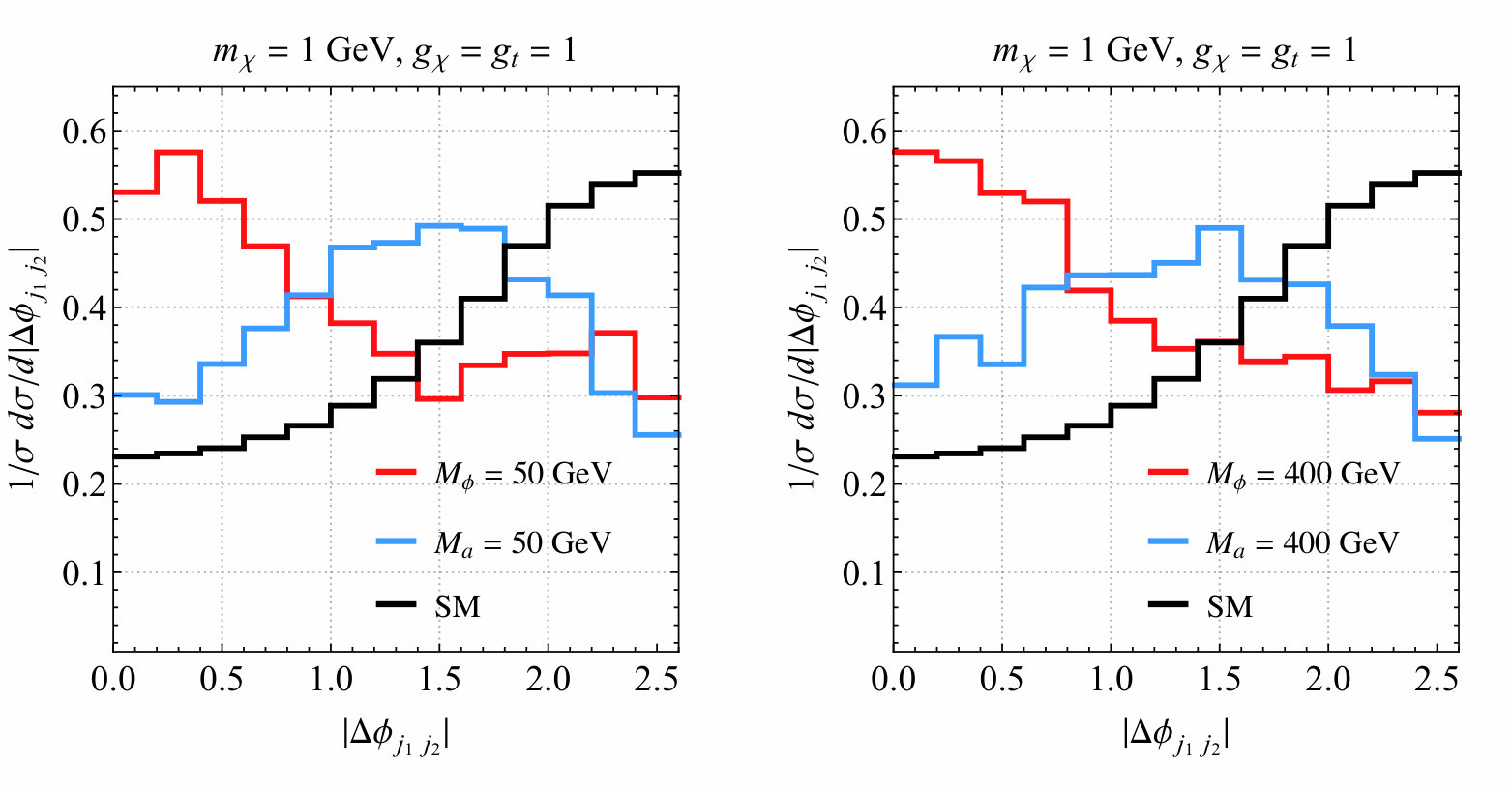 Figure 1
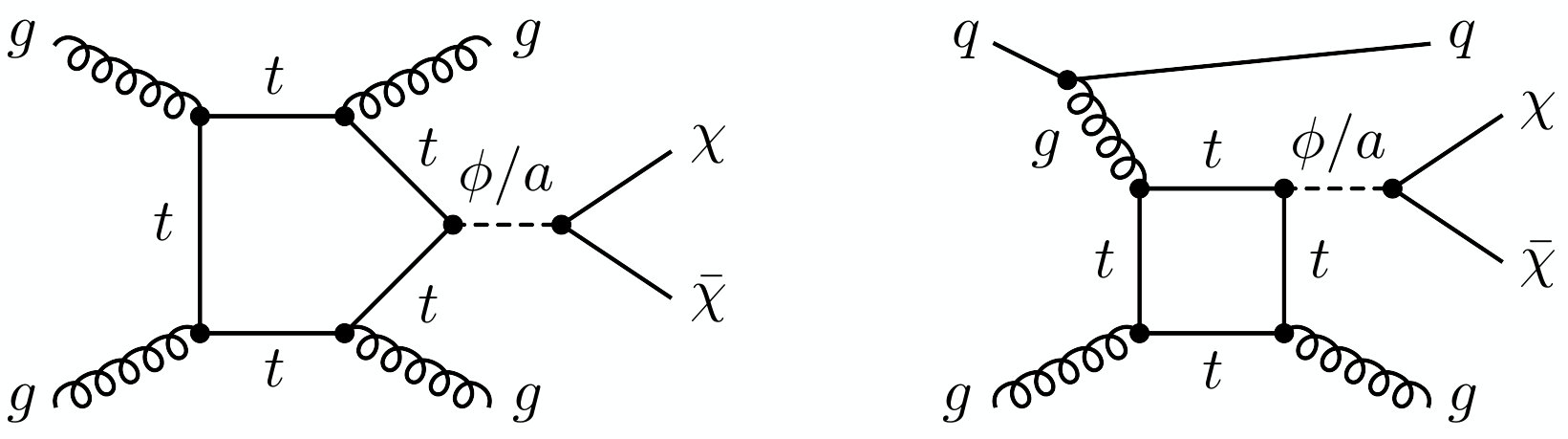 Figure 2
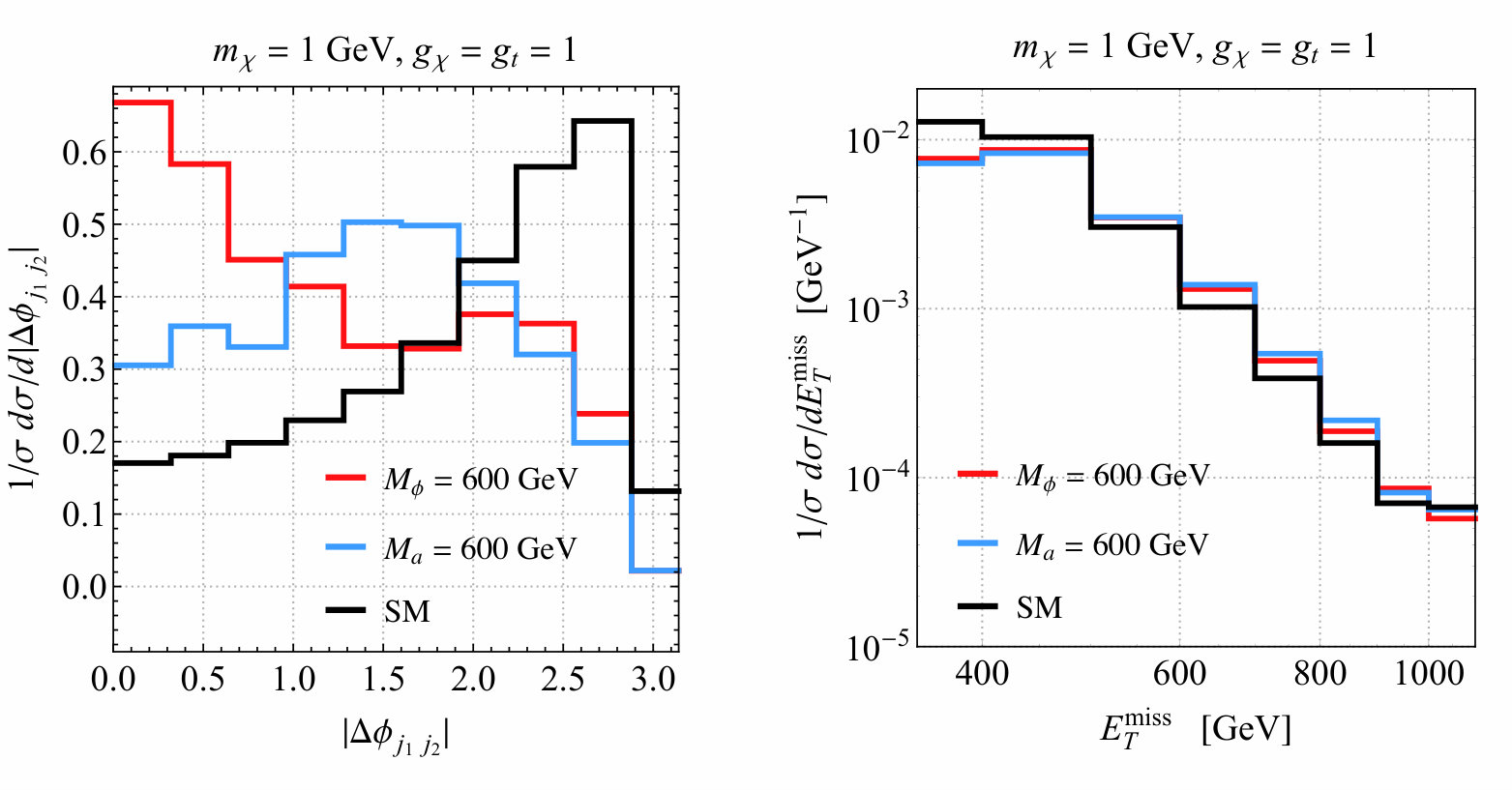 Figure 3
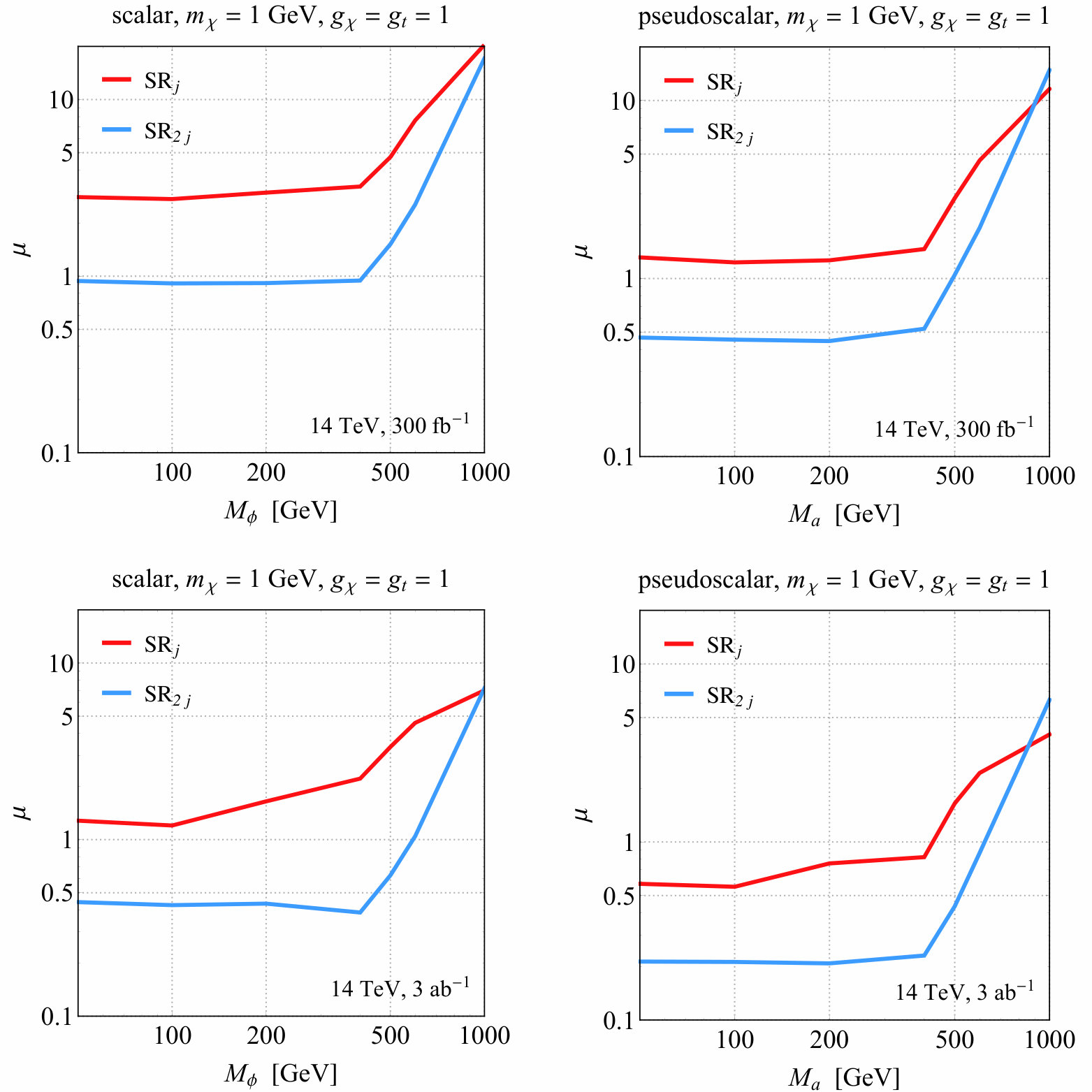 Figure 4
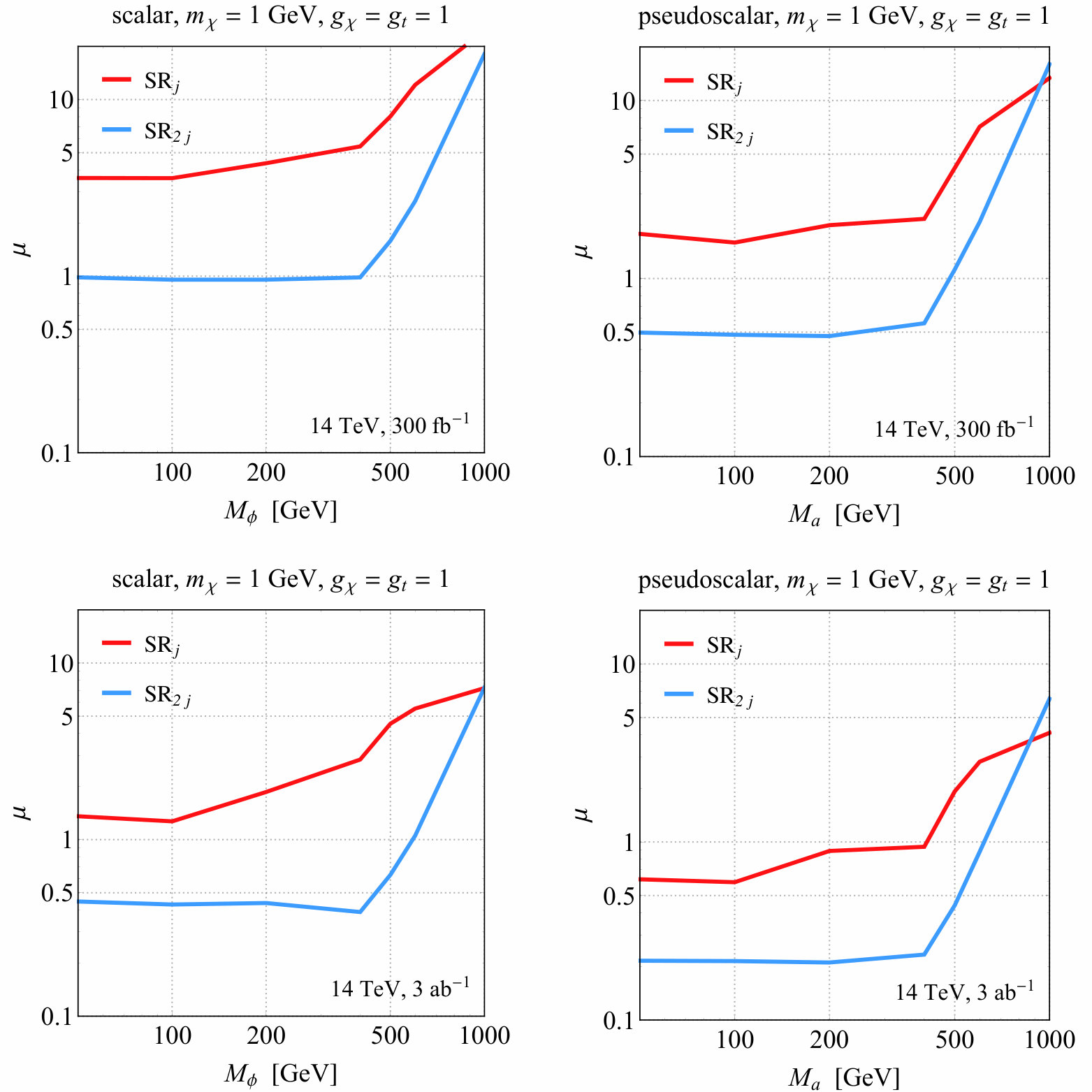 Figure 5
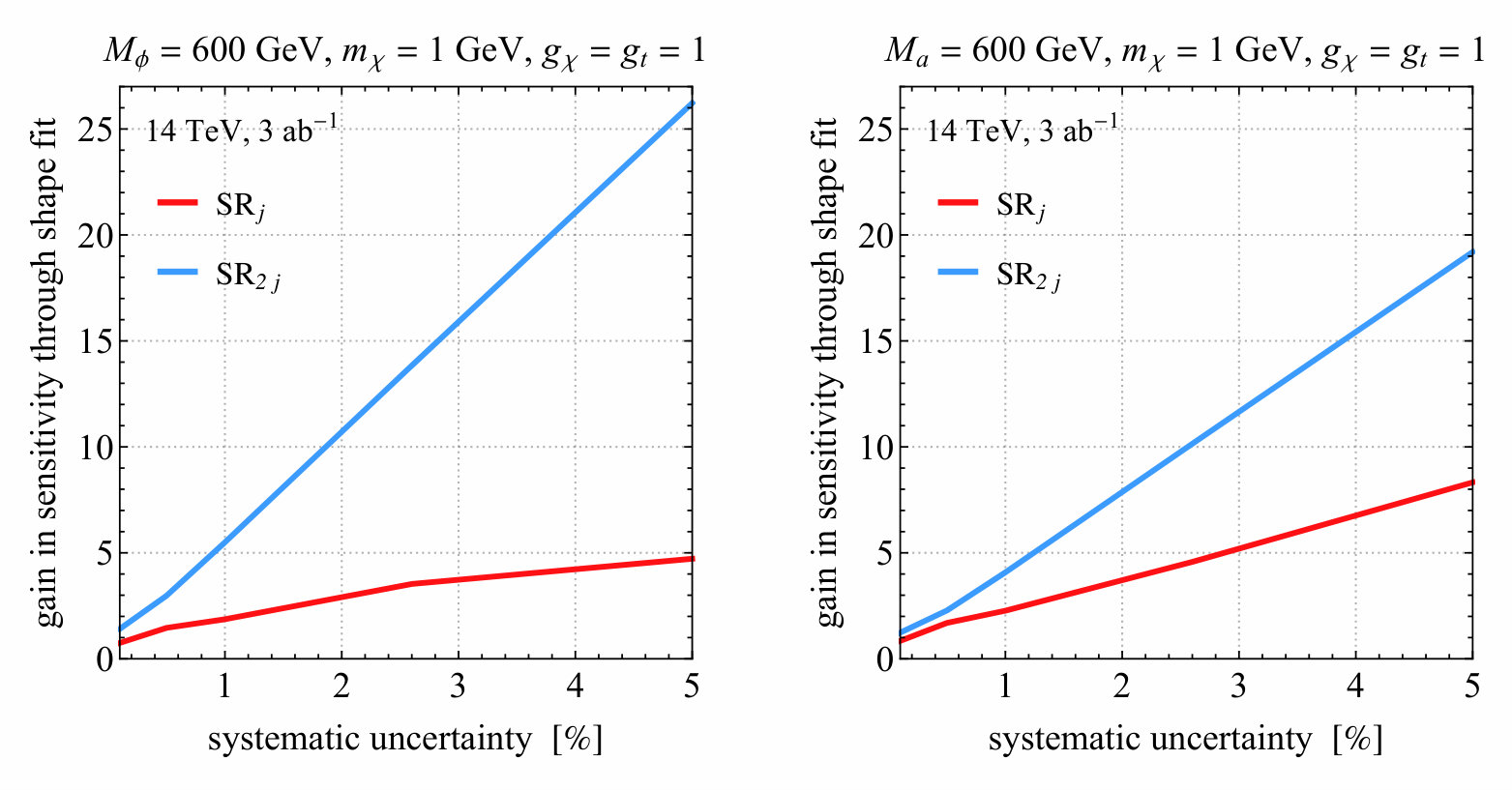 Figure 6
| leading jet | , | |
|---|---|---|
| subleading jet | ||
Peer Reviews
No public reviews on file for this paper yet. If you reviewed it on a platform where reviews are public (OpenReview, ICLR, NeurIPS, ICML), you can paste yours below so the community can read it here.
Videos
No videos yet. Explain this paper in a talk, walkthrough, or lecture? Add one.
11institutetext: Max Planck Institute for Physics, Föhringer Ring 6, 80805 München, Germany22institutetext: INFN, Sezione di Pavia, Via Bassi 6, 27100 Pavia, Italy
Searching for dark matter in final states
with two jets and missing transverse energy
Ulrich Haisch 2
and Giacomo Polesello
Abstract
We reemphasise the usefulness of angular correlations in LHC searches for missing transverse energy () signatures that involve jet pairs with large invariant mass. For the case of mono-jet production via gluon-fusion, we develop a realistic analysis strategy that allows to split the dark matter (DM) signal into distinct one jet-like and two jet-like event samples. By performing state-of-the-art Monte Carlo simulations of both the mono-jet signature and the standard model background, it is shown that the dijet azimuthal angle difference in production provides a powerful discriminant in realistic searches. Employing a shape fit to , we then determine the LHC reach of the mono-jet channel in the context of spin-0 -channel DM simplified models. The constraints obtained by the proposed shape fit turn out to be significantly more stringent than those that derive from standard shape analyses.
1 Introduction
One of the main channels used in the search for direct production of dark matter (DM) at hadron colliders is the final state that includes a high transverse momentum () hardonic jet recoiling against the undetectable DM particles. These so-called mono-jet searches have a long and partly colourful history. They have been performed in the past at all major general purpose detector experiments like UA1, CDF and DØ Arnison:1984qu ; Abazov:2003gp ; Aaltonen:2008hh , and at the LHC they now represent an important pillar of the search strategy for new physics beyond the standard model (SM).
The latest ATLAS and CMS mono-jet results Aaboud:2017phn ; Sirunyan:2017jix are based on an integrated luminosity of around of LHC data. Both searches require the presence of at least a single high- jet and fit the shape of the missing transverse energy () spectrum to extract limits on DM production. Given the good theoretical understanding of the SM backgrounds Lindert:2017olm , LHC measurements of the distribution in mono-jet production place the leading constraints on -channel DM simplified models (see for instance Abdallah:2015ter ; Abercrombie:2015wmb ; Boveia:2016mrp and references therein) in certain regions of parameter space. However, since the corresponding shapes of the spectra are featureless and largely independent of the type of mediation mechanism, existing mono-jet measurements provide insufficient information to determine additional DM properties.
In order to disentangle different types of DM-SM interactions through studies of signatures more complicated observables and/or final states need to be considered. The simplest option are channels with at least two SM particles such as two jets () or two charged leptons () and in the final state. The signature can thereby result from either the gluon-fusion Haisch:2013fla or the vector-boson fusion Eboli:2000ze ; Cotta:2012nj ; Crivellin:2015wva channel, while the signal can for instance arise from Buckley:2015ctj ; Haisch:2016gry and 181111048 ; Haisch:2018tw production. In all cases the angular correlations of the visible final state particles have been studied and shown to provide useful information on the structure of the interactions between the dark and the SM sector. The goal of this work is to reassess the usefulness of dijet angular correlations in the gluon-fusion channel, applying the general ideas presented in Haisch:2013fla to the case of spin-0 simplified DM models. By performing simulations of the DM signal taking into account the effects of matrix element matching and merging, parton shower and hadronisation corrections and a realistic detector modelling, we show that the azimuthal angle difference between the two jets in events furnishes a powerful model discriminant in a realistic experimental environment. We find that compared to standard likelihood fits, the inclusion of shape information on should lead to a significantly improved reach in spin-0 -channel DM simplified models. Projections are presented based on and of 14 TeV LHC data, corresponding to LHC Run-3 and the high-luminosity phase of the LHC (HL-LHC).
Our article is organised as follows. In Section 2 we briefly describe the structure of the DM simplified models that we use to interpret the searches. In this section also the generation of the DM signal and the SM backgrounds is explained and our detector simulation is described. Section 3 details our analysis strategy and discusses the angular correlations of the DM signal. The LHC Run-3 and HL-LHC projections are presented in Section 4. We conclude in Section 5. Supplementary material can be found in Appendix A.
2 DM signal and SM backgound
In our work the following simplified Lagrangians are studied (see e.g. Abdallah:2015ter ; Abercrombie:2015wmb ; Boveia:2016mrp )
[TABLE]
which describe the coupling of a dark sector to the SM through the -channel exchange of scalar () and pseudoscalar () mediators. In (1) the symbol represents the DM particle assumed to be a Dirac fermion, is a dark-sector Yukawa coupling, are the SM quark Yukawa couplings with the mass of the relevant quark and the Higgs vacuum expectation value, and denotes the fifth Dirac matrix.
The DM signal samples are generated at leading order (LO) using the DMsimp Backovic:2015soa implementation of the Lagrangians (1) together with MadGraph5_aMC@NLO Alwall:2014hca and NNPDF3.0 Ball:2012cx parton distribution functions (PDFs). The associated production of DM with one and two jets are generated for collisions at a centre-of-mass (CM) energy of 14 TeV. See Figure 1 for representative one-loop graphs that contribute to the signal in the spin-0 -channel DM simplified models. The events are showered with PYTHIA 8.2 Sjostrand:2014zea using the Catani-Kraus-Kuhn-Webber (CKKW) jet matching prescription Catani:2001cc . We consider five different values of the mediator mass in the range from to . The mass of the DM particles is set to and we employ for the couplings of the mediators to DM and top quarks. The total decay width of the mediator is assumed to be minimal and calculated at tree level using MadGraph5_aMC@NLO. Since in the narrow width approximation the signal predictions factorise into the cross sections for production times the branching ratio, changing leads only to a rescaling of the signal strength. The experimental acceptance is instead insensitive to the total decay width, and hence it is sufficient to generate samples for a single choice of couplings. The predictions for other values of and can then be obtained by scaling with the associated branching ratio.
The dominant SM backgrounds arise from production. We consider separately the channel with and the mode with where . These backgrounds are generated at LO with MadGraph5_aMC@NLO and NNPDF3.0 PDFs, and can contain up to two additional jets in the matrix element. The generation is performed in slices of the vector-boson , and the resulting events are showered with PYTHIA 8.2 employing a CKKW jet matching. The inclusive signal region IM3 of the analysis Aaboud:2017phn requires , and for these selections the background from production amounts to around 95% of the total SM background. Our samples are normalised such that the different contributions match the number of events in the IM3 signal region as estimated by the ATLAS collaboration scaled to a CM energy of 14 TeV and to the appropriate integrated luminosity. In addition, the small SM backgrounds arising from Campbell:2014kua , Re:2010bp and diboson Melia:2011tj ; Nason:2013ydw production were simulated at next-to-leading order (NLO) using POWHEG BOX Alioli:2010xd . Only the final states with at least one neutrino are considered. The samples produced with POWHEG BOX are normalised to the NLO cross section given by the generator, except for production which is normalised to the cross section obtained at next-to-next-to-leading order plus next-to-next-to-leading logarithmic accuracy Czakon:2011xx ; Czakon:2013goa .
The most important experimental objects in our analysis are hadronic jets and , whereas charged leptons are only used for vetoing purposes. Charged leptons are constructed from stable particles in the generator output, while jets are built by clustering the true momenta of all particles but muons that interact in the calorimeters. FastJet Cacciari:2011ma is used to construct anti- jets Cacciari:2008gp of radius . The variable with magnitude is defined at truth level, i.e. before applying detector effects, as the vector sum of the transverse momenta of all invisible particles. The effect of the detector is simulated by applying Gaussian smearing functions to the momenta of the experimental objects and by employing reconstruction and tagging efficiency factors tuned to reproduce the performance of the ATLAS detector Aad:2008zzm ; Aad:2009wy . To smear the transverse momenta of xunsmeared electrons, muons and jets are subtracted from the truth and replaced by the corresponding smeared quantities. The residual truth imbalance is then smeared as a function of the scalar sum of the of the particles not assigned to electrons or jets. Similar techniques for fast detector simulation are used for the projection studies ATL-PHYS-PUB-2016-026 of the ATLAS collaboration, and have also been employed in the phenomenological analyses Haisch:2016gry ; Haisch:2018tw ; Pani:2017qyd ; Haisch:2018djm .
3 Analysis strategy
In our analysis, two orthogonal signal regions are defined. One focusing on the signature with a single jet (), and another one with two jets of high dijet invariant mass (). The definitions of the signal regions are summarised in Table 1. The basic selections for both signal regions require , and that the separation in the azimuthal angle between and any jet satisfies . Reconstructed jets have to have and , and events containing more than four jets, i.e. , with are vetoed. The latter two cuts ensure that the background from QCD multijet production is subdominant in the experimental analysis. We also veto events with electrons or muons.
Jets are treated differently in the two signal regions. In (), we demand the presence of at least one jet () with and (). Notice that the , the and the leading-jet cuts imposed in match those of the signal region IM3 defined in Aaboud:2017phn . If contains two or more jets we require and , whereas for the second hardest jet has to satisfy and . In the case of the signal region , we finally ask that the invariant mass of the two leading jets fulfills () in the extrapolation to () of integrated luminosity, while if an event in features more than one jet, is required to be smaller than the cut employed in . We emphasise that the requirements on have been optimised in our analysis to provide the best possible separation between DM signal and SM background in terms of distributions. Such an optimisation has not been performed in the earlier study Haisch:2013fla .
After applying the above cuts, the SM background amounts to approximately 595 k (102 k) events in () per of integrated luminosity at the 14 TeV LHC. In both signal regions, the ratio of the number of DM signal to SM background events turns out to be in the ballpark of 1% (2%) for a scalar (pseudoscalar) mediator with mass below . For larger values of the signal-to-background ratio rapidly decreases.
The distributions for the azimuthal angle difference between the two jets in the signal region with are shown in Figure 2. All the distributions are normalised to unity when integrated over . We see that in the case of the DM signal the normalised spectra display a pronounced cosine-like and sine-like modulation that, as explained for example in Haisch:2013fla ; Plehn:2001nj ; Klamke:2007cu , is typical for scalar (red) and pseudoscalar (blue) exchange. Compared to the scalar and pseudoscalar distributions the SM background (black) is peaked towards . The observed shape differences offer the possibility of improving the sensitivity of the mono-jet analysis and, in the case of discovery, may allow to distinguishing between a CP-even and a CP-odd mediation mechanism. It is important to notice in this respect that the shape of the spectra is rather insensitive to the mediator mass as illustrated by the left and right panel corresponding to masses of and , respectively. We stress that compared to the previous work Haisch:2013fla that used hard matrix elements only, the Monte Carlo (MC) modelling of the DM signals performed here is more sophisticated as it includes the effects of CKKW jet matching, parton shower and hadronisation corrections and a realistic detector simulation (cf. Section 2). Our study thus shows that the azimuthal angle difference in production is not washed out by soft physics and/or detector effects, and therefore provides a powerful model discriminant in realistic LHC mono-jet analyses. In Appendix A we quantify the gain in sensitivity that is achieved by adding shape information to the search strategy .
Before discussing our LHC Run-3 and HL-LHC projections, we briefly comment on the relevance of the , and diboson backgrounds in our analysis. In the signal region , we find that the impact of the sum of and (diboson) production is negligible as this contribution amounts to a fraction of only 0.2% (0.8%) of the total SM background. In the contribution due to and (diboson) production instead amounts to 6% (3%). The distribution of the and background is however peaked at around with a flat tail that slowly grows from , whereas the shape of the spectrum of the diboson background resembles that of the leading SM background from production (cf. the black histograms in Figure 2). The discriminating power of the observable is therefore not affected by the subleading backgrounds if the shape fit is limited to the range , as done in the subsequent numerical analysis.
4 LHC Run-3 and HL-LHC projections
The goal of this section is to derive upper limits on the signal strength , i.e. the ratio of the signal yield to that predicted in the spin-0 -channel DM simplified models (1). Given that in both signal regions the signal-to-background ratio is at the percent level, a shape fit to a discriminant variable is necessary to maximise the sensitivity to the DM signal. In our analysis, we perform a standard shape fit in the signal region , while in the shape of the distributions is used as a discriminator. In the case of the HL-LHC, the high number of events in the two signal regions implies that the sensitivity of the search largely depends on how well the SM background can be modelled and/or constrained. Since the systematic uncertainties plaguing the background have been identified as the limiting factor in mono-jet analyses, much experimental and theoretical effort went into minimising these uncertainties by employing techniques that involve a mix of data-driven methods and MC studies (see e.g. Aaboud:2017phn ; Sirunyan:2017jix ; Lindert:2017olm ). Since it is beyond the scope of this work to perform such an evaluation on our MC generated SM backgrounds, we will rely on published experimental data to approximate the effect of systematic uncertainties on the LHC sensitivity prospectives.
Given that apart from the additional cut in the case, our signal region resembles the requirements of the selection IM3 of the ATLAS search Aaboud:2017phn , we base our extrapolations on the information provided in the latter article. In the recent mono-jet analysis of the ATLAS collaboration, the systematic uncertainties are evaluated through a combined shape fit to the signal region and to appropriate control regions enriched by the dominant SM backgrounds. The obtained systematic uncertainty on the number of SM background events in IM3 amounts to 2.6%, and we assume that uncertainties of the same size also arise in the case of our signal regions and . Besides the systematic uncertainty on the normalisation of the SM background, also the shapes of the distributions which enter the likelihood fits carry uncertainties. In the case of Aaboud:2017phn for instance, the bin-by-bin systematic uncertainties on the shape of the distribution amount to around for . These uncertainties are however strongly correlated among bins and cannot be naively used as bin-by-bin errors in a likelihood fit. In addition, no experimental information on the systematic uncertainties of the distributions is available, although it seems likely that the shapes of the spectra shown in Figure 2 can be modelled with higher precision than the steeply falling distributions. As we are mainly interested in the relative reach of the two signal regions and , as a minimal approach we only use the uncertainty of on the total number of expected events in each signal region, ascribing no additional error to the shapes of the and distributions. This procedure will allow us to calculate an upper limit on the sensitivity of our analysis strategy.
In order to evaluate the upper confidence level (CL) limits on the signal strength , we construct parametrised probability density functions for the DM signals and the SM background with the HistFactory package Cranmer:2012sba . The significance is then calculated using the method Read:2002hq . The actual calculation is performed with the RooStats toolkit Moneta:2010pm , which utilises the asymptotic formulas for likelihood-based tests presented in Cowan:2010js . The assumptions on systematic uncertainties incorporated in the probability density functions for each of the signal regions has already been discussed before. Figure 3 displays our 95% CL limits for integrated luminosities of (upper row) and (lower row) as a function of the mediator mass for scalar (left) and pseudoscalar (right) mediators. The red (blue) curves correspond to the results of the () shape fit in () as described above. The corresponding fit ranges are and , respectively. One observes that under the assumption of systematic uncertainties of on the number of SM background events in and , the shape fit proposed by us leads to significantly stronger LHC Run-3 and the HL-LHC constraints on than a standard shape analysis. This finding can be understood qualitatively by recalling that there is a large fraction of two jet-like events in the case of gluon-fusion induced mono-jet production Haisch:2013ata , and our shape fit exploits this feature. Numerically, our search strategy leads to the 95% CL limits and for , and of 14 TeV data. The corresponding bounds for of integrated luminosity read and . We emphasise that the quoted exclusions have been obtained under the assumption that only the total number of expected events carries a systematic uncertainty. This procedure hence leads to upper bounds on the sensitivity of our analysis strategy , corresponding to the limit of distributions with vanishing shape uncertainties. Since a reliable estimate of shape uncertainties and their correlations is only possible in an analysis that uses real LHC data, it is beyond the scope of this work to quantify to which extent our projections would be weakened if shape uncertainties were to be included. Additional extrapolations based on a different systematic uncertainty scenario can be found in Appendix A.
5 Conclusions and outlook
The main goal of this article was to put the earlier study Haisch:2013fla of angular correlations in gluon-fusion production of loop-induced signatures on more solid ground both from a theoretical and experimental point of view. To this purpose, we have performed state-of-the-art MC simulations of both the mono-jet signal in spin-0 -channel simplified models and the associated SM backgrounds. The dominant background from production, but also the subleading , and diboson channels have been considered. Our event generation includes the effects of jet matching and merging as well as parton shower and hadronisation corrections, and we have performed a realistic detector modelling (see Section 2).
The proposed analysis strategy aims at separating the mono-jet signature into two distinct signal regions. The first signal region called focuses on single jet-like events, while the second signal region referred to as requires the presence of a jet pair with large invariant mass in the final state (see Section 3). In the signal region , we have studied the azimuthal angle difference in mono-jet production. Our study shows that the latter observable provides a powerful model discriminant in realistic LHC analyses. In fact, shape fits to the variable will generically help to improve the sensitivity of mono-jet searches (see Appendix A), and, in the case of a discovery, might allow to distinguishing between scalar and pseudoscalar mediators.
We have then analysed the mono-jet coverage of the parameter space of the spin-0 -channel DM simplified models expected at LHC Run-3 and the HL-LHC (see Section 4). In a first step, we have derived hypothetical limits on the signal strength that follow from a standard shape analysis to the signal region. In a second step, we have then obtained bounds by performing shape fits to the variable utilising the event samples. Under the reasonable assumption that the systematic uncertainties on the number of SM background events in and are the same, we have found that the proposed shape fit has a significantly better reach than a standard shape analysis. For the benchmark parameter choices and , the 95% CL exclusion limits that derive from our search strategy read and for of 14 TeV data. The corresponding bounds for of integrated luminosity turn out to be and . Notice that in the scalar case the quoted LHC Run-3 limit is slightly weaker than the bound that follows from a combined analysis of and production Haisch:2018tw , while in all other cases the mono-jet sensitivity exceeds that of the search. This finding illustrated the synergy and complementarity of the latter two mono- channels Buckley:2014fba ; Haisch:2015ioa in the context of spin-0 -channel DM simplified models.
We finally note that the analysis strategy proposed by us can also be straightforwardly applied to next-generation DM simplified models such two-Higgs-doublet extensions with an extra spin-0 gauge singlet Ipek:2014gua ; No:2015xqa ; Goncalves:2016iyg ; Bell:2016ekl ; Bauer:2017ota ; Tunney:2017yfp ; Abe:2018bpo . Like in the case of the spin-0 -channel DM simplified models discussed here, we expect that exploiting the correlations in production will also allow to significantly strengthen future LHC mono-jet constraints on spin-0 next-generation DM simplified models.
Acknowledgements.
We are grateful to Giuliano Gustavino for useful comments on the manuscript.
Appendix A Supplementary material
In this appendix we extend the numerical study performed in Section 4. We start by presenting LHC explorations based on an alternative more aggressive assumption about the systematic uncertainties of future LHC mono-jet searches. Anticipating improvements in detector performance and modelling of DM signal and SM background processes, we assume, in the spirit of CMS-PAS-FTR-16-005 ; ATL-PHYS-PUB-2018-043 , that the present systematic uncertainties on the total number of expected events in the signal regions and can be reduced by a factor of 2. In Figure 4 we show the 95% CL limits for (upper row) and (lower row) of data as a function of the scalar (left) and pseudoscalar (right) mediator mass. The red (blue) curves illustrate the results of the () shape fit in () as described in Section 4, assuming an improved systematic uncertainty of . Under this assumption, we find that the proposed search strategy leads to the 95% CL limits and for , and of 14 TeV data. The corresponding bounds are and . Notice that these limits are only marginally better than the bounds reported at the end of Section 4. The 95% CL bounds on that derive from the search strategy are in contrast notable improved if the systematic uncertainties are reduced from 2.6% to 1.3%. Numerically, we find average improvements of 45% and 15% at LHC Run-3 and HL-LHC, respectively.
In addition let us quantify the impact of shape information in the two mono-jet search strategies considered by us. To do so, we define the gain of sensitivity through the shape fit as the ratio of values obtained with and without the inclusion of shape information. This ratio is displayed in Figure 5 as a function of the assumed systematic uncertainty on the number of events in (red curves) and (blue curves). The shown results correspond to the HL-LHC and two benchmark spin-0 -channel DM simplified models. From the panels it is evident that the shape information carried by is a significantly more powerful constraint than that of . This finding is unsurprising, if one considers the shapes of the and corresponding to the parameter choices used to obtain the latter figure. As can be seen from Figure 6, the spectrum displays a marked cosine-like (sine-like) modulation in the scalar (pseudoscalar) case, while the distributions are steeply falling and largely independent of the mediator type. In the case of the distributions, one furthermore observes a clear distinction between the shapes of the DM signals and the SM background, while in the case the differences between the three normalised spectra are significantly less prominent.
The features of the results shown in Figures 3, 4, 5 and 6 thus strongly suggest that search strategies based on shape fits are not only more powerful than standard shape analyses in constraining the parameter space of spin-0 -channel DM simplified models, but are also less dependent on hypothetical improvements of the systematic uncertainties of future mono-jet searches.
The reference list from the paper itself. Each links out to its DOI / PubMed record.
- 1(1) UA 1 collaboration, G. Arnison et al., Experimental Observation of Events with Large Missing Transverse Energy Accompanied by a Jet Or a Photon(s) in p p ¯ 𝑝 ¯ 𝑝 p\bar{p} Collisions at s 𝑠 \sqrt{s} = 540 Ge V , Phys. Lett. 139B (1984) 115 . · doi ↗
- 2(2) DØ collaboration, V. M. Abazov et al., Search for large extra dimensions in the monojet + missing E T subscript 𝐸 𝑇 E_{T} channel at DØ , Phys. Rev. Lett. 90 (2003) 251802 , [ hep-ex/0302014 ]. · doi ↗
- 3(3) CDF collaboration, T. Aaltonen et al., Search for large extra dimensions in final states containing one photon or jet and large missing transverse energy produced in p p ¯ 𝑝 ¯ 𝑝 p\bar{p} collisions at s 𝑠 \sqrt{s} = 1.96 Te V , Phys. Rev. Lett. 101 (2008) 181602 , [ 0807.3132 ]. · doi ↗
- 4(4) ATLAS collaboration, M. Aaboud et al., Search for dark matter and other new phenomena in events with an energetic jet and large missing transverse momentum using the ATLAS detector , JHEP 01 (2018) 126 , [ 1711.03301 ]. · doi ↗
- 5(5) CMS collaboration, A. M. Sirunyan et al., Search for new physics in final states with an energetic jet or a hadronically decaying W 𝑊 W or Z 𝑍 Z boson and transverse momentum imbalance at s 𝑠 \sqrt{s} = 13 Te V , Phys. Rev. D 97 (2018) 092005 , [ 1712.02345 ]. · doi ↗
- 6(6) J. M. Lindert et al., Precise predictions for V + limit-from 𝑉 V+ jets dark matter backgrounds , Eur. Phys. J. C 77 (2017) 829 , [ 1705.04664 ]. · doi ↗
- 7(7) J. Abdallah et al., Simplified Models for Dark Matter Searches at the LHC , Phys. Dark Univ. 9-10 (2015) 8–23 , [ 1506.03116 ]. · doi ↗
- 8(8) D. Abercrombie et al., Dark Matter Benchmark Models for Early LHC Run-2 Searches: Report of the ATLAS/CMS Dark Matter Forum , 1507.00966 .