Universal relaxation in a holographic metallic density wave phase
Andrea Amoretti, Daniel Are\'an, Blaise Gout\'eraux, Daniele Musso

TL;DR
This paper reveals a universal relaxation mechanism for pinned density waves in holographic models, linking collective mode damping to material properties and explaining transport phenomena in high-temperature superconductors.
Contribution
It introduces a universal formula for the damping rate of collective modes in density wave phases using gauge/gravity duality and effective field theory.
Findings
The damping rate is proportional to the shear modulus and the square of the pinning mass.
Resistivity becomes linear in temperature at low temperatures.
Spectral weight shifts from a pinning peak to a Drude-like peak in conductivity.
Abstract
In this work, we uncover a universal relaxation mechanism of pinned density waves, combining Gauge/Gravity duality and effective field theory techniques. Upon breaking translations spontaneously, new gapless collective modes emerge, the Nambu-Goldstone bosons of broken translations. When translations are also weakly broken (eg by disorder or lattice effects), these phonons are pinned with a mass and damped at a rate , which we explicitly compute. This contribution to is distinct from that of topological defects. We show that , where is the shear modulus and is related to a diffusivity of the purely spontaneous state. This result follows from the smallness of the bulk and shear moduli, as would be the case in a phase with fluctuating translational order. At low temperatures, the collective modes relax quickly into the heat current, so…
Click any figure to enlarge with its caption.
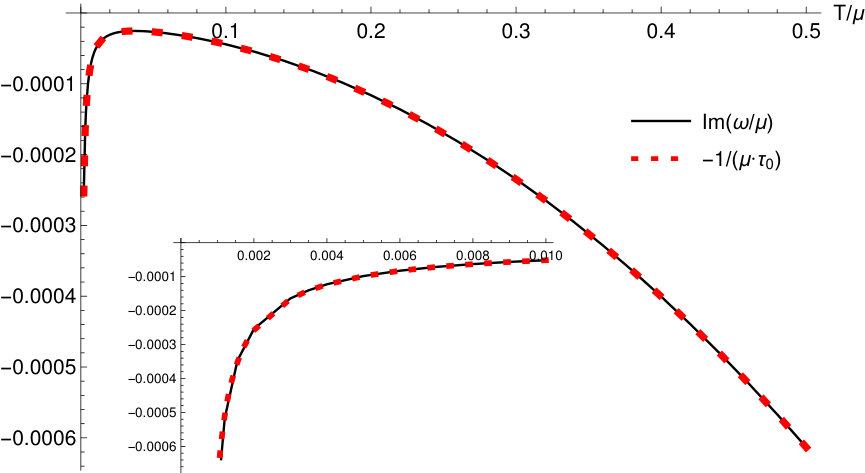 Figure 1
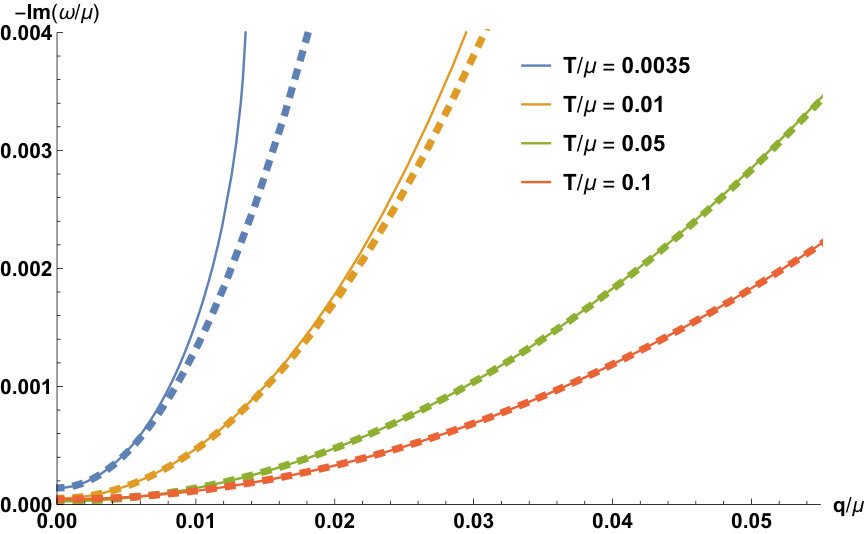 Figure 2
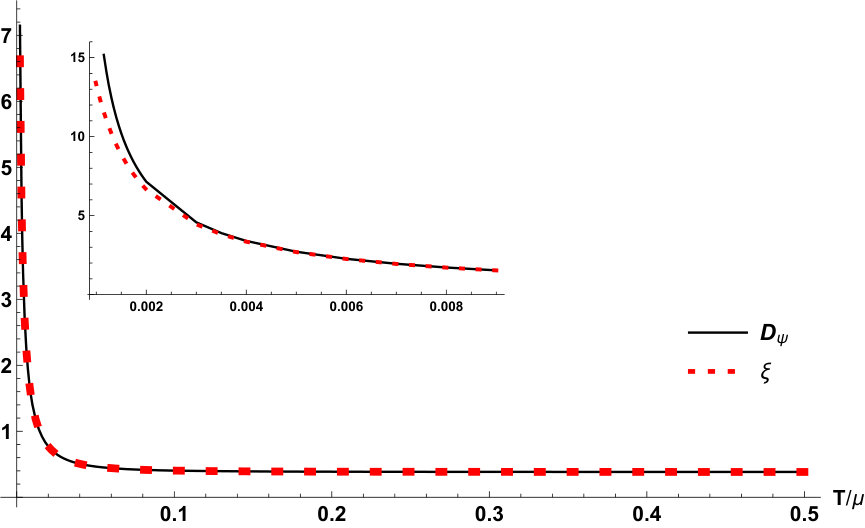 Figure 3
 Figure 4
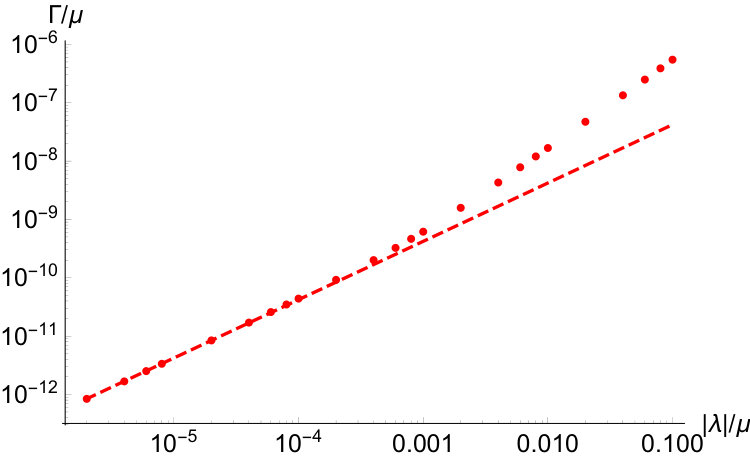 Figure 5
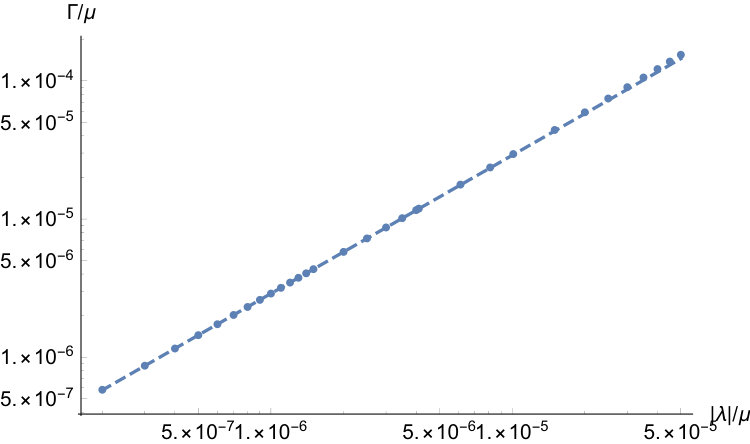 Figure 6
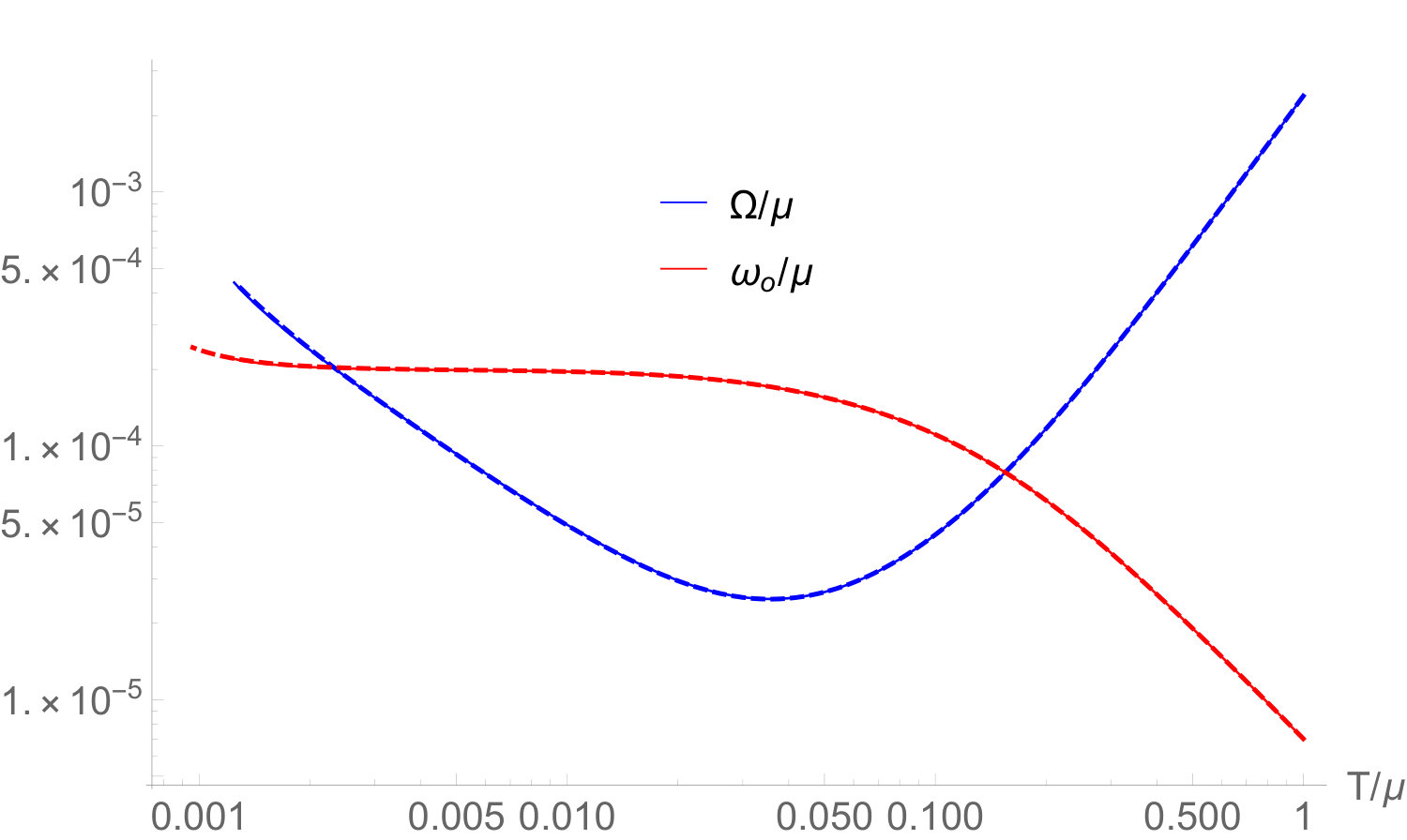 Figure 7
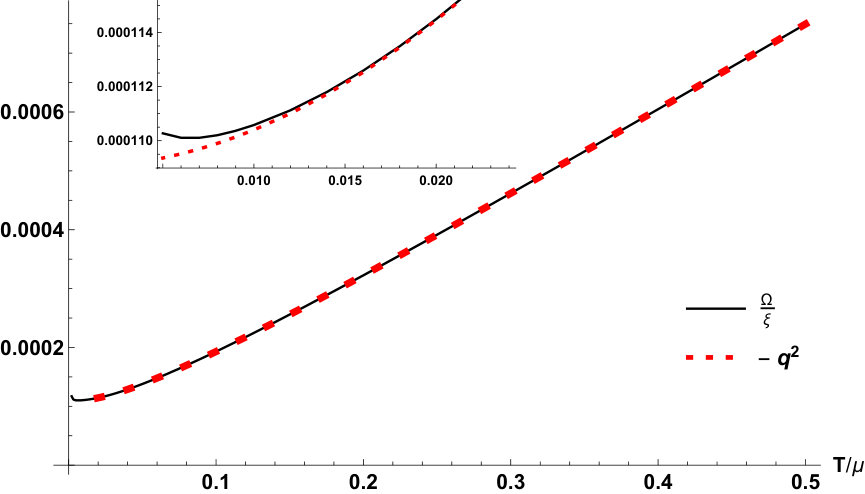 Figure 8
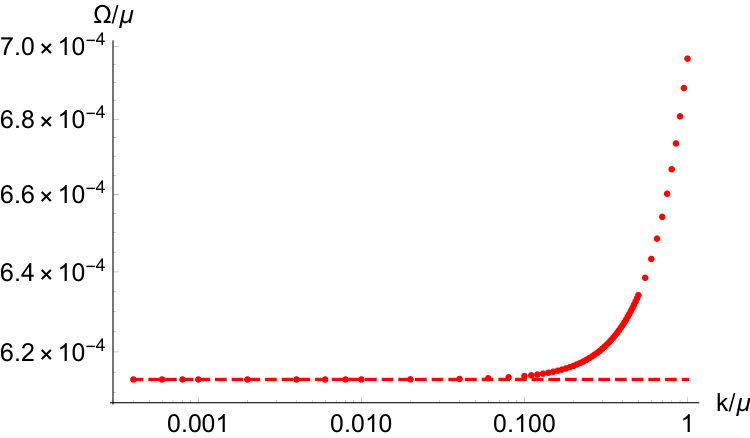 Figure 9
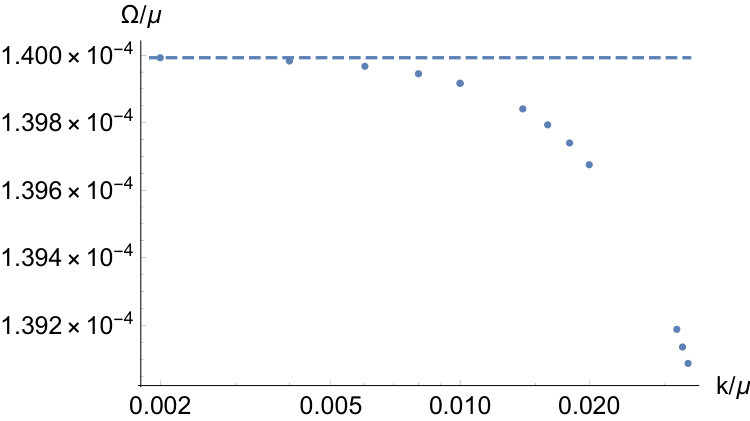 Figure 10
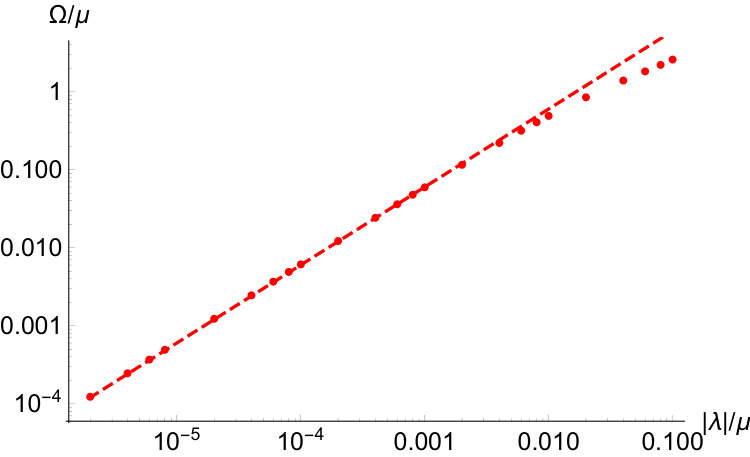 Figure 11
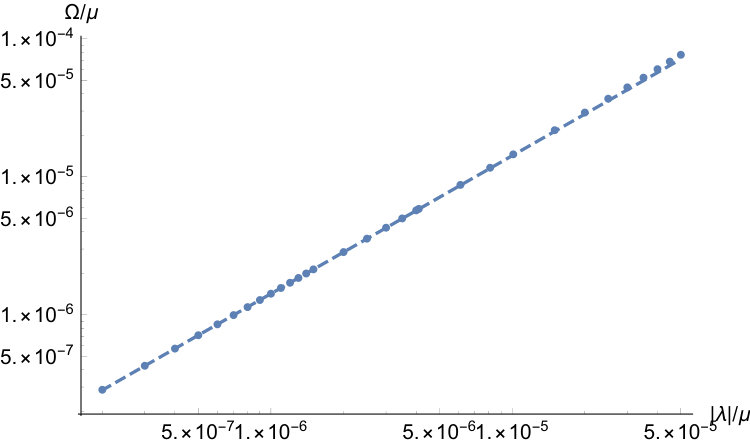 Figure 12
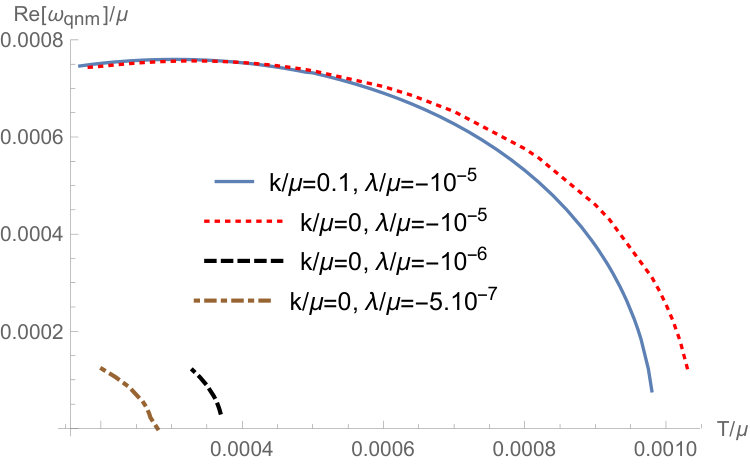 Figure 13
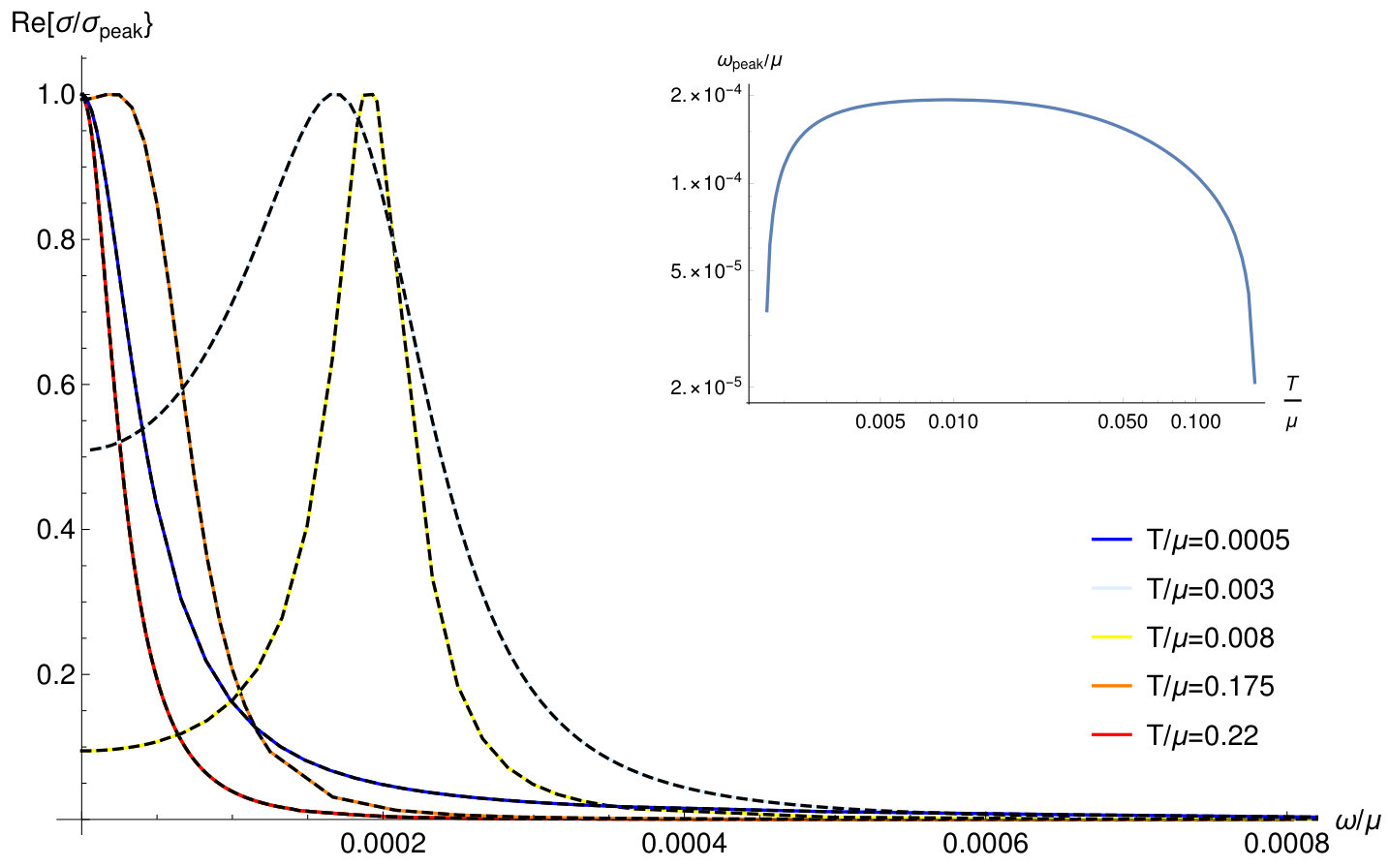 Figure 14
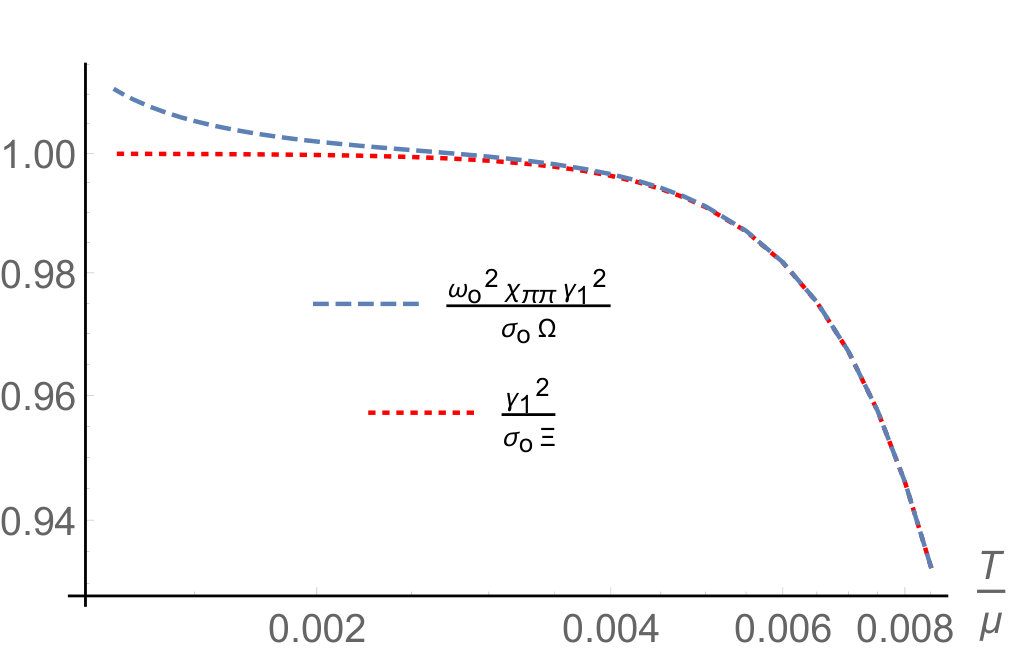 Figure 15
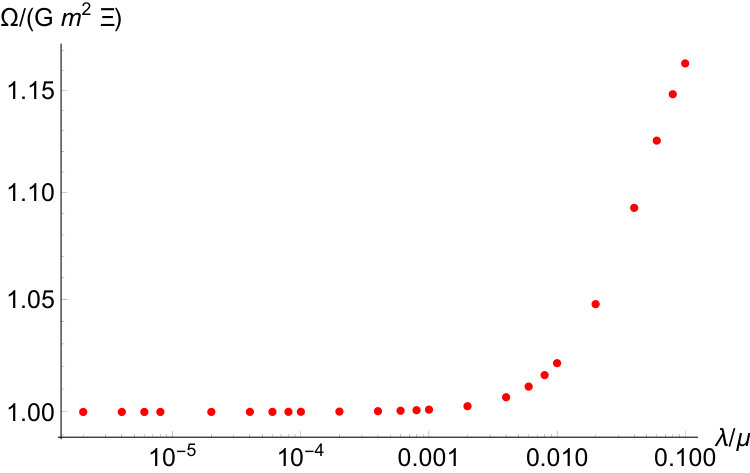 Figure 16
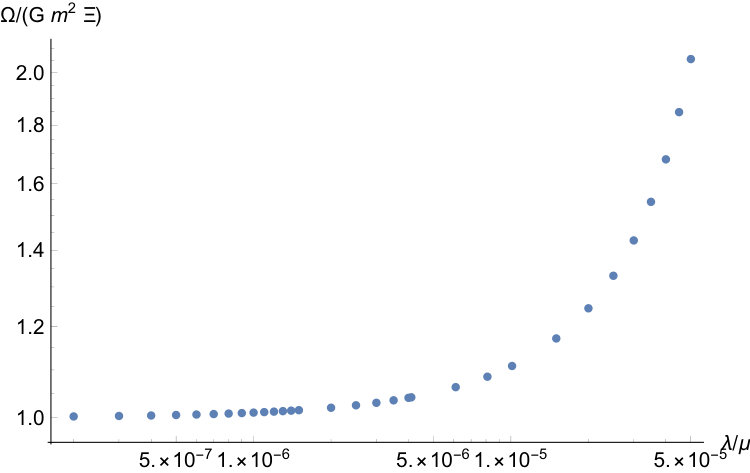 Figure 17
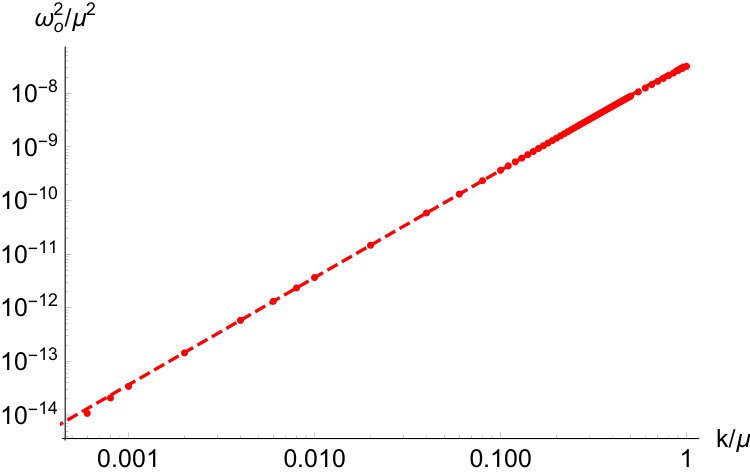 Figure 18
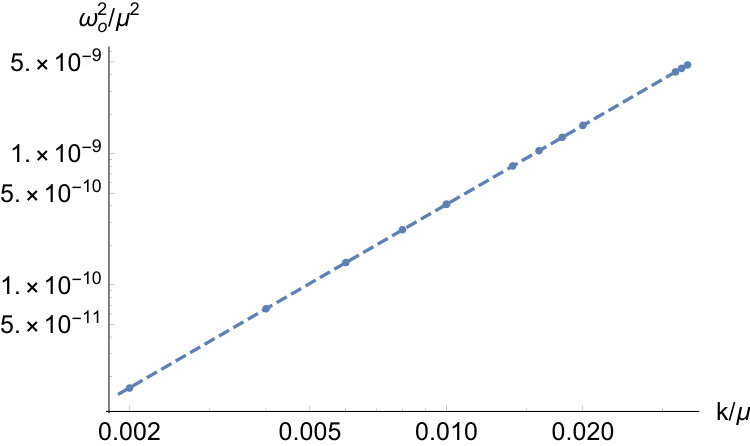 Figure 19
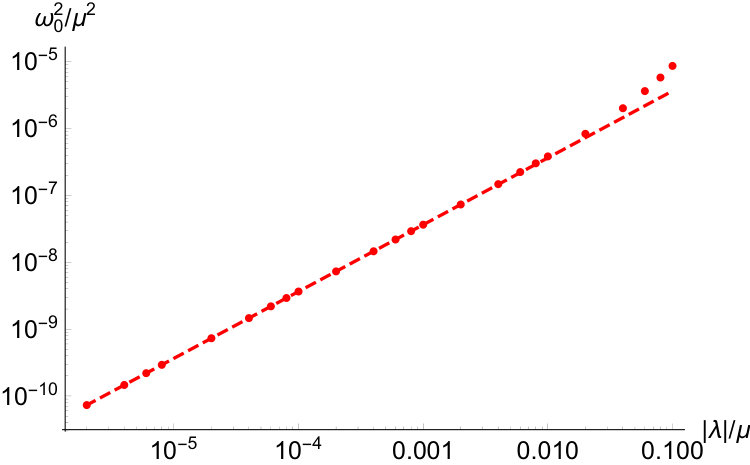 Figure 20
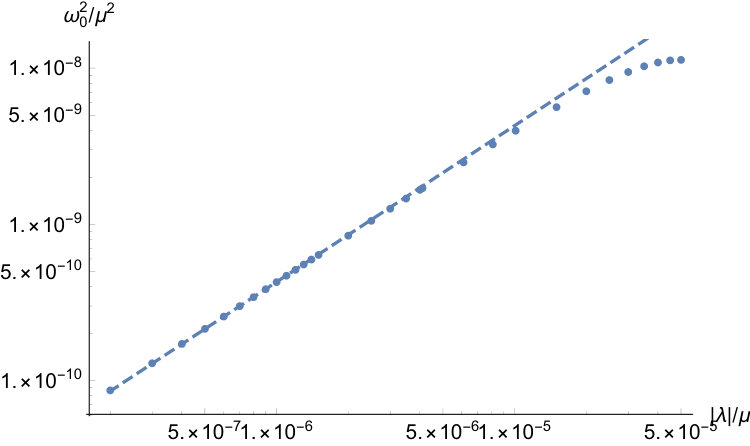 Figure 21
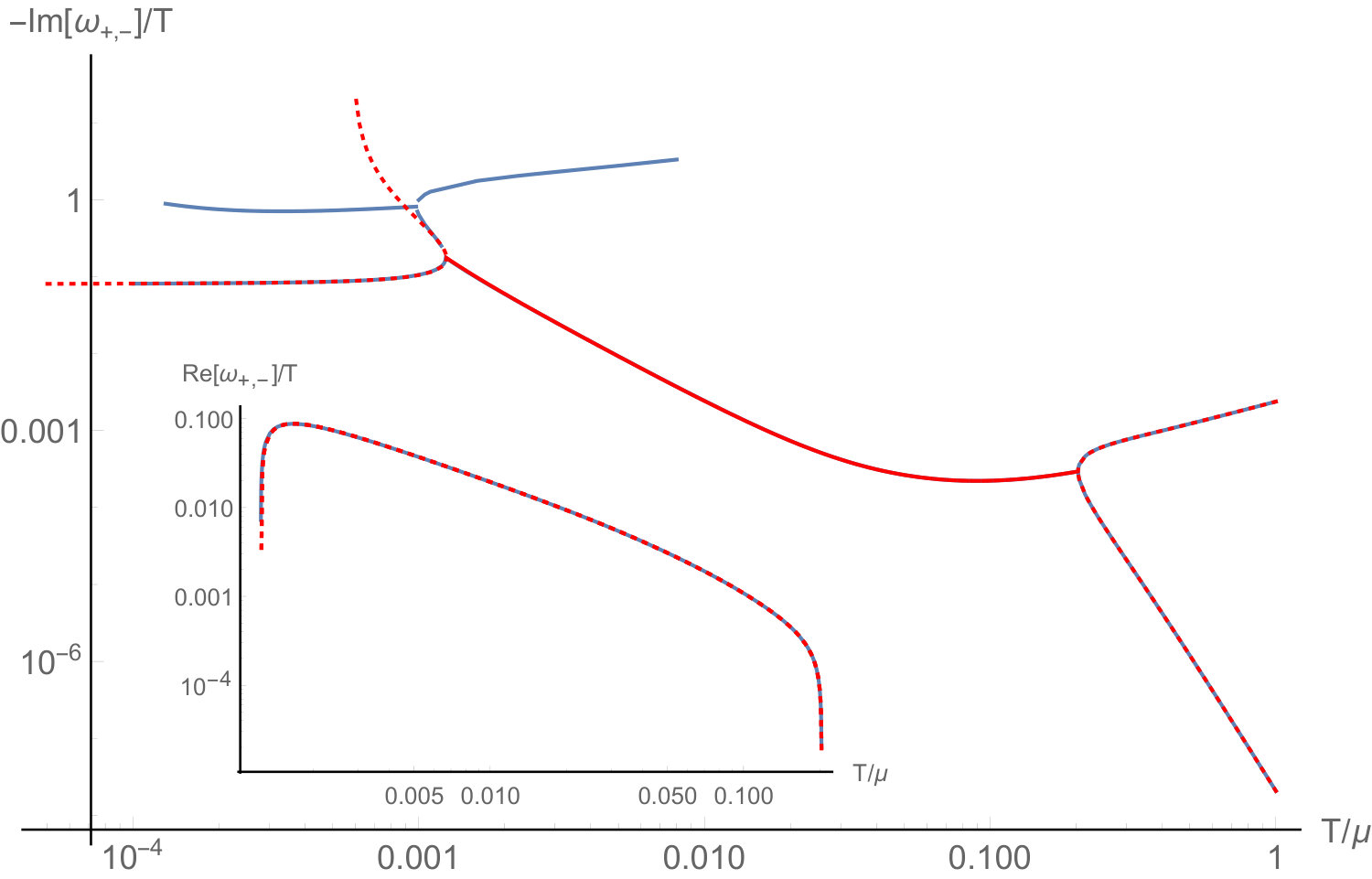 Figure 22
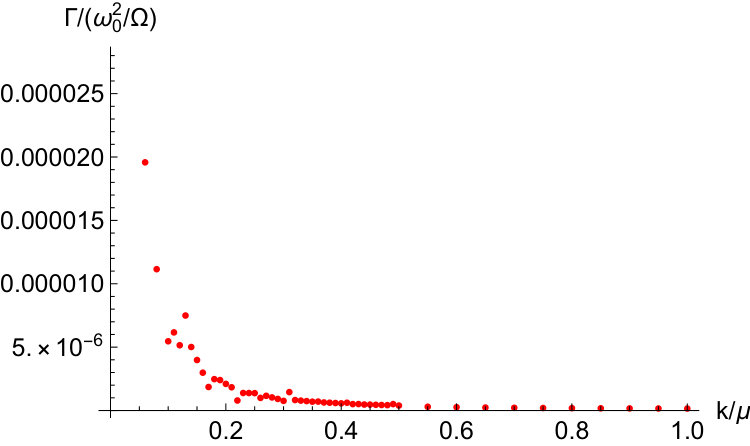 Figure 23
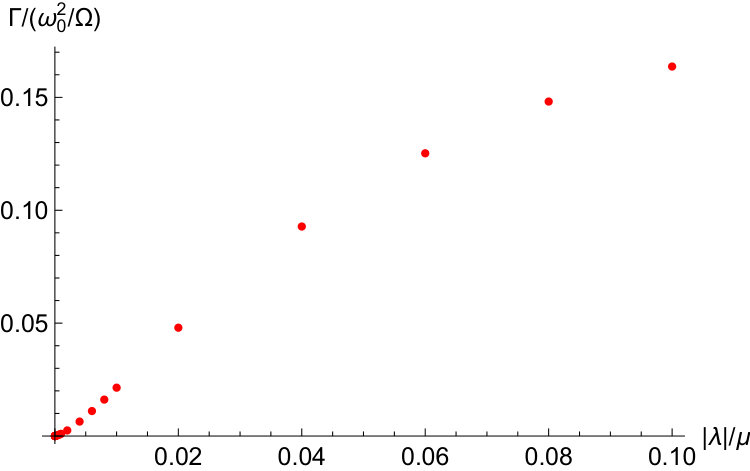 Figure 24
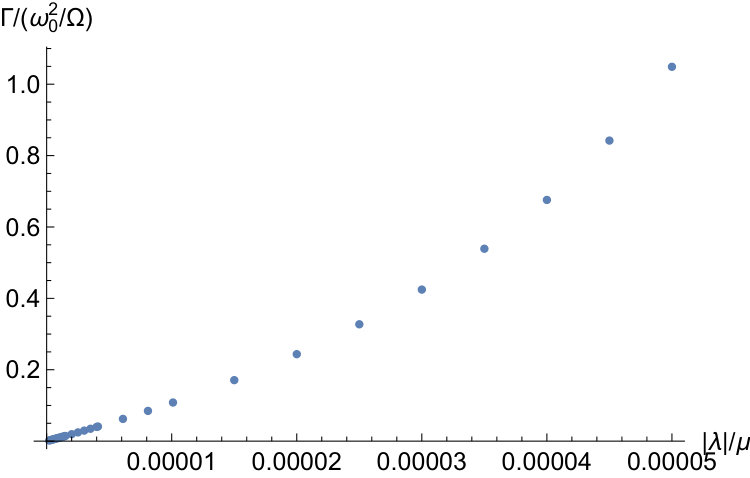 Figure 25
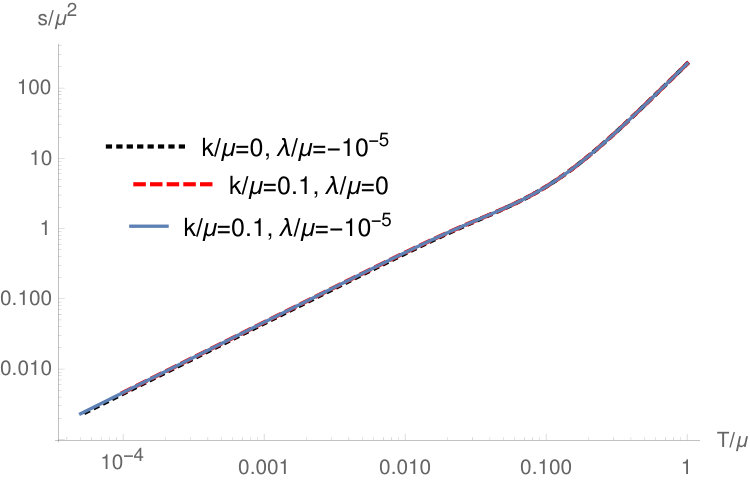 Figure 26
Peer Reviews
No public reviews on file for this paper yet. If you reviewed it on a platform where reviews are public (OpenReview, ICLR, NeurIPS, ICML), you can paste yours below so the community can read it here.
Videos
No videos yet. Explain this paper in a talk, walkthrough, or lecture? Add one.
Universal relaxation in a holographic metallic density wave phase
Andrea Amoretti
Dipartimento di Fisica, Università di Genova, via Dodecaneso 33, I-16146, Genova, Italy and I.N.F.N. - Sezione di Genova
Physique Théorique et Mathématique and International Solvay Institutes Université Libre de Bruxelles, C.P. 231, 1050 Brussels, Belgium
Daniel Areán
Instituto de Física Teórica UAM/CSIC, Calle Nicolás Cabrera 13-15, Cantoblanco, 28049 Madrid, Spain
Blaise Goutéraux
CPHT, CNRS, Ecole polytechnique, IP Paris, F-91128 Palaiseau, France
Nordita, KTH Royal Institute of Technology and Stockholm University, Roslagstullsbacken 23, SE-106 91 Stockholm, Sweden
and Daniele Musso
Departamento de Física de Partículas, Universidade de Santiago de Compostela and Instituto Galego de Física de Altas Enerxías (IGFAE).
Abstract
In this work, we uncover a universal relaxation mechanism of pinned density waves, combining Gauge/Gravity duality and effective field theory techniques. Upon breaking translations spontaneously, new gapless collective modes emerge, the Nambu-Goldstone bosons of broken translations. When translations are also weakly broken (eg by disorder or lattice effects), these phonons are pinned with a mass and damped at a rate , which we explicitly compute. This contribution to is distinct from that of topological defects. We show that , where is the shear modulus and is related to a diffusivity of the purely spontaneous state. This result follows from the smallness of the bulk and shear moduli, as would be the case in a phase with fluctuating translational order. At low temperatures, the collective modes relax quickly into the heat current, so that late time transport is dominated by the thermal diffusivity. In this regime, the resistivity in our model is linear in temperature and the ac conductivity displays a significant rearranging of the degrees of freedom, as spectral weight is shifted from an off-axis, pinning peak to a Drude-like peak. These results could shed light on transport properties in cuprate high superconductors, where quantum critical behavior and translational order occur over large parts of the phase diagram and transport shows qualitatively similar features.
pacs:
††preprint: CPHT-RR116.122018††preprint: IFT-UAM/CSIC-18-130††preprint: NORDITA 2018-125
The spontaneous formation of charge density waves and other types of translational order in weakly-coupled one-dimensional metals is well-understood: the Peierls instability opens a gap and a collective mode of electron-hole pairs is formed Grüner (1988). After condensation, the spectrum of the system contains a gapless mode (the phase of the condensate, ie the Goldstone boson generated by the spontaneous breaking of translations): physically, the density wave can slide without energy cost. In the presence of weak disorder or lattice effects, the Goldstone (or with a slight abuse of terminology, phonon) is pinned. More formally, weak explicit breaking of translations generates a small phonon mass .
Pinning has dramatic consequences on the linear frequency-dependent response. Assuming a normal metallic state with an ac conductivity characterized by a Drude-like peak centered at zero frequency, the spatially modulated state is characterized by a transfer of spectral weight to finite frequencies: an off-axis peak is formed at the so-called pinning frequency . In classic treatments Grüner (1988), the Goldstone contribution vanishes at zero frequency and the system is an electrical insulator.
The pinning peak is also characterized by its width, which heuristically captures the typical lifetime of excitations of the system. There are two well-known contributions to the peak width Grüner (1988). One comes from the rate at which the momentum of the system relaxes due to disorder or lattice effects. The other comes from the rate at which the Goldstone relaxes in the presence of mobile defects Halperin and Nelson (1978). In direct analogy to how vortices relax superfluid phase gradients and eventually destroy superfluidity, dislocations/disclinations also spoil phase coherence of the density wave. The phonon contributes to the dc conductivity where is the plasma frequency (the Drude weight), Delacrétaz et al. (2017a). As temperature decreases, defects freeze out, leading to vanishing phase relaxation and insulating behavior.
Density waves play an important role in the phase diagram of cuprate high superconductors. These materials are doped Mott insulators Keimer et al. (2015), which tend to order translationally upon doping Zaanen and Gunnarsson (1989); Tranquada et al. (1996); Kivelson et al. (1998, 2003); Hücker et al. (2011); Peng et al. (2018); Arpaia et al. (2018); Huang et al. (2017). In the strange metallic phase, their resistivity scales linearly with temperature Bruin et al. (2013) and violates the Mott-Ioffe-Regel limit Gunnarsson et al. (2003). This signals the breakdown of the quasiparticle picture and is usually interpreted as a sign of strongly-coupled dynamics. This behavior has been attributed to an underlying metallic quantum critical point with maximal, Planckian dissipation Sachdev (2011); Zaanen (2004) characteristic of strongly-coupled phases.
In the strange metallic phase, a shift of spectral weight is often observed with sharp Drude peaks at low temperatures moving off-axis as temperature increases Hussey et al. (2004). Quantum melting of stripe order by proliferating defects has been proposed as the origin of the strange metallic phase, see eg Kivelson et al. (1998); Taillefer (2010), but microscopic descriptions of fluctuating stripes in the vicinity of a quantum critical metallic phase and their effects on the ac conductivity remain a challenge Abanov and Chubukov (2000); Metlitski and Sachdev (2010); Mross and Senthil (2012a, b). Based on an effective field theory approach (hydrodynamics), Delacrétaz et al. (2017b) argued that fluctuating translational order could cause the shift in spectral weight mentioned above. However the relaxation parameters , and enter as an input in the hydrodynamic theory, and need to be computed by a microscopic theory valid at strong coupling.
In this Letter, we combine Gauge/Gravity duality with hydrodynamics Delacrétaz et al. (2017a) to study the long distance transport properties of strongly-coupled, weakly-pinned density waves in the vicinity of a metallic quantum critical phase with a -linear resistivity. Gauge/Gravity duality allows to address the strongly-coupled dynamics of certain quantum field theories by mapping them to a weakly-coupled theory of gravity Maldacena (1999); Ammon and Erdmenger (2015); Zaanen et al. (2015); Hartnoll et al. (2016).
We identify unambiguously a new contribution to the phase relaxation rate due to weak explicit breaking of translations, which drives the shift in spectral weight and dominates the resistivity. While this type of damping is well-known from studies of the magnetic field-induced melting of Wigner solids Fukuyama and Lee (1978a); Fogler and Huse (2000), and phonon damping by disorder was studied very early on, see eg Fukuyama and Lee (1978b); Finger and Rice (1983), it was reported to affect the ac conductivity only through the pinning frequency and the momentum relaxation rate Grüner (1988); Delacrétaz et al. (2017a). Our results should also shed light on previous holographic studies of pinned density waves Ling et al. (2014); Baggioli and Pujolas (2015); Jokela et al. (2017a); Andrade et al. (2018a); Alberte et al. (2018a); Andrade et al. (2018b); Andrade and Krikun (2018), where this contribution was not explicitly identified. In passing, we verify the validity of the hydrodynamic theory of damped and pinned density waves written in Delacrétaz et al. (2017a).
Furthermore, we uncover a universal relation between the phonon damping rate and its mass,
[TABLE]
is a phonon diffusive transport coefficient, the phonon shear modulus, the charge density, the momentum static susceptibility and the pinning frequency is defined from the phonon mass as . It is universal since it determines microscopic parameters in terms of universal thermodynamic/hydrodynamic data. The expression for the resistivity is reminiscent of an Einstein relation. We show that this relation is true in the limit of small bulk and shear moduli. We expect it will hold more generally in phases with fluctuating translational order, or close to a phase transition towards a translationally-ordered phase, where these quantities are small.
Remarkably, at low temperatures, we observe that the system saturates a bound ensuring the positivity of entropy production. This is naturally explained by relaxation of the phonons into the heat current. The resistivity is then controlled by the thermal diffusivity . Our result resonates with the idea that the thermalization time in strange metals and other strongly-coupled quantum phases is bounded from below by the ‘Planckian’ timescale Sachdev (2011); Zaanen (2004) and that production of entropy is minimal eg through a lower bound on the shear viscosity Kovtun et al. (2005); Davison et al. (2014); Zaanen (2018).
We now explain in more detail how we arrive at these results, and close by commenting further on the relevance of our results to strange metals.
A number of technical details are relegated to a few Appendices.
I Holographic model
We consider the holographic model Donos and Gauntlett (2014a)
[TABLE]
with the scalar couplings behaving near the AdS boundary as , , . For concreteness, in our numerical calculations we work with , , . Details of our numerical procedure are given in appendix B.
The model (2) enjoys a global shift symmetry . Adopting the background Ansatz , , the product of spacetime translations and shifts is broken to a diagonal . The then transform non-linearly under translations precisely as Goldstones of broken translations are expected to. The other background fields can consistently be taken to depend solely on the holographic radial coordinate, , , . Near the AdS boundary , , where is the source and the vev of the operator dual to . Moreover, the bulk scalar fields can be rewritten as complex scalars close to the boundary. This shows that the breaking is spontaneous when or explicit when Amoretti et al. (2016, 2018a, 2018b), which is the main focus of this work.
This holographic model does not capture the phase transition between the normal and the ordered phase. Instead, it describes the low energy dynamics of the (pseudo)phonons in the ordered phase, consistent with the pattern of symmetry breaking in an isotropic, two-dimensional Wigner crystal (WC) 111A similar model was considered in Iqbal et al. (2010) to study spin density waves. Previous recent holographic studies of collective transport in phases that break translations spontaneously include Jokela et al. (2017b, a); Alberte et al. (2018a); Andrade et al. (2018a); Alberte et al. (2018b); Andrade et al. (2018b)..
Finite temperature, finite density states are modeled by charged black holes in the bulk, which implies the existence of a regular Killing horizon at . Hereafter, we use a subscript to denote quantities evaluated at .
II Unrelaxed WC hydrodynamics from holography
Aspects of unrelaxed WC hydrodynamics were studied previously in Amoretti et al. (2018a, b), and are reviewed in appendix A. The hydrodynamic retarded Green’s functions at zero wavevector for the electric current and the phonons are Chaikin and Lubensky (1995); Delacrétaz et al. (2017a)
[TABLE]
, and are diffusive transport coefficients that appear in the longitudinal sector of hydrodynamic constitutive relations at first order in gradients Delacrétaz et al. (2017a). , with the entropy density given by the horizon area, by the electric flux out of the horizon and the chemical potential . The bulk and shear moduli are Alberte et al. (2018b); Amoretti et al. (2018a); Alberte et al. (2018b). has been computed in Amoretti et al. (2018a, b); Donos et al. (2018), and the computation of and is presented in the companion paper Amoretti et al. (2019):
[TABLE]
We have verified that these expressions match the correlators computed numerically and that the phonons are dual to the vevs of the bulk fields Amoretti et al. (2019). After turning on relaxation, these coefficients only receive small corrections, which can be safely neglected.
III Relaxed WC hydrodynamics from holography
To describe weak explicit breaking of translations, we assume . We also take . In our numerics, we choose and . At zero wavevector , WC hydrodynamics predicts for the ac conductivity Delacrétaz et al. (2017a) (see appendix A)
[TABLE]
We have set , consistent with our numerics (see appendix D). There are two gapped poles, which capture the relaxation of the phonons and of momentum:
[TABLE]
In figure 1, we compute numerically (see appendix B.2 for details) the lightest pair of quasi-normal modes (QNMs) of the holographic system at zero wavevector and match their location to (6), see figure 2.
We also find that , (see appendix D) and , so that 222Similar Gell Mann-Oakes-Renner relations have previously been obtained in holography and in field theory Amoretti et al. (2016); Musso (2018); Andrade and Krikun (2018).. This implies that both and can be extracted in the limit , ie small bulk and shear modulus. In this limit, the hydrodynamic correlator of the transverse phonon is
[TABLE]
Near the boundary, , where is the source and the vev. In appendix C, we show that the phonon is . The pseudo-diffusive pole at is a consequence of the explicit breaking of the global shift symmetry when . We also compute:
[TABLE]
The match to the exact numerics is excellent, see figures 1 and 2.
At small , (LABEL:gamma1xiUnrelaxed) becomes . Putting this together with (8) leads to the relation (1) above. This is one of our key results, and shows that the relaxation of the phonon is entirely governed by a diffusivity of the unrelaxed theory, in the entire range of temperatures where WC hydrodynamics applies.
Assuming , the holographic Ward identity governing momentum relaxation is , which shows that controls the strength of momentum relaxation. Recall that while . Restoring in the WC hydrodynamic expressions for the retarded Green’s functions,
[TABLE]
[TABLE]
The Ward identity relates both quantities on the left hand side to evaluated at (see appendix C), leading to the same expressions as in (8).
IV Charge transport at high temperature
As in many conventional systems where translations are broken spontaneously Grüner (1988), our holographic system is an electrical insulator () at high .
Its dc conductivity is , Donos and Gauntlett (2014b); Goutéraux (2014). Our numerics reveal that the dc conductivity is dominated by phase relaxation, .
As decreases, the ac conductivity (see figure 3) shows a pinning peak moving away from zero frequency, . Correspondingly, the two poles collide, acquire a real gap and move away from the imaginary axis at low temperatures, see figure 1. The match between the lineshape of the ac conductivity and the hydrodynamic prediction (5) is excellent. and are obtained from the location of the QNMs. We emphasize that there is no further fitting: and are computed using (LABEL:gamma1xiUnrelaxed), and directly from the numerical background.
V Charge transport at low temperatures
For temperatures , the bulk geometry undergoes a qualitative change and becomes conformal to AdSR2 near the horizon Amoretti et al. (2018a, b), with and metallic behavior – see eg Anantua et al. (2013); Davison (2013) and appendix B.1.
As temperature is lowered, the two off-axis QNMs turn around and move back towards the imaginary axis, see figure 1.
Accordingly, the off-axis peak in reverses direction, , and moves back towards zero frequency, see figure 3. In this region, small deviations between the hydrodynamic formula (5) and the exact ac conductivity computed numerically are observed, together with a small mismatch between the dc values of at most . The first reason is that a third QNM is coming closer. The second reason are small but finite departures from the hydrodynamic formula (5) at low temperatures, similar to those reported in Davison and Goutéraux (2015a). In contrast, at high these corrections decay like a negative power of , similar to Davison and Goutéraux (2015b).
Eventually, the two QNMs collide, and one of them moves back up the imaginary axis, dominating the dynamics at very low temperatures. The other QNM goes down the imaginary axis and collides at with the third QNM mentioned above, which signals the breakdown of WC hydrodynamics. is controlled by the magnitude of the explicit breaking scale (see figure 8 in appendix C). Below , the system behaves like a fluid with slow momentum relaxation with a Drude-like conductivity Hartnoll et al. (2016)
[TABLE]
see figure 3. The longest-lived QNM captures slowly-relaxing momentum and controls the width of the Drude peak. Its location is predicted to be (setting in the right hand side of (9) for purely explicit breaking). In this regime, the phonons have decoupled from momentum: the two sub-dominant QNMs are very well approximated by the two longest-lived QNMs of the correlator (the phonons), and contribute negligibly to .
To summarize, we can distinguish between a high temperature phase with a crossover from insulating to metallic behavior as , dominated by damped, pinned phonons as predicted by WC hydrodynamics Delacrétaz et al. (2017a); and a low temperature metallic phase at , where the charge dynamics of the system is simply governed by slow momentum relaxation, and the phonons are decoupled.
VI Universal low temperature relaxation
Another universal aspect of relaxation in our model stems from positivity of entropy production in WC hydrodynamics, which places a bound on transport coefficients (see appendix A)
[TABLE]
Due to (1), both terms on the right hand side are equal. At temperatures marking the onset of the quantum critical phase, we observe from (LABEL:gamma1xiUnrelaxed) (neglecting eg terms vs or ) and our numerics (see figure 4) that
[TABLE]
where since (from relativistic symmetry) and . The expressions (13) saturate the bound (12).
These results can be explained by considering the relaxation of the phonons into the heat current , which is a universal mechanism in finite temperature systems. In particular, as translations are explicitly broken in our system, the only collective modes at the longest distances are diffusion of charge and energy. From WC hydrodynamics Delacrétaz et al. (2017a),
[TABLE]
[TABLE]
The limits and zero relaxation do not commute. The limit must be taken last. The universal contribution to the Hamiltonian gives . This leads to (13) using (14) and (15): in this regime relaxation is controlled by thermal/incoherent diffusion processes Davison et al. (2015, 2019, 2018).
The small violation of the bound (12) in figure 4 as signals the breakdown of WC hydrodynamics. As , as well, so that in the spontaneous limit WC hydrodynamics applies to arbitrarily low temperatures and the bound saturates without violation Amoretti et al. (2019). In Amoretti et al. (2019), we also discuss how this depends on the scaling properties of the IR critical phase.
VII Outlook
Experimental data in bad metals suggests , Delacrétaz et al. (2017b) (see also Wang et al. (2018); Charnukha et al. (2018) for more recent experimental observations). In our holographic model, while , we do not observe . This is because in the region where , the phonon mass has a very weak dependence on temperature, while , consistent with the resistivity .
A linear temperature dependence would obtain if Delacrétaz et al. (2017b), as expected for quantum fluctuations of an order parameter in the vicinity of a quantum critical point Sachdev (2011), provided . For small bulk and shear modulus, this is indeed the behavior predicted by WC hydrodynamics in our system for the thermal diffusivity, . In strongly-coupled systems, diffusivities are expected to saturate a lower bound Hartnoll (2015), where is some characteristic velocity. This is the behavior reported in recent experiments on cuprates and cold atoms Zhang et al. (2017, 2018); Brown et al. (2018). It would be interesting to further investigate if holographic models of pinned density waves can capture this behavior.
Two distinct universal relaxation mechanisms are at play in our model. First, the smallness of the shear and bulk moduli implies in the whole temperature regime where WC hydrodynamics applies . Independently, at low temperatures , the phonons relax into the heat current leading to (13) (see also Delacrétaz et al. (2019)). Universal relaxation by hydrodynamic operators was discussed previously in Davison et al. (2014); Lucas (2015) (see also Zaanen (2018)). This motivates a better characterization of the parameter space where these relaxation mechanisms dominate, including in other holographic models of pinned translational order Jokela et al. (2017a); Andrade et al. (2018a); Alberte et al. (2018a); Andrade et al. (2018b); Andrade and Krikun (2018); Donos and Pantelidou (2019), in order to consider further their applicability to real materials.
Acknowledgements.
We would like to thank Riccardo Argurio, Marco Fazzi, Saso Grozdanov, Javier Mas, Alfonso Ramallo and Javier Tarrío for stimulating and insightful discussions. We thank Richard Davison for comments on a previous version of the manuscript. We would also like to thank Tomas Andrade and Alexander Krikun for sharing with us an advanced draft of their work Andrade and Krikun (2018), which has some overlap with our results. BG would especially like to thank Luca Delacrétaz, Sean Hartnoll and Anna Karlsson for numerous insightful discussions on Wigner crystal hydrodynamics and the various relaxation mechanisms for the phonons. BG has been partially supported during this work by the Marie Curie International Outgoing Fellowship nr 624054 within the 7th European Community Framework Programme FP7/2007-2013 and by the European Research Council (ERC) under the European Union’s Horizon 2020 research and innovation programme (grant agreements No 341222 and No 758759). DM is funded by the Spanish grants FPA2014-52218-P and FPA2017-84436-P by Xunta de Galicia (GRC2013-024), by FEDER and by the María de Maeztu Unit of Excellence MDM-2016-0692. D.A. is supported by the ‘Atracción del Talento’ programme (Comunidad de Madrid) under grant 2017-T1/TIC-5258 and by Severo Ochoa Programme grant SEV-2016-0597 and FPA2015-65480-P (MINECO/FEDER). D.A. and D.M. thank the FRont Of pro-Galician Scientists for unconditional support.
Appendix A Wigner crystal hydrodynamics
We briefly recap the main features of Wigner crystal hydrodynamics, in the presence of weak explicit breaking of translations. More details can be found in Chaikin and Lubensky (1995); Delacrétaz et al. (2017a). As translations are broken spontaneously along both spatial directions, the usual conserved densities (energy, charge, momentum) need to be coupled to two Goldstone modes, , . The free energy is supplemented by terms capturing the effect of the Goldstones:
[TABLE]
and are the bulk and shear moduli, and characterize the stiffness of phase fluctuations around the ordered state. is the Goldstone mass generated by the explicit breaking of translations. It is convenient to parameterize the Goldstones by their longitudinal and transverse contributions, and . The corresponding sources are defined by requiring that .
To leading order in gradients and keeping only linear terms, the Goldstones obey the following ‘Josephson’ relations
[TABLE]
where is the velocity, the chemical potential, and and are diffusive transport coefficients. We have introduced two Goldstone damping rates and . They can in principle be distinct. For instance, in the presence of dislocations, the climb motion of dislocations, , is suppressed Beekman et al. (2017).
These Josephson relations are supplemented by current, heat and momentum conservation equations (energy can be traded for entropy to linear order):
[TABLE]
together with the constitutive relations
[TABLE]
The underlying conformal symmetry of the holographic setup implies that the stress-energy tensor is traceless, which sets the bulk viscosity to zero.
The hydrodynamic retarded Green’s functions at nonzero frequency and wavevector are derived by following the Kadanoff-Martin procedure Kadanoff and Martin (1963); Kovtun (2012):
[TABLE]
where the vevs and the corresponding sources are . is the matrix
[TABLE]
Relativistic symmetry of the holographic setup enforces that the momentum and energy current densities must be equal , which places constraints on the transport coefficients:
[TABLE]
Observe that this also means that the heat current . Finally, the susceptibility matrix is333In general, nonzero static susceptibilities , are also allowed. They play no role in our analysis, so we have set them to zero.
[TABLE]
A nonzero Goldstone mass implies that the Goldstone static susceptibilities are finite in the limit (rather than divergent like if ): there is no long range translational order in the system in the presence of explicit breaking.
Positivity of entropy production can be ensured by requiring all the eigenvalues of the matrix to be positive Delacrétaz et al. (2017a). This implies:
[TABLE]
Using (20) and identities between the Green’s functions stemming from (18) gives the retarded Green’s functions quoted in equation (LABEL:gamma1xiUnrelaxed) of the main text (with relaxation parameters turned off). We defined eg
[TABLE]
In this limit, and in absence of relaxation, for an isotropic crystal, , since there should be no distinction between the longitudinal and transverse phonons. This leads to the constraint
[TABLE]
Of direct interest to us is the presence in the longitudinal part of the spectrum of a diffusive mode, which in the limit of small bulk and shear moduli takes the simple expression:
[TABLE]
This diffusive mode can be thought of as encoding the dissipation of the longitudinal Goldstone mode at long distances.
When translations are broken explicitly but the breaking is weak, the two Goldstone damping rates , become -dependent (see Delacrétaz et al. (2017a)). In the long distance limit applicable to conductivities, , they are equal . Although explicit translation symmetry breaking was not considered as a microscopic origin for in Delacrétaz et al. (2017a), the functional form of the hydrodynamic equations and retarded Green’s functions is insensitive to the microscopic origin of such terms. Phonon damping by disorder was studied very early on, see eg Fukuyama and Lee (1978b); Finger and Rice (1983), but was reported to affect the ac conductivity only through a pinning mass and momentum relaxation rate Grüner (1988). Here we show that it also leads to phase relaxation in the sense of Delacrétaz et al. (2017b, a) and a nonzero dc conductivity. This is well-known from studies of the magnetic field-induced melting of Wigner solids Fukuyama and Lee (1978a); Fogler and Huse (2000)
The conductivity equation (5) quoted in the main text is defined from the retarded Green’s function of the current
[TABLE]
The poles in the denominator of this expression are given in equation (6) of the main text, with the pinning frequency defined as and setting . For reference, we quote here its full expression without neglecting terms proportional to the momentum relaxation rate :
[TABLE]
The Drude formula in equation (11) of the main text is recovered by setting the pinning frequency to zero or equivalently sending .
Appendix B Numerical methods
We have computed numerically black hole solutions to the action
[TABLE]
We adopt the following Ansatz for the metric and matter fields
[TABLE]
which allows for solutions that break translations pseudo-spontaneously. This follows from the Ansatz for the scalars and the asymptotic behavior of the scalar coupling , as explained in the main text.
The resulting equations of motion can be reduced to a system of four ordinary differential equations (three are second order and one is first order). The scalar couplings behave in the UV as
[TABLE]
The asymptotic behavior of the metric and matter fields is
[TABLE]
where higher order coefficients are functions of , , , , , and . Notice that in order for this solution to asymptote to AdS we must have , and . is the charge density, the chemical potential and is related to the vev of the scalar .
We can also expand the solution near the black hole horizon :
[TABLE]
In our numerics, we choose for the potentials
[TABLE]
Then
[TABLE]
determines the temperature of the black hole , and further higher order coefficients in (35) are also determined in terms of , , , and .
By using the scale invariance , , of the equations of motion, we can set the horizon radius in our numerical computations. Numerical solutions are generated by integrating the equations of motion from the IR () to the UV (). Using another scale invariance of the equations under , , , we set . This fixes , leaving three free IR parameters , , ; and one UV condition: . Therefore, for each value of we expect to obtain a two-parameter family of solutions. We can choose those parameters to be the dimensionless ratios , . All in all we can parametrize the space of solutions in terms of the three dimensionless ratios , , and .
In this work we are interested in solutions breaking translations pseudo-spontaneously. These are geometries where .
B.1 Low temperature, near horizon geometry
As we decrease the temperature below , the scalar diverges near the horizon. The scalar couplings become
[TABLE]
leading to a solution of the equations of motion conformal to AdS, with a dynamical Lifshitz exponent Anantua et al. (2013); Davison et al. (2014); Goutéraux (2014); Amoretti et al. (2018a, b):
[TABLE]
This solution is valid for values of the IR radial coordinate . The constants , , , can be determined by matching to the UV AdS4 asymptotics. In these coordinates, , so that the entropy density .
A rough estimate of the temperature where the near horizon geometry becomes conformal to AdS is given by the temperature below which the entropy density becomes linear in temperature. This is displayed in figure 5 for various values of and . All curves fall on top of one another, which demonstrates that is relatively insensitive to the specific value of and for the typical ranges we are interested in.
B.2 AC Correlators: Conductivity and QNMs
In order to compute the conductivity of the boundary theory and the QNMs at zero momentum, it is sufficient to study the following consistent set of fluctuations
[TABLE]
To linear order in the fluctuations, the equations of motion for , , and are a consistent set formed by two second order and one first order differential equation.
For a pseudo-spontaneous background geometry with , the fluctuations have the following UV expansion
[TABLE]
where higher order coefficients are functions of , , , and .
The AC conductivity can be read from through a Kubo formula which in terms of the asymptotic expansion (41) takes the form
[TABLE]
The second equality holds for configurations where the only nonzero source is given by which corresponds to turning on an electric field along . The only other independent source in the UV solution (41) is given by the diffeomorphism-invariant combination
[TABLE]
and it should vanish on the solutions used to compute through (42).
We are interested in computing a retarded correlator, hence we look for solutions with ingoing boundary conditions at the black hole horizon. They read
[TABLE]
with
[TABLE]
and other higher order coefficients determined as well in terms of , and .
We construct numerical solutions by integrating the system of three linear differential equations for from the horizon () to the boundary (). There are two free IR parameters in (44), but since the equations are linear we can scale away one of them (eg set ). Therefore we are left with one free (complex) parameter and one UV boundary condition: we shoot for solutions where the combination (43) vanishes, and read using (42).
We shall next compute the QNMs given by the poles of the holographic correlator where are the set of fields (40). We follow Kaminski et al. (2010) and employ the so-called determinant method. Hence we need to obtain three independent solutions for the fluctuations, and construct the following matrix of sources
[TABLE]
where in order to generate the third column we have used the pure gauge solution
[TABLE]
It is straightforward to construct two independent numerical solutions integrating from the horizon with boundary conditions (44).
Finally, the QNMs, namely the complex frequencies where the holographic Green functions have a pole, are given by the values of for which the determinant of the matrix (46) vanishes Kaminski et al. (2010).
Appendix C correlators at
In this appendix, we solve the equations of motion and compute the correlators of the fields in the limit . Similar results have also been reported in Donos et al. (2019). In this case, both fields decouple and so we will just denote them by . The equation of motion for the fluctuation is
[TABLE]
Using a standard procedure in holography Policastro et al. (2002a, b); Herzog (2003), this equation can be solved perturbatively at small compared to , assuming the presence of a regular black hole horizon. We consider the expansion of the perturbation
[TABLE]
After transforming to Eddington-Finkelstein coordinates, this corresponds to the ingoing mode at the horizon Son and Starinets (2002). The horizon is located at and the boundary at . Plugging (49) into (48), the equation is solved perturbatively order by order in .
The order is trivially solved by a constant, which can always be set to unity by linearity of the equation of motion. The solution at ) reads
[TABLE]
where we have imposed horizon regularity to fix one of the integration constants, and chose the other one such that (which otherwise would simply correspond to a different choice of normalization of the source).
The solution for after imposing horizon regularity is
[TABLE]
We now put everything together back in (49) and expand close to the boundary. For nonzero source , the asymptotic expansion of takes the form
[TABLE]
where the term is the source and the term is related to the vev by
[TABLE]
We find
[TABLE]
with
[TABLE]
and
[TABLE]
This gives a pseudo-diffusive pole located at
[TABLE]
which matches very well the exact location of the pole determined numerically, see figures 6 and 7. The exact numerical dispersion relation deviates from (57) as increases or as decreases, which is expected. Actually, at sufficiently low or large , the pole collides with another purely imaginary pole and moves off axis. This collision and subsequent motion of the poles matches very well the motion of the two CM poles in figure 1 of the main text at the lowest temperatures .
In figure 8, we compare the collision temperature at and by plotting the real part of the relevant QNMs close to the collision. At , there is little variation between and . On the other hand, varying from to shows that depends in a much more pronounced way on the value of , which is expected since (see top row of figure 11 below). Indeed, in the purely spontaneous limit , Amoretti et al. (2019).
The presence of an overdamped mode when is a consequence of the explicit breaking of the global shift symmetry . It is easy to check that when , the gap vanishes and the mode (57) becomes purely diffusive
[TABLE]
which coincides with the limit of the CM diffusivity in equation (6) of the main text. Turning back on, we expect that
[TABLE]
which we verify numerically in figure 9. Small deviations appear at very low temperature, upon approaching the pole collision. This is because the corrections of are no longer small compared to .
Holographic and hydrodynamic correlators may differ by contact terms Kovtun (2012), so we compare
[TABLE]
to
[TABLE]
The two expressions can be seen to match since from (59) and , as we verify in figure 10, after identifying the boundary Goldstone mode and the vev of the bulk operator as
[TABLE]
Appendix D and dependence of the relaxation parameters
Using the quasi-normal modes computed numerically together with the hydrodynamic expression for the conductivity (29) and the analytic expression for the diffusivity (formula (LABEL:gamma1xiUnrelaxed) of the main text), we have been able to compute the relaxation parameters , and and to fit their and dependence. The results are shown in figures 11, 12 and 13 for two different values of the temperature: the red dots refer to and the blue dots to .
The result of the fitting analysis is:
[TABLE]
as reported in the main text. All our best fits include a small intercept, which is typically very close to our numerical zero and should be disregarded.
At either very small or , the dc conductivity we use to extract the relaxation parameters becomes very large, and our numerical procedure loses accuracy. This is particularly apparent in the left panel of figure 13, which shows the dependence of on at high . We find values of of order , which we do not regard as very reliable. For all intents and purposes, should be set to zero, which we have done in the main text. This is further justified by the fact that in this range of , , as shown in the right plot in fig 13. Moreover, we have verified that the values of and obtained setting are quasi-identical to those obtained keeping . At fixed and , we obtain values for oscillating between tiny positive and negative values, once again with little effect on the values of and . For this reason, we have set for the results presented in the right column of figure 12. As a final check, we have verified that the limits for the parameters and agree with the values we find setting exactly, as is done in the previous section.
Figure 14 shows the dependence of the ratio at high and low temperature. As one can see from the plots, for small (eg as it is considered in the main text) the ratio is very small with a very weak dependence on , implying that can be safely neglected as is done in presenting the results in the main text. The situation is different increasing , since becomes comparable to for large enough . This is expected since by increasing we are moving from the pseudo-spontaneous to the purely explicit regime, where any spontaneous component of the system is washed out and is the dominant relaxation scale.
Figure 15 shows the dependence of the ratio at high and low temperature. For small , the dependence on is also very weak, before increasing more sharply as the explicit regime is approached.
Finally, we have checked that as is varied from very low values up to values , the ratio shows no significant deviations from unity.
Acknowledgements.
We are grateful to Hyun-Sik Jeong and Keun-Young Kim for pointing out some typos in a previous version of these appendices.
The reference list from the paper itself. Each links out to its DOI / PubMed record.
- 1Grüner (1988) G. Grüner, “The dynamics of charge-density waves,” Rev. Mod. Phys. 60 , 1129–1181 (1988) . · doi ↗
- 2Halperin and Nelson (1978) B. I. Halperin and David R. Nelson, “Theory of two-dimensional melting,” Phys. Rev. Lett. 41 , 121–124 (1978) . · doi ↗
- 3Delacrétaz et al. (2017 a) Luca V. Delacrétaz, Blaise Goutéraux, Sean A. Hartnoll, and Anna Karlsson, “Theory of hydrodynamic transport in fluctuating electronic charge density wave states,” Phys. Rev. B 96 , 195128 (2017 a) , ar Xiv:1702.05104 [cond-mat.str-el] . · doi ↗
- 4Keimer et al. (2015) B. Keimer, S. A. Kivelson, M. R. Norman, S. Uchida, and J. Zaanen, “From quantum matter to high-temperature superconductivity in copper oxides,” Nature 518 , 179 EP – (2015) , review Article. · doi ↗
- 5Zaanen and Gunnarsson (1989) Jan Zaanen and Olle Gunnarsson, “Charged magnetic domain lines and the magnetism of high- T c subscript 𝑇 𝑐 {T}_{c} oxides,” Phys. Rev. B 40 , 7391–7394 (1989) . · doi ↗
- 6Tranquada et al. (1996) J. M. Tranquada, J. D. Axe, N. Ichikawa, Y. Nakamura, S. Uchida, and B. Nachumi, “Neutron-scattering study of stripe-phase order of holes and spins in la 1.48 subscript la 1.48 {\mathrm{la}}_{1.48} nd 0.4 subscript nd 0.4 {\mathrm{nd}}_{0.4} sr 0.12 subscript sr 0.12 {\mathrm{sr}}_{0.12} cuo 4 subscript cuo 4 {\mathrm{cuo}}_{4} ,” Phys. Rev. B 54 , 7489–7499 (1996) . · doi ↗
- 7Kivelson et al. (1998) S. A. Kivelson, E. Fradkin, and V. J. Emery, “Electronic liquid-crystal phases of a doped mott insulator,” Nature 393 , 550 EP – (1998) . · doi ↗
- 8Kivelson et al. (2003) S. A. Kivelson, I. P. Bindloss, E. Fradkin, V. Oganesyan, J. M. Tranquada, A. Kapitulnik, and C. Howald, “How to detect fluctuating stripes in the high-temperature superconductors,” Rev. Mod. Phys. 75 , 1201–1241 (2003) . · doi ↗