Integrated all-optical manipulation of orbital angular momentum carrying modes via enhanced electro-optic Kerr effect
S. Faezeh Mousavi, Rahman Nouroozi

TL;DR
This paper introduces a novel integrated optical device that uses enhanced electro-optic Kerr effect in PPLN to efficiently manipulate higher order OAM modes for advanced communication and quantum key distribution.
Contribution
It presents a versatile, low-loss integrated optical mode converter utilizing phase-mismatched cascaded polarization coupling in PPLN for OAM mode manipulation.
Findings
Achieves 91% mode purity in OAM mode conversion
Operates with low voltage compatible with commercial modulators
Enables high-capacity, secure quantum communication
Abstract
Mode Division Multiplexing (MDM) technique using higher order Orbital Angular Momentum (OAM) carrying modes through a channelized bandwidth provides enhanced capacity communication systems. OAM based high-dimensional Quantum Key Distribution (QKD) encrypted channels also improve transmission rate and security. All-optical mode-selective spatial distribution manipulation is a significant function in implemented MDM and QKD networks. This paper proposes a novel versatile-designed integrated optical device with Y ridge Periodically Poled Lithium Niobate (PPLN) photonic wire configuration which acts as spatial mode converter for data modulated on higher order OAM modes. It is schemed in such a way that control the phase of decomposed guided modes by enhanced electro-optic Kerr effect via phase-mismatched cascaded polarization coupling interaction in PPLN sections. The…
Click any figure to enlarge with its caption.
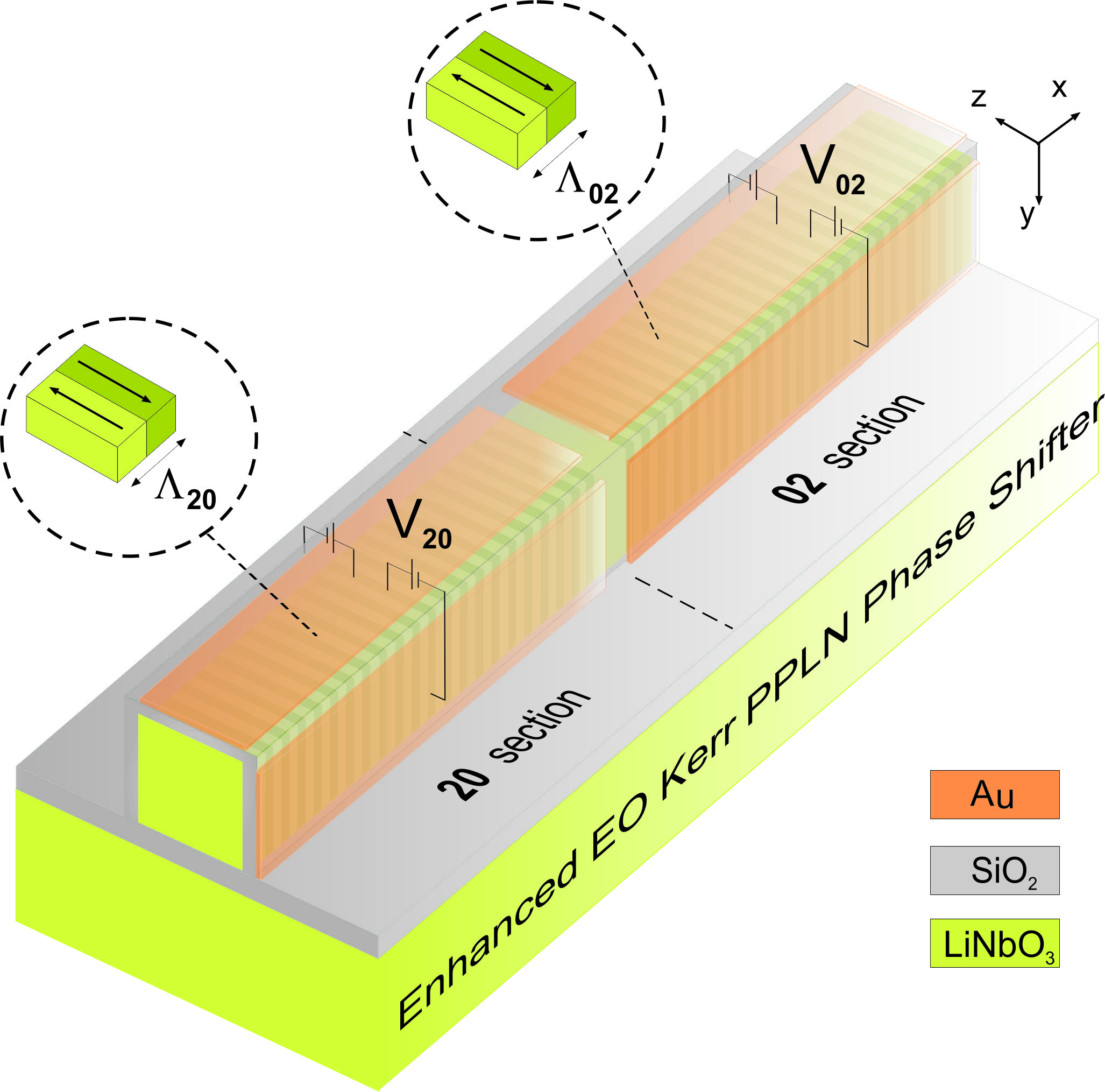 Figure 1
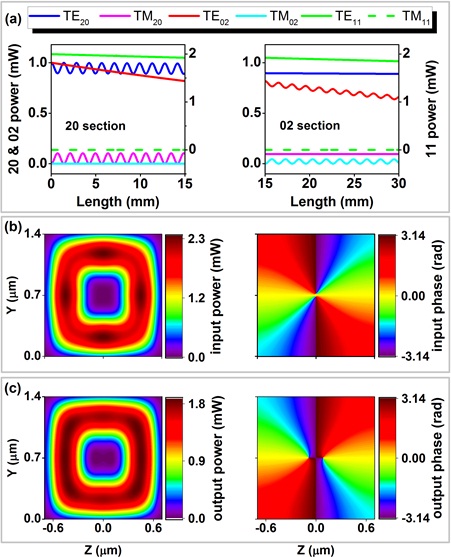 Figure 2
| (dB/cm) | ||
|---|---|---|
| 1.995532 | 0.57900 | |
| 1.987716 | 0.02224 | |
| 2.027477 | 0.11191 | |
| 2.058751 | 0.10033 | |
| 2.076045 | 0.00218 | |
| 2.103931 | 0.01282 |
Peer Reviews
No public reviews on file for this paper yet. If you reviewed it on a platform where reviews are public (OpenReview, ICLR, NeurIPS, ICML), you can paste yours below so the community can read it here.
Videos
No videos yet. Explain this paper in a talk, walkthrough, or lecture? Add one.
Taxonomy
TopicsPhotonic and Optical Devices · Optical Network Technologies · Orbital Angular Momentum in Optics
Integrated all-optical manipulation of orbital angular momentum carrying modes via enhanced electro-optic Kerr effect
S. Faezeh Mousavi
Rahman Nouroozi
Corresponding author: [email protected]
Department of Physics, Institute for Advanced Studies in Basic Sciences (IASBS), Zanjan 45137-66731, Iran
Abstract
Mode Division Multiplexing (MDM) technique using higher order Orbital Angular Momentum (OAM) carrying modes through a channelized bandwidth provides enhanced capacity communication systems. OAM based high-dimensional Quantum Key Distribution (QKD) encrypted channels also improve transmission rate and security. All-optical mode-selective spatial distribution manipulation is a significant function in implemented MDM and QKD networks. This paper proposes a novel versatile-designed integrated optical device with Ycut ridge Periodically Poled Lithium Niobate (PPLN) photonic wire configuration which acts as spatial mode converter for data modulated on higher order OAM modes. It is schemed in such a way that control the phase of decomposed guided modes by enhanced electro-optic Kerr effect via phase-mismatched cascaded polarization coupling interaction in PPLN sections. The low-loss, high-purity (91 %), and low-voltage proposed device enables to operate compatible with applicable commercial modulators in OAM based MDM and QKD communication systems.
pacs:
(130.0130) Integrated optics; (130.3730) Lithium niobate; (230.2090) Electro-optical devices; (260.5430) Polarization; (260.6042) Singular optics; (230.1150) All-optical devices.
I Introduction
Wavelength Division Multiplexing (WDM) and Polarization Division Multiplexing (PDM) are efficient techniques which occupy the fiber bandwidth by independent wavelength and polarization modulated channels, respectively, in order to meet the rapidly growing demands of high transmission capacities in optical networks Qian et al. (2012); PDMWDM2; PDMWDM3. However, the combination of Shannon limit and fiber nonlinearities prohibits larger capacity by these technologies Mitra and Stark (2001). Hence, Space Division Multiplexing (SDM) which utilizes the optimized cross section of the fiber with distinct channels in multi-core and multi-mode outlines, is a potential candidate of breakthrough technology against the capacity crunch Richardson et al. (2013). More specifically, Mode Division Multiplexing (MDM) in multi-mode fibers is an effective method with more achievable performance which exploits orthogonal spatial modes as new degrees of freedom for separately data modulation in independent channels of the fiber bandwidth Ryf et al. (2012). One of the recently interested high order spatial modes in communication systems is Orbital Angular Momentum (OAM) with helical phase structure of (, the azimuthal angle and topological charge) which carries OAM of per optical mode Yao and Padgett (2011). As a theoretically unbounded quantity of , it has been proved that the combination of different OAM spatial modes can considerably expand the limits of traffic capacity in free space and fiber based optical networks Willner et al. (2017); Bozinovic et al. (2013); Wang et al. (2012).
Meanwhile, in response to the security concern of communication systems, Quantum Cryptography (QC) improves privacy, authentication, and confidentiality for users. Quantum Key Distribution (QKD) protocols are effective approaches for commercialization of QC task. QKD schemes conventionally use a qubit system for distributing encoded information between two authorized participants connected by the quantum channel Gisin et al. (2002); Scarani et al. (2009). Beyond two-level bases, it has been shown that employing multi-level quantum states can increase the robustness of a QKD system against eavesdropping Bechmann-Pasquinucci and Tittel (2000); Cerf et al. (2002). High-dimensional QKD is feasible by OAM modulated states and provides higher transmission rates and security Sit et al. (2017); Mirhosseini et al. (2015).
Accordingly, higher order OAM modes play key roles for realization of enhanced capacity and security via MDM and QKD systems in classical and quantum regimes Sit et al. (2017); Huang et al. (2014). Therefore, as future prospects for the next generations of improved telecommunication and encrypted systems, mode-selective manipulation (such as (de)multiplexing, sorting, frequency conversion, polarization conversion, switch, and …) of modulated information by OAM carriers is an inevitable function in actualized systems.
Practically, high-speed all-optically manipulation of encoded data in conventional communication optical channels can be precisely achieved by electro-optical and/or nonlinear effects in integrated optical devices. For instance, wavelength, phase, amplitude, and polarization of the electric field for a communication signal can be all-optically modulated in a miniaturized integrated waveguides Lu et al. (2001); Chang (2009). Hitherto, several on-chip approaches such as asymmetric Y-junction Driscoll et al. (2013), micro-ring Luo et al. (2014) fiber based 28; fusedfiber, multimode interference Uematsu et al. (2012); WDMMDM_MMI, adiabatic Xing et al. (2013), multistaged Bagheri and Green (2009), tapered directional Ding et al. (2013), grating-assisted Qiu et al. (2013), and asymmetrical directional Wang et al. (2014) couplings have been proposed to convert and multiplex the spatial modes. More specifically, some integrated optical modulators have been theoretically and experimentally investigated to emit, (de)multiplexe, switch, receive, detect, and sort OAM carrying modes Zhu et al. (2013); Wang et al. (2016); Strain et al. (2014); Li et al. (2015a); Cai et al. (2012); Wang et al. (2015); Su et al. (2012); Xiao et al. (2016); Guan et al. (2014); Cicek et al. (2016); Rui et al. (2016); Huang et al. (2015). Even more, an integrated optical modulator has been proposed to alter the polarization and rotation handedness of OAM carrying modes via manipulation of their decomposed guided modes by linear electro-optic effect Mousavi et al. (2017). However, although higher () order OAM carrying modes impressively enable to provide even more enhanced capacity and improved security communication systems, but their integrated optically manipulation is not operated yet, to the best of our knowledge.
This paper proposes a versatile-designed integrated optical configuration enabling all-optically exchange of the spatial OAM modes with via electro-optically manipulation of their decomposed guided modes. Similar to the introduced basic device of reference Mousavi et al. (2017), the principal outline of the improved proposed modulator schematically displayed in figure 1 is based on a Ycut Lithium Niobate (LN) on Insulator (silica) (LNOI) ridge photonic wire configuration, whereas LN and silica act as the core and cladding, respectively. The top and lateral gold electrodes are additionally coated for applying external electric field and benefiting nonlinear electro-optic effect. Laguerre Gaussian () modes as famous OAM carriers are combined of Hermite Gaussian () modes with desired amplitudes and relative phases. More specifically, horizontally () (vertically ()) polarized modes are the desired phase related compounds of similarly () polarized and modes for (i. e. ); and , , and modes for (i. e. ) O’Neil and Courtial (2000). Although irradiated () polarized LG modes are not individually guided ones of the symmetric rectangular shaped designed device, but are decomposed into its (), (), and () guided modes which are comparable to the mentioned horizontally (vertically) polarized , , and ones. Since the decomposed guided modes are simultaneously excited in the designed modulator, their separately manipulation and relative phase compensation can achieve desirably modulated modes which carry OAM with high purity. Herein, the manipulation of decomposed guided modes is suggested, for the first time, to be obtained via enhanced electro-optic Kerr effect in cascaded phase-mismatched polarization coupling interactions (in 20 and 02 PPLN sections of figure 1). Whereas the expressed effect can be utilized over diverse wavelength and polarization states, the novel proposed device enables to compatibly operate in practical fiber-based and free-space MDM and QKD communication systems and at the following of any desired polarization and wavelength dependent modulators (such as wavelength and polarization converters) which employ higher order OAM modes.
II Spatial Mode Conversion
Investigating the manipulation of higher order spatial OAM carrying modes, a typical TE polarized OAM mode with is considered to be converted into similarly polarized one but with . The mentioned modes consist of desired phase related three decomposed , and guided modes. Their relative phases at the beginning of the waveguide are in such a way that lead to O’Neil and Courtial (2000). Indeed, this kind of complex higher order spatial mode conversion () can be achieved if the relative phases between three decomposed guided modes are properly accomplished as:
[TABLE]
According to ref Mousavi et al. (2017), such a phase compensation is electro-optically attainable. The proposed modulator of ref Mousavi et al. (2017) was designed for manipulation of (e. g. TE polarized) OAM modes which are decomposed into two guided ones and so included one phase shifter to induce the desired relative phase between and modes. Since at least two relative phases associated to OAM modes have to be satisfied simultaneously, the proposed scheme in ref Mousavi et al. (2017) is not proportional. The improved modulator in this paper, thus, consists of two phase shifters to satisfy two required relative phases between three decomposed guided modes which are adequate for generation of desired OAM modes. Furthermore, albeit spatial mode conversion of OAM modes can be carried out via linear electro-optic process which varies by first order of external applied electric field (and then voltage) Mousavi et al. (2017), it is not sufficient to satisfy more than one relative phases conditions. Consequently, the essential relative phases of the input OAM carrying modes with topological charges are proposed, for the first time, to be fulfilled by strong nonlinear phase shifters based on enhanced electro-optic Kerr effect Li et al. (2015b).
The enhanced Kerr effect as a recently introduced effective electro-optic phenomenon can be realized in LN (as a second order nonlinear medium) via cascaded phase-mismatched polarization coupling interaction Huo and Chen (2012). The polarization coupling process is possible in Periodically Poled Lithium Niobate (PPLN) by perturbation in the dielectric constant tensor of LN due to the transversely applied external electric field Shi et al. (2003). Based on the cascaded phase-mismatched polarization coupling, the effective Kerr constant which is similar to the electro-optical Kerr effect and determined by the transversely applied electric field, is several orders of magnitude larger than that in the classic counterparts, and hence leads to large nonlinear phase shift for the input wave Huo and Chen (2012); Huo et al. (2014).
In the case of input OAM carrying mode incidence into the polarization coupling interaction, the amplitude of decomposed , , and guided modes are related to the orthogonally polarized , , and ones via coupled-mode equations as:
[TABLE]
In this equation, and are the amplitude of input TE () and output TM () decomposed guided modes which are determined by effective loss coefficients and refractive indices of and , respectively. also represents the wave-vector mismatch and so phase-mismatch between two interacting orthogonal modes in wavelength during long sections with poling wavelength of PPLN, and is the coupling coefficient. In the definition of , is the desired electro-optical coefficient of LN, and describes the overlap integral between spatial distribution of two interacting orthogonal optical modes and the external electric field applying in y direction () Shi et al. (2003); Mousavi et al. (2017).
In the limit of weak cascading and trivial depletion of input mode (under non quasi-phase matching (NQPM) condition), the total phase of input TE mode () which consists of propagation and electro-optic phases (), is modified dominantly by second power of applied external electric field () as:
[TABLE]
In this equation, is the rotation angle of new index ellipsoid via applied external electric field and represents the effective electro-optical Kerr constant of input mode Li et al. (2015b). In order to satisfy the appropriate relative phase between three decomposed guided modes which independently accumulate their own phases during the propagation through the device, only two independent PPLN sections with known lengths are thusly considered to weakly convert the orthogonal modes (according to the coupled equations 2) and benefit large nonlinear phase in enhanced Kerr effect (according to equation 3). These two sequent sections are arbitrarily selected and functionalized to negligibly perform and couplings. Thus, three equation 3 for , , and are numerically evaluated. Then two and relative phases equations with two and unknowns are calculated in such a way to provide suitable relative phases between three decomposed modes and achieve conversion. The proposed device which is schematically displayed in Fig. 1 includes two identically 15 mm long PPLN sections for 20 and 02 spatial modes with and poling wavelengths, receptively. Such domain grating wavelengths are chosen to attain high phase-mismatches and weakly and conversions through the cascaded polarization coupling processes in 20 and 02 PPLN sections. The numerically calculated voltages which consequently change TE modes of into are and volts. Table 1 indicates the effective refractive indices and loss coefficients of the involved modes at nm wavelength for the mentioned interactions.
Fig. 2(a) illustrates the power evolution of the involved orthogonal guided modes along the 20 and 02 PPLN sections effected by the calculated voltages. As theoretically expected, in section 20 cascaded coupling is weakly attained by applied voltage while the other and input guided modes are not modified except attenuated. Followingly, in response to applied voltage, weakly coupling is achieved cascadingly in 02 PPLN section, whereas , and involved modes are wholly unchanged just by loss affects. Furthermore, the lengths of 20 and 02 PPLN sections are specified in a way to optimize adequate amplitude ratios of three decomposed guided modes and generate output OAM carrying mode with efficient configuration. The power distribution (left) and phase pattern (right) of the input (OAM) and output (OAM) modes are respectively displayed in Fig. 2(b) and Fig. 2(c). Their comparisons confirm that the generated output OAM mode carries topological charge. This result is corroborated by 91 % calculated purity of the output mode, too. They also point to the output mode production of 78 % efficieny with respect to the expressed attenuations.
III Conclusion
A novel integrated optical Ycut PPLN ridge photonic wire configuration is proposed and numerically evaluated to electro-optically manipulate the spatial higher order OAM modes. To meet the desired relative phases, the input decomposed guided modes are modified via enhanced electro-optic Kerr effect in cascaded phase-mismatched polarization coupling interaction through PPLN sections. The low-loss, low-voltage, and high-purity (91 %) schemed device is compliant with free space and fiber based practical MDM and QKD communication systems which employ OAM modes in classic and quantum regimes. It also enables to operate consecutively after many applicable operator for higher order OAM modes, such as polarization dependent mode-selective wavelength converter, (de)multiplexer, switch, and sorter.
IV Supplemental Material
For implementation of the proposed modulator in this paper, the procedures listed below are suggested Gui (2010); Hu et al. (2009); Rabiei et al. (2013); Ueno et al. (2012):
-
Exploiting plasma enhanced chemical vapor deposition (PECVD) method for coating silica layer on substrate (first layer). This silica layer would be as the bottom clad of the phonic wire.
-
A ion implanted layer (second layer) can be used to bond to the insulator on layer (first layer) prepared in the first step.
-
Annealing the bonded layers to improve bonding strength and split thin layer of along implanted ions. This layer that would be remained on the , is the core of modulator.
-
Applying Chemical Mechanical Polishing (CMP) on the films to improve the surface roughnesses of resulted on Insulator (LNOI) wafer.
-
Using Plasma etching for slicing the part of resulted LNOI wafer and achieving a core with rectangle cross section attached to bottom silica clad and substrate.
-
Using photolithography for fabricating comb-like electrodes and then applying electric field to pole the etched (PPLN) core periodically. For forming in this modulator, structure with two part, any one with its specific wavelength is recommended.
-
Exploiting PECVD method for coating thin layer of , as top and lateral clads, on etched core; and then slicing the resulted coated wafer by plasma etching.
-
Applying PECVD method for coating thin layer of on layer (top and lateral clads), as top and lateral electrodes.
-
Using Plasma etching to form electrodes in the desired shapes.
The reference list from the paper itself. Each links out to its DOI / PubMed record.
- 1Qian et al. (2012) D. Qian, M.-F. Huang, E. Ip, Y.-K. Huang, Y. Shao, J. Hu, and T. Wang, Journal of Lightwave Technology 30 , 1540 (2012).
- 2Mitra and Stark (2001) P. P. Mitra and J. B. Stark, Nature 411 , 1027 (2001).
- 3Richardson et al. (2013) D. Richardson, J. Fini, and L. Nelson, Nature Photonics 7 , 354 (2013).
- 4Ryf et al. (2012) R. Ryf, S. Randel, A. H. Gnauck, C. Bolle, A. Sierra, S. Mumtaz, M. Esmaeelpour, E. C. Burrows, R.-J. Essiambre, P. J. Winzer, et al. , Journal of Lightwave technology 30 , 521 (2012).
- 5Yao and Padgett (2011) A. M. Yao and M. J. Padgett, Advances in Optics and Photonics 3 , 161 (2011).
- 6Willner et al. (2017) A. E. Willner, Y. Ren, G. Xie, Y. Yan, L. Li, Z. Zhao, J. Wang, M. Tur, A. F. Molisch, and S. Ashrafi, Phil. Trans. R. Soc. A 375 , 20150439 (2017).
- 7Bozinovic et al. (2013) N. Bozinovic, Y. Yue, Y. Ren, M. Tur, P. Kristensen, H. Huang, A. E. Willner, and S. Ramachandran, science 340 , 1545 (2013).
- 8Wang et al. (2012) J. Wang, J.-Y. Yang, I. M. Fazal, N. Ahmed, Y. Yan, H. Huang, Y. Ren, Y. Yue, S. Dolinar, M. Tur, et al. , Nature Photonics 6 , 488 (2012).