Nucleon-nucleon correlations and the single-particle strength in atomic nuclei
S. Paschalis, M. Petri, A.O. Macchiavelli, O. Hen, E. Piasetzky

TL;DR
This paper presents a phenomenological model linking nucleon-nucleon correlations to the reduction of single-particle strength in nuclei, explaining recent experimental observations and exploring implications for neutron star matter.
Contribution
It introduces a new approach connecting short-range correlations with spectroscopic factor quenching and their evolution in asymmetric nuclei and neutron matter.
Findings
High-momentum proton components increase in neutron-rich nuclei.
Spectroscopic factors are reduced due to nucleon-nucleon correlations.
The approach quantitatively relates experimental data to correlation effects.
Abstract
We propose a phenomenological approach to examine the role of short- and long-range nucleon-nucleon correlations in the quenching of single-particle strength in atomic nuclei and their evolution in asymmetric nuclei and neutron matter. These correlations are thought to be the reason for the quenching of spectroscopic factors observed in , and transfer reactions. We show that the recently observed increase of the high-momentum component of the protons in neutron-rich nuclei is consistent with the reduced proton spectroscopic factors. Our approach connects recent results on short-range correlations from high-energy electron scattering experiments with the quenching of spectroscopic factors and addresses for the first time quantitatively this intriguing question in nuclear physics, in particular regarding its isospin dependence. We also speculate about the nature…
Click any figure to enlarge with its caption.
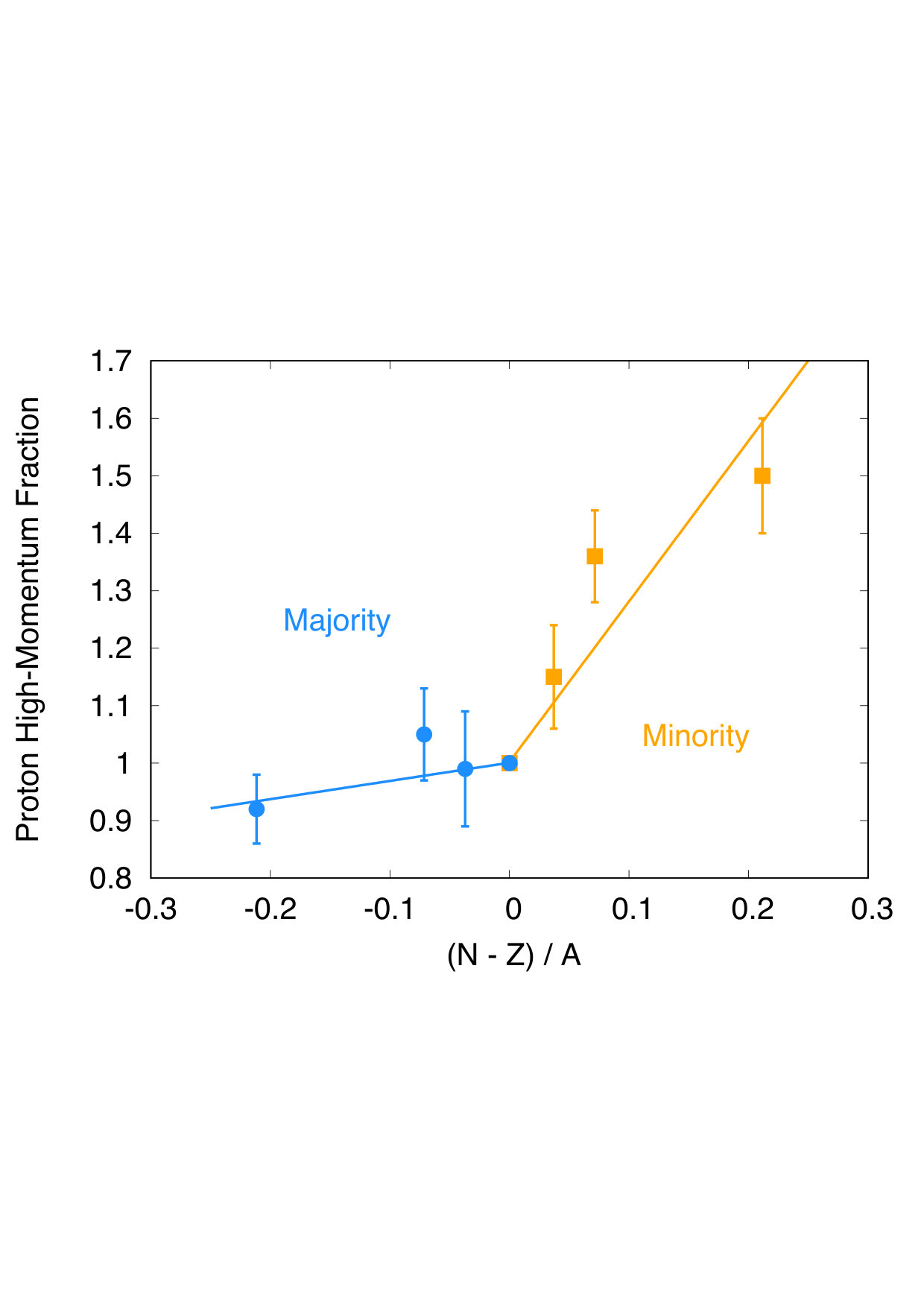 Figure 1
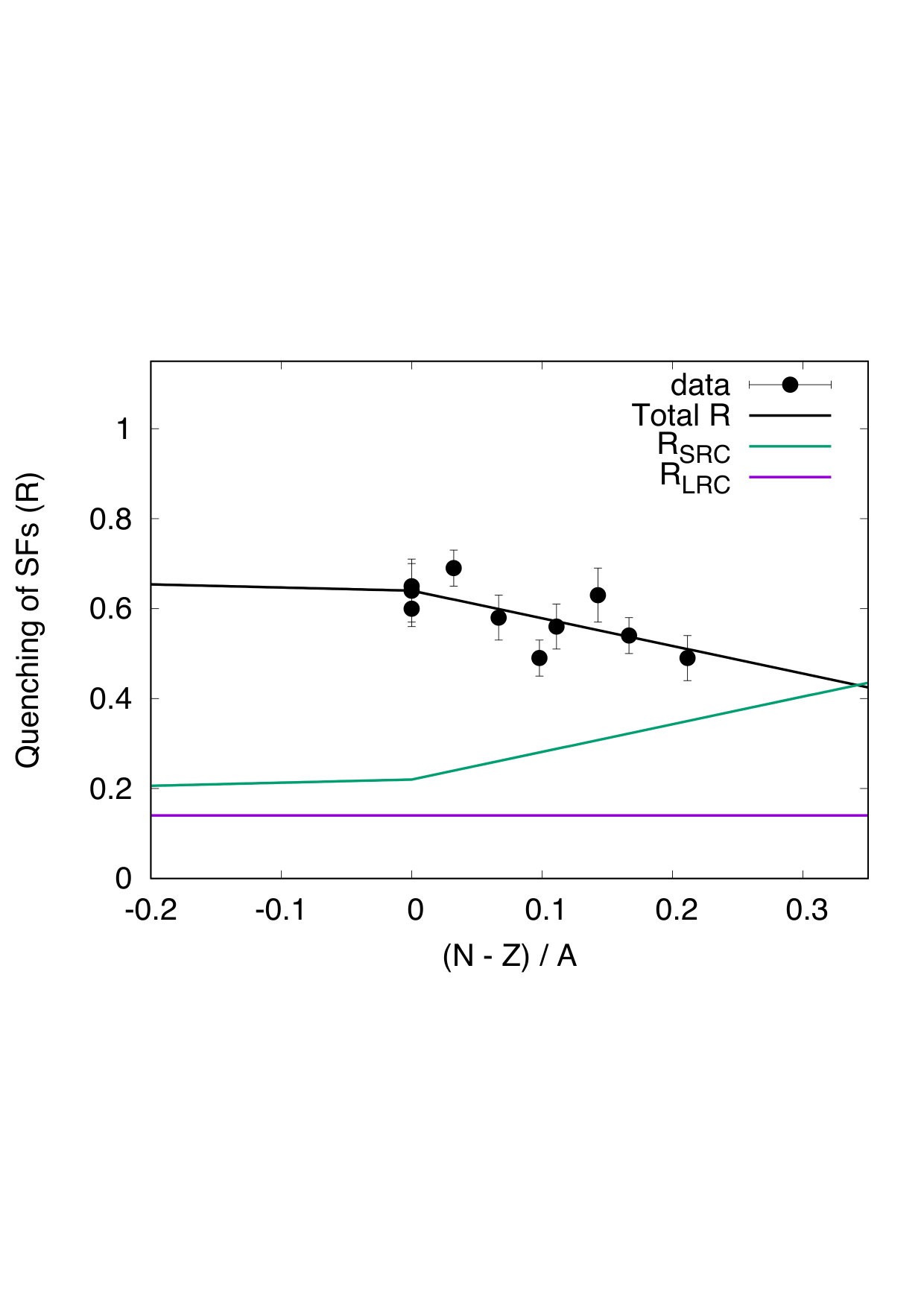 Figure 2
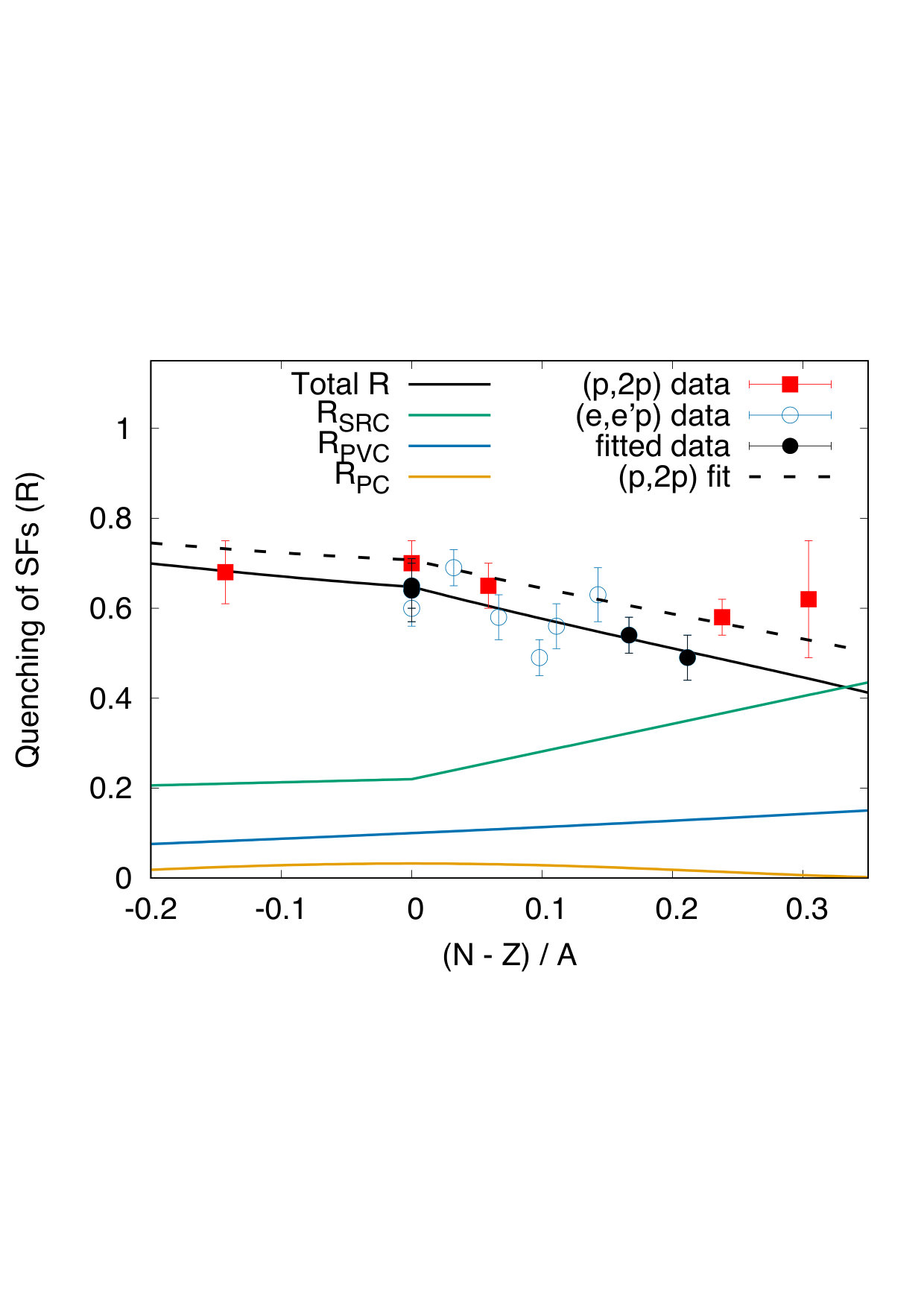 Figure 3
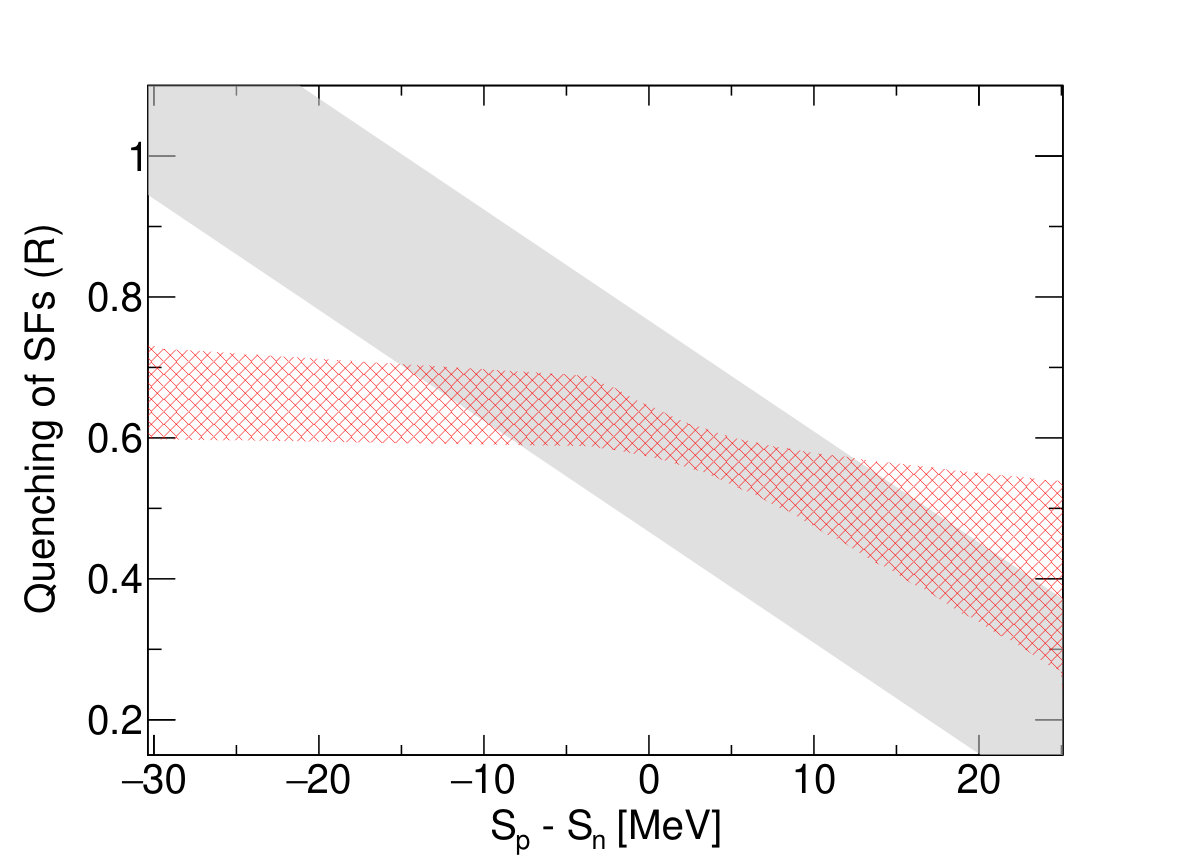 Figure 4
| Nucleus | (N–Z)/A | SFexp | R |
|---|---|---|---|
| 7Li | 0.143 | 0.42 0.04 | 0.63 0.06 |
| 12C | 0 | 1.72 0.11 | 0.60 0.04 |
| 16O | 0 | 1.27 0.13 | 0.64 0.07 * |
| 30Si | 0.067 | 2.21 0.20 | 0.58 0.05 |
| 31P | 0.032 | 0.40 0.03 | 0.69 0.04 |
| 40Ca | 0 | 2.58 0.19 | 0.65 0.05 * |
| 48Ca | 0.167 | 1.07 0.07 | 0.54 0.04 * |
| 51V | 0.098 | 0.37 0.03 | 0.49 0.04 |
| 90Zr | 0.111 | 0.72 0.07 | 0.56 0.05 |
| 208Pb | 0.212 | 0.98 0.09 | 0.49 0.05 * |
Peer Reviews
No public reviews on file for this paper yet. If you reviewed it on a platform where reviews are public (OpenReview, ICLR, NeurIPS, ICML), you can paste yours below so the community can read it here.
Videos
No videos yet. Explain this paper in a talk, walkthrough, or lecture? Add one.
Nucleon-nucleon correlations and the single-particle strength in atomic nuclei
S. Paschalis
M. Petri
A. O. Macchiavelli
O. Hen
E. Piasetzky
Department of Physics, University of York, York, YO10 5DD, UK
Nuclear Science Division, Lawrence Berkeley National Laboratory, Berkeley, CA 94720, USA
Massachusetts Institute of Technology, Cambridge, MA 02139, USA
School of Physics and Astronomy, Tel Aviv University, Tel Aviv, 69978, Israel
Abstract
We propose a phenomenological approach to examine the role of short- and long-range nucleon-nucleon correlations in the quenching of single-particle strength in atomic nuclei and their evolution in asymmetric nuclei and neutron matter. These correlations are thought to be the reason for the quenching of spectroscopic factors observed in , and transfer reactions. We show that the recently observed increase of the high-momentum component of the protons in neutron-rich nuclei is consistent with the reduced proton spectroscopic factors. Our approach connects recent results on short-range correlations from high-energy electron scattering experiments with the quenching of spectroscopic factors and addresses for the first time quantitatively this intriguing question in nuclear physics, in particular regarding its isospin dependence. We also speculate about the nature of a quasi-proton (nuclear polaron) in neutron matter and its kinetic energy, an important quantity for the properties of neutron stars.
keywords:
spectroscopic factors, single-particle strength, asymmetric nuclei, neutron matter, arXiv: 1812.08051
††journal: Physics Letters Bmytitlenotemytitlenotefootnotetext: This article is registered under preprint number: 1812.08051
Many-body quantum mechanical systems consisting of interacting particles are encountered in many fields of modern physics, including condensed matter, atomic and nuclear physics. In general, it is not possible to obtain analytical solutions of the equations governing the dynamics of particles within such quantum systems, starting explicitly from the individual particle-particle interactions. Quantum Monte-Carlo and other numerical techniques can be used to obtain solutions, but these methods are computationally intense and are therefore limited to few interacting particles [1, 2, 3]. To overcome these limitations, many-body systems are often described in terms of independent particles moving in an effective mean-field potential that reflects the average influence of all individual particle-particle interactions. In fermionic systems, neglecting any residual interactions between the particles (beyond those captured by the effective mean-field potential), one can define a Fermi level below which all quantum states are occupied. In the presence of residual interactions between fermions, important correlations arise that deplete the occupancy of states below the Fermi level and populate states above it, thus making the Fermi surface diffused.
The atomic nucleus consists of strongly interacting nucleons forming a dense quantum system. It is noteworthy that for such strongly interacting quantum system the independent-particle model (IPM) is proven to be a valid approximation and has provided the framework to explain many nuclear properties. Nevertheless, correlations between nucleons modify the mean-field approximation and dilute the pure independent-particle picture***Mottelson has given arguments based on the quantality parameter, , that nuclei should behave like a quantum Fermi fluid [4], with quasi-particles (qp) taking the role of the particles in the IPM. Where is the inter-constituents distance. is a measure of the ratio of the zero point motion kinetic energy to the strength of the NN interaction.. These nucleon-nucleon (NN) correlations are often distinguished into long-range correlations (LRC) and short-range correlations (SRC), referring to their spatial separation and the part of the NN potential they are most sensitive to [5, 6, 7]. Studies show that for stable nuclei at any given moment, only 60% – 70% of the states below the Fermi momentum are occupied, with 30% – 40% of the nucleons participating in LRC and SRC configurations [5, 8, 9, 10, 11, 12, 13, 14, 15]. Therefore, both LRC and SRC deplete the occupancy of single-particle states, with LRC primarily mixing states near the nuclear Fermi-momentum and SRC populating states well above it.
There are two questions regarding this depletion that require further study, and have attracted the attention of the Nuclear Physics community:
What are the individual contributions of LRC and SRC to the observed single-particle depletion?
- 2.
What is the isospin (neutron-proton asymmetry) dependence of LRC and SRC, and how do they compete in very asymmetric nuclei?
Inspired by recent results from Jefferson Lab [16], where the ratio of the fraction of high- to low-momentum protons (where high and low are relative to the Fermi momentum) was measured, we propose a phenomenological model that directly connects these new results with the reduction of single-particle strength in atomic nuclei. Our approach captures both LRC and SRC ingredients and allows one to extract their individual contributions as well as their evolution with mass number and isospin.
Experimentally, the depletion of single-particle states is quantified as quenching of spectroscopic factors (SFs) with respect to the IPM limit, observed in [10, 11], [14] and transfer reactions [12, 13]. This is reflected in the probability to end up at a given final state after a nucleon is removed from the parent nucleus compared to theoretically calculated cross sections for the same reaction. At this point it is important to note that the quenching extracted from measurements may depend on the momentum transfer, [17, 18]. Although the dependence of the quenching needs to be better understood, here we analyze the (well established) low- data, where the scale resolution should be sensitive to probe the quenching due to both SRC and LRC [17].
Recently, single-nucleon removal [19, 20] and hadron-induced (p,2p and p,pn) quasi-free scattering (QFS) reactions in inverse kinematics [21, 22, 23] have been employed using radioactive-ion beams and probed the quenching of SFs across a wider region of isospin asymmetry, exploring its isospin dependence. These experiments agree on the depletion of the single-particle strength for nuclei near stability but report significantly different isospin dependency. The reported discrepancy has triggered an active debate on the validity of the reaction models used in the analysis and the extent to which this can lead to an overestimation of isospin effects [12, 13, 19, 20, 21].
In parallel, electron scattering experiments indicate a high-momentum tail extending far beyond the Fermi momentum [24, 25] attributed to SRC between a pair of strongly interacting nucleons [6, 26]. A value of about 20% SRC contribution was indirectly inferred from scaling inclusive measurements of the fraction of high-momentum nucleons in nuclei relative to deuterium [6, 26, 27, 28, 29, 30]. Proton and electron scattering studies of 12C showed that SRC are predominantly neutron-proton (np) pairs, as opposed to proton-proton (pp) or neutron-neutron (nn) pairs that are favored at lower momenta [31, 32, 33]. This was interpreted as manifestation of the tensor part of the NN interaction, which at short distances (q 2 fm*-1*) favors the (quasi-deuteron) channel [6, 26, 34, 35, 36, 37, 38]. Follow-up works extended these findings to both lighter and heavier nuclei, see e.g. Refs. [39, 40, 41].
Finally, the Jefferson Lab results from Ref. [16] revealed that in neutron-rich nuclei the ratio of the fraction of high- to low-momentum protons increases as a linear function of the ratio of neutron to proton number (N/Z), while the equivalent fraction for neutrons is rather constant or possibly decreasing slightly. This indicates that the percentage of protons participating in SRC pairs increases for neutron-rich systems and consequently depletes the proton strength from the region below the Fermi momentum, which is probed in measurements of SFs. Hence the SRC dependence with isospin asymmetry should be reflected in the quenching of the proton SFs and furthermore in other low-energy observables [42].
To study the consistency between SRC experimental results and SFs, we introduce a phenomenological model to estimate the total “missing strength” in terms of contributions from LRC (defined here as pairing [43] and particle-vibration coupling) and SRC components. While generally in low-energy nuclear structure one refers to pairing correlations as the short-range part of the force, compared to the quadrupole force which is of longer range, within the context of this paper pairing is not part of the SRC associated with high-momentum components. We approximate the wave function of a “dressed” nucleon (quasi-particle or qp) in the nuclear medium in the following form:
[TABLE]
The first term represents the pure single-particle (SP) configuration, and the following three terms the particle-vibration coupling (PVC), pairing correlations (PC) and SRC induced configurations, respectively. Thus, the overlap for the removal of a nucleon from the ground state of nucleus A to the ground state of is and the probability to find a nucleon in the pure single-particle configuration is = . For non-interacting nucleons , while in the presence of correlations (quenched). The missing part of the single-particle strength is distributed to the correlation terms with probabilities given by the square of the corresponding amplitudes in the wavefunction of eq. 1, i.e. , and . The quenched single-particle strength, R, can then be expressed in terms of these three independent components:
[TABLE]
In this approach, we associate R to the overall quenching of SFs reported in and measurements and extract the weighting of each of the three components entering eq. 2 as fitting parameters.
The linear form of eq. 1, and lack of interference terms in eq. 2, both stem from the underlying assumption that the SP, PVC, PC and SRC states are all orthogonal to each other. SRC induce mixing to states of very high momentum and energy in the nuclear spectral function and there should be a small overlap with the SP and LRC components, thus supporting the orthogonality assumption [9, 26, 38]. Near doubly magic nuclei, for which both pairing and deformation manifest themselves as vibrations, the individual terms in eq. 1 can be justified in first order perturbation as one-particle-one-hole (1p1h) (PVC) and two-particle-two-hole (2p2h) (PC) excitations (see later discussions).
The trend of the SRC component as a function of isospin is derived from Ref. [16]. The measured dependence of the relative fractions of high- to low-momentum nucleons in nuclei relative to 12C has been discussed in Ref. [44], where it was shown that a low-order correlation operator approximation (LCA) can account for the observed trends in the data. Here we reproduce the Jefferson Lab data in Fig. 1 (after transforming their N/Z axis to ) and make the assumption that the neutron momentum fraction measured for neutron-rich systems (neutrons being the majority nucleons) can be used as the proton momentum fraction in a proton-rich system (protons being the majority nucleons). Using the fitted slopes and , see Fig. 1, we write the following expressions:
[TABLE]
[TABLE]
The proton SF data used in this analysis are taken from experiments of Ref. [11] and are summarized in Table 1. The SFs include only reactions that have populated the ground state of the daughter nucleus. Also included in Table 1 is the quenching of SFs (R) with respect to large-scale shell-model (SM) calculations of Ref. [45]. In SM calculations the reported SFs for doubly-magic nuclei is almost the same to that expected from an IPM picture (indicated in Table 1 with an asterisk). In other words, there is no quenching predicted by SM for these closed-shell systems. This is inconsistent with the experimentally reported values for the quenching of SFs for doubly-magic nuclei and reflects the fact that SM calculations cannot reproduce the full strength lost in LRC due to the yet limited model space used [9, 46], and the lack of the SRC component. Similarly, the reduced SFs obtained by the SM for non-doubly magic nuclei can also be regarded as additional LRC not completely captured by the SM even in a large model-space.
Realizing that the available data are somewhat limited we make first the simplifying assumption that is a constant as a function of isospin. We will further discuss this dependence later on. While local deviations are expected, we believe that the overall constant trend (used in our first fit) is justified, as seen for example in the Relativistic Mean Field calculations of Ref. [47]. In Fig. 2, we show the results of the fit for the overall quenching of single-particle strength R (eq. 2) together with the contribution by each of the individual components, as discussed above. To extract the errors on the individual components and investigate their statistical correlation, the fitting has been performed in a Monte-Carlo approach by re-sampling the values R within their probability density distribution (assumed to be Gaussian with standard deviation defined by their errors). The SRC contribution amounts to and the LRC contribution to . This is in accordance with expectations [6, 16, 27, 32, 40].
While the simplest form introduced above () appears to capture the main ingredients of the quenching mechanism, we now proceed to elaborate in more detail the individual contributions from PVC and PC with isospin dependence.
If due to PVC a single particle near a doubly-closed shell core is removed from its shell by coupling to surface phonons (built up from a coherent superposition of 1p1h excitations of multipolarity ), then the single particle state becomes dressed and we write [48, 49]:
[TABLE]
The quenching can be estimated by the amplitude of the coupling term, . Following Refs. [48, 49], this is proportional to the collectivity of the phonon (as measured by the dynamic deformation parameter ) and the radial form factor, proportional to . The potential depth (V) for a proton is often parametrized, including a term that depends on the neutron excess, as:
[TABLE]
We thus expect,
[TABLE]
Using the potential given in Ref. [49] (pg. 239, Eq. 2-182), we propose a parametrization of the form
[TABLE]
with . For finite nuclei, can be taken as a constant, given the average dependence of and with mass number. However, for infinite systems it should scale as reflecting the surface nature of the coupling.
In a similar way, we can estimate the effect of fragmentation due to pairing (vibration) correlations. The mixing amplitude should be proportional in lowest order to the ratio of the pairing gap () to a typical shell gap ( MeV), . With the parametrization of in Ref. [50] we obtain:
[TABLE]
here, is also a constant. Note that, specifically for , we have . Turning again our attention to the doubly magic nuclei, for which to lowest order pairing vibrations will introduce 2p2h admixtures in the unperturbed (0p0h) ground-state configuration, one can make a simple estimate of as , using specifically MeV [50], since we are looking at proton spectroscopic factors.
With the expressions in eqs. 2, 3, 4, 8 and 9 we attempt a fit of the experimental data on doubly magic nuclei. The result of the fit gives a PVC contribution of . The SRC and PC contribution have been fixed to (from the fit of Fig. 2) and , respectively, based on the above arguments. The total fit (and the individual components) shown in Fig. 3 is in good agreement with the full data set. As discussed earlier, the agreement seen also for open-shell nuclei indicates a level of missing strength in the full shell-model results, due to LRC, similar to that in the IPM for doubly-magic systems. QFS data [21] are also shown in the same plot. The reported QFS data are inclusive measurements to all bound final states and not only ground-state to ground-state transitions like the data. This means that part of the LRC correlations that distributes the single-particle strength to low-lying excitations in the final states is integrated in the experimental cross section. Indeed, repeating the fit for the data, we obtain a PVC contribution of . Actually, the measurement has the only data point at negative asymmetry, which is nicely reproduced with the different slope of the SRC contribution for removing a proton from a proton-rich system (see eq. 4). In this case, the protons are the majority nucleons.
Another topic of current debate is the quenching observed in one-proton (and one-neutron) removal reactions carried out at intermediate energies (). The study of Ref. [20] showed an unexpectedly strong dependence of the quenching, expressed as a function of the difference () in proton and neutron separation energies, ( ). The origin of this strong dependence (i.e. whether it is indeed due to NN correlations or due to the reaction model) is still an open question. To add to the discussion, it is interesting to compare our predictions (from Fig. 2) with the results of Ref. [20]. For this purpose, we use the equations given in Ref. [51] to convert A, Z, and N into . For the conversion from to we derive the equation , which holds for light and medium mass nuclei, considered in the systematics of Ref. [20]. The two trends are shown as shaded areas in Fig. 4. Our results give a less pronounced dependence on , suggesting that the theory of the reaction mechanism is playing a role in the measured dependence of Ref. [20].
As a final note, we can also speculate about the nature of a quasi-proton (nuclear polaron [52]) in neutron matter (nM). In the limit of and , and neglecting both surface and pairing coupling terms, expected to be small for infinite matter at saturation density, we predict a proton quenching factor of . The high relative kinetic energy components in the wavefunction, present in this limit, will give the proton an average kinetic energy:
[TABLE]
from the nucleon momentum distribution in nuclear matter. If we assume , above which the two-nucleon wave function that dominates the SRC tail decays very rapidly [6, 38, 53, 54, 55, 56], we obtain \rm\big{\langle}T_{p}\big{\rangle}_{nM} of approximately 3 times that of a proton in a Fermi Gas, an important quantity for the properties of neutron stars [57]. Similarly, the average kinetic energy for the neutrons \rm\big{\langle}T_{n}\big{\rangle}_{nM} (for which ) is estimated to be approximately 1.4 times that of a neutron in a Fermi Gas.
In summary, we presented a phenomenological model that connects the quenching of spectroscopic factors with the recent SRC Jefferson Lab study. We derived simple phenomenological parametrizations for the combined effects of SRC, PVC, and PC that were used in an analysis of data from low- electron scattering and proton induced QFS experiments. Our analysis shows that approximately 20% of the missing strength observed in the region of can be attributed to SRC, in agreement with reported expectations. Furthermore, we show how the missing strength, including contributions from LRC, is expected to evolve with and speculate an extrapolation to a quasi-proton in neutron matter and its kinetic energy, with implications to neutron stars. While perhaps rather speculative at this stage, given the available data, we trust our conjecture will stimulate further theoretical and experimental work. In particular for the latter, we highlight the need to:
- Measure the quenching of spectroscopic factors in stable nuclei with higher precision, including transfer reactions,
- Study of reactions on very asymmetric nuclei available at radioactive beam facilities, and
- Extend those studies to neutron removal reactions.
Acknowledgements
This work is supported by the UK STFC awards ST/M006433/1 and ST/P003885/1, by the Royal Society award UF150476, by the U.S. Department of Energy, Office of Nuclear Physics, under contract nos DE-AC02-05CH11231 (LBNL) and DE-FG02-94ER40818, by the Israel Science Foundation and the Pazy Foundation. Enlightening discussions with R. Casten, J. Dobaczewski, R. Liotta, A. Pastore, and J. Schiffer are gratefully acknowledged.
References
- [1]
J. Carlson, S. Gandolfi, F. Pederiva, S. C. Pieper, R. Schiavilla, K. E. Schmidt, R. B. Wiringa, Quantum monte carlo methods for nuclear physics, Rev. Mod. Phys. 87 (2015) 1067–1118.
- [2]
R. B. Wiringa, R. Schiavilla, S. C. Pieper, J. Carlson, Nucleon and nucleon-pair momentum distributions in nuclei, Phys. Rev. C 89 (2014) 024305.
- [3]
D. Lonardoni, S. Gandolfi, J. E. Lynn, C. Petrie, J. Carlson, K. E. Schmidt, A. Schwenk, Auxiliary field diffusion Monte Carlo calculations of light and medium-mass nuclei with local chiral interactions, Phys. Rev. C 97 (2018) 044318.
doi:10.1103/PhysRevC.97.044318.
- [4]
B. Mottelson, Why are nuclei described by independent particle motion ?, Nuclear Physics A 649 (1) (1999) 45.
- [5]
W. Dickhoff, C. Barbieri, Self-consistent green’s function method for nuclei and nuclear matter, Prog. Part. Nucl. Phys. 52 (2) (2004) 377 – 496.
doi:https://doi.org/10.1016/j.ppnp.2004.02.038.
- [6]
O. Hen, G. A. Miller, E. Piasetzky, L. B. Weinstein, Nucleon-Nucleon Correlations, Short-lived Excitations, and the Quarks Within, Rev. Mod. Phys. 89 (4) (2017) 045002.
- [7]
L. L. Frankfurt, M. I. Strikman, High-Energy Phenomena, Short Range Nuclear Structure and QCD, Phys. Rept. 76 (1981) 215.
- [8]
K. A. Brueckner, R. J. Eden, N. C. Francis, High-energy reactions and the evidence for correlations in the nuclear ground-state wave function, Phys. Rev. 98 (1955) 1445–1455.
- [9]
G. Bertsch, T. Kuo, Effective mass in nuclei, Nucl. Phys. A 112 (1) (1968) 204 – 208.
doi:https://doi.org/10.1016/0375-9474(68)90230-3.
- [10]
L. Lapikas, Quasi-elastic electron scattering off nuclei, Nucl. Phys. A 553 (1993) 297 – 308.
doi:https://doi.org/10.1016/0375-9474(93)90630-G.
- [11]
G. Kramer, H. Blok, L. Lapikas, A consistent analysis of (e,e’p) and (d,3he) experiments, Nucl. Phys. A 679 (3) (2001) 267 – 286.
doi:https://doi.org/10.1016/S0375-9474(00)00379-1.
- [12]
B. P. Kay, J. P. Schiffer, S. J. Freeman, Quenching of cross sections in nucleon transfer reactions, Phys. Rev. Lett. 111 (2013) 042502.
doi:10.1103/PhysRevLett.111.042502.
- [13]
F. Flavigny, et al., Limited asymmetry dependence of correlations from single nucleon transfer, Phys. Rev. Lett. 110 (2013) 122503.
doi:10.1103/PhysRevLett.110.122503.
- [14]
D. Devins, D. Friesel, W. Jones, A. Attard, I. Svalbe, V. Officer, R. Henderson, B. Spicer, G. Shute, The 12c(p,2p)11b reaction at 100 mev, Aust. J. Phys. 32 (4) (1979) 323–334.
- [15]
M. C. Atkinson, H. P. Blok, L. Lapikás, R. J. Charity, W. H. Dickhoff, Validity of the distorted-wave impulse-approximation description of data using only ingredients from a nonlocal dispersive optical model, Phys. Rev. C 98 (2018) 044627.
doi:10.1103/PhysRevC.98.044627.
- [16]
M. Duer, et al., Probing high-momentum protons and neutrons in neutron-rich nuclei, Nature 560 (7720) (2018) 617–621.
doi:10.1038/s41586-018-0400-z.
- [17]
L. Lapikás, G. van der Steenhoven, L. Frankfurt, M. Strikman, M. Zhalov, Transparency of for protons, Phys. Rev. C 61 (2000) 064325.
doi:10.1103/PhysRevC.61.064325.
- [18]
L. Frankfurt, M. Strikman, M. Zhalov, Single particle strength restoration and nuclear transparency in high Q**2 exclusive (e, e-prime p) reactions, Phys. Lett. B 503 (2001) 73–80.
doi:10.1016/S0370-2693(01)00173-3.
- [19]
A. Gade, et al., Reduction of spectroscopic strength: Weakly-bound and strongly-bound single-particle states studied using one-nucleon knockout reactions, Phys. Rev. C 77 (2008) 044306.
doi:10.1103/PhysRevC.77.044306.
- [20]
J. A. Tostevin, A. Gade, Systematics of intermediate-energy single-nucleon removal cross sections, Phys. Rev. C 90 (2014) 057602.
doi:10.1103/PhysRevC.90.057602.
- [21]
L. Atar, et al., Quasifree (, ) reactions on oxygen isotopes: Observation of isospin independence of the reduced single-particle strength, Phys. Rev. Lett. 120 (2018) 052501.
doi:10.1103/PhysRevLett.120.052501.
- [22]
V. Panin, et al., Exclusive measurements of quasi-free proton scattering reactions in inverse and complete kinematics, Phys. Lett. B 753 (2016) 204 – 210.
doi:http://dx.doi.org/10.1016/j.physletb.2015.11.082.
- [23]
S. Kawase, et al., Exclusive quasi-free proton knockout from oxygen isotopes at intermediate energies, Prog. Theor. Exp. Phys. 2018 (2) (2018) 021D01.
- [24]
V. R. Pandharipande, I. Sick, P. K. A. deWitt Huberts, Independent particle motion and correlations in fermion systems, Rev. Mod. Phys. 69 (1997) 981–991.
doi:10.1103/RevModPhys.69.981.
- [25]
D. Rohe, et al., Correlated strength in the nuclear spectral function, Phys. Rev. Lett. 93 (2004) 182501.
doi:10.1103/PhysRevLett.93.182501.
- [26]
C. Ciofi degli Atti, In-medium short-range dynamics of nucleons: Recent theoretical and experimental advances, Phys. Rept. 590 (2015) 1–85.
doi:10.1016/j.physrep.2015.06.002.
- [27]
N. Fomin, et al., New measurements of high-momentum nucleons and short-range structures in nuclei, Phys. Rev. Lett. 108 (2012) 092502.
doi:10.1103/PhysRevLett.108.092502.
- [28]
K. S. Egiyan, et al., Phys. Rev. C 68 (2003) 014313.
doi:10.1103/PhysRevC.68.014313.
- [29]
K. S. Egiyan, et al., Measurement of two- and three-nucleon short-range correlation probabilities in nuclei, Phys. Rev. Lett. 96 (2006) 082501.
doi:10.1103/PhysRevLett.96.082501.
- [30]
L. L. Frankfurt, M. I. Strikman, D. B. Day, M. Sargsian, Evidence for short range correlations from high Q**2 (e, e-prime) reactions, Phys. Rev. C 48 (1993) 2451.
- [31]
E. Piasetzky, M. Sargsian, L. Frankfurt, M. Strikman, J. W. Watson, Evidence for strong dominance of proton-neutron correlations in nuclei, Phys. Rev. Lett. 97 (16) (2006) 162504.
doi:10.1103/PhysRevLett.97.162504.
- [32]
R. Subedi, et al., Probing cold dense nuclear matter, Science 320 (2008) 1476.
- [33]
R. Shneor, et al., Investigation of proton-proton short-range correlations via the reaction, Phys. Rev. Lett. 99 (2007) 072501.
doi:10.1103/PhysRevLett.99.072501.
- [34]
R. Schiavilla, R. B. Wiringa, S. C. Pieper, J. Carlson, Tensor Forces and the Ground-State Structure of Nuclei, Phys. Rev. Lett. 98 (2007) 132501.
- [35]
M. M. Sargsian, T. V. Abrahamyan, M. I. Strikman, L. L. Frankfurt, Exclusive electro-disintegration of He-3 at high Q2. II. Decay function formalism, Phys. Rev. C 71 (2005) 044615.
- [36]
M. Alvioli, C. Ciofi degli Atti, H. Morita, Proton-neutron and proton-proton correlations in medium-weight nuclei and the role of the tensor force, Phys. Rev. Lett. 100 (2008) 162503.
- [37]
R. Weiss, R. Cruz-Torres, N. Barnea, E. Piasetzky, O. Hen, The nuclear contacts and short range correlations in nuclei, Phys. Lett. B 780 (2018) 211–215.
- [38]
R. Weiss, I. Korover, E. Piasetzky, O. Hen, N. Barnea, Energy and momentum dependence of nuclear short-range correlations - spectral function, exclusive scattering experiments and the contact formalism, Physics Letters B 791 (2019) 242 – 248.
doi:https://doi.org/10.1016/j.physletb.2019.02.019.
- [39]
I. Korover, et al., Probing the repulsive core of the nucleon-nucleon interaction via the triple-coincidence reaction, Phys. Rev. Lett. 113 (2014) 022501.
doi:10.1103/PhysRevLett.113.022501.
- [40]
O. Hen, et al., Momentum sharing in imbalanced fermi systems, Science 346 (6209) (2014) 614–617.
- [41]
M. Duer, O. Hen, E. Piasetzky, L. B. Weinstein, A. Schmidt, I. Korover, E. O. Cohen, H. Hakobyan, Direct Observation of Proton-Neutron Short-Range Correlation Dominance in Heavy NucleiarXiv:1810.05343.
- [42]
G. Miller, A. Beck, S. M.-T. Beck, L. Weinstein, E. Piasetzky, O. Hen, Can long-range nuclear properties be influenced by short range interactions? a chiral dynamics estimate, Physics Letters B 793 (2019) 360 – 364.
doi:https://doi.org/10.1016/j.physletb.2019.05.010.
URL http://www.sciencedirect.com/science/article/pii/S0370269319303193
- [43]
S. Frauendorf, A. Macchiavelli, Overview of neutron–proton pairing, Prog. Part. Nucl. Phys. 78 (2014) 24 – 90.
doi:https://doi.org/10.1016/j.ppnp.2014.07.001.
- [44]
J. Ryckebusch, W. Cosyn, S. Stevens, C. Casert, J. Nys, The isospin and neutron-to-proton excess dependence of short-range correlations, Physics Letters B 792 (2019) 21 – 28.
doi:https://doi.org/10.1016/j.physletb.2019.03.016.
URL http://www.sciencedirect.com/science/article/pii/S0370269319301704
- [45]
J. Lee, J. A. Tostevin, B. A. Brown, F. Delaunay, W. G. Lynch, M. J. Saelim, M. B. Tsang, Reduced neutron spectroscopic factors when using potential geometries constrained by hartree-fock calculations, Phys. Rev. C 73 (2006) 044608.
doi:10.1103/PhysRevC.73.044608.
- [46]
C. Barbieri, Role of long-range correlations in the quenching of spectroscopic factors, Phys. Rev. Lett. 103 (2009) 202502.
doi:10.1103/PhysRevLett.103.202502.
- [47]
E. V. Litvinova, A. V. Afanasjev, Dynamics of nuclear single-particle structure in covariant theory of particle-vibration coupling: From light to superheavy nuclei, Phys. Rev. C 84 (2011) 014305.
doi:10.1103/PhysRevC.84.014305.
- [48]
D. M. Brink, R. A. Broglia, Nuclear Superfluidity, Cambridge University Press, 2010.
- [49]
A. Bohr, B. R. Mottelson, Nuclear Structure, Volume I, World Scientific, 2008.
- [50]
A. Jensen, P. Hansen, B. Jonson, New mass relations and two- and four-nucleon correlations, Nucl. Phys. A 431 (3) (1984) 393 – 418.
doi:https://doi.org/10.1016/0375-9474(84)90116-7.
- [51]
K. Vogt, T. Hartmann, A. Zilges, Simple parametrization of single- and two-nucleon separation energies in terms of the neutron to proton ratio n/z 517 (3) (2001) 255 – 260.
doi:https://doi.org/10.1016/S0370-2693(01)01014-0.
- [52]
M. Kutschera, W. Wójcik, Proton impurity in the neutron matter: A nuclear polaron problem, Phys. Rev. C 47 (1993) 1077–1085.
- [53]
R. Weiss, R. Cruz-Torres, N. Barnea, E. Piasetzky, O. Hen, The nuclear contacts and short range correlations in nuclei, Physics Letters B 780 (2018) 211 – 215.
doi:https://doi.org/10.1016/j.physletb.2018.01.061.
URL http://www.sciencedirect.com/science/article/pii/S0370269318300777
- [54]
O. Hen, B.-A. Li, W.-J. Guo, L. B. Weinstein, E. Piasetzky, Symmetry energy of nucleonic matter with tensor correlations, Phys. Rev. C 91 (2015) 025803.
doi:10.1103/PhysRevC.91.025803.
URL https://link.aps.org/doi/10.1103/PhysRevC.91.025803
- [55]
O. Hen, L. B. Weinstein, E. Piasetzky, G. A. Miller, M. M. Sargsian, Y. Sagi, Correlated fermions in nuclei and ultracold atomic gases, Phys. Rev. C 92 (2015) 045205.
doi:10.1103/PhysRevC.92.045205.
URL https://link.aps.org/doi/10.1103/PhysRevC.92.045205
- [56]
G.-C. Yong, Constraining nucleon high momentum in nuclei, Physics Letters B 765 (2017) 104 – 108.
doi:https://doi.org/10.1016/j.physletb.2016.12.013.
URL http://www.sciencedirect.com/science/article/pii/S0370269316307511
- [57]
G.-C. Yong, Probing proton transition momentum in neutron-rich matter, Phys. Lett. B 776 (2018) 447 – 450.
The reference list from the paper itself. Each links out to its DOI / PubMed record.
- 1[1] J. Carlson, S. Gandolfi, F. Pederiva, S. C. Pieper, R. Schiavilla, K. E. Schmidt, R. B. Wiringa, Quantum monte carlo methods for nuclear physics, Rev. Mod. Phys. 87 (2015) 1067–1118.
- 2[2] R. B. Wiringa, R. Schiavilla, S. C. Pieper, J. Carlson, Nucleon and nucleon-pair momentum distributions in a ≤ 12 𝑎 12 a\leq 12 nuclei, Phys. Rev. C 89 (2014) 024305.
- 3[3] D. Lonardoni, S. Gandolfi, J. E. Lynn, C. Petrie, J. Carlson, K. E. Schmidt, A. Schwenk, Auxiliary field diffusion Monte Carlo calculations of light and medium-mass nuclei with local chiral interactions, Phys. Rev. C 97 (2018) 044318. doi:10.1103/Phys Rev C.97.044318 . · doi ↗
- 4[4] B. Mottelson, Why are nuclei described by independent particle motion ?, Nuclear Physics A 649 (1) (1999) 45.
- 5[5] W. Dickhoff, C. Barbieri, Self-consistent green’s function method for nuclei and nuclear matter, Prog. Part. Nucl. Phys. 52 (2) (2004) 377 – 496. doi:https://doi.org/10.1016/j.ppnp.2004.02.038 . · doi ↗
- 6[6] O. Hen, G. A. Miller, E. Piasetzky, L. B. Weinstein, Nucleon-Nucleon Correlations, Short-lived Excitations, and the Quarks Within, Rev. Mod. Phys. 89 (4) (2017) 045002.
- 7[7] L. L. Frankfurt, M. I. Strikman, High-Energy Phenomena, Short Range Nuclear Structure and QCD, Phys. Rept. 76 (1981) 215.
- 8[8] K. A. Brueckner, R. J. Eden, N. C. Francis, High-energy reactions and the evidence for correlations in the nuclear ground-state wave function, Phys. Rev. 98 (1955) 1445–1455. doi:10.1103/Phys Rev.98.1445 . · doi ↗