Logarithmic spreading of out-of-time-ordered correlators without many-body localization
Adam Smith, Johannes Knolle, Roderich Moessner, and Dmitry L., Kovrizhin

TL;DR
This paper investigates the behavior of out-of-time-ordered correlators in a disorder-free localized model, revealing a surprising logarithmic spreading of correlations typically associated with many-body localization, even in non-interacting systems.
Contribution
The study demonstrates logarithmic correlation spreading in a disorder-free, non-interacting model, challenging the conventional association with many-body localization.
Findings
Logarithmic spreading of OTOCs observed in the model.
Proposed a novel Loschmidt echo protocol to probe correlation spreading.
Logarithmic spreading is a generic feature of localized systems, regardless of interactions.
Abstract
Out-of-time-ordered correlators (OTOCs) describe information scrambling under unitary time evolution, and provide a useful probe of the emergence of quantum chaos. Here we calculate OTOCs for a model of disorder-free localization whose exact solubility allows us to study long-time behaviour in large systems. Remarkably, we observe logarithmic spreading of correlations, qualitatively different to both thermalizing and Anderson localized systems. Rather, such behaviour is normally taken as a signature of many-body localization, so that our findings for an essentially non-interacting model are surprising. We provide an explanation for this unusual behaviour, and suggest a novel Loschmidt echo protocol as a probe of correlation spreading. We show that the logarithmic spreading of correlations probed by this protocol is a generic feature of localized systems, with or without interactions.
Click any figure to enlarge with its caption.
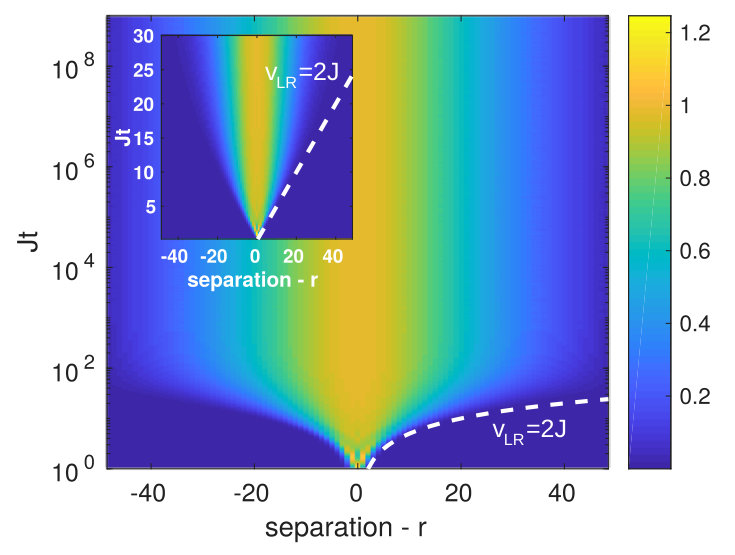 Figure 1
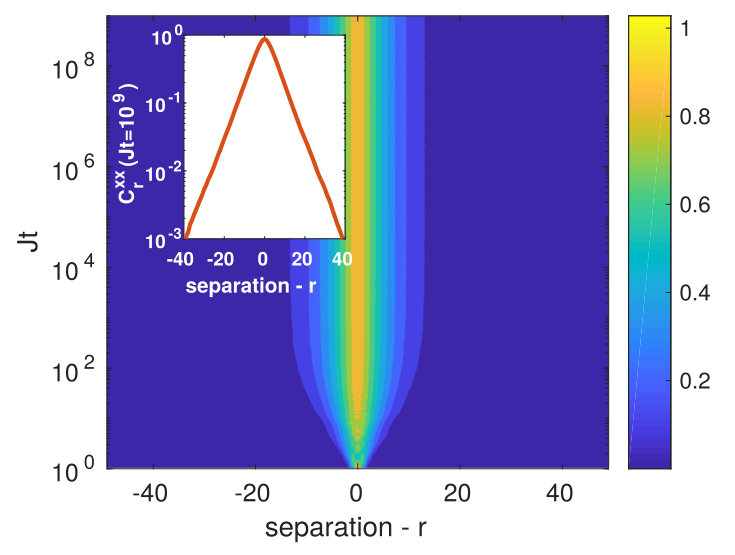 Figure 2
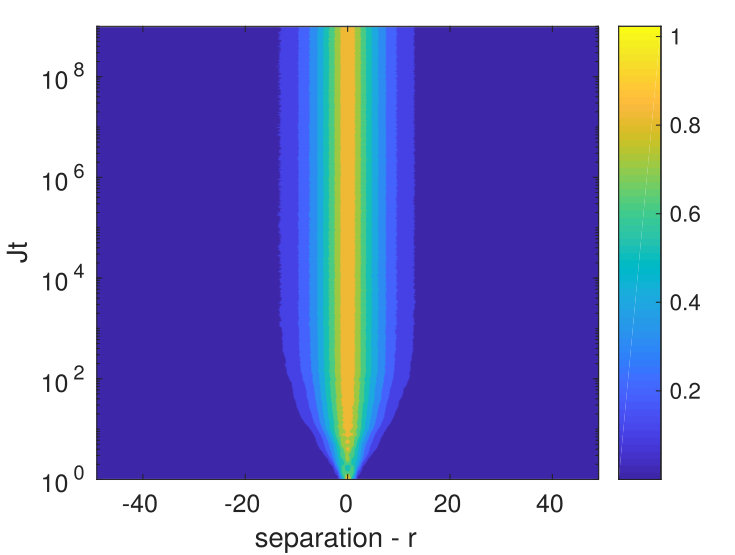 Figure 3
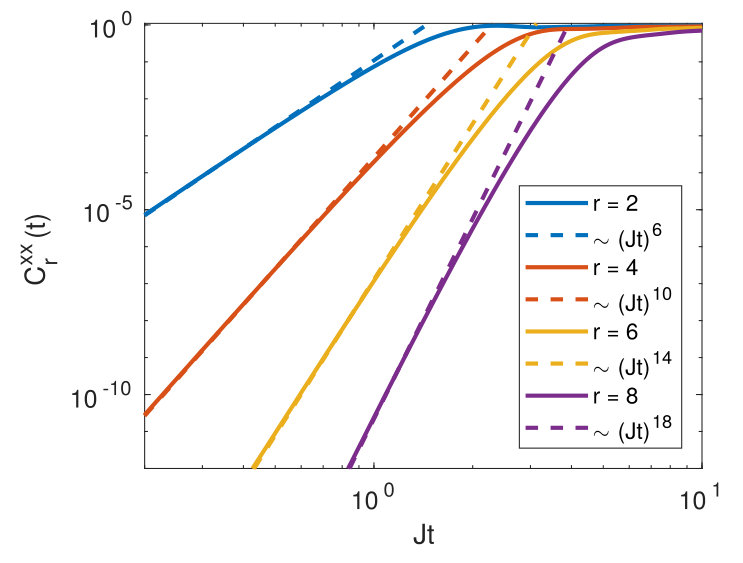 Figure 4
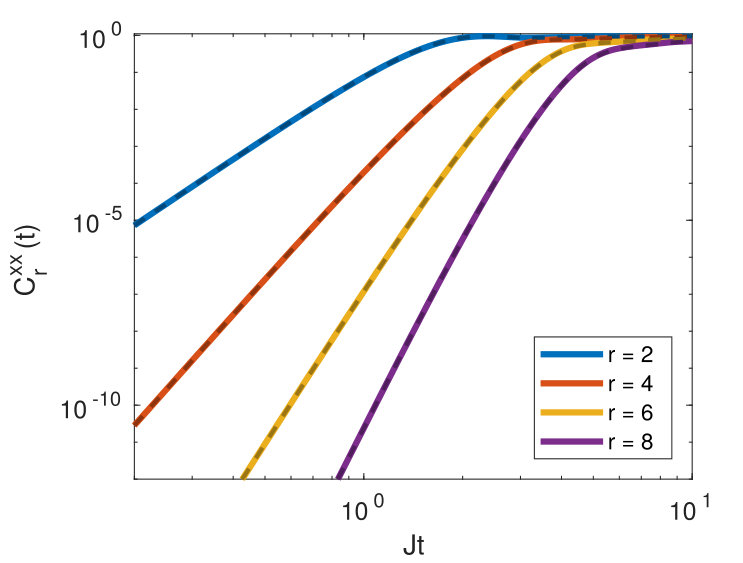 Figure 5
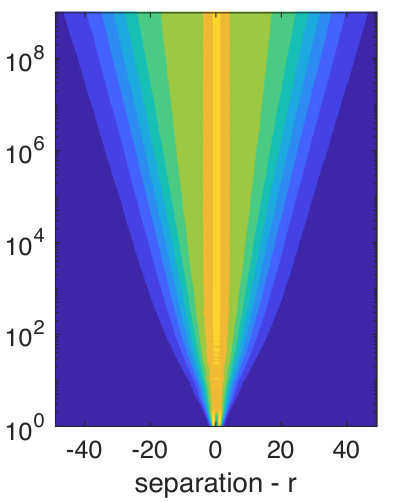 Figure 6
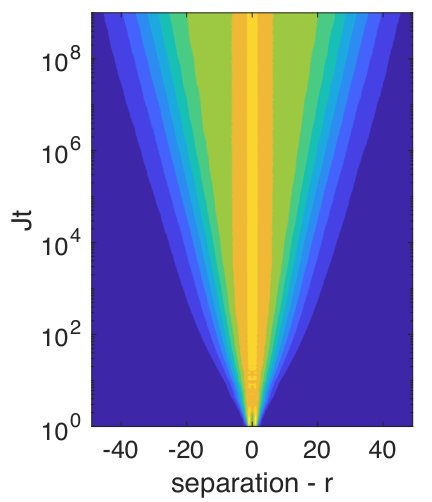 Figure 7
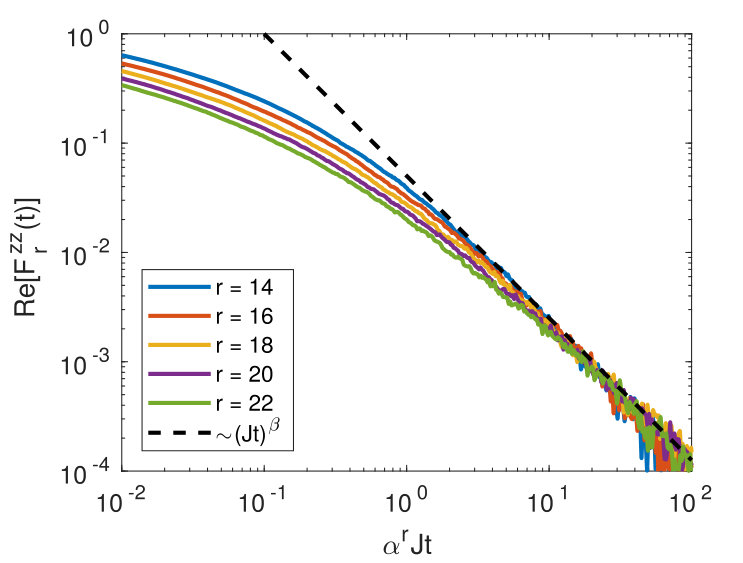 Figure 8
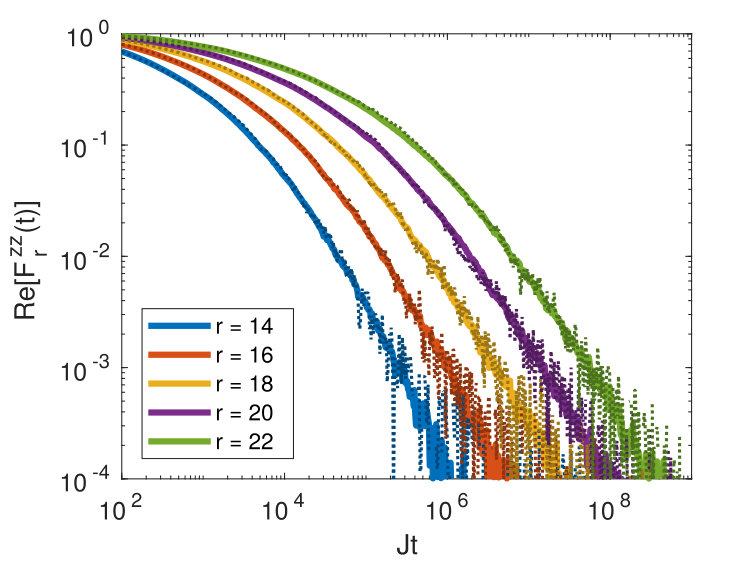 Figure 9
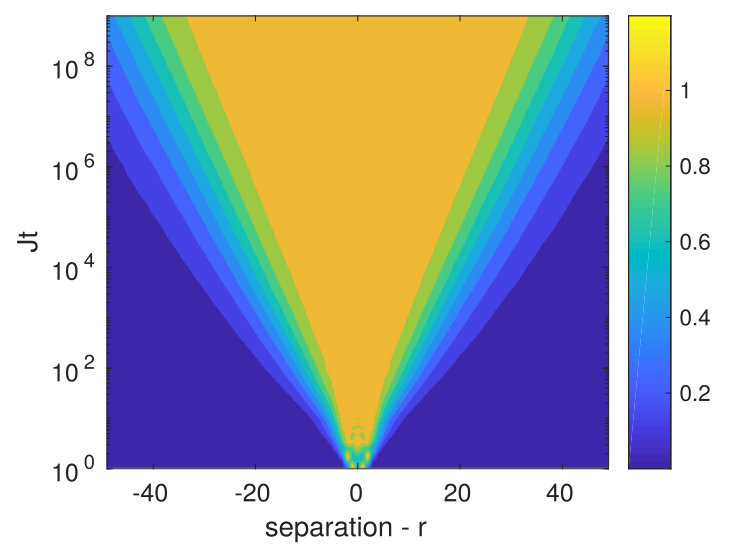 Figure 10
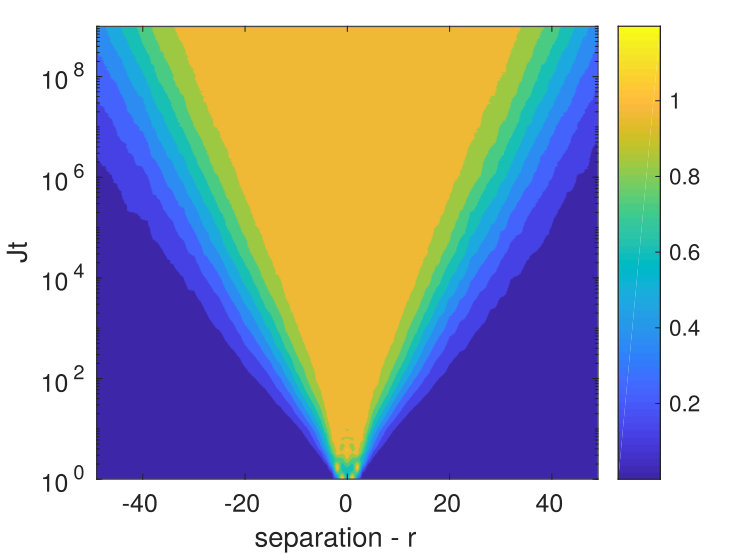 Figure 11
 Figure 12
 Figure 13
Peer Reviews
No public reviews on file for this paper yet. If you reviewed it on a platform where reviews are public (OpenReview, ICLR, NeurIPS, ICML), you can paste yours below so the community can read it here.
Videos
No videos yet. Explain this paper in a talk, walkthrough, or lecture? Add one.
Logarithmic spreading of out-of-time-ordered correlators without many-body localization
Adam Smith
T.C.M. group, Cavendish Laboratory, J. J. Thomson Avenue, Cambridge, CB3 0HE, United Kingdom
Johannes Knolle
T.C.M. group, Cavendish Laboratory, J. J. Thomson Avenue, Cambridge, CB3 0HE, United Kingdom
Blackett Laboratory, Imperial College London, London SW7 2AZ, United Kingdom
Roderich Moessner
Max Planck Institute for the Physics of Complex Systems, Nöthnitzer Str. 38, 01187 Dresden, Germany
Dmitry L. Kovrizhin
Rudolf Peierls Centre for Theoretical Physics, 1 Keble Road, Oxford, OX1 3NP, United Kingdom
NRC Kurchatov institute, 1 Kurchatov sq., 123182, Moscow, Russia
(March 7, 2024)
Abstract
Out-of-time-ordered correlators (OTOCs) describe information scrambling under unitary time evolution, and provide a useful probe of the emergence of quantum chaos. Here we calculate OTOCs for a model of disorder-free localization whose exact solubility allows us to study long-time behaviour in large systems. Remarkably, we observe logarithmic spreading of correlations, qualitatively different to both thermalizing and Anderson localized systems. Rather, such behaviour is normally taken as a signature of many-body localization, so that our findings for an essentially non-interacting model are surprising. We provide an explanation for this unusual behaviour, and suggest a novel Loschmidt echo protocol as a probe of correlation spreading. We show that the logarithmic spreading of correlations probed by this protocol is a generic feature of localized systems, with or without interactions.
Out-of-time-ordered correlators have proven to be useful in quantifying the spreading of correlations and entanglement in many-body quantum dynamics. While originally introduced in the context of quasiclassical approaches to quantum systems Larkin and Ovchinnikov (1969), recently they have received renewed interest due to their connections with the emergence of quantum chaotic behaviour Berry (1989); Maldacena et al. (2016); Bohrdt et al. (2017). This has generated a flurry of activity on OTOCs in the studies of entanglement and information scrambling in integrable Lin and Motrunich (2018); Dóra and Moessner (2017); McGinley et al. (2018), thermalizing Bohrdt et al. (2017) and many-body-localized (MBL) systems Chen et al. (2017); Huang et al. (2017); Fan et al. (2017), where OTOCs have been calculated for a number of important models including the transverse field Ising model Lin and Motrunich (2018), Luttinger-liquids Dóra and Moessner (2017), and random unitary circuits Nahum et al. (2018); von Keyserlingk et al. (2018); Rakovszky et al. (2017); Zhou and Nahum (2018). Beyond these examples, the calculation of OTOCs is a difficult task. Nonetheless, some generic features of OTOCs are emerging.
We consider OTOCs where are two local operators in their Heisenberg representation, and in the following we assume that expectation values are taken with respect to pure quantum states. For local operators, the infinite temperature OTOC is bounded, having a light-cone causality structure and exponentially suppressed correlations outside the light-cone Lieb and Robinson (1972). However, in many paradigmatic models the behaviour differs. For example, in generic thermalizing systems, and for random unitary circuits, the OTOC saturates to a non-zero value within the light-cone Bohrdt et al. (2017), whereas for particular spin components for the transverse-field Ising model the OTOC decays back to zero Lin and Motrunich (2018).
Localized systems provide a distinct setting where correlations do not spread linearly. For example, in non-interacting disordered systems correlations (including OTOCs) don’t spread beyond the localization length Chen et al. (2017); Huang et al. (2017), while in many-body localized systems they extend beyond the localization length, albeit logarithmically slowly Žnidarič et al. (2008); Bardarson et al. (2012); Huang et al. (2017).
Here we show that the situation in disordered systems is even more complex: in particular, many-body localization is not a necessary prerequisite for logarithmic OTOC spreading. We demonstrate this in a disorder-free localization model that we have introduced recently Smith et al. (2017a, b, 2018a, 2018b), which consists of spinless fermions coupled via a minimal coupling to dynamical Ising spins. Here, the OTOCs are accessible to large scale numerics and unambiguously demonstrate spreading of correlations beyond the localization length in an essentially non-interacting localized system. While some of the OTOCs for the fermions corresponds to those discussed previously in the context of Anderson localization Chen et al. (2017); Huang et al. (2017), the spin degrees of freedom yield a richer set of correlators, which in fact correspond to novel fermion correlators.
The main results of this paper are threefold: (i) OTOCs in our model can be expressed in terms of a double Loschmidt echo, which can be reduced to disorder-averaged correlators in a model of Anderson localization via a non-linear mapping to free-fermions. (ii) at short times we find power-law growth of the OTOCs, similar to the behaviour found for integrable models, and in contrast to the exponential growth found in semiclassical and large- models Aleiner et al. (2016a); Kitaev (2015); Maldacena and Stanford (2016). (iii) most remarkably, we observe logarithmic spreading of OTOCs at long times, and we argue that this is a generic feature of localized systems, with or without interactions. Since logarithmic correlation spreading is typically associated with many-body localization, this not only adds a facet to our knowledge of OTOC behavioural types, but also imposes further constraints on their systematic classification.
Setup of the problem. First, we review our model of disorder-free localization Smith et al. (2017a, b, 2018a), which is a model of spinless fermions living on lattice sites (here we consider a 1D lattice with open boundary conditions) which are minimally coupled to spin-1/2s, , defined on the links between neighbouring sites and . The model is described by the Hamiltonian
[TABLE]
where is the number of lattice sites, and are the fermion tunnelling amplitude and spin-couplings correspondingly, which we assume to be position independent, and .
The Hamiltonian Eq. (1) is an example of a lattice gauge theory, closely related to the slave-spin description of the Hubbard model Rüegg et al. (2010); Žitko and Fabrizio (2015). An experimental proposal for simulating a 2D version of the model using current technologies in cold atom experiments was presented in Ref. Smith et al. (2018b) and generalization of the model have been been discussed in Refs. Smith et al. (2018a); Prosko et al. (2017). The disorder-free mechanism for localization has also been considered for the case of gauge fields Brenes et al. (2018).
In the following we study OTOCs for the spins,
[TABLE]
where , and is an initial state of the fermions and spins, and we defined
[TABLE]
We take the initial state to be a tensor product of the spins polarized along the -axis, and a Slater determinant for the fermions describing a half-filled Fermi-sea. Thus the OTOC in Eq. (2) corresponds to a global quantum quench Essler and Fagotti (2016); Vasseur and Moore (2016). This initial state is also regularly prepared in cold atom optical lattice experiments Schneider et al. (2008); Hackermuller et al. (2010); Schneider et al. (2012). Note that both the Hamiltonian and the initial state are translationally invariant.
Double Loschmidt echo. It is instructive to rewrite the correlator in terms of an average that is similar to a Loschmidt echo. Using standard commutation relations for the spin-operators we have and , where is the Hamiltonian with redefined couplings for , and for we have , and similarly for . Hence, we can write the correlator in terms of a double Loschmidt echo
[TABLE]
This correlator can be interpreted in a generalized Keldysh formalism with a contour that folds forward and backward in time twice Aleiner et al. (2016b); Tsuji et al. (2017). The double Loschmidt echo procedure in Eq. (4) measures the spatial influence of local perturbations as a function of time, which is not captured by the standard Loschmidt echo , see SM for further interpretation.
Free-fermion mapping. The calculations of the OTOCs are made possible by an exact mapping to free-fermions Smith et al. (2018a) resulting from the identification of mutually commuting conserved charges having eigenvalues . The mapping proceeds by a duality transformation for the spins Fradkin (2013) defining new spin degrees of freedom on lattice sites via
[TABLE]
After introducing new fermions, , the Hamiltonian acting in each of the charge sectors, labelled by , can be written as
[TABLE]
For a given charge configuration this Hamiltonian corresponds to a tight-binding model with a binary potential.
In terms of conserved charges, our initial state assumes the form Smith et al. (2017a, 2018a)
[TABLE]
with the same Slater determinant for fermions as for fermions. Equation (4) in terms of free-fermions reads
[TABLE]
where the sum is over all charge configurations. This is our first key result, that the spin OTOCs reduce to disorder-averaged double Loschmidt echo for free-fermions. Since the Hamiltonian of Eq. (6) is bilinear in fermion operators, the expectation values in every charge sector can be efficiently computed using determinants, as explained in the Appendix of Ref. Smith et al. (2018a). We note that the OTOCs for the fermion density operators, , correspond exactly to disorder-averaged density correlators for the free-fermions, see e.g. Huang et al. (2017); Chen et al. (2017).
Below we present results of numerical evaluation of the spin OTOCs for sites. Calculations are performed by randomly sampling over charge configurations appearing in Eq. (8), with 20,000 samples in Fig. 3(b) and 10,000 in all other figures. See Ref. Smith et al. (2017a) and the SM for discussion of the convergence of the random sampling. We fix to be the central bond so that the correlators become functions of the distance from this bond. We plot data for where the localization length is sufficiently small compared with system size.
Short-Time Behaviour. In all cases that we studied (quenches for different components of spin and values of ) we observe power-law growth of the OTOC, as shown, e.g., in Fig. 1, consistent with the discussion in Refs. Lin and Motrunich (2018); Dóra and Moessner (2017). This power-law behaviour can be extracted from the Baker-Campbell-Hausdorff expansion for the time evolution of the operators,
[TABLE]
At leading order the OTOC behaves as , where is given by the smallest value for which \big{[}[\hat{H},\hat{\sigma}^{\alpha}_{j}]_{n},\hat{\sigma}^{\beta}_{l}\big{]} does not vanish. Since is a local Hamiltonian, the operator has finite support proportional to , and the lowest-order contribution to the OTOCs arise when is of the order of the distance between spins . This analysis agrees with the observed short-time behaviour. In particular, we find that has the asymptotic form , see Fig. 1.
The authors of Ref. Lin and Motrunich (2018) suggested that similar arguments hold for any OTOC of bounded local operators whose time evolution is generated by a local Hamiltonian. However, this is in contrast to the exponential growth observed in models with semiclassical limits Aleiner et al. (2016a); Kitaev (2015); Maldacena and Stanford (2016), and is our second key result.
Spreading of correlations. In Figs. 2-4 we present the correlation spreading in the four distinct spin OTOCs. First, let us discuss the behaviour of . At short-times, and particularly for small values of the Ising coupling, e.g. shown in Fig. 2(a), we find a linear light-cone behaviour (see inset), which agrees with the Lieb-Robinson bound with velocity . At longer times the spreading halts and we find only short-range correlations at long-times. In Fig. 2(b) we show the spreading with for which the localization length is shorter and the spreading halts more quickly. The inset shows the spatial correlations at long-times, which decay exponentially with separation.
This exponential decay of spatial correlations can be understood from Eq. (8). For each charge configuration the Hamiltonians in the forward and backward evolution differ only in the signs of the hopping coefficients on particular bonds. However, as we show in the SM, these changes in sign can be gauged away, i.e. the spectrum of the free-fermion Hamiltonian (6) is independent of the signs of hoppings, and the correlator can only decay via particle transport between the sites and . However, this transport is exponentially suppressed in the separation for typical disordered charge configurations due to the Anderson localization of the fermions.
Next we discuss the logrithmic spreading of the correlator, which is one of the main results of our paper. The logrithmic behaviour is evident from the linear form of the contours on a semi-log plot, shown in Fig. 3(a). Note that for the value shown in this figure, the single-particle localization length for the fermions is , much smaller than the system size and the scale of correlation spreading.
This logarithmic spreading is a result of the local potential quenches appearing in this correlator (see Eq. (8)), which cannot be gauged away – unlike the bond quenches considered above – and change the spectra of the Hamiltonians in the forward and backward time evolution. In the SM we use the Lehmann representation to show that this quantity is the sum of terms that decay when , where , with a many-body eigenstate, the corresponding energy, and are the perturbed energies due to changes in the potential. When decays exponentially with the separation due to localization of the eigenstates Serbyn et al. (2013), we obtain the logarithmic spreading of correlations, as seen in Fig. 3(a). Note that our arguments are independent of presence/absence of interactions, so that this logarithmic spreading is a generic feature of localized systems, see SM for details.
At long times the OTOC has power-law behaviour, as can be seen in Fig. 3(b), which shows the time-dependent piece . The exponent appears to be approximately independent of the separation as we find by scaling the time by such that the curves coincide with each other. The value and the exponent of the power-law are found empirically. The authors of Refs. Vardhan et al. (2017); Serbyn and Abanin (2017) also found power-law decay of the Loschmidt echo for localized systems. Similar power-law decay was also observed in the context of OTOCs in a many-body localized system Lee et al. (2018), the transverse-field Ising model Lin and Motrunich (2018), as well as for the XY spin-chain and symmetric Kitaev chain in Ref. McGinley et al. (2018).
Finally, we consider two inequivalent OTOCs involving different spin components and , namely and , see Fig. 4. These correlators show qualitatively similar behaviour. For short separations we find nearly time independent contours signifying localization behaviour. However, for larger separations we observe additional spreading of correlations. While the analytic arguments presented above do not apply to this case of mixed-component correlators, the logarithmic spreading appears to be a more general feature.
Discussion. We have studied four distinct OTOCs for the spins in a model of disorder-free localization. These present a remarkably rich phenomenology beyond that which has been observed for Anderson-localized systems. We show that OTOCs in our model can be mapped onto a disorder-averaged double Loschmidt echo. Perhaps unsurprisingly, we do not find exponential growth of the OTOC that has been attributed to chaotic behaviour. Instead we find short-time power-law growth consistent with that found for other integrable models Lin and Motrunich (2018); Dóra and Moessner (2017); McGinley et al. (2018). While our model does not contain the ingredients of many-body localization, we find correlation spreading which is logarithmic, and in some cases the model shows a complete lack of correlation spreading.
We suggest that the logarithmic spreading arises as a result of the double Loschmidt echo form of the spin correlators, which are unlike the usual correlators appearing in fermion models with quenched disorder. When the local perturbations in the double Loschmidt echo correlator change the energy spectrum we get logarithmic spreading. We note that a similar slow spreading of free-fermion OTOCs has been observed in Ref. McGinley et al. (2018) due to a different mechanism, namely a non-local form of the operators in the computational basis. A logarithmic correction to the inverse participation ratio was also derived for a free-fermion model in Ref. Arias and Luck (1998), and logarithmic entanglement growth was observed in the critical phase of a non-interacting central-site model Hetterich et al. (2017) In cases where changes of bond signs can be gauged away, we find exponentially localized correlations, similar to the standard fermion correlators in quenched disorder models of Anderson localization, see e.g. Ref. Huang et al. (2017).
Although these quantities arise as natural spin OTOCs in our model, we propose that the resulting double Loschmidt echo form of the correlators may be useful in the studies of correlation spreading more generally. We stress that the analytical arguments for logarithmic behaviour do not depend on specific features of our model and apply more generally to other localized systems. Our work shows that the spreading of correlations, operators and perturbations under unitary evolution – as probed by standard correlation functions, OTOCs and the double Loschmidt echo, respectively – can all be distinct. Additional tools, such as the double Loschmidt echo may therefore be required to fully characterize the possible non-equilibrium behaviour.
Our model provides an ideal setting for further studies of OTOC phenomenologies because of a free-fermion mapping which allows one to access large system sizes and gain analytical insights, which can also be used for thermal or infinite-temperature OTOCs. We leave a full investigation of the initial state and temperature dependence of the OTOCs to future work. It is worth stressing that the gauge-invariance of the spectrum under bond quenches is not a special feature of our model, but applies more generally to, e.g., a representation of the Hubbard model Smith et al. (2018a). Unfortunately, in these cases one is facing severe computational limitations on system sizes and time scales. Remarkably, there are also prospects of simulating OTOCs in experiments Yao et al. (2016); Garttner et al. (2017). These precisely controlled systems may provide access to strongly-correlated physics beyond numerical capabilities.
Acknowledgements.
Acknowledgements. We thank F. Pollmann, A. Nahum, G. De Tomasi and K. Hémery for discussions. A.S. acknowledges EPSRC for studentship funding under Grant No. EP/M508007/1. The work of D.K. was supported by EPSRC Grant No. EP/M007928/2, R.M. was in part supported by DFG under grant SFB 1143 and EXC 2147.
The reference list from the paper itself. Each links out to its DOI / PubMed record.
- 1Larkin and Ovchinnikov (1969) A. I. Larkin and Y. N. Ovchinnikov, Sov. Phys. JETP 28 , 1200 (1969).
- 2Berry (1989) M. Berry, Phys. Scr. 40 , 335 (1989) . · doi ↗
- 3Maldacena et al. (2016) J. Maldacena, S. H. Shenker, and D. Stanford, J. High Energy Phys. 2016 , 106 (2016) . · doi ↗
- 4Bohrdt et al. (2017) A. Bohrdt, C. B. Mendl, M. Endres, and M. Knap, New J. Phys. 19 , 063001 (2017) . · doi ↗
- 5Lin and Motrunich (2018) C.-J. Lin and O. I. Motrunich, Phys. Rev. B 97 , 144304 (2018) . · doi ↗
- 6Dóra and Moessner (2017) B. Dóra and R. Moessner, Phys. Rev. Lett. 119 , 026802 (2017) . · doi ↗
- 7Mc Ginley et al. (2018) M. Mc Ginley, A. Nunnenkamp, and J. Knolle, , 1 (2018) , ar Xiv:1807.06039 .
- 8Chen et al. (2017) X. Chen, T. Zhou, D. A. Huse, and E. Fradkin, Ann. Phys. 529 , 1600332 (2017) . · doi ↗