A Statistical Study on Parameter Selection of Operators in Continuous State Transition Algorithm
Xiaojun Zhou

TL;DR
This paper investigates optimal parameter selection for the continuous State Transition Algorithm (STA) using a statistical study on benchmark functions, leading to an improved STA that accelerates search and outperforms other metaheuristics.
Contribution
It introduces a new parameter strategy for continuous STA based on statistical analysis, enhancing its efficiency and effectiveness in high-dimensional optimization.
Findings
Optimal parameters significantly improve STA performance.
The proposed STA outperforms other metaheuristics on benchmarks.
Effective in high-dimensional spaces (20, 30, 50 dimensions).
Abstract
State transition algorithm (STA) has been emerging as a novel metaheuristic method for global optimization in recent few years. In our previous study, the parameter of transformation operator in continuous STA is kept constant or decreasing itself in a periodical way. In this paper, the optimal parameter selection of the STA is taken in consideration. Firstly, a statistical study with four benchmark two-dimensional functions is conducted to show how these parameters affect the search ability of the STA. Based on the experience gained from the statistical study, then, a new continuous STA with optimal parameters strategy is proposed to accelerate its search process. The proposed STA is successfully applied to twelve benchmarks with 20, 30 and 50 dimensional space. Comparison with other metaheuristics has also demonstrated the effectiveness of the proposed method.
Click any figure to enlarge with its caption.
 Figure 1
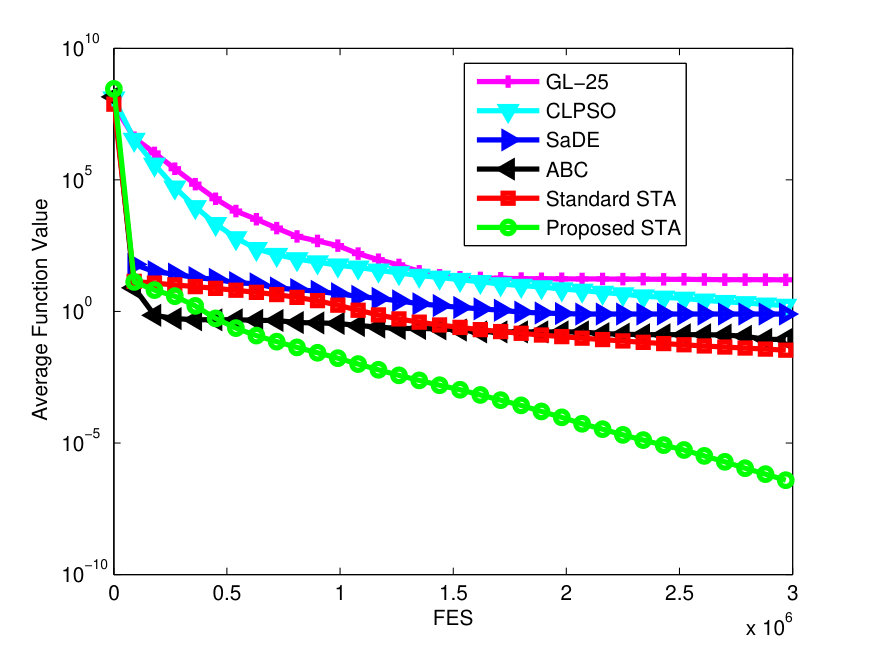 Figure 2
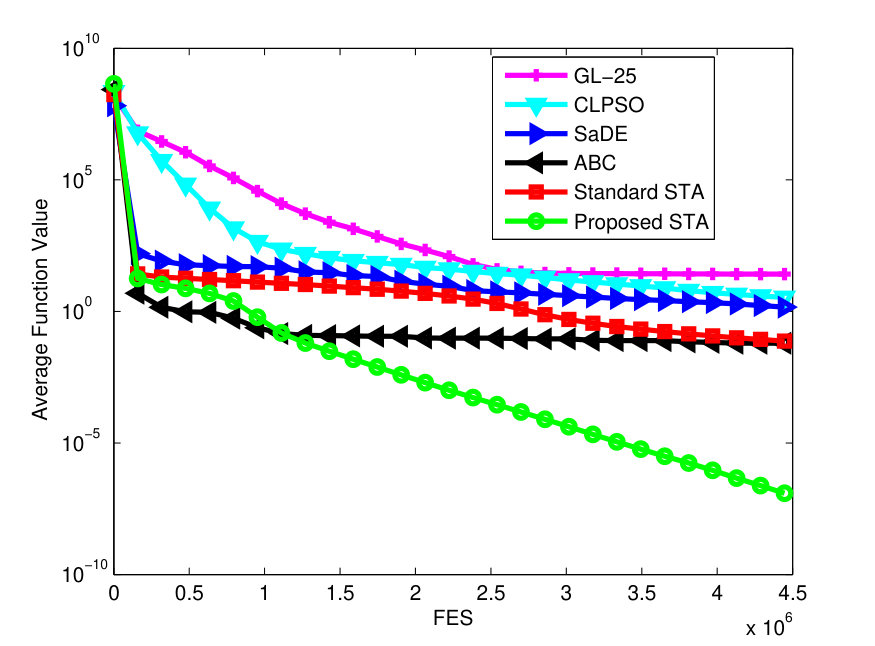 Figure 3
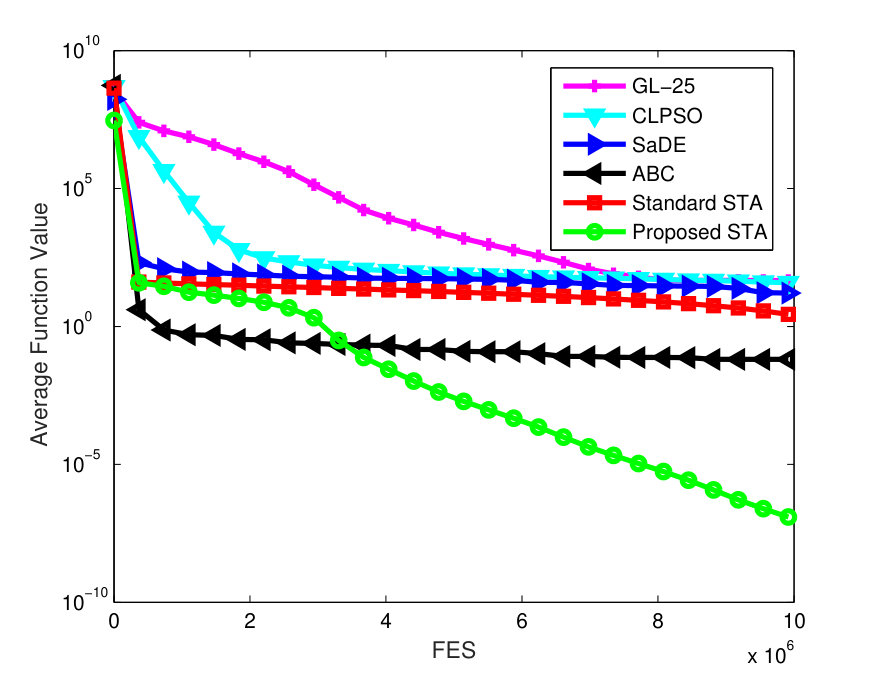 Figure 4
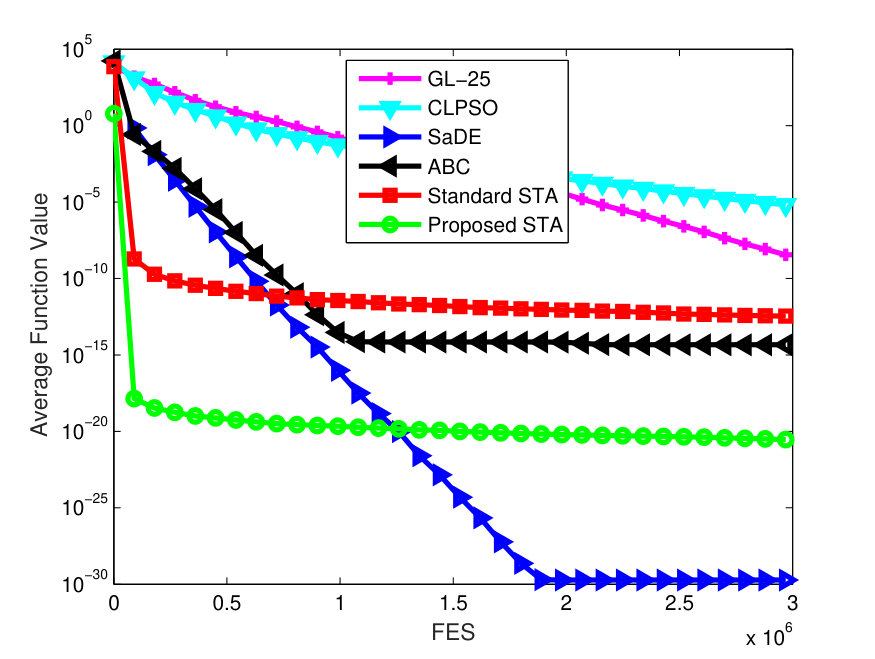 Figure 5
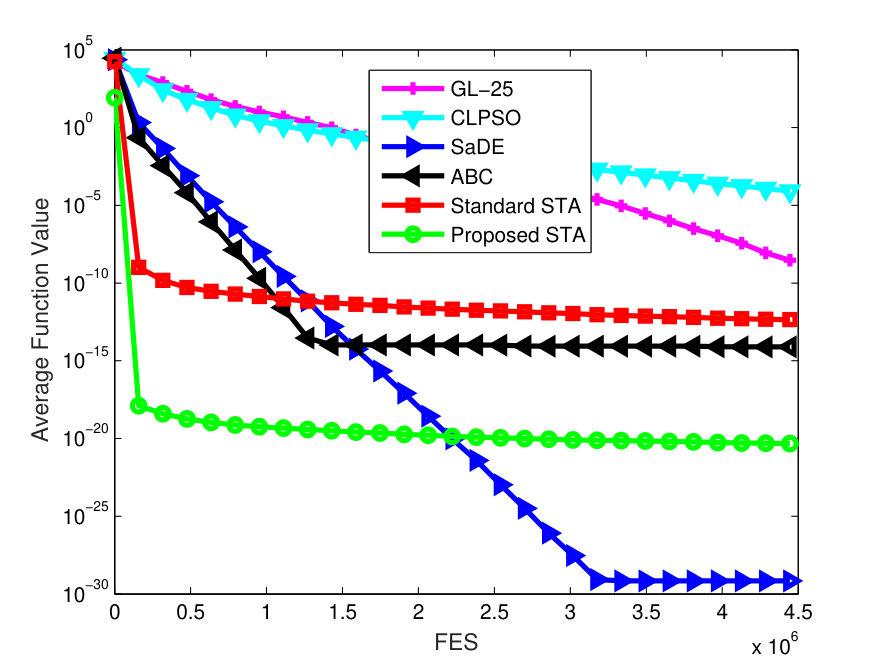 Figure 6
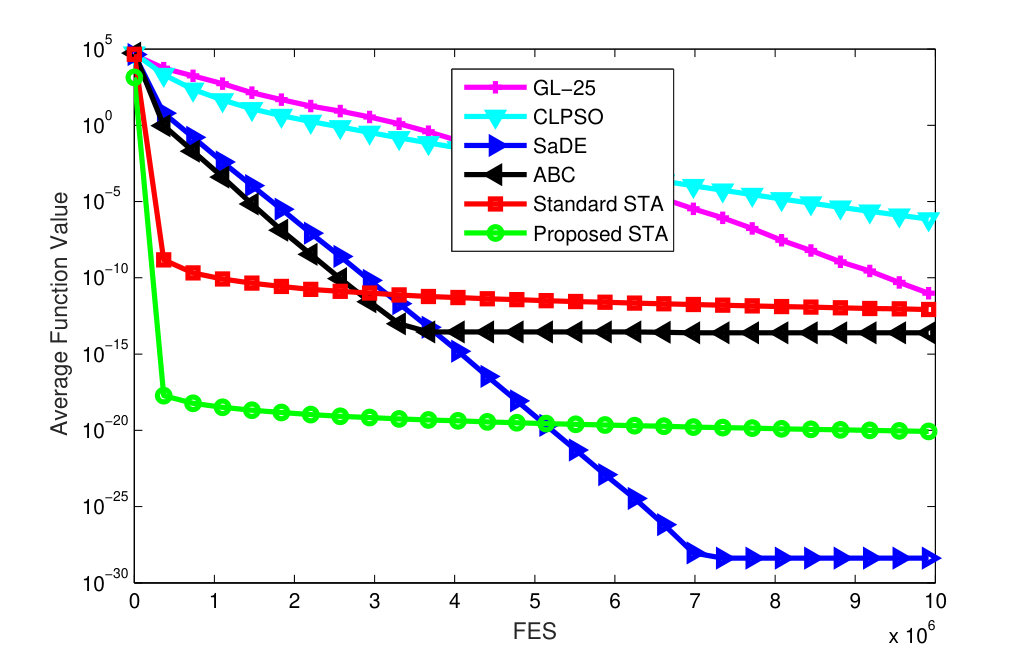 Figure 7
 Figure 8
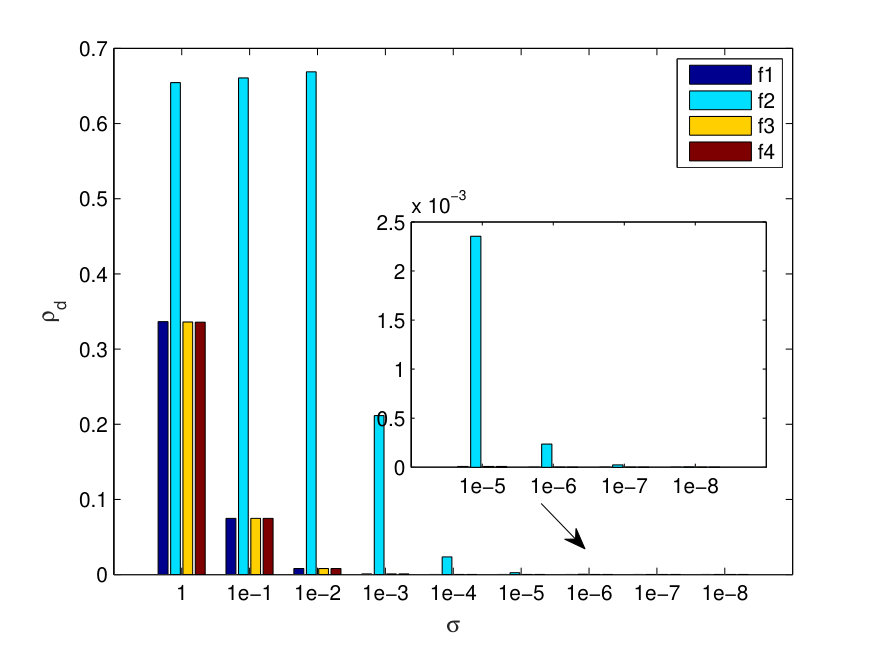 Figure 9
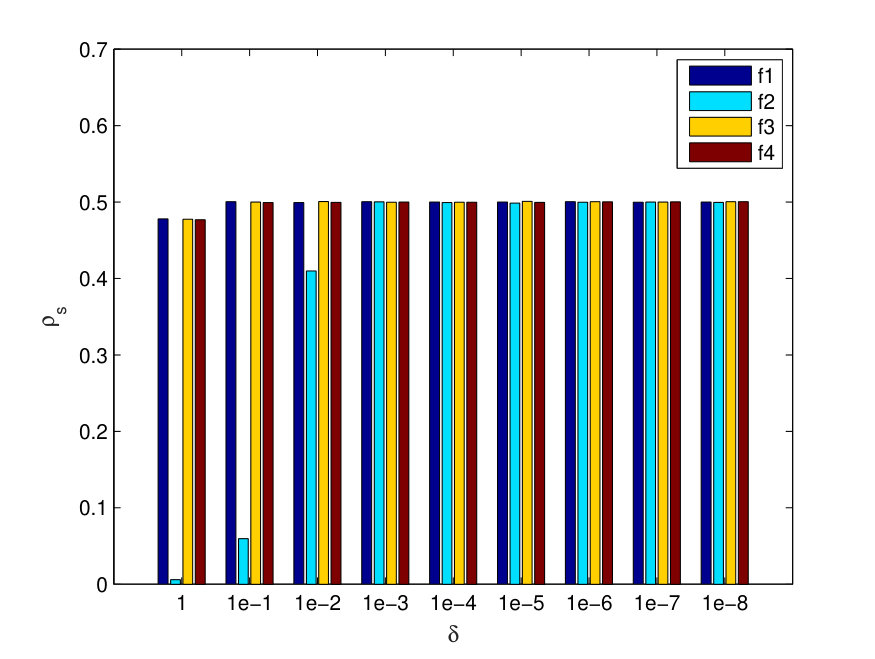 Figure 10
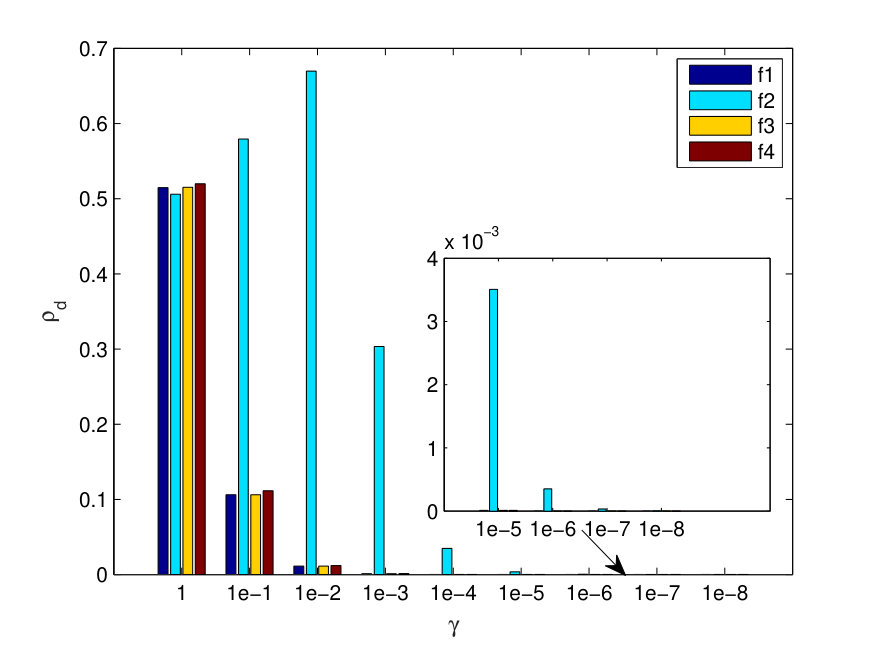 Figure 11
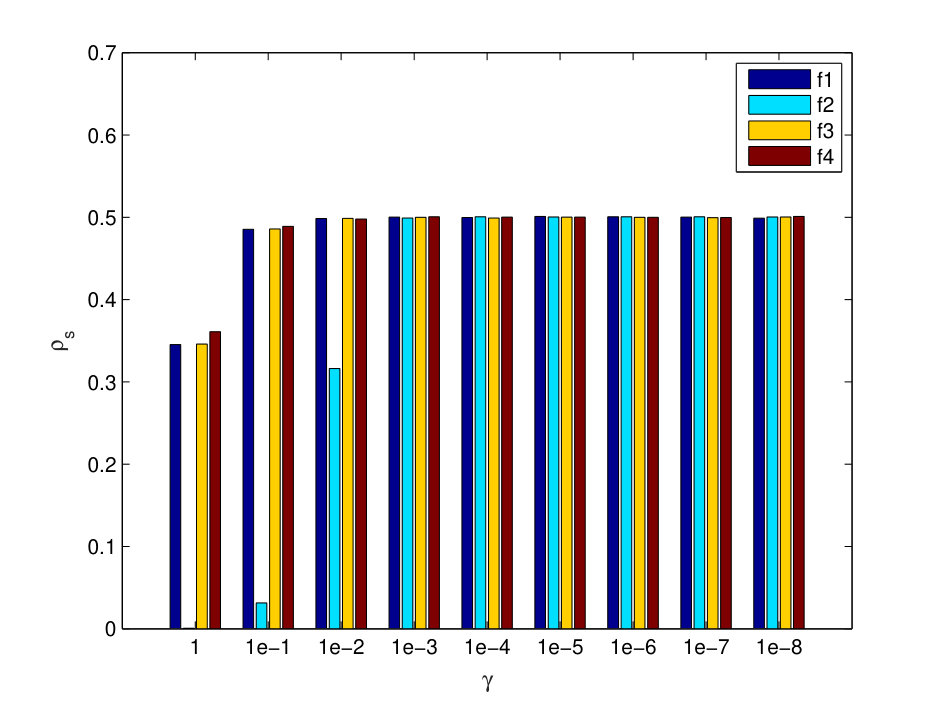 Figure 12
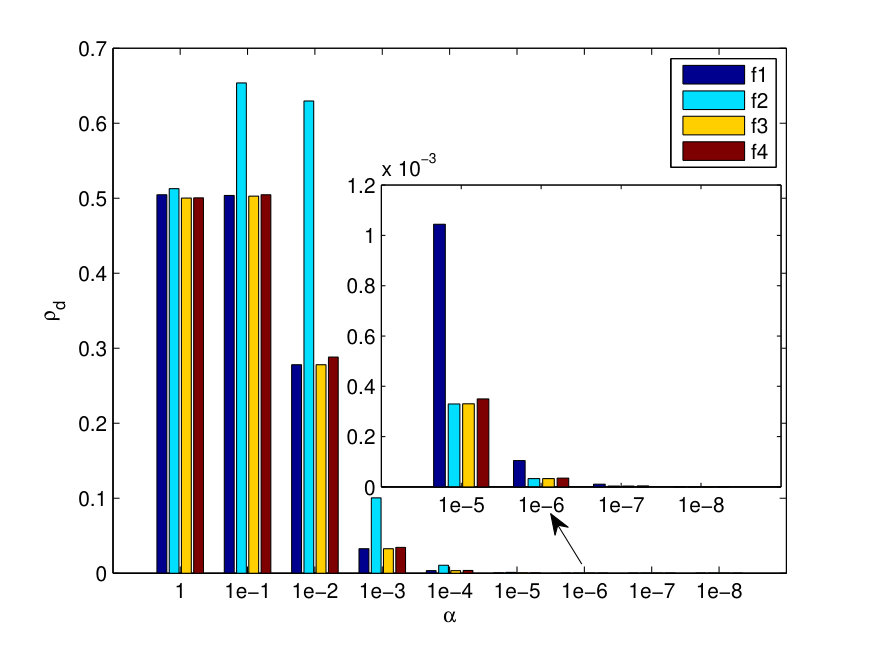 Figure 13
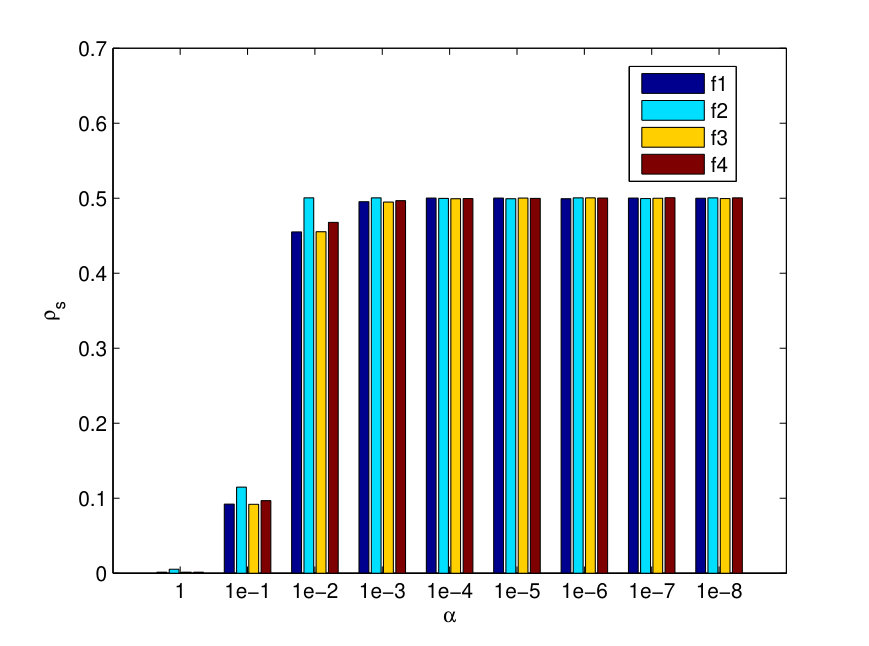 Figure 14
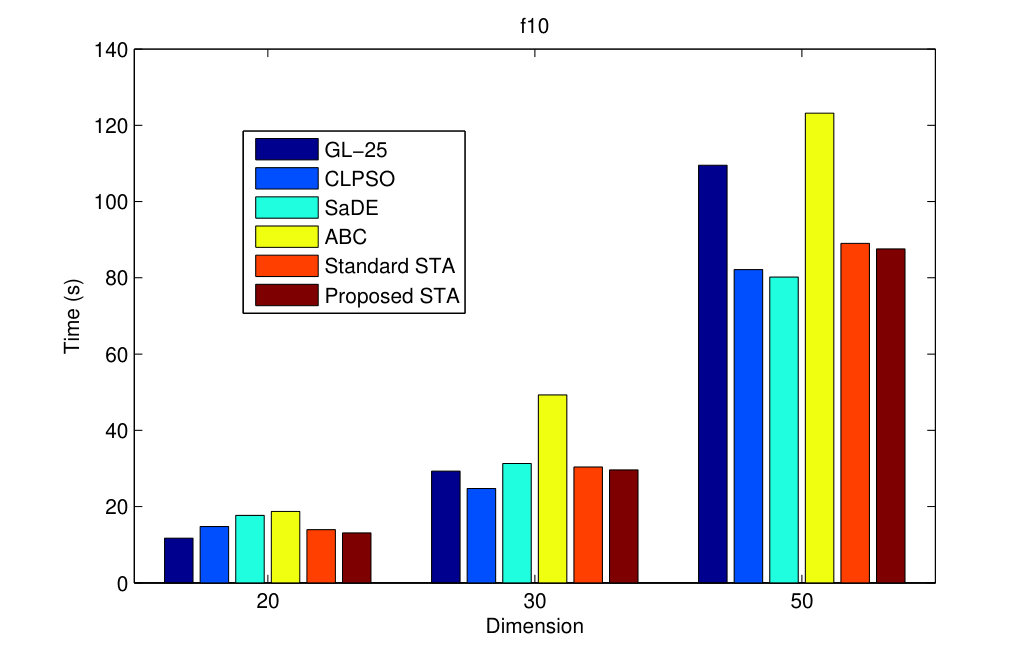 Figure 15
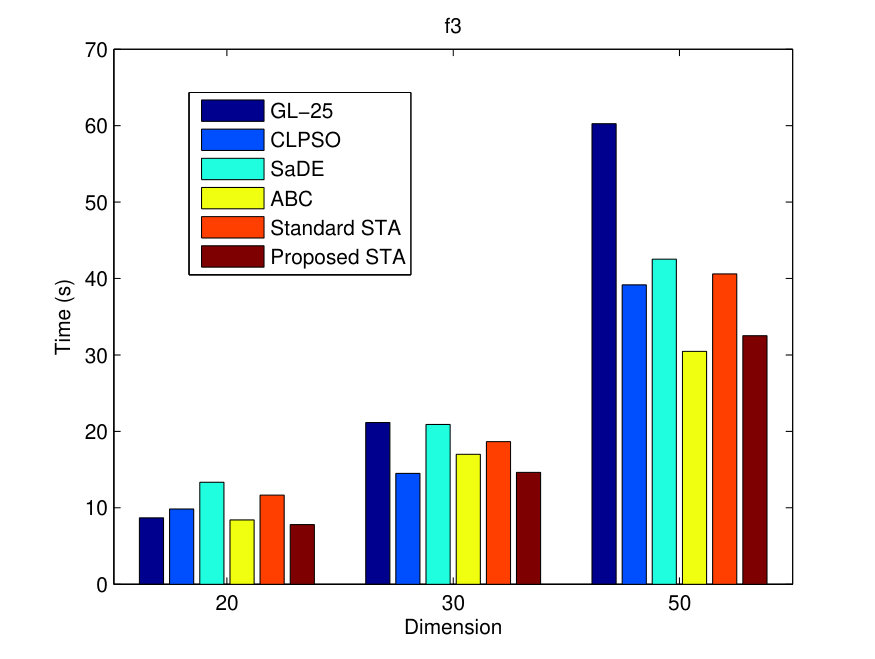 Figure 16
 Figure 17
| Fcn | Dim | GL-25 | CLPSO | SaDE | ABC | Standard STA | Proposed STA |
|---|---|---|---|---|---|---|---|
| 20 | 2.5523e-10 1.5883e-10 | 6.2546e-43 1.4407e-42 | 6.3533e-188 0 | 2.7287e-16 6.1809e-17 | 0 0 | 0 0 | |
| 30 | 1.7872e-8 1.0381e-8 | 1.9944e-40 1.8175e-40 | 5.5498e-184 0 | 5.6618e-16 7.3169e-17 | 0 0 | 0 0 | |
| 50 | 2.3336e-6 1.5613e-6 | 8.3697e-63 6.6314e-63 | 4.8082e-190 0 | 1.3115e-15 1.4686e-16 | 0 0 | 0 0 | |
| 20 | 15.9120 0.2273 | 1.3524 1.5792 | 0.7973 1.6361 | 0.0871 0.1254 | 0.0327 0.0019 | 3.2981e-07 1.0312e-06 | |
| 30 | 25.9785 0.1774 | 3.3395 4.4690 | 1.3895 2.1499 | 0.0523 0.0672 | 0.0711 0.0128 | 1.0027e-07 1.0502e-07 | |
| 50 | 46.3067 0.4004 | 38.4515 31.7815 | 16.2265 21.2962 | 0.0634 0.1142 | 2.5228 1.2541 | 1.0660e-07 8.0190e-08 | |
| 20 | 88.3377 10.1747 | 0 0 | 0.2985 0.4678 | 4.2633e-15 1.0412e-14 | 0 0 | 0 0 | |
| 30 | 177.1109 12.2431 | 5.6843e-15 1.7496e-14 | 1.0945 0.8479 | 8.5265e-14 4.3251e-14 | 0 0 | 0 0 | |
| 50 | 365.4491 12.8696 | 0 0 | 5.5220 2.6516 | 1.0601e-12 1.6704e-12 | 0 0 | 8.5265e-15 2.7817e-14 | |
| 20 | 0.2620 0.1020 | 5.2736e-16 1.4066e-15 | 0.0034 0.0051 | 1.3711e-15 2.2887e-15 | 0 0 | 0 0 | |
| 30 | 0.0178 0.0797 | 0 0 | 0.0041 0.0098 | 7.9936e-16 6.3277e-16 | 0 0 | 0 0 | |
| 50 | 2.0621e-6 1.2609e-6 | 0 0 | 0.0229 0.0338 | 1.5432e-15 6.5721e-16 | 0 0 | 0 0 | |
| 20 | 2.9519e-6 8.5896e-7 | 6.0396e-15 7.9441e-16 | 2.6645e-15 0 | 2.4336e-14 3.6267e-15 | 7.1054e-16 1.8134e-15 | 1.2434e-15 1.7857e-15 | |
| 30 | 1.7312e-5 4.9711e-6 | 7.2831e-15 1.6704e-15 | 0.4004 0.5677 | 4.7073e-14 5.2189e-15 | 2.4869e-15 7.9441e-16 | 2.6645e-15 0 | |
| 50 | 1.5638e-4 5.1830e-5 | 1.2790e-14 1.3015e-15 | 1.8811 1.8811 | 1.0214e-13 8.3914e-15 | 2.6645e-15 0 | 2.6645e-15 0 | |
| 20 | 1.0920e-7 8.5896e-7 | 9.6865e-40 1.0089e-39 | 2.9962e-182 0 | 2.8100e-16 2.2693e-17 | 0 0 | 0 0 | |
| 30 | 4.3319e-6 4.1372e-6 | 9.6865e-40 1.0089e-39 | 7.5626e-180 0 | 5.0197e-16 5.0710e-17 | 0 0 | 0 0 | |
| 50 | 1.4938e-4 9.1548e-5 | 1.0767e-59 9.2087e-60 | 3.6584e-188 0 | 1.2513e-15 1.3320e-16 | 0 0 | 0 0 | |
| 20 | -10.7121 0.4311 | -19.6363 0.0013 | -19.6204 0.0210 | -19.6359 0.0013 | -19.2512 0.7144 | -19.6370 4.5865e-15 | |
| 30 | -13.5080 4.1372e-6 | -29.5405 0.0422 | -29.5668 0.0439 | -29.6083 0.0121 | -29.2917 0.5761 | -29.3322 0.4810 | |
| 50 | -18.2114 0.8100 | -49.2281 0.1068 | -49.3694 0.1155 | -49.5258 0.0239 | -48.9364 0.7706 | -49.2284 0.5118 | |
| 20 | -1.2099e3 63.9563 | -1.2126e3 198.0180 | -1.5200e3 0.0030 | -1.4934e3 17.7408 | -1.5200e3 7.6568e-10 | -1.5200e3 1.0526e-09 | |
| 30 | -2.1886e3 419.3236 | -2.3303e3 786.8715 | -4.8684e3 30.0984 | -3.7616e3 379.9890 | -4.9300e3 1.0317e-8 | -4.9300e3 1.9630e-8 | |
| 50 | -3.8943e3 1.0972e3 | -4.6039e3 2.1276e3 | -1.6988e4 1.9831e3 | -6.2731e3 2.9887e3 | -2.2050e4 2.4728e-5 | -2.2050e4 1.2703e-06 | |
| 20 | -3.4543e3 262.3109 | -8.3797e3 3.7325e-12 | -8.3678e3 52.9672 | -8.3797e3 1.7705e-12 | -8.3797e3 2.0013e-12 | -8.3797e3 2.4688e-12 | |
| 30 | -4.2340e3 206.4148 | -1.2569e4 1.8662e-12 | -1.2534e4 55.6852 | -1.2569e4 5.0878e-10 | -1.2569e4 3.9808e-12 | -1.2569e4 3.9808e-12 | |
| 50 | -5.5094e3 308.3849 | -2.0949e4 7.4650e-12 | -2.0848e4 123.1747 | -2.0949e4 2.2694e-4 | -2.0949e4 6.9328e-12 | -2.0949e4 6.8824e-12 | |
| 20 | 680.7399 158.9219 | 6.0736 3.4399 | 3.4609e-29 1.5188e-28 | 122.8894 57.5833 | 0 0 | 5.4347e-323 0 | |
| 30 | 6.0084e3 891.0211 | 192.7349 40.2446 | 1.7348e-18 3.7702e-18 | 1.4779e3 417.2093 | 0 0 | 2.9857e-207 0 | |
| 50 | 2.6141e4 3.4905e3 | 1.7640e3 334.6602 | 1.1549e-11 2.5786e-11 | 1.3111e4 2.0672e3 | 4.9187e-16 2.1481e-15 | 1.3290e-143 2.4407e-143 | |
| 20 | 2.6106e-9 2.0321e-9 | 5.9122e-6 2.7178e-6 | 1.8933e-30 1.2854e-30 | 4.6418e-15 1.2107e-15 | 3.4527e-13 1.9644e-13 | 2.8663e-21 1.5596e-21 | |
| 30 | 1.8994e-9 1.5212e-9 | 7.2339e-5 1.6458e-5 | 6.9050e-30 1.9571e-30 | 7.9455e-15 1.9605e-15 | 4.3734e-13 2.3603e-13 | 4.7017e-21 1.8546e-21 | |
| 50 | 6.2123e-12 1.0570e-11 | 4.6982e-7 1.0856e-7 | 4.1750e-29 2.8959e-29 | 2.3607e-14 7.8298e-15 | 8.2000e-13 2.3292e-13 | 8.3954e-21 2.8656e-21 | |
| 20 | 0.0047 0.0012 | 0 0 | 0 0 | 0 0 | 0 0 | 0 0 | |
| 30 | 0.0302 0.0077 | 0 0 | 0.2097 0.3033 | 0 0 | 0 0 | 0 0 | |
| 50 | 0.2307 0.0805 | 0 0 | 1.7162 0.8589 | 2.7711e-14 9.7534e-15 | 0 0 | 0 0 |
Peer Reviews
No public reviews on file for this paper yet. If you reviewed it on a platform where reviews are public (OpenReview, ICLR, NeurIPS, ICML), you can paste yours below so the community can read it here.
Videos
No videos yet. Explain this paper in a talk, walkthrough, or lecture? Add one.
A Statistical Study on Parameter Selection of Operators in Continuous State Transition Algorithm
Xiaojun Zhou, Chuhua Yang , Weihua Gui X. Zhou, C. Yang and W. Gui are with the School of Information Science and Engineering, Central South University, Changsha, Hunan, China e-mail: ([email protected], [email protected], [email protected]).Manuscript received XX, 2017; revised XX, 2018.
Abstract
State transition algorithm (STA) has been emerging as a novel metaheuristic method for global optimization in recent few years. In our previous study, the parameter of transformation operator in continuous STA is kept constant or decreasing itself in a periodical way. In this paper, the optimal parameter selection of the STA is taken in consideration. Firstly, a statistical study with four benchmark two-dimensional functions is conducted to show how these parameters affect the search ability of the STA. Based on the experience gained from the statistical study, then, a new continuous STA with optimal parameters strategy is proposed to accelerate its search process. The proposed STA is successfully applied to twelve benchmarks with 20, 30 and 50 dimensional space. Comparison with other metaheuristics has also demonstrated the effectiveness of the proposed method.
Index Terms:
State transition algorithm, statistical study, metaheuristic, global optimization.
I Introduction
State-transition-algorithm (STA) [1, 2] is a recently emerging metaheuristic method for global optimization and has found applications in nonlinear system identification and control [3], water distribution networks configuration [4], sensor network localization [5], PID controller design [6, 7], overlapping peaks resolution [8], image segmentation [9], wind power prediction [10], dynamic optimization [11, 12], bi-level optimization [13], modeling and control of complex industrial processes [14, 15, 16, 17, 18, 19], etc. In STA, a solution to an optimization problem is considered as a state, and an update of a solution can be regarded as a state transition. Unlike the population-based evolutionary algorithms [20, 21, 22], the standard STA is an individual-based optimization method. Based on an incumbent best solution, a neighborhood with special characteristics will be formed automatically when using certain state transformation operator. A variety of state transformation operators, for example, rotation, translation, expansion, and axesion in continuous STA, or swap, shift, symmetry and substitute in discrete STA, are designed purposely for both global and local search. On the basis of the neighborhood, then, a sampling technique is used to generate a candidate set, and the next best solution is updated by using a selection technique based on previous best solution and the candidate set. This process is repeated using state transformation operators alternatively until some terminal conditions are satisfied.
In this paper, the continuous state transition algorithm is studied. As aforementioned, in continuous STA, there are four state transformation operators, and each transformation operator has certain geometric significance, i.e., the neighborhood formed by each transformation operator has certain geometric characteristic. To be more specific, the rotation transformation has the functionality to search in a hypersphere with the maximal radius , called rotation factor; the translation transformation has the functionality to search along a line with the maximal length , called translation factor; the expansion transformation has the functionality to search in a broader space controlled by the expansion factor ; and the axesion transformation is designed to strengthen single-dimensional search regulated by the axesion factor . In our previous studies, the rotation factor is exponentially decreasing from a maximum value to a minimum value in a periodic way, and other transformation factors are kept constant at one [1]. To gain a better exploitation ability, all state transformation factors are exponentially decreasing from a maximum value to a minimum value in a periodic way in [5].
As is known to us, there exist several parameters in metaheuristic methods and parameter selection plays a significant role in their performance. For instance, crossover and mutation probability in genetic algorithms (GAs) [23], inertia weight and acceleration factors in particle swarm optimization (PSO) [24, 25], amplification factor and crossover rate in differential evolution (DE) [26, 27, 28], and neighborhood radius in artificial bee colony (ABC) [29]. In general, the parameter setting can be summarized to two types: parameter tuning and parameter control. The former is to find good parameter values before running these algorithms, and they remain fixed during the run. On the contrary, the later is to update parameter values in the process, and the types of update mechanisms can be deterministic, adaptive, or self-adaptive (for details, please refer to [30, 31, 32]).
To gain a better understanding of the parameters of transformation operators in continuous STA affecting its performance, the parameter selection in continuous STA is focused in this study. With four commonly used benchmark functions as cases, several properties of the operator parameters are observed from a statistical study. With the gained experience from the statistical results, a new continuous STA with optimal operator parameter selection strategy is proposed, and the proposed STA is successfully applied to other benchmarks with higher dimensions.
The remainder of this paper is organized as follows. In Section II, the standard continuous STA are described. Section III gives a statistical study to show how the operator parameters in continuous STA affecting its performance . The proposed STA with optimal operator parameter selection strategy is given in Section IV. In Section V, experimental results are given to testify the effectiveness of the proposed STA. Finally, conclusion is drawn in Section VI.
II Standard continuous state transition algorithm
Consider the following continuous optimization problem with simple constraints:
[TABLE]
where is a closed and compact set, which is usually composed of lower and upper bounds of , i.e., .
In classical iterative methods for numerical optimization, a new candidate is generated based on a previous solution by using different optimization operators. In a state transition way, a solution can be regarded as a state, and an update of a solution can be considered as a state transition. On the basis of state space representation, the unified form of generation of solution in state transition algorithm can be described as follows:
[TABLE]
where and stand for a current state and the next state respectively, corresponding to solutions of the optimization problem; is a function of and historical states; is the fitness value at ; and are state transition matrices, which can be considered as transformation operators; is the objective function or fitness function.
II-A State transition operators
Using state space representation and state transformation for reference, four special state transformation operators are designed to generate candidate solutions for an optimization problem [33, 1].
(1) Rotation transformation
[TABLE]
where is a positive constant, called the rotation factor; , is a random matrix with its entries being uniformly distributed random variables defined on the interval [-1, 1], and is the L2-norm (or Euclidean norm) of a vector. This rotation transformation has the functionality to search in a hypersphere with the maximal radius , which has been testified. The rotation transformation is designed for local search and can be used to guarantee local optimality and manipulate solution accuracy.
(2) Translation transformation
[TABLE]
where is a positive constant, called the translation factor; is a uniformly distributed random variable defined on the interval [0,1]. It is not difficult to understand that the translation transformation has the functionality to search along a line from to at the starting point with maximum length . The translation operator is actually a line search, and it can be considered as a heuristic operator since there exists a possible better solution along the line if is better than .
(3) Expansion transformation
[TABLE]
where is a positive constant, called the expansion factor; is a random diagonal matrix with its entries obeying the Gaussian distribution (or normal distribution). In the standard STA, the mean equals zero and standard deviation equals one, i.e., the standard normal distribution is used. The expansion transformation has the functionality to search in the whole space in probability, and it is designed for global search.
(4) Axesion transformation
[TABLE]
where is a positive constant, called the axesion factor; is a random diagonal matrix with its entries obeying the Gaussian distribution and only one random position having nonzero value. The axesion transformation is designed to search along the axes, aiming to strengthen single-dimensional search [34].
II-B A sampling technique
The idea of sampling incorporated in continuous STA was firstly illustrated in [35]. It is found that for a given solution, a neighborhood will be automatically formed. To avoid enumerating all possible candidate solutions, representative samples can be used to reflect the characteristics of the neighborhood. Taking the rotation transformation for example, when independently executing the rotation operator for SE times, a total number of SE samples are generated in pseudocode as follows
1:for , SE do
2:
3:end for
where is the incumbent best solution, and SE samples are stored in the matrix .
II-C An update strategy
As mentioned above, based on the incumbent best solution, a total number of SE candidate solutions are generated, but it should be noted that these candidate solutions do not always belong to the domain . To address this issue, these samples are projected into through
[TABLE]
As a result, the candidate solutions can be guaranteed to be always feasible. Next, a new best solution is selected from the candidate set by virtue of the fitness function, denoted as . Finally, an update strategy based on greedy criterion is used to update the incumbent best as shown below
[TABLE]
II-D Algorithm procedure of the standard continuous STA
With the state transformation operators for both local and global search, sampling technique for time-saving and update strategy for convergence, the standard continuous STA can be described by the following pseudocodes
1:State initialization(SE,)
2:Best fitness(funfcn,State)
3:repeat
4: if then
5:
6: end if
7: Best expansion(funfcn,Best,SE,,)
8: Best rotation(funfcn,Best,SE,,)
9: Best axesion(funfcn,Best,SE,,)
10:
11:until the specified termination criterion is met
As for detailed explanations, rotation in above pseudocode is given for illustration purposes as follows
1:oldBest Best
2:fBest feval(funfcn,oldBest)
3:State op_rotate(Best,SE,)
4:[newBest,fnewBest] fitness(funfcn,State)
5:if fnewBest fBest then
6: fBest fnewBest
7: Best newBest
8: State op_translate(oldBest,newBest,SE,)
9: [newBest,fnewBest] fitness(funfcn,State)
10: if fnewBest fBest then
11: fBest fnewBest
12: Best newBest
13: end if
14:end if
As shown in the above pseudocodes, initialization is used to make sure the initial solution is in the range . The rotation factor is decreasing periodically from a maximum value to a minimum value in an exponential way with base fc, which is called lessening coefficient. op_rotate and op_translate represent the implementations of proposed sampling technique for rotation and translation operators, respectively, and fitness represents the implementation of selecting the new best solution from SE samples. It should be emphasized that the translation operator is only executed when a solution better than the incumbent best solution can be found in the SE samples from rotation, expansion or axesion transformation. In the standard continuous STA, the parameter settings are given as follows: -4, , .
III Statistical study of the state transformation factors
As described in Section II, in the standard continuous STA, the state transformation factors like expansion factor , axesion factor are kept constant, and rotation factor is decreasing periodically from a maximum value to a minimum value in an exponential way. In order to select the values of these parameters in a more effective manner, a statistical study of the state transformation factors is carried out to investigate the effect of parameter selection on the performance of state transition operators.
Four well-known benchmark functions are listed below:
(1) Spherical function
[TABLE]
where the global optimum and , .
(2) Rosenbrock function
[TABLE]
where the global optimum and , .
(3) Rastrigin function
[TABLE]
where the global optimum and , .
(4) Griewank function
[TABLE]
where the global optimum and , .
For a given solution , three state transition operators (rotation, expansion and axesion) are performed respectively for SE times (yielding SE samples) independently on each benchmark function using different values of state transformation factors. To be more specific, there are five groups of given solutions, i.e., , ; the total number of samples is set at SE = 1e6; and the value of state transformation operators is chosen from the set 1, 1e-1, 1e-2, 1e-3, 1e-4, 1e-5, 1e-6, 1e-7, 1e-8.
To evaluate the influence of the parameter selection on the performance of state transition operators, the following two indexes are introduced:
[TABLE]
where and are called success rate and descent rate, respectively. is the number of samples whose objective function values are smaller than that of the . is the average function value of the samples, and represents the function value for ,
The statistical results for different values of state transformation factors can be found from Table I to Table IV.
As indicated in these tables, the following properties can be observed:
as the decrease of a state transformation factor below a certain threshold, the descent rate is showing a declining trend. 2. 2.
the success rate remains almost steadily high if a state transformation factor is below a certain threshold. 3. 3.
the success rate of the rotation transformation is not high until the rotation factor is below a threshold when current solution is approaching the global optimal solution.
To be more specific, let’s take the rotation transformation for example, the changes of success rate and descent rate with the rotation factor are illustrated in Fig. 1 when current solution is approaching the global optimum. Here, equals to (0.01, 0.01), (0.99, 0.99), (0.01, 0.01) and (0.01, 0.01) for , , and respectively. By taking a closer look at these two figures, it is not difficult to find that there exists a trade-off between the success rate and the descent rate. For instance, when , the success rate is quite low, while the descent rate is quite high. On the contrary, when 1e-5, 1e-6, 1e-7, 1e-8, the success rate is quite high, while the descent rate is quite low.
Remark 1
The property 3) can provide additional support to the way in changing the rotation factor in the standard continuous STA, i.e., is not kept constant but decreasing periodically from a maximum value to a minimum value . Anyway, it is obvious that the way in changing the state transition factors is not in an optimal manner.
IV State transition algorithm with optimal parameter selection
As inspired by the statistical study of the state transformation factors, in this section, an optimal parameter selection strategy is proposed to accelerate the search of the standard continuous state transition algorithm.
IV-A Optimal parameter selection for the state transformation factors
In classical iterative methods for numerical optimization, the following iterative formula is usually adopted
[TABLE]
where is the search direction, and is the step size. For gradient-based algorithms, the search direction is relevant to the gradient of current iterative point, for instance, the steepest descent method, , and the step size is often restricted to the range [0,1]. It can be found that the pattern of iterative formula in continuous STA is similar to that of Eq. (11), as shown below
[TABLE]
and a big difference is that the search direction is not determined. Compared with gradient-based algorithms, the STA can be used for global optimization lies in at least two aspects: 1) the search is in all directions; 2) the search can go to any length. While compared with the traditional trust region method, the similarity is that some parts of the STA (except the translation transformation) can be considered as a special kind of trust region method, but the differences are: i) the STA utilizes the original function not its quadratic approximation; ii) the search direction in STA is stochastic.
For rotation and translation transformation, the search zone is restricted in a hypersphere or along a line, which are controlled by the corresponding transformation factors. For expansion and axesion transformation, although the search zone can be expanded to the whole space in probability due to the Gaussian distribution, the search zone is restricted and manipulated by the expansion and axesion factors as well. That is to say, in practical numerical computation, the neighborhood formed by the state transformation operators is controlled by the transformation factors to a large extent, which are also testified by the statistical study. To simplify the parameter selection and accelerate the search process, the values of these parameters are all taken from the set 1, 1e-1, 1e-2, 1e-3, 1e-4, 1e-5, 1e-6, 1e-7, 1e-8, and the parameter value with the corresponding smallest objective function value is chosen.
IV-B The proposed STA
Let’s denote the optimal parameter as , and then we have
[TABLE]
In theory, the neighborhood formed by the state transformation operators has infinite candidate solutions; however, only SE samples are used for evaluation in practice. That is to say, for a given parameter value, only SE samples are taken into consideration. In order to further utilize the parameter more completely, the selected parameter value is kept for a period of time, denoted as . To be more specific, the detailed of the proposed STA can be outlined as follows
1:repeat
2: Best expansion_w(funfcn,Best,SE,)
3: Best rotation_w(funfcn,Best,SE,)
4: Best axesion_w(funfcn,Best,SE,)
5:until the specified termination criterion is met
In the meanwhile, rotation_w in above pseudocode is given for further explanations
1:[Best,] update_alpha(funfcn,Best,SE,)
2:for do
3: Best rotation(funfcn,Best,SE,)
4:end for
where the function update_alpha represents the implementation of selection the optimal parameter value of rotation factor. The proposed STA differs from the standard STA in three folds: 1) the periodical way of diminishing the transformation factors is no longer used; 2) the optimal parameter is selected for state transformation; 3) the optimal parameter is kept to utilize for a period of time.
V Experimental results
In order to testify the effectiveness of the proposed STA, the following additional benchmark functions are used for test.
(5) Ackley function
[TABLE]
where the global optimum and , .
(6) High Conditioned Elliptic function
[TABLE]
where the global optimum and , .
(7) Michalewicz function
[TABLE]
where the global optimum is unknown, .
(8) Trid function
[TABLE]
where the global optimum and , .
(9) Schwefel function
[TABLE]
where the global optimum and , .
(10) Schwefel 1.2 function
[TABLE]
where the global optimum and , .
(11) Schwefel 2.4 function
[TABLE]
where the global optimum and , .
(12) Weierstrass function
[TABLE]
where , the global optimum and , .
Other metaheuristics are used for comparison, including the GL-25 [36], CLPSO [37], SaDE [38], and ABC [39], with the same parameter settings as in these literatures. The parameters in the proposed STA are given by experience as follows: SE = 30, (additional experiments have testified the validity of these parameter values). The number of decision variables of the benchmark functions is set to 20, 30 and 50, and the corresponding maximum function evaluations is set at 5e4nlog(n). A total of 20 independent runs are conducted in the MATLAB (Version R2010b) software platform on Intel(R) Core(TM) i3-2310M CPU @2.10GHz under Window 7 environment. The statistic results are given in Table V and some typical instances with respect to elapsed time and iterative curves are illustrated in Figs. 2-4.
From the experimental results, it can be found that the proposed STA is superior to the basic STA among most of these test problems. The global search ability (see the Michalewicz function) and the solution accuracy (see the Schwefel 1.2 and Schwefel 2.4 function) has greatly improved. It can also be comparable to other metaheuristics except for the Michalewicz function and the Schwefel 2.4 function. However, it should be noted that only mean and standard deviation are given for comparison. Actually, for the Michalewicz function, the results obtained from the proposed STA hit the known global solution for more than 50% of the total runs.
VI Conclusion and future work
In this study, the optimal parameter selection of operators in continuous STA was considered to improve its search performance. Firstly, a statistical study with four benchmark cases was conducted to investigate how these parameters affect the performance of continuous STA. And several properties are observed from the statistical study. With the experience gained from the statistical results, then, a new continuous STA with optimal parameters strategy was proposed to accelerate its search process. The proposed STA was successfully applied to other benchmarks. Comparison with other metaheuristics was conducted to demonstrate the effectiveness of the proposed method as well.
It should be noted that the parameter is given by experience that needs further study, and the parameter selection of operators in continuous STA is still a challenging problem, since the proposed optimal parameter selection strategy can only be considered as a local vision. From an overall perspective, the parameters set should be taken into consideration as well, and it is not necessarily restricted to one below. Furthermore, it can be found that the STA doesn’t work steadily for the Michalewicz function and global search ability should be strengthened further. In our future work, the upper bound of the parameter set will be considered as well, and an adaptive parameter selection strategy and appropriate utilization of transformation operators can also be alternative choices.
The MATLAB source codes of the standard STA and the proposed STA are available upon request from the corresponding author, or can be downloaded from MATLAB central file exchange, or from X. Zhou’s homepage as follows
https://www.mathworks.com/matlabcentral/fileexchange/
http://faculty.csu.edu.cn/michael_x_zhou/zh_CN/index.htm
Acknowledgment
This study is supported by the National Natural Science Foundation of China (Grant No. 61503416, 61533021, 61621062 and 61725306), the Innovation-Driven Plan in Central South University (Grant No. 2018CX12), the 111 Project (Grant No. B17048) and the Hunan Provincial Natural Science Foundation of China (Grant No. 2018JJ3683).
The reference list from the paper itself. Each links out to its DOI / PubMed record.
- 1[1] X. Zhou, C. Yang, and W. Gui, “State transition algorithm,” Journal of Industrial and Management Optimization , vol. 8, no. 4, pp. 1039–1056, 2012.
- 2[2] X. Zhou, D. Y. Gao, C. Yang, and W. Gui, “Discrete state transition algorithm for unconstrained integer optimization problems,” Neurocomputing , vol. 173, pp. 864–874, 2016.
- 3[3] X. Zhou, C. Yang, and W. Gui, “Nonlinear system identification and control using state transition algorithm,” Applied Mathematics and Computation , vol. 226, pp. 169–179, 2014.
- 4[4] X. Zhou, D. Y. Gao, and A. R. Simpson, “Optimal design of water distribution networks by a discrete state transition algorithm,” Engineering Optimization , vol. 48, no. 4, pp. 603–628, 2016.
- 5[5] X. Zhou, P. Shi, C.-C. Lim, C. Yang, and W. Gui, “A dynamic state transition algorithm with application to sensor network localization,” Neurocomputing , vol. 273, pp. 237–250, 2018.
- 6[6] F. Zhang, C. Yang, X. Zhou, and W. Gui, “Fractional-order pid controller tuning using continuous state transition algorithm,” Neural Computing and Applications , pp. 1–10, 2016.
- 7[7] G. Saravanakumar, K. Valarmathi, M. P. Rajasekaran, S. Srinivasan, M. W. Iruthayarajan, and V. E. Balas, “Tuning multivariable decentralized pid controller using state transition algorithm,” Studies in Informatics and control , vol. 24, no. 4, pp. 367–378, 2015.
- 8[8] G. Wang, C. Yang, H. Zhu, Y. Li, X. Peng, and W. Gui, “State-transition-algorithm-based resolution for overlapping linear sweep voltammetric peaks with high signal ratio,” Chemometrics and Intelligent Laboratory Systems , vol. 151, pp. 61–70, 2016.