Inclusive jet measurements in pp and Pb-Pb collisions with ALICE
James Mulligan (for the ALICE Collaboration)

TL;DR
This paper presents new measurements of inclusive charged and full jet production in proton-proton and lead-lead collisions at 5.02 TeV, using ALICE's advanced tracking and calorimetry to explore jet quenching and medium effects.
Contribution
It provides the first low transverse momentum full jet measurements at this energy, enhancing understanding of jet modification in quark-gluon plasma.
Findings
Jet R_AA varies with jet radius R.
Measurements extend to low jet p_T.
Results are compared with theoretical models.
Abstract
Measurements of jet yields in heavy-ion collisions can be used to constrain jet energy loss models, and in turn provide information about the physical properties of deconfined QCD matter. ALICE reconstructs charged particle jets () with high-precision tracking of charged particles down to MeV/, and jets () with the addition of particle information from the electromagnetic calorimeter down to MeV. By including low momentum jet constituents, ALICE is uniquely positioned at the LHC to measure jets down to low jet momentum, to determine the modification to the soft components of jets, and to measure medium recoil particles. New inclusive full jet measurements in pp and Pb-Pb collisions at TeV with ALICE will be shown, over and extending…
Click any figure to enlarge with its caption.
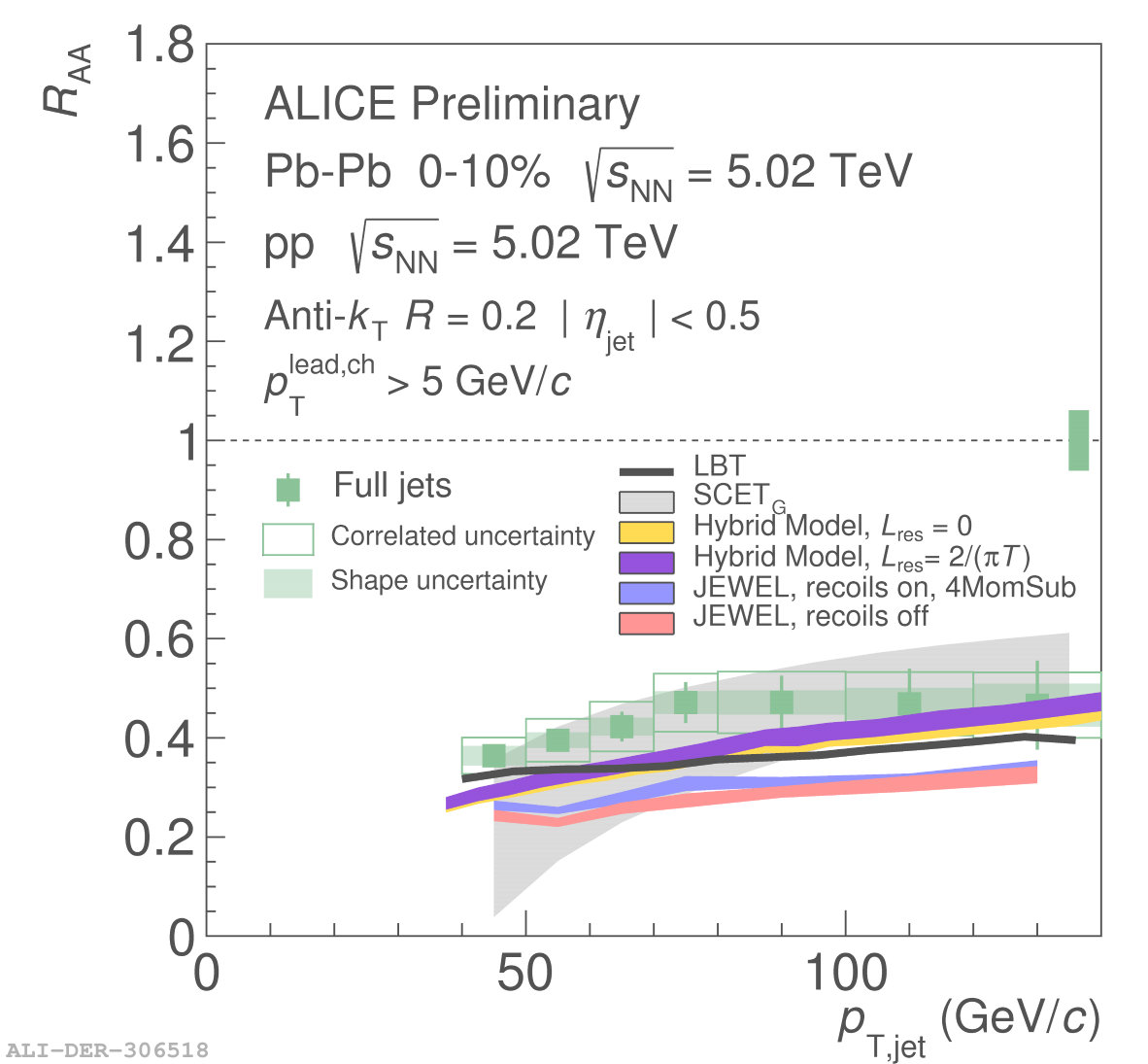 Figure 1
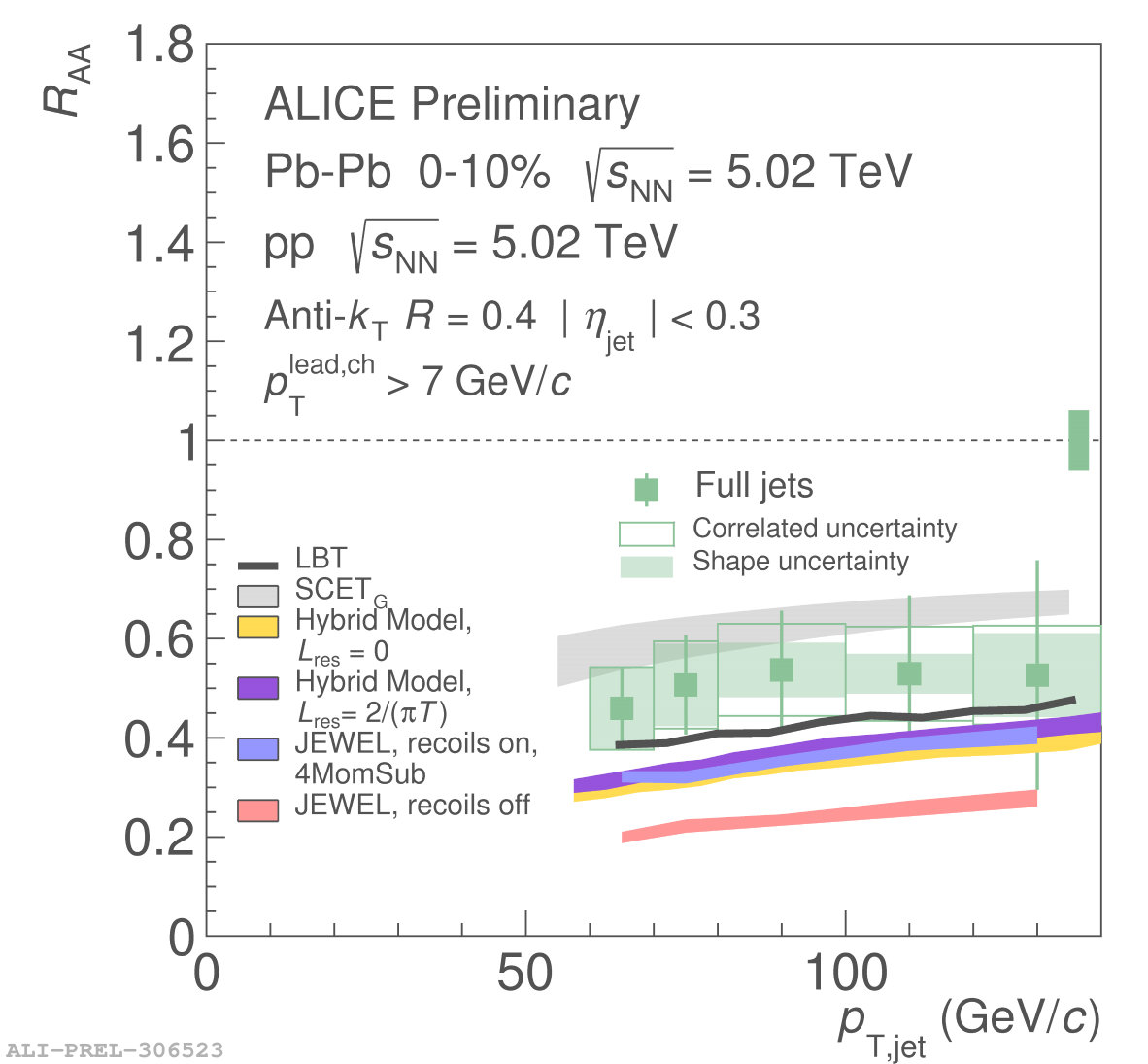 Figure 2
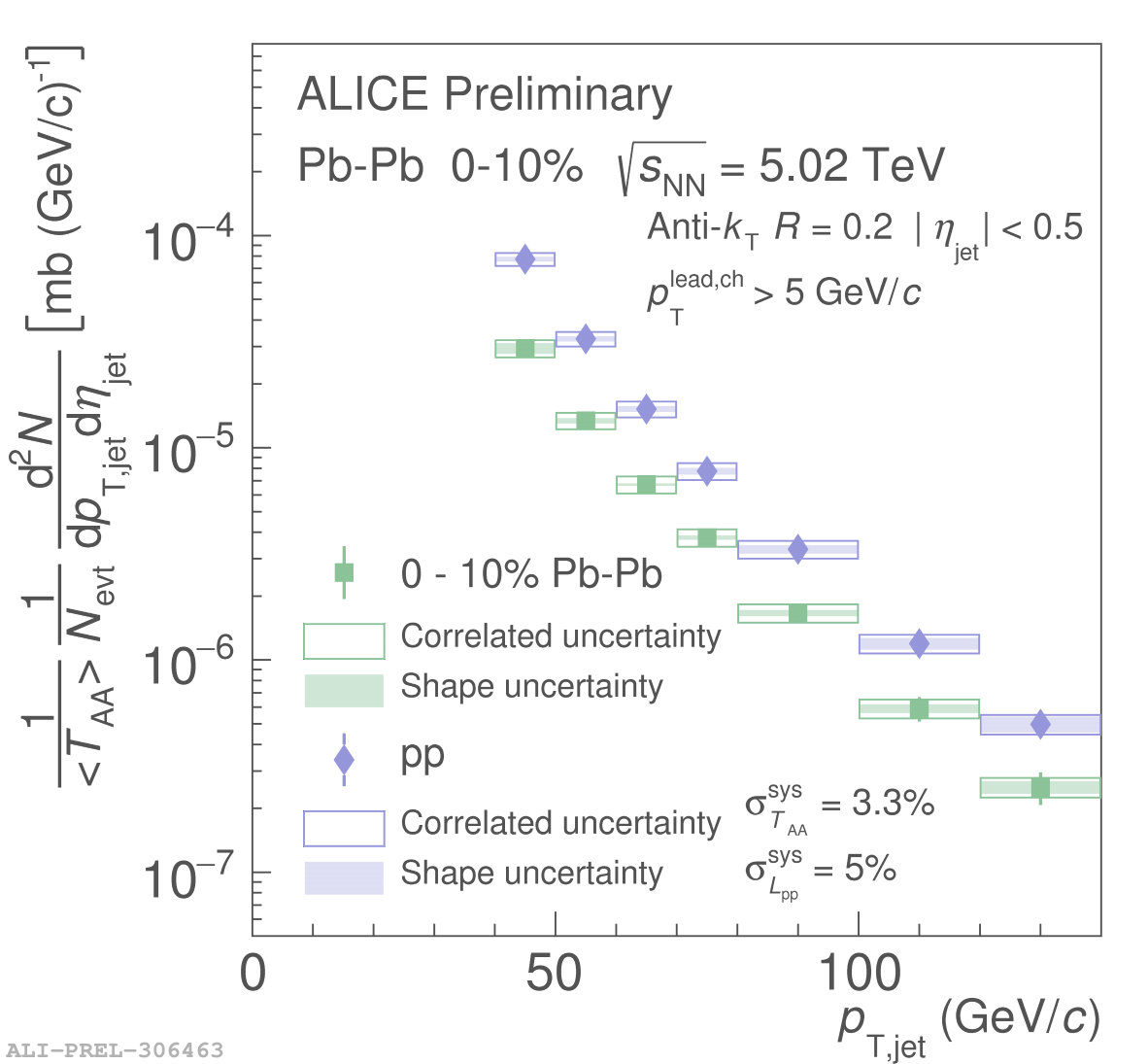 Figure 3
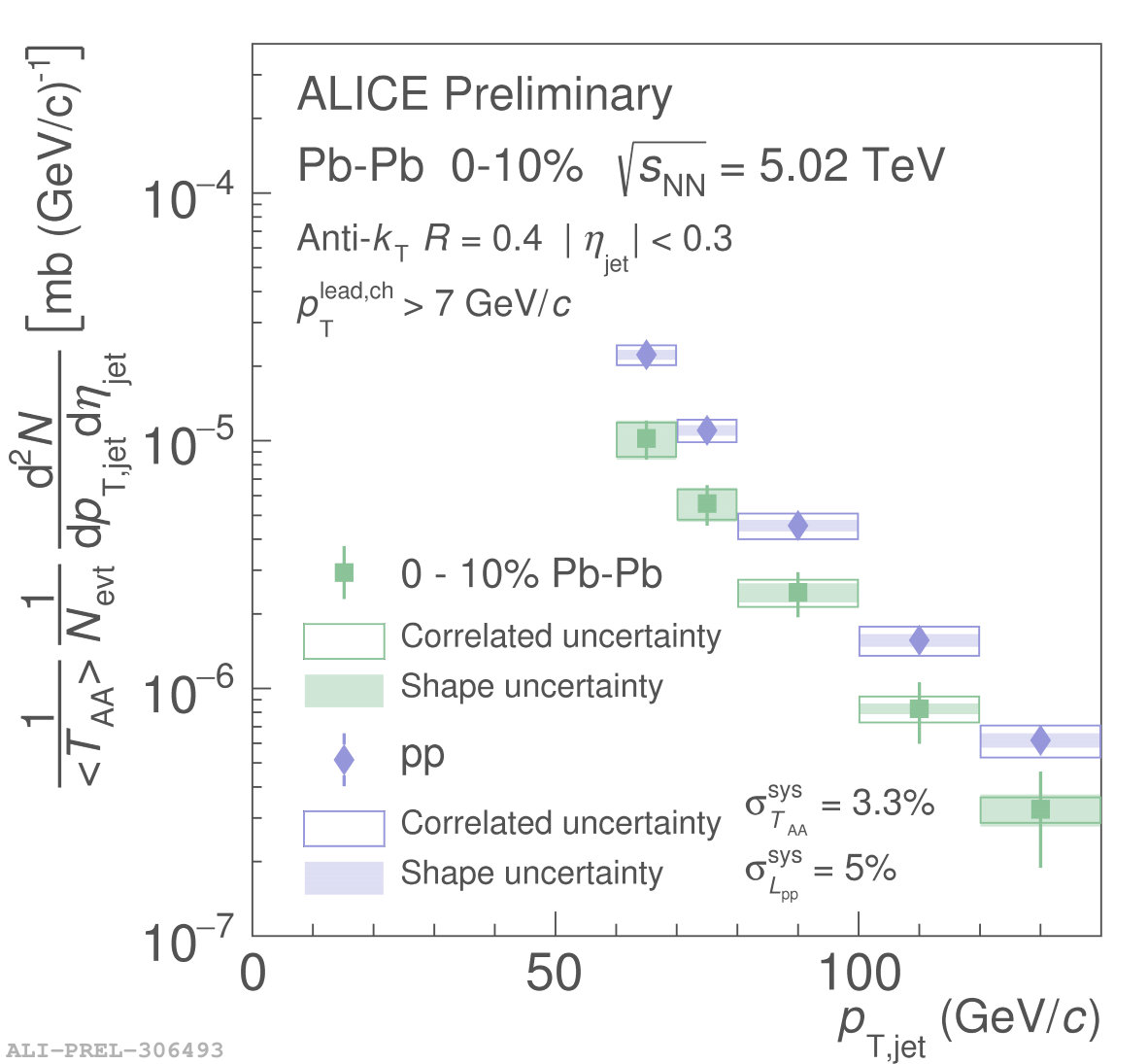 Figure 4
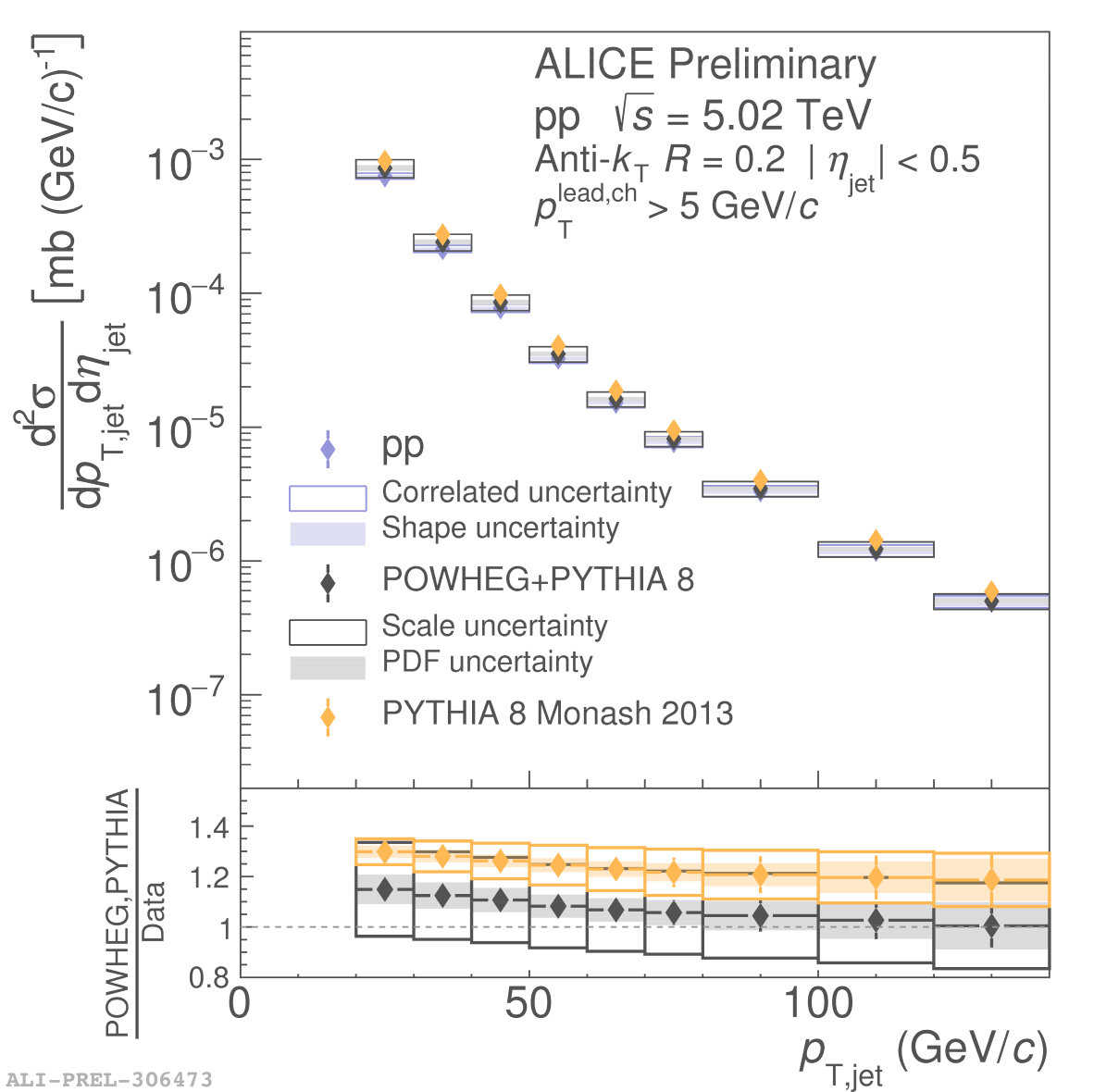 Figure 5
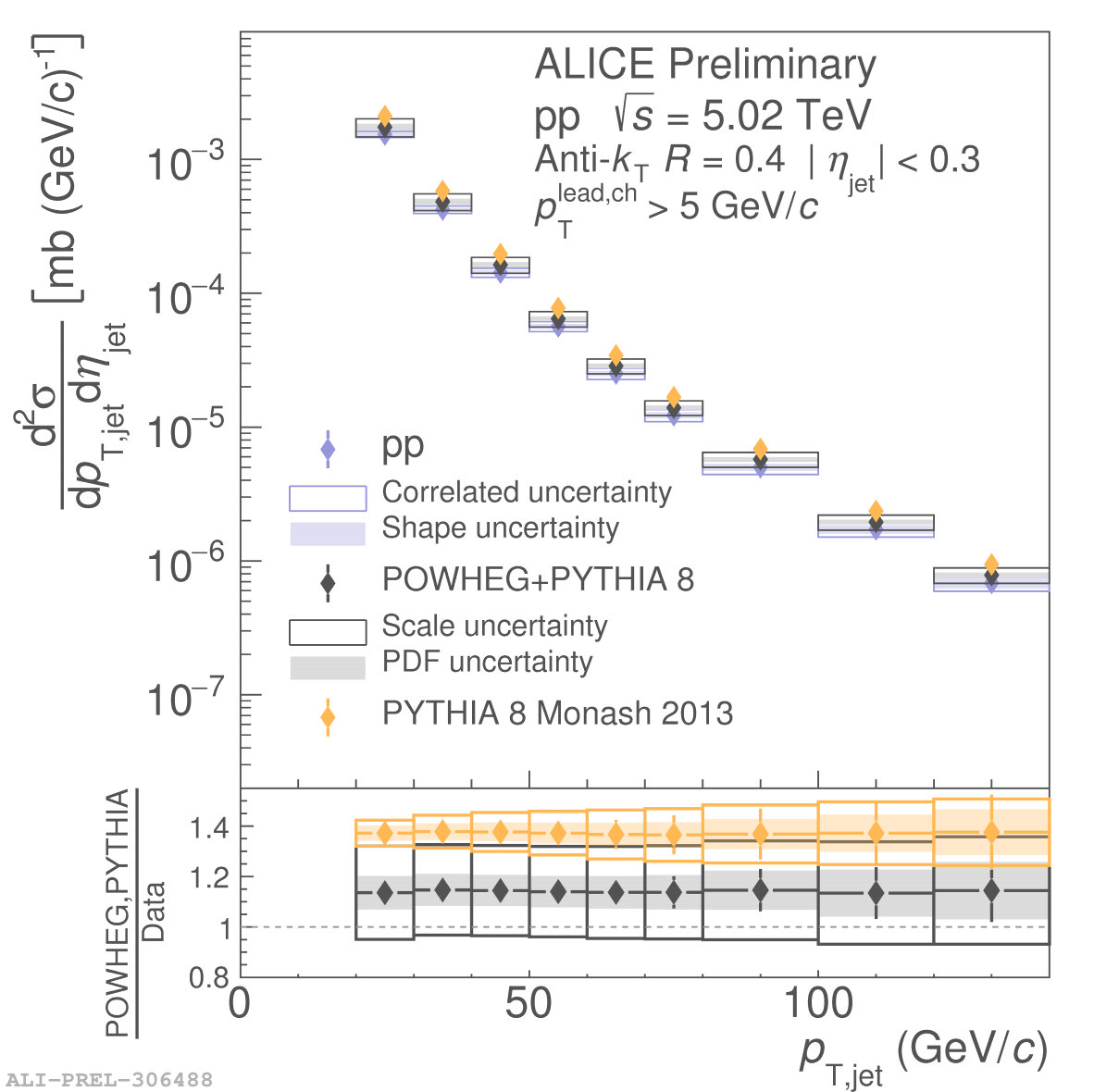 Figure 6
Peer Reviews
No public reviews on file for this paper yet. If you reviewed it on a platform where reviews are public (OpenReview, ICLR, NeurIPS, ICML), you can paste yours below so the community can read it here.
Videos
No videos yet. Explain this paper in a talk, walkthrough, or lecture? Add one.
Inclusive jet measurements in pp and Pb–Pb collisions with ALICE
James Mulligan111Speaker. on behalf of the ALICE Collaboration
Wright Laboratory, Department of Physics, Yale University, New Haven, CT 06520, USA
Abstract:
Measurements of jet yields in heavy-ion collisions can be used to constrain jet energy loss models, and in turn provide information about the physical properties of deconfined QCD matter. ALICE reconstructs charged particle jets (charged jets) with high-precision tracking of charged particles down to MeV/, and jets (full jets) with the addition of particle information from the electromagnetic calorimeter down to MeV. By including low momentum jet constituents, ALICE is uniquely positioned at the LHC to measure jets down to low jet momentum, to determine the modification to the soft components of jets, and to measure medium recoil particles. New inclusive full jet measurements in pp and Pb-Pb collisions at TeV with ALICE will be shown, over and extending to low jet . These will include the jet for different jet , and will constitute the first such full jet measurements at low transverse jet momentum at this collision energy. The results are compared to several theoretical predictions.
Introduction
A deconfined state of Quantum Chromodynamics (QCD) is produced in ultra-relativistic heavy-ion collisions – and the study of jet modification is one of the major avenues of the heavy-ion experimental program. Jets traverse a significant pathlength of the medium, and the effect that the medium has on jets can be deduced by comparing jet properties in heavy-ion collisions to those in collisions. Previous measurements demonstrate suppression of the jet transverse momentum () spectrum in heavy-ion collisions, indicating that jets transfer energy to the hot QCD medium [1, 2, 3, 4]. However, the basic nature of this deconfined QCD state remains largely unknown. Jets are sensitive to a wide range of momentum exchanges with the medium, and thereby can provide insight into the medium at a wide range of resolution scales.
We report measurements of inclusive jet spectra in and Pb–Pb collisions at TeV with the ALICE detector [5] at the Large Hadron Collider (LHC) [6]. In , we report the jet cross-section for resolution parameters over the range GeV/. In Pb–Pb, we report the jet spectrum for GeV/ and GeV/, respectively. Jets are reconstructed at pseudo-rapidity , and are required to contain at least one charged track with GeV (depending on the jet radius) in order to reject combinatorial jets. The jet spectra are fully corrected for detector and background effects.
Data analysis
The reported Pb–Pb () data were recorded by the ALICE detector at the LHC in 2015 (2017) at TeV. We utilize a sample of 4.5M (500M) 0-10% Pb–Pb () accepted minimum bias events. Jets are reconstructed with the FastJet 3.2.1 anti- algorithm [7] from the combination of charged particle tracks with and electromagnetic calorimeter (EMCal) clusters with . We account for the fact that charged particles deposit energy in both the tracking system and the EMCal by extrapolating tracks to the EMCal and subtracting transverse momentum from the matched clusters.
In Pb–Pb, we subtract the average background from each jet: , where is the event-averaged background density in each event, and is the jet area [1]. However, fails to account for fluctuations in the underlying background and a variety of detector effects, including tracking inefficiency, missing long-lived neutral particles, and material interactions. We therefore deconvolute the reconstructed jet spectrum with a response matrix describing the correlation of to the true , obtained by embedding a PYTHIA 8 Monash 2013 event with the GEANT3 ALICE detector simulation into Pb–Pb data. We then employ the SVD unfolding algorithm [8] using RooUnfold [9], and correct the resulting spectrum for the kinematic efficiency and jet reconstruction efficiency.
We categorize two classes of systematic uncertainties: correlated uncertainties, which are positively correlated among all bins, and shape uncertainties, which alter the shape of the final spectrum. The dominant correlated uncertainty is the uncertainty in the tracking efficiency, and the dominant shape uncertainty is the systematic uncertainty in the unfolding procedure.
Results
The jet cross-sections are reported differentially in and as: where we experimentally measure the yield and the integrated luminosity [10]. The yield is corrected for the partial azimuthal acceptance of the EMCal and the vertex efficiency. Figure 1 shows the unfolded jet spectrum for and jets. The jet cross-section predictions by PYTHIA 8 tune Monash 2013 are also plotted for comparison, as well as the NLO event generator POWHEG [11], with PYTHIA 8 tune ATLAS-A14 for fragmentation. The POWHEG predictions are consistent with the measured data, while PYTHIA 8 Monash 2013 alone is not.
The Pb–Pb jet spectra are reported differentially in and as: where is the ratio of the number of binary nucleon-nucleon collisions to the inelastic nucleon-nucleon cross-section, computed in a Glauber model to be for 0-10% centrality. Figure 2 shows the unfolded Pb–Pb full jet spectra for and . A leading track bias of 5 GeV/ is required for the spectra, while a 7 GeV/ bias is required for the spectra (both and Pb–Pb) in order to suppress combinatorial jets in Pb–Pb.
The jet is reported as: namely the ratio of the Pb–Pb and spectra plotted in Fig. 2. Figure 3 shows the unfolded full jet for and jets, which exhibit strong suppression. There is visible -dependence in the case, with stronger suppression at lower . There is no significant -dependence of the jet within the experimental uncertainties.
We compare these results to four theoretical predictions: the Linear Boltzmann Transport (LBT) model [14, 15], Soft Collinear Effective Theory with Glauber gluons (SCETG) [16, 17], the Hybrid model [18, 19], and JEWEL [12, 13]. The predictions are all computed using the anti- jet algorithm with . Leading track requirements are only applied by JEWEL (as in data) and the Hybrid model (with 5 GeV/ for both radii). All models exhibit strong suppression, and produce the same qualitative trend of as a function of . In the case , we see that JEWEL under-predicts the jet , and appears to be inconsistent with the data regardless of whether medium recoils are included, while for the “recoils on” prediction is more consistent with the data. The LBT model describes the data better, although it has slight tension with the data. Note however that neither the JEWEL nor LBT predictions include systematic uncertainties. The SCETG predictions are fully consistent with the data, although the prediction has large systematic uncertainties due to a lack of in-medium re-summation in this calculation. Additionally, the SCETG calculation did not include collisional energy loss, which the authors anticipate to increase the suppression for . The Hybrid model describes the trend of the data reasonably well, although like the LBT model, exhibits slight tension particularly in the GeV/ range. It should be noted that JEWEL has no free parameters in the fit, and so it faces the strictest test of all the models presented. While the experimental uncertainties are larger for , the model predictions span a wider range of than in the case of , which highlights the importance of measuring the -dependence of the jet .
Most of the models describe the reasonably well, but a firm quantitative conclusion remains somewhat nebulous. The predictions typically use different strategies for each of the ”non jet energy loss” pieces (initial state, expansion, hadronization, spectrum), and do not attempt to incorporate these differences in a systematic uncertainty, which makes a strict quantitative comparison to data difficult. Moreover, the models fix their free parameters in different ways. This necessitates investigation of complementary jet observables and the need for global analyses, but it also highlights the need to standardize the ingredients of jet energy loss calculations.
The reference list from the paper itself. Each links out to its DOI / PubMed record.
- 1[1] ALICE Collaboration, Measurement of jet suppression in central Pb–Pb collisions at s NN = 2.76 subscript 𝑠 NN 2.76 \sqrt{s_{\mathrm{NN}}}=2.76 Te V , PLB 1 (2015) .
- 2[2] ALICE Collaboration, Measurement of jet quenching with semi-inclusive hadron-jet distributions in central Pb-Pb collisions at s NN = 2.76 subscript 𝑠 NN 2.76 \sqrt{s_{\mathrm{NN}}}=2.76 Te V , JHEP 2015 (2015) 170 . · doi ↗
- 3[3] ATLAS Collaboration, Measurement of the nuclear modification factor for inclusive jets in Pb–Pb collisions at s NN = 5.02 subscript 𝑠 NN 5.02 \sqrt{s_{\mathrm{NN}}}=5.02 Te V with the ATLAS detector , arxiv/1805.05635 .
- 4[4] CMS Collaboration, Measurement of inclusive jet cross sections in pp pp \mathrm{p\kern-0.50003 ptp} and Pb–Pb collisions at s NN = 2.76 subscript 𝑠 NN 2.76 \sqrt{s_{\mathrm{NN}}}=2.76 Te V , PRC 96 (2017) 015202 . · doi ↗
- 5[5] ALICE Collaboration, The ALICE experiment at the CERN LHC , J. Instrum. 3 (2008) .
- 6[6] LHC Machine, The CERN large hadron collider: accelerator and experiments , J. Instrum. 3 (2008) .
- 7[7] M. Cacciari, G. Salam and G. Soyez, The anti- k T subscript 𝑘 𝑇 k_{T} jet cluster algorithm , JHEP 063 (2008) .
- 8[8] A. Hocker and V. Kartvelishvili, SVD approach to data unfolding , NIM A 372 (1996) 469 . · doi ↗