Update on $B\to D^\ast \ell \nu$ form factor at zero-recoil using the Oktay-Kronfeld action
Tanmoy Bhattacharya, Rajan Gupta, Sungwoo Park, Yong-Chull Jang, Jon, A. Bailey, Benjamin J. Choi, Hwancheol Jeong, Seungyeob Jwa, Sunkyu Lee,, Weonjong Lee, Jeonghwan Pak, Jaehoon Leem

TL;DR
This paper updates the calculation of the B to D* semileptonic form factor at zero recoil using the Oktay-Kronfeld action on HISQ ensembles, providing preliminary results and analyzing valence quark mass dependence.
Contribution
It introduces an improved lattice QCD calculation of the B to D* form factor at zero recoil using the Oktay-Kronfeld action on new ensembles.
Findings
Preliminary form factor results at two lattice spacings.
Analysis of valence quark mass dependence.
Controlled excited state contamination with multistate fits.
Abstract
We present an update on the calculation of semileptonic form factor at zero recoil using the Oktay-Kronfeld bottom and charm quarks on flavor HISQ ensembles generated by the MILC collaboration. Preliminary results are given for two ensembles with and fm and MeV. Calculations have been done with a number of valence quark masses, and the dependence of the form factor on them is investigated on the fm ensemble. The excited state is controlled by using multistate fits to the three-point correlators measured at 4--6 source-sink separations.
Click any figure to enlarge with its caption.
 Figure 1
 Figure 2
 Figure 3
 Figure 4
 Figure 5
 Figure 6
 Figure 7
 Figure 8
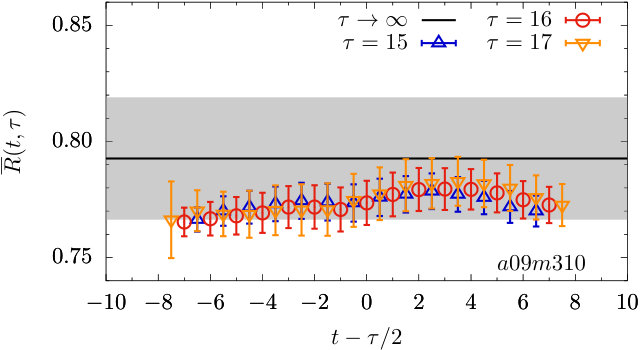 Figure 9
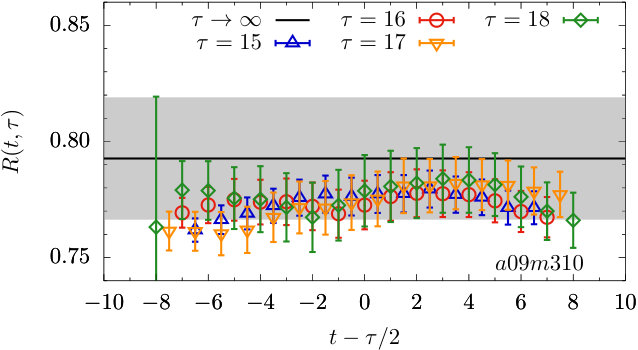 Figure 10
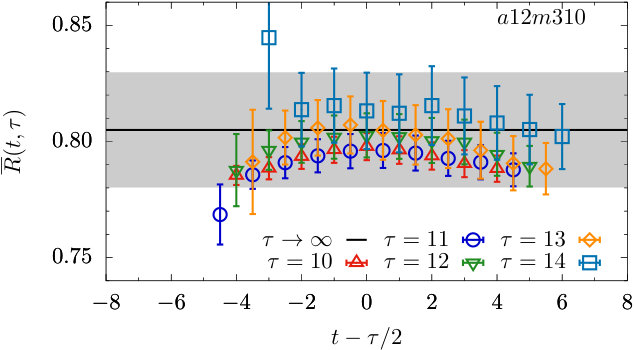 Figure 11
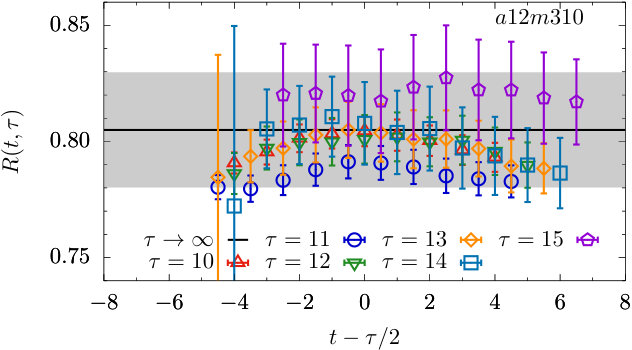 Figure 12
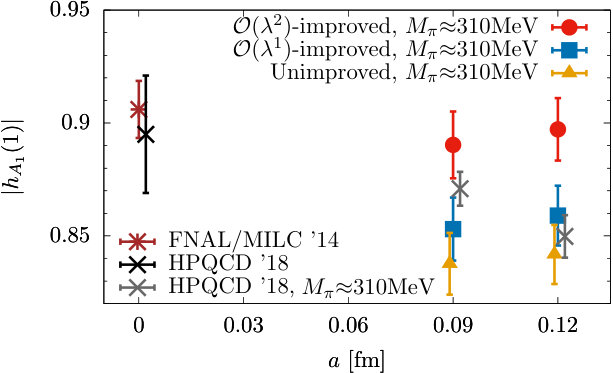 Figure 13
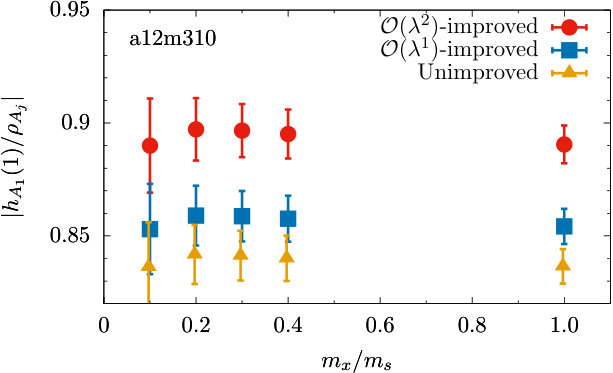 Figure 14
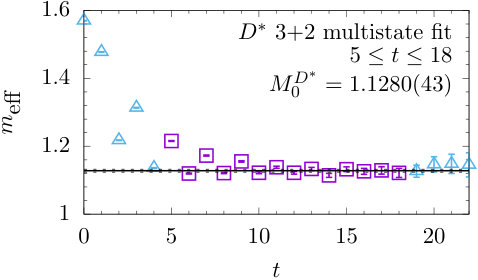 Figure 15
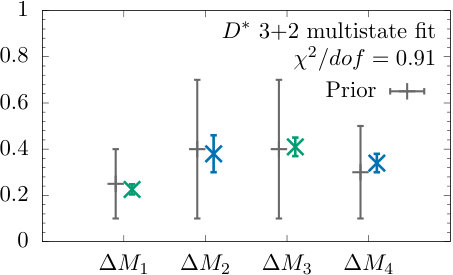 Figure 16
| ID | |||||||||
|---|---|---|---|---|---|---|---|---|---|
| 305 | 0.1, , | 0.051211 | 0.048524 | 0.04102 | 10, 11, 12, | ||||
| 0.3, 0.4, 1.0 | 13, 14, 15 | ||||||||
| 313 | , 1.0 | 0.05075 | 0.04894 | 0.0429 | 15, 16, 17, 18 |
| Current | ||||||||
|---|---|---|---|---|---|---|---|---|
| Unimp. | 3.88(8) | 1.20 [0.21] | 8.44(17) | 0.73 [0.84] | 4.79(10) | 0.73 [0.84] | 4.84(11) | 0.89 [0.63] |
| 3.89(8) | 1.20 [0.21] | 8.45(17) | 0.73 [0.84] | 4.90(10) | 0.74 [0.83] | 4.96(12) | 0.84 [0.70] | |
| 3.74(8) | 1.27 [0.15] | 7.50(15) | 0.86 [0.68] | 4.71(10) | 0.73 [0.84] | 4.79(11) | 0.93 [0.56] |
| Current | ||||||||
|---|---|---|---|---|---|---|---|---|
| Unimp. | 3.88(8) | 1.20 [0.21] | 8.44(17) | 0.73 [0.84] | 4.79(10) | 0.73 [0.84] | 4.84(11) | 0.89 [0.63] |
| 3.89(8) | 1.20 [0.21] | 8.45(17) | 0.73 [0.84] | 4.90(10) | 0.74 [0.83] | 4.96(12) | 0.84 [0.70] | |
| 3.74(8) | 1.27 [0.15] | 7.50(15) | 0.86 [0.68] | 4.71(10) | 0.73 [0.84] | 4.79(11) | 0.93 [0.56] |
| Current | ||||||||
|---|---|---|---|---|---|---|---|---|
| Unimp. | 4.64(12) | 1.44 [0.05] | 9.26(22) | 0.90 [0.63] | 5.49(10) | 1.54 [0.03] | 5.48(15) | 0.68 [0.91] |
| 4.65(12) | 1.44 [0.05] | 9.27(22) | 0.90 [0.63] | 5.60(10) | 1.54 [0.03] | 5.60(15) | 0.67 [0.92] | |
| 4.42(12) | 1.34 [0.09] | 8.10(19) | 0.84 [0.73] | 5.33(10) | 1.62 [0.02] | 5.32(15) | 0.76 [0.83] |
Peer Reviews
No public reviews on file for this paper yet. If you reviewed it on a platform where reviews are public (OpenReview, ICLR, NeurIPS, ICML), you can paste yours below so the community can read it here.
Videos
No videos yet. Explain this paper in a talk, walkthrough, or lecture? Add one.
Taxonomy
TopicsParticle physics theoretical and experimental studies · Quantum Chromodynamics and Particle Interactions · Particle Accelerators and Free-Electron Lasers
Update on form factor at zero-recoil
using the Oktay-Kronfeld action
Tanmoy Bhattacharya, Rajan Gupta,
Theoretical Division T-2, Los Alamos National Laboratory, Los Alamos, NM 87545, USA
Yong-Chull Jang
Phsics Department, Brookhaven National Laboratory, Upton, NY 11973, USA
Jon A. Bailey, Benjamin J. Choi, Hwancheol Jeong, Seungyeob Jwa, Sunkyu Lee, Weonjong Lee, Jeonghwan Pak
Lattice Gauge Theory Research Center, CTP, and FPRD,
Department of Physics and Astronomy, Seoul National University, Seoul 08826, South Korea
[email protected], [email protected]
Jaehoon Leem
School of Physics, Korea Institute for Advanced Study (KIAS), Seoul 02455, South Korea
LANL/SWME Collaboration
Abstract:
We present an update on the calculation of semileptonic form factor at zero recoil using the Oktay-Kronfeld bottom and charm quarks on flavor HISQ ensembles generated by the MILC collaboration. Preliminary results are given for two ensembles with and fm and MeV. Calculations have been done with a number of valence quark masses, and the dependence of the form factor on them is investigated on the ensemble. The excited state is controlled by using multistate fits to the three-point correlators measured at 4–6 source-sink separations.
1 Introduction
Lattice calculation of semileptonic decay form factors can be used to determine the CKM matrix element from the measured exclusive decay rates. Precise results for exclusive will address the well-known discrepancy from the inclusive determination of [1]. In addition, there is an analysis showing tension in the standard model evaluation of [2] using the exclusive .
For the study, the heavy quark discretization error, estimated by HQET power counting in terms of , is dominant especially for charm. Calculations of the zero recoil form factor using the Fermilab action has uncertainty assuming . To achieve precision below 1% in , we propose to use the Oktay-Kronfeld (OK) action, in which the discretization error are provided a full one-loop improvement of correction terms is carried out [3, 4]. In this work, we are working with tree-level tadpole-improvement of the action and current operators since the one-loop calculations are not complete.
We calculate the form factor using the double ratio of ground state matrix elements [5],
[TABLE]
is the matching factor that is expected to be close to unity [5]. Each of the matrix element is extracted from the related three-point function calculated on the lattice. For example, is from defined in Eq. (3). We also use an improved current operator where the improved field is obtained by the following field rotation on the unimproved fermion field : . Improvement up to can be obtained using tree-level matching of the coefficients and operators [6, 7].
We present an update on our previous calculation of [8], paying attention to controlling the excited-state contamination (ESC) using multistate fits to 3-point (3pt) data with 4–6 source-sink time separations. The parameters in the calculation on the two HISQ ensembles, generated by the MILC collaboration [9], are given in Table 1. The light quark propagators () are calculated using the HISQ action with point source and sink. For the heavy quark () propagators, we use the OK action with covariant Gaussian smearing at both the source and the sink. The hopping parameters , , have been tuned nonperturbatively as described in Ref. [8].
2 Controlling excited-state contamination
To achieve sub-percent precision, we have to control the ESC. On a lattice with time extent , the - and -meson 2-point (2pt) functions, , are fit using a -state ansatz:
[TABLE]
where is the meson interpolating operator. with are the mass gaps for even parity, and and for the two odd parity states that arise in staggered formulations. An empirical Bayesian method is used to fix the priors for the excited-state masses and amplitudes to stabilize the fits as described in Ref. [10]. Fig. 1 illustrates the results for the ground- and excited-state masses of meson and the priors used for excited states.
The 3pt data is fit including states for and in the spectral decomposition:
[TABLE]
where is the improved axial current inserted at time , and , , and values are taken from fits to the 2pt functions. Similar fit functions are used for the other channels: , and . In all the fits, we skip four points next to the source and the sink that have the largest ESC. In Fig. 2, we display the ratio, ,
[TABLE]
where , , and are ground-state amplitudes and masses determined from 2pt function fits. asymptotes to the ground state matrix element in the and limits. The data show the size of the ESC and the oscillatory nature of the convergence. The term controls the even-odd oscillation about the grey band while controls the convergence as for both even or odd data. We also find that the contribution of terms of the form is tiny and that of is negligible. The latter is therefore set to zero in the final fits. On the other hand, the grey horizontal band in Fig. 2 is the ground-state matrix element obtained by fitting using Eq. (4), to which should converge. These results from the fits are summarized in Table 2. Note that there is no significant improvement at in and , but a large change at 111Here, we used the improvement coefficient for the current given in the Ref. [6]. Taking the coefficient from Ref. [7] results in a negligible change. Full current improvement presented in Ref. [7] is being implemented. (also see Fig. 4). Thus, higher order improvements for these two channels may be necessary.
3 result
We obtain , defined in Eq. (1), using the ground-state matrix elements given in Table 2. The result for the two values of the lattice spacing at fixed pion mass MeV (unitary point) is shown by the grey horizontal band in all panels of Fig. 3. The error estimate includes the uncertainty coming from the fits used to remove excited-state effects. The left two panels in Fig. 3 show the data for the double ratio
[TABLE]
that significantly cancels the ESC in each individual correlator illustrated in Fig. 2. The right panels in Fig. 3 show the linear combination defined as [5],
[TABLE]
that further suppresses the ESC, especially from the opposite parity states. Since the grey band in Fig. 3 is constructed as the ratio of ground state matrix elements (albeit evaluated using 2+1 state fits), both the ratios, and should asymptote to it in the and limits. We find that and overlap with the grey band, however the spread due to remaining ESC is larger in than in . In fact, on the finer ensemble, we do not observe a spread in versus , however, the comparison with the grey band suggests that quoting the average of the data as the final result could underestimate the error.
The data for in Fig. 4 (left) show no significant dependence on the spectator quark mass . The observed dependence on the order of improvement in the current is unexpected from naive HQET power counting and could an artifact of setting , which also depends on the order of improvement. In Fig. 4 (right), we compare our results with those from the FNAL/MILC and HPQCD collaborations [5, 11] obtained in the continuum limit. The data are consistent with the FNAL/MILC and HPQCD results and show no significant lattice spacing dependence. This rough agreement provides a good and encouraging check of our calculations that are being done with a much more complicated heavy quark action and current.
A brief summary of the work under progress is as follows. (i) Analysis with the -improvement terms in the current, (ii) analysis of the data for the nonzero recoil form factors in decays, and (iii) the analysis for the decay constants , , , and .
Acknowledgments.
We thank the MILC collaboration for sharing the -flavor HISQ ensembles generated by them. Computations for this work were carried out in part on (i) facilities of the USQCD collaboration, which are funded by the Office of Science of the U.S. Department of Energy, and (ii) the DAVID GPU clusters at Seoul National University. The research of W. Lee is supported by the Creative Research Initiatives Program (No. 2017013332) of the NRF grant funded by the Korean government (MEST). W. Lee acknowledges support from the KISTI supercomputing center through the strategic support program for the supercomputing application research (No. KSC-2016-C3-0072).
The reference list from the paper itself. Each links out to its DOI / PubMed record.
- 1[1] Y. Amhis et al. Eur. Phys. J. C 77 (2017), no. 12 895, [ 1612.07233 ].
- 2[2] J. A. Bailey, S. Lee, W. Lee, J. Leem, and S. Park 1808.09657 .
- 3[3] M. B. Oktay and A. S. Kronfeld Phys. Rev. D 78 (2008) 014504, [ 0803.0523 ].
- 4[4] J. A. Bailey, C. De Tar, Y.-C. Jang, A. S. Kronfeld, W. Lee, and M. B. Oktay Eur. Phys. J. C 77 (2017), no. 11 768, [ 1701.00345 ].
- 5[5] J. A. Bailey et al. Phys. Rev. D 89 (2014), no. 11 114504, [ 1403.0635 ].
- 6[6] A. X. El-Khadra, A. S. Kronfeld, and P. B. Mackenzie Phys. Rev. D 55 (1997) 3933–3957, [ hep-lat/9604004 ].
- 7[7] J. Bailey, Y.-C. Jang, W. Lee, and J. Leem EPJ Web Conf. 175 (2018) 14010, [ 1711.01777 ].
- 8[8] J. A. Bailey, T. Bhattacharya, R. Gupta, Y.-C. Jang, W. Lee, J. Leem, S. Park, and B. Yoon EPJ Web Conf. 175 (2018) 13012, [ 1711.01786 ].