Breathing Mode of a BEC Repulsively Interacting with a Fermionic Reservoir
Bo Huang, Isabella Fritsche, Rianne S. Lous, Cosetta Baroni, Jook T., M. Walraven, Emil Kirilov, Rudolf Grimm

TL;DR
This study explores how the breathing mode frequency of a small Bose-Einstein condensate changes when coupled to a large Fermi sea, especially during phase separation caused by strong interspecies repulsion.
Contribution
It provides experimental observations and theoretical models explaining the frequency shift of the BEC's breathing mode in a coupled Bose-Fermi mixture during phase separation.
Findings
Significant frequency shift observed at phase separation
Maximum shift depends on atom number ratio
Models successfully explain the experimental results
Abstract
We investigate the fundamental breathing mode of a small-sized elongated Bose-Einstein condensate coupled to a large Fermi sea of atoms. Our observations show a dramatic shift of the breathing frequency when the mixture undergoes phase separation at strong interspecies repulsion. We find that the maximum frequency shift in the full phase-separation limit depends essentially on the atom number ratio of the components. We interpret the experimental observations within a model that assumes an adiabatic response of the Fermi sea, or within another model that considers single fermion trajectories for a fully phase-separated mixture. These two complementary models capture the observed features over the full range of interest.
Click any figure to enlarge with its caption.
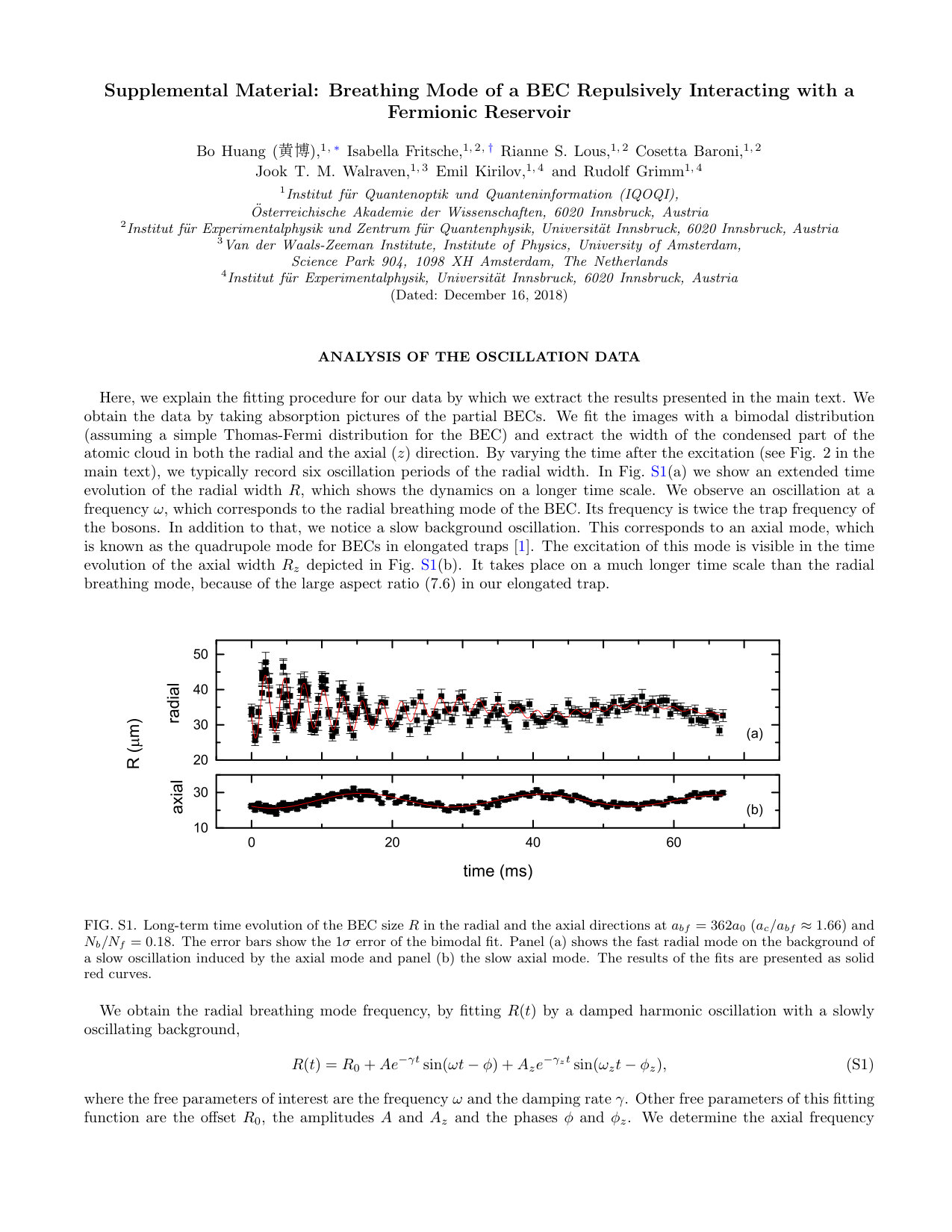 Figure 1
Peer Reviews
No public reviews on file for this paper yet. If you reviewed it on a platform where reviews are public (OpenReview, ICLR, NeurIPS, ICML), you can paste yours below so the community can read it here.
Videos
No videos yet. Explain this paper in a talk, walkthrough, or lecture? Add one.
††thanks: I.F. and B.H. contributed equally to this work.
Breathing Mode of a BEC Repulsively Interacting with a Fermionic Reservoir
Bo Huang (é\guillemetrightå)
Institut für Quantenoptik und Quanteninformation (IQOQI), Österreichische Akademie der Wissenschaften, 6020 Innsbruck, Austria
Isabella Fritsche
Rianne S. Lous
Cosetta Baroni
Institut für Quantenoptik und Quanteninformation (IQOQI), Österreichische Akademie der Wissenschaften, 6020 Innsbruck, Austria
Institut für Experimentalphysik und Zentrum für Quantenphysik, Universität Innsbruck, 6020 Innsbruck, Austria
Jook T. M. Walraven
Institut für Quantenoptik und Quanteninformation (IQOQI), Österreichische Akademie der Wissenschaften, 6020 Innsbruck, Austria
Van der Waals-Zeeman Institute, Institute of Physics, University of Amsterdam, Science Park 904, 1098 XH Amsterdam, The Netherlands
Emil Kirilov
Institut für Experimentalphysik und Zentrum für Quantenphysik, Universität Innsbruck, 6020 Innsbruck, Austria
Rudolf Grimm
Institut für Quantenoptik und Quanteninformation (IQOQI), Österreichische Akademie der Wissenschaften, 6020 Innsbruck, Austria
Institut für Experimentalphysik und Zentrum für Quantenphysik, Universität Innsbruck, 6020 Innsbruck, Austria
Abstract
We investigate the fundamental breathing mode of a small-sized elongated Bose-Einstein condensate coupled to a large Fermi sea of atoms. Our observations show a dramatic shift of the breathing frequency when the mixture undergoes phase separation at strong interspecies repulsion. We find that the maximum frequency shift in the full phase-separation limit depends essentially on the atom number ratio of the components. We interpret the experimental observations within a model that assumes an adiabatic response of the Fermi sea, or within another model that considers single fermion trajectories for a fully phase-separated mixture. These two complementary models capture the observed features over the full range of interest.
pacs:
to be checked 34.50.Cx, 67.85.Lm, 67.85.Pq, 67.85.Hj
pacs:
Mixtures of quantum fluids play a fascinating role in our understanding of multi-component many-body quantum systems. For decades, the study of such mixtures focused on the phases of the helium isotopes 3He and 4He and their properties in mixed states, under phase-separated conditions, or at the interface between two phases Ebner and Edwards (1971). Ultracold atomic gases have opened up many new opportunities, and various weakly and strongly interacting Bose-Bose, Fermi-Fermi and Bose-Fermi mixtures have been investigated Pitaevskii and Stringari (2016); Pethick and Smith (2002). A unique feature of ultracold quantum gases is the possibility to tune the interparticle interactions over a wide range by magnetically controlled Feshbach resonances (FRs) Chin et al. (2010).
Right from the early experiments on harmonically trapped quantum gases Jin et al. (1996); Mewes et al. (1996), collective modes have served as powerful probes for interparticle interactions. Depending on their particular character Pitaevskii and Stringari (2003), collective modes can be sensitive to different effects. If the trapped sample changes its position, angle, or form without undergoing significant volume changes, the mode can be classified as a surface mode. Excitations of this kind have been used to study the transition from hydrodynamic to collisionless behavior in both bosonic Stamper-Kurn et al. (1998); Buggle et al. (2005) and fermionic Altmeyer et al. (2007a); Wright et al. (2007) quantum gases. If, in contrast, the oscillation involves significant changes of the volume and thus of the density of the sample, then the mode can be classified as a compression or breathing mode. Modes with predominant compression character can serve as sensitive probes for the equation of state. As an example, the radial breathing mode in an elongated trap Stringari (1996); Chevy et al. (2002) has served as a tool to probe strongly interacting Fermi gases Kinast et al. (2004); Bartenstein et al. (2004); Altmeyer et al. (2007b).
In ultracold atomic mixtures, the motional coupling generally leads to rich behavior in the collective modes, see e.g. Refs. Busch et al. (1997); Esry and Greene (1998); Ho (1998); Bijlsma et al. (2000); Yip (2001); Capuzzi and Hernández (2001); Pu et al. (2002); Liu and Hu (2003); Rodríguez et al. (2004) for early theoretical considerations. As a basic example, the center-of-mass oscillations of different components (their so-called dipole modes), which can experience frequency shifts and damping Vichi and Stringari (1999); Maddaloni et al. (2000); Gensemer and Jin (2001), have been utilized in recent experiments to study coupling effects in mixed superfluids Ferrier-Barbut et al. (2014); Delehaye et al. (2015); Roy et al. (2017); Wu et al. (2018) and to investigate mediated interactions DeSalvo et al. (2018). In the case of strong interspecies interactions, instabilities (collapse Modugno et al. (2002); Ospelkaus et al. (2006a) or phase separation Zaccanti et al. (2006); Ospelkaus et al. (2006b); Papp et al. (2008); Shin et al. (2008); Valtolina et al. (2017); Lous et al. (2018)) render the collective dynamics even more complex. Although the understanding of collective behavior near instabilities is essential in view of proposed fermionic superfluids based on mediated pairing Bijlsma et al. (2000); Heiselberg et al. (2000); Efremov and Viverit (2002); Suzuki et al. (2008); Enss and Zwerger (2009); Caracanhas et al. (2017); Kinnunen et al. (2018), corresponding experimental information is rather scarce.
In this Letter, we consider the fundamental breathing mode of a Bose-Einstein condensate (BEC) repulsively coupled to a large fermionic reservoir of atoms. Our system, realized with optically trapped 41K bosons and 6Li fermions (see Fig. 1), offers tunable interspecies interaction and allows us to explore the regime of strong repulsion, where the BEC phase separates from the surrounding fermions Lous et al. (2018). As a dynamic phenomenon resulting from phase separation, we demonstrate the emergence of a drastic up-shift of the BEC’s breathing mode frequency. We show how this effect depends on the interaction strength and on the atom number ratio of bosons and fermions. We interpret the complex dynamical many-body physics of our system in terms of two complementary models, which capture the observed features over the full range of interest.
The frequency shift can be understood qualitatively by considering the interface that emerges from phase separation of the Bose-Fermi mixture. In the presence of the interface, the BEC becomes hydrostatically compressed by the Fermi pressure. Exciting a collective mode of the BEC leads to a motion of this interface. If the mode is a breathing mode, the oscillation inflates and deflates the interface, like modulating a bubble in the Fermi sea. Intuitively, the volume change of the BEC leads to a significant reversible work against the Fermi pressure. Because of the existence of this strong restoring mechanism the oscillation frequency substantially increases. This stands in contrast to surface modes of BECs immersed in Fermi gases, which have been observed in experiments Ferrier-Barbut et al. (2014); Delehaye et al. (2015); Roy et al. (2017); DeSalvo et al. (2018); Wu et al. (2018). There, the frequency shifts are rather small, since surface modes do not change the volume and thus do no work against the Fermi pressure.
The transition into the phase-separated regime is characterized by two distinct values of the interspecies scattering length . We define a depletion scattering length as the value at which the fermion density drops to zero in the center of the trap, where one finds the highest boson density. The value of is trap specific and depends on the densities of the components, so we obtain it numerically Lous et al. (2018). We also define a critical scattering length
[TABLE]
as the value where the mixture fully phase separates in the Thomas-Fermi limit Viverit et al. (2000). Here , and are the boson and the fermion masses respectively, is the Fermi wave number, and is the boson-boson scattering length. We note that, under the realistic experimental conditions of a system of finite size, the phase transition is smoothed by the kinetic energy of the BEC Lous et al. (2018).
Our 41K-6Li mixture is produced via laser and evaporative cooling following a procedure described in Ref. Lous et al. (2018) and kept in an elongated optical dipole trap, which is formed by two crossed infrared laser beams and has an aspect ratio of 7.6 ODT . The radial trap frequency is Hz for K and Hz for Li. Typically, we have a sample of Li atoms in the lowest spin state Li (, ) and K atoms prepared in the second-to-lowest spin state K (, ). The mixture is thermalized at a temperature of , where nK is the Fermi temperature of the Li cloud. With a condensate fraction of about 1/3, the K BEC has an atom number of .
We vary the interspecies interaction strength by a combination of spin-state manipulation and Feshbach tuning. First, we control the particular spin state of the K atoms by application of radio-frequency (rf) -pulses. In the case of the Zeeman sublevel K (, ), a Feshbach resonance near 335G facilitates tuning of the interspecies scattering length according to , where ( is Bohr’s radius), G and G lig . In the case of K, only the weak background interaction is present (), which provides enough thermalization for sympathetic cooling between the two species, but is too weak to induce significant changes to the density profiles Lous et al. (2018). The boson-boson scattering length stays constant as abb .
To excite the breathing mode of the K condensate we modulate the interspecies interaction by periodically changing the scattering length Matthews et al. (1998); Pollack et al. (2010) . As illustrated in Fig. 2, this is achieved by alternating the state of the K atoms between K () and K () using a short burst of rf-pulses at = mG. The -pulse duration is 100 s, which is much shorter than the pulse spacing of 1.4 ms. The latter is roughly matched to half the period of the radial breathing mode (full period ) in order to resonantly drive the oscillation. Starting in K, a burst of three rf pulses enables us to excite the fundamental breathing mode of the K condensate (which is mostly radial) with a 25% modulation of the radial size, accompanied by a much slower oscillation in the axial size SM . The duration of the burst affects the oscillation amplitude but has no noticeable influence on the measured breathing mode frequency . Within our detection limits, we do not observe oscillations in the thermal cloud of K atoms or in the Li cloud.
Immediately after the excitation stage, the -field is ramped within 1 ms to the target value of . We hold the excited mixture for a variable time and then we switch off the trap and take time-of-flight images of the expanding atomic clouds. To obtain the frequency of the breathing mode, we fit the recorded time evolution of the width of the BEC with a damped harmonic oscillation with a slowly varying background, the latter being caused by the small residual excitation of the axial mode SM . Typically we record about six breathing mode periods for each measurement, as a longer hold time can only marginally improve the precision of the measurement SM . Moreover, we can safely ignore the influence of atom number decay on within this short period, since the recombination loss from the BEC is below 20% at most of the values of and still smaller than 50% for the few points taken very close to the FR center ().
In order to normalize we measure corresponding value in the limit of small . This is accomplished by adding an additional -pulse to the above excitation sequence to prepares a K BEC, which provides a good approximation of the non-interaction case. We verified the expected relation to the trap frequency for the radial breathing mode of an elongated BEC Stringari (1996); Chevy et al. (2002) within a 1 uncertainty of 2%.
In Fig. 3(a) we present our measurements of as a function of the dimensionless interaction parameter with according to Eq. (1). The first set of measurements (filled black circles) was taken with the boson number and the fermion number (), for which we calculate the two characteristic values of the scattering length as and (). For increasing repulsive strength, i.e. decreasing , we first observe a slow increase of until is reached. Here the fermion cloud becomes fully depleted in the center of the BEC Lous et al. (2018). Then, in the intermediate range of between 2 and 1, rapidly rises until a plateau value of about 1.2 is reached. For even stronger repulsion in the phase-separated regime, no further frequency change is observed. These results show that the frequency up-shift emerges exactly where the transition to the phase-separated regime occurs and finally levels off at the plateau value when full phase separation is reached.
We conducted a second set of measurements with a different atom number ratio (, and thus ) SM , for which and (). The corresponding results (set 2) are presented as filled red squares in Fig. 3. In comparison with set 1, the breathing mode frequency in set 2 starts to increase at a slightly smaller value of . But the increase of is steeper, and a higher plateau value around 1.3 is reached. This is qualitatively expected since a smaller value of corresponds to a more strongly compressed BEC and thus a larger frequency change.
For completeness we also show the normalized damping rate as a function of the interaction parameter in Fig. 3(b). In the region of we observe a nearly constant value of , and we attribute this weak damping to the anharmonicity of the crossed optical dipole trap and the interaction between the BEC and the non-condensate bosons Jin et al. (1996); dam . In the phase-separated regime where , the damping rate shows a trend towards higher values with larger uncertainties, which may be due to a residual excitation of higher-order radial modes.
Motivated by the observed different plateau values of in the phase-separated regime, we further study the role of the number ratio . We carried out a series of measurements at a fixed scattering length of () ac . As shown in Fig. 4, the largest frequency shift observed amounts to about 40% for the smallest , and it decreases to 10% when increases from 0.03 to 0.19 SM .
A theoretical description of the many-body dynamics of our Bose-Fermi system turns out to be rather challenging, because of the kinetics of the Fermi sea being essentially determined by the collisionless motion of the trapped fermions. The most simple model that captures the elementary features is an adiabatic Fermi sea (AFS) model, which assumes that the whole Fermi sea adapts adiabatically to the time-dependent mean-field formed by the BEC. This can be justified if at any position the local Fermi velocity is much larger than the speed of sound of the BEC Yip (2001); Hua . In addition we take advantage of the fermionic reservoir approximation Lous et al. (2018), which assumes a constant global chemical potential for the fermions. This leads to a time-dependent Gross-Pitaevskii equation for the BEC with a mean-field term from the fermions calculated in a quasi-stationary way. We solve the resulting differential equation numerically SM and show the results for the BEC breathing mode frequency by the dashed lines in Figs. 3 and 4 for . For stronger repulsion strengths (), the extremely thin interface leads to numerical instabilities and challenges the basic assumption of an adiabatic fermion response.
Regarding the dependence on the strength of the repulsive effect (Fig. 3), the AFS model predictions agree with the measured points if the Fermi sea is not completely depleted in the trap center (). Beyond that, in the intermediate regime () the model reproduces the emergence of a strong frequency up-shift, and it finally also shows the tendency of leveling-off in the limit of full phase separation (FPS), where . Qualitative agreement is also found in the dependence of the up-shift value on the number ratio (the dashed curve in Fig. 4) in the FPS regime. Quantitatively, however, the frequency change calculated at is about 1.5 times larger than observed experimentally.
For the case of full phase separation, we develop another approach, named the FPS model, to calculate the frequency shift Van Schaeybroeck and Lazarides (2009); SM ; Hua . Instead of assuming a quasi-static behavior of the Fermi sea, the FPS model describes the full dynamic response of a trapped Fermi sea. Intuitively, it embodies the trajectories of individual fermions, which repeatedly bounce off the interface and fall back to it at time intervals up to half of the fermion oscillation period . Based on the collisionless Boltzmann transport equation, we calculate the dynamic response of the Fermi pressure at the oscillating Bose-Fermi interface. Then the frequency is obtained by matching the pressure and the radial speed at the interface. We find that the FPS model (solid curves in Fig. 3 and 4) gives a frequency shift very similar to the AFS results in the regime of full phase separation for all values that we have studied. Therefore we conclude that the dynamic character of the response does not provide an explaination for the deviation from the experiment SM ; Hua .
A possible reason for the deviation may be due to the excitation scheme, which involves rapid switching of the interaction and thus creates additional fermion excitations Nascimbène et al. (2009), which remain unresolved in the oscillation signal SM and contaminate our signal. Another reason may be a finite-temperature effect. The thermal bosonic component overlaps with the fermions and, at large interspecies scattering lengths, this forms a hydrodynamic shell around the BEC, which may affect the whole oscillation spectrum. Further investigations will be necessary to fully account for all mechanisms contributing to the large breathing mode frequency shift.
In general terms, our work shows how a small-sized BEC serves as a probe in a quantum fluid and provides information on both the interaction regime and the local properties of the environment. The latter can be described in terms of a decomposition into moments, which couple differently to various collective modes. The local pressure couples to the monopole (breathing) mode, the pressure gradient to dipole modes, and more complex anisotropies to higher-order modes. In our specific situation, the dominant effect results from the Fermi pressure acting on the breathing mode, whereas many scenarios can be envisioned where higher moments will strongly affect the collective mode spectrum. This can be the case in inhomogeneous systems, in more complex trapping potentials, in anisotropic environments realized in dipolar quantum fluids Baranov (2008); Lahaye et al. (2009); Burdick et al. (2016); Kadau et al. (2016); Trautmann et al. (2018), or in spin-orbit coupled systems Galitski and Spielman (2013); Zhai (2015).
Bose-Fermi mixtures with tunable interactions represent promising systems for the realization of novel fermionic superfluids based on boson-mediated pairing effects Bijlsma et al. (2000); Heiselberg et al. (2000); Efremov and Viverit (2002); Suzuki et al. (2008); Enss and Zwerger (2009); Caracanhas et al. (2017); Kinnunen et al. (2018), for both strongly attractive and repulsive interspecies interactions. The current experimental possibilities are enhanced by the increasing number of mixtures available in the laboratory; see e.g. Refs. Trautmann et al. (2018); Ravensbergen et al. (2018) for recent examples. In all candidate systems for boson-mediated fermion pairing, an issue of crucial importance is the competition between the formation of pairing phases and the onset of instabilities. Our current studies unveil the elementary dynamics in a strongly repulsive Bose-Fermi mixture and point to more general ways to extract information from the collective dynamics in regimes of particular interest.
Acknowledgements.
We acknowledge valuable discussions with M. Baranov, D. Yang, R. van Bijnen, B. van Schaeybroeck, A. Lazarides and T. Maruyama on the theoretical models. We also thank A. Bergschneider and T. W. Grogan for comments on the manuscript. We acknowledge support by the Austrian Science Fund FWF within the Spezialforschungsbereich FoQuS (F4004-N23) and within the Doktoratskolleg ALM (W1259-N27).
The reference list from the paper itself. Each links out to its DOI / PubMed record.
- 1Ebner and Edwards (1971) C. Ebner and D. Edwards, Phys. Rep. 2 , 77 (1971) . · doi ↗
- 2Pitaevskii and Stringari (2016) L. Pitaevskii and S. Stringari, Bose-Einstein condensation and Superfluidity (Oxford University Press, 2016).
- 3Pethick and Smith (2002) C. J. Pethick and H. Smith, Bose-Einstein condensation in dilute gases (Cambridge University Press, 2002).
- 4Chin et al. (2010) C. Chin, R. Grimm, P. S. Julienne, and E. Tiesinga, Rev. Mod. Phys. 82 , 1225 (2010) . · doi ↗
- 5Jin et al. (1996) D. S. Jin, J. R. Ensher, M. R. Matthews, C. E. Wieman, and E. A. Cornell, Phys. Rev. Lett. 77 , 420 (1996) . · doi ↗
- 6Mewes et al. (1996) M.-O. Mewes, M. R. Andrews, N. J. van Druten, D. M. Kurn, D. S. Durfee, C. G. Townsend, and W. Ketterle, Phys. Rev. Lett. 77 , 988 (1996) . · doi ↗
- 7Pitaevskii and Stringari (2003) L. Pitaevskii and S. Stringari, Bose-Einstein condensation (Oxford University Press, 2003).
- 8Stamper-Kurn et al. (1998) D. M. Stamper-Kurn, H.-J. Miesner, S. Inouye, M. R. Andrews, and W. Ketterle, Phys. Rev. Lett. 81 , 500 (1998) . · doi ↗