Partition of graphs and quantum walk based search algorithms
Yusuke Ide

TL;DR
This paper introduces a graph partitioning technique called equitable partition to optimize quantum walk-based search algorithms by reducing problem size through effective subspace determination.
Contribution
It extends equitable partition concepts to quantum walk algorithms, enabling more efficient search by reducing the problem's effective subspace.
Findings
Effective subspace can be determined using equitable partition
Reduced operators improve search efficiency
Method applicable to various graph structures
Abstract
In this paper, we show reduction methods for search algorithms on graphs using quantum walks. By using a graph partitioning method called equitable partition for the the given graph, we determine "effective subspace" for the search algorithm to reduce the size of the problem. We introduce the equitable partition for quantum walk based search algorithms and show how to determine "effective subspace" and reduced operator.
Click any figure to enlarge with its caption.
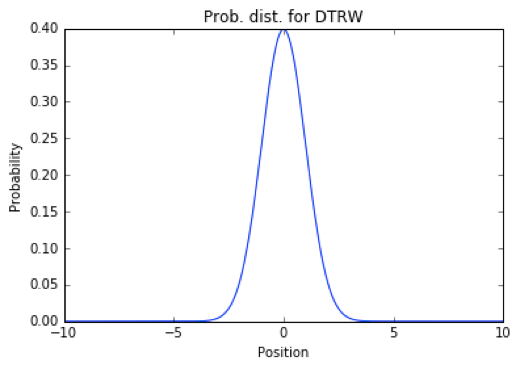 Figure 1
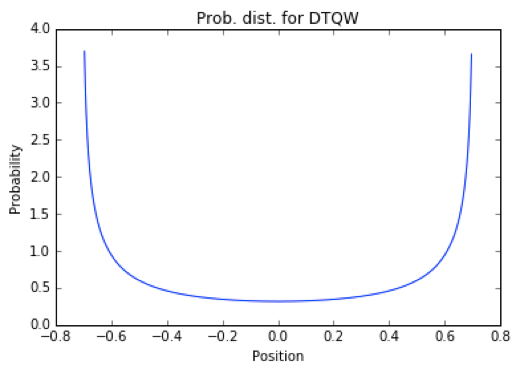 Figure 2
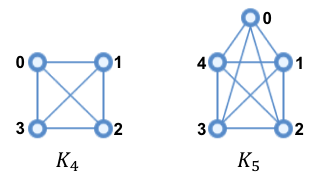 Figure 3
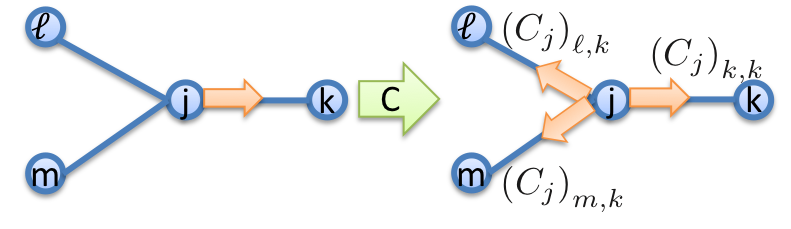 Figure 4
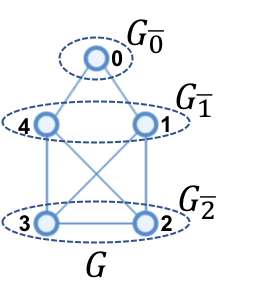 Figure 5
 Figure 6
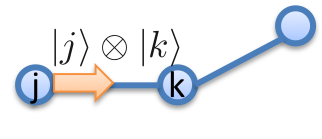 Figure 7
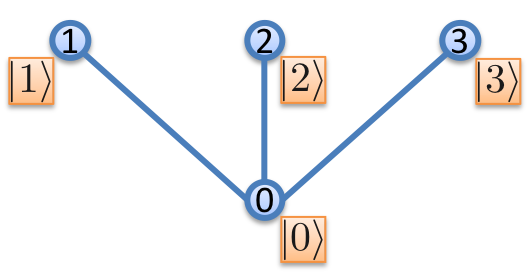 Figure 8
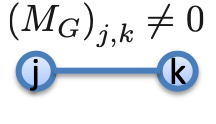 Figure 9
Peer Reviews
No public reviews on file for this paper yet. If you reviewed it on a platform where reviews are public (OpenReview, ICLR, NeurIPS, ICML), you can paste yours below so the community can read it here.
Videos
No videos yet. Explain this paper in a talk, walkthrough, or lecture? Add one.
Taxonomy
TopicsQuantum Computing Algorithms and Architecture · Quantum-Dot Cellular Automata · DNA and Biological Computing
Partition of graphs and quantum walk based search algorithms
Yusuke Ide School of Knowledge Science, Japan Advanced Institute of Science and Technology,
1-1 Asahidai, Nomi 923-1292, Japan
e-mail: [email protected]
Abstract
In this paper, we show reduction methods for search algorithms on graphs using quantum walks. By using a graph partitioning method called equitable partition for the the given graph, we determine “effective subspace” for the search algorithm to reduce the size of the problem. We introduce the equitable partition for quantum walk based search algorithms and show how to determine “effective subspace” and reduced operator. 000 *Keywords: * Quantum walks, Quantum search, Equitable partition
1 Introduction
In the last two decades, the study of the quantum walks (QWs) has been extensively developed by many researchers. QWs can be viewed as quantum counterparts of usual random walks (RWs) but they have several different features from that of RWs. For example, if we consider the discrete-time QW on the one-dimensional lattice case with parameters corresponding to the simple RW, the position of the walker at time follows the following limit theorem [15, 16]:
[TABLE]
Here the random variable has the following probability density function:
[TABLE]
Note that stands for the weak convergence. Let be the expectation with respect to the probability distribution of for each . We also consider the characteristic function of for each where (resp. ) denotes the imaginary unit (resp. the set of real numbers). Then is equivalent to for all .
This theorem corresponds to the central limit theorem for the RWs. The theorem shows that the position of the quantum walker spreads in ballistic order (order ) not in diffusive order (order ) of the random walker. The limit distribution (Fig. 2) is also different from the Gaussian distribution which is appear in the central limit theorem for the RWs (Fig. 2).
Recently, QWs have received much attention in various fields not only mathematical interests but also such as experimental realization [11, 22], connection between topological phase [3, 14], reduction method for radioactivity [9, 20], quantum search algorithms [1, 2, 4, 5, 6, 7, 18, 23]. There are good review articles for the theory of QWs such as [12, 13, 17, 19, 21, 24].
In this paper, we show reduction methods for search algorithms on graphs using QWs. By using the equitable partition [8] for the graph, we determine “effective subspace” for the search algorithm to reduce the size of the problem. For this purpose, we review two types of QWs, discrete-time and continuous-time versions, in Sec. 2. In Sec. 3, we introduce QW based search algorithms. The main contribution of this paper is Sec. 4. In this section, we introduce the equitable partition for QW based search algorithms and show how to determine “effective subspace” and reduced operator.
2 Quantum walks
2.1 Discrete-Time Quantum Walk (DTQW)
Let be a simple graph (undirected graph without self-loops and multiple edges) with its vertex set and edge set . As an example, for the complete graph on vertices which is the simple graph with edges (fully connected), the edge set is defined by . More concretely, for and (Fig. 3), the edge sets are defined by and .
Discrete-time quantum walk (DTQW) is a quantum dynamics on the graph with the following Hilbert space :
[TABLE]
where |j\rangle={}^{T}[0,\ldots,0,\overbrace{1}^{\text{j-th}},0,\ldots,0] is the -dimensional standard basis (column vector, denotes the transpose of ) corresponding to the vertex and represents the tensor product of the two bases and . The Hilbert space is the Hilbert space spanned by the basis . We usually call each element in the Hilbert space as state. The state is interpreted as “the state (direction) from the vertex to an adjacent vertex ” (Fig. 4).
There are many choices of the definition of the time evolution operator (unitary matrix) of DTQW on the graph . Here we adopt the following definition:
[TABLE]
Where is called the flip-flop type shift operator which governs the motion of the walker. The definition of the shift is the following (Fig. 5):
[TABLE]
Also is called the coin operator which mixes the walker’s states. The coin operator is given by
[TABLE]
where is the conjugate transpose of . The unitary matrix is a ( the degree of the vertex , i.e., the number of edges connected with the vertex ) -dimensional unitary matrix which is defined by
[TABLE]
for each with . From the definition of the coin operator , we can see that
[TABLE]
for each . From this observation, we can say that the coin operator “mixes” each state corresponding to each vertex with suitable weights (Fig. 6).
There are many choices of . One of a typical choice of is the following Grover’s coin which corresponds to the simple random walk on :
[TABLE]
where is called the diagonal sate corresponding to the vertex which is defined by
[TABLE]
and denotes the identity matrix of order .
For DTQW, we choose a unit vector (initial state) of the walker. Then we consider the time evolution
[TABLE]
for . Here is called the probability amplitude at time . Using this probability amplitude, we define the probability
[TABLE]
that the walker is found on at time .
2.2 Continuous-Time Quantum Walk (CTQW)
Again we consider a simple graph with . Continuous-time quantum walk (CTQW) is a quantum dynamics on the graph with the following Hilbert space (Fig. 8):
[TABLE]
On this Hilbert space , we define the time evolution operator of CTQW. We choose an -dimensional Hermitian matrix with when and when . The component is interpreted as “the weight of the edge ” as Fig. 8.
For the time , we define the time evolution operator
[TABLE]
of CTQW on corresponding to . We note that CTQW is nothing but quantum dynamics determined by the Schrödinger equation with its Hamiltonian . We choose a unit vector (initial state) then the time evolution
[TABLE]
for is defined. Here represents the probability amplitude at time . We define the probability that the walker is found on at time as
[TABLE]
One of a typical choice of is the adjacency matrix
[TABLE]
of the graph .
For example, we show the time evolution for the complete graph on vertices case. In this case,
[TABLE]
Thus we have
[TABLE]
Therefore we obtain
[TABLE]
If we consider the initial state as which is corresponding to the case that the walker starts from the vertex then we can calculate
[TABLE]
Therefore we obtain
[TABLE]
3 Quantum Walk based search algorithms
3.1 DTQW cases
In this section, we consider discrete-time quantum walk based search (DTQW search) on simple graph with . Let be the vertex which we want to find (marked vertex). For DTQW search, we use the following special coin operator:
[TABLE]
Then we consider the DTQW on with the uniform initial state
[TABLE]
The main task for DTQW search is finding a time such that we can attain
[TABLE]
For example, for DTQW search on the hypercube case, there is a time such that the search is successful [23]. For the square lattice cases [2], there also exist times .
3.2 CTQW cases
In this section, we consider continuous-time quantum walk based search (CTQW search) on simple graph with . The Hermitian matrix for CTQW search on is defined by
[TABLE]
where is the marked vertex. Now we consider the CTQW on with its time evolution operator . The main task for CTQW search is finding a suitable and a time such that we can attain
[TABLE]
with the uniform initial state
[TABLE]
For example, CTQW search on the complete graph, the hypercube and the square lattice cases, there exist suitable and a time such that the search are successful [7]. For the Erdös-Rényi random graph with suitable condition for the connection probability cases, there also exist suitable and a time such that the search are successful for almost all generated graphs [4].
4 Equitable partition and quantum walk search
4.1 Equitable partition of graphs for quantum walk search
For both DTQW search and CTQW search, a partition of the graph so-called equitable partition [8] is very useful. Note that the equitable partition can be viewed as a generalization of the modular partition [10]. Without loss of generality, we assume that the marked vertex is . We consider the partition of which is satisfied the following conditions:
2. 2.
3. 3.
For each , there exists a non-negative integer such that for each .
This partition is a special case of so-called equitable partition. We use the notation if .
The partition of consists of subgraphs. For each subgraph is -regular graph. Especially, is the null graph () which consists of only the marked vertex . In addition, for each vertex the number of edges connected to the vertices in is regardless the choice of vertex. In Fig. 9, we show an example of the partition. In this case, and .
By using this partition, we can construct efficient eigenspace for both DTQW search and CTQW search. Note that for each graph , the graph itself, i.e., with for each , is a trivial equitable partition. Therefore the proposed method works well for graphs with equitable partition consists of small numbers of subgraphs.
4.2 DTQW cases
In this section, we consider DTQWs defined by “Grover type coins” on simple, connected graphs. For each , we consider the following coin:
[TABLE]
where with . Note that if then this Grover type coin has two eiganvalues and with multiplicities and , respectively.
Here we consider the equitable partition with of . We define the following uniform states related to the partition:
[TABLE]
for each where is the zero vector of . The state is the uniform state on the states corresponding to edges from to . Assume that every vertices in have the same coin for then we obtain
[TABLE]
with convention for . On the other hand,
[TABLE]
where we use the relations then and coming from simplicity of the graph. This shows that the action of is
[TABLE]
for .
From this observation, the action of the time evolution operator is closed on the subspace of . Also the uniform initial state is represented by linear combination of uniform states related to the partition,
[TABLE]
This shows that . We summarize this fact as the following proposition:
Proposition 4.1
Consider the DTQW defined by Grover type coin with the equitable partition starting from the uniform initial state . Then we have . Assume that every vertices in have the same coin . Then the action of the time evolution operator is closed on the subspace of as follows:
[TABLE]
for .
Proposition 4.1 states a reduction method for the DTQW defined by Grover type coin with the equitable partition starting from the uniform initial state . Whenever we start from the uniform initial state , we can only consider the action of the time evolution operator on that is defined as Eq. (4.1). This means that we can only consider at most dimensional subspace of which dimension is . Applying Proposition 4.1 to DTQW search, we have the following theorem:
Theorem 4.2
Consider the DTQW search on simple, connected graph with the equitable partition . Then we have . Then the action of the time evolution operator is closed on the subspace of as follows:
[TABLE]
4.3 CTQW cases
In this section, we consider the CTQW search on simple, connected graph with equitable partition with of . We define the following uniform states related to the partition:
[TABLE]
for . By direct calculation, we obtain
[TABLE]
where we use the relation coming from simplicity of the graph.
Now we define a matrix as
[TABLE]
Recall that the Hermitian matrix for DTQW search is defined by . If we define a matrix as
[TABLE]
then the action of the Hermitian matrix is closed on the subspace as
[TABLE]
for . We also obtain . This shows that
[TABLE]
thus
[TABLE]
We summarize this fact as the following theorem:
Theorem 4.3
Consider the CTQW search on simple, connected graph with the equitable partition . Then we have . Define a matrix as
[TABLE]
where is also matrix with . Then the finding probability of the marked vertex at time is
[TABLE]
By using Theorem 4.3, we obtain the following concrete example of CTQW search:
Proposition 4.4
Let be the graph with marked vertex which is connected to all the vertices of a -regular graph with vertices then we obtain
[TABLE]
when we take . Particularly, if we take then we have . The finding probability takes any values in with period .
Proposition 4.4 shows that if we consider a graph with such that the complete graph then with . In this case, the reduced matrix is a matrix (simplest case). Finding concrete examples which reduced matrix is a general matrix and the search is successful might be an interesting future problem.
Proof of Proposition 4.4.
In this case, we can consider an equitable partition with and . By Theorem 4.3 we have the reduced matrix
[TABLE]
In order to obtain eigenvalues and eigenvectors of , we deal with the following equation:
[TABLE]
This equation is equivalent to
[TABLE]
If we set then the eigenvalues and eigenvectors are obtained by
[TABLE]
Therefore we obtain spectral decomposition
[TABLE]
On the other hand,
[TABLE]
Then we have
[TABLE]
As a consequence, we obtain
[TABLE]
∎
5 Summary
In this paper, we show reduction methods for search algorithms on graphs using QWs. By using the equitable partition for the graph, we determine “effective subspace” for the search algorithm to reduce the size of the problem in both DTQW search and CTQW search. It can be an interesting future problem that determining conditions of equitable partition which induce successful DTQW search and CTQW search.
Acknowledgments.
The author was supported by the Grant-in-Aid for Young Scientists (B) of Japan Society for the Promotion of Science (Grant No. 16K17652).
The reference list from the paper itself. Each links out to its DOI / PubMed record.
- 1[1] Ambainis, A., Bach, E., Nayak, A., Vishwanath, A., Watrous, J.: One-dimensional quantum walks. In: Proceedings of the 33rd Annual ACM Symposium on Theory of Computing, pp. 37–49 (2001).
- 2[2] Ambainis, A., Kempe, J., Rivosh, A.: Coins Make Quantum Walks Faster. In: Proceedings of the 16th ACM-SIAM Symposium on Discrete Algorithms, pp. 1099–1108 (2005).
- 3[3] Asboth, J. K., Edge, J. M.: Edge-state-enhanced transport in a two-dimensional quantum walk. Phys. Rev. A 91 , 022324 (2015).
- 4[4] Chakraborty, S., Novo, L., Ambainis, A, Omar, Y.: Spatial search by quantum walk is optimal for almost all graphs. Phys. Rev. Lett. 116 , 100501 (2016).
- 5[5] Childs, A. M.: Universal computation by quantum walk. Phys. Rev. Lett. 102 , 180501 (2009).
- 6[6] Childs, A. M., Cleve, R., Deotto, E., Farhi, E., Gutmann, S., Spielman, D. A.: Exponential algorithmic speedup by quantum walk. In: Proceedings of the 35rd Annual ACM Symposium on Theory of Computing, pp. 59–68 (2003).
- 7[7] Childs, A. M., Goldstone, J.: Spatial search by quantum walk. Phys. Rev. A 70 , 022314 (2004).
- 8[8] Godsil, C., Royle, G. F.: Algebraic Graph Theory. Springer-Verlag, New York (2001).