Bernoulli Ballot Polling: A Manifest Improvement for Risk-Limiting Audits
Kellie Ottoboni, Matthew Bernhard, J. Alex Halderman, Ronald L., Rivest, Philip B. Stark

TL;DR
This paper introduces Bernoulli ballot polling, a flexible and decentralized risk-limiting audit method that improves logistical efficiency and can start early in polling places, with strong statistical guarantees.
Contribution
It proposes a novel Bernoulli sampling approach for risk-limiting audits, eliminating the need for a ballot manifest and enabling independent, early, and location-specific auditing.
Findings
High probability of confirming 2016 election outcomes with minimal sampling
Advantages include independence, early start, and no need for a ballot manifest
Potential for logistical and security improvements in election audits
Abstract
We present a method and software for ballot-polling risk-limiting audits (RLAs) based on Bernoulli sampling: ballots are included in the sample with probability , independently. Bernoulli sampling has several advantages: (1) it does not require a ballot manifest; (2) it can be conducted independently at different locations, rather than requiring a central authority to select the sample from the whole population of cast ballots or requiring stratified sampling; (3) it can start in polling places on election night, before margins are known. If the reported margins for the 2016 U.S. Presidential election are correct, a Bernoulli ballot-polling audit with a risk limit of 5% and a sampling rate of would have had at least a 99% probability of confirming the outcome in 42 states. (The other states were more likely to have needed to examine additional ballots.) Logistical and…
Click any figure to enlarge with its caption.
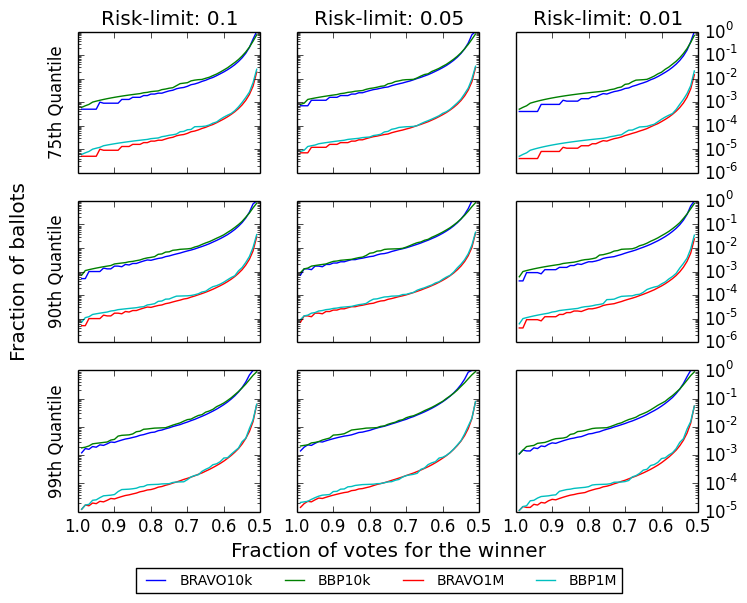 Figure 1
Peer Reviews
No public reviews on file for this paper yet. If you reviewed it on a platform where reviews are public (OpenReview, ICLR, NeurIPS, ICML), you can paste yours below so the community can read it here.
Videos
No videos yet. Explain this paper in a talk, walkthrough, or lecture? Add one.