Four-Gauge-Particle Scattering Amplitudes and Polyakov String Path Integral in the proper-time gauge
Taejin Lee

TL;DR
This paper computes four-gauge-particle scattering amplitudes using the Polyakov string path integral in the proper-time gauge, revealing alpha prime corrections and tachyon poles, which are relevant for understanding string effects beyond field theory.
Contribution
It introduces a novel approach to evaluate string scattering amplitudes in the proper-time gauge, systematically incorporating alpha prime corrections and analyzing their differences from conventional methods.
Findings
Proper-time gauge yields amplitudes with alpha prime corrections.
Amplitudes contain tachyon poles consistent with three-particle scattering.
Proper-time gauge approach may better explore string corrections and high-energy behavior.
Abstract
We evaluate four-gauge-particle tree level scattering amplitudes using the Polyakov string path integral in the proper-time gauge, where the string path integral can be cast into the Feynman-Schwinger proper-time representation. We compare the resultant scattering amplitudes, which include -corrections, with the conventional ones that may be obtained by substituting local vertex operators for the external string states. In the zero-slope limit, both amplitudes are reduced to the four-gauge-particle scattering amplitude of non-Abelian Yang-Mills gauge theory. However, when the string corrections become relevant with finite , the scattering amplitude in the proper-time gauge differs from the conventional one: The Polyakov string path integral in the proper-time gauge, equivalent to the deformed cubic string field theory, systematically provides the alpha prime corrections. In…
Click any figure to enlarge with its caption.
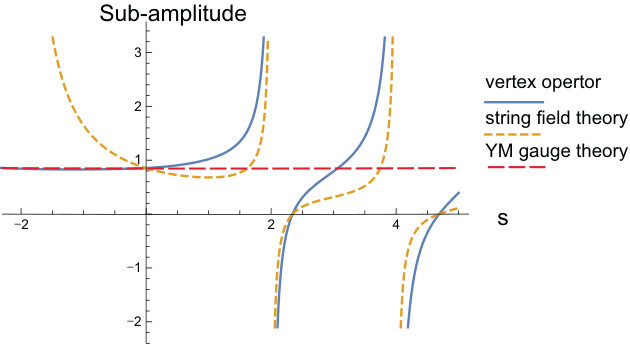 Figure 1
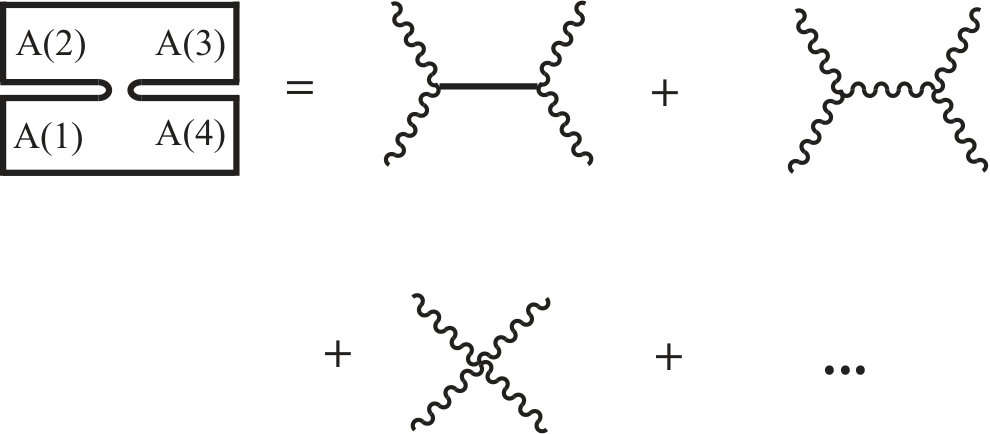 Figure 2
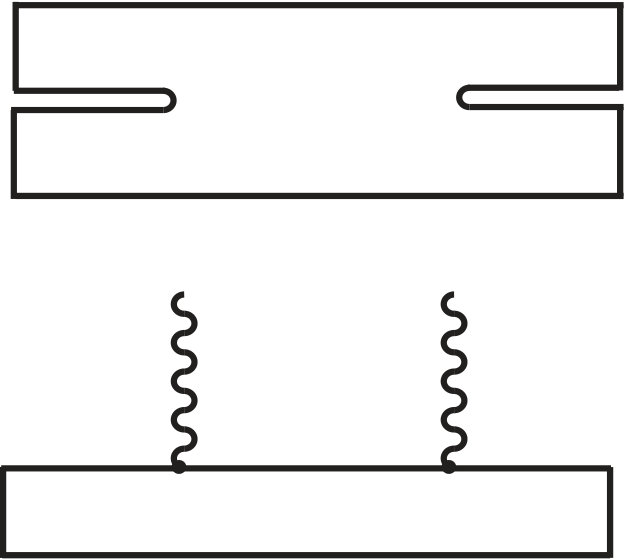 Figure 3
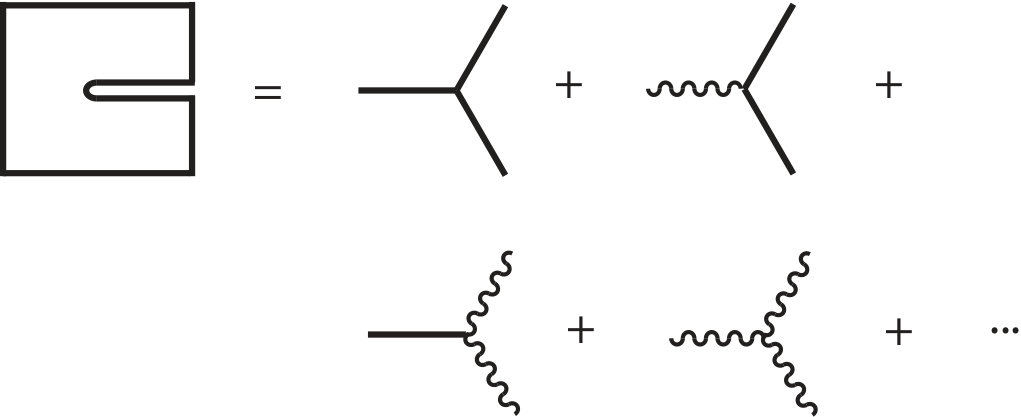 Figure 4
Peer Reviews
No public reviews on file for this paper yet. If you reviewed it on a platform where reviews are public (OpenReview, ICLR, NeurIPS, ICML), you can paste yours below so the community can read it here.
Videos
No videos yet. Explain this paper in a talk, walkthrough, or lecture? Add one.
Four-Gauge-Particle Scattering Amplitudes and
Polyakov String Path Integral in the proper-time gauge
Taejin Lee
Department of Physics, Kangwon National University, Chuncheon 24341 Korea
Abstract
We evaluate four-gauge-particle tree level scattering amplitudes using the Polyakov string path integral in the proper-time gauge, where the string path integral can be cast into the Feynman-Schwinger proper-time representation. We compare the resultant scattering amplitudes, which include -corrections, with the conventional ones that may be obtained by substituting local vertex operators for the external string states. In the zero-slope limit, both amplitudes are reduced to the four-gauge-particle scattering amplitude of non-Abelian Yang-Mills gauge theory. However, when the string corrections become relevant with finite , the scattering amplitude in the proper-time gauge differs from the conventional one: The Polyakov string path integral in the proper-time gauge, equivalent to the deformed cubic string field theory, systematically provides the alpha prime corrections. In addition, we find that the scattering amplitude in the proper-time gauge contains tachyon poles in a manner consistent with three-particle-scattering amplitudes. The scattering amplitudes evaluated using the Polyakov string path integral in the proper-time gauge may be more suitable than conventional ones for exploring string corrections to the quantum field theories and high energy behaviors of open string.
string scatttering amplitude, Polyakov string path integral, Yang-Mills gauge theory
pacs:
11.15.−q, 11.25.-w, 11.25.Sq
I Introduction
Scattering amplitudes, which have yielded many important new discoveries, have long been ubiquitous tools in both experimental and theoretical physics. In string theory, theoretical studies of string scattering amplitudes are also expected to lead to new findings in high energy physics, where string theory is considered the most promising candidate for a unified framework of the fundamental forces, including gravity. In some scenarios Lykken1996 ; Antoniadis1998 involving embedding the standard model in the frame work of string theory, the string scale may be as low as the weak scale. These theoretical proposals allow for new possibilities that we may directly study string physics at high energy colliders. Therefore, it becomes an important and urgent task to accurately calculate the multi-particle scattering amplitudes in string theory.
Conventionally, the string scattering amplitudes are calculated by substituting the local vertex operators for external string states. This procedure is based on the one-to-one correspondence between string states and local operators Polchinski.book.1998 . This method of calculation for string scattering amplitude has proven successful for producing the four-tachyon scattering amplitudes known as the Veneziano amplitude Veneziano68 for open string and the Virasoro-Shapiro amplitude Virasoro69 ; Shapiro69 for closed string. However, it is not clear whether we can apply this vertex operator technique to more general cases, such as evaluating high energy scattering amplitudes or alpha-prime corrections. In fact, the validity of this procedure has never been examined thoroughly.
An alternative method to evaluate the string scattering amplitudes, which does not make use of vertex operators, is the Polyakov string path integral Polyakov1981 . By evaluating the Polyakov string path integral defined on the string world-sheet with appropriately chosen boundary conditions for the external string states, we may obtain the string scattering amplitudes. Although this technique is more complicated than the vertex operator technique, it offers a number of advantages: The external string states do not need to be on-shell and the momenta of external strings may not be restricted to the low energy region. If we choose the proper-time gauge TLee88ann in fixing the reparametrization invariance on the string world-sheet covariantly, we can cast string scattering amplitudes into those of second quantized theory in a fashion similar to the Feynman-Schwinger representation of quantum field theory. The string field theory Lee2016i ; TLee2017cov defined by the Polyakov string path integral in the proper-time gauge has been shown to be equivalent to the deformed cubic string field theory Lee2017d ; Lai2017S .
As for the four-tachyon-scattering amplitudes, both methods yield the same result: The well-known Veneziano amplitude and the Virasoro-Shapiro amplitude. However, a recent work Lai2017S has pointed out that the two methods may produce different results if we apply them to more general external string states. A simple extension of the Veneziano amplitude is the scattering amplitude of three tachyons and one arbitrary string state, which has been studied extensively in Refs. Chan2006notes ; Lai2016string ; Chan2005solving ; Lai2016lauri ; Lai2017sloving to explore symmetric properties of the string scattering amplitudes in the high energy limit Gross87 ; Gross88 ; Gross88prl ; Gross89Phil ; Gross89nucl . When calculating the string scattering amplitude defined by the Polyakov string path integral, we must map the string world-sheet onto upper half complex plane by the Schwarz-Christoffel transformation. On the other hand, if we adopt the conventional vertex operator technique, the string scattering amplitude is readily defined on upper-half complex plane. It follows then that the two methods may yield the same result only when the scattering amplitude is invariant under the conformal transformation generated by the Schwarz-Christoffel mapping.
In this present work, we shall study the four-gauge-particle tree level scattering amplitude in bosonic open string theory explicitly evaluating the Polyakov string path integral in the proper-time gauge and compare the resulant scattering amplitude with the conventional expression obtained by the vertex operator technique. We will examine their high energy behaviors and the difference of the singularity structures.
II Open String Fields on multiple space-filling Branes
The multiple string scattering amplitude may be written in terms of the Polyakov string path integral defined on the corresponding string world-sheet GreenSW1987
[TABLE]
where , and for open bosonic string and for open super-string. On a space-filling brane, the string coordinates , satisfying the Neumann boundary condition
[TABLE]
may be expanded in terms of normal modes as
[TABLE]
If we choose the proper-time gauge where the proper-time on the string world-sheet is defined properly TLee88ann ,
[TABLE]
we may recast the string scattering amplitudes into the Feynman-Schwinger proper-time representaion, which may help obtain a covariant second quantized string theory. Here , are normal modes of the lapse and shift functions of the two-dimensional metric on the world-sheet
[TABLE]
Evaluating defined as the Polyakov path integral over a strip, we can obtain the covariant free string propagator of the open string. The Polyakov string path inegral, in the proper-time gauge has been calculated in Refs. Lee2016i ; Lee2017d and the three-string scattering amplitude has been found to be
[TABLE]
where and , denote the external string states which carry group indices. For the proper-time gauge,
[TABLE]
Expicit expressions of the Neumann functions for the three-string scattering, and can be found in Ref. Lee2016i :
[TABLE]
If we expand the external string states in terms of mass eigen-states,
[TABLE]
we may obtain various three-particle interaction terms. Fig. 2 depicts an expansion of three-string scattering into those of various three-particle scatterings.
By choosing as the external three-string state, we obtain the three-tachyon interaction from Eq. (8a)
[TABLE]
If we are interested in the three-particle interaction terms between tachyon and gauge particle, we may choose the external three-string external state as follows
[TABLE]
where Expanding the external string state in terms of component fields, from Eq. (8a) we may get three-particle interactions between tachyons and gauge particles
[TABLE]
The second term in and the second term in correspond to alpha-prime corrections to three-particle interactions. Here, we note that there exists a three-particle interaction of two gauge particles and one tachyon, which may generate a four-gauge particle scattering mediated by a tachyon.
Using algebra we obtain
[TABLE]
In configuration space, it contributes to the action as
[TABLE]
Similarly, we have
[TABLE]
The three-gauge particle interaction may be written as
[TABLE]
Using the Neumann functions for three-string scattering, we get
[TABLE]
In configuration space they may be represented by three-gauge-field interaction terms of the non-Abelian group Yang-Mills gauge theory:
[TABLE]
It is worth mentioning that is completely consistent with the -correction to the three-gauge field interaction term, which has been obtained by previous approaches Neveu72 ; Scherk74 ; Tseytlin86 ; Coletti03 .
III Four-gauge-particle scattering amplitude on space-filling Branes
The four-gauge-particle scattering amplitude has been discussed previously in Refs. Lee2016i ; TLee2017cov in the framework of string field theory in the proper-time gauge. However, in the previous works, we only studied the four-gauge-particle scattering amplitude in the zero-slope limit. Here, we shall evaluate the amplitude without taking the limit so that the resultant amplitude is valid for the full range of the energy scale. By mapping the string world-sheet for the four-string scattering onto the upper half complex plane by the Schwarz-Christoffel function, we may find that the four-string scattering amplitude on multiple space-filling branes may be written at tree level Lee2016i as
[TABLE]
where denote the Koba-Nelson variables, corresponding to the locations of four external strings on upper half complex plane,
[TABLE]
In the proper-time gauge, we choose .
In order to evaluate the four-gauge particle scattering amplitude, we choose the external string states as
[TABLE]
Expanding the four-string vertex operator in terms of oscillator operators, we may find that the four-gauge particle scattering amplitude is given by
[TABLE]
If we explicitly reintroduce , the momenta may be replaced by , and this expansion can also be understood as a series expansion of the four-gauge particle scattering amplitude in powers of . The third term in yields the alpha prime correction, which would have been missed if we had employed the vertex operator technique. It may be convenient to separately calculate each of the three terms in .
The first term in may be defined by
[TABLE]
Using the Neumann functions given in the Appendix, we may evaluate as follows:
[TABLE]
where is restored and , are abbreviated as , . It can be compared with the corresponding sub-amplitude Schwarz1982 obtained by using the vertex operator technique
[TABLE]
In the zero slope limit, both scattering amplitudes reduce to the corresponding sub-amplitude of non-Abelian gauge theory
[TABLE]
However, we also notice the difference between two amplitudes: does not contain the tachyon poles whereas has the tachyon poles in all three channels: They differ for any finite and the amplitudes of Eq. (26) and Eq. (27) only coincide at . As we have observed in the last section, the three-open-string vertex gives rise to various three-particle interaction terms, including a coupling between two-gauge field and one tachyon when external string states are expanded in terms of mass eigenstates. Thus, the four-string scattering amplitude which is generated by the three-string vertex should contain the tachyon poles. Fig. 4 depicts the difference between the sub-amplitudes in -channel at a fixed angle. Thanks to the tachyon pole, the sub-amplitude of four-gauge particle scattering amplitude in -channel changes significantly with finite .
The second term in which is of order is written as
[TABLE]
Using the Neumann functions in the proper-time gauge given in the Appendix, we find that may be expressed as an integral over the real Koba-Nelson variable ,
[TABLE]
Integrating out the Koba-Nielsen variable leads us to
[TABLE]
Again, we find that the scattering amplitude contains the tachyon poles in all three channels. It may be interesting to compare this sub-amplitude with the corresponding one, which can be obtained using the conventional vertex operator technique. If we apply the vertex operator technique to evaluate the corresponding sub-amplitude, we obtain Schwarz1982
[TABLE]
The main difference between two sub-amplitudes and is the presence of tachyon poles. In the zero-slope limit, both scattering amplitudes reduce to the corresponding one of Yang-Mills gauge theory as expected
[TABLE]
IV The alpha prime corrections
One of outstanding advantages of the string field theory in the proper-time gauge is that we may be able to systematically calculate the -corrections . An expansion of -string vertex operator in terms of oscillator operators naturally yields a series expansion of with a unique ordering of non-Abelian operators. When we expand the vertex operator Eq. (21a) in terms of oscillator operators, we find that the third term is proportional to . This term may be considered as -corrections to the four-gauge-particle scattering amplitude, which do not have counterparts in the conventional calculation using vertex operators:
[TABLE]
Using the Neumann functions evaluated in the Appendix and integrating out the real Koba-Nielsen variable , we find that
[TABLE]
It is apparent that the sub-amplitude also contains the tachyon poles. It would have been difficult to obtain these -corrections to the four-gauge particle scattering amplitude if we employ the vertex opertor technique. In the zero slope limit, reduces to
[TABLE]
From this expression of , we may infer that the corresponding -corrections to the non-Abelian Yang-Mills action are of order .
V Discussions and Conclusions
We conclude this work with a few remarks on possible extensions. We calculated the four-gauge-particle treee level scattering amplitudes on multiple space-filling D-branes using the Polyakov string path integral in the proper-time gauge. Although the resultant scattering amplitudes are completely consistent with the conventional ones obtained by substituting local vertex operators for external strings in the low energy region, they significantly differ from the conventional ones when string corrections become relevant with finite , as they contain tachyon poles in all three scattering channels in a manner consistent with three-particle interactions and -corrections, which are of order .
The string scale may be as low as the weak scale Lykken1996 ; Antoniadis1998 in some phenomenological models based on string theory, so it is important to accurately evaluate particle scattering amplitudes, which are valid for the full range of the energy scale. The Polyakov string path integral in the proper-time gauge, which is equivalent to the deformed cubic string field theory Lee2017d may be the right theoretical tool to handle this request. The momenta of external strings are not restricted to the low energy region and the multi-particle scattering amplitudes evaluated in the proper-time gauge yield series expansions of with an unambiguously defined ordering of non-Abelian field operators.
Particle scattering amplitudes satisfy various relationships between themselves such as the Kleiss-Kuijf (KK) relation Kleiss1989 and the Bern-Carrasco-Johansson (BCJ) relation BCJ , and there has been much effort toward understanding the origins of these relations in string theory Chan2006notes ; Stieberger09 ; Bjerrum-Bohr2014 ; Stieberger2016 ; Lai2016string . Because the multi-particle scattering amplitudes obtained by evaluating Polyakov string path integral in the proper-time gauge can be interpreted as the Feynman-Schwinger proper-time representation of open string field theory, we may be able to study relations between scattering amplitudes of massive higher spin particles in string theory by extending this work. It may also be interesting to explore the scattering amplitudes of massless scalars and non-Abelian gauge fields by defining the scattering amplitudes of open strings on -branes TLee2017cov . It may also be worth noting that the scattering amplitudes in the proper-time gauge are valid for the full range of energy scales and expanded in a power series of . These properties make them useful tools for probing high energy limits of string theory Gross87 ; Gross88 ; Gross88prl ; Gross89Phil ; Gross89nucl .
Acknowledgements.
This work was supported by Basic Science Research Program through the National Research Foundation of Korea(NRF) funded by the Ministry of Education (2017R1D1A1A02017805).
Appendix A Neumann Functions for Four-String Scattering Amplitudes
In order to evaluate the Polakov string path integral, we map the world sheet of four-string scattering onto upper half complex plane: Four external strings are located on the boundary of upper half complex plane
[TABLE]
Accordingly, the Schwarz-Christoffel transformation which maps the four-string-scattering world sheet onto upper half complex plane is constructed as
[TABLE]
where , . It follows from this mapping that relations between the global coordinate and the local coordinates , on individual string patches as given by
[TABLE]
where and are two intraction times on the world sheet.
The Neumann functions are given by contour integrals as follows
[TABLE]
Performing the contour integrals and the binormial series expansions we may explicitly evaluate
[TABLE]
[TABLE]
[TABLE]
[TABLE]
For , we have
[TABLE]
The Neuman functions is defined by
[TABLE]
We may explicitly calculate ,
[TABLE]
Through algebra, we find that
[TABLE]
The reference list from the paper itself. Each links out to its DOI / PubMed record.
- 1(1) J. D. Lykken, Phys. Rev. D 54 , 3693 (1996).
- 2(2) I. Antoniadis, N. Arkani-Hamed, S. Dimopoulos and G. Dvali, Phys. Lett. B 436 , 257 (1998).
- 3(3) J. Polchinski, String Theory (Cambridge Univ. Press, Cambridge 1998) Vols. 1, 2.
- 4(4) G. Veneziano, Nuovo Cimento A 57 , 190 (1968).
- 5(5) M. Virasoro, Phys. Rev. 177 , 2309 (1969).
- 6(6) J. A. Shapiro, Phys. Rev. 179 , 1345 (1969).
- 7(7) A. M. Polyakov, Phys. Lett. B 103 , 207 (1981).
- 8(8) T. Lee, Ann. Phys. 183 , 191 (1988).