Electroweak phase transition and Higgs phenomenology in the Georgi-Machacek model
Ruiyu Zhou, Wei Cheng, Xin Deng, Ligong Bian, and Yongcheng Wu

TL;DR
This paper studies the electroweak phase transition in the Georgi-Machacek model, exploring conditions for strong first order transitions and their testability at future colliders, with implications for Higgs phenomenology.
Contribution
It provides a detailed analysis of the electroweak phase transition in the Georgi-Machacek model, identifying parameter spaces compatible with a strong first order transition and experimental constraints.
Findings
Two-step SFOEWPT can occur with small mixing angles.
LHC Higgs measurements constrain the parameter space.
Distinct collider signatures differentiate one-step and two-step SFOEWPT.
Abstract
In this work, we perform the electroweak phase transition study with the Georgi-Machacek model. We investigate both the one-step and two-step strong first order electroweak phase transition (SFOEWPT). The SFOEWPT viable parameter spaces could be tested by the future 14 TeV LHC, HL-LHC, and ILC. The LHC Higgs signal strength measurements severely bound the SFOEWPT valid parameter spaces, a tinny region of the mixing angle between the neutral fields of the isospin-doublet and isospin-triplet scalars around can allow the two-step SFOEWPT to occur. The triplet vacuum expectation value (VEV) is crucial for both SFOEWPT and related Higgs phenomenology. The two-step SFOEWPT can be distinguished from the one-step SFOEWPT through the triple Higgs coupling searches and the low mass doubly charged Higgs searches at colliders.
Click any figure to enlarge with its caption.
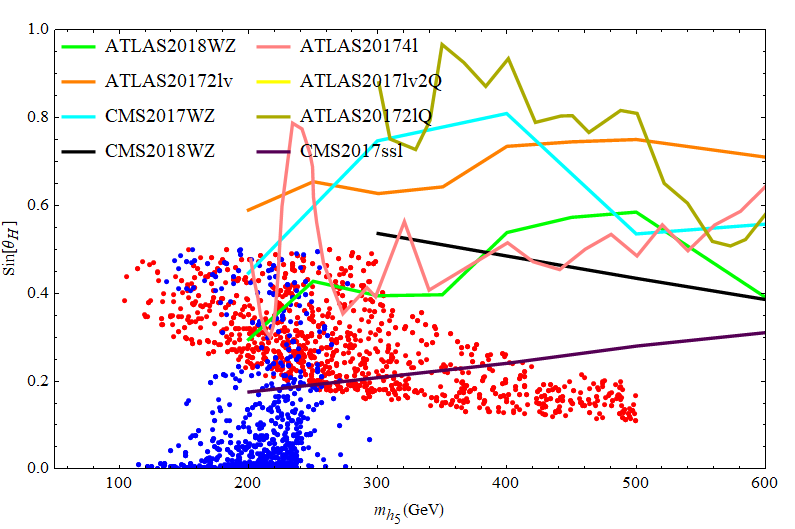 Figure 1
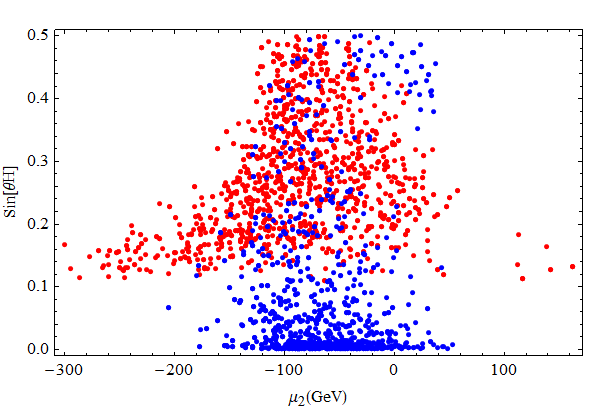 Figure 2
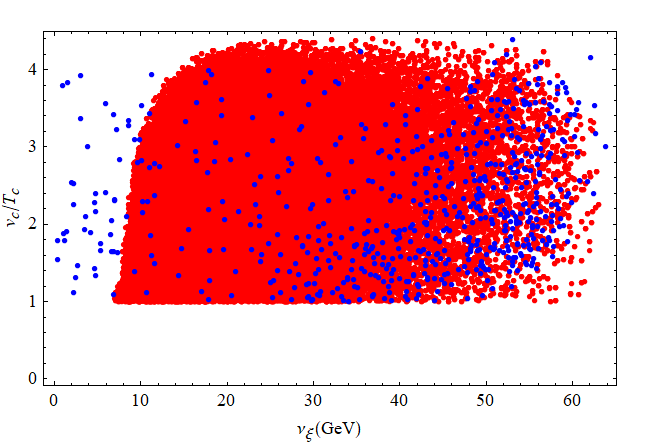 Figure 3
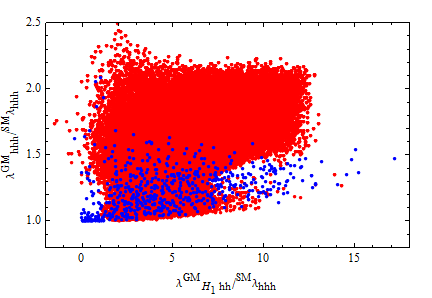 Figure 4
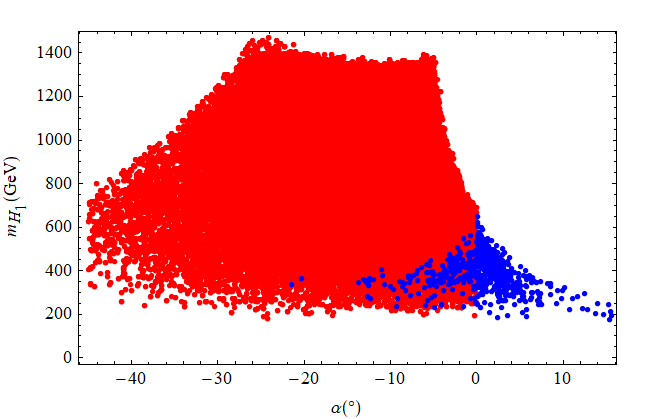 Figure 5
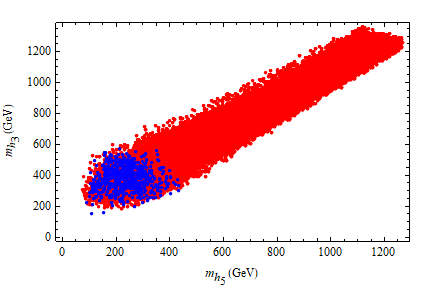 Figure 6
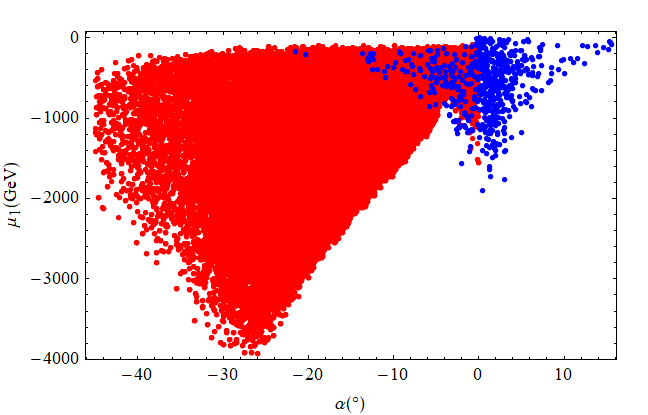 Figure 7
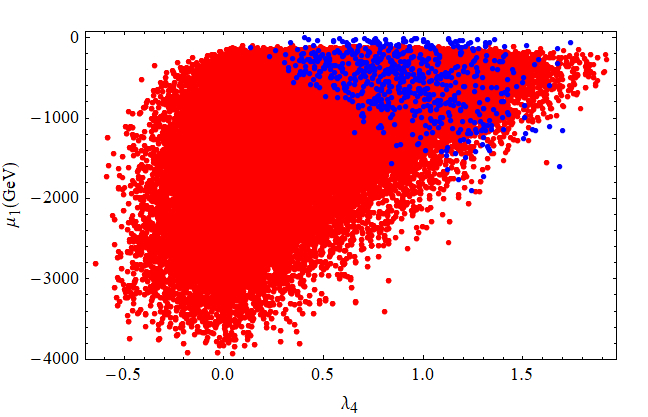 Figure 8
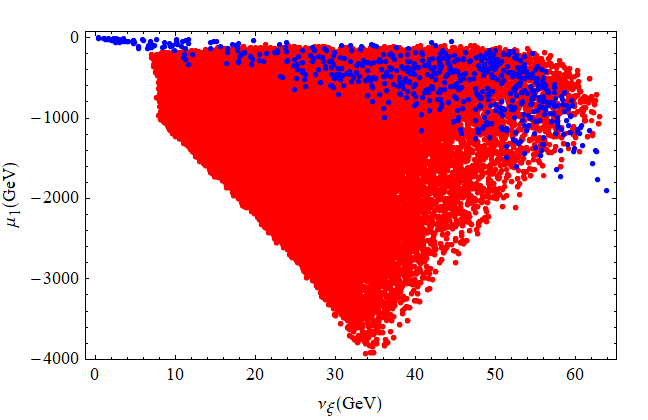 Figure 9
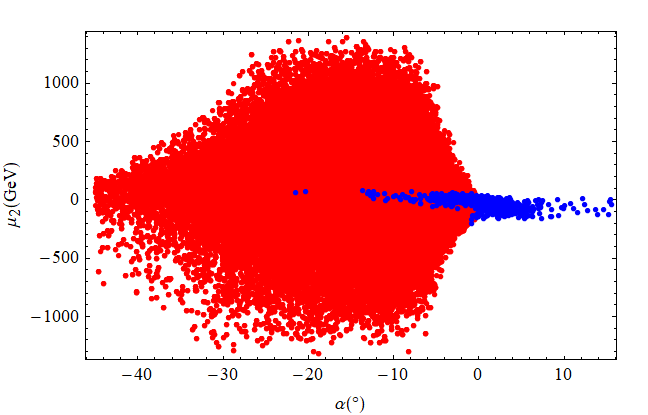 Figure 10
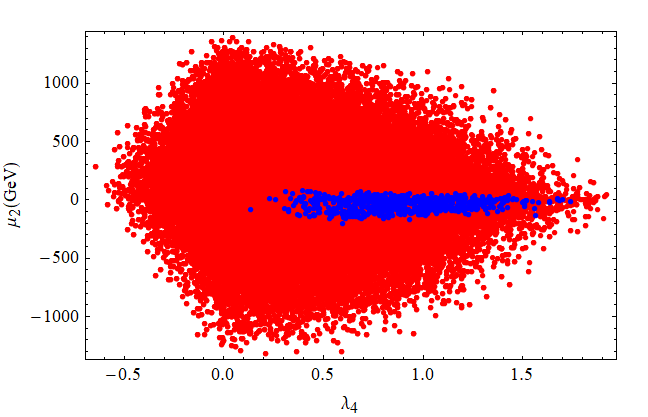 Figure 11
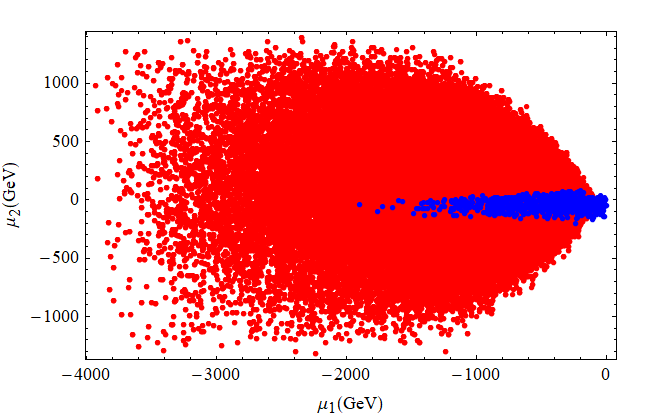 Figure 12
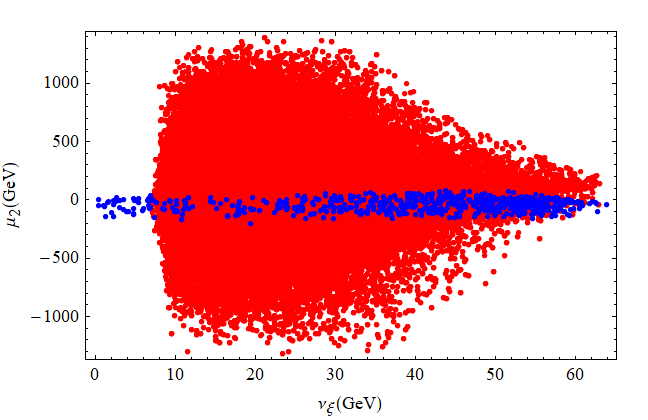 Figure 13
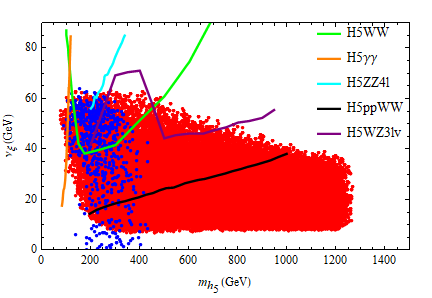 Figure 14
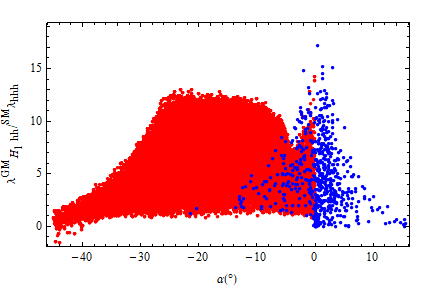 Figure 15
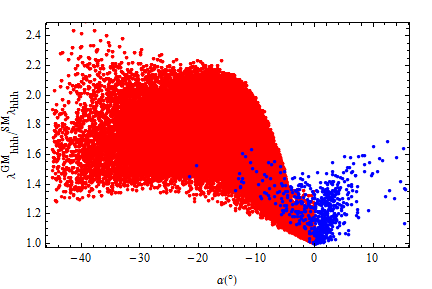 Figure 16
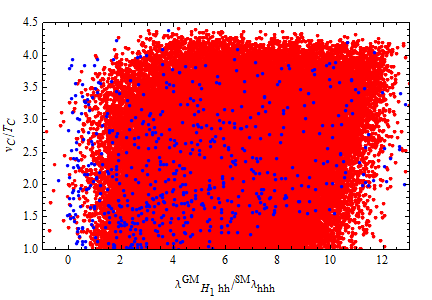 Figure 17
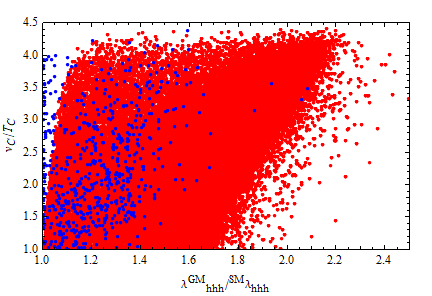 Figure 18
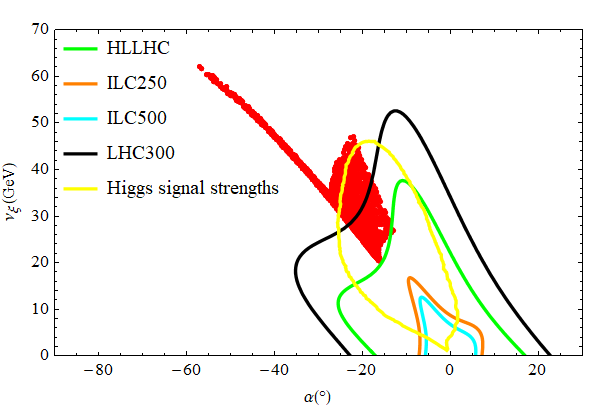 Figure 19
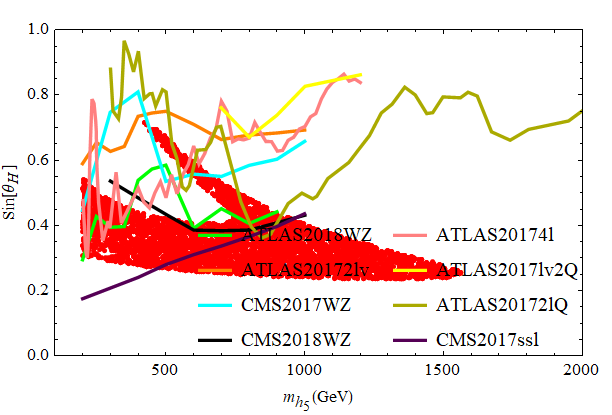 Figure 20
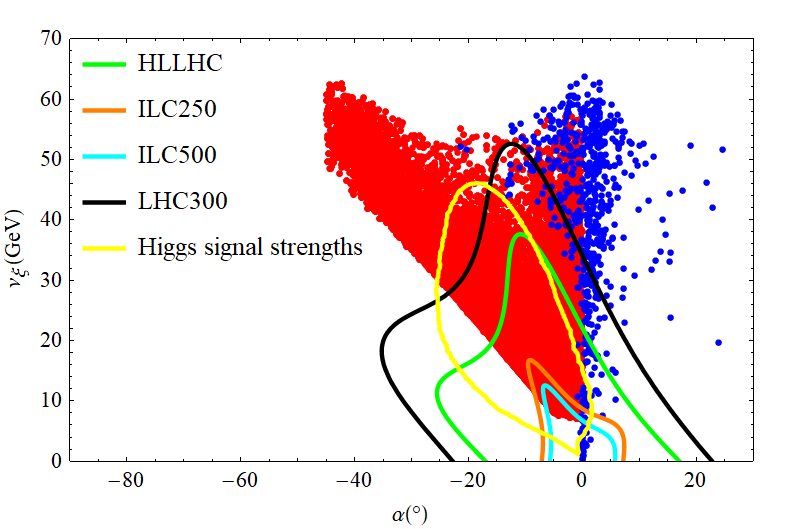 Figure 21
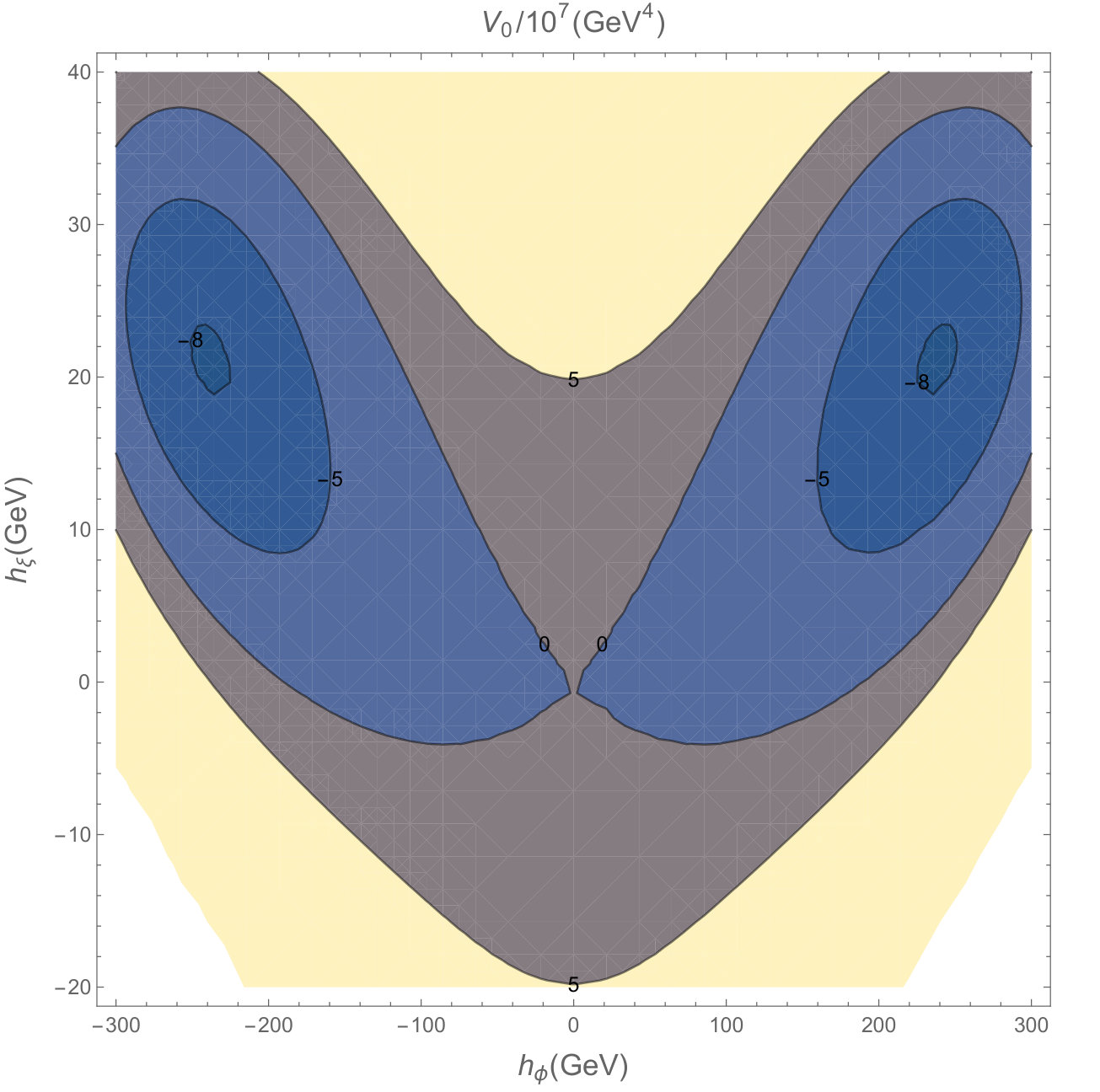 Figure 22
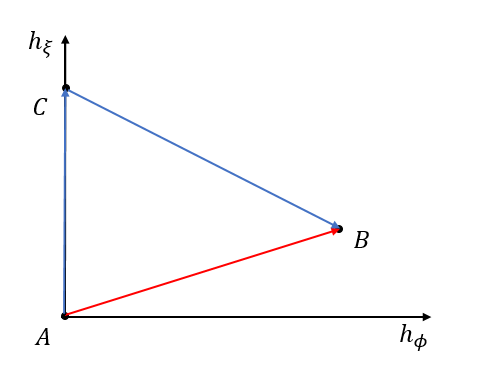 Figure 23
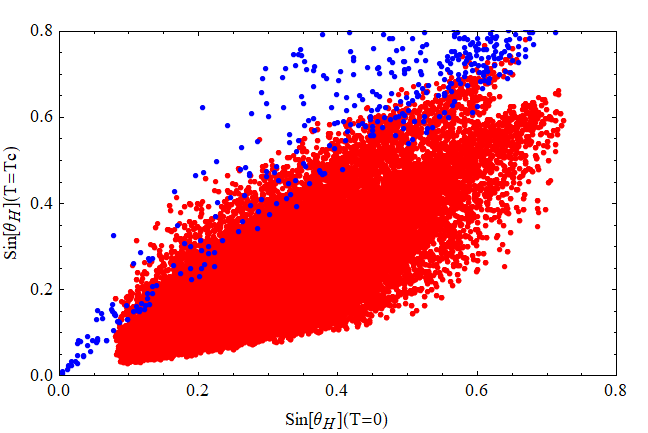 Figure 24
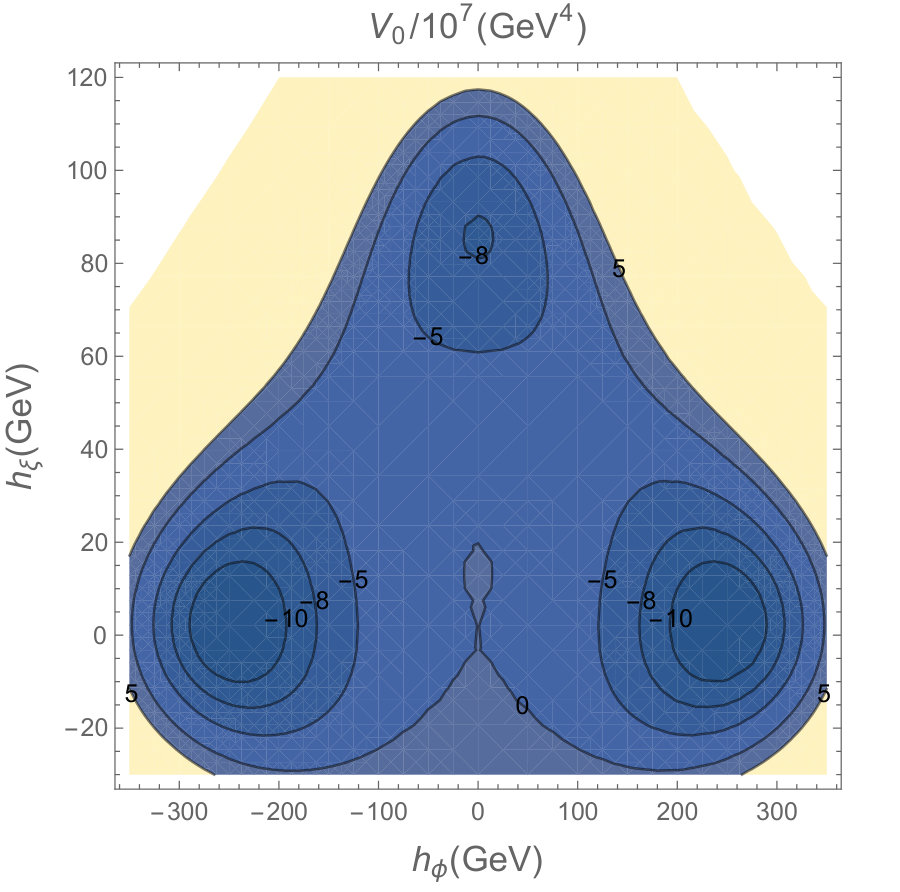 Figure 25
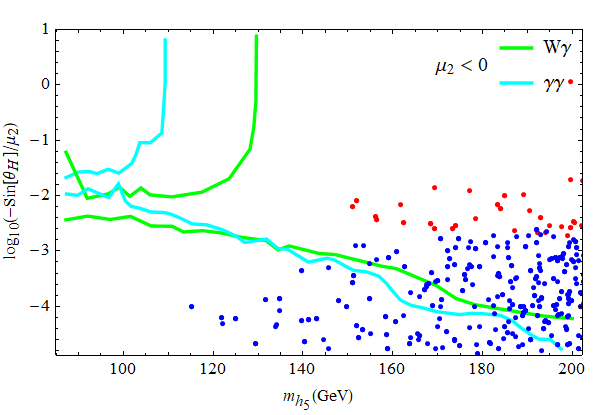 Figure 26
| Variable Parameters | Other Parameters | |
|---|---|---|
| GeV | GeV2 | |
| GeV | ||
| GMCalc | This work |
Peer Reviews
No public reviews on file for this paper yet. If you reviewed it on a platform where reviews are public (OpenReview, ICLR, NeurIPS, ICML), you can paste yours below so the community can read it here.
Videos
No videos yet. Explain this paper in a talk, walkthrough, or lecture? Add one.
Electroweak phase transition and Higgs phenomenology in the Georgi-Machacek model
Ruiyu Zhou 1
Wei Cheng 1
Xin Deng 1
Ligong Bian 1,2
Yongcheng Wu3
1 Department of Physics, Chongqing University, Chongqing 401331, China
2 Department of Physics, Chung-Ang University, Seoul 06974, Korea
3 Ottawa-Carleton Institute for Physics, Carleton University, 1125 Colonel By Drive, Ottawa, Ontario K1S 5B6, Canada
Abstract
In this work, we perform the electroweak phase transition study with the Georgi-Machacek model. We investigate both the one-step and two-step strong first order electroweak phase transition (SFOEWPT). The SFOEWPT viable parameter spaces could be tested by the future 14 TeV LHC, HL-LHC, and ILC. The LHC Higgs signal strength measurements severely bound the SFOEWPT valid parameter spaces, a tinny region of the mixing angle between the neutral fields of the isospin-doublet and isospin-triplet scalars around can allow the two-step SFOEWPT to occur. The triplet vacuum expectation value (VEV) is crucial for both SFOEWPT and related Higgs phenomenology. The two-step SFOEWPT can be distinguished from the one-step SFOEWPT through the triple Higgs coupling searches and the low mass doubly charged Higgs searches at colliders.
Contents
I Introduction
The baryon asymmetry of the Universe (BAU) as a fundamental problem of the nature has puzzled particle and cosmology physicists for several decades. To address the problem, three Sakharov conditions are necessary Sakharov:1967dj . Wherein, the CP violation and the departure from thermodynamic equilibrium all call for new physics beyond the SM. Among variant baryogenesis mechanisms, the electroweak baryogenesis mechanism (EWBG) inspires people interest recently due to the two key ingredients that are testable Morrissey:2012db : One crucial ingredient is the CP violation beyond the SM that bias the sphalerons to create baryon asymmetry, it could be probed indirectly with the high precision electric dipole moment experiments (EDMs). Another crucial ingredient is the strongly first order electroweak phase transition (SFOEWPT) that prevents the sphaleron process washing out the baryon asymmetry, which naturally provide an explanation of symmetry breaking as the Universe temperature cools down and could be tested at colliders Arkani-Hamed:2015vfh .
In this work, we will focus on the SFOEWPT study where the Higgs phenomenology are more involved. The generated gravitational wave signals from which with a typical peak frequency O(10*-3* - 10*-1*)Hz is detectable at the projected space-based interferometers, such as: eLISA Caprini:2015zlo , BBO, DECIGO (Ultimate-DECIGO) Kudoh:2005as and ALIA Gong:2014mca . After the gravitational waves signals from the merging black holes are detected by LIGO Abbott:2016blz , the gravitational waves from the SFOEWPT has inspired extensive studies in various BSM models with the SM Higgs sectors being extended. To achieve SFOEWPT, it is well known that the scalar sectors of the SM should be extended and can lead to testable signals at colliders Arkani-Hamed:2015vfh , including the colliders (such as the projected CEPC CEPCStudyGroup:2018ghi , ILC Baer:2013cma , and FCC-ee Gomez-Ceballos:2013zzn ) and high luminosity pp colliders (such as FCC-hh FCC ; FCChh ; CERN and SPPC CEPCStudyGroup:2018ghi ). On the other hand, in the present post-Higgs era, the ongoing collider search of heavy and charged Higgs beyond the SM also assumes the extension of the SM scalar sectors.
Among various extensions of the SM, the Georgi-Machacek model introduces a real and a complex isospin-triplet scalar to extend the SM Higgs sector Georgi:1985nv ; Chanowitz:1985ug , which introduce a new contribution of the electroweak symmetry breaking. The custodial symmetry there is preserved explicitly at tree level by assuming the same vacuum expectation value (VEV) to the neutral fields of the two isospin-triplet scalars Hartling:2014zca . The interaction strength of the SM vector bosons and the doubly- and singly-charged Higgs bosons of the quintuple is controlled by the vacuum expectation value (VEV) of the triplets, which can be probed through the charged Higgs searches Chiang:2012cn ; Chiang:2013rua ; Logan:2017jpr . A recent study on the heavy Higgs and charged Higgs in the “H5plane” benchmark scenario for the GM model (developed by the LHC Higgs Cross Section Working Group deFlorian:2016spz ) can be found in Ref. Logan:2017jpr . The triplet scalars can introduce additional vacuum structures (local minimum), which might make the symmetry breaking history occur through a two-step pattern since the can occur before the electroweak symmetry breaking. Therefore, we perform the study of phase transition patterns to find the relation between the SFOEWPT conditions and the Higgs phenomenology. As for the relation between the SFOEWPT and the charged Higgs bosons phenomenology, we focus on the low mass benchmark not yet covered by the LHC Logan:2018wtm . This constitutes our motivation to study electroweak phase transition within the GM model and makes our study significantly different from the previous one Chiang:2014hia . In this work we focus on the SFOEWPT study utilizing the custodial vacuum alignment scenario of the GM model. The CP violation of the GM model requires custodial symmetry breaking, we left that to the future work.
This work is organized as follows: We first review the GM model under study in Sec. II. The electroweak phase transition methodology being adopted is explored in Sec. III. The interplay between the SFOEWPT condition and the related Higgs phenomenology are constructed in Sec. IV. The Sec. V is attributed to the conclusions.
II The Georgi-Machacek Model
II.1 The Model Setup
In the Georgi-Machacek model, there are one isospin doublet scalar field with hypercharge , one complex isospin triplet scalar field with hypercharge , and one real triplet with hypercharge . The custodial symmetry is introduced at tree level by imposing a global SU(2)SU(2)R symmetry upon the scalar potential. In order to make this symmetry explicit, the doublet and the two triplets are written in the form of a bi-doublet and a bi-triplet under SU(2)SU(2)R:
[TABLE]
with
[TABLE]
where the phase convention for the scalar field components is: . and are transformed under as and with and being the generators.
The most general scalar potential invariant under is given by
[TABLE]
where summations over are understood, ’s and ’s are the (Pauli matrices) and matrix representations of the generators, respectively
[TABLE]
The P matrix, which is the similarity transformation relating the generators in the triplet and the adjoint representations, is given by
[TABLE]
The neutral components in Eq.(6) can be parameterized into real and imaginary parts according to
[TABLE]
where , and are the VEVs of , and , respectively. With only neutral components of this model, the potential reads:
[TABLE]
We can derived the EWSB vacuum from this conditions:
[TABLE]
where the fields other than , and take zero VEV’s. In this paper, the solution satisfying the relation is selected, by which the EWSB vacuum maintains the diagonal symmetry. Thus the parameter is established at the tree level. The W and Z boson masses from the EWSB give the constraint,
[TABLE]
When , with the help of Eq.(29) (under the relation ), we could rewrite , in terms of , and other parameters in the Higgs potential as:
[TABLE]
There are 13 scalar fields in this model. After diagonalizing the mass matrices, the fields can be rewritten as the physical scalars (quintuple, triplet and singlet respectively)
[TABLE]
and the goldstone bosons
[TABLE]
where and , and is the mixing angle between two singlets which is determined by the mass matrix of these scalars as will be shown below.
The 3 goldstone bosons eventually become the longitudinal components of the W and Z bosons, while, the remaining 10 physical fields can be organized into a quintuple , , , , , a triplet and two singlets and , where the former () is used to denote the SM-like Higgs boson. The triplet scalar is CP-odd, while others are CP-even. The masses of different multiplets can be written as
[TABLE]
The singlets masses of are the eigenvalues of mass matrix written in terms of gauge eigenstates:
[TABLE]
with
[TABLE]
where and . The mixing angle is determined by
[TABLE]
The five dimensionless couplings in the potential, , can be substituted by five physical parameters .
[TABLE]
II.2 The Theoretical Constraints
Three theoretical constraints are taken into account to constrain the dimensionless quartic couplings of the scalar potential at tree level: the unitarity of the perturbation theory, the stability of the electroweak vacuum and avoiding custodial symmetry-breaking vacuum. All these constraints have been investigated in detail in Ref. Hartling:2014zca , and will be automatically imposed on our parameter scan using GMCalc Hartling:2014xma .
II.2.1 Tree-level unitarity
The bound from perturbative unitarity is obtained by requiring that the zeroth partial wave amplitude, , for elastic scalar boson scatterings does not become too large to violate S-matrix unitarity. That means that the amplitude satisfy or . Then, the perturbative unitarity bound reads:
[TABLE]
II.2.2 Vacuum stability constraints
Following the approach of Ref. Arhrib:2011uy , we can parameterize the potential using the following definitions:
[TABLE]
The quartic terms in the potential are given in this parametrization by,
[TABLE]
The vacuum stability requires the scalar potential to be bounded from below and leads to following constraints on the quartic couplings Ref. Chiang:2018xpl .
[TABLE]
where
[TABLE]
II.2.3 Absence of deeper custodial symmetry-breaking minima
With the notation in Eq.(48), the full scalar potential can be written as:
[TABLE]
For a check that the scalar potential possesses no custodial symmetry-breaking minima that are deeper than the desired custodial symmetry-preserving minimum, we could parameterize these values as below:
[TABLE]
Our desired electroweak-breaking and custodial -preserving vacuum corresponds to , thus and . The vacuum is also acceptable; it corresponds to a negative . Other values of correspond to vacua that spontaneously break custodial .
III Electroweak Phase transition methodology
With the temperature cooling down, the Universe can evolve from the symmetric phase to the symmetry broken phase. The critical behavior can be studied with the finite temperature effective potential with particle physics models, through which one can obtain the critical classics field value and temperature being and . Roughly speaking, SFOEWPT can be obtained when , with which, one may have the electroweak sphaleron process quenched inside the bubble after bubble nucleation, and therefore prevent the washout of the baryon asymmetry generated within the EWBG mechanism Morrissey:2012db . We first analyse the vacuum structure of the potential at zero temperature, then demonstrate the phase transition computation method adopted in this work.
III.1 Vacuum structure analysis
Assume , the vacuum structure of the zero temperature potential could be obtained through the following minimization conditions
[TABLE]
In the classical field spaces of , there are three minima: (1) The A point being the original point, which preserves the EW and symmetries; (2) The B point being the electroweak vacuum; (3) and the C point where one have the symmetry breaking of the .
[TABLE]
Here, we note that the parameter is crucial for the existence of the C point. As shown in Fig. 1, as the temperature of the Universe cools down, the symmetry breaking process may occurs along the direction of by one-step or by two-steps. The two correspond to one-step or two step phase transitions depending on the vacuum structure and potential height as will be explored in the following paragraph.
The scalar potential of the EW vacuum should be the lowest one and the scalar potential of the original point is the maximal one of the three. The three scalar potentials are,
[TABLE]
The two step phase transition might happen only when and (with ). Meanwhile, the one-step phase transition would take place when () and . The potential differences are given as,
[TABLE]
Depending on the zero temperature vacuum structure and potential height, one may have one-step or two-step phase transition. Two-step phase transition may occur when a local minimum exists as shown in the right panel of the Fig. 2, and for the left panel plot case there could be a one-step phase transition.
III.2 Phase Transition patterns
Utilizing the gauge invariant approach Patel:2011th ; Chao:2017vrq ; Bian:2018mkl ; Bian:2018bxr , the finite temperature potential adopted for the study of phase transition behavior in the GM model is given by,
[TABLE]
where the zero temperature potential is given by the Eq. (28) and the finite temperature corrections are calculated as,
[TABLE]
Here, the are gauge couplings and top Yukawa coupling respectively. We note that, with the high temperature approximation, the tadpole term involving that would make the symmetry break at high temperature does not appear as in the singlet model Profumo:2014opa ; Espinosa:2011ax due to the global symmetry of being imposed to the tree level potential. After substituting in of Eq. (62), we obtain the finite temperature potential used for the phase transition study. Due to the rich vacuum structures of the potential at finite temperature, there can be one-step or two-step phase transitions depending on whether the symmetry breaking of occurs earlier than the EW symmetry breaking. Ref. Profumo:2014opa indicates that realization of the one step phase transition requires
[TABLE]
where at finite temperature, the correspondence between the and for both one-step and two-step SFOEWPT are given in Fig. 12. The here are given by the minimization of the tree level potential at the EW minimum, see Eq. (32). Through which, the above conditions implicitly relay on the cubic Higgs coupling . For two step pattern phase transition, the T-dependence location of the minima can be described by the curves of Espinosa:2011ax ,
[TABLE]
Following Ref. Espinosa:2011ax , to make the EW broken minimum (B point) the deepest one of the three vacua (A,B, and C point) for , one needs the condition of . In turn, one has
[TABLE]
where the B and C in the parentheses stand for the classical value of the fields () at the EW breaking vacuum (around B point of Fig. 1) and vacuum ( around C points of Fig. 1). To ensure the B point being the global minimum at zero temperature, one needs the additional vacuum structure conditions being analyzed in Sec. III.1. The parameter is useful for setting the tree level potential barrier for the phase transition, with the the term of in Eq. (28). The parameter, as studied previously in Sec. III.1, is another key parameter to ensure the possibility to have two-step phase transition with the existence of the C point of Eq. (56). Our study will demonstrate that a typical region of is necessary for a two-step SFOEWPT to occur.
Usually, the one-step SFOEWPT requires relatively large cubic Higgs coupling, which may suffer from perturbativity problem of the model at high scale Cheng:2018ajh ; Cheng:2018axr . The mixing between the SM Higgs and the additional Higgs can be easily tested by current and the future collider searches Cheng:2018axr ; Chen:2017qcz ; Arkani-Hamed:2015vfh ; Curtin:2014jma , and therefore test the possibility to obtain the one-step SFOEWPT. Due to the typical vacuum structure, the two-step SFOEWPT can occur with much lower cubic Higgs coupling, see Ref. Jiang:2015cwa ; Grzadkowski:2018nbc for the complex singlet model scenario which have a similar vacuum structure with the custodial symmetry conserving GM model. For completeness, we study both one-step and two-step SFOEWPT in this work. The SFOEWPT condition being is adopted in this work with the and evaluated as follows.
III.2.1 One-step phase transition
When the temperature of the Universe drops to the critical temperature with the Universe expands, two degenerate vacua (A and B points) occur with a potential barrier structure, which can be expressed as:
[TABLE]
through which, critical temperature and critical field value can be obtained. Here, we note that, to ensure two degenerate vacua occur the following constrains also should be satisfied: , where
[TABLE]
The locates around at finite temperature .
III.2.2 Two-step phase transition
When the temperature of the Universe drops to the critical temperature with the Universe expands, two degenerate vacua (B and C points) occur with a potential barrier structure, which can be expressed as:
[TABLE]
Through which, the critical temperature and critical field value can be obtained. As the one-step case, to ensure two degenerate vacua occur the following condition needs to be fulfilled: , with
[TABLE]
Here, the locates around , and the locates around given in Eq. (56) at finite temperature .
IV Phase transition patterns and the Higgs phenomenological prospects
We first study the general feature of the SFOEWPT in the GW model, which will reveal the relation between the triplet VEV and the SFOEWPT condition after considering the current and the projected experimental constraints: a lower magnitude of the triplet VEV is favored by both one-step and two-step SFOEWPT. The low mass benchmark is subsequently studied where small is accompanied with GeV to be covered by future collider searches.
IV.1 The phase transition features in the GM model
To consider theoretical and experimental constraints, we employ the GMCalc Hartling:2014xma to generate parameters of the GM model. Within these parameter spaces, we perform phase transition analysis with the approach explored in Sec. III.
We first investigate how does the SFOEWPT relay on the cubic scalar couplings and the quartic scalar couplings. Fig. 3 depicts that one-step SFOEWPT usually requires a larger cubic scalar coupling of , and the two-step SFOEWPT can occur with a relatively lower magnitude of . This can trace back to the analysis of the phase transition patterns conditions in the Sec. III.2. One can find that the one-step SFOEWPT can occur with both negative and positive , and the two-step SFOEWPT can only occur in the parameter spaces with a positive . The two-step SFOEWPT can occur with much lower magnitude of the cubic coupling in comparison with the one-step SFOEWPT, that reconfirms the vacuum structure analysis in Sec. III.
To reveal the relation between the phase transition and the mixing among the (the mixing angle ), we plot the SFOEWPT allowed points in - plane. In order to make clear how does the phase transition relay on the location of the point for one-step and two-step phase transition, we also show the SFOEWPT valid points in - plane. The top-left plot of the Fig. 4 indicates that for a larger magnitude of a larger mixing angle of is necessary for the one-step SFOEWPT, mostly . Meanwhile, the two step SFOEWPT can occur with a much higher probability around (both and are allowed) with small mixing between the light and heavy Higgs or and , and a smaller is accompanied with a larger . The top-right panel of Fig. 4 reflects the same information as the middle panel of Fig. 3 because the is characterized by . The bottom-left panel indicates that the two-step SFOEWPT can occur with a larger in the parameter regions with a larger , which means a larger . In addition to the negative value of , positive angel can also lead to two-step SFOEWPT. The bottom-right plot demonstrates that the occurrence possibility of the one-step SFOEWPT decreases as (or ) increases, while the two-step SFOEWPT almost occur with the same probability with relatively lower magnitude of .
To make a better understanding how does the phase transition relay on the VEV of the triplet, and furthermore the phase transition patterns, we perform the survey of the relation between the SFOEWPT condition and in Fig. 5. The left plot shows that SFOEWPT can occur in the parameter regions of GeV. One can read the strength of the phase transition in the plot, which is found to be almost for one and two step cases. It seems that the possibility to reach one-step SFOEWPT is much higher than the two-step one, and there is a tendency that increases with for the two-step case. The Ref. Chiang:2015amq ; Li:2017daq ; Chiang:2018cgb performed the study of the constraints on the - parameter spaces of the GM model. Their results mostly bound the parameter spaces to a negative due to the LHC Higgs signal strength constraints. The projected 14 TeV LHC with 300 fb*-1*, HL-LHC with 3000 fb*-1*, and ILC at 250 and 500 GeV can also probe the parameter spaces. The right plot of fig. 5 demonstrates that the one-step SFOEWPT can occur for an increasing as increases. The 13 TeV LHC Higgs signal strength fitted by Ref. Chiang:2018cgb has been adopted here to restrict the GM model parameter, which set severe bounds on the parameter spaces of the two-step SFOEWPT: with GeV, which corresponds to .
To understand the relation between the SFOEWPT condition and the charged Higgs mass , we plot Fig. 6. The left panel of Fig.6 shows the SFOEWPT valid point in the parameter spaces of . The two-step SFOEWPT favors 200 GeV600 GeV together with 100 GeV GeV. The right panel of Fig.6 indicates one can have only two-step SFOEWPT for , one-step SFOEWPT requires slightly larger for smaller or , for the two-step case one has relatively smaller and accompany with lower value of . We impose collider search bounds in the plane of . Curves with different colors are the constraints from current experiment searches for heavy scalars, where the green, cyan and black lines are the upper bounds from channel Aaboud:2018ohp ; Sirunyan:2017sbn ; CMS:2018ysc , the yellow and orange lines are the bounds from channel Aaboud:2017gsl ; Aaboud:2017fgj , the pink and brown lines are the bounds from channel Aaboud:2017rel ; Aaboud:2017itg . The purple line which is the limit from same-sign searches of the doubly charged scalar is the strongest constraints in this parameter space. The same-sign channel ruled out the SFOEWPT validated parameter spaces (including both one-step and two-step) with relatively large increasing with . This motivates the study of the two-step SFOEWPT in the parameter spaces with low magnitudes of and .
We summarize the relation between the SFOEWPT and Higgs phenomenology explored in this section as follows:
- •
On the trilinear scalar couplings We first review the information we got on the relation between the SFOEWPT condition and the trilinear scalar couplings, , that constitute a main contribution to the triple Higgs couplings, as shown in Eq. (71) and will be discussed later. In comparison with the two-step SFOEWPT, relatively higher magnitude of is required for one-step SFOEWPT. Lower value of (close to 0) is required to realize the two-step SFOEWPT.
- •
The SFOEWPT valid parameter spaces confronting with the experimental constraints The right panel of the Fig. 5 indicates that the 13 TeV LHC signal strength measurements would restrict the possibility to obtain two-step SFOEWPT in the relatively narrow region . The projected electron-positron colliders would constrain the magnitude of to even lower value, and therefore narrow down the possibility to obtain the SFOEWPT through one-step and two-step patterns. The right panel of Fig. 6 shows that the larger would be excluded by the same-sign WW boson channel search at 13 TeV LHC, which means that the possibility to reach SFOEWPT would be bounded to the parameter spaces with small and small .
IV.2 On triple Higgs couplings and the SFOEWPT condition
To reveal the relation between the SFOEWPT and the triple Higgs coupling to be searched at and colliders, we plot Fig. 7. The top-left and top-middle plots of the Fig. 7 illustrate that the magnitude of the triple Higgs couplings( and ) grows with the increase of the strength of phase transitions for both one-step and two-step SFOEWPTs, which means larger deviation from the SM case can lead to a larger . The deviation of triple Higgs couplings can be probed through the Higgs associated production process at lepton colliders and Higgs pair search at hadron colliders (LHC, FCC-hh, and SPPC), we refer to Ref. Li:2017daq and Ref. Chang:2017niy for recent studies. The top-right panel depicts that, the two-step phase transition can occur in the parameter spaces with a smaller and a larger . In this situation, the constraint from Higgs pair productions is usually more powerful, see Ref. Chang:2017niy for a recent study. The bottom-left plot shows that for the mixing angel of , the two-step phase transition can occur with a largest value of 600 GeV. For the parameter spaces with a positive value of , the phase transition can be two-step SFOEWPT with a relatively lower mass of the CP-even Higgs (200 GeV 600 GeV). Furthermore, the bottom-middle (bottom-right) plot shows that the triple Higgs coupling () increases (decreases) with the decrease of . One can probe the two-step SFOEWPT valid parameter spaces with the Higgs pair searches at LHC, Fcc-hh and SPPC, we left the detailed studies to the future study.
The interaction strength between the Higgs and SM fermions and gauge bosons are:
[TABLE]
In the scenario with small and small , the close to the SM case, are suppressed. For small mixing angle bounded by LHC, HL-LHC, and ILC, the triple Higgs coupling given in Eq. (71) recast as
[TABLE]
The first formula implicit that a large , corresponding to most parameter spaces of the one-step SFOEWPT, can lead to a large deviation of the from the . Thus the probe of the triple Higgs coupling of through the colliders should be able to test the parameter regions where the one-step SFOEWPT can be realized. For small , one has and . That means that the Higgs pair searches of the utilizing to test the two-step SFOEWPT parameter regions (at LHC, FCC-hh, and SPPC) for is characterized by the parameter .
IV.3 The “H5plane”
At last, we comment on the phase transition behaviors within the “H5plane” benchmarks developed by the LHC Higgs Cross Section Working Group deFlorian:2016spz . The Ref. Logan:2017jpr studied the “H5plane” benchmark scenarios, where the regions with smaller GeV and (see Fig. 5 and Fig.6) that are crucial for the two-step SFOEWPT are not covered. That results in losing of the possibility of the two-step SFOEWPT, see the Fig. 8. In the following section, we would go beyond this benchmark and study the phase transition in the scenario including low mass GeV case.
IV.4 Low mass charged Higgs benchmarks
As illustrated in the previous section, the current same-sign channel searches of doubly charged Higgs at the LHC preclude the possibility to obtain SFOEWPT in the parameter spaces with large along with the increase of . Therefore, we consider the electroweak phase transition in one particular benchmark scenario, the low mass fermiophobic charged scalar considered in Ref. Logan:2018wtm . In this case, the quintuple is the lightest scalar multiplet, the usual searching channels involving gauge bosons are suppressed by which is chosen to be much less than 1, as well as by the phase space where the quintuple is light and below the diboson threshold. This leaves only four physical input parameters that are relevant in this benchmark, which can be chosen as follows: two parameters and that control the mass spectrum of the heavy Higgs bosons, and two parameters and that control the couplings. In particular, we adapt the definition of the benchmark from Ref. Logan:2018wtm with small modifications as listed in Tab. 1. The parameters are chosen to accommodate low as indicated in Ref. Logan:2018wtm .
In Fig. 9, we show SFOEWPT viable points in the parameter space of and . The blue and red points satisfy the two-step and one-step SFOEWPT conditions respectively. Several current experimental constraints are also imposed in this plane represented by the lines with different colors. By construction, the low mass benchmark can evade most searching channels involving gauge bosons ( channel (green, black and cyan lines) Aaboud:2018ohp ; Sirunyan:2017sbn ; CMS:2018ysc , channel (yellow and orange lines) Aaboud:2017gsl ; Aaboud:2017fgj and channel (pink and brown lines) Aaboud:2017rel ; Aaboud:2017itg ). The same-sign search from doubly charged scalar (purple line) Sirunyan:2017ret has the sensitivity down to about 0.17 for at GeV. In this case, the same-sign search is still the strong constraint and can explore large viable parameter spaces of one-step SFOEWPT for GeV. The figure also indicates that extending the search of same-sign down to lower mass region could explore most one-step SFOEWPT parameter space. While two-step viable points can extend to lower region, which is difficult for channels that are suppressed by .
For this low and low mass region, as indicated in Ref. Logan:2018wtm , the most sensitive channels are those loop-induced channels ( and etc). The dominant contributions to these channels come from the triple scalar couplings which is proportional to and is not suppressed by . In the Fig. 10 we show the SFOEWPT valid points including one-step and two-step in the - plane, the SFOEWPT mostly occurs for a negative . We can see that lower value for is accompanied by larger range of for one-step SFOEWPT valid point, which means the triple scalar coupling is generally large in this region and leads to large partial width of these loop-induced channels.
In the low mass region, when channels are suppressed by the phase space as well as by , the loop-induced channels will dominate. We impose the constraints from channel from Ref. Logan:2018wtm as well as the diphoton search from 8 TeV ATLAS Aad:2014ioa in this low mass region, the results are shown in Fig. 11 where the red and blue points present the one- and two-step SFOEWPT viable points as before. The green line and cyan line are the constraints from and searches respectively. We find that the loop induced decay channel has the sensitivity for the two-step viable parameter space in low mass region. Further improvement (such as higher luminosity, extending to lower mass region for channel) in these searches will explore most of the two-step SFOEWPT parameter space.
V Conclusions
In this work, we study the EWPT in the frame work of GM model. The EWPT can be SFOEWPT through one-step or two-step as the Universe cools down. In comparison with the one-step SFOEWPT, the two-step SFOEWPT can occur with a relatively smaller trilinear couplings between the Higgs doublet and the triplet scalars. The contribution of the triplets to the electroweak symmetry breaking is crucial for the SFOEWPT and the Higgs phenomenology, which is characterized by the parameter or . The bounds from LHC, HL-LHC and the projected ILC constraints in the - plane can lower the possibility to realize SFOEWPT, especially the two-step SFOEWPT. The 13 TeV LHC Higgs signal strength measurements limit the two-step SFOEWPT valid parameter spaces to a rather small region with . The current same-sign WW search performed at the 13 TeV LHC ruled out a lot parameter spaces to realize SFOEWPT including both one-step and two-step.
The Higgs pairs search would be able to search the two-step SFOEWPT when one have a nonnegative mixing angle accompanied with a lower mass of . For much smaller triplet VEV (with the ) and lower quintuple mass, the phase transition could be two-step SFOEWPT rather than one-step. The , and searches for the GeV parameter regions can probe the two-step SFOEWPT within the GM model in this low mass and small region.
At last, we note that the custodial symmetry in the Higgs potential prohibits the CP violation in the GM model. To address the BAU with the EWBG mechanism in the GM model, one may need to introduce a tinny custodial symmetry breaking without violate the parameter constraints to include CP violation phases or introduce additional CP violations through high dimensional operators.
Acknowledgement
We thank Zhi-Long Han and Bin Li for helpful discussions on the collider bounds on the GM model. We are grateful to Chengwei Chiang and Kei YagYu for helpful communications on the custodial symmetry of the GM model. The work of LGB is Supported by the National Natural Science Foundation of China (under grant No.11605016 and No.11647307), Basic Science Research Program through the National Research Foundation of Korea (NRF) funded by the Ministry of Education, Science and Technology (NRF-2016R1A2B4008759), and Korea Research Fellowship Program through the National Research Foundation of Korea (NRF) funded by the Ministry of Science and ICT (2017H1D3A1A01014046). The work of Y.C.W. is partially supported by the Natural Sciences and Engineering Research Council of Canada.
Appendix A GMcalc convention vs our convention
For the reader’s convenience, we give the comparison of the convention adopted by GMCalc and this work in Table. 2.
Appendix B The triplet Higgs couplings
The trilinear Higgs couplings can be read:
[TABLE]
Appendix C On custodial symmetry
In the previous sections, we focus on the custodial symmetry preserving case. Previous studies of Ref. Blasi:2017xmc ; Keeshan:2018ypw shows that the custodial symmetry that are preserved at tree level can be explicitly break by loop effects of the hyper- charge gauge interaction, the custodial symmetry breaking could be probed at future colliders. At zero temperature, the parameter is described by,
[TABLE]
Thought the custodial symmetry study is beyond this work, we briefly list useful formula for the finite temperature study. At finite temperature, with the parameter can be parametrized as,
[TABLE]
In the first stage phase transition of the two-step phase transition, one have null with the . While, for the second stage phase transition of the two-step phase transition, one have,
[TABLE]
where
[TABLE]
and
[TABLE]
Suppose the condition of maintains as studied in this work, the following relations maintains,
[TABLE]
with being given in Eq. III.2. The correspondence of at and is given in the Fig. 12, which indicates the match situation of the two. After the temperature drops below , the would evolve to be the fininally (i.e., ) and one obtain the EW symmetry break vacuum with symmetry.
The reference list from the paper itself. Each links out to its DOI / PubMed record.
- 1[1] A. D. Sakharov, Pisma Zh. Eksp. Teor. Fiz. 5 , 32 (1967) [JETP Lett. 5 , 24 (1967)] [Sov. Phys. Usp. 34 , no. 5, 392 (1991)] [Usp. Fiz. Nauk 161 , no. 5, 61 (1991)].
- 2[2] D. E. Morrissey and M. J. Ramsey-Musolf, New J. Phys. 14 , 125003 (2012).
- 3[3] N. Arkani-Hamed, T. Han, M. Mangano and L. T. Wang, Phys. Rept. 652 , 1 (2016).
- 4[4] C. Caprini et al. , JCAP 1604 , no. 04, 001 (2016)
- 5[5] H. Kudoh, A. Taruya, T. Hiramatsu and Y. Himemoto, Phys. Rev. D 73 , 064006 (2006)
- 6[6] X. Gong et al. , J. Phys. Conf. Ser. 610 , no. 1, 012011 (2015)
- 7[7] B. P. Abbott et al. [LIGO Scientific and Virgo Collaborations], Phys. Rev. Lett. 116 , no. 6, 061102 (2016)
- 8[8] [CEPC Study Group], ar Xiv:1811.10545 [hep-ex]. F. An et al. , ar Xiv:1810.09037 [hep-ex]. IHEP-CEPC-DR-2015-01,IHEP-EP-2015-01,IHEP-TH-2015-01.