Network Utility Maximization under Maximum Delay Constraints and Throughput Requirements
Qingyu Liu, Haibo Zeng, Minghua Chen

TL;DR
This paper addresses the complex problem of optimizing network utility with maximum delay and throughput constraints, introducing a polynomial-time approximation algorithm that balances utility maximization with constraint violations, demonstrated through extensive simulations.
Contribution
It presents PASS, a novel polynomial-time approximation algorithm for network utility maximization under delay and throughput constraints, with theoretical guarantees and practical effectiveness.
Findings
PASS achieves up to 100% utility improvement over existing methods.
PASS relaxes delay and throughput constraints within acceptable ratios for practical use.
Extensive simulations validate PASS's effectiveness in supporting video conferencing traffic.
Abstract
We consider the problem of maximizing aggregate user utilities over a multi-hop network, subject to link capacity constraints, maximum end-to-end delay constraints, and user throughput requirements. A user's utility is a concave function of the achieved throughput or the experienced maximum delay. The problem is important for supporting real-time multimedia traffic, and is uniquely challenging due to the need of simultaneously considering maximum delay constraints and throughput requirements. We first show that it is NP-complete either (i) to construct a feasible solution strictly meeting all constraints, or (ii) to obtain an optimal solution after we relax maximum delay constraints or throughput requirements up to constant ratios. We then develop a polynomial-time approximation algorithm named PASS. The design of PASS leverages a novel understanding between non-convex…
Click any figure to enlarge with its caption.
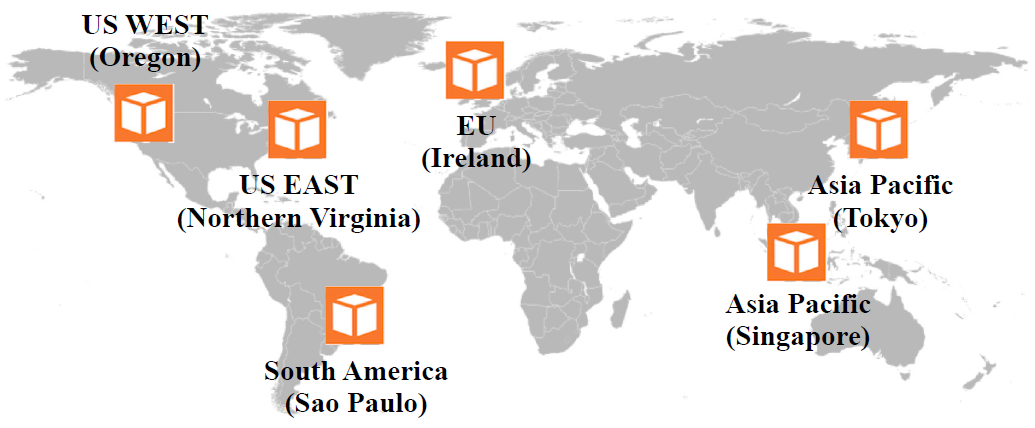 Figure 1
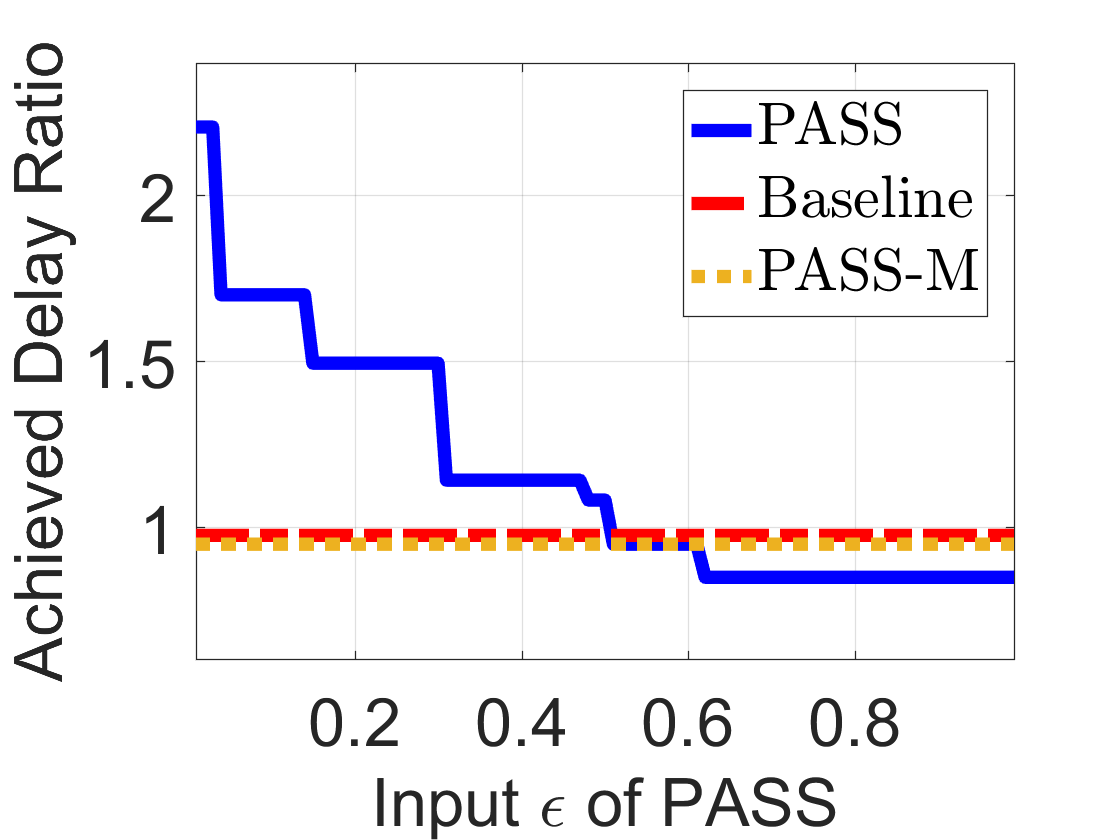 Figure 2
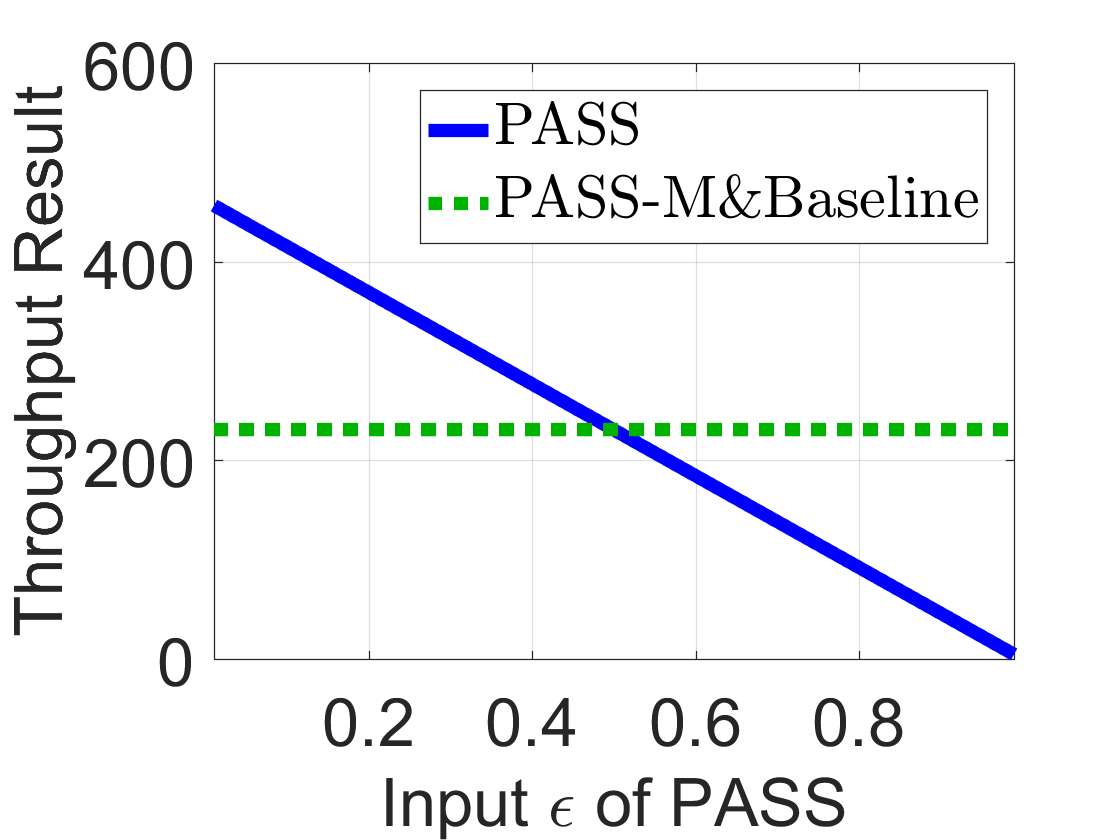 Figure 3
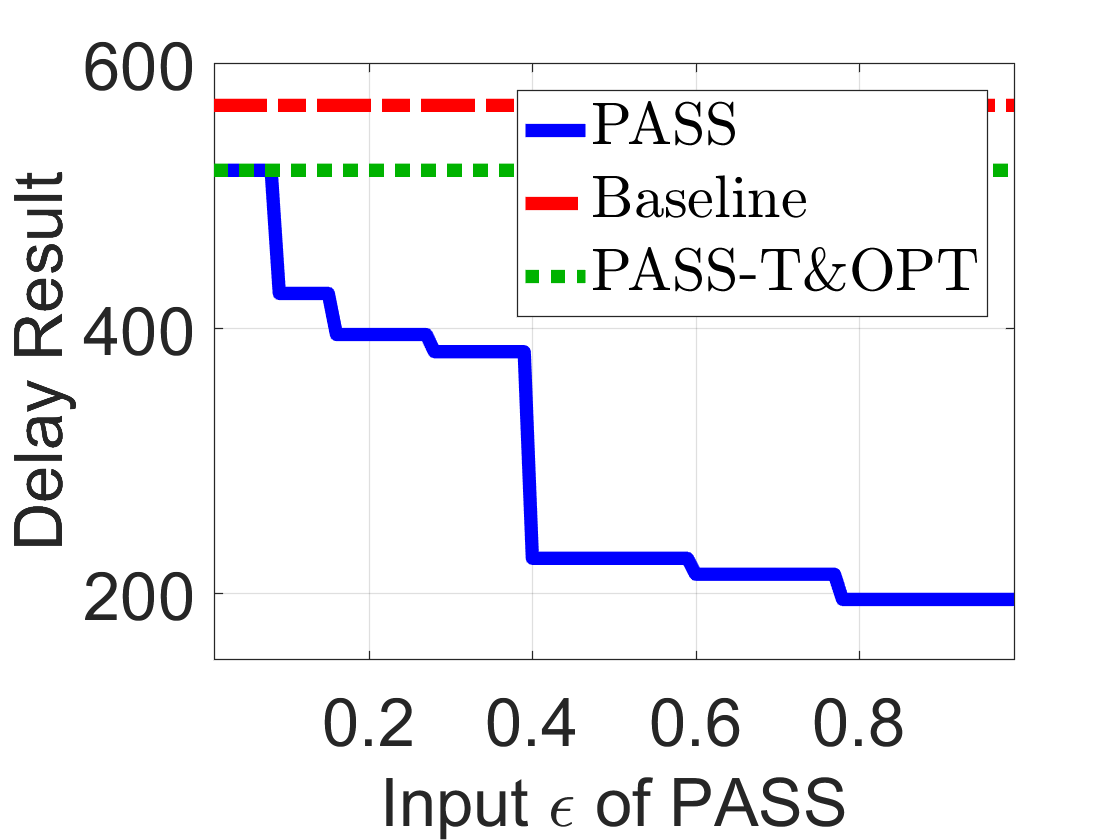 Figure 4
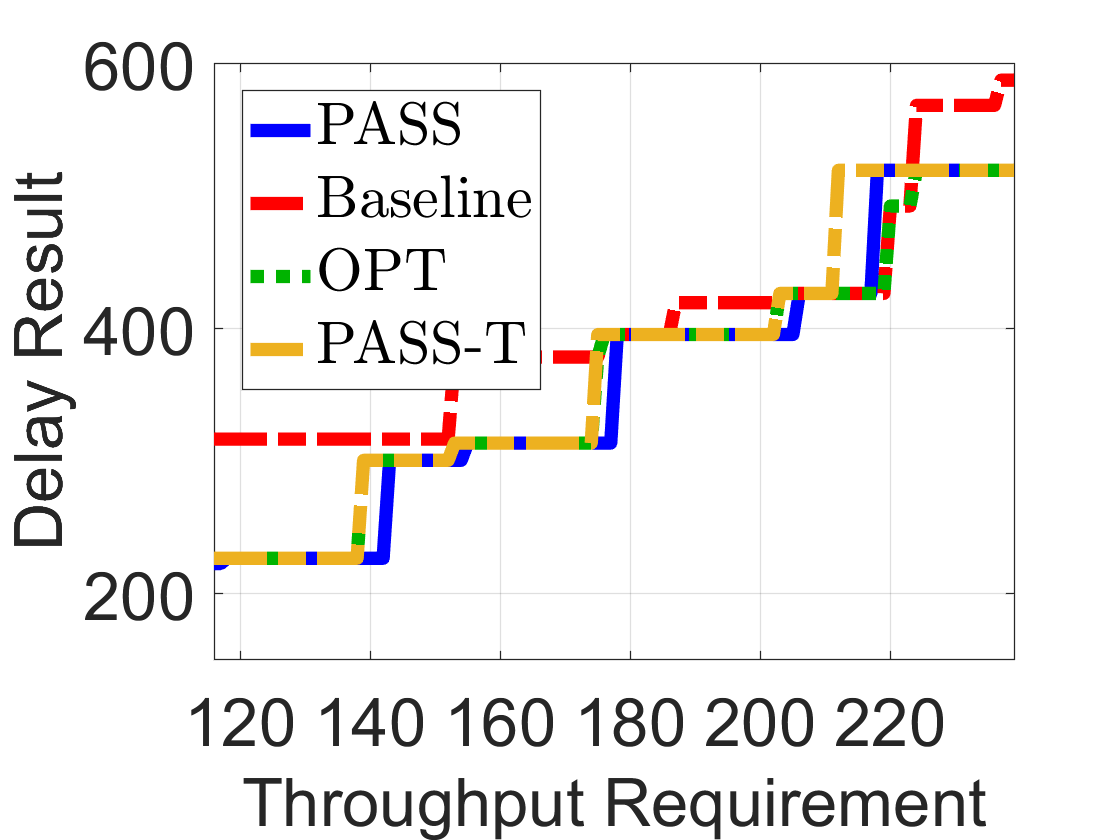 Figure 5
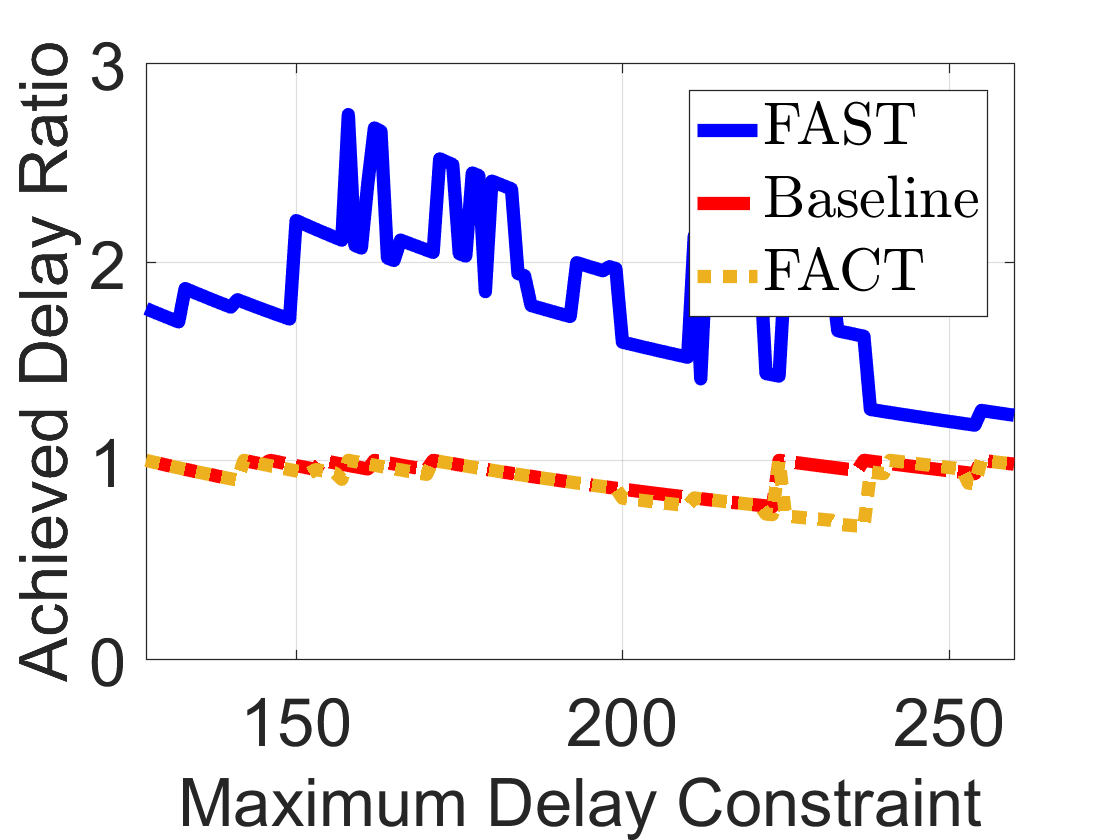 Figure 6
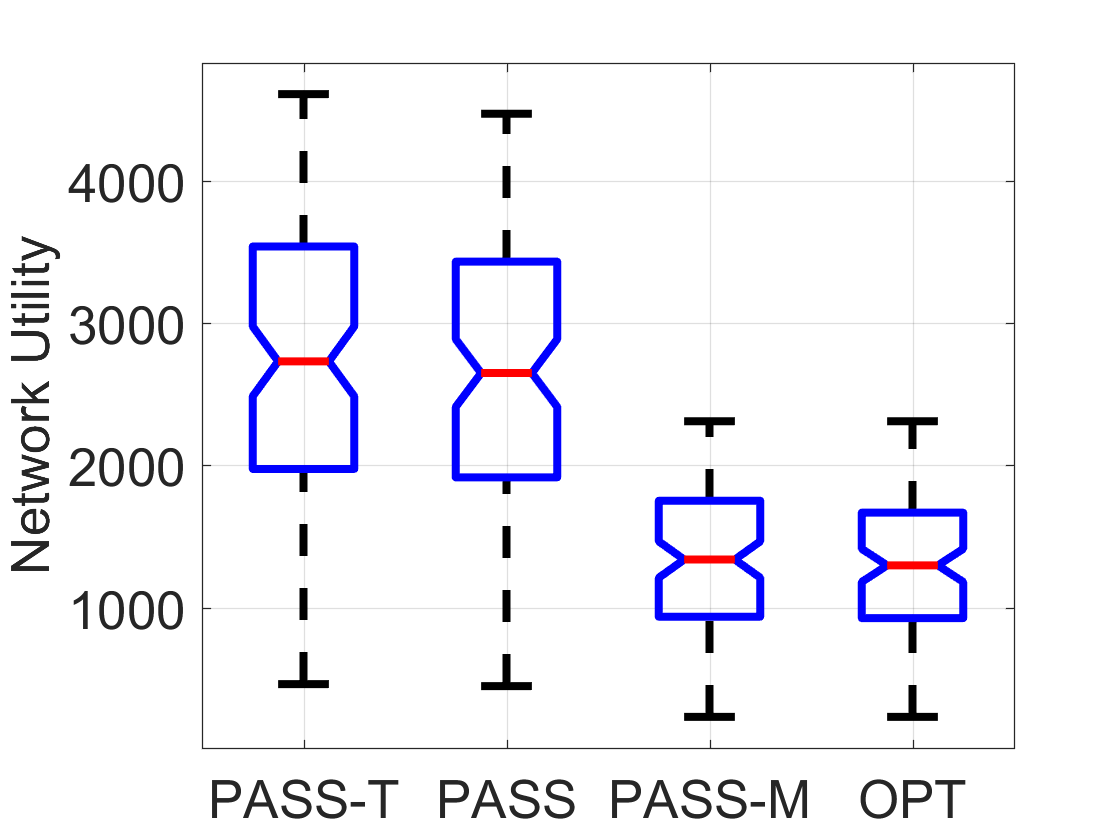 Figure 7
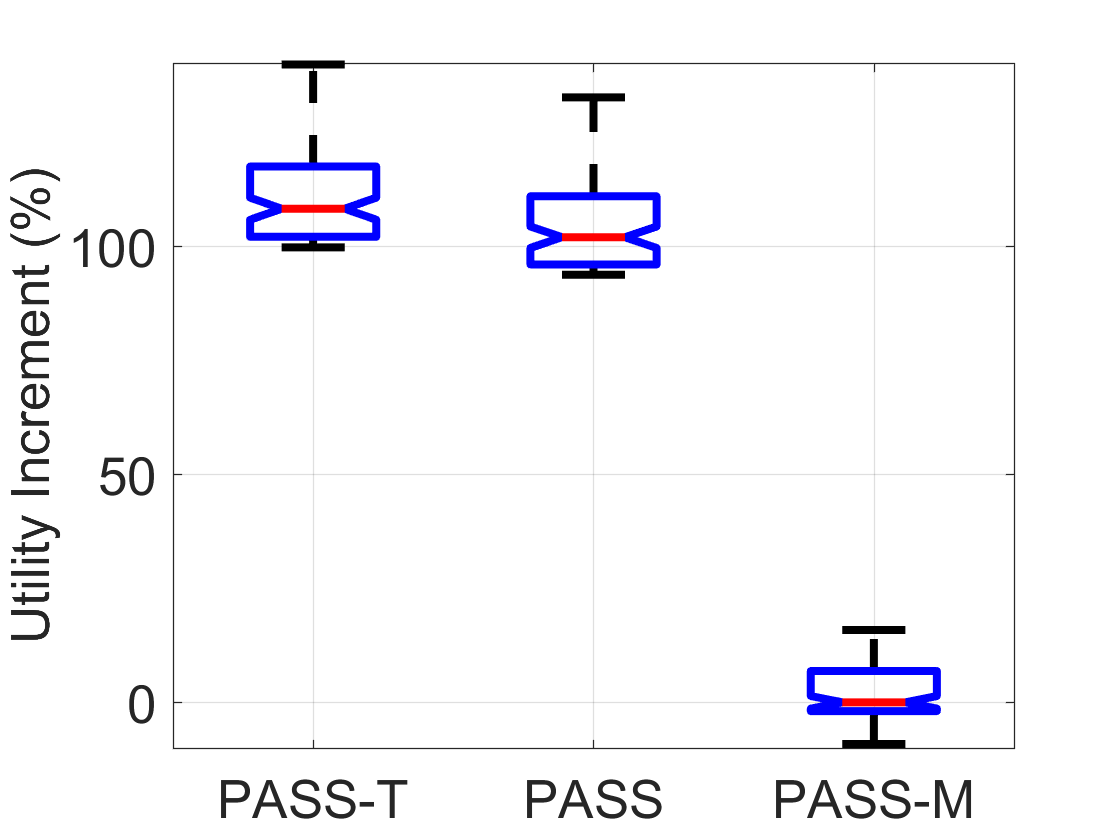 Figure 8
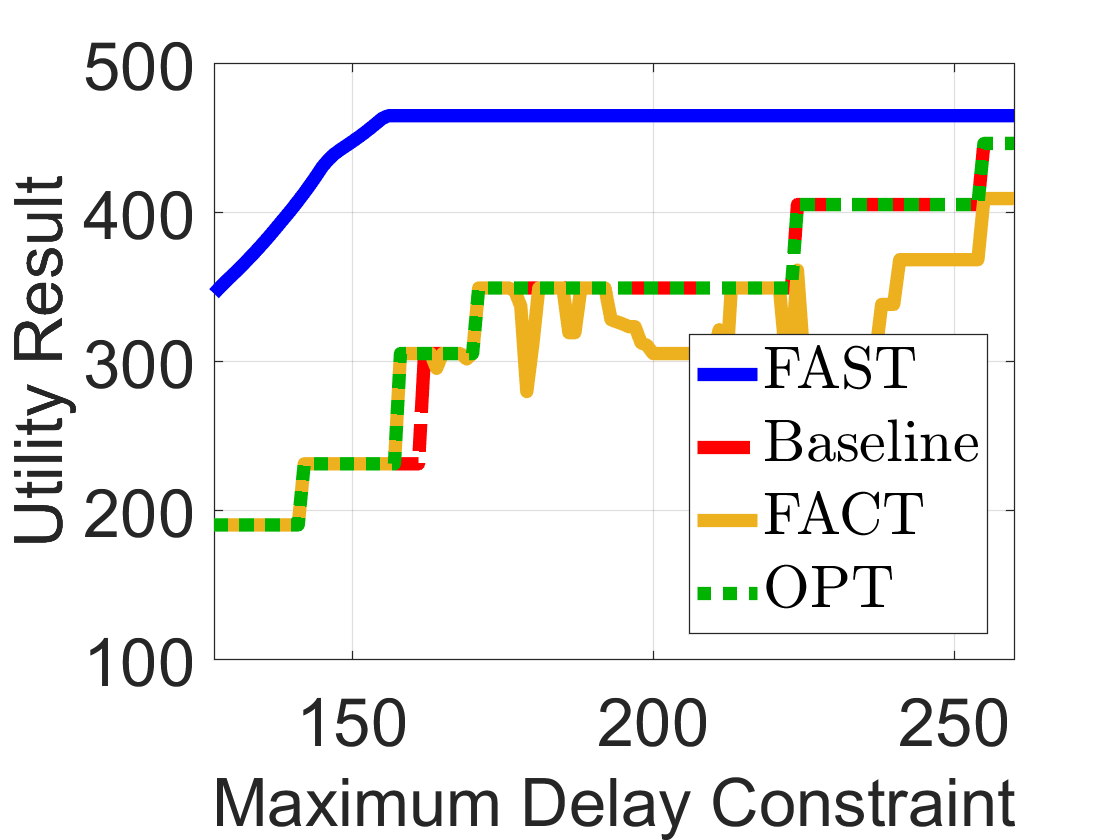 Figure 9
| Maximization Objective | Constraints | Networking Setting | ||||||||||
|
|
|
|
Multiple-Unicast | ||||||||
| Many, e.g., (Kelly et al., 1998; Low and Lapsley, 1999; Wang et al., 2003; Palomar and Chiang, 2006) | ✓ | ✗ | ✓ | ✗ | ✓ | |||||||
| (Misra et al., 2009; Zhang et al., 2010; Correa et al., 2004, 2007; Liu et al., 2018) | ✗ | ✓∗ | ✓ | ✗ | ✗ | |||||||
| (Cao et al., 2017; Yu et al., 2018) | ✓∗∗ | ✗ | ✗ | ✓ | ✓ | |||||||
| Out Work | ✓ | ✓ | ✓ | ✓ | ✓ | |||||||
| OR | VA | IR | TO | SI | SP | |
| OR | N/A | (41,82) | (86,86) | (68,138) | (117,74) | (104,67) |
| VA | - | N/A | (54,72) | (101,41) | (127,52) | (82,70) |
| IR | - | - | N/A | (138,56) | (117,44) | (120,61) |
| TO | - | - | - | N/A | (45,166) | (151,41) |
| SI | - | - | - | - | N/A | (182,33) |
| SP | - | - | - | - | - | N/A |
Peer Reviews
No public reviews on file for this paper yet. If you reviewed it on a platform where reviews are public (OpenReview, ICLR, NeurIPS, ICML), you can paste yours below so the community can read it here.
Videos
No videos yet. Explain this paper in a talk, walkthrough, or lecture? Add one.
Taxonomy
TopicsNetwork Traffic and Congestion Control · Software-Defined Networks and 5G · Caching and Content Delivery
Network Utility Maximization under Maximum Delay
Constraints and Throughput Requirements
Qingyu Liu, Haibo Zeng
Electrical and Computer EngineeringVirginia Tech
and
Minghua Chen
Information EngineeringThe Chinese University of Hong Kong
(2018)
Abstract.
We consider the problem of maximizing aggregate user utilities over a multi-hop network, subject to link capacity constraints, maximum end-to-end delay constraints, and user throughput requirements. A user’s utility is a concave function of the achieved throughput or the experienced maximum delay. The problem is important for supporting real-time multimedia traffic, and is uniquely challenging due to the need of simultaneously considering maximum delay constraints and throughput requirements. We first show that it is NP-complete either (i) to construct a feasible solution strictly meeting all constraints, or (ii) to obtain an optimal solution after we relax maximum delay constraints or throughput requirements up to constant ratios. We then develop a polynomial-time approximation algorithm named PASS. The design of PASS leverages a novel understanding between non-convex maximum-delay-aware problems and their convex average-delay-aware counterparts, which can be of independent interest and suggest a new avenue for solving maximum-delay-aware network optimization problems. Under realistic conditions, PASS achieves constant or problem-dependent approximation ratios, at the cost of violating maximum delay constraints or throughput requirements by up to constant or problem-dependent ratios. PASS is practically useful since the conditions for PASS are satisfied in many popular application scenarios. We empirically evaluate PASS using extensive simulations of supporting video-conferencing traffic across Amazon EC2 datacenters. Compared to existing algorithms and a conceivable baseline, PASS obtains up to improvement of utilities, by meeting the throughput requirements but relaxing the maximum delay constraints that are acceptable for practical video conferencing applications.
Network utility maximization, multiple-unicast network flow, delay-aware network optimization
††copyright: rightsretained††ccs: Mathematics of computing Network flows††ccs: Networks Network resources allocation††journalyear: 2018††copyright: acmcopyright††conference: The Twentieth International Symposium on Mobile Ad Hoc Networking and Computing; July 2–5, 2019; Catania, Italy††booktitle: Submission to MobiHoc ’19, July 2–5, 2019, Catania, Italy††price: 15.00††doi: x††isbn: x
1. Introduction
We consider a multiple-unicast communication scenario where each unicast source streams a network flow to its destination over a multi-hop network, possibly using multiple paths. We study the problem of maximizing aggregate user utilities, subject to link capacity constraints, maximum delay constraints, and user throughput requirements. A user’s utility is a concave function of the achieved throughput or the experienced maximum delay. The maximum delay denotes the maximum Source-to-Destination (S2D) delay, or equivalently the delay of the slowest S2D path that carries traffic.
Our study is motivated by the increasingly interests on supporting delay-critical traffic in various applications, e.g., video conferencing (Chen et al., 2011; Liu et al., 2016; Hajiesmaili et al., 2017). It is reported that 51 million users per month attend WebEx meetings, and 3 billion minutes of calls per day use Skype (Liu et al., 2018). Low S2D delay is vital for such video conferencing applications. As recommended by the International Telecommunication Union (ITU) (ITU, 2003), a delay less than 150ms can provide a transparent interactivity while delays above 400ms are unacceptable for video conferencing. We remark that the maximum S2D delay, instead of the average one, is a critical concern for provisioning low delay services, since there may exist traffic which experiences an arbitrarily large S2D delay even for the solution that minimizes average S2D delay performance (Liu et al., 2018). In sharp contrast, all the traffic can be streamed from its source to its destination timely following any solution that has an acceptable maximum S2D delay performance, because the maximum S2D delay is defined as an upper bound of S2D delays of all the traffic.
We consider a delay model where transmission over a link experiences a constant delay if the aggregate flow rate of the link is within a constant capacity, and unbounded delay otherwise. This model fits a number of practical applications, particularly the routing of delay-critical video conferencing traffic over inter-datacenter networks. Specifically, according to recent reports from Microsoft (Hong et al., [n. d.]) and Google (Jain et al., [n. d.]), most real-world inter-datacenter networks are characterized by sharing link bandwidth for different applications, with over-provisioned link capacities. (i) Real-world inter-datacenter networks nowadays are utilized to simultaneously support traffic from various services, some of which have stringent delay requirements (e.g., video conferencing) while others are bandwidth-hungry and less sensitive to delay (e.g., data maintenance). Link capacity is often reserved separately for different types of services depending on their characteristics. (ii) Cloud providers typically over-provision inter-datacenter link capacity by times on a dedicated backbone to guarantee reliability, and the average link-capacity utilizations (the aggregate utilization of applications, not the bandwidth-utilization of individual applications) for busy links are (Liu et al., 2016). As such, for applications whose traffic volume is within the reserved capacity for their types of service, queuing delays are negligible and the constant propagation delays dominate end-to-end delays, as evaluated by (Liu et al., 2016) in a realistic network of Amazon EC2. Otherwise, if the traffic volume exceeds the reserved capacity, the applications will start to experience substantial queuing delays and thus substantial end-to-end delays. These observations justify our link capacity and delay model, especially for the critical problem of routing video-conferencing traffic over real-world inter-datacenter networks.
1.1. Existing Studies
We summarize existing studies in Tab. 1. In the literature, there exist many network utility maximization studies with throughput concerns, e.g., (Kelly et al., 1998; Low and Lapsley, 1999; Wang et al., 2003; Palomar and Chiang, 2006), but less of them consider maximum delays. This is because the maximum delay of a single-unicast network flow is non-convex with the flow decision variables, and hence even a maximum-delay-aware problem in a simple networking scenario, e.g., the single-unicast maximum delay minimization problem, is NP-hard and thus challenging to solve (Misra et al., 2009).
Misra et al. (Misra et al., 2009) study the single-unicast maximum delay minimization problem subject to a throughput requirement, and design a Fully-Polynomial-Time Approximation Scheme (FPTAS). Zhang et al. (Zhang et al., 2010) generalize the FPTAS of (Misra et al., 2009) and develop an FPTAS to minimize maximum delay subject to throughput, reliability, and differential delay constraints also in the single-unicast scenario. We observe that both FPTASes require to solve flow problems iteratively in time-expanded networks, by employing a binary-search based idea applicable only in the single-unicast setting. It is thus unclear how to extend their techniques to the general multiple-unicast scenario where the utility of an unicast (user) can be a concave function with the experienced maximum delay.
Cao et al. (Cao et al., 2017) develop an FPTAS that can maximize throughputs subject to maximum delay constraints in a multiple-unicast setting. This FPTAS is generalized by Yu et al. (Yu et al., 2018) to design FPTASes for other throughput maximization problems for practical IoT applications. Similar to FPTASes proposed by (Misra et al., 2009; Zhang et al., 2010), to satisfy maximum delay constraints while optimizing throughputs, FPTASes of (Cao et al., 2017; Yu et al., 2018) require to solve flow problems iteratively in time-expanded networks, which is time-consuming. Moreover, the design of FPTASes in (Cao et al., 2017; Yu et al., 2018) leverages the primal-dual algorithm, where their primal problems and associated dual problems need to be casted as linear programs. It is unclear how to extend their technique to the general scenario where the utility of an unicast can be a concave function with the achieved throughput.
We note that there exist other maximum-delay-aware studies in the literature. However, they only develop heuristic approaches instead of approximation algorithms. For example, Liu et al. (Liu et al., 2016) target the multicast maximum delay optimization problems. Their heuristic approach suffers from two limitations: (i) the running time could be high because the number of variables increases exponentially in the network size, and (ii) there is not yet theoretical performance guarantee of the achieved solution.
Instead of modeling link delay as a constant within a capacity as in (Misra et al., 2009; Zhang et al., 2010; Cao et al., 2017; Yu et al., 2018; Liu et al., 2016), there exist studies which model the link delay as a link-flow-dependent function. For example, Correa et al. (Correa et al., 2004, 2007) minimize maximum delay with delay-function-dependent approximation ratios guaranteed. Liu et al. (Liu et al., 2018) minimize maximum delay with constant approximation ratios guaranteed. Our study models link delay as a constant within a capacity, which is the same as those in (Misra et al., 2009; Zhang et al., 2010; Cao et al., 2017; Yu et al., 2018; Liu et al., 2016), but different from the ones in (Correa et al., 2004, 2007; Liu et al., 2018). We remark that maximum-delay-aware problems are fundamentally different with these different link delay models, since it is APX-hard to minimize the single-unicast maximum delay (hence no PTAS exists unless P = NP) with the flow-dependent delay model (Correa et al., 2007), but an FPTAS111Unless P = NP, it holds that in that the runtime of a PTAS is required to be polynomial in problem input but not , while the runtime of an FPTAS is polynomial in both the problem input and (WIKI, [n. d.]). exists to minimize the single-unicast maximum delay with the constant delay model (Misra et al., 2009).
Overall, with the constant delay model, existing maximum-delay-aware studies focus on either the throughput-constrained maximum delay minimization problem or the maximum-delay-constrained throughput maximization problem, which are just special cases of our problem (Tab. 1). To design approximation algorithms, they rely on a technique of solving problems in expanded networks iteratively, leading to impractically high time complexities (e.g., at least to minimize single-unicast maximum delay where is number of nodes, is number of links, and is input size of the given problem instance (Misra et al., 2009)). It is unclear how to generalize their techniques to our multiple-unicast utility maximization scenario, where the utility of an unicast is a concave function of the achieved throughput or the experienced maximum delay. In sharp contrast, we develop an approximation algorithm for our problem of maximizing utilities, by leveraging a novel understanding between non-convex maximum-delay-aware problems and their convex average-delay-aware counterparts. Specifically, we solve an average-delay-aware problem only once in the input network, and then deletes certain flow rate from individual unicast flows, resulting in a small time complexity (e.g., to minimize single-unicast maximum delay in a dense network (Thm. 3.2).
1.2. Our Contributions
In this paper, we study a multiple-unicast flow problem of maximizing aggregate user utilities over a multi-hop network, subject to link capacity constraints, maximum delay constraints, and user throughput requirements. We make the following contributions.
We prove that it is NP-complete either (i) to construct a feasible solution meeting all constraints, or (ii) to obtain an optimal solution after we relax maximum delay constraints or throughput requirements up to constant ratios, due to the need of simultaneously considering maximum delay constraints and user throughput requirements.
We design an algorithm named PASS (Polynomial-time Algorithm Supporting utility-maximal flows Subject to throughput/delay constraints) for constructing approximate solutions to our problem in a polynomial time. Our design leverages a novel understanding between non-convex maximum-delay-aware problems and their convex average-delay-aware counterparts, which can be of independent interest and suggests a new avenue for solving maximum-delay-aware network optimization problems.
We characterize sufficient conditions for PASS to solve our problem in a polynomial time, providing (i) a constant approximation ratio after relaxing throughput requirements and maximum delay constraints by constant ratios, or (ii) a problem-dependent approximation ratio satisfying maximum delay constraints, after relaxing throughput requirements by a problem-dependent ratio, or (iii) a problem-dependent approximation ratio satisfying throughput requirements, after relaxing maximum delay constraints by a problem-dependent ratio. We note that one can use pre-scaled maximum delay constraints or throughput requirements as the input to PASS to generate feasible solutions as the output.
We observe that our characterized conditions are satisfied in many popular application settings, where PASS can be applied with strong theoretical performance guarantee. Representative settings include minimizing throughput-constrained maximum delay and maximizing maximum-delay-constrained network utility. We evaluate the empirical performance of PASS in simulations of supporting video-conferencing traffic across Amazon EC2 datacenters. Compared to existing algorithms as well as a conceivable baseline, PASS can obtain up to improvement of utilities, by meeting throughput requirements but relaxing maximum delay constraints that are acceptable for video conferencing applications.
2. System Model
2.1. Preliminary
We consider a multi-hop network modeled as a directed graph with nodes and links. Each link has a constant capacity and a constant delay . For each link , data streamed to experiences a delay of to pass it, and the rate of streaming data to must be within the capacity . We are given users, where for each user (), a source needs to stream a single-unicast network flow to a destination , possibly using multiple paths.
We denote as the set of all simple paths from to , and . For any , its path delay is defined as
[TABLE]
i.e., the summation of link delays along the path. We denote a multiple-unicast network flow solution as , where a single-unicast flow is defined as the assigned flow rate over , i.e., . For , we define
[TABLE]
as the aggregated link rate of of the unicast (or the user equivalently). Similarly, we denote as the total aggregated link rate of link , and
[TABLE]
We further denote the flow rate, or the throughput equivalently, achieved by a single-unicast flow by ,
[TABLE]
where (resp. In(v)) is the set of outgoing (resp. incoming) links of . The maximum delay experienced by is defined as
[TABLE]
i.e., the delay of the longest (slowest) path with positive rates from to 222We call a path with as a flow-carrying path of .. The total delay of is defined as
[TABLE]
With , we can easily define the average delay experienced by as , and we let if .
For each , , we denote its throughput-based utility as , which is a function that rewards based on the achieved throughput. Similarly, we denote its maximum-delay-based utility as , where is a function that penalizes based on the experienced maximum delay.
2.2. Problem Definition
In this paper, we study the following problem of Maximizing aggregate user Utilities subject to link capacity constraints, maximum Delay constraints, and Throughput requirements (MUDT),
[TABLE]
where defines a feasible multiple-unicast flow meeting flow conservation constraints and link capacity constraints, i.e.,
[TABLE]
In formula (1), the objective (1b) (resp. (1b)) maximizes the aggregate throughput-based utilities (resp. maximum-delay-based utilities) of all the users, the throughput requirements (1e) require the throughput achieved by each user to be no smaller than , the maximum delay constraints (1e) restrict the maximum delay experienced by each user to be no greater than , and the feasibility constraint (1e) defines a feasible multiple-unicast network flow solution, meeting link capacity constraints.
In the end of this section, we give an important theorem of MUDT, which argues that it is impossible even to (i) construct a feasible solution meeting all constraints, or (ii) obtain an optimal solution meeting relaxed constraints, in a polynomial time, unless P = NP. Thus it is non-trivial to develop polynomial-time approximation algorithms for MUDT subject to relaxed constraints.
Theorem 2.1.
For MUDT, it is NP-complete (i) to construct a feasible solution that meets all constraints, or (ii) to obtain an optimal solution that meets throughput requirements but relaxes maximum delay constraints, or (iii) to obtain an optimal solution that meets maximum delay constraints but relaxes throughput requirements.
Proof.
Refer to our Appendix 7.3. ∎
3. Proposed Algorithm PASS
In this section we design an algorithm PASS for MUDT of maximizing aggregate user utilities. We characterize conditions of the input utility functions such that PASS theoretically gives approximate solutions in a polynomial time, meeting relaxed constraints.
3.1. Algorithmic Structure of PASS
We note that the non-convex maximum delays bring difficulties for solving MUDT. The key idea of our proposed PASS is to replace the non-convex maximum delays in MUDT by the convex average delays, and solve the average-delay-aware counterpart to obtain an approximate solution to MUDT in a polynomial time. (i) We denote the average-delay-aware counterpart of the MUDT that maximizes throughput-based utilities, i.e., problem (1) with an objective of (1b), as MUAT-T, with the following formulation
[TABLE]
(ii) Similarly, we denote the average-delay-aware counterpart of the MUDT that maximizes maximum-delay-based utilities, i.e., problem (1) with an objective of (1b), as MUAT-M. MUAT-M has the following formulation
[TABLE]
Algorithm 1 describes the details of PASS. It first solves the average-delay-aware counterpart of the MUDT and obtain the corresponding multiple-unicast flow solution (line 5). Next for each , we delete a rate of iteratively from the slowest flow-carrying paths of (line 8). In the end, the remaining flow is the solution returned by PASS.
3.2. PASS can Solve MUDT Approximately, Meeting Relaxed Constraints
Now we give an important lemma which will be used later to prove the approximation ratio of our PASS.
Lemma 3.1.
In Algorithm 1 with an arbitrary , suppose is the solution to the average-delay-aware counterpart of MUDT (solution achieved in line 5), and suppose is the solution returned in the end (the remaining solution achieved in line 14). For any , we have
[TABLE]
Proof.
Refer to our Appendix 7.1. ∎
Lem. 3.1 implies that , i.e., the maximum delay of each single-unicast flow after deleting rate is bounded by a constant ratio as compared to the average delay of the corresponding single-unicast flow before deleting rate. With this critical observation that relates the non-convex maximum delays with the convex average delays, we can characterize conditions for PASS to solve MUDT approximately in a polynomial time.
Theorem 3.2.
Given a feasible problem (1), suppose we use PASS (Algorithm 1) with an arbitrary to solve it. If the problem is feasible, meeting all conditions below
- (1)
*for each , for an arbitrary , is concave, non-decreasing, and non-negative with , is convex, non-decreasing, and non-negative with , * 2. (2)
for an arbitrary , the following holds given any
[TABLE]
then PASS must return a solution in a polynomial time, meeting the following relaxed constraints
[TABLE]
Suppose is the optimal solution to the problem (1). If the throughput-based utility maximization (1b) is the objective, provides the following approximation ratio
[TABLE]
If the maximum-delay-based utility maximization (1b) is the objective, provides the following approximation ratio
[TABLE]
Proof.
Refer to our Appendix 7.2. ∎
It is clear that PASS provides a constant approximation ratio, at the cost of violating throughput requirements (1e) by a constant ratio of , and violating maximum delay constraints (1e) by a constant ratio of . For certain applications, the throughput requirements or the maximum delay constraints are hard constraints that cannot be violated. We note that one can use pre-scaled maximum delay constraints and throughput requirements as the input to PASS to generate feasible solutions as the output. Moreover, in the following, by slightly modifying PASS, we respectively develop (i) an algorithm PASS-M to achieve approximate solutions that can strictly meet maximum delay constraints, and (ii) an algorithm PASS-T to achieve approximate solutions that can strictly meet throughput requirements.
3.3. Modify PASS to Strictly Meet Maximum Delay Constraints
We introduce PASS-M in Algorithm 2. Similar to PASS, PASS-M first solves the average-delay-aware counterpart of MUDT. But different from PASS that deletes rate from slowest flow-carrying paths of each , PASS-M deletes rate from slowest flow-carrying paths of till the maximum delay of strictly meets the constraint . In the following theorem, we prove that PASS-M can obtain a solution with a problem-dependent approximation ratio.
Theorem 3.3.
Given a feasible problem (1), suppose it meets all conditions in Thm. 3.2. Suppose we use PASS-M (Algorithm 2) to solve it. Then PASS-M must return a solution in a polynomial time, meeting the following relaxed constraints
[TABLE]
where is defined as follows
[TABLE]
where is the optimal solution to the average-delay-aware problem in line 4 of Algorithm 2. Suppose is the optimal solution to problem (1). If the throughput-based utility maximization (1b) is the objective, provides the following approximation ratio
[TABLE]
If the maximum-delay-based utility maximization (1b) is the objective, provides the following approximation ratio
[TABLE]
where is defined as follows
[TABLE]
Proof.
Refer to our Appendix 7.4. ∎
Comparing Thm. 3.2 of PASS with Thm. 3.3 of PASS-M, to solve MUDT, (i) PASS achieves a solution with a constant approximation ratio, at the cost of violating both throughput requirements and maximum delay constraints by constant ratios, while (ii) PASS-M obtains a solution with a problem-dependent approximation ratio, strictly meeting maximum delay constraints, but at the cost of violating throughput requirements by a problem-dependent ratio.
3.4. Modify PASS to Strictly Meet Throughput Requirements
In order to strictly meet throughput requirements, our PASS-T suggest to use the optimal solution to the average-delay-aware counterpart of MUDT directly as a solution to the maximum-delay-aware problem MUDT, i.e.,
PASS-T: directly solve the average-delay-aware counterpart of the problem (1).
Theorem 3.4.
Given a feasible problem (1), suppose it meets all conditions in Thm. 3.2. We denote as the solution returned if we use PASS (Algorithm 1) to solve it with an . Now suppose we use PASS-T to solve the problem (1). Then PASS-T must return a solution in a polynomial time, meeting the following relaxed constraints
[TABLE]
where is defined as follows
[TABLE]
Suppose is the optimal solution to problem (1). If the throughput-based utility maximization (1b) is the objective, provides the following approximation ratio
[TABLE]
If the maximum-delay-based utility maximization (1b) is the objective, provides the following approximation ratio
[TABLE]
Proof.
Refer to our Appendix 7.5. ∎
Thm. 3.4 suggests that we can figure out an approximation ratio of PASS-T with the knowledge of an arbitrary solution of PASS. Comparing Thm. 3.2 of PASS with Thm. 3.4 of PASS-T, in order to solve MUDT, (i) PASS achieves a solution with a constant approximation ratio, at the cost of violating both throughput requirements and maximum delay constraints by constant ratios, while (ii) PASS-T obtains a solution with a problem-dependent approximation ratio, strictly meeting throughput requirements, but at the cost of violating maximum delay constraints by a problem-dependent ratio.
3.5. Our Proposed Algorithms Can Solve Other Maximum-Delay-Aware Problems
As shown in problem (1), MUDT has an objective of either (1b) or (1b), both of which maximize aggregate user utilities. Differently, another two representative user-utility-sensitive objectives are
[TABLE]
both of which maximize worst user utilities. Following same proof to Thm. 3.2, Thm. 3.3, and Thm. 3.4, it is easy to verify that as long as the conditions in Thm. 3.2 are satisfied, we can use PASS, PASS-M, and PASS-T to solve the problem with an objective of either (14a) or (14b), subject to throughput requirements (1e), maximum delay constraints (1e), and feasibility constraints (1e), approximately in a polynomial time. Our design of PASS suggests a new avenue for solving maximum-delay-aware network optimization problems.
Overall in this section, we design PASS to solve the maximum-delay-aware problem MUDT approximately in a polynomial time under practical conditions. PASS solves the average-delay-aware counterpart of MUDT only once in the input network, and then deletes certain flow rate from slowest flow-carrying paths to obtain solutions with theoretical performance guarantee. Note again that in sharp contrast, existing maximum-delay-aware problems either minimize throughput-constrained maximum delay or maximize maximum-delay-constrained throughput, which are special cases of our problem MUDT. They rely on a time-consuming technique of solving problems iteratively in the time-expanded network to provide approximate solutions. Our PASS leverages a novel understanding between non-convex maximum-delay-aware problems and their convex average-delay-aware counterparts, which can be of independent interest and suggest a new avenue for solving maximum-delay-aware network optimization problems.
4. Popular Delay-/Throughput- Aware Network Communication Scenarios
In this section we introduce several popular network communication settings that are sensitive both to the throughputs and to the maximum delays. Although associated problems are all NP-hard, we observe that they are all special cases of MUDT, and all satisfy conditions introduced in Thm. 3.2, and hence can be solved by PASS, PASS-M, and PASS-T approximately with strong theoretical performance guarantee in a polynomial time.
4.1. Throughput-Constrained Maximum Delay Minimization
The Throughput-Constrained maximum Delay Minimization problem (TCDM) aims to find a network flow to minimize the weighted summation of maximum delays of all users, subject to link capacity constraints and throughput requirements.
[TABLE]
where in the objective (15a) a non-negative weight is associated with the maximum delay of for each .
TCDM is NP-hard, since as its special case when , the single-unicast maximum delay minimization problem is known to be NP-hard (Misra et al., 2009). Maximum delay minimization problems similar to TCDM have been studied in (Misra et al., 2009; Zhang et al., 2010; Correa et al., 2004, 2007; Liu et al., 2018). It is clear that TCDM satisfies our conditions introduced in Thm. 3.2. Therefore, by replacing the non-convex maximum delays with the convex average delays, we can get the average-delay-aware counterpart formulated in the way of problem (3), and thus can either (i) use PASS to solve TCDM with a constant approximation ratio while violating throughput requirements also by a constant ratio (see Thm. 3.2), or (ii) use PASS-T to solve TCDM with a problem-dependent approximation ratio, strictly meeting throughput requirements (see Thm. 3.4).
4.2. Maximum-Delay-Constrained Throughput-Based Utility Maximization
The maximum-Delay-Constrained throughput-based Utility Maximization (DCUM) problem aims to find a network flow to maximize aggregate user utilities, subject to link capacity constraints and maximum delay constraints. It has the following formulation.
[TABLE]
DCUM is NP-hard, because as its special case when and , the problem can be proved to be NP-hard following a similar proof as introduced in the Appendix of (Misra et al., 2009). Throughput-based utility maximization problems similar to DCUM have been studied in (Cao et al., 2017; Yu et al., 2018). Due to practical concerns, it is fair to assume that the throughput-based utility function of each user is concave, non-decreasing, and non-negative with the achieved throughput, thus meeting conditions introduced in our Thm. 3.2. After replacing the non-convex maximum delays with the convex average delays, we can get the average-delay-aware counterpart formulated in the way of problem (2), and thus can either (i) use PASS to solve DCUM with a constant approximation ratio while violating maximum delay constraints also by a constant ratio (see Thm. 3.2), or (ii) use PASS-M to solve DCUM with a problem-dependent approximation ratio, strictly meeting maximum delay constraints (see Thm. 3.3).
5. Performance Evaluation
We evaluate the empirical performance of our proposed algorithms, by simulating the delay-critical video conferencing traffic over a real-world continent-scale inter-datacenter network topology of 6 globally distributed Amazon EC2 datacenters (see Fig. 1). The network is modeled as a complete undirected graph. Each undirected link is treated as two directed links that operate independently and have identical delays and capacities, a common way to model an undirected graph by a directed one, e.g. in (Grimmer and Kapoor, 2016). We set link delays and capacities according to practical evaluations on Amazon EC2 from (Hajiesmaili et al., 2017; Liu et al., 2016) (see Tab. 2). We assume two unicasts, namely , with to be Virginia, to be Singapore, to be Oregon, and to be Tokyo. Our test environment is an Intel Core i5 (2.40 GHz) processor with 8 GB memory running Windows 64-bit operating system. All the experiments are implemented in C++ and linear programs are solved using CPLEX (IBM, 2017).
5.1. Use PASS to Minimize Maximum Delay
We now use PASS to minimize the maximum delay, subject to link capacity constraints and throughput requirements (i.e., to solve TCDM with formula (15)). We assume and in the formula (15).
We compare PASS with the optimal solution, a conceivable greedy baseline, and PASS-T respectively. (i) Because link delays are all integers (see Tab. 2), the delay of any path must be an integer. Therefore, we can obtain the optimal solution minimizing the summation of maximum delays, by enumerating all possible maximum delays of individual unicasts to figure out the minimal performance such that a feasible flow exists in the time-expanded network. Note that this approach theoretically has an exponential time complexity, and is the foundation of the FPTAS (Misra et al., 2009) designed for the single-unicast maximum delay minimization problem. (ii) In order to minimize delay while satisfying throughput requirements, the baseline greedily obtains the routing solution from the unicast to the unicast one by one. In the iteration of the unicast , it assigns as much rate as possible to the shortest paths from to iteratively respecting the link capacity constraints, till the throughput requirement is satisfied. Similar heuristic approaches have been used in other delay-aware network flow studies, e.g., in (Devetak et al., 2011).
First, we evaluate the summation of maximum delays of PASS with (see Fig. 2(a)). We set and vary from to by a step of . According to the figure, (i) PASS-T obtains the optimal solution to our problem, (ii) the delay of the baseline is strictly larger than optimal, and (iii) the delay of PASS is a staircase function with . We remark that the delay of PASS can be smaller than optimal in many instances because PASS can only support -fraction of the throughput requirement, while the optimal solution achieves the minimal summation of maximum delays among network flows supporting the full throughput requirement.
Second, we evaluate the summation of maximum delays of PASS with the throughput requirement (see Fig. 2(b)). We set since a throughput loss is very acceptable for video conferencing with protection/recovery capabilities (Weinstein, 2008). We vary from to with a unit step. We remark that Mbps is the smallest throughput when the baseline needs multiple paths to forward it for each of the two unicasts, and Mbps is the largest throughput that can be routed. From Fig. 2(b), it is clear that PASS outputs a smaller maximum delay compared with the baseline in most instances. In average, the maximum delay of the baseline () is over more than that of the optimal () and of the PASS (). In the worst case (), the maximum delay of the baseline is over more than that of the optimal and of the PASS. In addition, PASS-T obtains the optimal solution to our problem in most instances, except for instances where .
5.2. Use PASS to Maximize Throughput
We then use PASS to maximize the throughput, subject to link capacity constraints and maximum delay constraints (i.e., to solve DCUM with formula (16)). We assume , , and in the formula (16). We compare PASS with the optimal solution, a conceivable baseline, and PASS-M, respectively. Similar to the greedy approach introduced in Sec. 5.1, the baseline assigns as much rate as possible to the shortest paths respecting both link capacity constraints and maximum delay constraints iteratively from the unicast to the unicast one by one. Besides, similar to Sec. 5.1, we can obtain the optimal solution maximizing throughput by solving multiple-unicast flow problems in the time-expanded network.
We set due to the following two concerns. (i) An end-to-end delay less than ms can provide a transparent interactivity for video conferencing (ITU, 2003). (ii) A delay larger than ms (as long as it is less than ms) is still acceptable for video conferencing (ITU, 2003), and hence a solution that violates the maximum delay constraint (e.g., the solution of PASS) may still be useful if it can achieve a huge amount of throughput increment.
We vary from to with a step of . We give the throughput results in Fig. 3(a), and the achieved maximum delay ratio results, i.e., where is the solution, in Fig. 3(b). In our simulations, both the baseline and PASS-M obtain the optimal throughput strictly meeting maximum delay constraints. For , the throughput of PASS is strictly larger than the optimal, while violating maximum delay constraints (e.g., more than when ). For , the solution of PASS meets maximum delay constraints, but the achieved throughput is strictly smaller than optimal. It is impressive that with a small , e.g., , the throughput of PASS is over more than optimal, while in the same time the maximum delays of PASS are less than ms which is still acceptable for video conferencing. In average, we observe a throughput increment as compared to optimal, but with a violation with the maximum delay constraints, when is decreased by for instances where .
5.3. Use PASS to Maximize Network Utility
Finally we use PASS to maximize aggregate user utilities, subject to link capacity constraints, maximum delay constraints, and throughput requirements (i.e., to solve MUDT with formula (1)). We assume the objective is (1b) where . And we assume , and in the formula (1).
We vary the weight (resp. ) from to with a step of , thus leading to simulation instances each of which is characterized by a specific . For each instance, we respectively run PASS, PASS-M, PASS-T, and compare their solutions with the optimal. Note that we obtain the optimal solution by solving multiple-unicast flow problems in the time-expanded network, similar to Sec. 5.1 and 5.2.
We present the achieved network utilities of different algorithms of the simulation instances in Fig. 4(a). And in Fig. 4(b), we give the utility increment () of our designed algorithms as compared to the optimal utility. Note that PASS, PASS-M, and PASS-T can obtain utilities that is strictly greater than optimal, because all of the three algorithms optimize utility subject to relaxed constraints, while the optimal utility is achieved by a feasible solution strictly meeting all the constraints.
From Fig. 4 we learn that PASS and PASS-T obtain a huge utility improvement compared to optimal (over more than optimal), while the utility achieved by PASS-M is close-to-optimal. According to Thm. 3.2, theoretically PASS can violate both throughput requirements and maximum delay constraints. Empirically, (i) the throughput achieved by PASS is (resp. ) in average for the first unicast (resp. second unicast), both satisfying throughput requirements . (ii) The maximum delay experienced by PASS is (resp. ) in average for the first unicast (resp. second unicast), both violating maximum delay constraints . But considering that video conferencing applications can accept a delay less than ms (ITU, 2003), the solution of PASS is acceptable. According to Thm. 3.3, theoretically PASS-M can meet maximum delay constraints while violate throughput requirements. Empirically, the throughput achieved by PASS-M is (resp. ) in average for the first unicast (resp. second unicast). It is clear that the first unicast flow violates throughput requirement. According to Thm. 3.4, theoretically PASS-T can meet throughput requirements while violate maximum delay constraints. Empirically, the maximum delay experienced by PASS-T is (resp. ) in average for the first unicast (resp. second unicast), both violating maximum delay constraints but within ms that is the largest acceptable delay.
6. Conclusion
We consider the problem of maximizing aggregate user utilities subject to link capacity constraints, maximum delay constraints, and throughput requirements. A user’s utility is a concave function of the achieved throughput or the experienced maximum delay. The problem is uniquely challenging due to the need of jointly considering maximum delay constraints and throughput requirements. We first prove that it is NP-complete either (i) to construct a feasible solution meeting all constraints, or (ii) to obtain an optimal solution after we relax maximum delay constraints or throughput requirements up to constant ratios. We then design the first polynomial-time approximation algorithm named PASS to obtain solutions that (i) achieve constant or problem-dependent approximation ratios, at the cost of (ii) violating maximum delay constraints or throughput requirements up to constant or problem-dependent ratios, under realistic conditions. PASS is practically useful since our conditions are satisfied in many popular application settings. We evaluate PASS empirically using extensive simulations of routing delay-critical video-conferencing traffic over Amazon EC2 datacenters. Our design leverage a new understanding between maximum-delay-aware problems and their average-delay-aware counterparts, which can be of independent interest and suggest a new avenue for solving maximum-delay-aware network optimization problems.
7. Appendix
7.1. Proof to Lem. 3.1
Proof.
According to Algorithm 1, for any , is obtained by iteratively deleting rate from . Suppose that there are in total iterations to get by deleting rate from (namely assume to be the number of iterations of the while-loop of line 8). And we use to represent the flow of the unicast at the beginning of the -th iteration (or equivalently, at the end of the -th iteration). Obviously, , . We denote as the set of of all flow-carrying paths in flow , and as the slowest flow-carrying path in . In the -th iteration of the unicast , PASS delete some rate, say , from .
Since all link delays are non-negative constants, the path delay cannot increase with reduced flow rate. Thus,
[TABLE]
Considering the total delay of the unicast , for any , we have the following held for any
[TABLE]
In (18), equality holds because is the path delay of the slowest flow-carrying path . Equality holds because flow is the flow when deletes rate from path . Inequality comes from (17) and .
We then do summation for (18) over , and get
[TABLE]
which proves our lemma. ∎
7.2. Proof to Thm. 3.2
Proof.
First, we prove the polynomial time complexity. Due to condition 1, both problem (2) and (3) can be solved in polynomial time, since (i) they are convex programs with a polynomial number of variables and a polynomial number of constraints, and (ii) convex programming problems can be solved up to an arbitrarily small additive error in polynomial time (e.g., see (Potra and Ye, 1993; Grötschel et al., 2012) for details). For example, the time complexity is where is the input size of the instance of the problem (2) or (3) if they are linear programs (Ye, 1991). After solving the average-delay-aware problem, we get single-unicast flows each of which is defined on edges. By the classic flow decomposition technique (Ford and Fulkerson, 1956), we can then achieve single-unicast flows each of which is defined on paths within a time of . Note that the flow decomposition outputs at most paths for each , and hence there are at most iterations to obtain each by deleting rate from . Overall, Algorithm 1 has a polynomial time complexity that is even independent to when all conditions are satisfied.
Second, we prove the existence of .
(i) Suppose (1b) is the objective of the problem (1). Because problem (1) is feasible and is its optimal solution, must satisfy all the constraints of problem (1), implying that also satisfies the constraints (2d) and (2d) of the problem (2) that is the average-delay-aware counterpart of the problem (1). Now consider that we have for any single-unicast flow , for any , the following holds
[TABLE]
where the inequality (a) comes from that meets the constraints (1e) of the problem (1). Therefore, is also a feasible solution to the problem (2). Due to the existence of , problem (2) must be feasible and hence Algorithm 1 must return a solution .
(ii) Suppose (1b) is the objective of the problem (1). Because problem (1) is feasible and is its optimal solution, must meet all the constraints of problem (1), e.g., we have . Now we construct another network flow based on as follows: for each , we obtain directly from , by deleting flow rate from arbitrary flow-carrying paths of till . The existence of implies the existence of . For problem (3), it is clear that meets the throughput requirements (3d). Since meets the constraint (1e), must satisfy the constraint (3d). Since we delete certain flow rate from to obtain , it is clear that the maximum delay does not increase, i.e., we have
[TABLE]
further implying the following for any
[TABLE]
i.e., meets the constraints (3d). Therefore, is a feasible solution to the problem (3). Due to the existence of , problem (3) must be feasible and hence Algorithm 1 must return a solution .
Third, we prove that satisfies the relaxed constraints (5). Suppose is the solution to the average-delay-aware problem in line 5. Then clearly that meets the following constraints:
[TABLE]
We know is the solution by deleting a rate of from for each . It is clear that satisfies the constraints (5a) and (5c). Now we look at the constraints (5b).
According to our Lem. 3.1, for any , it holds that
[TABLE]
implying that . Based on the satisfied constraints (20b), we have the following for any
[TABLE]
Finally, we prove the approximation ratio of . If (1b) is the objective of problem (1), we have
[TABLE]
where the inequality (b) holds because in the second part of this proof, we have proved that is a feasible solution to the average-delay-aware problem (2), while is its optimal solution. Inequality (a) comes from the following inequalities for each
[TABLE]
where the inequality (c) holds due to the concavity of the function , and the inequality (d) comes from that the function is non-negative, considering that the condition 1 is satisfied.
If (1b) is the objective of problem (1), we assume is the feasible solution to the average-delay-aware problem (3) that is constructed from as discussed in the second part of this proof. Then we have
[TABLE]
where the inequality (a) comes from the satisfied condition 2, the inequality (b) holds since is feasible to problem (3) while is optimal to problem (3), and the inequality (c) is true because of the inequality (19) and the non-decreasing property of . ∎
7.3. Proof to Thm. 2.1
Proof.
First, we consider the following problem that is a special case of the MUDT with relaxed maximum delay constraints,
[TABLE]
It has been proved to be NP-complete to find the optimal solution to above problem (see Appendix of (Misra et al., 2009)).
Second, we consider the following problem that is a special case of the MUDT with relaxed throughput requirements,
[TABLE]
Follow a similar proof as that in the Appendix of (Misra et al., 2009), it can be proved to be NP-complete to find the optimal solution to the aforementioned problem.
Third, also following a similar proof as that in the Appendix of (Misra et al., 2009), it can be proved that it is NP-complete even to construct a feasible solution to the following problem that is a special case of our MUDT, strictly meeting all constraints
[TABLE]
where which is a constant. ∎
7.4. Proof to Thm. 3.3
Proof.
First, due to the same proof to Thm. 3.2, Algorithm 2 has a polynomial time complexity, and must give a solution .
Second, it is straightforward that constraints (8b) and (8c) are met. Now let us denote as . Thus for any , implying the following
[TABLE]
i.e., the constraints (8b) are satisfied.
Third, following the same proof as to Thm. 3.2, the approximation ratio (9) can be proved.
As for the approximation ratio (10), let as assume to be the solution where for each , we delete rate from the slowest flow-carrying paths of to obtain . It is clear that
[TABLE]
because both and are flows after we delete rates from the slowest flow-carrying paths of , but the amount of deleted rate to obtain is no smaller than the amount of deleted rate to obtain , for each . Therefore, we have the following
[TABLE]
where the inequality (a) comes from our Thm. 3.2, since is also the solution returned if we use Algorithm 1 with to solve the problem (1). ∎
7.5. Proof to Thm. 3.4
Proof.
Same to the proof as that of Thm. 3.2, it holds that PASS-T must return a solution in a polynomial time, meeting the constraints (11a), (11c), and providing the approximation ratio (12).
Because that is the solution of PASS, we have
[TABLE]
According to the definition of , we have
[TABLE]
implying the following considering the inequality (22)
[TABLE]
i.e., satisfies the constraints (11b). We further have
[TABLE]
where the inequality (a) comes from the satisfied condition 2, and the inequality (b) holds due to the inequality (23). Thus the approximation ratio (13) holds. ∎
The reference list from the paper itself. Each links out to its DOI / PubMed record.
- 1(1)
- 2Cao et al . (2017) Zizhong Cao, Paul Claisse, René-Jean Essiambre, Murali Kodialam, and TV Lakshman. 2017. Optimizing throughput in optical networks: The joint routing and power control problem. IEEE/ACM Trans. Networking 25, 1 (2017), 199–209.
- 3Chen et al . (2011) Xiangwen Chen, Minghua Chen, Baochun Li, Yao Zhao, Yunnan Wu, and Jin Li. 2011. Celerity: a low-delay multi-party conferencing solution. In Proc. ACM Int’l Conf. Multimedia . 493–502.
- 4Correa et al . (2004) Jose R Correa, Andreas S Schulz, and Nicolás E Stier Moses. 2004. Computational complexity, fairness, and the price of anarchy of the maximum latency problem. In Proc. Int’l Conf. Integer Programming and Combinatorial Optimization . 59–73.
- 5Correa et al . (2007) José R Correa, Andreas S Schulz, and Nicolás E Stier-Moses. 2007. Fast, fair, and efficient flows in networks. Operations Research 55, 2 (2007), 215–225.
- 6Devetak et al . (2011) Fabrizio Devetak, Junghwan Shin, Tricha Anjali, and Sanjiv Kapoor. 2011. Minimizing path delay in multipath networks. In Proc. IEEE Int’l Conf. Communications . 1–5.
- 7Ford and Fulkerson (1956) Lester R Ford and Delbert R Fulkerson. 1956. Maximal flow through a network. Canadian journal of Mathematics 8, 3 (1956), 399–404.
- 8Grimmer and Kapoor (2016) Benjamin Grimmer and Sanjiv Kapoor. 2016. Nash equilibrium and the price of anarchy in priority based network routing. In Proc. IEEE Int’l Conf. Computer Communications . 1–9.