New perspectives on galactic angular momentum, galaxy formation, and the Hubble Sequence
S. Michael Fall, Aaron J. Romanowsky

TL;DR
This paper investigates the relationship between specific angular momentum and stellar mass in galaxies, proposing a model that explains the observed scaling relations and their dependence on galaxy bulge fraction.
Contribution
It introduces a simple superposition model combining disk and bulge components with distinct scaling relations to explain galaxy angular momentum properties.
Findings
Observations are consistent with a linear superposition model.
Galaxies follow a curved surface in the space of angular momentum, mass, and bulge fraction.
Disks and bulges follow separate scaling relations with similar exponents.
Abstract
This paper provides a summary of our recent work on the scaling relations between the specific angular momentum j_* and mass M_* of the stellar parts of normal galaxies of different bulge fraction beta_*. We find that the observations are consistent with a simple model based on a linear superposition of disks and bulges that follow separate scaling relations of the form j_*d ~ M_*d^alpha and j_*b ~ M_*b^alpha with alpha = 0.67 +/- 0.07 but offset from each other by a factor of 8 +/- 2 over the mass range 8.9 <= log (M_*/M_Sun) <= 11.8. This model correctly predicts that galaxies follow a curved 2D surface in the 3D space of log j_*, log M_*, and beta_*.
Click any figure to enlarge with its caption.
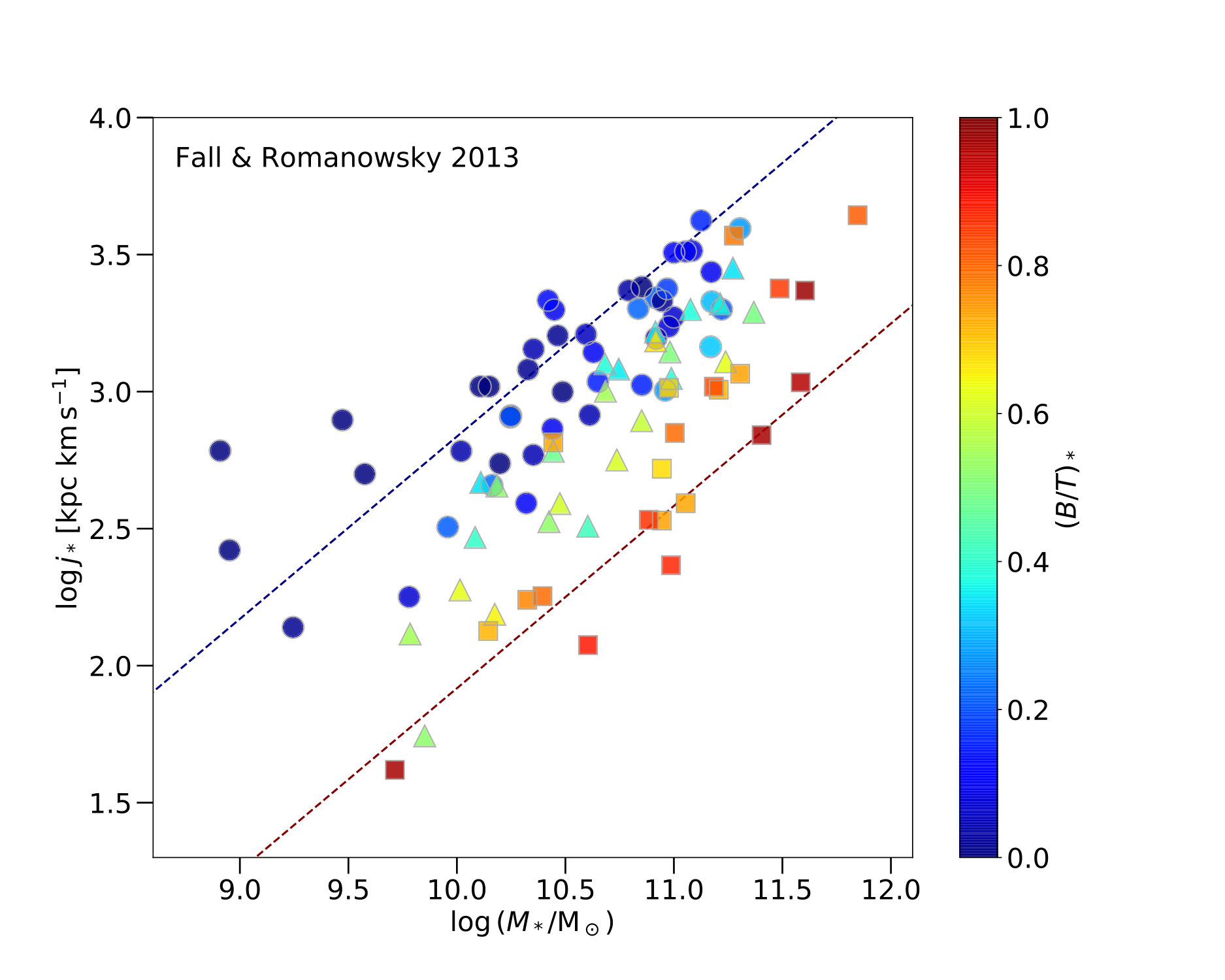 Figure 1
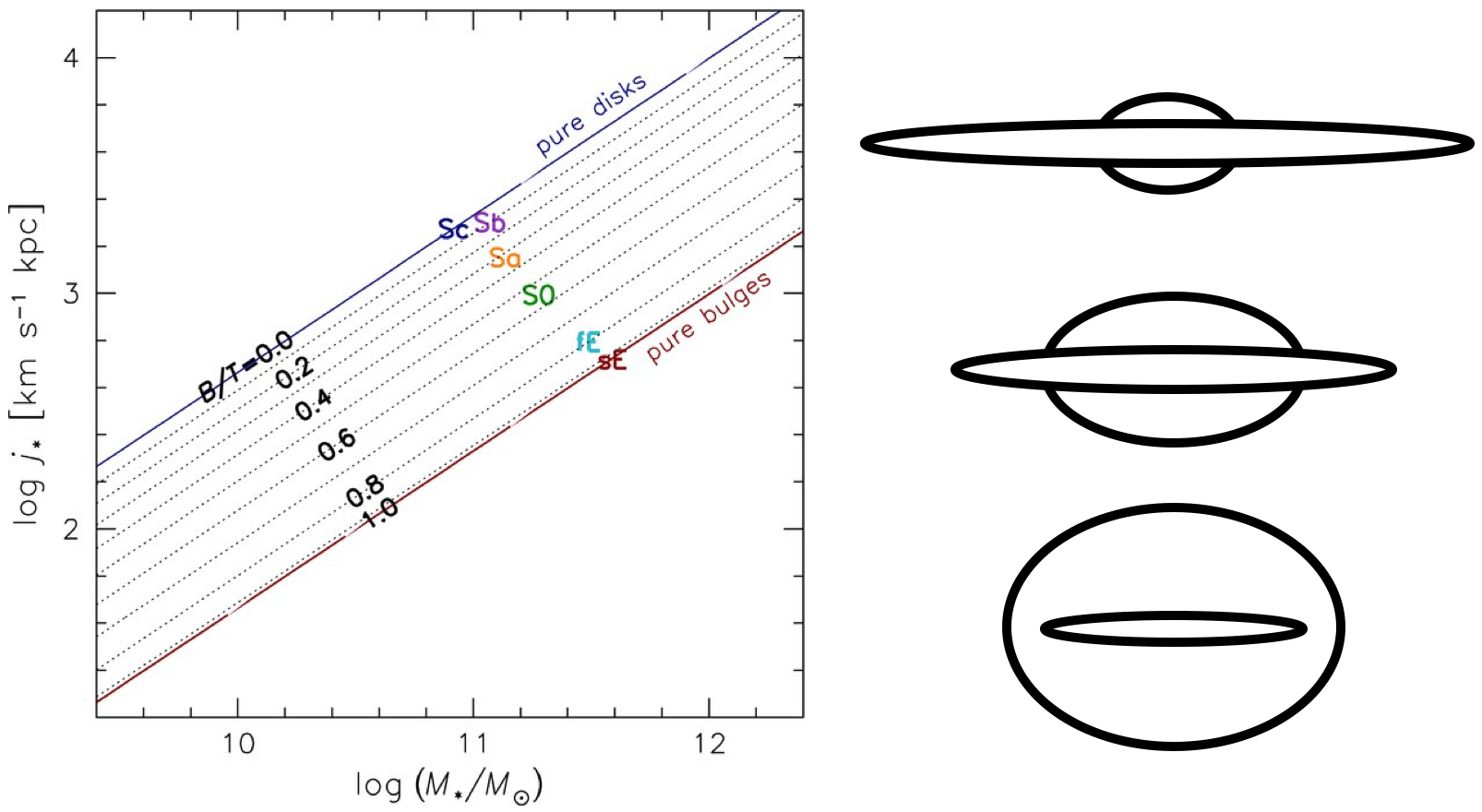 Figure 2
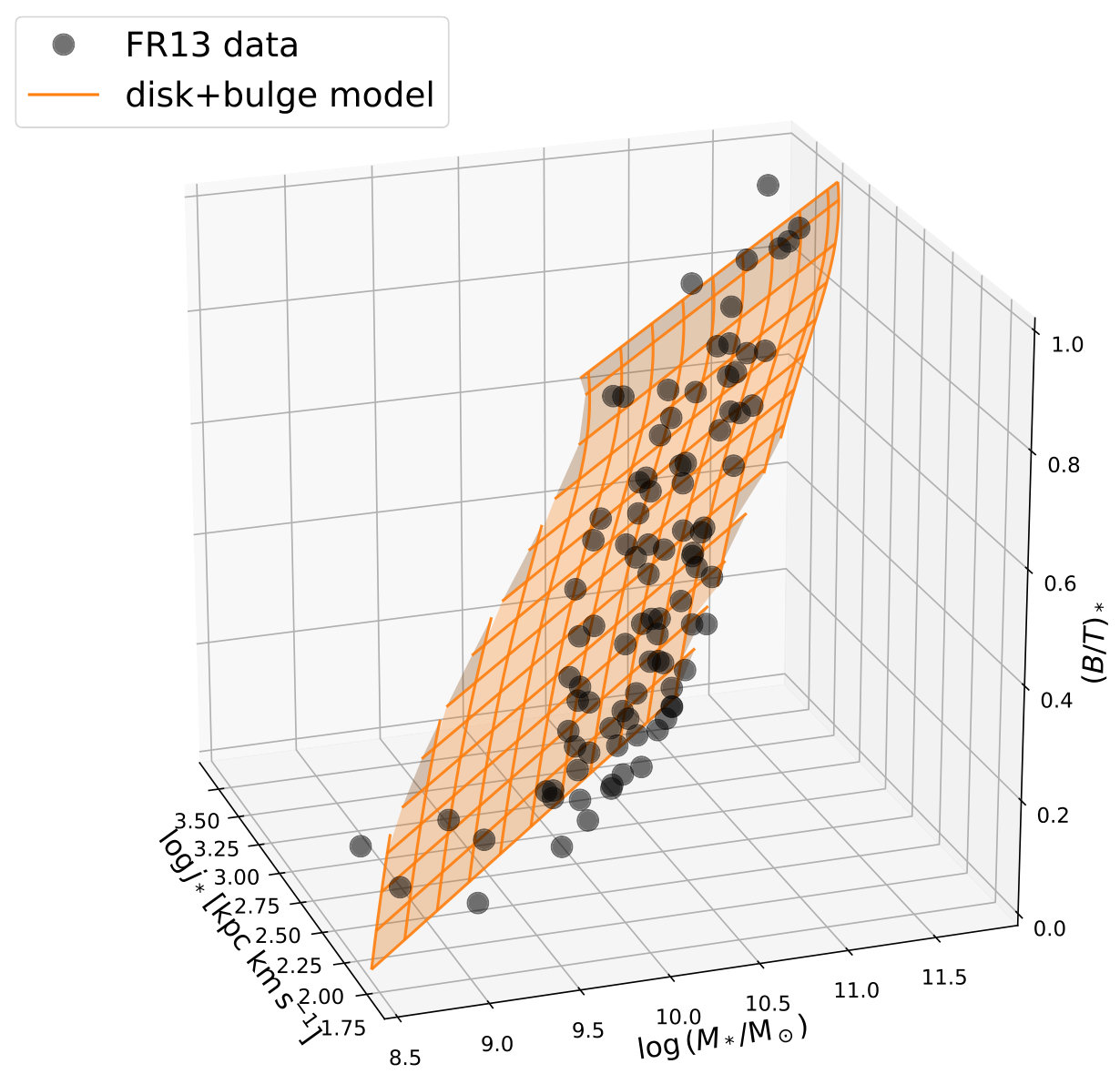 Figure 3
Peer Reviews
No public reviews on file for this paper yet. If you reviewed it on a platform where reviews are public (OpenReview, ICLR, NeurIPS, ICML), you can paste yours below so the community can read it here.
Videos
No videos yet. Explain this paper in a talk, walkthrough, or lecture? Add one.
Taxonomy
TopicsGalaxies: Formation, Evolution, Phenomena · Astronomy and Astrophysical Research · Stellar, planetary, and galactic studies
New perspectives on galactic angular momentum, galaxy formation, and the Hubble Sequence
S. Michael Fall1
Aaron J. Romanowsky2
1Space Telescope Science Institute,
3700 San Martin Drive, Baltimore, MD 21218, USA
email: [email protected]
2Dept. of Physics & Astronomy, San José State University,
One Washington Square, San Jose, CA 95192, USA
email: [email protected]
(2018)
Abstract
This paper provides a summary of our recent work on the scaling relations between the specific angular momentum and mass of the stellar parts of normal galaxies of different bulge fraction . We find that the observations are consistent with a simple model based on a linear superposition of disks and bulges that follow separate scaling relations of the form and with but offset from each other by a factor of over the mass range . This model correctly predicts that galaxies follow a curved 2D surface in the 3D space of , , and .
keywords:
galaxies: elliptical and lenticular, cD — galaxies: evolution — galaxies: fundamental parameters — galaxies: kinematics and dynamics — galaxies: spiral — galaxies: structure
††journal: FM6, Galactic Angular Momentum††editors: Danail Obreschkow, ed.
1 Introduction
Specific angular momentum () and mass () are two of the most basic properties of galaxies. We have studied the scaling relations between and from both observational and theoretical perspectives (Fall 1983; Romanowsky & Fall 2012; Fall & Romanowsky 2013, 2018; hereafter Papers 0, 1, 2, and 3). Here, we present some highlights from Paper 3 of this series.
2 Results
Figure 1 shows plotted against for the 94 galaxies in our sample (with ). Galaxies of different bulge fraction, , are indicated by symbols with different shapes and colors in this diagram. Here and throughout, the subscript refers to the stellar components of galaxies, as distinct from their interstellar, circumgalactic, and dark-matter components, while the subscripts d and b refer to disks and bulges, respectively. We note from Figure 1 that galaxies with different follow roughly parallel scaling relations of the form with exponents close to ( for disks, for bulges).
Figure 2 illustrates schematically the parallel – scaling relations for galaxies of different bulge fraction . This immediately suggests a connection between the locations of galaxies in the – diagram and their morphologies. And this in turn suggests that the distribution of galaxies of different in the – diagram is a physically based alternative to the Hubble sequence. The analogy here is with the description of elementary particles – the “eigenstates” for galaxies being disks and bulges. One wonders whether Hubble might have proposed a classification scheme for galaxies based on physical variables like and if he had been a physicist rather than an astronomer.
Figure 3 shows the distribution of our sample galaxies in the 3D space of (, , ). Figure 1 is, of course, just the projection of this distribution onto the – plane. We note that galaxies lie on or near the curved 2D orange surface in the 3D space. The orange surface is derived from a simple model based on a linear superposition of disks and bulges that follow separate scaling relations of the form and with but offset from each other by a factor of .
In Paper 3, we make detailed comparisons between our – scaling relations and those of other authors. We find excellent agreement between our results from Paper 2 and those of Obreschkow & Glazebrook (2014) and Posti et al. (2018) for disk-dominated galaxies. The – scaling relation derived by Sweet et al. (2018) appears to suffer from an unknown systematic error (by a factor of 2) relative to the relations derived in the other three studies. We find no statistically significant indication that galaxies with classical bulges and pseudo bulges follow different relations in (, , ) space.
In Paper 3, we provide an updated interpretation of the – scaling relations, following the precepts of Paper 1. In particular, we have revised slightly our earlier estimates of the fractions of angular momentum in the stellar components of galaxies relative to dark matter, . We now find for disks (slightly higher than before) and for bulges (slightly lower than before). We also note that these fractions are expected to be nearly constant over the mass range 10^{9.5}M_{\odot}{\>\hbox to0.0pt{\raise 2.0pt\hbox{<}\hss}\lower 3.0pt\hbox{\sim}\>}M_{\star}{\>\hbox to0.0pt{\raise 2.0pt\hbox{<}\hss}\lower 3.0pt\hbox{\sim}\>}10^{11.5}M_{\odot}. Posti et al. (2018) suggested that may decrease gradually toward lower galactic masses based on their extension of the – relation down to . Future studies should aim to determine for dwarf galaxies from the baryonic – relation (including both stars and cold gas) since this may be slightly shallower than the stellar – relation, and thus consistent with .
We note that the retention factor derived from the observed – relation for galactic disks agrees well with the value of postulated in simple disk formation models (Paper 0), although the physical reasons for this agreement are still an active research topic (as discussed at this meeting by Bullock, DeFelippis, El-Badry, Genel, and others). The retention factor also agrees well with the observed sizes of disk-dominated galaxies over the redshift range . Using the method of abundance matching, Huang et al. (2017) showed that the relation between the sizes of galaxies and their dark-matter halos is linear and stable over this redshift range and consistent with simple disk formation models (i.e., ).
3 Conclusions
-
The observed – scaling relations for galaxies with different constitute a physically motivated alternative to subjective classifications schemes such as the Hubble sequence.
-
At fixed , specific angular momentum and mass are related by power laws, , with for disks, for bulges, and overall.
-
For giant galaxies (with 10^{9.5}M_{\odot}{\>\hbox to0.0pt{\raise 2.0pt\hbox{<}\hss}\lower 3.0pt\hbox{\sim}\>}M_{\star}{\>\hbox to0.0pt{\raise 2.0pt\hbox{<}\hss}\lower 3.0pt\hbox{\sim}\>}10^{11.5}M_{\odot}), the angular momentum retention or sampling factors are for disks and for bulges.
The reference list from the paper itself. Each links out to its DOI / PubMed record.
- 1[Fall (1983)] Fall, S.M. 1983, in: E. Athanassoula (ed.), IAU Symp. 100, Internal Kinematics and Dynamics of Galaxies (Cambridge: Cambridge Univ. Press), p. 391 (Paper 0)
- 2[Fall & Romanowsky (2013)] Fall, S.M., & Romanowsky, A.J. 2013, Ap J (Letters), 769, L 26 (Paper 2)
- 3[Fall & Romanowsky (2018)] Fall, S.M., & Romanowsky, A.J. 2018, Ap J, 868, 133 (Paper 3)
- 4[Huang et al. (2017)] Huang, K.-H. et al. 2017, Ap J , 838, 6
- 5[Obreschkow & Glazebrook (2014)] Obreschkow, D., & Glazebrook, K. 2014, Ap J , 784, 26
- 6[Posti et al. (2018)] Posti, L., Fraternali, F., Di Teodoro, E.M., & Pezzulli, G. 2018, A&A , 612, L 6
- 7[Romanowsky & Fall (2013)] Romanowsky, A.J., & Fall, S.M. 2012, Ap JS , 203, 17 (Paper 1)
- 8[Sweet et al. (2018)] Sweet, S.M. et al. 2018, Ap J , 860, 37