Improved lower bound on the family complexity of Legendre sequences
Ya\v{g}mur \c{C}ak{\i}ro\v{g}lu, O\v{g}uz Yayla

TL;DR
This paper improves the lower bound on the family complexity of binary Legendre sequences, a measure of pseudorandomness, providing a more accurate estimate and a fast calculation method.
Contribution
The authors enhance Gyarmati's previous bound on family complexity for Legendre sequences, incorporating the Lambert W function and subfield elements, along with a new efficient computation method.
Findings
Improved lower bound on family complexity using Lambert W function
Derived a faster method for calculating the bound
Bound depends on subfield elements in finite fields
Abstract
In this paper we study a family of binary Legendre sequences and its family complexity. Family complexity is a pseudorandomness measure introduced by Ahlswede et.~al.~in 2003. A lower bound on the family complexity of a family based on the Legendre symbol of polynomials over a finite field was given by Gyarmati in 2015. In this article we improve the bound given by Gyarmati on family complexity of binary Legendre sequences. The bound depends on the Lambert W function and the number of elements in a finite field belonging to its proper subfield. Moreover, we present a fast method for calculating the bound.
Click any figure to enlarge with its caption.
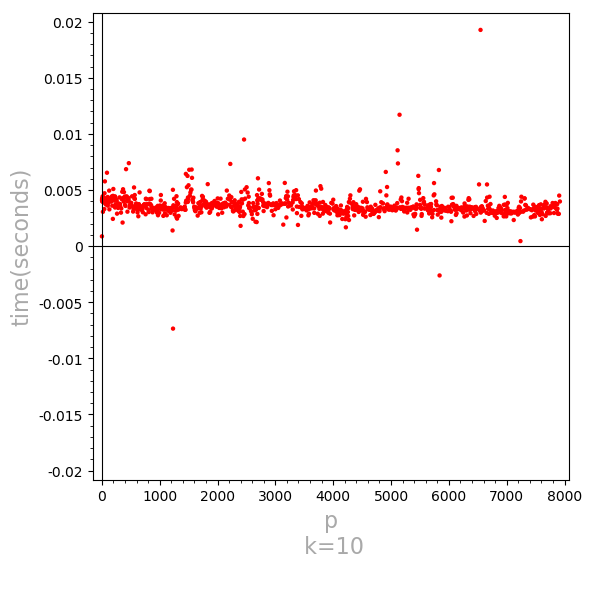 Figure 1
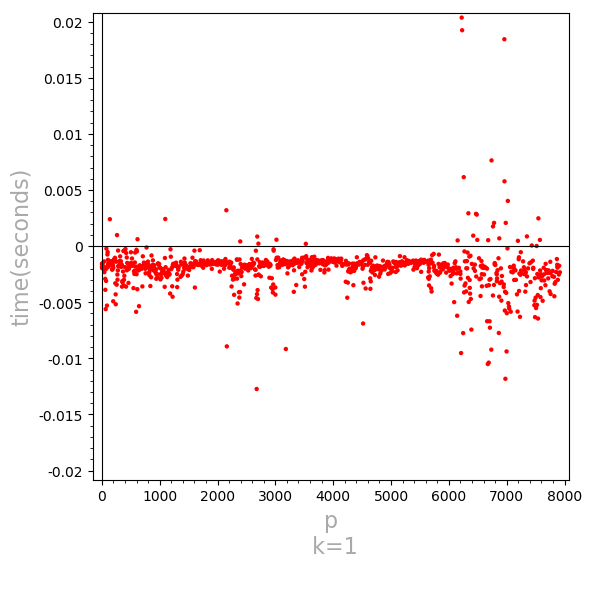 Figure 2
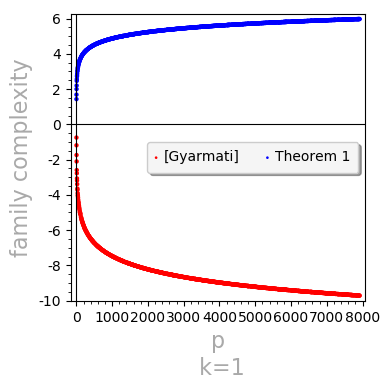 Figure 3
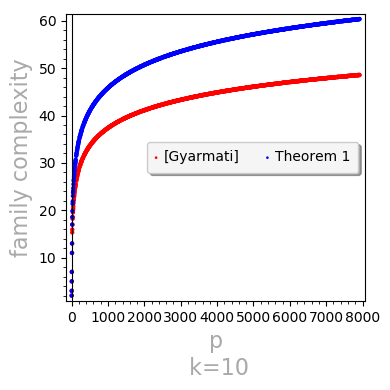 Figure 4
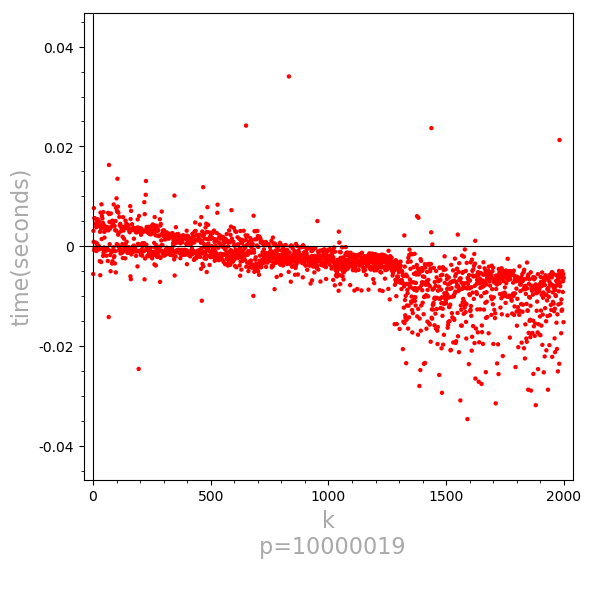 Figure 5
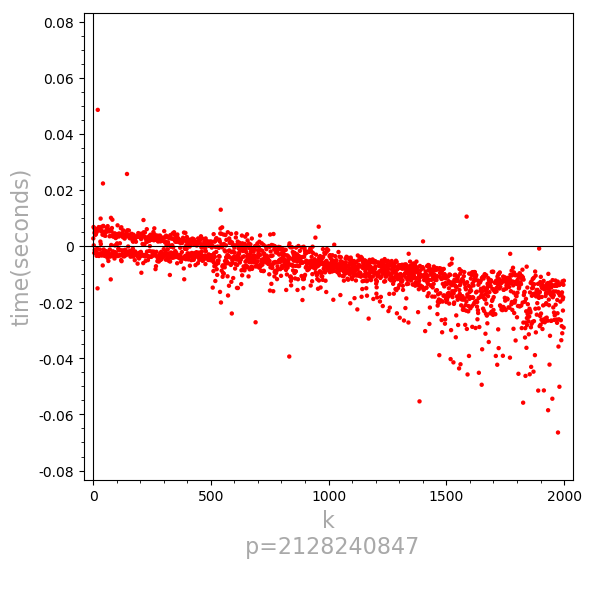 Figure 6
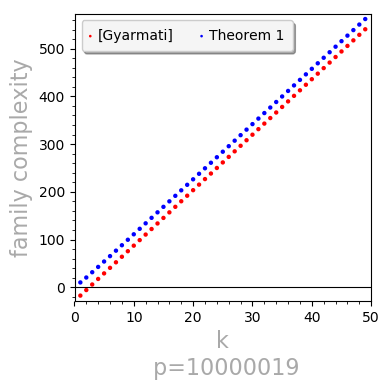 Figure 7
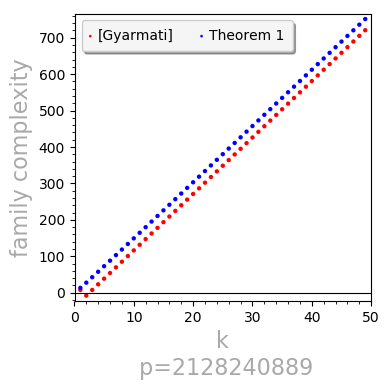 Figure 8
Peer Reviews
No public reviews on file for this paper yet. If you reviewed it on a platform where reviews are public (OpenReview, ICLR, NeurIPS, ICML), you can paste yours below so the community can read it here.
Videos
No videos yet. Explain this paper in a talk, walkthrough, or lecture? Add one.
Taxonomy
TopicsChaos-based Image/Signal Encryption · Polynomial and algebraic computation · Advanced Mathematical Theories and Applications
Improved lower bound on the family complexity of Legendre sequences
Yağmur Çakıroğlu and Oğuz Yayla
Department of Mathematics, Hacettepe University
Beytepe, 06800, Ankara, Turkey
Abstract
In this paper we study a family of binary Legendre sequences and its family complexity. Family complexity is a pseudorandomness measure introduced by Ahlswede et al. in 2003. A lower bound on the family complexity of a family based on the Legendre symbol of polynomials over a finite field was given by Gyarmati in 2015. In this article we improve bound given by Gyarmati. The new bound depends on the Lambert function and the number of elements in a finite field belonging to its proper subfield.
Keywords: pseudorandomness, binary sequences, family complexity, family of binary Legendre sequences, Lambert Function, polynomials over finite fields
Subject Classification: 11K45 94A55 94A60
1 Introduction
A pseudorandom sequence is a sequence of numbers which is generated by a deterministic algorithm and looks truly random. A pseudorandom sequence in the interval [0, 1) is called a sequence of pseudorandom numbers. Randomness measures of a sequence depend on its application area, for instance, it has to be unpredictable for cryptographic applications, uncorrelated for wireless communication applications and uniformly distributed for quasi-Monte Carlo methods [13, 25].
In this paper we consider Legendre sequences. It is known that the Legendre sequence has several good randomness measures such as high linear complexity [4, 8, 27, 29] and small correlation measure up to rather high orders [21] for cryptography, and a small (aperiodic) autocorrelation [23, 26] for wireless communication, GPS, radar or sonar.
In case, a family of sequences is considered for an application, for instance as a key-space of a cryptosystem, then its randomness in terms of many directions is concerned. For instance, a family of sequences must have large family size, large family complexity and low crosscorrelation. Family complexity as a randomness measure was first introduced by Ahlswede, Khachatrian, Mauduit and Sárközy [1] in 2003, and they estimated the family complexity of some sequences. Then, in 2006, they studied families of pseudorandom sequences on -symbols and their family complexity [2, 3]. In 2013 Mauduit and Sárközy studied family complexity measure of sequences of symbols and they also gave the connection between family complexity and VC-dimension [22]. In 2016, Winterhof and the second author gave a relation between family complexity and cross correlation measure [30]. Moreover the complexity measures for different families have been studied in some papers [5, 11, 14, 17, 18, 28].
Recently Gyarmati [16] presented a bound for the family complexity of Legendre sequences. In this paper we improve Gyarmati’s bound for all primes and degrees . For instance the bound given in this article is positive for all but the bound is positive for . We plotted two bounds on family complexity of Legendre sequences for all primes and degrees . We compare also two bounds in terms of time complexity. Then we plotted the difference between elapsed times for calculating bounds given by Gyarmati [16] and Theorem 1. We give more details about these comparisons in the last section.
The paper is organized as follows. The new bound we present in this paper depends on Lambert function, so we give its definition and some properties in Section 2. Then we present some auxiliary lemmas in Section 3 and previous results in Section 4. Next, we give our main contribution in Section 5. Finally we compare the new bound and Gyarmati’s one in Section 6.
2 Lambert Function
Firstly we begin with the definition of Lambert function and we present some properties and examples for this function.
Definition 1**.**
(Lambert Function) The Lambert function, also called the omega function or product logarithm, is defined as the multivalued function that satisfies
[TABLE]
for any complex number .
Equivalently, Lambert function is known as the inverse function of . Note that the multivaluedness of the Lambert function means that mostly there are multiple solutions since the function is not injective. The equation is by definition solved by and the equation is solved by . So many equations containing exponential expressions can be solved by the Lambert Function. For instance, the equation is solved by
[TABLE]
the equation is solved by
[TABLE]
and the equation is solved by
[TABLE]
The Lambert function has many applications in pure and applied mathematics, see [7] for details about its applications. Lambert function stems form the equation proposed by Johann Heinrich Lambert in 1758
[TABLE]
which is known as Lambert’s transcendental equation. Then in 1779 Euler wrote a paper about Lambert’s transcendental equation and introduced special case which is nearly the definition of function [10]. Actually Euler investigated theory behind the function and he had referenced work by Lambert in his paper, and so this function is called Lambert function. Lambert function, which has applications in many fields from past to present, was applied to problems ranging from quantum physics to population dynamics, to the complexity of algorithms. The new bound we obtain for -complexity given in this paper is related to this function. Now we give a simple example in order to show how we use this function in numerical solutions.
Example 1**.**
Let us solve for . We first divide both sides by to get
[TABLE]
and equivalently by multiplying we have
[TABLE]
Since the right hand side of the equation is of the form for , we can write the solution by definition of Lambert function
[TABLE]
which is approximately .
We note that function can be approximately evaluated by using some root-finding methods as given in [7].
3 Preliminaries
In this section we present some definitions and results which we need for the proof of our new bound on family complexity.
Definition 2**.**
Let denote the finite field having elements and define as follows.
[TABLE]
One can calculate the number of elements in for arbitrary by counting. But this method would be very slow. Thus, we need a formula for , in order to do that we give some definitions and results below.
Definition 3**.**
[24, Definition 2.1.22] The Möbius function is defined on the set of positive integers by
[TABLE]
Denote the number of monic irreducible polynomials of degree n over by . Then the following formula is well known, see [9, Chapter 14.3] or [6] for its proof.
Proposition 1**.**
[24] (Gauss’s Formula) For all any prime power q, we have
[TABLE]
Note that this formula was discovered by Gauss [12] for prime q, and so it is called Gauss’s formula. By using the formula on , one can count the number of elements in .
Lemma 1**.**
Let and be a prime power. Then
[TABLE]
Proof.
It is clear that any root of an irreducible polynomial of degree over can not be an element of its proper subfield. Hence the proof follows. ∎
Example 2**.**
Consider for . Then we have and by Lemma 1 we get
[TABLE]
Now we give the definition of a norm and trace of an element in a finite field, see [20, Chapter 2] for their properties.
Definition 4**.**
For the norm of is defined by
[TABLE]
and the trace of is defined by
[TABLE]
In particular and are elements of .
Definition 5**.**
[20, Chapter 5] Let be an additive and a multiplicative character of . Then and can be lifted to by setting for and for . Also from the additivity of the trace and multiplicativity of the norm is an additive and is a multiplicative character of .
By the definition of lifted character Gyarmati gave the following corollary in her paper [16]. We give this corollary to use in the proof of Theorem 1.
Corollary 1**.**
[16, Corollary 2.1.] Let be a prime number and be the Legendre symbol. Let be the quadratic character of . Then for
[TABLE]
In the following we define two new polynomials for a given polynomial over a finite field.
Definition 6**.**
For , we define
[TABLE]
for and
[TABLE]
Next, we give a result from the book of Lidl and Niederreiter [20], which will be the basis of the proof of our main theorem.
Lemma 2**.**
[20, Exercise 5.64] Let be distinct elements of , p odd, and . Let denote the number of with
[TABLE]
where is the quadratic character of . Then,
[TABLE]
4 Previous Results
In this paper we improve bound given by Gyarmati [16] on family complexity of Legendre sequences generated by irreducible polynomials. We will give construction method and result given by Gyarmati in this section. We begin with the definition of well known Legendre sequence [14, 21].
Construction 1**.**
Let be an integer and be a prime number. If is a polynomial with degree and has no multiple zeros in , then define the binary sequence by
[TABLE]
Let denote the set of all sequences obtained in this way.
Hoffstein and Lieman [19] presented the use of the polynomials given in Construction 1 but they did not give a proof for its pseudorandom properties. Goubin, Mauduit and Sárközy [14] proved that the sequences obtained in this way have strong pseudorandom properties.
We now give the definition of the - of a family , which was first defined by Ahlswede et. al. [1] in 2003.
Definition 7**.**
The family complexity (or briefly -complexity) of a family of binary sequences of length is the greatest integer such that for any and any there is a sequence with
[TABLE]
The - of a family is denoted by .
We note that the trivial upper bound on family complexity in terms of family size is
[TABLE]
We set the family of Legendre sequences generated by irreducible polynomials of degree over a prime field by :
[TABLE]
This family has been studied for different measures (crosscorrelation etc.) in several papers [14, 15, 18].
Gyarmati [16] recently proved a lower bound on the -complexity of the family , which says that the -complexity is at least of order .
Theorem A**.**
[16]** Let p be an odd prime and k be a positive integer. Define if and if then
**
In the next section, we improve the lower bound given in Theorem A by using the formula given in Lemma 1 and Lambert function given in Definition 1.
5 Main Method
The main contribution of this paper is given in the following theorem, which is a new bound on the family complexity of Legendre sequences generated by irreducible polynomials. This new bound improves the bound given by Gyarmati [16]. The comparison of two bounds is given in the next section.
Theorem 1**.**
Let be an odd prime and be a positive integer. Let and be defined as
[TABLE]
Then
[TABLE]
Before proving the theorem, we will give two auxiliary lemmas. In the first lemma, the solution of a logarithmic equation is obtained by Lambert function. In the second lemma, we give an upper bound on such that .
Lemma 3**.**
Let . If , then
Proof.
We have
[TABLE]
or equivalently,
[TABLE]
Then we get
[TABLE]
and
[TABLE]
Thus by Definition 1 we have
[TABLE]
that is
[TABLE]
∎
Lemma 4**.**
Let be an odd prime and be a positive integer. Let be defined as in Lemma 1. Let and be defined as
[TABLE]
Let be an integer such that j<log_{2}\bigg{(}\frac{A}{W(2^{B}A)}\bigg{)}. Let and be defined as in Lemma 2. Then
[TABLE]
Proof.
Assume that Then by Lemma 2
[TABLE]
Divide both sides by
[TABLE]
Multiply both sides by , and so get the following equation array
[TABLE]
[TABLE]
[TABLE]
Divide both sides by ,
[TABLE]
By definition of A and B, we have
[TABLE]
Hence, by Lemma 3 we obtain that
[TABLE]
which is a contradiction. ∎
Proof of Theorem 1 We need to show the existence of irreducible polynomial of degree such that
[TABLE]
for any tuple and for any integer . By Lemma 4 we know that
[TABLE]
From definition of we get that there exists such that
[TABLE]
Let and we define . We note that is an irreducible polynomial by using [16, Lemma 2.4]. We know that if p is a prime number, is the Legendre symbol and is the quadratic character of then for we have
[TABLE]
By [16, Lemma 2.3], we know that if then for we have
[TABLE]
Finally, using these and (1) we get
[TABLE]
as desired.
Since thus we can give the following corollary.
Corollary 2**.**
Let p be an odd prime and K be a positive integer. Let A and B be defined as in Theorem 1. Then
[TABLE]
6 Comparison
We compare the bounds given in Theorem 1 on family complexity of Construction 1 and given in Theorem A [16] with respect to the value of lower bounds and time to compute them.
Firstly, it is seen in Figures 1 and 2 that the lower bound given in Theorem 1 is better than bound given by Gyarmati [16]. Here the red lines show the bound in [16] (see also Theorem A in this paper) and the blue lines show the bound given Theorem 1 in this paper.
In Figure 1, both bounds on family complexity of Construction 1 is plotted with respect to primes for fixed and respectively. For , it is seen that bound given by Gyarmati is negative, on the other hand, the bound in Theorem 1 is always positive. We note that bound given by Gyarmati turns into positive for . For , it is seen that both lower bounds are positive and the lower bound given in Theorem 1 is better than bound given by Gyarmati for all . In Figure 2 the lower bound on family complexity of Construction 1 is plotted in range for fixed and respectively. Here, is the first prime greater than and is the first prime Gyarmati’s bound turns into positive for . In both cases, lower bounds are near to each other, but the lower bound in Theorem 1 is better.
Secondly, we compare two bounds in terms of time complexity. We plotted in Figures 3 and 4 the difference between elapsed times for evaluating bounds given by Gyarmati [16] and Theorem 1. In other words, we measured the elapsed times (in seconds) for calculating two bounds for all values of and that we have already examined in Figures 1 and 2. Then we plotted each difference of elapsed times of two bounds in Figures 3 and 4. It is seen that time to calculate two bounds are quite close to each other for all and . For instance, in Figure 3 for , time needed to calculate our bound is more than bound given by Gyarmati, the difference is at most 0.005 seconds. On the other hand, for bound given by Gyarmati is calculated slower and the difference between elapsed times is at most 0.01 seconds. Similarly, in Figure 4 it is seen that time to calculate two bounds differ from each other at most 0.06 seconds for primes , and . We conclude that the bound given in Theorem 1 can be calculated very fast for arbitrarily large prime powers and it only differs a few milliseconds form evaluating a bound depending only on and .
Acknowledgment
The authors are supported by the Scientific and Technological Research Council of Turkey (TÜBİTAK) under Project No: 116R026.
The reference list from the paper itself. Each links out to its DOI / PubMed record.
- 1[1] Rudolf Ahlswede, Levon H. Khachatrian, Christian Mauduit, and András Sárközy. A complexity measure for families of binary sequences. Period. Math. Hungar. , 46(2):107–118, 2003.
- 2[2] Rudolf Ahlswede, Christian Mauduit, and András Sárközy. Large families of pseudorandom sequences of k 𝑘 k symbols and their complexity. I. In General theory of information transfer and combinatorics , volume 4123 of Lecture Notes in Comput. Sci. , pages 293–307. Springer, Berlin, 2006.
- 3[3] Rudolf Ahlswede, Christian Mauduit, and András Sárközy. Large families of pseudorandom sequences of k 𝑘 k symbols and their complexity. II. In General theory of information transfer and combinatorics , volume 4123 of Lecture Notes in Comput. Sci. , pages 308–325. Springer, Berlin, 2006.
- 4[4] Hassan Aly and Arne Winterhof. On the k 𝑘 k -error linear complexity over 𝔽 p subscript 𝔽 𝑝 \mathbb{F}_{p} of Legendre and Sidelnikov sequences. Des. Codes Cryptogr. , 40(3):369–374, 2006.
- 5[5] Ramachandran Balasubramanian, Cécile Dartyge, and Élie Mosaki. Sur la complexité de familles d’ensembles pseudo-aléatoires. Annales de l’Institut Fourier , 64(1):267–296, 2014.
- 6[6] Sunil K. Chebolu and Ján Mináč. Counting irreducible polynomials over finite fields using the inclusion-exclusion principle. Mathematics Magazine , 84(5):369–371, 2011.
- 7[7] R. M. Corless, G. H. Gonnet, D. E. G. Hare, D. J. Jeffrey, and D. E. Knuth. On the Lambert W 𝑊 W function. Adv. Comput. Math. , 5(4):329–359, 1996.
- 8[8] Cunsheng Ding, T Hesseseth, and Weijuan Shan. On the linear complexity of legendre sequences. IEEE Transactions on Information Theory , 44(3):1276–1278, 1998.