Current Control of Magnetism in Two-Dimensional Fe3GeTe2
{\O}yvind Johansen, Vetle Risingg{\aa}rd, Asle Sudb{\o} and, Jacob Linder, Arne Brataas

TL;DR
This paper demonstrates how electric current can be used to control the magnetic properties of 2D Fe3GeTe2, enabling tunable magnetic phases and potential studies of phase transitions in two-dimensional systems.
Contribution
It introduces a simple and powerful current-induced spin torque mechanism in Fe3GeTe2, allowing control over magnetic anisotropy and phase transitions in 2D ferromagnets.
Findings
Current density tunes magnetic anisotropy from easy-axis to easy-plane.
Spin-orbit torque acts as an effective out-of-equilibrium free energy.
Potential to study Berezinskii-Kosterlitz-Thouless transition in 2D systems.
Abstract
The recent discovery of magnetism in two-dimensional van der Waals systems opens the door to discovering exciting physics. We investigate how a current can control the ferromagnetic properties of such materials. Using symmetry arguments, we identify a recently realized system in which the current-induced spin torque is particularly simple and powerful. In Fe3GeTe2, a single parameter determines the strength of the spin-orbit torque for a uniform magnetization. The spin-orbit torque acts as an effective out-of-equilibrium free energy. The contribution of the spin-orbit torque to the effective free energy introduces new in-plane magnetic anisotropies to the system. Therefore, we can tune the system from an easy-axis ferromagnet via an easy-plane ferromagnet to another easy-axis ferromagnet with increasing current density. This finding enables unprecedented control and provides the…
Click any figure to enlarge with its caption.
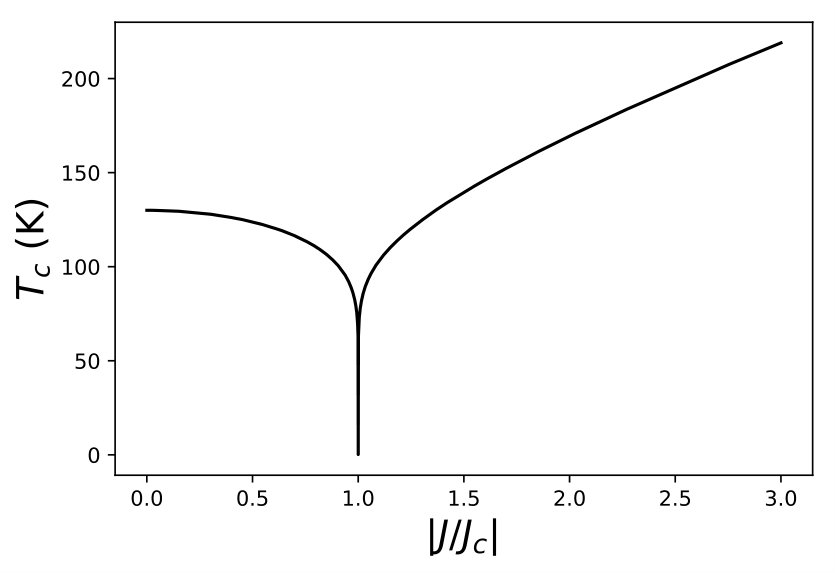 Figure 1
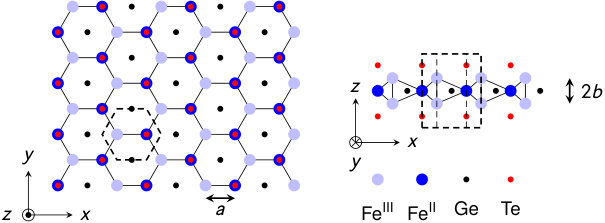 Figure 2
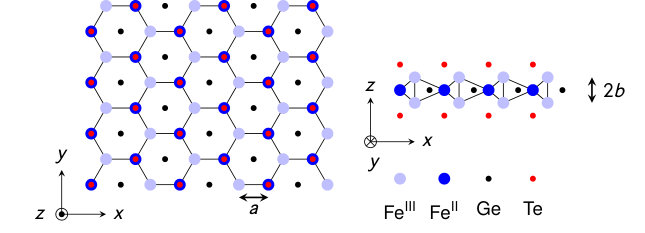 Figure 3
Peer Reviews
No public reviews on file for this paper yet. If you reviewed it on a platform where reviews are public (OpenReview, ICLR, NeurIPS, ICML), you can paste yours below so the community can read it here.
Videos
No videos yet. Explain this paper in a talk, walkthrough, or lecture? Add one.
Current Control of Magnetism in Two-Dimensional \ceFe3GeTe2
Øyvind Johansen
Vetle Risinggård
Asle Sudbø
Jacob Linder
Arne Brataas
Center for Quantum Spintronics, Department of Physics, Norwegian University of Science and Technology, N-7491 Trondheim, Norway
(March 7, 2024)
Abstract
The recent discovery of magnetism in two-dimensional van der Waals systems opens the door to discovering exciting physics. We investigate how a current can control the ferromagnetic properties of such materials. Using symmetry arguments, we identify a recently realized system in which the current-induced spin torque is particularly simple and powerful. In \ceFe3GeTe2, a single parameter determines the strength of the spin–orbit torque for a uniform magnetization. The spin–orbit torque acts as an effective out-of-equilibrium free energy. The contribution of the spin–orbit torque to the effective free energy introduces new in-plane magnetic anisotropies to the system. Therefore, we can tune the system from an easy-axis ferromagnet via an easy-plane ferromagnet to another easy-axis ferromagnet with increasing current density. This finding enables unprecedented control and provides the possibility to study the Berezinskiǐ–Kosterlitz–Thouless phase transition in the 2D model and its associated critical exponents.
Introduction.—Magnetism in lower dimensions hosts interesting physics that has been studied theoretically for many decades. Examples include the intriguing physics of the exactly solvable 2D Ising model Onsager (1944) and the Berezinskiǐ–Kosterlitz–Thouless (BKT) phase transition in the 2D model Berezinskiǐ (1971, 1972); Kosterlitz and Thouless (1973). However, experimentally realizing the details of these theoretical predictions has proven difficult. One reason for this difficulty is that fabricating atomically thin films is challenging. The isolation of graphene in 2004 provided a path for exploring two-dimensional van der Waals materials Novoselov et al. (2004). Creating two-dimensional films that have long-range magnetic order at finite temperatures is more challenging because of the Mermin–Wagner theorem Mermin and Wagner (1966). This theorem states that long-range magnetic order does not exist at finite temperatures below three dimensions when the exchange interaction has a finite range and the material has a continuous symmetry in spin space. Consequently, realizing two-dimensional magnetic materials requires breaking the continuous symmetry of the system, e.g. by a uniaxial magnetocrystalline anisotropy. This provides an energy cost (also known as a magnon gap) to suppress long-range fluctuations that can destroy the magnetic order. The recent discovery of magnetic order in two-dimensional van der Waals materials has therefore led to a large number of studies of magnetism in atomically thin films Burch et al. (2018). Magnetic order has been reported in \ceFePS3 Lee et al. (2016), \ceCr2GeTe6 Gong et al. (2017), \ceCrI3 Huang et al. (2017), \ceVSe2 Bonilla et al. (2018), \ceMSe_ O’Hara et al. (2018), and \ceFe3GeTe2 Fei et al. (2018); Deng et al. (2018). In addition, multiferroicity has been identified in \ceCuCrP2S6 Lai et al. . These new two-dimensional magnets are amenable to electrical control Deng et al. (2018); Huang et al. (2018); Jiang et al. (2018); Wang et al. (2018) and produce record-high tunnel magnetoresistances Kim et al. (2018).
Currents can induce torques in magnetic materials Brataas et al. (2012). In ferromagnets with broken inversion symmetry, the spin–orbit interaction leads to spin–orbit torques (SOTs) Manchon and Zhang (2008). These torques can be present even in the bulk of the materials without requiring additional spin-polarizing elements. The effects of SOTs are typically sufficiently large to induce magnetization switching or motion of magnetic textures Manchon et al. . With the rich physics that is known to exist in two-dimensional magnetic systems, we explore how currents can provide additional control over the magnetic state via SOTs.
Although many of the newly discovered two-dimensional magnetic systems exhibit SOTs, we find that in one material the torque is particularly simple and powerful. The form of the torque is simple because it is determined by a single parameter. The torque is also influential in determining the magnetic state of the system. In contrast to many other systems, we can describe the current-induced effects via an effective out-of-equilibrium free energy. Therefore, the SOT enables unprecedented control over the magnetic state via the current. We will demonstrate how the current can drive the system from having easy-axis anisotropy along one direction to anisotropy along a different axis by proceeding via an intermediate state with easy-plane anisotropy.
Interestingly, the current-induced easy-plane configuration provides the possibility to study the BKT phase transition in this system. The BKT transition is an example of a so-called conformal phase transition in which the scale invariance of a topologically ordered state, i.e. conformal invariance, is lost at the (topological) phase transition Kaplan et al. (2009). When driven by a current, we realize a 2D conformal field theory in the low-temperature phase, with conformality being lost Kaplan et al. (2009) at the transition to the paramagnetic phase. Additionally, it was recently discovered that an ionic gate considerably increases the critical temperature Deng et al. (2018). Consequently, two-dimensional \ceFe3GeTe2 forms an ideal and very rich laboratory for studying fundamental problems of broad current interest in condensed matter physics and beyond at elevated temperatures.
System.—We consider a monolayer of \ceFe3GeTe2. Fig. 1 shows the crystal structure of this material. \ceFe3GeTe2 crystallizes in the hexagonal system, space group 194, point group , known as in the Schönflies notation Deiseroth et al. (2006). However, the basis reduces the point group symmetry to (). Placing an \ceFe3GeTe2 monolayer on a substrate may reduce the symmetry even further (point group ) if the bottom tellurium layer hybridizes with the surface. Here, we assume that a possible monolayer–substrate interaction is weak.
The SOT can be written as Hals and Brataas (2013); *Hals2015
[TABLE]
where is the gyromagnetic ratio and is the magnetization unit vector. For a spatially uniform magnetization, the effective magnetic field due to the SOT in an \ceFe3GeTe2 monolayer is 111 See the Supplemental Material, which includes Ref. Birss (1964), a derivation of the spin–orbit torques, and the details of the critical-temperature calculation.
[TABLE]
Here, are magnetization components, and are components of the current density. is a free parameter that is determined by the spin–orbit coupling.
We provide a rigorous derivation of the effective field based on Neumann’s principle in the Supplementary Material Note (1). In \ceFe3GeTe2, we can understand the dependence of the SOT on the magnetization and currents in Eq. (missing) 2 as follows. The crystal structure in Fig. 1 is invariant under a three-fold rotation about the axis (), an inversion of the axis (), and an inversion of the axis (). These symmetry operations generate the point group . Since only contains terms that are quadratic in , it is invariant under the operation . The operation transforms into
[TABLE]
and similarly for and . Back-substitution of the transformation in Eq. (missing) 3 into Eq. (missing) 2 shows that is also invariant under this operation. The effective field is invariant under since neither nor appear in Eq. (missing) 2.
Micromagnetics.—The magnetization dynamics can be described by the semiclassical Landau–Lifshitz–Gilbert (LLG) equation
[TABLE]
Here, is the dimensionless Gilbert damping parameter, is an effective magnetic field that describes the magnetization direction that minimizes the free energy density functional , and is the saturation magnetization. Interestingly, we note that a functional exists that generates the effective SOT field in Eq. (missing) 2, which is given by
[TABLE]
The out-of-equilibrium current-induced SOT can therefore be absorbed into an effective field that minimizes the effective free energy density .
The 2D ferromagnet \ceFe3GeTe2 is a uniaxial ferromagnet with an out-of-plane easy axis Deng et al. (2018); Fei et al. (2018); Zhuang et al. (2016). The contribution of the dipole–dipole interaction to the spin-wave spectrum can be neglected for a monolayer system Chartoryzhskii et al. (1976); Kalinikos (1980, 1981); Kalinikos and Slavin (1986); Kalinikos et al. (1990). If we consider a spatially uniform magnetization and use a spherical basis, , the effective free energy becomes
[TABLE]
Here, is the out-of-plane anisotropy constant, and and are the magnitude and azimuthal angle of the applied current, respectively. From this, we find that the SOT effectively acts as in-plane magnetocrystalline anisotropies. The anisotropy originating from the SOT always comes in a pair of perpendicular easy and hard axes. The directions of the anisotropy axes depend on the direction of the applied current. For weak currents (), the magnetization of \ceFe3GeTe2 remains out of plane (). However, for sufficiently strong currents (), an in-plane configuration of the magnetization becomes more energetically favorable. Assuming that , the effective free energy is then minimized by and (). When , the easy and hard axes are interchanged, and the minima are . The easy and hard axes also interchange upon reversal of the applied current.
Magnon gap.—Because the SOT can effectively be considered a current-controlled magnetocrystalline anisotropy, we can electrically control the magnon gap in \ceFe3GeTe2. The magnon gap is governed by the energy difference between the out-of-plane and in-plane magnetization configurations, i.e. . At the critical current , the magnon gap vanishes as the magnetic easy axis transitions from an out-of-plane axis to an in-plane axis. Exactly at this transition point, we obtain a magnetic easy plane. Below the critical current, the magnon gap decreases monotonically with the applied current, whereas it increases monotonically above the critical current. The ability to electrically tune the magnon gap in a 2D magnetic material opens the door for exploring a wide variety of effects in magnetism in two dimensions.
Curie temperature.—The first effect that is characteristic of a two-dimensional system that we will now illustrate is the dependence of the Curie temperature on the magnon gap. Because the Curie temperature in 2D is primarily governed by the magnon gap, unlike in 3D Auerbach (1994), we will study its behavior as we tune the SOT-controlled magnon gap through the transition from an out-of-plane easy axis to an in-plane easy axis. To illustrate the basic aspects of current control of the Curie temperature, we make a few simplifications to reduce the number of free parameters and the complexity of the calculations. \ceFe3GeTe2 is an itinerant ferromagnet, and its magnetic interactions are therefore described by the Stoner model Zhuang et al. (2016). The Stoner model can in our system be transformed into an RKKY exchange interaction between the iron atoms Prange and Korenman (1979). We assume that the exchange interaction in an \ceFe3GeTe2 monolayer has a finite range and therefore obeys the Mermin–Wagner theorem. To simplify the calculations, we replace the Stoner/RKKY exchange interaction by a simple nearest-neighbor interaction between the \ceFe^II and \ceFe^III atoms (i.e. there is no exchange interaction within each sublattice or between the two different \ceFe^III sublattices). This will also obey the Mermin–Wagner theorem, and this system will consequently also exhibit the same qualitative dependence on the magnon gap as other finite-range interactions. We also assume that the magnetic anisotropy constants are identical at all sites. Consequently, we consider the model Hamiltonian
[TABLE]
Here, is an energy constant that describes the nearest-neighbor exchange interactions of spins separated by , is an energy constant that describes the out-of-plane anisotropy, and is an energy constant that describes the effective in-plane anisotropies caused by the SOT. () describes the -th component of the spin operator located at position . We split the \ceFe3GeTe2 monolayer into three distinct sublattices: one for the \ceFe^II atoms, one for the \ceFe^III atoms at , and one for the \ceFe^III atoms at .
We proceed by performing a Holstein–Primakoff transformation of the spin operators around the equilibrium spin direction. This is in the direction below the critical current and along the direction above the critical current. Because of the anomalous Hall effect in \ceFe3GeTe2 Deng et al. (2018); Tan et al. (2018); Nagaosa et al. (2010), applying the current exactly along the direction can be experimentally challenging. However, as can be deduced from Eq. (missing) 6, a scenario in which the current is applied in a different direction can be achieved by a rotation of the unit cell or Brillouin zone. Since it is the magnons closest to the point that dominate the calculation of the Curie temperature, we expect the results to be very similar for an off-axis current.
In our calculations, we keep terms to the second order in the Holstein–Primakoff magnon operators. We expect this to be a good qualitative approximation, although it will not be a very good quantitative approximation because the magnon population diverges at the critical point. However, keeping terms to, for instance, the fourth order in the magnon operators to include magnon–magnon interactions Gong et al. (2017) would be complicated because Eq. (missing) 7 does not conserve the magnon number for finite currents.
Following the Holstein–Primakoff transformation, we perform a Fourier transformation of the magnon operators to momentum space. We then diagonalize the Hamiltonian by a Bogoliubov transformation such that it takes the form Note (1)
[TABLE]
Here, the operator annihilates (creates) an eigenmagnon with a momentum and energy . There are three different modes () of the eigenmagnons. We have imposed the constraint on the Bogoliubov transformation that the new operators have to satisfy bosonic commutation relations: .
From the energy spectrum of the eigenmagnons in \ceFe3GeTe2, we can estimate the Curie temperature . To determine , we use the fact that the magnetization along the equilibrium direction of the spins vanishes at this temperature. Because we consider a monolayer system, we only have magnons with in-plane momenta. Balancing the magnetic moments, we find the constraint
[TABLE]
Here, is the dimensionless spin number of the magnetic moments in sublattice (where for the \ceFe^II atoms, and for the \ceFe^III atoms located at ), and is the (reciprocal) area of the first Brillouin zone. is the spin of the eigenmagnons, which is not an integer for finite SOT because of magnon squeezing Kamra et al. (2017). The spin of the eigenmagnons depends on the parameters of the Bogoliubov transformation and is given in the Supplementary Material Note (1).
We can now calculate the Curie temperature numerically based on Eq. (missing) 9. In our calculations, we set the out-of-plane anisotropy constant to be meV Zhuang et al. (2016). The value of the nearest-neighbor exchange coupling is set to be meV to reproduce the experimental of a monolayer of K Fei et al. (2018) (note, however, that a different experiment determined the of a monolayer to be K Deng et al. (2018)). The real value of is in all likelihood larger Deng et al. (2018) because the linear response method typically overestimates . The dimensionless spin numbers for the spins in sublattice are and Rodriguez et al. (1996). We plot the Curie temperature as a function of the applied current in Fig. 2.
Because we only kept terms to the second order in the magnon operators, we do not expect that our calculation of will be quantitatively correct. However, the qualitative features of our result appear to be physically reasonable. When we apply a SOT below the critical current , we effectively reduce the magnon gap by creating a pair of easy and hard axes perpendicular to the out-of-plane magnetization. Because the Curie temperature in 2D materials is governed by the magnon gap, this also reduces . At the critical current strength, we obtain a continuous symmetry in the form of an easy plane when the in-plane easy axis induced by the SOT becomes equal to the out-of-plane magnetocrystalline anisotropy. Because of the Mermin–Wagner theorem, there can be no long-range magnetic order at finite temperatures in this scenario, and drops to zero. Above the critical current, we now increase the magnon gap for an in-plane magnetization configuration, and increases accordingly. will then saturate at the Curie temperature of the Ising model for large currents, which our model does not capture Torelli and Olsen .
In addition to the current affecting the Curie temperature through a SOT, the current will also increase the temperature in the material due to Joule heating, which needs to be taken into account when measuring the Curie temperature of the material. The Joule heating increases quadratically with the applied current. Conversely, the SOT is linear in the applied current, but its effect on the Curie temperature depends on whether we are above or below the critical current. Consequently, if the critical current is sufficiently small, then the effect of the SOT will dominate that of the Joule heating. In this case, the magnetic ordering exhibits reentrant behavior as a function of the applied current. Notably, above the critical current, when the magnetization is in the plane, the easy and hard axes are interchanged upon reversal of the current direction. A reversal of the applied current would therefore lead to a rotation of the magnetization.
2D model.—Although the spontaneous magnetization vanishes for finite temperatures at the critical current density , this regime remains an interesting region for studying the magnetic properties. At the critical current density (), the model in Eq. (missing) 7 becomes, quite remarkably, a 2D easy-plane ferromagnet, where the easy plane is perpendicular to the plane of the monolayer. Therefore, at this current density, the model features a critical phenomenon in the universality class of the 2D model. Consequently, the system has a topological phase transition rather than the more conventional phase transition of the 2D Ising model Onsager (1944). The 2D Ising universality class falls within the framework of the Landau–Ginzburg–Wilson paradigm of phase transitions of an order–disorder transition monitored by a local order parameter Landau et al. (1999); Wilson and Kogut (1974). The spin–spin correlation length diverges from above and below as , where is a universal critical exponent. There is true long-range order in the low-temperature phase, short-range order in the high-temperature phase, and power-law spin–spin correlations precisely at the critical point. In contrast, the 2D model features a genuine phase transition with no local order parameter. At this phase transition, the spin–spin correlation length diverges as from the high-temperature side only Kosterlitz and Thouless (1973), where is the critical temperature of the BKT transition. The high-temperature phase has short-range order, and the entire low-temperature phase is critical with a spin–spin correlation function featuring a nonuniversal temperature-dependent anomalous dimension , Kosterlitz and Thouless (1973).
In 2D \ceFe3GeTe2, we may realize this type of highly nontrivial behavior by tuning the electric current to the critical value and then drive the system through the phase transition by varying the temperature. Moreover, below the BKT transition, the temperature dependence of the nonuniversal anomalous dimension of the 2D model can be mapped by varying the temperature and measuring the spin–spin correlation function by polarized small-angle neutron scattering, which is particularly well suited for ultrathin films Maurer et al. (2014). The present system is also amenable to studying the universal anomalous dimension of the 2D Ising-model at , Itzykson and Drouffe (1989). The prediction for the 2D model, Kosterlitz and Thouless (1973), where is the effective exchange coupling and is Boltzmann’s constant, has not been tested in real 2D magnetic systems to our knowledge.
Examples of real physical systems with this level of control over such phenomena are very rare, particularly for systems where the phenomena are accessible at relatively elevated temperatures. The most well-known example is superfluidity in thin films of , where the BKT transition occurs below Bishop and Reppy (1978). In that context, the remarkable prediction and experimental verification of a universal jump in the superfluid density of the system Nelson and Kosterlitz (1977); Bishop and Reppy (1978) is also worth noting. We expect the corresponding physics of a universal jump in the spin stiffness of the system to occur at liquid nitrogen or oxygen temperatures in the system studied here. The spin stiffness may be measured in spin-wave resonance experiments Golosovsky et al. (2007). Furthermore, and in contrast to our present case, is not experimentally accessible in superfluid thin films of .
The parameter determines the magnitude of the critical current and thus the accessibility of the effects that we discuss. This value cannot be obtained purely from symmetry considerations but rather needs to be determined experimentally or by ab initio calculations. In light of the exciting physics that can be realized and the flexibility of the system, determining its value would be very interesting. Based on the strong magnetic anisotropy of the material, we believe that the spin–orbit coupling is sufficiently strong. Paired with the observation that SOTs are typically sufficiently large to induce magnetization switching in other materials Manchon et al. , we have reason to believe that reentrant magnetism and topological phase transitions can be experimentally observed in \ceFe3GeTe2.
Acknowledgements.
The authors thank Alireza Qaiumzadeh for helpful discussions. We gratefully acknowledge funding via the “Outstanding Academic Fellows” program at NTNU, the Research Council of Norway Grant No. 240806, 239926, and 250985, and the Research Council of Norway through its Centres of Excellence funding scheme, Project No. 262633, “QuSpin”. Ø. J. and V. R. contributed equally to this work.
The reference list from the paper itself. Each links out to its DOI / PubMed record.
- 1Onsager (1944) L. Onsager, “Crystal statistics. I. A two-dimensional model with an order-disorder transition,” Phys. Rev. 65 , 117–149 (1944) . · doi ↗
- 2Berezinskiǐ (1971) V. L. Berezinskiǐ, “Destruction of long-range order in one-dimensional and two-dimensional systems having a continuous symmetry group I. Classical systems,” Soviet Phys. JETP 32 , 493 (1971).
- 3Berezinskiǐ (1972) V. L. Berezinskiǐ, “Destruction of long-range order in one-dimensional and two-dimensional systems possessing a continuous symmetry group. II. Quantum systems,” Soviet Phys. JETP 34 , 610 (1972).
- 4Kosterlitz and Thouless (1973) J. M. Kosterlitz and D. J. Thouless, “Ordering, metastability and phase transitions in two-dimensional systems,” J. Phys. C: Solid State 6 , 1181 (1973) .
- 5Novoselov et al. (2004) K. S. Novoselov, A. K. Geim, S. V. Morozov, D. Jiang, Y. Zhang, S. V. Dubonos, I. V. Grigorieva, and A. A. Firsov, “Electric field effect in atomically thin carbon films,” Science 306 , 666–669 (2004) . · doi ↗
- 6Mermin and Wagner (1966) N. D. Mermin and H. Wagner, “Absence of ferromagnetism or antiferromagnetism in one- or two-dimensional isotropic Heisenberg models,” Phys. Rev. Lett. 17 , 1133–1136 (1966) . · doi ↗
- 7Burch et al. (2018) K. S. Burch, D. Mandrus, and J.-G. Park, “Magnetism in two-dimensional van der Waals materials,” Nature 563 , 47–52 (2018) . · doi ↗
- 8Lee et al. (2016) J. U. Lee, S. Lee, J. H. Ryoo, S. Kang, T. Y. Kim, P. Kim, C.-H. Park, J.-G. Park, and H. Cheong, “Ising-type magnetic ordering in atomically thin \ce Fe PS 3,” Nano Lett. 16 , 7433–7438 (2016) . · doi ↗