Upper branch magnetism in quantum magnets: Collapses of excited levels and emergent selection rules
Changle Liu, Fei Ye Li, Gang Chen

TL;DR
This paper introduces the concept of upper branch magnetism in quantum magnets, emphasizing the importance of excited crystal field states in understanding magnetic phase transitions and emergent selection rules.
Contribution
It develops a microscopic theory accounting for the role of excited crystal field states, revealing new magnetic phases and transition mechanisms in rare-earth magnets.
Findings
Excited crystal field states can significantly influence magnetic properties.
Phase transitions driven by excited states can lead to new magnetic orders.
Emergent selection rules help detect underlying excitations.
Abstract
In many quantum magnets especially the rare-earth ones, the low-lying crystal field states are not well separated from the excited ones and thus are insufficient to describe the low-temperature magnetic properties. Inspired by this simple observation, we develop a microscopic theory to describe the magnetic physics due to the collapses of the weak crystal field states. We find two cases where the excited crystal field states should be seriously included into the theory. One case is when the bandwidth of the excited crystal field states is comparable to the crystal field gap. The other case is when the exchange energy gain between the low-lying and excited crystal field states overcomes the crystal field gap. Both cases could drive a phase transition and result in magnetic orders by involving the excited crystal field states. We dub the above physics as upper branch magnetism and phase…
Click any figure to enlarge with its caption.
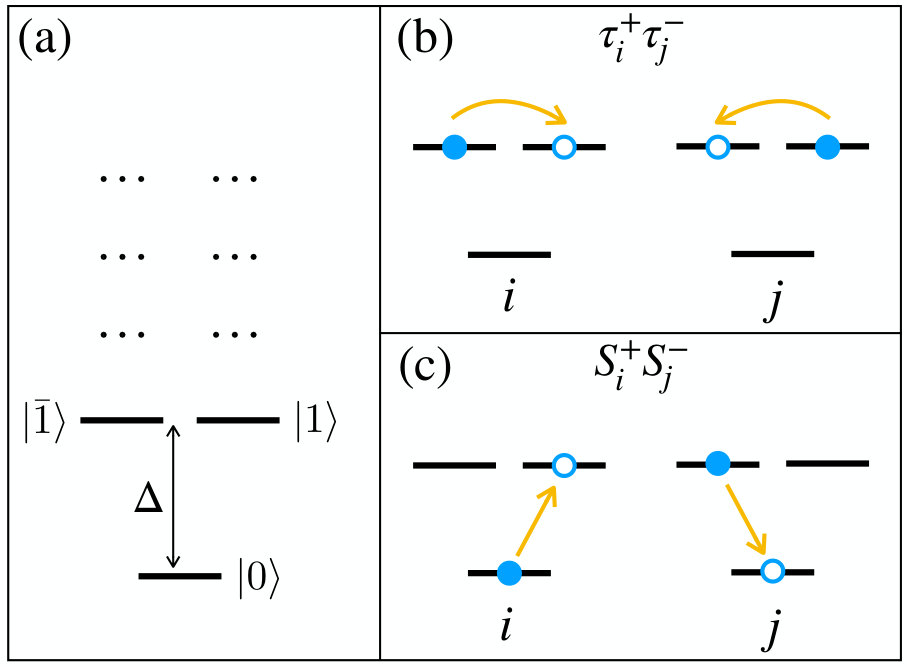 Figure 1
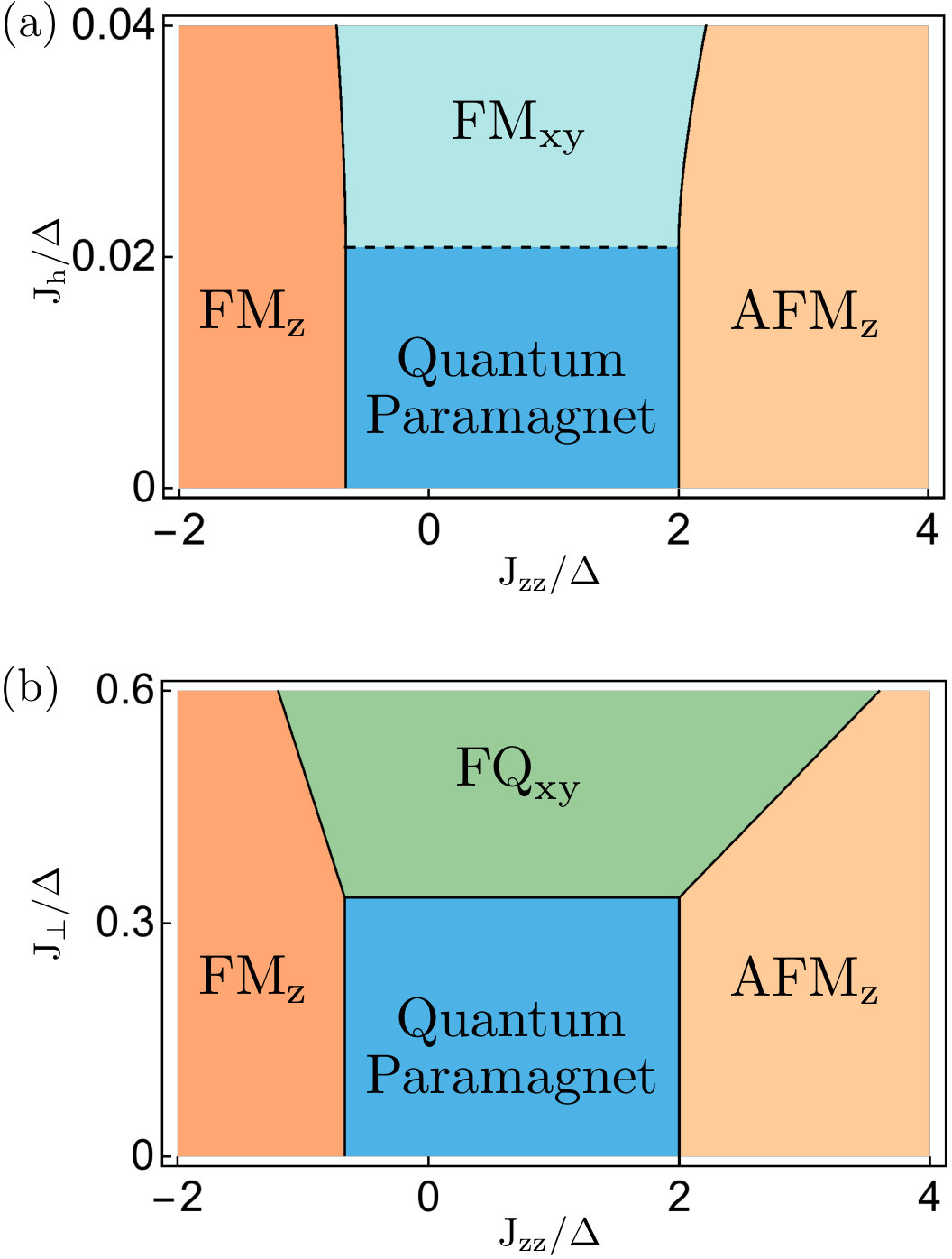 Figure 2
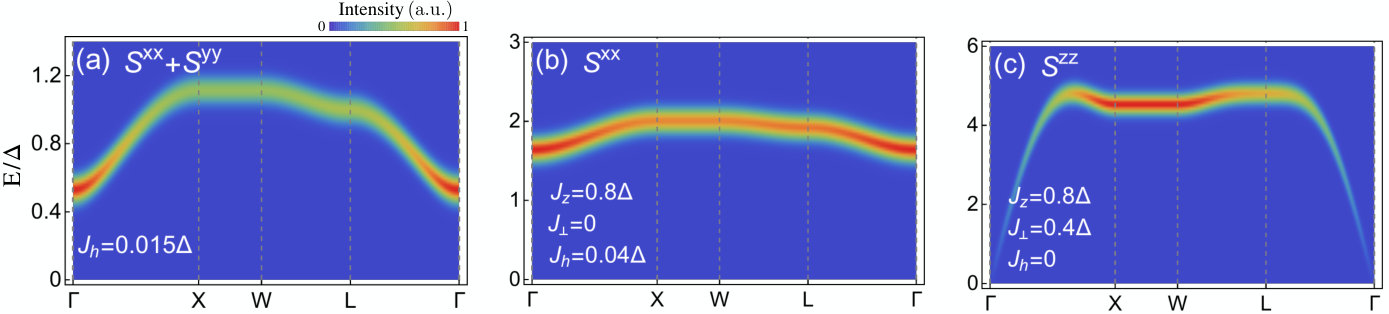 Figure 3
 Figure 4
| Magnetic phases | Dipoles | Quadrupoles | Local variational wavefunction | Variational energy per site |
|---|---|---|---|---|
| Quantum paramagnet | ||||
| FM | ||||
| FM | or | |||
| AFM | with | |||
| FQ |
| Systems and materials | Local low-lying states | Relevant condensation | Refs |
|---|---|---|---|
| Dimerized magnets | Singlet of two neighboring spins | Triplon from the triplets | Ref. Giamarchi et al.,2008 |
| A-site spinel FeSc2S4 | Spin-orbital singlet with orbitals | Spin-orbital excited states | Refs. Chen et al.,2009a, b |
| Mott insulators (Ca2RuO4) | Spin-orbital singlet with orbitals | Spin-orbital excitons | Refs. Khaliullin,2013; Akbari and Khaliullin,2014; Chaloupka and Khaliullin,2016; Souliou et al.,2017 |
| Mott insulators | Spin-orbital singlet with orbitals | Spin-orbital excitons | Ref. Li and Chen,2018 |
| Magnets with weak crystal field gaps | Local low-lying crystal field state | Excited crystal field states | This work |
Peer Reviews
No public reviews on file for this paper yet. If you reviewed it on a platform where reviews are public (OpenReview, ICLR, NeurIPS, ICML), you can paste yours below so the community can read it here.
Videos
No videos yet. Explain this paper in a talk, walkthrough, or lecture? Add one.
††thanks: These two authors contributed equally.††thanks: These two authors contributed equally.
Upper branch magnetism in quantum magnets:
Collapses of excited levels and emergent selection rules
Changle Liu1
Fei-Ye Li1
Gang Chen1,2
1State Key Laboratory of Surface Physics and Department of Physics, Fudan University, Shanghai 200433, China
2Department of Physics and Center of Theoretical and Computational Physics, The University of Hong Kong, Pokfulam Road, Hong Kong, China
Abstract
In many quantum magnets especially the rare-earth ones, the low-lying crystal field states are not well separated from the excited ones and thus are insufficient to describe the low-temperature magnetic properties. Inspired by this simple observation, we develop a microscopic theory to describe the magnetic physics due to the collapses of the weak crystal field states. We find two cases where the excited crystal field states should be seriously included into the theory. One case is when the bandwidth of the excited crystal field states is comparable to the crystal field gap. The other case is when the exchange energy gain between the low-lying and excited crystal field states overcomes the crystal field gap. Both cases could drive a phase transition and result in magnetic orders by involving the excited crystal field states. We dub the above physics as upper branch magnetism and phase transition. We discuss the multitude of magnetic phases and the emergent selection rules for the detection of the underlying excitations. We expect our results to help improve the understanding of many rare-earth magnets with weak crystal field gaps such as Tb2Ti2O7 and Tb2Sn2O7, and also provide a complementary perspective to the prevailing local “” physics in / magnets.
I Introduction
Frustrated quantum magnetism has been a rather active field of research, both theoretically and experimentally Balents (2010); Moessner (2001). The interest not only lies on the possibility of searching for novel quantum phase of matter and the related phenomena Balents (2010); Moessner (2001); Savary and Balents (2017); pal (2008); Norman (2016), but also arises from the vast families of quantum materials with frustrated magnetic interactions Gingras and McClarty (2014); Balents (2010); Savary and Balents (2017); Gardner et al. (2010); Rau and Gingras (2018a). This prosperous field requires both the microscopic understanding of the quantum materials and their quantum chemistry and the theoretical understanding of abstract and fundamental concepts for quantum matter, and more importantly, establishing the bridge between fundamental theories and experimental phenomena. The first step in the theoretical understanding of these complex quantum magnets is to understand the microscopic degrees of freedom. For (magnetic) Mott insulators, the conventional recipe is based on the Hund’s rules that clarify the microscopic local moment structure Patrik (1999). From the interaction of the local moments, one can then establish a microscopic many-body model for the system.
For the rare-earth based quantum magnets that are currently under an active study Gingras and McClarty (2014); Savary and Balents (2017); Gardner et al. (2010), the crystal field effect is an important ingredient in the understanding of the microscopics. The widely accepted standard approach is to understand the crystal field level and find the local ground states Patrik (1999). The local ground states can be usual Kramers doublets Ross et al. (2011); Thompson et al. (2011); D’Ortenzio et al. (2013); Li et al. (2015a, 2016a); Rau and Gingras (2018b); Scheie et al. (2017); Hallas et al. (2016); Onoda (2011), dipole-octupole doublets Huang et al. (2014); Li and Chen (2017); Li et al. (2016b); Lhotel et al. (2015); Benton (2016); Xu et al. (2015); Petit et al. (2016), and non-Kramers doublets Onoda and Tanaka (2010, 2011); Lee et al. (2012); Chen (2017, 2016); Wen et al. (2017); MacLaughlin et al. (2015); Liu et al. (2018), and these local ground states control the low-temperature magnetic properties of many rare-earth magnets. This standard approach has found a great success in the study of rare-earth pyrochlore magnets such as Yb2Ti2O7 Ross et al. (2011); Thompson et al. (2017); Rau and Gingras (2018b); Yan et al. (2017) and Er2Ti2O7 Yan et al. (2017); Savary et al. (2012); Zhitomirsky et al. (2012); Ross et al. (2014); Rau et al. (2016) rare-earth triangular magnets such as YbMgGaO4 Li et al. (2015a, b); Shen et al. (2016); Zhang et al. (2018); Li et al. (2017a, 2018); Xu et al. (2016); Paddison et al. (2017); Zhu et al. (2017, 2018); Maksimov et al. (2018); Shen et al. (2018a); Kimchi et al. (2018); Li et al. (2017b, 2016c), and rare-earth based double perovskites Li et al. (2017c). The local moment structure of the iridate family such as hyperkagome Na4Ir3O8 Okamoto et al. (2007); Lawler et al. (2008); Chen and Balents (2008), honeycomb Na2IrO3 Jackeli and Khaliullin (2009); Chaloupka et al. (2010, 2013), hyper-honeycomb -Li2IrO3 Takayama et al. (2015), harmonic-honeycomb Li2IrO3 Modic et al. (2014) may also be interpreted under this scheme. The success of this approach requires that the crystal field gap between the ground state doublet and the excited one is sufficiently large. This requirement, however, may not be always satisfied in many systems. In this paper, we provide a non-standard approach to understand the magnetic physics for the systems when the crystal field gap is not so large. For our purpose, we include the excited crystal field levels and consider the interactions between these levels from different lattice sites. At the same time, we consider the hybridization between the excited levels and the ground state level from the neighboring sites. From these new ingredients in the microscopic analysis, we illustrate this new theoretical framework by applying to a specific example on a face centered cubic (FCC) lattice. Because the magnetic physics emerges from the excited energy levels, we dub this piece of physics as the upper branch magnetism.
The remaining part of the paper is organized as follows. In Sec. II, we first introduce our microscopic model for the specific case that we consider. In Sec. III, we use both the Weiss mean-field method and the flavor wave theory to establish the full phase diagram of this model and explain the magnetic excitations. In Sec. IV, we explain the emergent selection rules for the detection of magnetic excitations. This is associated with certain symmetry properties of the ground state wavefunctions of the relevant magnetic phases. In Sec. V, we conclude with a discussion about the general applicability of our understanding to weak crystal field quantum magnets and present a list of systems and materials that share some similarities in terms of local energy level schemes, phase transitions and universality.
II Microscopic model
The magnetic physics out of the weak crystal field levels is quite general and applies to many different systems with different lattice geometries. To illustrate the essential physics, we merely focus on one lattice. We study the interacting local moments with weak crystal fields on the FCC lattice. To further simplify the model and keep the essential physics, we consider the local crystal field level scheme in Fig. 1. The local ground state here is a singlet, and the first excited state is a doublet. This crystal field scheme could occur for the rare-earth ion with even number of electrons Bertin et al. (2012). For the rare-earth ion with odd number of electrons, the ground state must at least be a doublet (though the possibility of being a quartet may still remain), and one then needs to consider the interaction between these doublets. This would complicate the problem and cover the essential physics that is uncovered in this work.
If the crystal field gap, , is much larger than other energy scales that are specified below, the ground state of the system would be a trivial product state of the local singlets. There are other microscopic processes that compete with the crystal field gap. As we show in Fig. 1, one process is the superexchange interaction between the upper doublets. The other process is the hybridization between the ground state and the excited doublet. Fundamentally, both processes arise from the superexchange interactions. To distinguish them, however, we quote them differently.
To model the minimal microscopic physics, we neglect the further excited states beyond the three states in Fig. 1. The three states, one ground state singlet and one excited doublet, can be thought as an effective spin-1 local moment. We identify the ground state singlet as the state, and identify the excited doublet as states. From this mapping, the crystal field splitting can be regarded as a single-ion anisotropy, i.e.,
[TABLE]
The superexchange interaction between the upper doublet is given as
[TABLE]
where the pseudospin-1/2 operator operates on the upper doublet, and “” refers to other interactions such as and . It is straight-forward to establish the following relation between the pseudospins and the spin-1 operators,
[TABLE]
where is a projection operator onto the upper doublet.
We introduce the hybridization as a conventional superexchange, i.e.,
[TABLE]
Summarizing the above results, we have our full minimal model as . This model hosts an symmetry generated by spin rotation of arbitrary angle about the axis. This continuous symmetry is due to oversimplification of our model, and is expected to vanish for realistic materials with strong spin-orbit coupling.
For the most common cases where the crystal field has point group symmetry, all effective spin components () are time-reversal odd and behave as dipole moments, while the spin bilinear terms behave as quadrupoles. Thus and can be served as dipolar and quadrupolar order parameters, respectively. It should be noticed that as the crystal field splitting term explicitly enters the Hamiltonian, the quadrupole component must have non-zero expectation value inside each phase. It is preformed and can not be served as an order parameter related to a symmetry breaking.
III Phase diagram
III.1 Weiss mean-field theory
To establish the ground state phase diagram of the full model, we adopt the Weiss mean-field method to decouple interactions between different sites. Here we set up a two-sublattice ansatz that is consistent with the antiferromagnetic configuration on the FCC lattice. This type of antiferromagnetic ordering is a common order pattern on an antiferromagnetically interacting FCC magnet. The Weiss mean-field approach is essentially a variational approach with simple product states as the variational wavefunction. We here express the trial ground state wavefunction as a product state
[TABLE]
The single-site state is then determined by minimizing the energy per site . The results are listed in Table 1 using the diagonal basis . Our mean-field phase diagram is shown in Fig. 2. We can understand the magnetic phases with interactions involving upper branch (excited) states. The corresponding order parameters for different phases are listed in Table 1.
In the large limit where the crystal field gap is dominant, the ground state is a trivial product state of non-magnetic singlet on each lattice site, which we dub as the quantum paramagnetic state. Such a state is protected by the energy gap and hence is stable against small perturbations. When the interactions in and become large enough such that the energy gain from the exchange or hybridization overcomes the crystal field gap, various magnetic orders can be realized. The term favors spins to form a dipolar order along the axis, leading to the FM (AFM) state in the left (right) side of the quantum paramagnetic state (see Fig. 2(a) and (b)). Similarly, the term favors the dipolar order with spins on the plane. This gives the FM state in the upper side of Fig. 2(a). Finally, the hybridization term term favors spins to form quadrupolar order with the director of the quadrupolar order on the plane, giving the FQ state in the upper side of Fig. 2(b). Both the FM and FQ state spontaneously break the global symmetry. The details of these states can be found in Table. 1.
Although both and could drive the system out of the quantum paramagnetic state, the mechanisms in which the excited levels are involved are quite different. For the former case, the neighboring magnetic states are driven by exchange terms through first-order transitions, reflecting the competition between the crystal field splitting and the exchange energy gain purely within the excited levels through, for example, the process shown in Fig. 1(b). For the latter case, however, the hybridization term drives the system into the FQ state through a continuous transition. The excited states can hop between different sites via the hybridization processes and one of such processes is shown in Fig. 1(c). hence introduce bandwidth to the excited states and the criticality is obtained when the bandwidth is comparable with the crystal field gap. To further clarify this point, we study the instability of the quantum paramagnetic state from the flavor wave theory below.
III.2 Flavor wave theory and magnetic excitations
We adopt the flavor wave theory to investigate the spin excitations and reveal the magnetic instability of the quantum paramagnetic state Joshi et al. (1999). Within this framework, different roles that are played by and will be clear.
Under the flavor wave representation, the internal states of a spin at site are represented by three flavors of bosons,
[TABLE]
and arbitrary onsite spin operator can be written as with . The physical Hilbert space is recovered under the local Hilbert space constraint .
In the following we will omit the site index for simplicity. The relevant onsite spin operators can be written as
[TABLE]
In the language of the flavor wave theory, different magnetic phases can be obtained by condensing corresponding flavors of the bosons. For the quantum paramagnet of this subsection, the flavor is condensed and
[TABLE]
while the other two flavors of bosons represent the excitated states above the quantum paramagnetic state. The (quadratic) flavor wave Hamiltonian is then obtained as
[TABLE]
where and , with and is summed over the twelve nearest neighbor vectors of the FCC lattice. The magnetic excitation with respect of the quantum paramagnetic state has a two-fold degeneracy that is protected by the time-reversal symmetry of the quantum paramagnet. The dispersion of the magnetic excitations is
[TABLE]
The magnetic excitations are fully gapped inside the quantum paramagnetic state. As the system approaches the transition to a proximate ordered phase, the gap of the excitation is closed. The closing point is at the point and . At this critical point, the excitation spectrum disperses linearly near the point, contributing to a heat capacity behavior at low temperatures.
It is apparent that the (quadratic) flavor wave Hamiltonian depends on while it does not depend on or . As we have previously discussed, the hybridization term would create quantum fluctuations above the quantum paramagnetic state and bring the dispersion to the excitation crystal field state. However, the exchange part only acts within the upper branch excited states and does not mix the upper branches with the local crystal field ground state. Therefore, the induced transitions from the quantum paramagnet to ordered states through must be strongly first order.
III.3 Flavor wave theory for FM state
For the FM state, we choose the magnetization along the direction to break the continuous U(1) symmetry such that the variational wavefunction has the form as
[TABLE]
We introduce a new basis for the three favors of bosons via an unitary transformation,
[TABLE]
and condense the flavor. The quadratic flavor wave Hamiltonian reads
[TABLE]
where the entries in the matrix are given by
[TABLE]
and {\Phi_{\bm{k}}\equiv\big{(}a_{\bm{k}{1}}^{\phantom{\dagger}},a_{\bm{k}2}^{\phantom{\dagger}},a_{\bm{-k}\bar{1}}^{\dagger},a_{\bm{-k}\bar{2}}^{\dagger}\big{)}}.
III.4 Flavor wave theory for FQ state
For the FQ state, we choose the director of this quadrupolar state along the axis to break the U(1) rotational symmetry. The single-site variational wave function is given as
[TABLE]
To describe the elementary excitations with respect to this ground state, we introduce a new basis for the flavors of bosons by the following transformation
[TABLE]
and condense the flavor. The quadratic flavor wave Hamiltonian reads
[TABLE]
where the matrix entries are given as
[TABLE]
and \Phi_{\bm{k}}\equiv\big{(}a_{\bm{k}{1}}^{\phantom{\dagger}},a_{\bm{k}2}^{\phantom{\dagger}},a_{\bm{-k}\bar{1}}^{\dagger},a_{\bm{-k}\bar{2}}^{\dagger}\big{)}.
IV Emergent selection rules
IV.1 Selective measurements of dipole and quadrupole moments
In conventional experimental measurements such as neutron and SR, one can only probe the dipolar orders while the quadrupolar orders are not directly visible in conventional magnetic measurements. The question thus arises that how to experimentally detect the phases accompanied by quadrupole components in our phase diagram. In previous works some of the authors have proposed the scheme of selective measurements of dipole and quadrupole components using elastic and inelastic probes Li et al. (2016b); Liu et al. (2018); Shen et al. (2018b), and similar approach can be used here. The dipole moment, , is directly visible through conventional magnetic measurements such as NMR and elastic neutron experiment. Since the quadrupole moments do not commute with dipolar ones along orthogonal directions, when the neutron scattering measures the dipole components, it creates quantum fluctuations to the orthogonal quadrupoles, leading to coherent spin-wave-like excitations. This means that although the quadrupole itself is invisible in an usual neutron scatterng measurement, the dynamic excitations of quadrupolar orders can be visible in experiments and these excitations carry information of the underlying quadrupole structure.
To demonstrate the above discussion, here we calculate the dynamic spin structure factors for three representative states in Fig. 2 using the flavor wave theory. The results are shown in Fig. 3. In the polarized inelastic neutron scattering experiment one measures the dynamic spin structure factors
[TABLE]
where represent the polarizations of incoming and scattered neutrons. Thus one can read off signatures of the dipole and quadrupole components separately from the elastic and inelastic probes.
IV.2 Emergent selection rules
In the plot of relevant dynamic spin structure factors in Fig. 3, the two branches of magnetic excitations in the quantum paramagnet are degenerate due to the time reversal symmetry, while only one branch of magnetic excitations in the and states is visible. As we show below, the latter arises from the emergent selection rules.
We start with the state. For this state, the elastic neutron scattering is able to reveal an in-plane ferromagnetic dipolar order (e.g., along the direction for the choice in the previous section). For the usual ferromagnet for spin-1/2 degrees of freedom, the dynamic spin structure factor for spin components along the ferromagnetic ordering direction measures the two magnon continuum. For our effective spin-1 local moments that have a larger physical Hilbert space, the microscopic interaction in the Hamiltonian could access the large Hilbert space at the linear order. This qualitatively explains the presence of coherent magnetic excitation in Fig. 3(b). More specifically, within the flavor wave theory, the operator in the reciprocal space is written as
[TABLE]
where the static piece for the ferromagnetic order has been ingored.
The absence of one branch of magnetic excitation in Fig. 3(b) is a consequence of the emergent selection rule. Our Hamiltonian is invariant under the following symmetry operations generated by
[TABLE]
For the state, we have chosen the dipolar magnetization along direction such that the symmetry is preserved. The flavor wave operators and (in Sec. III.3) are odd and even under , respectively. Therefore, the operation only excites the flavor with even parity while the band that has odd parity is hidden in this measurement.
The same strategy can be applied to the state (we have chosen the quadrupolar director along axis) but we need to consider the symmetry. Following the same argument, one can see that in the channel only odd-parity excitation can be measured in the spectrum. More explicitly, the operator is written as
[TABLE]
in the flavor wave formulation of Sec. III.4.
V Discussion
In summary, we have explored the physical consequences of the weak crystal field splitting for which the standard approach is insufficient to capture the low-enegy magnetic physics. For concreteness, we study a model system with the weak crystal field level scheme on the FCC lattice. Using both the Weiss mean-field method and the flavor wave theory, we obtain the phase diagram of the model and reveal the effects of the excited crystal field states. There are two different mechanisms from which various magnetic ordering happens, one is related to the exchange within the excited levels and the other is related to the hybridization between the ground state level and the excited levels. The FCC lattice may not be highly frustrated, and the states are mostly ordered in our study. On more frustrated lattices, the collapses of the excited crystal field states may lead to more possibilities such as quantum spin liquid.
As for the physical relevance, we are currently not aware of many relevant physical systems that explicitly show the upper branch magnetism. The pyrochlore material Tb2Ti2O7 (and maybe other Tb-based pyrochlore magnets, e.g. Tb2Sn2O7) Bertin et al. (2012); Zhang et al. (2014); Princep et al. (2015); Mirebeau et al. (2007); Molavian et al. (2007); Gardner et al. (2003, 1999); Mirebeau et al. (2005) can be thought as a potential relevance. The crystal field gap is not as large as other well-known pyrochlore magnets such as Yb2Ti2O7 or Er2Ti2O7. For example, Ref. Gardner et al., 1999 actually measured a crystal field gap of 1.5meV between the ground state doublet and the excited state doublet. Thus, the usage of the effective spin-1/2 local moment for the ground state doublet of the Tb3+ ion may not apply very well in certain cases. The magnetic entropy of Tb2Sn2O7 does increase beyond R as the temperature is increased beyond 4K Mirebeau et al. (2005). The inelastic neutron scattering measurement in Tb2Ti2O7 shows a clear dispersion for the excited doublets with a renormalized gap Petit, Sylvain et al. (2015). All these phenomena suggest the importance of the upper branch physics. It would be interesting in the future to actually suppress the crystal field gap and drive the system to magnetic orders by collapsing the excited levels. In fact, Tb2Sn2O7 experiences a magnetic ordering transition around 1K Mirebeau et al. (2005). The actual modeling of the magnetic physics should be in terms of an effective local moment that takes care of both the ground state doublet and the first excited state doublet, and the interaction would naturally be a -matrix model.
For the magnets such as iridates and others, the often used description is in terms of the spin-orbit-entangled local moment Witczak-Krempa et al. (2014). It should certainly be the case if the local ground state state is well separated from the excited states. The / orbitals, however, are very extended. Very often, the hybridization of the superexchange involving the upper excited states may be not that small compared to the local energy gap due to the spin-orbit coupling. This piece of physics has been nicely invoked by G. Khaliullin in Ref. Khaliullin, 2013 for the magnets, where he described the physics as the singlet-triplet condensation to make the analogy with the triplon condensation in the dimerized magnets. Here we think this physics is not restricted to the magnets whose local ground state would be a trivial spin-orbit singlet with , but extends broadly to many other non-singlet spin-orbit-coupled magnets (as long as the spin-orbit-coupling induced local gap is not large).
In Table. 2, we list the relevant systems/materials that could share a similar physics as the upper branch physics in this work. Our result simply provides a new member to this list of “triplon”-like physics. We expect the universal physics like the Higgs mode (or amplitude mode) could also emerge in the relevant materials of our work where the conendensation or criticality is from the collapse of the excited crystal field states.
VI Acknowledgments
This work is supported by the ministry of science and technology of China with Grant No. 2016YFA0301001, 2016YFA0300500, the start-up fund and the first-class University construction fund of Fudan University, and the thousand-youth-talent program of China.
The reference list from the paper itself. Each links out to its DOI / PubMed record.
- 1Balents (2010) Leon Balents, “Spin liquids in frustrated magnets,” Nature 464 , 199 (2010).
- 2Moessner (2001) R Moessner, “Magnets with strong geometric frustration,” Canadian Journal of Physics 79 , 1283–1294 (2001) . · doi ↗
- 3Savary and Balents (2017) Lucile Savary and Leon Balents, “Quantum spin liquids: a review,” Reports on Progress in Physics 80 , 016502 (2017) .
- 4pal (2008) “An end to the drought of quantum spin liquids,” Science 321 , 1306–1307 (2008) . · doi ↗
- 5Norman (2016) M. R. Norman, “Colloquium: Herbertsmithite and the search for the quantum spin liquid,” Rev. Mod. Phys. 88 , 041002 (2016) . · doi ↗
- 6Gingras and Mc Clarty (2014) M J P Gingras and P A Mc Clarty, “Quantum spin ice: a search for gapless quantum spin liquids in pyrochlore magnets,” Reports on Progress in Physics 77 , 056501 (2014) .
- 7Gardner et al. (2010) Jason S. Gardner, Michel J. P. Gingras, and John E. Greedan, “Magnetic pyrochlore oxides,” Rev. Mod. Phys. 82 , 53–107 (2010) . · doi ↗
- 8Rau and Gingras (2018 a) Jeff Rau and Michel J. P. Gingras, “Frustrated quantum rare-earth pyrochlores,” ar Xiv preprint ar Xiv:1806.09638 (2018 a).