Negative thermal expansion in the plateau state of a magnetically-frustrated spinel
L. Rossi, A. Bobel, S. Wiedmann, R. K\"uchler, Y. Motome, K. Penc, N., Shannon, H. Ueda, B. Bryant

TL;DR
This study reveals negative thermal expansion in a frustrated magnetic insulator's high-field plateau phase, linking it to spin excitations and magnetization changes, with implications for discovering new NTE materials.
Contribution
It provides the first detailed phase diagram of CdCr2O4 under high magnetic fields and explains the origin of NTE through spin-lattice coupling and localized spin excitations.
Findings
NTE observed in the half-magnetization plateau phase above 27T
Phase diagram mapped up to 30T using dilatometry
NTE linked to large negative magnetization change with temperature
Abstract
We report on negative thermal expansion (NTE) in the high-field, half-magnetization plateau phase of the frustrated magnetic insulator CdCr2O4. Using dilatometry, we precisely map the phase diagram at fields of up to 30T, and identify a strong NTE associated with the collinear half-magnetization plateau for B > 27T. The resulting phase diagram is compared with a microscopic theory for spin-lattice coupling, and the origin of the NTE is identified as a large negative change in magnetization with temperature, coming from a nearly-localised band of spin excitations in the plateau phase. These results provide useful guidelines for the discovery of new NTE materials.
Click any figure to enlarge with its caption.
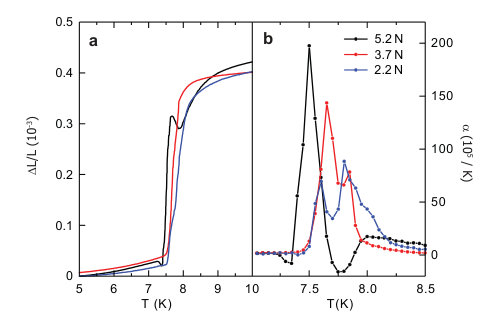 Figure 1
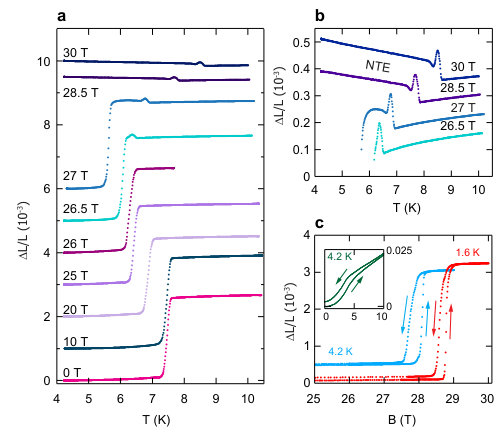 Figure 2
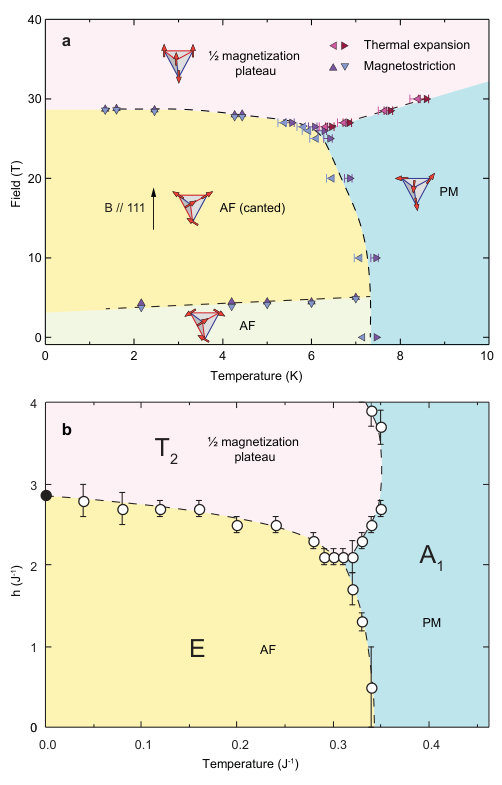 Figure 3
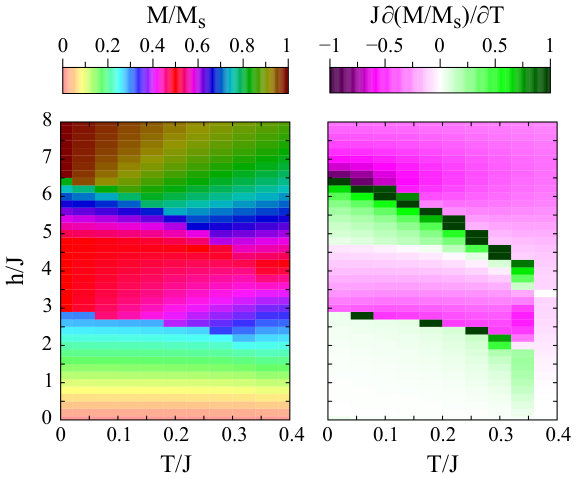 Figure 4
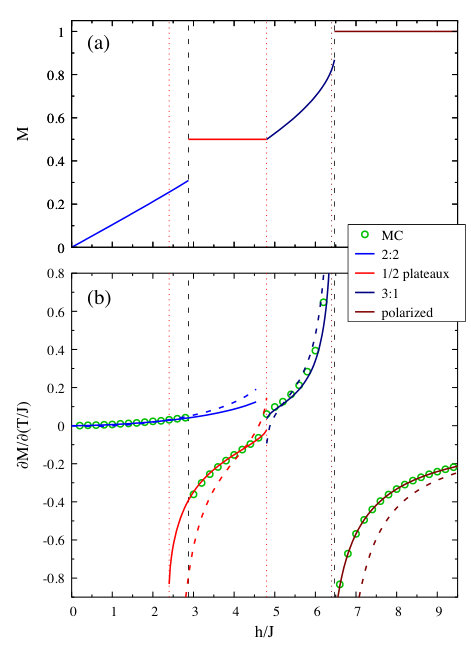 Figure 5
Peer Reviews
No public reviews on file for this paper yet. If you reviewed it on a platform where reviews are public (OpenReview, ICLR, NeurIPS, ICML), you can paste yours below so the community can read it here.
Videos
No videos yet. Explain this paper in a talk, walkthrough, or lecture? Add one.
Negative thermal expansion in the plateau state of a
magnetically–frustrated spinel
L. Rossi
A. Bobel
S. Wiedmann
High Field Magnet Laboratory (HFML-EMFL), Radboud University, Nijmegen, Netherlands
Radboud University, Institute of Molecules and Materials, Nijmegen, Netherlands
R. Küchler
Max Planck Institute for Chemical Physics of Solids, Nöthnitzer Str. 40, 01187 Dresden, Germany
Y. Motome
Department of Applied Physics, The University of Tokyo, Hongo 7-3-1, Bunkyo-ku, Tokyo 113-8656, Japan
K. Penc
Institute for Solid State Physics and Optics, Wigner Research Centre for Physics, Hungarian Academy of Sciences, Budapest, Hungary
N. Shannon
Okinawa Institute of Science and Technology Graduate University, Onna–son, Okinawa 904–0495, Japan
Department of Physics, Technische Universität München, D-85748 Garching, Germany
H. Ueda
Department of Chemistry, Graduate School of Science, Kyoto University, Kyoto, Japan
B. Bryant
High Field Magnet Laboratory (HFML-EMFL), Radboud University, Nijmegen, Netherlands
Radboud University, Institute of Molecules and Materials, Nijmegen, Netherlands
Abstract
We report on negative thermal expansion (NTE) in the high–field, half–magnetization plateau phase of the frustrated magnetic insulator CdCr2O4. Using dilatometry, we precisely map the phase diagram at fields of up to , and identify a strong NTE associated with the collinear half–magnetization plateau for . The resulting phase diagram is compared with a microscopic theory for spin–lattice coupling, and the origin of the NTE is identified as a large negative change in magnetization with temperature, coming from a nearly–localised band of spin excitations in the plateau phase. These results provide useful guidelines for the discovery of new NTE materials.
Frustrated magnets are materials with competing spin interactions, which cannot be simultaneously satisfied. While these materials are most famous as a playground for novel phases such as quantum spin liquids Lee (2008); Savary and Balents (2017), they also exhibit other, more technologically–relevant properties, such as multiferroicity Cheong and Mostovoy (2007); Tokura et al. (2014); Fiebig et al. (2016), and an enhanced magnetocaloric effect Zhitomirsky (2003); Zhitomirsky and Honecker (2004); Zhitomirsky and Tsunetsugu (2005); Derzhko and Richter (2006); Schmidt et al. (2007). Negative thermal expansion (NTE) is another unusual phenomenon often observed in frustrated magnets Ramirez et al. (2000); Shiga et al. (1993); Hemberger et al. (2007); Li et al. (2016). This effect provides a route for the control of thermal expansion necessary to ensure the performance of high–precision devices Takenaka (2018), so theoretical models which can act as a guide for discovery of new NTE materials are highly valuable.
In frustrated magnets with a strong coupling between the spin and lattice degrees of freedom, the interplay between magnetic field and spin–lattice coupling produces a range of phases in which frustration is partially relieved, an effect known as “order by distortion” Yamashita and Ueda (2000); Tchernyshyov et al. (2002a, b); Penc et al. (2004); Motome et al. (2006); Bergman et al. (2006); Shannon et al. (2010). A paradigm for this type of behaviour is provided by Cr–spinels, which exhibit many different magnetically–ordered phases as a function of magnetic field Ueda et al. (2006); Rudolf et al. (2007); Kojima et al. (2008); Tsurkan et al. (2011); Miyata et al. (2011a, b, 2012). Many of these systems exhibit NTE Hemberger et al. (2007); Yokaichiya et al. (2009); Tachibana et al. (2011), including the spinel CdCr2O4 in zero magnetic field Kitani et al. (2013). This suggests that the unusual thermodynamic behaviour may have a common origin; however to date there is no general understanding of this phenomenon, or how it is linked to spin–lattice coupling. Moreover, to obtain a complete picture of NTE in spinels, high–precision measurements are also needed for the ordered phases induced by magnetic field.
In this Letter, we report on thermal expansion and magnetostriction measurements of the frustrated spinel CdCr2O4, in magnetic fields up to 30 T. We map the phase diagram, which we compare to that derived from a microscopic model of spin–lattice coupling. The high–field half–magnetization plateau phase exhibits enhanced thermal stability compared to theory, characteristic of a strong spin–lattice coupling in this phase. This state also shows a marked NTE, distinct from that observed in zero field. Starting from the same model of spin–lattice coupling, we develop a microscopic theory of this NTE, and identify its origin as being a band of nearly–localised magnetic excitations. These results provide a general framework for modelling and predicting NTE in pyrochlore lattices, and in frustrated magnets in general.
The pyrochlore lattice, which consists of corner sharing tetrahedra, is a well–known stage for strong geometric frustration Gardner et al. (2010). This structure is realized in the position of the Cr3+ ions in the chromium spinels ACr2X4, where A is Zn, Cd or Hg and X is O, S or Se. The strength and sign of the Cr-Cr spin coupling depends strongly on the interatomic distance Yaresko (2008); Ueda and Ueda (2008), leading to a strong coupling between spin ordering and lattice distortions. The oxide spinels ACr2O4 all have antiferromagnetic spin coupling and are magnetically frustrated: because of the frustration they remain paramagnetic down to temperatures well below the Curie–Weiss temperature . At TN the spin frustration is relieved due to a spontaneous lattice distortion Yamashita and Ueda (2000); Tchernyshyov et al. (2002a); *Tchernyshyov2002PRB, which allows a noncollinear spin–spiral antiferromagnetic ground state Matsuda et al. (2007, 2010).
The Cr oxide spinels show another magnetostructural transition at high magnetic field, into a collinear state with one–half of the saturation magnetization, in which three of the spins in each tetrahedron point “up”, and one points “down” Penc et al. (2004); Ueda et al. (2005, 2006); Shannon et al. (2006, 2010). This state has a constant magnetization across a wide range of magnetic fields, and it is thus often referred to as the “plateau” state. Both the magnetostructural transition at TN and the transition to the half–magnetization plateau are manifestations of the strong spin–lattice-coupling in the Cr oxide spinels: a developed microscopic magnetoelastic theory Penc et al. (2004); Bergman et al. (2006), describes how the plateau state is stabilized by the spin–lattice coupling Miyata et al. (2011a, 2012).
In order to probe the interplay of frustration and spin–lattice coupling, we performed thermal expansion and magnetostriction measurements of CdCr2O4 using capacitive dilatometry at low temperatures and high magnetic fields up to 30 T Küchler et al. (2012, 2017). This compound was chosen since it is highly frustrated, with T 10, high quality single crystals are available, and it is possible to reach the plateau phase in static (DC) high field facilities. So far, zero–field thermal expansion measurements Kitani et al. (2013), and pulsed–field magnetostriction measurements Ueda et al. (2005), have been reported. We measured the strain along the [111] direction: the magnetic field is parallel to the [111] direction. The sample is clamped between two plates in the dilatometer, thus applying a small [111] uniaxial pressure. The effect of varying the applied pressure is discussed in the Supplemental Material 111See Supplemental Material for additional data on the effect of varying applied stress, the derivation of Eq. (3) and discussion of the microscopic origin of , including refs Chacon et al. (2015); Chung et al. (2013). We studied a series of single–crystal samples, all of which are plate–like with wide (111) faces, around 3-5 mm in diameter and between 80 m and 500 m thick.
High field measurements were carried out with the sample mounted in a compact capacitive dilatometer in a 30 T resistive Bitter magnet Küchler et al. (2012). Fig. 1(a) presents thermal expansion from 4.2 K to 10.4 K at zero field and at field increments up to 30 T. Clearly visible up to 27 T is the magnetostructural transition at TN, seen here on warming from the tetragonal antiferromagnetic phase to the cubic paramagnetic phase. decreases from 7.5 K at zero field to 5.5 K at 27 T, while the measured [111] strain at remains constant. Above 26.5 T, the transition from the high–temperature paramagnetic phase to the low–temperature half–magnetization plateau phase can be seen in the data as a peak superposed on a step, Fig. 1(b). The appearance or the absence of the peak is sample dependent, while the step was present in all the measured samples. Both phases are cubic - the paramagnetic state Fdm, the plateau state P Matsuda et al. (2010), so, from measurements on three samples, we can estimate a change in unit cell volume on cooling, of 222In this estimate we are assuming that both phases have cubic symmetry, thus neglecting any structural anisotropy induced by magnetic field. Such distortions may be regarded as second-order corrections Penc et al. (2004). We can explain this increase in volume qualitatively as part of the general principle of the magnetoelastic theory that increased magnetization leads to increased unit cell volume, if antiferromagnetic interactions are assumed Penc et al. (2004). Below this transition and above 27 T, NTE is seen in the plateau phase, shown in Fig. 1(b).
In addition to thermal expansion, constant–temperature magnetostriction measurements were made, with field sweeps up to 30 T, at temperatures between 1.3 K and 4.2 K. Fig. 1(c) shows the results from 25 T to 30 T. We see a hysteretic transition from the tetragonal antiferromagnetic phase to the plateau phase, which is consistent with a first order phase transition. The sweep rate close to the transition was 0.5 T / min. Previous pulsed field measurements reported a colossal negative magnetostriction at the transition to the half–magnetization plateau, for both [111] and [110] directions Ueda et al. (2005); Shannon et al. (2006). In our [111] measurements we find a positive magnetostriction at this transition 333The negative magnetostriction in ref. Ueda et al. (2005) might have been caused by an anomalous strain induced by thermal contraction of an adhesive used to mount the sample. H. Ueda, private communication (2019). This is consistent both with measurements on HgCr2O4 Tanaka et al. (2007), and with the magnetoelastic theory Penc et al. (2004), in which jumps in magnetization are mirrored by unit cell expansion. Both the transition with field to the plateau phase (Fig. 1(c)) and the thermal transition at to the cubic, paramagnetic phase (Fig. 1(a)) have the same sign and similar magnitude in . This indicates that these phases have a similar unit cell, and supports the finding that the plateau phase also has overall cubic symmetry Inami et al. (2006); Matsuda et al. (2010).
We also performed a second magnetostriction experiment in a superconductor magnet, between zero and 15 T and from 2.2 K to 7 K. The inset in Fig. 1(c) presents magnetostriction data at 4.2 K, which show a hysteretic low field transition at around 4.5 T. A similar transition has previously been observed in magnetization data Kimura et al. (2006); Matsuda et al. (2007). Based on ESR and optical spectroscopy measurements Kimura et al. (2006); Sawada et al. (2014) this has been interpreted as a transition from a helical structure to a commensurate canted spin structure. Neutron diffraction experiments, though, appear to rule out an incommensurate to commensurate transition Matsuda et al. (2007), instead implying a rearrangement of spin spiral domains between 2.5 and 6 T. When the field is in the a-c plane in which the spins rotate in the spiral, a spin–flop is observed: since we apply the field along the [111] direction we would expect a flop to a conical spin spiral.
We can summarize the results from the thermal expansion and magnetostriction measurements in a phase diagram, shown in Fig. 2(a). Three main phases are described: the high–temperature paramagnetic phase, the antiferromagnetic phase below 7.5 K and below 28.7 T, and the high–field half–magnetization plateau phase. Inside the antiferromagnetic phase we identify a low field transition, which increases from 4.3 T at 2.2 K to 5.1 T at 7 K. Hysteresis is observed in all the transitions. We do not find any experimental evidence of the additional phase transition recently reported from sound velocity measurements Zherlitsyn et al. (2015), though the temperature dependence of the low field transition is consistent with that report. Our new phase diagram is more precise for fields above 12 T than previous diagrams Ueda et al. (2005); Kojima et al. (2008).
We can use a microscopic magnetoelastic theory to reproduce the experimental phase diagram, and explain the presence of NTE in the plateau state. A simple Hamiltonian to account for the effects of spin–lattice coupling on the phase transitions in applied magnetic field in Cr spinels was introduced in Penc et al. (2004):
[TABLE]
where the summation is over the nearest neighbor bonds on the pyrochlore lattice. is the antiferromagnetic exchange interaction, is the spin-lattice coupling, is the change of the length of the bonds from the equilibrium distances in the paramagnetic phase, is the elastic constant and is the applied magnetic field. In its simplest form, this theory reduces to solving an effective spin model with only two adjustable parameters,
[TABLE]
where reflects the strength of the spin–lattice coupling. In the case of CdCr2O4, measurements of magnetization lead to an estimate of Kimura et al. (2015).
The effective spin model [Eq. (2)] can be solved using classical Monte Carlo calculations Motome et al. (2006); Shannon et al. (2006), leading to the phase diagram shown in Fig. 2(b). Here, calculations have been carried out for 4–sublattice order, stabilized by an additional third–neighbor interaction Motome et al. (2006). However, very similar results are obtained for 16–sublattice order Motome et al. (2008). The phase diagram in Fig. 2(b) has been calculated for : for purposes of comparison, the results have been scaled for the experimental values of TN and the critical field Hc1.
The Monte Carlo results reproduce the experimental phases well, particularly the B-T dependence of the transitions to the antiferromagnetic phase. The main discrepancy between theory and experimental data is seen in the transition from the paramagnetic phase to the plateau phase, which experimentally has a considerably lower slope in B/T. This indicates that the plateau phase is stable to a higher temperature than the antiferromagnetic phase, as observed experimentally for HgCr2O4 Ueda et al. (2006). By contrast, the Monte Carlo phase diagram (Fig. 2(b)) predicts that the plateau phase is stable only up to a temperature similar to TN. In a more general formulation of the magnetoelastic theory, the coefficient of spin–lattice coupling, , takes on different values in phases in which tetrahedra undergo distortions with different symmetry Penc et al. (2004, 2007). In the present case, this leads to three distinct parameters; (uniform changes in volume); (tetragonal distortions, found in the AF phase); (trigonal distortions, found in the half–magnetization plateau). From detailed comparison of the magnetoelastic theory to magnetization and ESR data for CdCr2O4, Kimura et al. Kimura et al. (2015) obtain = 0.05, = 0.1, = 0.14. The Monte Carlo calculations shown in Fig. 2(b) assume = = = 0.1 so probably underestimate , and hence the thermal stability of the plateau state, explaining the discrepancy seen between the experimental and theoretical results.
We now turn to the issue of the NTE in the plateau phase. Several spinel compounds show NTE at zero field, including CdCr2S4 Tachibana et al. (2011), ZnCr2Se4 Hemberger et al. (2007); Chen et al. (2014), and CdCr2O4 Kitani et al. (2013). In all of these cases, the onset of NTE on cooling is in the paramagnetic phase, above the magnetic ordering temperature. Zero–field NTE in CdCr2O4 occurs exclusively within the paramagnetic phase for Kitani et al. (2013). This contrasts with the results in field, presented in Fig. 1, in which there is an abrupt onset of NTE at the magnetic ordering temperature, and the NTE occurs only within the low-temperature ordered phase. This suggests that the NTE observed within the plateau phase of CdCr2O4, may have a qualitatively different origin from that observed in the paramagnetic phase in zero field.
NTE in pyrochlore lattices is often attributed to strong spin–lattice coupling Hemberger et al. (2007); Tachibana et al. (2011); Kitani et al. (2013), but a general, microscopic theory is lacking. It is therefore interesting to explore the predictions of the microscopic model of spin–lattice coupling, Eq. (1). These calculations, which are developed in the Supplemental Material 111 , naturally divide into two parts; (1) an analysis of the different symmetry channels in which the lattice can distort, each with its own associated form of magnetic order; and (2) a characterisation of the spin excitations within each different ordered phase. We find that the dominant magnetic contribution to the thermal expansion comes from the dependence of the (volume) distortion on the magnetization, viz:
[TABLE]
where is the equilibrium lattice spacing, and and are magnetoelastic couplings defined through Eq. (1).
NTE will occur when the magnetic contribution, Eq. (3), is both negative and sufficiently large to overcome the usual thermal expansion of the lattice Hausch (1973). This criterion is easily met in the half-magnetization plateau of CdCr2O4, where and are individually large and positive, and the existence of a nearly–localised band of spin excitations at low energies provides a microscopic explanation for the rapid decrease of magnetization with temperature, 111.
This mechanism finds validation in both experiment Ueda et al. (2005), where the magnetization is observed to be sharply suppressed by increasing temperature, and in Monte Carlo simulation, as shown in Fig. S2 and Fig. S3 111, and in Ref. Motome et al. (2006). It is also interesting to note that the NTE must be accompanied by a substantially–enhanced magnetocaloric effect (MCE)
[TABLE]
coming from the same nearly–localised band of excitations Zhitomirsky (2003); Derzhko and Richter (2006); Schmidt et al. (2007). To the best of our knowledge, this has yet to be measured in experiment.
In making this analysis, we have assumed in Eq. (3) that does not vary with temperature: this is a good approximation for changes occurring within a given phase, although clearly can change substantially between phases with different lattice symmetry Kimura et al. (2015). We can estimate the fractional change in with temperature within the plateau phase, from the known dependence of on the Cr-Cr spacing Ueda and Ueda (2008) and the magnitude of the NTE, at . We note that ZnCr2Se4 shows a positive Curie–Weiss temperature while ordering antiferromagnetically, and this has been taken to imply that J varies strongly with temperature [50]. However we conclude that this is attribute is not necessary to achieve NTE.
While Eq. (3) has been derived here in the context of the half–magnetization plateau of a Cr spinel, it has a much wider validity, and we would expect NTE to occur in many pyrochlore compounds where the above criteria are met: this is supported by measurements on other Cr spinels. In CdCr2S4, NTE is observed to set in below 98 K in the paramagnetic phase, and persists into the ferromagnetic phase Tachibana et al. (2011): here in both phases. ZnCr2Se4 shows NTE below 75 K, but it is suppressed below TN = 21 K Hemberger et al. (2007); Chen et al. (2014), where . We would also predict NTE to occur in the high–field saturated magnetization phase of the oxide spinels 111.
In summary, we made thermal expansion and magnetostriction measurements of the frustrated spinel CdCr2O4, at low temperatures and at magnetic fields up to 30 T. The experimental phase diagram strongly resembles that produced from Monte Carlo simulations of a minimal model of spin–lattice coupling, but diverges in that the plateau phase is more thermally stable than predicted, providing independent verification of the particularly strong spin–lattice coupling in this phase. We also observe NTE in the half–magnetization plateau phase, and show how this can be explained in terms of the same microscopic model. We find the origin of the NTE to be a large, negative temperature–derivative of magnetization, which comes from a band of nearly–localized spin excitations.
These results are applicable across a broad range of spinel and pyrochlore magnets, and potentially other frustrated magnets. They offer a route to the identification of other new NTE materials, by suggesting that NTE is likely to occur in frustrated magnets where there is a collinear magnetic phase with a flat band. The results also imply a strong link between NTE and an enhanced magnetocaloric effect.
Acknowledgements.
This work was supported by the Dutch funding organization NWO-I and by HFML-RU/FOM, a member of the European Magnetic Field Laboratory (EMFL). R.K. is is supported by the German Science Foundation through Project No. KU 3287/1-1, K.P. by Hungarian NKFIH Grant No. K 124176 and BME - Nanonotechnology and Materials Science FIKP grant of EMMI (BME FIKP-NAT), and N.S. by the Theory of Quantum Matter Unit of the Okinawa Institute of Science and Technology Graduate University. K.P. acknowledges the hospitality of the Theory Quantum Matter Unit, OIST, where part of this work was carried out.
The reference list from the paper itself. Each links out to its DOI / PubMed record.
- 1Lee (2008) P. A. Lee, Science 321 , 1306 (2008) . · doi ↗
- 2Savary and Balents (2017) L. Savary and L. Balents, Reports on Progress in Physics 80 , 016502 (2017) .
- 3Cheong and Mostovoy (2007) S.-W. Cheong and M. Mostovoy, Nature Materials 6 , 13 (2007) . · doi ↗
- 4Tokura et al. (2014) Y. Tokura, S. Seki, and N. Nagaosa, Reports on Progress in Physics 77 , 076501 (2014) . · doi ↗
- 5Fiebig et al. (2016) M. Fiebig, T. Lottermoser, D. Meier, and M. Trassin, Nature Reviews Materials 1 , 16046 EP (2016) . · doi ↗
- 6Zhitomirsky (2003) M. E. Zhitomirsky, Phys. Rev. B 67 , 104421 (2003) . · doi ↗
- 7Zhitomirsky and Honecker (2004) M. E. Zhitomirsky and A. Honecker, Journal of Statistical Mechanics: Theory and Experiment 2004 , P 07012 (2004) . · doi ↗
- 8Zhitomirsky and Tsunetsugu (2005) M. E. Zhitomirsky and H. Tsunetsugu, Progress of Theoretical Physics Supplement 160 , 361 (2005) . · doi ↗