
TL;DR
This paper reviews experimental searches for a potential new Higgs boson around 96 GeV, discussing hints from CMS and LEP, and explores theoretical interpretations within BSM models like NMSSM and munuSSM.
Contribution
It summarizes experimental hints and explores possible theoretical explanations for a new Higgs-like particle at 96 GeV within various BSM frameworks.
Findings
CMS reports a diphoton excess at 96 GeV
LEP data shows a 2 sigma hint in bb final state
Discussion of BSM models explaining the potential signal
Abstract
We briefly summarize some searches for Higgs bosons with a mass of m_phi <= 110 GeV at LEP and the LHC. We discuss a possible signal in the diphoton decay mode at m_phi = 96 GeV as reported by CMS, together with a 2 sigma hint in the bb final state at LEP. We briefly review possible interpretation of such a new particle in various BSM models. We focus on possible explanations as reported within the NMSSM and the munuSSM. Conclusions for future collider projects are briefly outlined.
Click any figure to enlarge with its caption.
 Figure 1
 Figure 2
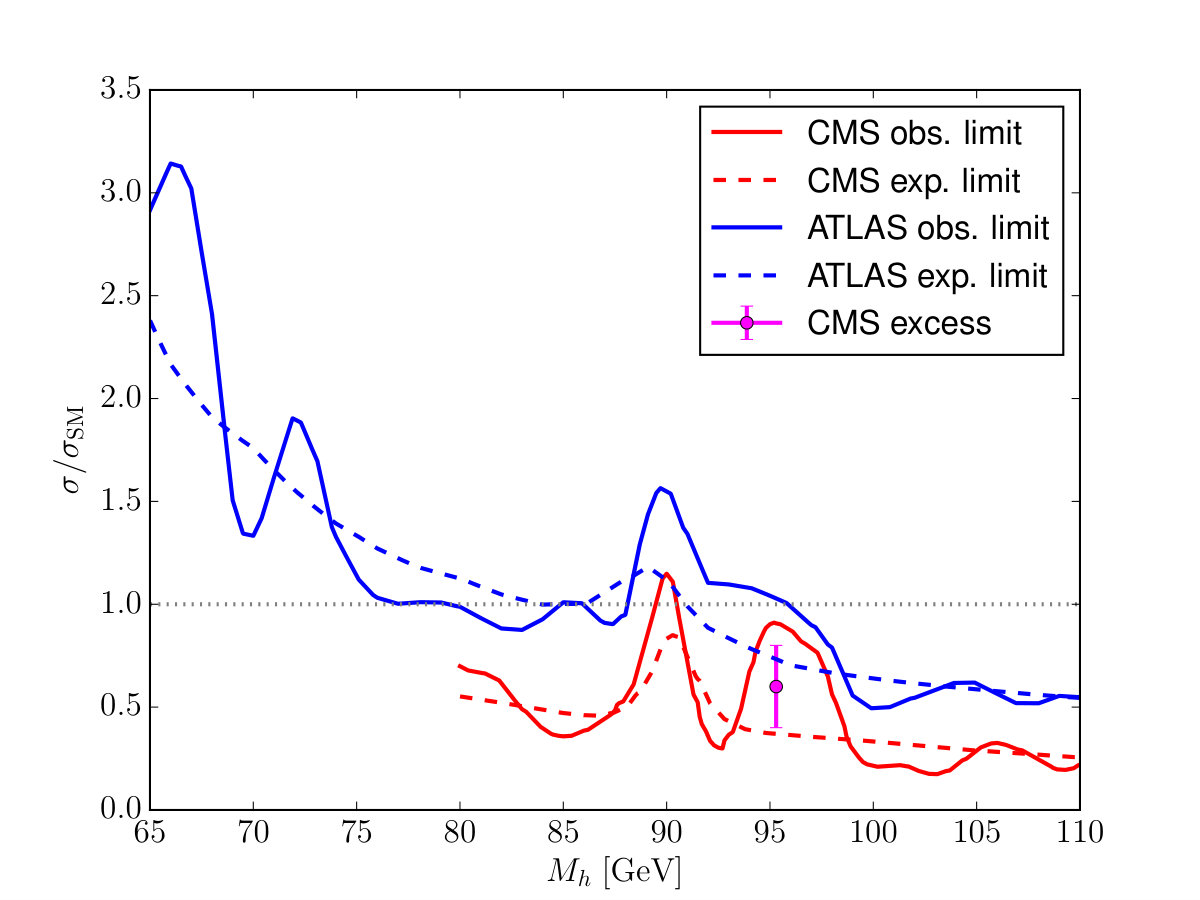 Figure 3
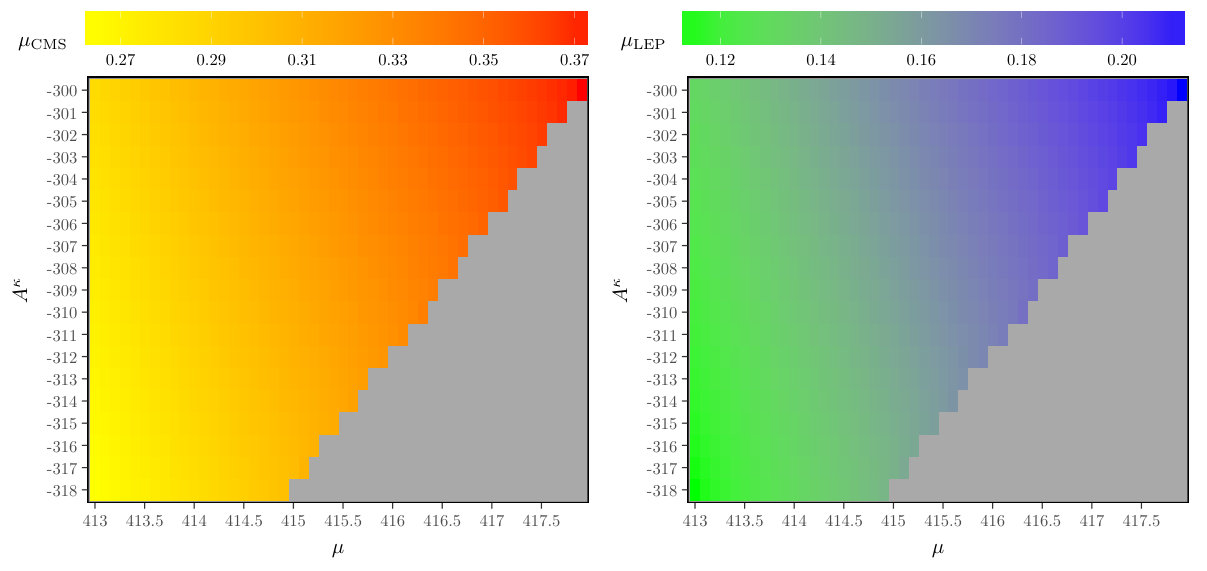 Figure 4
| [GeV] | ||||
| [GeV] | ||||
| [GeV] | ||||
| [GeV] | ||||
| [GeV] | ||||
| [GeV] | ||||
| [GeV] | ||||
| [GeV] |
Peer Reviews
No public reviews on file for this paper yet. If you reviewed it on a platform where reviews are public (OpenReview, ICLR, NeurIPS, ICML), you can paste yours below so the community can read it here.
Videos
No videos yet. Explain this paper in a talk, walkthrough, or lecture? Add one.
A Higgs Boson at 96 GeV?!
Instituto de Física Teórica, (UAM/CSIC), Universidad Autónoma de Madrid,
Cantoblanco, E-28049 Madrid, Spain
Campus of International Excellence UAM+CSIC, Cantoblanco, E-28049, Madrid, Spain
Instituto de Física de Cantabria (CSIC-UC), E-39005 Santander, Spain
T. Stefaniak
DESY, Notkestraße 85, D-22607 Hamburg, Germany
Abstract:
We briefly summarize some searches for Higgs bosons with a mass of at LEP and the LHC. We discuss a possible signal in the diphoton decay mode at as reported by CMS, together with a hint in the final state at LEP. We briefly review possible interpretation of such a new particle in various BSM models. We focus on possible explanations as reported within the NMSSM and the \mnSSM. Conclusions for future collider projects are briefly outlined.
1 Introduction
In the year 2012 the ATLAS and CMS collaborations have discovered a new particle that – within theoretical and experimental uncertainties – is consistent with the existence of a Standard-Model (SM) Higgs boson at a mass of [2, 3, 4]. No conclusive signs of physics beyond the SM have been found so far at the LHC. However, the measurements of Higgs-boson couplings, which are known experimentally to a precision of roughly , leave room for Beyond Standard Model (BSM) interpretations. Many BSM models possess extended Higgs-boson sectors. Consequently, one of the main tasks of the LHC Run II and beyond will be to determine whether the observed scalar boson forms part of the Higgs sector of an extended model.
Motivated by the Hierarchy Problem, Supersymmetry (SUSY) extensions of the SM play a prominent role in the exploration of new physics. SUSY doubles the particle degrees of freedom by predicting two scalar partners for all SM fermions, as well as fermionic partners to all SM bosons. The simplest SUSY extension is the Minimal Supersymmetric Standard Model (MSSM) [5, 6]. In contrast to the single Higgs doublet of the SM, in the MSSM two Higgs doublets, and , are required. In the conserving case the MSSM Higgs sector consists of two -even, one -odd and two charged Higgs bosons. The light (or the heavy) -even MSSM Higgs boson can be interpreted as the signal discovered at [7] (see Refs. [8, 9] for recent updates).
Going beyond the MSSM, a well-motivated extension is given by the Next-to-MSSM (NMSSM), see e.g. [10, 11] for reviews. The NMSSM provides a solution for the so-called “ problem” by naturally associating an adequate scale to the parameter appearing in the MSSM superpotential [12, 13]. In the NMSSM a new singlet superfield is introduced, which only couples to the Higgs- and sfermion-sectors, giving rise to an effective -term, proportional to the vacuum expectation value (vev) of the scalar singlet. In the conserving case the NMSSM Higgs sector consists of three -even Higgs bosons, (), two -odd Higgs bosons, (), and the charged Higgs boson pair . In the NMSSM the lightest but also the second lightest -even Higgs boson can be interpreted as the signal observed at about , see, e.g., [14, 15].
A natural extension of the NMSSM is the \mnSSM, in which the singlet superfield is interpreted as a right-handed neutrino superfield [16, 17] (here we focus on the “one generation case”), see Refs. [18, 19, 20] for reviews. The \mnSSM is the simplest extension of the MSSM that can provide massive neutrinos through a see-saw mechanism at the electroweak scale. A Yukawa coupling for the right-handed neutrino of the order of the electron Yukawa coupling is introduced that induces the explicit breaking of -parity. One consequences is that there is no lightest stable SUSY particle anymore. Nevertheless, the model can still provide a dark matter candidate with a gravitino that has a life time longer than the age of the observable universe [21, 22, 23, 24]. The explicit violation of lepton number and lepton flavor can modify the spectrum of the neutral and charged fermions in comparison to the NMSSM. The three families of charged leptons will mix with the chargino and the Higgsino and form five massive charged fermions. Within the scalar sector, due to -parity breaking, the left- and right-handed sneutrinos will mix with the doublet Higgses and form six massive -even and five massive -odd states, assuming that there is no -violation. Also in the \mnSSM the signal at can be interpreted as the lightest or the second lightest -even scalar. As SUSY models, but also other BSM Higgs-boson sector extensions can possess a scalar below the search for such light scalars is of high importance at the LHC.
2 Experimental data
Searches for Higgs bosons below have been performed at LEP, the Tevatron and the LHC. LEP reported a local excess observed in the searches [25], which would be consistent with a scalar mass of (but due to the final state the mass resolution is rather coarse). The “excess” corresponds to
[TABLE]
where the signal strength is the measured cross section normalized to the SM expectation, with the SM Higgs-boson mass at . The value for was extracted in Ref. [26] using methods described in Ref. [27].
Interestingly, recent CMS Run II results [28] for Higgs searches in the diphoton final state show a local excess of around , with a similar excess of in the Run I data at a comparable mass. In this case the “excess” corresponds to (combining 7, 8 and data)
[TABLE]
First Run II results from ATLAS with fb*-1* in the searches below GeV were recently published [29]. No significant excess above the SM expectation was observed in the mass range between and . However, the limit on cross section times branching ratio obtained in the diphoton final state by ATLAS is not only well above , but even weaker than the corresponding upper limit obtained by CMS at . This is illustrated in Fig. 1, where we compare the expected (dashed) and observed (solid) limits in the channel (normalized to the SM value) as reported by CMS (red) and ATLAS (blue) as a function of . Shown in magenta is of Eq. (2). The “weaker” expected (and observed) exclusion around corresponds to the peak, where a larger background is expected.
3 BSM models
Several analyses attempted to explain the combined “excess” of LEP and CMS in a variety of BSM models111More analyses attempted to explain one of the two “excesses”, but we will not discuss these further here.. To our knowledge explanations exist in the following frameworks (see also [30]):
- •
Higgs singlet with additional vector-like matter, as well as Type-I 2HDM [31].
- •
Radion model [32].
- •
Type-I 2HDM with a moderately-to-strongly fermiophobic -even Higgs [33].
- •
\mnSSM
[34], as will be discussed in Sect. 3.2.
- •
Higgs associated with the breakdown of an symmetry [35].
- •
NMSSM [36], as will be discussed in Sect. 3.1.
- •
Higgs inflation inspired NMSSM [37].
On the other hand, in the MSSM the CMS excess cannot be realized [8].
3.1 The NMSSM solution
The results in this section are based on Ref. [36]. Within the NMSSM a natural candidate to explain the LEP “excess” consists in a mostly singlet-like Higgs with a doublet component of about (mixing squared). Relatively large Higgs branching fractions into are possible due to the three-state mixing, in particular when the effective Higgs coupling to becomes small, see e.g. Refs. [38, 39]. In our numerical analysis we display the quantities and , defined as follows:
[TABLE]
These definitions of give estimates of the signals that would generate in the LEP searches for and the LHC searches for , normalized to the SM cross-sections. In the analysis in Ref. [36] constraints from “other sectors” (such as Dark Matter or ) are not taken into account, as they are not closely related to Higgs sector physics.
The NMSSM parameters are chosen as (see Ref. [36] for definitions and details),
[TABLE]
In our analysis we vary in a narrow interval as indicated above. It was tested with HiggsBounds -4.3.1 (and 5.1.1beta) [40, 41, 42, 43, 44] and HiggsSignals-1.3.1 (and 2.1.0beta) [45, 46, 47, 44] that our parameter points are in agreement with the Higgs rate measurements at the LHC as well as with the Higgs boson searches at LEP, the Tevatron and the LHC.
With growing , the mixing between the two light -even states increases, eventually pushing the singlet mass down to and the mass of the SM-like state up to . Consistency with the experimental results obtained on the observed state at GeV is achieved for a mass of the SM-like state that is compatible with the LHC discovery within experimental and theoretical uncertainties. The -odd singlet has a mass of , while the heavy doublet states are at in this scenario. The decay properties of and are given in Tab. 1 (for a specific point). The quantities and of Eq. (3), are shown in Fig. 2, estimating the signals associated with in the channel at LEP and in the channel at the LHC, as compared to an SM Higgs at the same mass. The magnitude of the estimated signal reaches of that of an SM Higgs at , while corresponds to more than of an SM signal in the same mass range. In this example, (or ) is only moderately enhanced with respect to the SM branching fraction due to an -dominated doublet composition of , while remains dominant, albeit slightly suppressed. This scenario would thus simultaneously address the LEP and the CMS excesses in a phenomenologically consistent manner.
3.2 The \mnSSM solution
The results in this section are based on Ref. [34]. Within the \mnSSM (in the simplified “one generation case”) we will interpret the light scalar as the -even right-handed sneutrino. Since the singlet of the NMSSM and the right-handed sneutrino of the \mnSSM are both gauge-singlets, they share very similar properties. However, the explanation of the excesses in the \mnSSM avoids bounds from direct detection experiments, because -parity is broken in the \mnSSM and the dark matter candidate is not a neutralino as in the NMSSM but a gravitino with a lifetime longer than the age of the universe [19]. This can be important since the direct detection measurements were shown to be very constraining in the NMSSM while trying to explain the dark matter abundance on top of the excesses from LEP and CMS [26].
In Tab. 2 we list the values of the parameters we used to account for the lightest -even scalar as the right-handed sneutrino and the second lightest one the SM-like Higgs boson (see Ref. [34] for definitions and details). As in the NMSSM HiggsBounds and HiggsSignals were used to ensure the compatibility with experimental data. In the analysis in Ref. [34] constraints from “other sectors” (such as flavor physics or ) are not taken into account, as they are not closely related to Higgs sector physics. is chosen to be large to account for a sizable mixing of the right-handed sneutrino and the doublet Higgs bosons. In the regime where the SM-like Higgs boson is not the lightest scalar, one does not need large quantum corrections to the Higgs boson mass (which were evaluated according to Ref. [34]), because the tree-level mass is already well above . This is why can be low and the soft trilinear couplings are set to zero. The values of and are chosen to be around to get masses for the heavy MSSM-like Higgs and the left-handed sneutrinos of this order, so they do not play an important role in the following discussion. On the other hand, is small to bring the mass of the right-handed sneutrino below the SM-like Higgs boson mass. Finally, the two parameters that are varied are and . By increasing the mixing of the right-handed sneutrino with the SM-like Higgs boson is increased, which is needed to couple the gauge-singlet to quarks and gauge-bosons. At the same time we used the value of to keep the mass of the right-handed sneutrino in the correct range.
The result are shown in Fig. 3, the CMS (left) and the LEP excesses (right) in the – plane. While the LEP excess is easily reproduced in the observed parameter space, we cannot achieve the central value for , but only slightly smaller values. As already observed in Ref. [26], the reason for this is that for explaining the LEP excess a sizable coupling to the bottom quark is needed. On the contrary, the CMS excess demands a small value for the coupling so that the total width of the becomes small and is enhanced. Nevertheless, considering the large experimental uncertainties in and , the scenario reviewed in this section accommodates both excesses comfortably well (at approximately ).
4 Conclusions (for future colliders)
Searches for Higgs bosons below have been performed at LEP, the Tevatron and the LHC. We have briefly reviewed that LEP reported a local excess observed in the searches [25], which would be consistent with a scalar mass of (but with a rather coarse mass resolution). Furthermore, recent LHC Run II results [28] for CMS Higgs searches in the diphoton final state show a local excess of in the vicinity of , with a similar upward fluctuation of in the Run I data at a comparable mass. First Run II results from ATLAS with fb*-1* in the searches below GeV are well compatible with the limit obtained by CMS at (although not showing a relevant excess).
We have briefly reviewed BSM interpretations, explaining simultaneously the LEP and the CMS “excess”. In particular we have reviewed the solution within the NMSSM and the \mnSSM. Within the NMSSM we investigated the case of a mostly singlet-like state with a mass of GeV. The decays of such a state can be notably affected by suppressed couplings to down- or up-type quarks which can occur in certain parameter regions due to the mixing between the different Higgs states. In particular, an additional Higgs boson of this kind could manifest itself via signatures in the channels and/or . The presence of such a light Higgs boson could thus explain the “excesses” reported by LEP and CMS in those channels.
Within the \mnSSM we reviewed that this model can accommodate a right-handed (-even) scalar neutrino with a mass of , where the full Higgs sector is in agreement with the Higgs-boson measurements and exclusion bounds obtained at the LHC, as well as at LEP and the Tevatron. It was demonstrated that the light right-handed sneutrino can explain an excess of events at as reported recently by CMS in their Run I and Run II date. It can simultaneously describe the excess of events observed at LEP at a similar mass scale.
A new Higgs boson with a mass of is easily kinematically accessible at future colliders, assuming an energy of at least . It was shown in Ref. [48] that a light Higgs boson explaining the LEP “excess” is easily within the reach of the ILC250. Further confirmation of these “excesses” would strengthen the already robust physics case for such a machine.
Acknowledgements
S.H. thanks T. Biekötter, F. Domingo, C. Muñoz, S. Paßehr and G. Weiglein, with whom the NMSSM and \mnSSM results presented here have been obtained. S.H. thanks K. Tackmann for interesting discussions. The work of S.H. was supported in part by the MEINCOP (Spain) under contract FPA2016-78022-P, in part by the Spanish Agencia Estatal de Investigación (AEI), in part by the EU Fondo Europeo de Desarrollo Regional (FEDER) through the project FPA2016-78645-P, in part by the “Spanish Red Consolider MultiDark” FPA2017-90566-REDC, and in part by the AEI through the grant IFT Centro de Excelencia Severo Ochoa SEV-2016-0597.
The reference list from the paper itself. Each links out to its DOI / PubMed record.
- 1[1]
- 2[2] G. Aad et al. [ATLAS Collaboration], Phys. Lett. B 716 (2012) 1 [ar Xiv:1207.7214 [hep-ex]].
- 3[3] S. Chatrchyan et al. [CMS Collaboration], Phys. Lett. B 716 (2012) 30 [ar Xiv:1207.7235 [hep-ex]].
- 4[4] G. Aad et al. [ATLAS and CMS Collab.], JHEP 1608 (2016) 045 [ar Xiv:1606.02266 [hep-ex]].
- 5[5] H. P. Nilles, Phys. Rept. 110 (1984) 1.
- 6[6] H. E. Haber and G. L. Kane, Phys. Rept. 117 (1985) 75.
- 7[7] S. Heinemeyer, O. Stål and G. Weiglein, Phys. Lett. B 710 (2012) 201 [ar Xiv:1112.3026 [hep-ph]].
- 8[8] P. Bechtle, H. E. Haber, S. Heinemeyer, O. Stål, T. Stefaniak, G. Weiglein and L. Zeune, Eur. Phys. J. C 77 (2017) no.2, 67 [ar Xiv:1608.00638 [hep-ph]].