Bose-Einstein condensation of dilute alpha clusters above four $\alpha$ threshold in $^{16}$O in field theoretical superfluid cluster model
Junichi Takahashi, Yoshiya Yamanaka, Shigeru Ohkubo

TL;DR
This paper demonstrates the Bose-Einstein condensation of alpha clusters in $^{16}$O using a field-theoretical superfluid model, successfully reproducing experimental energy levels and revealing the underlying symmetry-breaking mechanisms.
Contribution
It introduces a novel field-theoretical superfluid cluster model that explains the alpha cluster states in $^{16}$O as Bose-Einstein condensates, aligning well with experimental data.
Findings
Reproduces experimental energy levels of $^{16}$O.
Identifies low-energy states as Nambu-Goldstone modes.
Shows robustness of alpha cluster structures above threshold.
Abstract
Observed well-developed cluster states in O, located above the four threshold, are investigated from the viewpoint of Bose-Einstein condensation of clusters by using a field-theoretical superfluid cluster model in which the order parameter is defined. The experimental energy levels are reproduced well for the first time by calculation. In particular, the observed 16.7 MeV and 18.8 MeV states with low-excitation energies from the threshold are found to be understood as a manifestation of the states of the Nambu-Goldstone zero-mode operators, associated with the spontaneous symmetry breaking of the global phase, which is caused by the Bose-Einstein condensation of the vacuum 15.1 MeV state with a dilute well-developed cluster structure just above the threshold. This gives evidence of the existence of the Bose-Einstein…
Click any figure to enlarge with its caption.
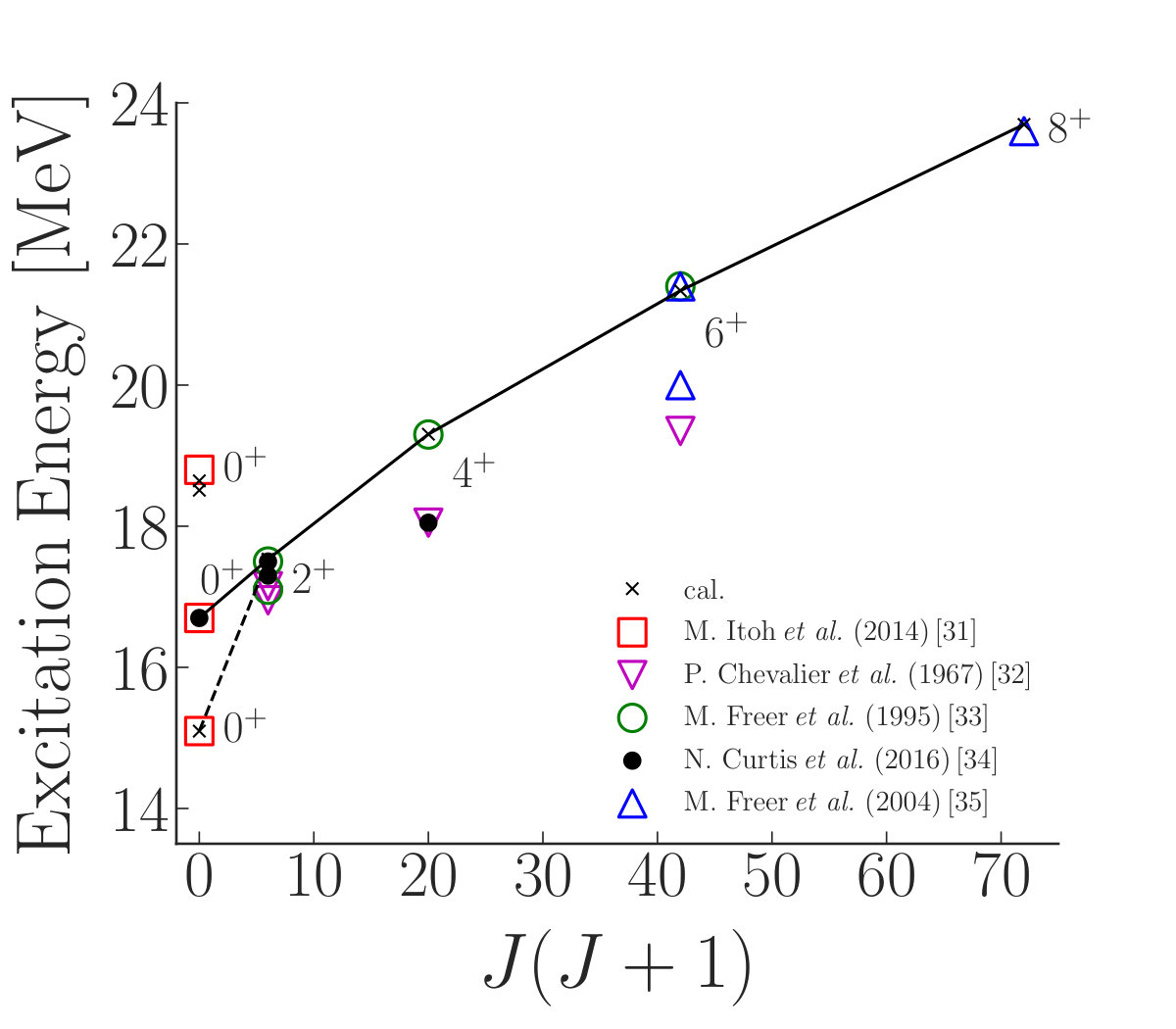 Figure 616
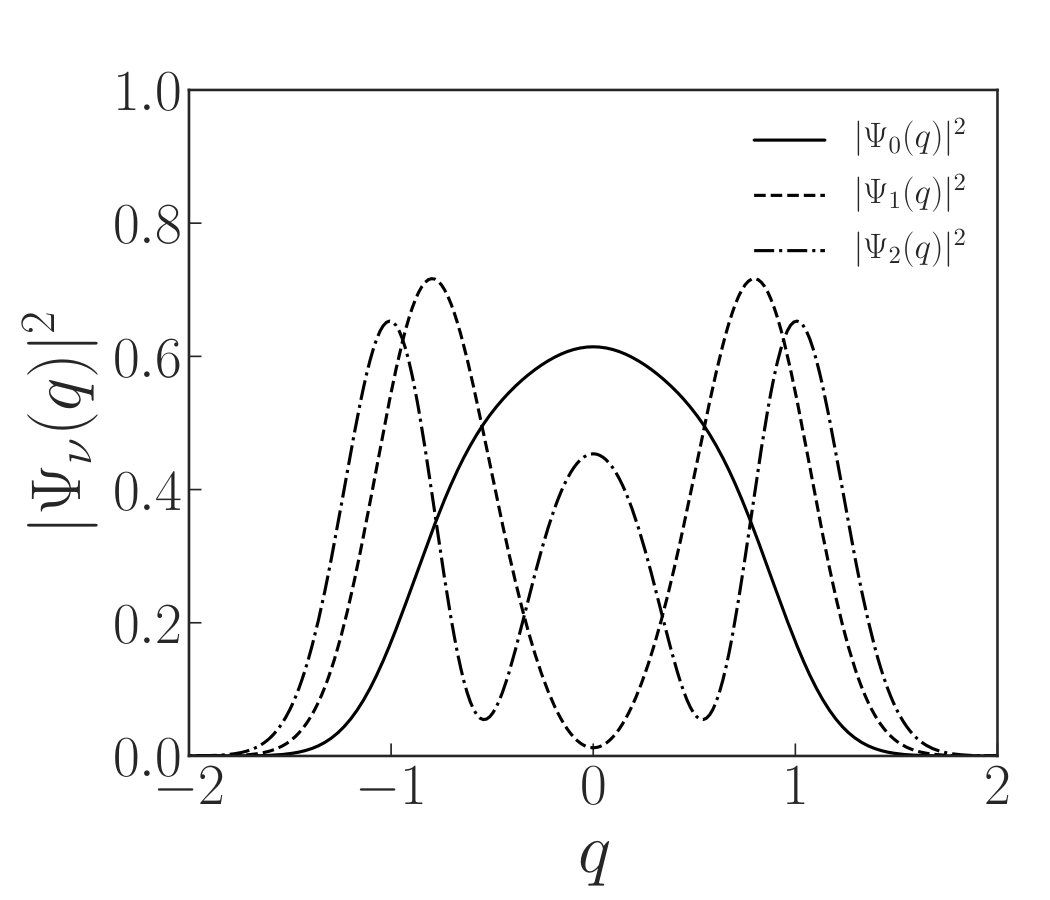 Figure 2
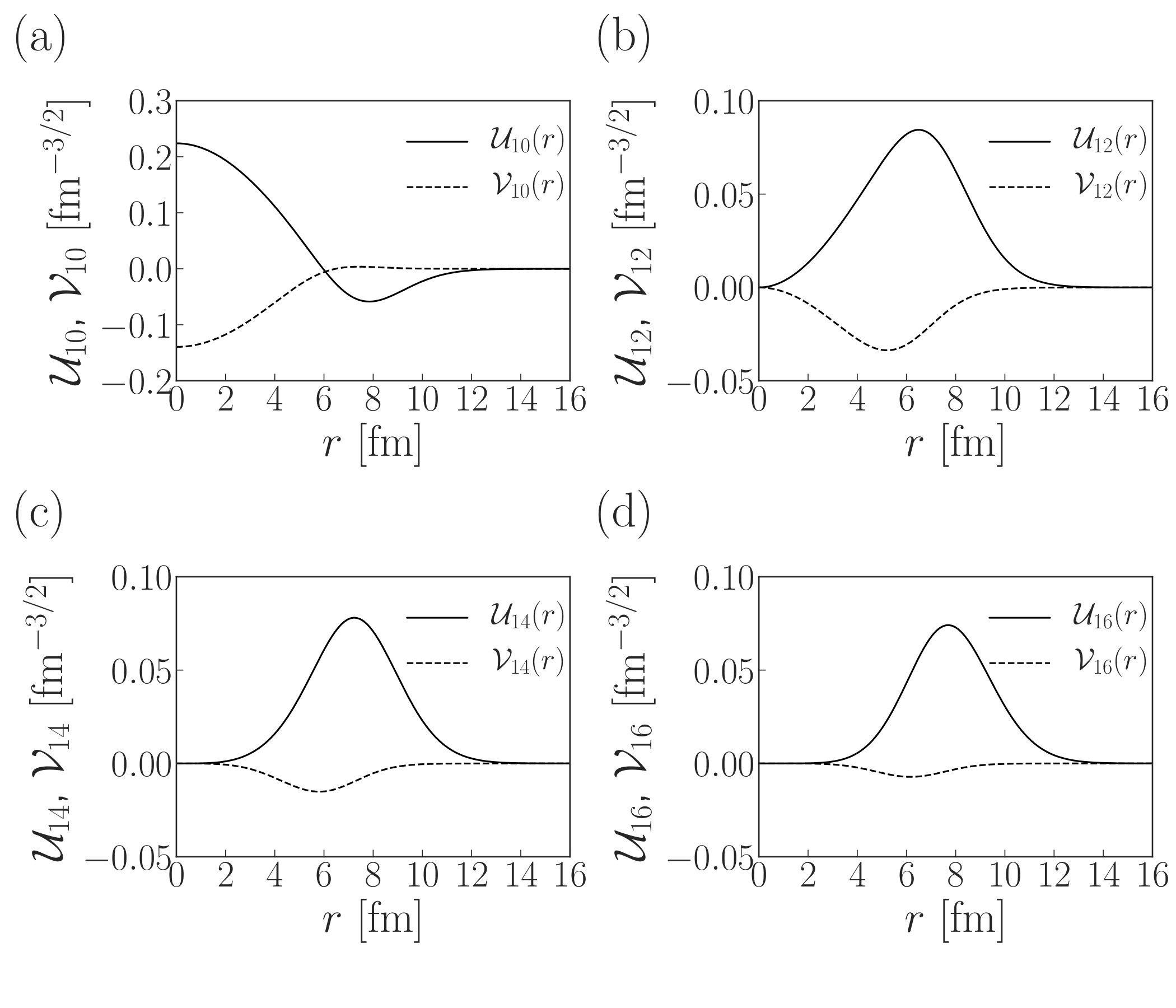 Figure 3
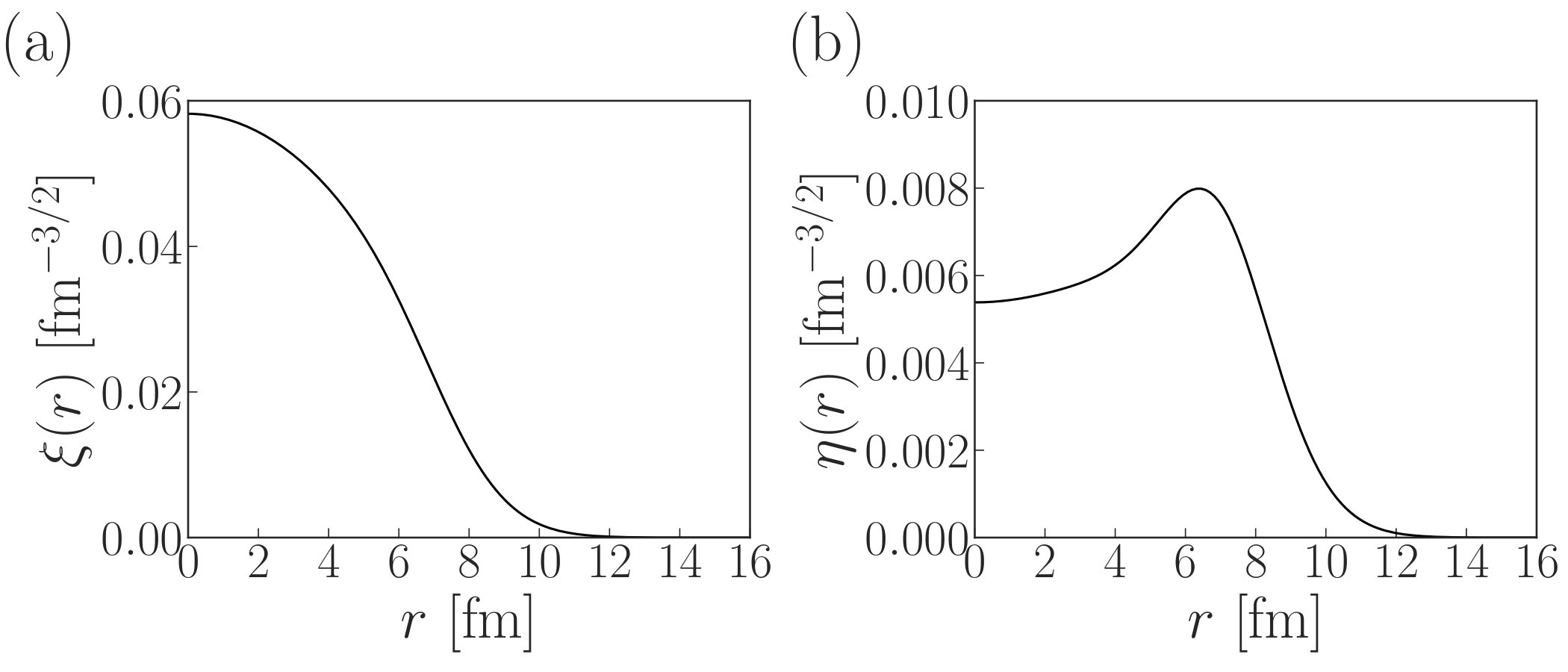 Figure 4
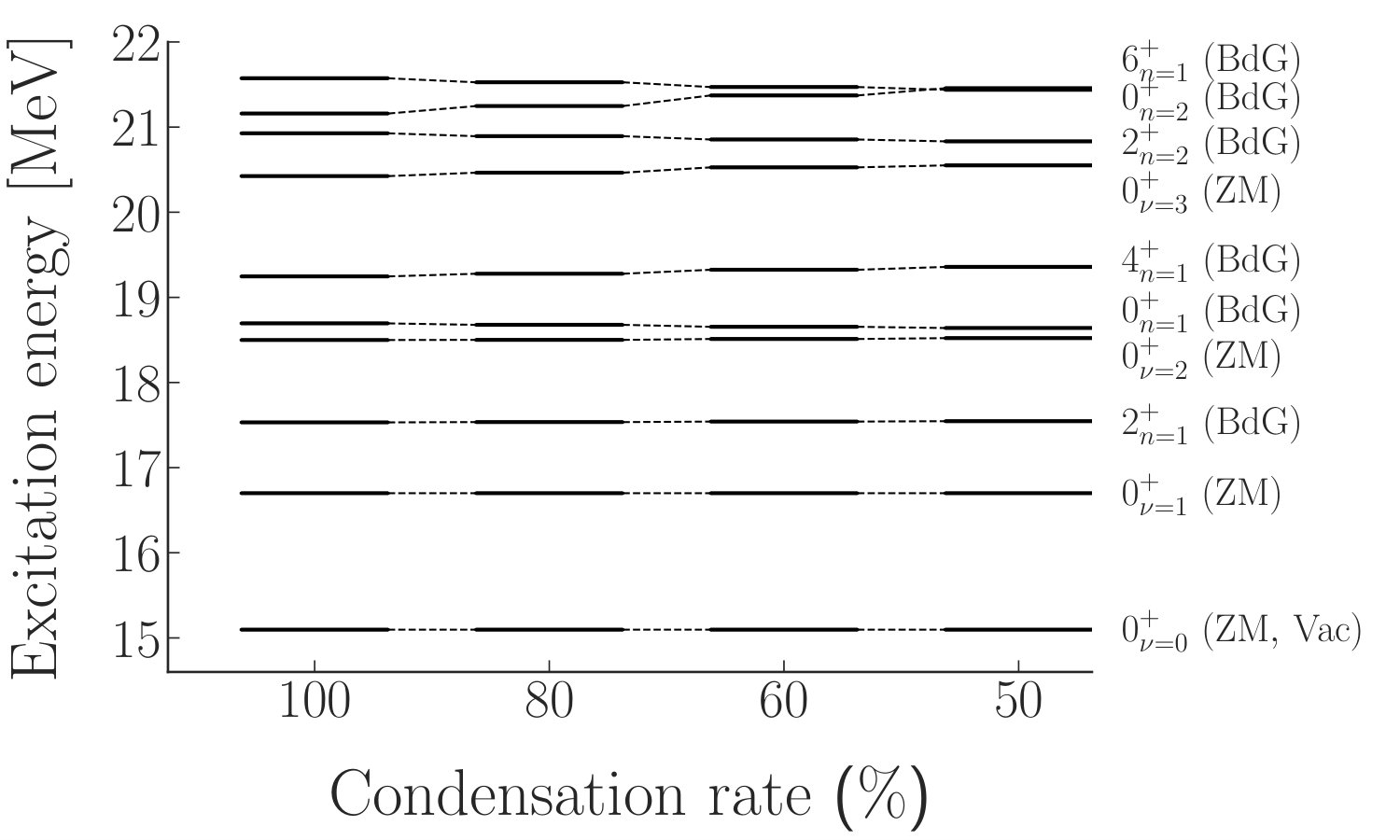 Figure 5
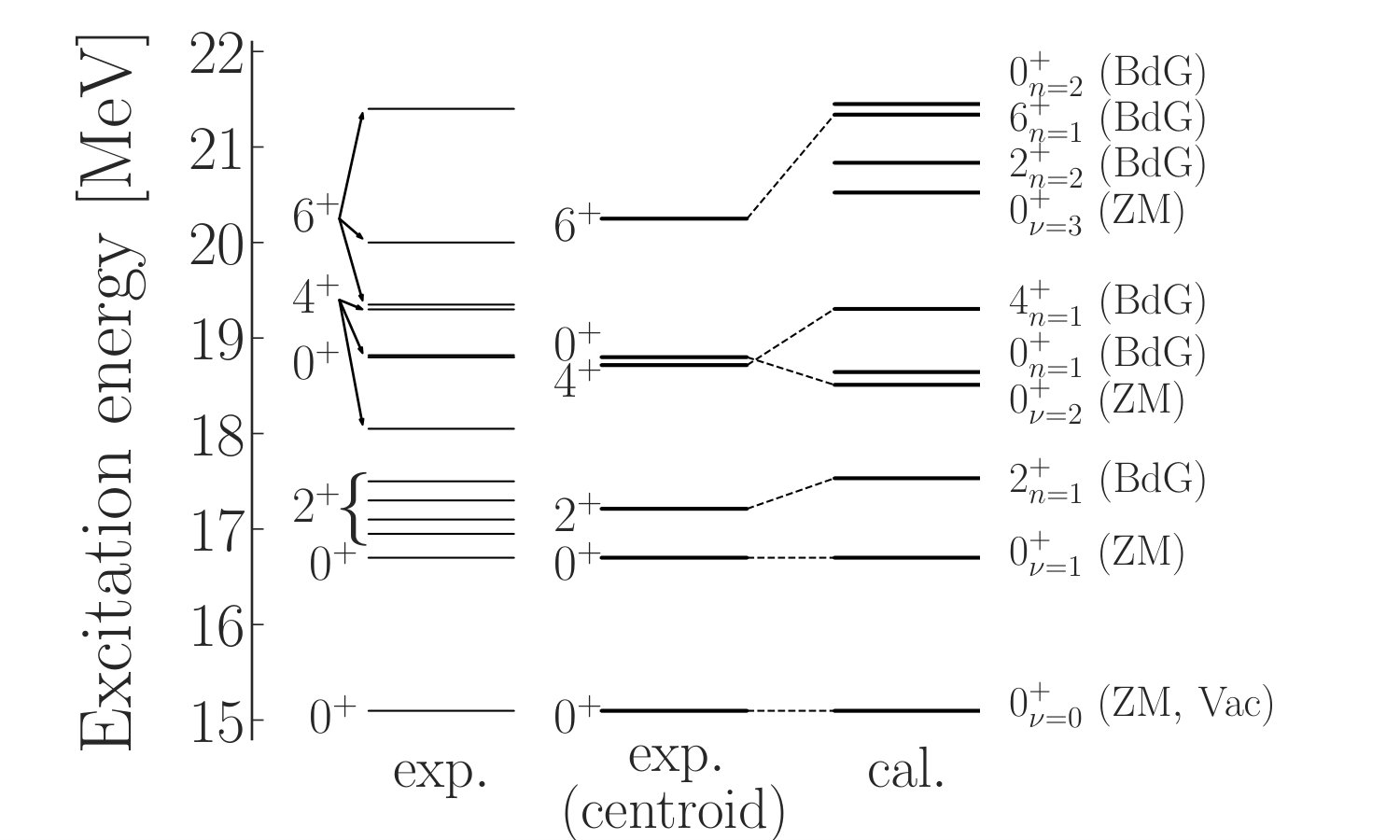 Figure 1
| Transition | 61% | 100% |
| 4.2 | 7.6 | |
| 0.24 | 0.62 | |
| 369 | 606 | |
| 1644 | 1724 | |
| 785 | 456 | |
| 1111 | 469 | |
| 1355 | 448 |
Peer Reviews
No public reviews on file for this paper yet. If you reviewed it on a platform where reviews are public (OpenReview, ICLR, NeurIPS, ICML), you can paste yours below so the community can read it here.
Videos
No videos yet. Explain this paper in a talk, walkthrough, or lecture? Add one.
Taxonomy
TopicsCold Atom Physics and Bose-Einstein Condensates · Quantum, superfluid, helium dynamics · Geophysics and Gravity Measurements
Bose–Einstein condensation of dilute alpha clusters
above four threshold
in 16O in field theoretical superfluid cluster model
J. Takahashi
Department of Electronic and Physical Systems, Waseda University, Tokyo 169-8555, Japan
Y. Yamanaka
Department of Electronic and Physical Systems, Waseda University, Tokyo 169-8555, Japan
S. Ohkubo
Research Center for Nuclear Physics, Osaka University, Ibaraki, Osaka 567-0047, Japan
Abstract
Observed well-developed cluster states in 16O located above the four threshold are investigated from the viewpoint of Bose-Einstein condensation of clusters by using a field-theoretical superfluid cluster model in which the order parameter is defined. The experimental energy levels are reproduced well for the first time by calculation. In particular, the observed 16.7 MeV and 18.8 MeV states with low-excitation energies from the threshold are found to be understood as a manifestation of the states of the Nambu-Goldstone zero-mode operators, associated with the spontaneous symmetry breaking of the global phase, which is caused by the Bose-Einstein condensation of the vacuum 15.1 MeV state with a dilute well-developed cluster structure just above the threshold. This gives evidence of the existence of the Bose-Einstein condensate of clusters in 16O. It is found that the emergence of the energy level structure with a well-developed cluster structure above the threshold is robust, almost independently of the condensation rate of clusters under significant condensation rate. The finding of the mechanism why the level structure that is similar to 12C emerges above the four threshold in 16O reinforces the concept of BEC of clusters in addition to 12C.
pacs:
21.60.Gx,27.20.+n,67.85.De,03.75.Kk
In this paper, we present evidence of Bose-Einstein condensation (BEC) of clusters in 16O. The idea of cluster structure of nuclei was originally proposed in Refs. Wefelmeier1937 ; Wheeler1937 as the first nuclear structure model and since the proposal of the Ikeda diagram in 8Be24Mg Ikeda1968 and 8Be32S Horiuchi1972 , the last century witnessed a fruitful existence of cluster structure in light nuclei Suppl1972 ; Wildermuth1977 ; Suppl1980 . The cluster structure has been shown to persist also in medium-weight and heavy mass region Suppl1998 , where the spin-orbit force becomes important. The diagram was extended to the -shell region, 44Ti region in Ref. Ohkubo1989 and 60Zn region in Ref. Ohkubo1998 . The discoveries of the excitations of the inter-cluster relative (vibrational) motion (the higher nodal state) typically in 20Ne Fujiwara1980 and 44Ti Michel1998 , which is not expected from the mean field picture of nuclei Bohr1969B ; Ring1980 , showed a diversity of collective motion caused by clustering.
As a new diversity of collective motion, BEC of clusters has been attracting much attention in the systems in nuclei, such as three clusters in 12C and four clusters in 16O, which are the highest order clustering in the Ikeda diagram Ikeda1968 ; Horiuchi1972 . This is a new collective motion caused by the spontaneous symmetry breaking (SSB) of the global phase in the gauge space and different from the collective motions in configuration space such as rotation and vibration with a geometrical intrinsic structure, which are also widely seen in the mean field picture Bohr1969B ; Ring1980 .
In fact, three clusters in 12C(, 7.654 MeV), the Hoyle state, has been shown to be in a gas phase by Uegaki et al. Uegaki1977 in contrast to the preceding picture of a rigid three chain structure Morinaga1956 . Matsumura et al. Matsumura2004 showed that about 70% of the clusters in the Hoyle state are sitting in the 0s state. Many theoretical and experimental studies were devoted to investigate whether the Hoyle state is a Bose-Einstein condensate Matsumura2004 ; Tohsaki2001 ; Kurokawa2004 ; Matsumura2004 ; Yamada2004 ; Ohtsubo2013 ; Funaki2015 ; Funaki2016 ; Kanada2007 ; Chernykh2007 ; Roth2011 ; Epelbaum2012 ; Dreyfuss2013 ; Nakamura2016 ; Katsuragi2018 .
The most intriguing nucleus beyond 12C is 16O, for which systematic experimental data have been accumulated Chevallier1967 ; Freer1995 ; Freer2004 ; Freer2005 ; Itoh2014 ; Curtis2016 . Despite theoretical studies Tohsaki2001 ; Funaki2008C ; Ohkubo2010 ; Funaki2018 whether the observed energy level structure of the cluster states just above the four threshold in 16O is due to BEC of clusters has not been confirmed. Full microscopic four cluster model calculations and ab initio calculations to understand the cluster level structure are presently formidably difficult for 16O. Also we note that whatever the calculated rate of clusters sitting in the 0s state may be, any theory without the order parameter is unable to conclude whether the system is in the Nambu-Goldstone (NG) phase of BEC or in the normal Wigner phase.
We have proposed a field theoretical superfluid cluster model in which the order parameter is defined Katsuragi2018 ; Nakamura2016 and showed in 12C that the emergence of the peculiar energy levels with a well-developed gas-like cluster structure built on the Hoyle state is a manifestation of the NG phase caused by the BEC of the vacuum Hoyle state.
The purpose of this paper is to show for the first time that the observed peculiar cluster level structure just above the four threshold in 16O can be understood in a superfluid cluster model and that in particular the emergence of the ground and excited states of the NG operators is a manifestation of the evidence for the BEC of clusters.
From the theoretical side, Tohsaki et al. Tohsaki2001 considered that the (14.0 MeV) state in 16O, located 0.44 MeV only just below the four threshold energy, is a BEC state of clusters. On the other hand, Funaki et al. Funaki2008C discussed, using a four semi-microscopic orthogonality condition model (OCM), that the (15.1 MeV) state located just above the four threshold ENSDF is a condensate of four clusters. Ohkubo et al. Ohkubo2010 suggested, in the unified description of nuclear rainbows in +12C scattering and cluster structures in the bound and quasi-bound energy region of 16O, that the observed (15.1 MeV) state could be a superfluid state of four clusters. As for the excited states above the (15.1 MeV) state, i.e., (16.95 MeV), (17.15 MeV), (18.05 MeV) and (19.35 MeV) states, observed by Chevalier et al. Chevallier1967 , which had been considered to have a four linear chain structure Chevallier1967 ; Horiuchi1972 ; Suzuki1972 , Ohkubo et al. Ohkubo2010 showed that they can be understood to have the local condensate +12C () structure. As for the four linear chain in 16O, Ichikawa et al. Ichikawa2011 and others Horiuchi2017 ; Inakura2018 showed that the excitation energy of the band head state is much higher, above 30 MeV. A search to observe such a high lying state has been attempted Curtis2013 .
On the other hand, from the experimental side, very important developments in searching for BEC of clusters in 16O were recently reported by Itoh et al. Itoh2014 , who observed two broad resonant states, i.e., at 16.7 MeV with the +12C() structure and at 18.8 MeV with the 8Be+8Be structure just above the (15.1 MeV) state. We note that this energy 16.7 MeV of exactly agrees within the width with 16.6 MeV predicted by Ohkubo et al. Ohkubo2010 from the viewpoint of BEC and superfluidity of 16O. In Ref. Ohkubo2013 , Ohkubo suggested that the state (16.7 MeV) may be a NG state due to the spontaneous symmetry breaking of the global phase caused by the BEC of the (15.1 MeV) state. In addition to the experimental data by Chevallier et al. Chevallier1967 and Freer et al. Freer1995 ; Freer2004 ; Freer2005 , Curtis et al. Curtis2016 very recently observed in the 13C(4He, 4)n breakup reaction the (17.3 MeV), (18.0 MeV), or (19.4 MeV), and or (21.0 MeV) states, which decay into the 8Be+8Be channel. These observations seem to be consistent with the previous results by Freer et al. Freer1995 , the (17.1 MeV), (17.5 MeV), (19.5 MeV) and (21.4 MeV) states in the 12C(16O, 4)12C reaction, and by Freer et al. Freer2004 , the states at 20.0 and 21.2 MeV in the 8Be+8Be decay channel of 16O. In the present study, we focus on the well developed four states above the four threshold (14.44 MeV), because almost all the energy levels and the electric transition probabilities below about 13 MeV in excitation energy are known to be explained well in the +12C cluster model by Suzuki Suzuki1976 .
We study these cluster states from the viewpoint of BEC of clusters, using the field-theoretical superfluid cluster model Nakamura2016 ; Katsuragi2018 . We briefly recapitulate the formulation. The model Hamiltonian for a bosonic field representing the cluster is given as follows:
[TABLE]
Here, the potential is a mean field potential introduced phenomenologically to trap the clusters inside the nucleus, and is taken to have a harmonic form, and the residual – interaction is given by the Ali–Bodmer type two-range Gaussian potential Ali1966 , We need no phenomenological three-body and four-body – interactions Funaki2008C . We set throughout this paper.
When BEC of clusters occurs, i.e. the global phase symmetry of is spontaneously broken, we decompose as , where the c-number is an order parameter and is assumed to be real and isotropic. To obtain the excitation spectrum, we need to solve three coupled equations, which are the Gross–Pitaevskii (GP) equation, Bogoliubov-de Gennes (BdG) equations, and zero-mode equation Nakamura2016 ; Katsuragi2018 . The GP equation that determines the order parameter is given by
[TABLE]
where The order parameter is normalized with the condensed particle number as
[TABLE]
The BdG equations that describe the collective oscillations on the condensate are given by
[TABLE]
where The index stands for the main, azimuthal and magnetic quantum numbers. The eigenvalue is the excitation energy of the Bogoliubov mode. For isotropic , the BdG eigenfunctions can be take to have separable forms, We necessarily have an eigenfunction belonging to zero eigenvalue, explicitly , and its adjoint function is obtained as
[TABLE]
The field operator is expanded as
[TABLE]
with the commutation relations and . The operator is an annihilation operator of the Bogoliubov mode, and the pair of canonical operators and originate from the SSB of the global phase and are called the NG or zero-mode operators.
The treatment of the zero-mode operators is a chief feature of our approach. The naive choice of the unperturbed bilinear Hamiltonian with respect to and fails due to their large quantum fluctuations. Instead, we gather all the terms consisting only of and in the total Hamiltonian to construct the unperturbed nonlinear Hamiltonian of and , denoted by . The coefficients in are and the integrations involving and , whose explicit forms are seen in the Ref. Katsuragi2018 . We set up the eigenequation for , called the zero–mode equation,
[TABLE]
This equation is similar to a one-dimensional Schrödinger equation for a bound problem.
The total unperturbed Hamiltonian is . The ground state energy is set to zero, . The states that we consider are with energy , called the zero-mode state, and with energy , called the BdG state, where .
As in Refs. Nakamura2016 ; Katsuragi2018 , we adjust the strength parameter of the short range repulsive potential of the Ali-Bodmer potential (set ) Ali1966 as a residual interaction in the mean field potential , because it stabilizes the condensate under the trapping potential and is the most sensitive in our analysis. The repulsive Coulomb potential affects numerical results little as in the case of 12C Nakamura2016 ; Katsuragi2018 in the presence of the mean field potential , and is suppressed in the present work. The chemical potential is fixed by the input .
We identify (15.10 MeV) state, considered to be a Hoyle analog-state Funaki2008C ; Ohkubo2010 , as the vacuum . In fact, according to Ref. Funaki2008C , 61% of the clusters in this state are sitting in the 0s state, while the rate is less than 25% for all the other states below, including (14.0 MeV). The two parameters, MeV and =514 MeV, which are determined by inputting and 16.7-15.1=1.6 MeV when the experimental (16.7 MeV) state is identified as ((ZM)) and also by minimizing the mean square errors between the experimental (centroid energies for the fragmented , and states) and calculated energies of the states above it, and to reproduce well the excitation energy of the experimental (16.7 MeV) state from the vacuum (15.10 MeV), i.e., 16.7-15.1=1.6 MeV under the condensation rate 61%, are used in the calculations below.
In Fig. 1, the energy levels calculated using the obtained parameters (, ) are displayed. We notice that the calculated second zero-mode state (ZM) appears at low excitation energy from the vacuum (15.10 MeV) and agrees well with the broad (18.8 MeV) state observed by Itoh et al. Itoh2014 . Our calculation locates also the (BdG) near the zero-mode (ZM) state, which seems to be within the broad width of the experimental (18.8 MeV) state. From the excitation function of Fig. 4(b) in Ref. Itoh2014 , it is difficult to know whether the broad (18.8 MeV) state is fragmented. The calculated BdG excited states (BdG), (BdG) and (BdG) states agree with the centroids of the experimental energy levels observed in Chevallier1967 ; Freer1995 ; Freer2004 ; Curtis2016 . Our calculation predicts a (BdG) at 23.7 MeV and a (BdG) at 26.4 MeV. The calculated state may correspond to the state at 23.6 MeV observed in Ref. Freer2004 .
The logical structure that the energy levels of the two zero-mode states appear at low energies from the vacuum followed by the (BdG) and (BdG) states in agreement with experiment is the same as that of the excited cluster states above the Hoyle state in 12C. The level structure is a manifestation of the emergence of the zero-mode and BdG states due to BEC of the clusters. The appearance of the zero-mode states confirms the conjecture by Ohkubo in Ref. Ohkubo2013 .
The reason why the dilute well-developed four cluster condensate states are fragmented was investigated by one of the present author (SO) and Hirabayashi in the coupled channel calculations that include the non-dilute +12C(gs, MeV), MeV)) cluster structure and the dilute +12C(MeV), MeV) ) cluster structure Ohkubo2010 . It was shown that the broad dilute +12C (Hoyle state) structure is fragmented, typically for the 4+ state, into two states separated about 1.5 MeV by the coupling. This is easily understood qualitatively by noting that the unperturbed energy of the +12C(, 4.44 MeV) cluster structure with the relative angular momentum , which generates [2_{1}^{+}$$\otimes ], located at 15.5 MeV in the relevant energy region. The appearance of the three fragmented states for each spin , , by the coupling can be understood qualitatively by noting the additional presence of the +12C(, 14.08 MeV) cluster structure with , which generates at the unperturbed energy 21.0 MeV in the relevant energy region. The fragmentation of BEC states of the clusters was not observed in the BEC of the three clusters in 12C, in which no other excited state exists except the below the three threshold. The interference between the BEC state and non-BEC impurity states is a new feature that has never been known and is expected to appear in other nuclei. In our model the fragmentation of the BEC can be treated by introducing a scalar field corresponding to the non-dilute +12C configuration, which is beyond the scope of the present work and is a future challenge.
In Fig. 2, the density distribution of the order parameter , which is related to the superfluidity density =, is displayed. The rms radius of the Hoyle-analog (15.1 MeV) state is calculated to be 5.22 fm as . Although the experimental value is not available, this large size compared with the experimental 2.71 fm of the ground state of 16O supports that the Hoyle-analog state is a dilute cluster state. This value is also consistent with 5 fm in Ref. Funaki2008C . In Fig. 2 (a) the superfluid density is the largest in the center of the condensate and decreases gradually toward the surface. We note that the density extends considerably beyond the rms radius 5.2 fm up to 10 fm. In Fig. 2 (b) the calculated , which is the derivative of with respect to the number of clusters, represents the number fluctuation of the superfluid condensate. We note that the fluctuation is the largest not in the central region but at around 6 fm in the surface region. This behavior is similar to the 12C case in Ref. Katsuragi2018 . The number fluctuation is visible even beyond 10 fm up to 12 fm where the superfluid density is very low. This feature does not change if the condensation rate is significantly increased (for example 100%) or decreased from the present 61%.
In Fig. 3, the wave functions and of the BdG states () with =0, 2, 4 and 6 are displayed. We note that is much smaller than , which becomes more notable as increases. The peak of for is in the surface region because of the repulsive force of the central condensate and moves outward with increasing due to the centrifugal force. For , the orthogonality of and to the nodeless and makes the node at around 6 fm and the energy level is raised above the state. The amplitude of is not small even in the central region. These features are similar to the BEC states built on the Hoyle state in 12C Nakamura2016 ; Katsuragi2018 .
In Fig. 4, the squares of the calculated zero-mode wave functions for the first three (=0, 1 and 2) states are displayed. The wave function of the =0 zero-mode state or the vacuum has no node in the -space, as in Fig. 4 (a). It is important to emphasize that in the present theory we obtain a series of states, which are the zero-mode excited states with . These excited states are realized by increasing the number of the nodes of the wave function in the -space, as seen in Fig. 4 (b) and (c). The first excited state with one node (=1) in Fig. 4 (b) and the second excited state (=2) with two nodes in Fig. 4 (c) are assigned to the experimental state at 16.7 MeV and state at 18.8 MeV, respectively. The reason why we have the two zero-mode excited states is because we treat the quantum fluctuations of and properly and are naturally led to the zero-mode equation (13). The logic that more than two states appear at low excitation energies from the Hoyle-analog state is shared by both the cases of 12C and 12O. This logic is quite similar to the case of a deformed nucleus, for which the rotational symmetry is spontaneously broken and the zero-mode states , , , are the members of the rotational band by increasing the angular momentum. In the case of the zero-mode excited states for the BEC, the quantum number counting the number of nodes in the -space plays the role of the angular momentum. Both of the emergences of the zero-mode excited states for the BEC of clusters and the rotational band for the deformed nucleus are due to the finiteness of the systems. We note that in the infinite limit of the system size of the BEC of clusters, all the zero-mode excited states become degenerate to zero energy.
To see the robustness of the emergence of energy level structure of the zero-mode and BdG states, the calculated energy levels for different condensation rates, 50, 60, 80 and 100%, are displayed in Fig. 5. While the parameter is kept to be 1.57 MeV, which was obtained for the case of 61%, the parameter is determined so as to minimize the mean square errors between the experimental and calculated energies of the state and the states above it. The energy level structure is little changed by the different condensation rates. Especially the excitation energies of the two states above the vacuum are almost independent of the condensation rate as long as the BEC is formed. Although the condensation rate has not been known experimentally, it is clear that the level structure due to BEC in Fig. 1 is robust.
In Table 1, the calculated and transition probabilities are listed. Although no experimental data are available, the transitions from the state to the (ZM) and (Vac) states are strong. Experimental measurements, which may serve to check the condensation rate and the models, are desired.
In Fig. 6 the calculated energy levels of the Nambu-Goldstone zero-mode states and the BdG states are displayed against in comparison with the experimental data. The calculated BdG states , , and are approximately located on the straight line in plot with a rotational constant =93 keV for the states, which seems to be consistent with the values of 95 20 from the data of Freer et al. Freer1995 , 86 keV estimated from each centroid of the observed , and states in Ref. Ohkubo2010 and 80 keV of the calculated value in Ref. Ohkubo2010 where = /2 with being the moment of inertia. This shows that the BdG states built on the Nambu-Goldstone state at 16.7 MeV are strongly deformed. The calculated large (E2) values of the transitions in this band in Table I are in accordance with a strongly deformed BEC of clusters. As seen in Fig. 6, it is also clear that the rotational band is built on the Nambu-Goldstone zero-mode state at 16.7 MeV and not on the vacuum 15.1 MeV state. The logical structure of the emergence of a deformed BEC on the Nambu-Goldstone zero-mode state is essentially the same as that seen for the BEC of three clusters, as has been suggested for 12C and 16O in Ref. Ohkubo2013 . In the picture of a local condensate with the +12C(Hoyle state) structure in Ref. Ohkubo2010 , the condensation rate is estimated to be 70%12/16=53%, which will be increased if the involvement of the fourth cluster to the condensation is taken into account. The present condensation rate around 60% seems to be consistent with this rough estimate.
The above discussions and conclusions are reconfirmed also by the other method of fitting the parameters, in which the rms radius of the Hoyle-analog state is constrained to 5 fm of Ref. Funaki2008C , which gives the best values of =1.67 MeV/ and MeV to fit the 16.7 MeV state. We mention that the present external harmonic potential with represents a phenomenological mean field potential of the clusters of Bose-Einstein condensate, which is accompanied by the residual interaction , and which corresponds to a “container” in Ref. Funaki2018 whose potential form is given neither microscopically nor phenomenologically. By using a finite well such as a Woods-Saxon or a Woods-Saxon squared form factor for , the decay width can be calculated. Therefore the experimental determinations of the decay widths, especially for the 16.7 MeV and 18.8 MeV states Itoh2014 , are highly desired.
To summarize, we have studied the observed well-developed cluster states above the four threshold from the viewpoint of Bose-Einstein condensation of clusters using a field theoretical superfluid cluster model in which the order parameter is defined. We could reproduce the observed level structure of the cluster states above the threshold for the first time. It is found that the emergence of the level structure that the two states with a well-developed cluster structure at very low excitation energies from the threshold is a manifestation of the Nambu-Goldstone zero-mode states due to the BEC of the vacuum (15.1 MeV). This mechanism is the same to the cluster structure above the three threshold in 12C. It is found that the obtained level structure is robust and changes little once the cluster condensation is realized with a significant condensation rate. The present results give evidence of the existence of Bose-Einstein condensate of cluster in 16O.
This work is supported by JSPS KAKENHI Grant No. 16K05488. One of the authors (SO) thanks the Yukawa Institute for Theoretical Physics at Kyoto University for the hospitality extended during stays in 2017 and 2018.
The reference list from the paper itself. Each links out to its DOI / PubMed record.
- 1(1) W. Wefelmeier, Z. Phys. 107 , 332 (1937).
- 2(2) J. A. Wheeler, Phys. Rev. 52 , 1083 (1937); Phys. Rev. 52 , 1107 (1937).
- 3(3) K. Ikeda, N. Takigawa, and H. Horiuchi, Prog. Theor. Phys. Suppl. E 68 , 464 (1968).
- 4(4) H. Horiuchi, K. Ikeda, and Y. Suzuki, Prog. Theor. Phys. Suppl. 52 , 89 (1972).
- 5(5) K. Ikeda, T. Marumori, R. Tamagaki, and H. Tanaka, Prog. Theor. Phys. Suppl. 52 , 1 (1972) and references therein.
- 6(6) K. Wildermuth and Y. C. Tang, A Unified Theory of the Nucleus (Vieweg, Braunschweig, 1977).
- 7(7) K. Ikeda, H. Horiuchi, and S. Saito, Prog. Theor. Phys. Suppl. 68 , 1 (1980) and references therein.
- 8(8) S. Ohkubo, M. Fujiwara, and P. E. Hodgson, Prog. Theor. Phys. Suppl. 132 , 1 (1998) and references therein.