KZ equations and Bethe subalgebras in generalized Yangians related to compatible R-matrices
Dimitri Gurevich, Pavel Saponov, Dmitry Talalaev

TL;DR
This paper introduces generalized Yangians derived from compatible braidings, constructs Bethe subalgebras within them, and explores their relation to KZ equations, expanding the algebraic framework of quantum integrable systems.
Contribution
It defines new generalized Yangian algebras and constructs commutative Bethe subalgebras, extending prior work on compatible braidings and symmetric polynomials.
Findings
Bethe subalgebras are generated in generalized Yangians.
Analogues of KZ equations are formulated in this new setting.
The constructed subalgebras commute, indicating integrability.
Abstract
The notion of compatible braidings was introduced by Isaev, Ogievetsky and Pyatov. On the base of this notion they defined certain quantum matrix algebras generalizing the RTT algebras and Reflection Equation ones. They also defined analogs of some symmetric polynomials in these algebras and showed that these polynomials generate commutative subalgebras, called Bethe. By using a similar approach we introduce certain new algebras called generalized Yangians and define analogs of some symmetric polynomials in these algebras. We claim that they commute with each other and thus generate a commutative Bethe subalgebra in each generalized Yangian. Besides, we define some analogs (also arising from couples of compatible braidings) of the Knizhnik-Zamolodchikov equation--classical and quantum.
Click any figure to enlarge with its caption.
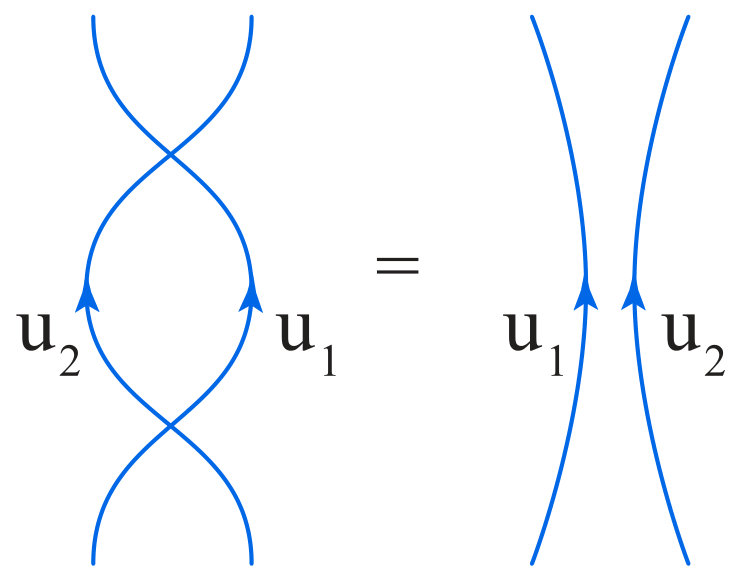 Figure 1
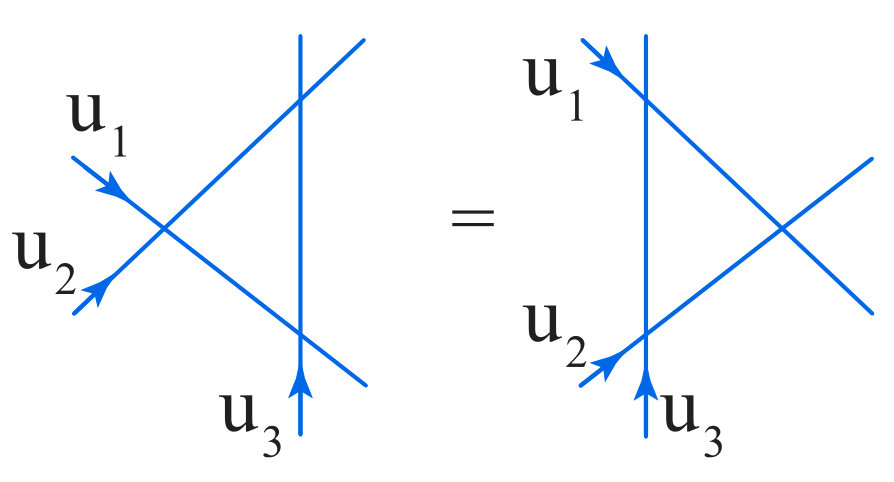 Figure 2
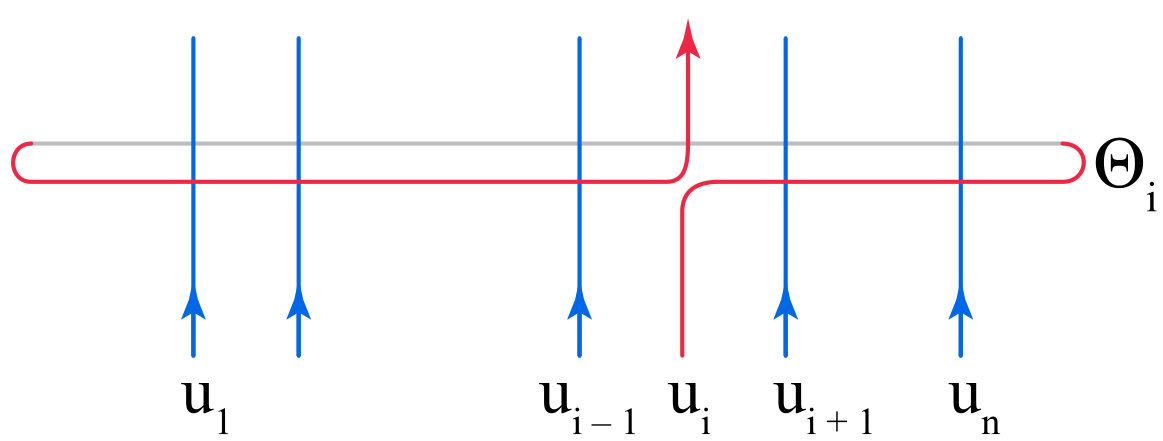 Figure 3
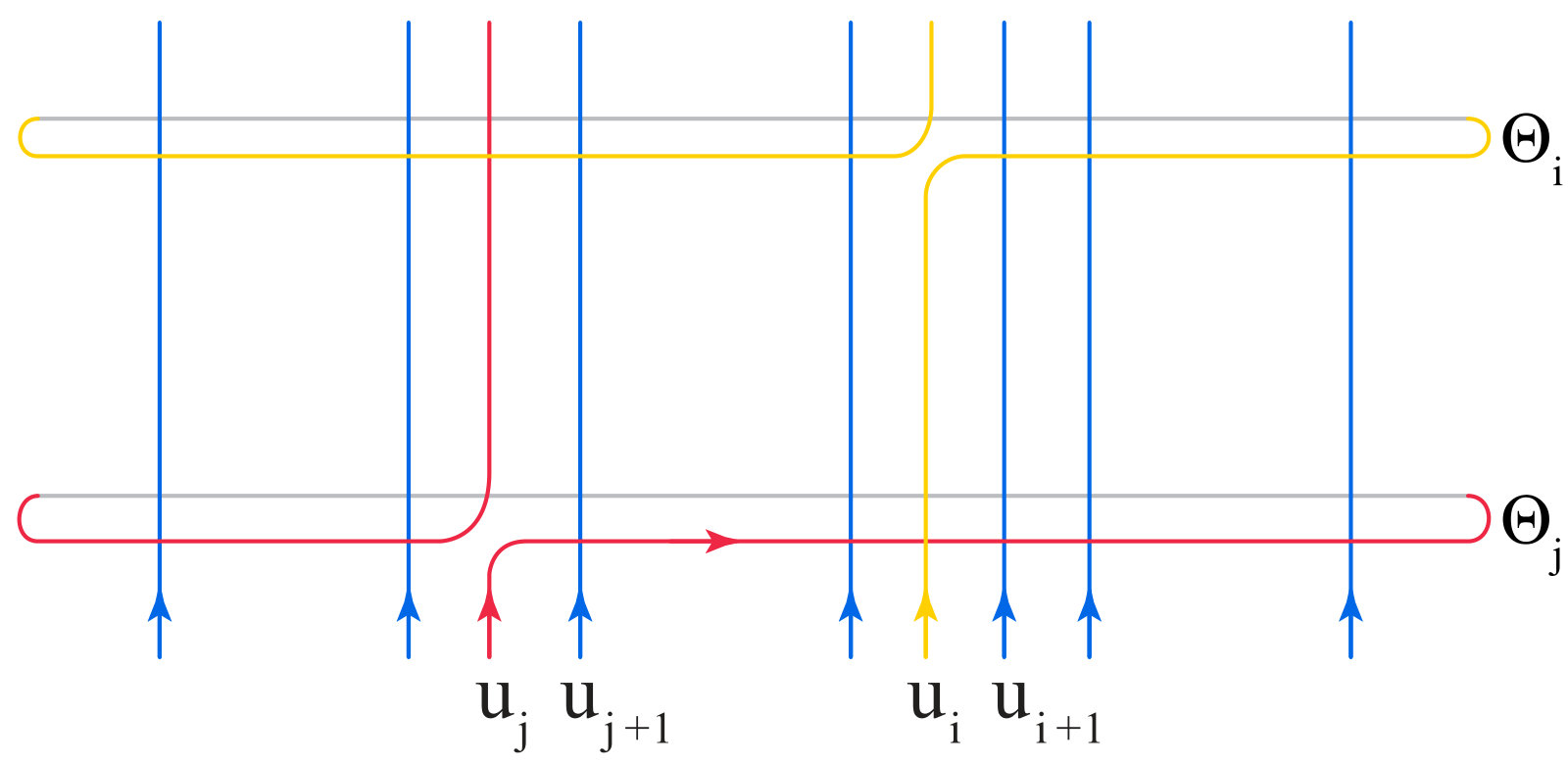 Figure 4
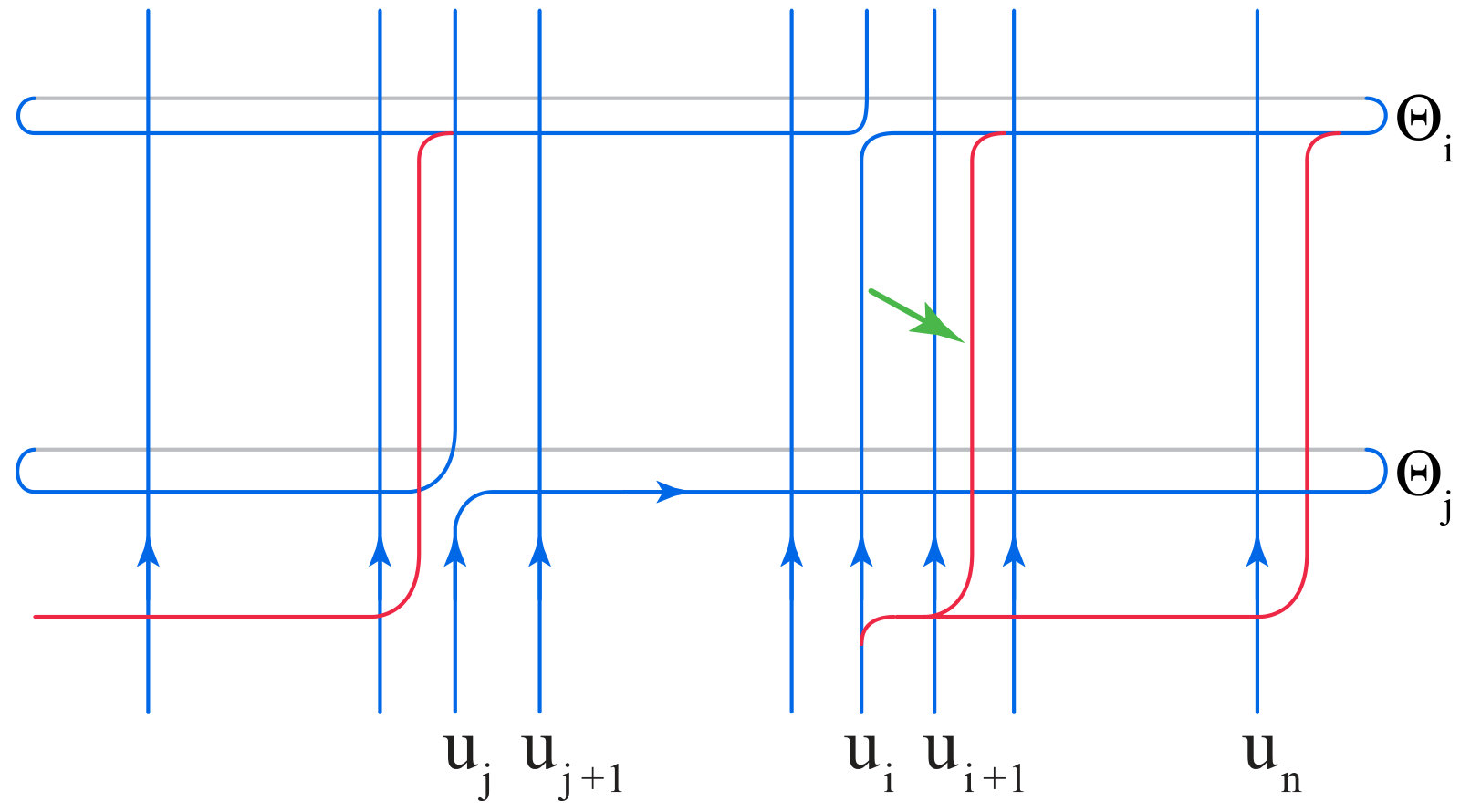 Figure 5
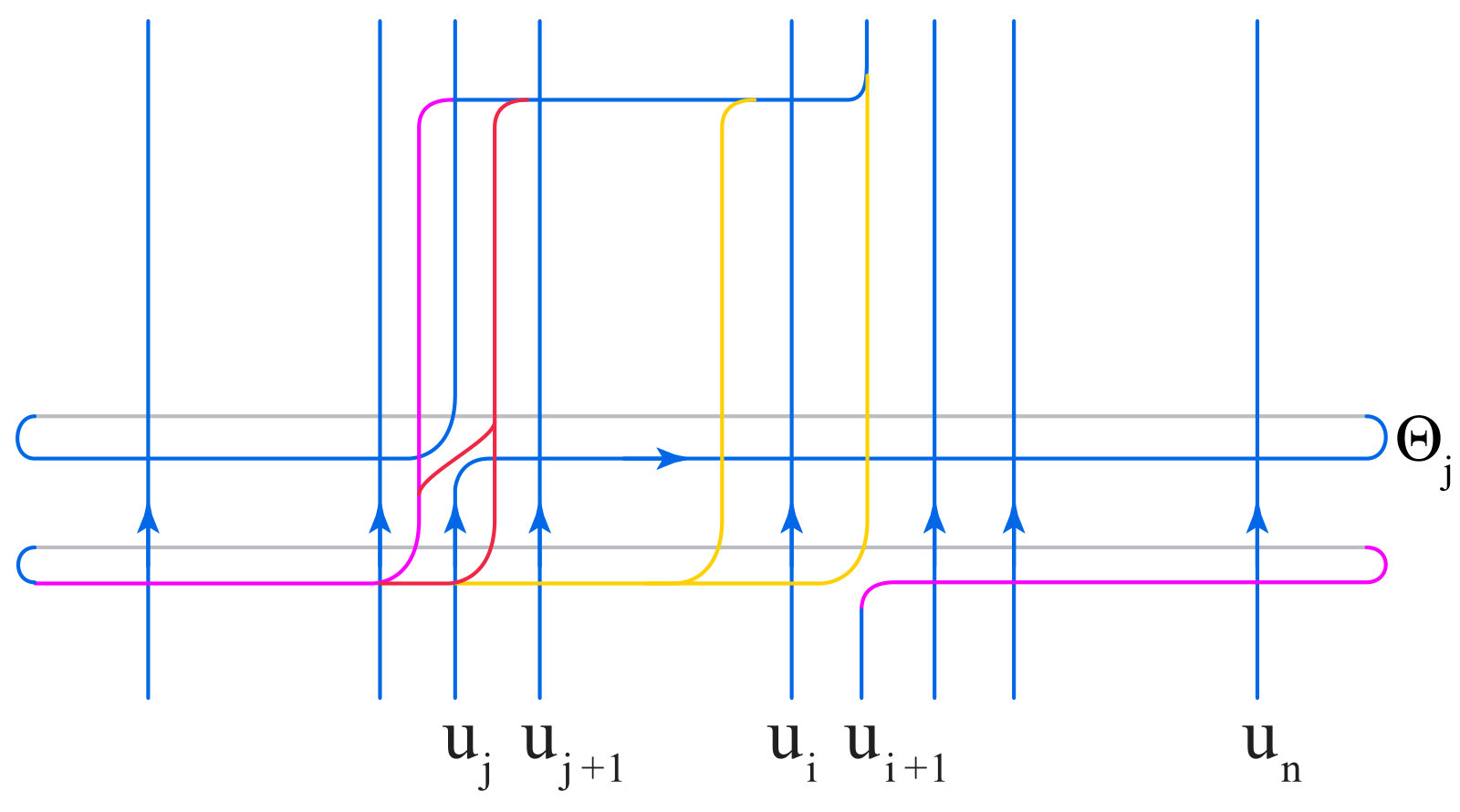 Figure 6
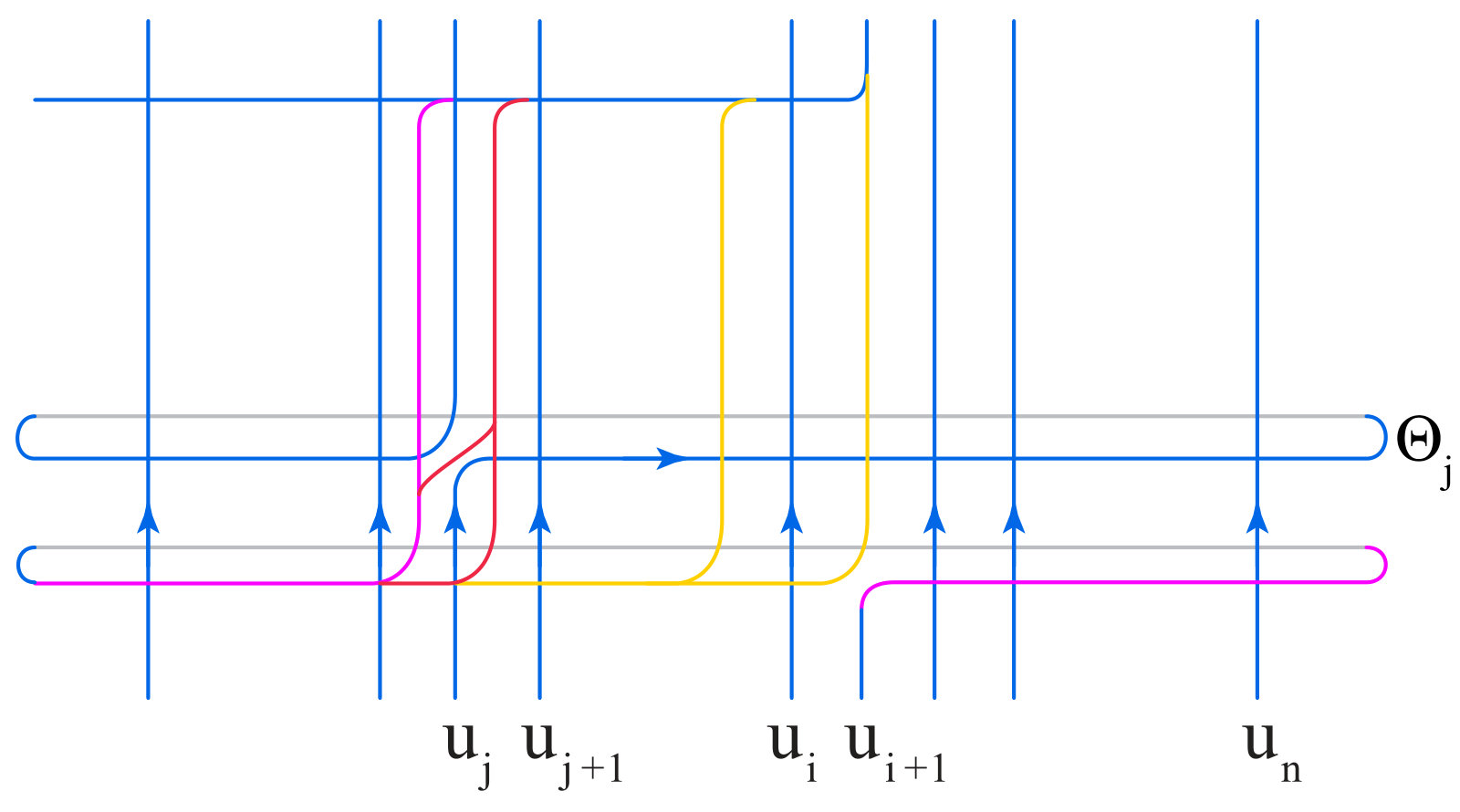 Figure 7
Peer Reviews
No public reviews on file for this paper yet. If you reviewed it on a platform where reviews are public (OpenReview, ICLR, NeurIPS, ICML), you can paste yours below so the community can read it here.
Videos
No videos yet. Explain this paper in a talk, walkthrough, or lecture? Add one.
KZ equations and Bethe subalgebras in generalized Yangians related to compatible -matrices
Dimitri Gurevich
*Univ. de Valenciennes, EA 4015-LAMAV
F-59313 Valenciennes, France
and
Interdisciplinary Scientific Center J.-V.Poncelet
Moscow 119002, Russian Federation
- Pavel Saponov
*National Research University Higher School of Economics,
20 Myasnitskaya Ulitsa, Moscow 101000, Russian Federation
and
Institute for High Energy Physics, NRC ”Kurchatov Institute”
Protvino 142281, Russian Federation
- Dmitry Talalaev
*Moscow State University, Faculty of Mechanics and Mathematics
119991 Moscow, Russian Federation*
*and
Institute for Theoretical and Experimental Physics, NRC ”Kurchatov Institute”
117218 Moscow, Russian Federation, 25 Bolshaya Cheremushkinskaya str.
and
Centre of integrable systems, P. G. Demidov Yaroslavl State University
150003, Yaroslavl, Russian Federation, 14 Sovetskaya str.* [email protected]@[email protected]
Abstract
The notion of compatible braidings was introduced in [IOP]. On the base of this notion the authors of [IOP] defined certain quantum matrix algebras generalizing the RTT algebras and Reflection Equation ones. They also defined analogs of some symmetric polynomials in these algebras and showed that these polynomials generate commutative subalgebras, called Bethe. By using a similar approach we introduce certain new algebras called generalized Yangians and define analogs of some symmetric polynomials in these algebras. We claim that they commute with each other and thus generate a commutative Bethe subalgebra in each generalized Yangian. Besides, we define some analogs (also arising from couples of compatible braidings) of the Knizhnik-Zamolodchikov equation–classical and quantum.
AMS Mathematics Subject Classification, 2010: 81R50
Keywords: compatible braidings, braided Yangians, Bethe subalgebra, braided -matrix, braided (quantum) KZ connections
1 Introduction
The notion of compatible -matrices (we call them braidings) was introduced in [IOP]. By a braiding we mean a linear operator subject to the braid relation
[TABLE]
where , is a vector space over the ground field and is the identity operator or its matrix.
According to [IOP], two braidings and are called compatible if they are subject to the system
[TABLE]
As usual, the low indexes indicate the positions, where a matrix (or an operator) is located. Observe that the matrices are obtained from that by means of the usual flip :
[TABLE]
Here, is an matrix, whereas and so on are matrices.
Following [IOP] we introduce the following notations
[TABLE]
and so on, where the overlined indexes mean that the matrix is pushed forward to higher positions by means of the second braiding . For the sake of the uniformity we also put .
Below, we fix a basis in the space and the corresponding bases in and identify operators and their matrices.
Following [IOP] introduce an algebra defined by the following system of relations
[TABLE]
where is a matrix with entries .
The matrix is called generating matrix of the algebra .
As shown in [IOP], in these algebras (under some conditions on the braidings) it is possible to define analogs of some symmetric polynomials and to establish analogs of the Cayley-Hamilton and Newton identities. (In [IOP] these identities are combined in the so-called Cayley-Hamilton-Newton ones.) Also, it is possible to show that quantum elementary symmetric polynomials commute with each other and consequently generate a subalgebra of called Bethe.
The first purpose of the present paper is to introduce some algebras similar to those but with infinite number of generators and to generalize the mentioned results to them. Each of these algebras is defined via the system
[TABLE]
where, is a matrix expanded in a Laurent series and the current (i.e. depending on parameters) quantum -matrices arises from a braiding via the Baxterization procedure. We denote this algebra and call it the *generalized Yangian111Note that if
we get the famous Drinfeld’s Yangian . (Usually, one also imposes the condition .) Its generators are entries of the matrices
A similar treatment is valid for our generalized Yangians. However, below we do not use this treatment and deal with the generating matrix in whole.*.
So far, our generalized Yangians are the most general quantum matrix algebras associated with rational and trigonometric -matrices for which analogs of some symmetric polynomials, namely, elementary ones and power sums, are constructed and their commutativity is established.
The second purpose of the paper is to introduce braided analogs of the Knizhnik-Zamolodchikov (KZ) equation–classical and quantum–and to establish their compatibility. Observe that the former ones are based on a braided version of the first Sklyanin bracket. In its turn this version is based on braided current -matrices. In the rational case such a braided current -matrix can be easily defined with the help of an involutive symmetry as follows . (So, in this case any second braiding is not needed.)
In the trigonometric case we are looking for a braided current -matrix under the form . In order to find a (constant) summand we need a Hecke symmetry analytically depending on in a vicinity of and deforming an involutive symmetry (i.e. ). Then by expanding at the point , we get .
The paper is organized as follows. In the next section we define compatible braidings and exhibit some examples. In Section 3 we introduce the aforementioned quantum symmetric polynomials in the generalized Yangians. In Section 4 we describe braided versions of current -matrices and the first Sklyanin bracket. In section 5 we introduce braided analogs of the classical and quantum KZ equation in the spirit of [KZ] and [FR] respectively.
Acknowledgements: The work of P.S. has been funded by the Russian Academic Excellence Project ’5-100’ and was also partially supported by the RFBR grant 19-01-00726-a. The work of D.T. was carried out within the framework of the State Programme of the Ministry of Education and Science of the Russian Federation, project 1.12873.2018/12.1, and was also partially supported by the RFBR grant 17-01-00366 A.
2 Compatible braidings
Let be a couple of compatible braidings. As noticed in Introduction, the braiding is used for transferring the generating matrix (depending on parameters or not) to the higher positions and the symmetry comes in the defining relations of the algebras or that .
We impose the following conditions on these braidings. We assume to be an involutive or Hecke symmetry. Remind that a braiding is called an involutive symmetry (resp., a Hecke symmetry) if it is subject to the condition
[TABLE]
For such symmetries we construct current -matrices according to the following Baxterization procedure.
Proposition 1
([GS]) Let be an involutive or a Hecke symmetry. Define the operators
[TABLE]
for an involutive symmetry and
[TABLE]
for a Hecke symmetry. The operators are current -matrices, i.e. they meet the Quantum Yang-Baxter equation with parameters
[TABLE]
Namely, these current -matrices are used in defining generalized Yangians. An -matrix (2.1) (resp., (2.2)) and the corresponding algebra is called rational (resp., trigonometric).
As for the braidings we assume them to be skew-invertible. This means that there exists an operator such that
[TABLE]
If it is so, we can introduce the so-called -trace of any square matrix by setting
[TABLE]
Also, we put
[TABLE]
for any matrix of the appropriate size.
Now, analogically to the notations we introduce similar notations for matrices. Let be such a matrix located at positions number 1 and 2, we put
[TABLE]
and so on. In general, the notation means that transferring of the matrix to the positions number and is performed by means of the symmetry as follows
[TABLE]
Thus, if is a couple of compatible braidings, the following holds
[TABLE]
This means that transferring of the braiding to the positions 2 and 3 performed either by means of the usual flip or by means of the braiding leads to the same result: . This entails that for any .
It is clear that the relation (1.1) for the operator is equivalent to the quantum Yang-Baxter equation
[TABLE]
for the operator .
However, if is a couple of compatible braidings, it is easy to see that the operator is subject to the following ”braided version” of the quantum Yang-Baxter equation
[TABLE]
Moreover, the following generalization of (2.5) is valid
[TABLE]
provided are positive integers such that .
The operators subject to (2.5) are called braided -matrices.
Observe that if is an involutive symmetry, the relation (2.6) becomes valid for any positive pairwise distinct integers . Besides, the the notation is well-defined for any matrix and any distinct positive integers and . For instance, .
Consider a few examples of compatible braidings. The braidings and are compatible for any . The corresponding algebra is called the (generalized) Yangian of RTT type. The Drinfeld’s Yangian is a particular case, respective to . Another example of such an algebra is the so-called -Yangian, as it is defined in [M]. The Hecke symmetry entering its definition is that coming from the quantum group .
It is also evident that if , then the braidings and are compatible. We say that the corresponding braided Yangian is of Reflection Equation (RE) type.
If is a super-flip, and is the Hecke symmetry coming from the Quantum super-group , the braidings and are compatible. In the case the Hecke symmetry is represented in a basis by the following matrix
[TABLE]
Note that this Hecke symmetry is a deformation of the involutive symmetry and it depends analytically on . Thus, we are in the frameworks of setting discussed at the end of Introduction.
3 Symmetric polynomials in generalized Yangians
In this section we define (quantum) symmetric polynomials in generalized Yangians. Namely, we are dealing with elementary symmetric polynomials and power sums. However, first we consider an numerical matrix . In this case the elementary symmetric polynomials and quantum power sums for this matrix are respectively defined as follows
[TABLE]
Note that if is triangular matrix, these polynomials are respectively equal to the elementary symmetric polynomials and power sums in eigenvalues of . This motivates the terminology.
If is a matrix with entries belonging to a noncommutative algebra, it is not in general possible to define analogs of these polynomials with interesting properties. Fortunately, it is possible to do in the algebras (see [IOP]) and generalized Yangians . First, define elementary symmetric polynomials in the trigonometric generalized Yangians
If is a Hecke symmetry, we put
[TABLE]
Here, is the skew-symmetrizer acting in the space and arising from the Hecke symmetry . It can be defined by the following recurrent relations
[TABLE]
In the rational case the corresponding elementary symmetric polynomials are defined as follows
[TABLE]
Here is the skew-symmetrizer respective to the involutive symmetry . Its explicit formula can be obtained from that (3.3) at .
As for the power sums, we define them respectively as follows
[TABLE]
[TABLE]
It should be emphasized that in the braided Yangians of RE type these formulae could be reduced to the following forms respectively
[TABLE]
Observe that these formulae are in a sense similar to the second formula from (3.1) but they contain shifts of the arguments, multiplicative and additive respectively.
Also, note that the elementary symmetric polynomials and power sums are related via a quantum version of the Newton identities. If is a Hecke symmetry these identities are
[TABLE]
If is involutive, then we have
[TABLE]
A proof of these identities is given in [GS] for the braided Yangians of RE type. For braided Yangians of general form these identities can be shown in a similar way.
Also, note that if the bi-rank of is , then for .
The subalgebra generated in by the elements is called Bethe one.
Proposition 2
Let be a rational or trigonometric generalized Yangian. Then the elements and consequently these commute with each other:
[TABLE]
and consequently the Bethe subalgebra is commutative.
A detailed proof of this claim is given in [GSS] for the braided Yangians of RE type. Generalized Yangians corresponding to all couples under consideration can be treated in a similar way.
Remark 3
In [IO] a notion of half-quantum algebras (HQA) was introduced. Each of these algebras is also defined via a couple of compatible braidings, namely, by the system
[TABLE]
are the skew-symmetrizer and symmetrizer respectively, provided is a Hecke symmetry. As usual, the braiding is employed for defining the overlined indexes.
Let us exhibit an equivalent form of (3.5), which is useful in the study of the generalized Yangians,
[TABLE]
In the HQA there exist analogs of the elementary symmetric polynomials and power sums and those of the Newton and Cayley-Hamilton identities (see [IO]).
However, in general in the HQA the commutativity of the these symmetric polynomials is not valid.
The HQA are related to the braided Yangians as follows. In the trigonometric -matrix we put . Then we have
[TABLE]
This operator coincides up to a factor with the skew-symmetrizer .
After multiplying the defining system of the corresponding braided Yangian evaluated at by from the right hand side, we get the relation
[TABLE]
which can be written under the following form
[TABLE]
This relation looks like that in a HQA but the role of the matrices is played by the operator .
A similar treatment is possible in the rational braided Yangians but in them the shifts are additive, since the parameters and are related as follows . **
4 Braided -matrices and braided Sklyanin brackets
Let be an involutive symmetry. Let us consider the following operator
[TABLE]
which is a braided generalization of the rational -matrix .
It is easy to see that it meets the following relations
[TABLE]
[TABLE]
In order to define a braided analog of trigonometric -matrix we need two compatible braidings. Again, let be a couple of compatible braidings. Also, suppose that is an involutive symmetry and is a Hecke symmetry deforming as described in Introduction. Let us expand the operator at the point :
[TABLE]
Definition 4
The element entering this expansion is called a (constant) braided -matrix.
Proposition 5
This braided -matrix has the following properties
[TABLE]
[TABLE]
Proof Similarly to the classical case, the relation (4.6) immediately follows from (2.5). The relation (4.6) follows from that
[TABLE]
Now, consider the following operator
[TABLE]
We call this operator braided trigonometric -matrix. As usual, the term ”trigonometric” is justified by another form of this operator obtained by the change .
Proposition 6
The operator (4.7) meets the relations (4.2) and (4.3)
Proof The first relation follows immediately from (4.5). In order to show (4.3), we have to compute the braided Schouten bracket of the operator with itself. Let us precise that by the braided Schouten bracket of two such operators and we mean the following expression
[TABLE]
[TABLE]
If and/or are constant, the corresponding parameters should be omitted.
By direct computations we have that the Schouten bracket of the summand with itself is equal to
[TABLE]
Also, the following holds
[TABLE]
[TABLE]
Besides, in virtue of (4.6). This completes the proof.
Let us remark that due to the property (4.2) of the braided -matrix defined by (4.7) it can be cast under the following form
[TABLE]
It should be emphasized that we do not use any concrete form of the symmetries and .
Below, we also need following properties of braided and -matrices.
Proposition 7
If is a couple of compatible braidings, then the following holds
[TABLE]
for any matrix .
Proof By using the compatibility of the braidings and , we get
[TABLE]
[TABLE]
Corollary 8
Additionally, suppose to be an involutive symmetry. Then for any pairwise distinct positive integers we have
[TABLE]
Proposition 9
Under the same hypothesis, if is an matrix and is a braided current (rational or trigonometric) -matrix, then the following holds
[TABLE]
Proof It suffices to consider the case . Then this relation is clear for any braided rational -matrix. It is also so for the first summand of any braided trigonometric -matrix. For the second summand it follows from the previous claim.
Now, we pass to describing a braided analog of the first Sklyanin bracket.
Let be in involutive symmetry and be a braided rational or trigonometric -matrix defined correspondingly by (4.1) or (4.7).
Let us define the following involutive symmetry on the space of the currents as follows
[TABLE]
Now, introduce the following Lie type operator, which is a braided analog of the first Sklyanin bracket
[TABLE]
Proposition 10
The operator (4.10) meets the following conditions
1.
2.
Proof The first claim follows immediately from the skew-symmetry of the braided -matrix . In order to prove the second one we use the relations (4.9) with . Then we have
[TABLE]
[TABLE]
[TABLE]
By using the relation (4.9) once more we can reduce this expression to the following form
[TABLE]
where .
Now, by applying the operators and to this expression and by adding all results we arrive to the conclusion.
5 Braided KZ equations–classical and quantum
Let us pass to constructing a family of commuting differential operators looking like the famous KZ ones. To this end we consider two families of matrices
[TABLE]
and
[TABLE]
associated with braided rational and trigonometric -matrices correspondingly. Here is an integer, is an arbitrary parameter, are pairwise distinct numbers, and is a numerical matrix. Also, throughout this section is assumed to be a skew-invertible involutive symmetry.
Also, constitute two families of differential operators
[TABLE]
and
[TABLE]
where .
Proposition 11
Let us assume that the matrix is subject to the relation . Then the following holds true
[TABLE]
We call the operators (5.1) and (5.2) braided KZ connections–rational and trigonometric respectively.
First, observe that the condition on the matrix can be cast under the following form
[TABLE]
which means that this matrix realizes a one-dimensional representation of the RE algebra associated with the involutive symmetry .
Proof of the first relation from (5.3) results from the fact that the operator is a braided -matrix and the following relations
[TABLE]
[TABLE]
where are pairwise distinct. (Note that .)
The second relation from (5.3) can be proven in the same way, with using the relation (4.9) and the following one
[TABLE]
instead of (5.5).
Corollary 12
The corresponding systems of differential equations (called the KZ ones)
[TABLE]
[TABLE]
where is a vector-function of the length , are compatible.
Our next purpose is to introduce quantum counterparts of these systems. In the case related to the affine Quantum Groups these counterparts were introduced in [FR]. Similarly to [FR] (also, see [EFK]), we get systems of difference equations. However, we deal without any Quantum Group. Instead, we use the rational and trigonometric braidings defined by (4.1) or (4.7) correspondingly.
Consider the following operators
[TABLE]
where
[TABLE]
The former (resp., latter) corresponds to a rational (resp., trigonometric) case.
Observe that due to the factor in (5.6) the following relation
[TABLE]
holds.
Similarly to the classical braided KZ operators above, below we use a matrix subject to the condition . Observe that in virtue of (4.8) we have
[TABLE]
Here are positive integer pairwise distinct. Let us additionally demand
[TABLE]
Besides, introduce operators
[TABLE]
which perform the shifts of the variables, additive and multiplicative respectively. Here, is an arbitrary nontrivial number.
Observe that any rational (resp., trigonometric) -matrix is invariant with respect to the operator (resp., ) applied to the both parameters and . Namely, we have
[TABLE]
Hereafter, for stands for the operator or that in function of the type of .
Let us introduce the following notations
[TABLE]
[TABLE]
Also, introduce the following operators
[TABLE]
Hereafter, we use the following notation .
We are interested in the compatibility condition of the system
[TABLE]
where is an arbitrary nontrivial number.
More explicitly, in the rational case the -th equation of this system reads
[TABLE]
where
[TABLE]
The compatibility condition of the system (5.11) is called the holonomy condition (see [EFK], section 10.5). It takes the form
[TABLE]
The commutativity of and provides an equivalent form of (5.12)
[TABLE]
Proposition 13
The system (5.10) satisfies the holonomy condition in both rational and trigonometric cases.
Proof. The demonstration is similar to the non-braided case. We exhibit it to make our paper self-contained.
Below, we systematically use the following relations
[TABLE]
provided are positive pairwise distinct integers.
Let us illustrate the expression by the figure 1.
Here, we use the standard pictorial representation for the basic structure equations involving -operator. These resemble the 2-nd and 3-rd Reidemeister moves illustrated in figures 2 and 3.
All pictures imply the application of at the crossing points to the vector spaces with corresponding numbers and with appropriate spectral parameters marked on the diagram. Here the symbol means the application of this operator to the corresponding space.
On the figure 4 we draw the diagram, corresponding to the expression
Without loss of generality we assume that We perform a series of mutations using the Yang-Baxter equation (YBE) and once the commutation relation with the shift operator.
The green arrow on the figure 5 illustrates the following algebraic transformation. First, we push forward the element {\color[rgb]{1,0,0}{\cal R}_{\overline{i\,i+1}}} till {\color[rgb]{0,0,1}{\cal R}_{\overline{j\,i+1}}{\cal R}_{\overline{j\,i}}}.
[TABLE]
Now, by using the YBE we arrive to the following formula
[TABLE]
Then, by the similar transformation we transpos the groups of magenta elements and the group of blue ones.
[TABLE]
In this procidure we used the YBE involving the green operator {\color[rgb]{0,1,0}{\cal R}_{\overline{j\,i}}} several times.
Then we use the formula
[TABLE]
Hence we have the following expression
[TABLE]
Now, we perform the transposition of blue and magenta elements with the help of the YBE involving the red operator:
[TABLE]
By using the fact that
[TABLE]
we arrive to the formula
[TABLE]
Then transposing the commuting elements (blue ones and magenta ones) we finalize by the expression:
[TABLE]
Now, we insert the product
[TABLE]
and by using the YBE several times in the same fashion as below we arrive to the following expression
[TABLE]
This completes the proof.
The reference list from the paper itself. Each links out to its DOI / PubMed record.
- 1[EFK] P.Etingof, I.Frenkel, A.Kirillov Jr Lectures on Representation Theory and Knizhnik-Zamolodchikov Equantions , Mathematical Surveys and Monographs, 58. American Mathematical Society, Providence, RI, 1998.
- 2[FR] I.Frenkel, N.Reshetikhin Quantum affine algebras and holonomic difference equations , Comm Math. Phys. 146 (1992), 1-60.
- 3[GS] D.Gurevich, P.Saponov, Braided Yangians , http://lanl.arxiv.org/abs/1612.05929.
- 4[GSS] D.Gurevich, P.Saponov, A.Slinkin Bethe subalgebras in Braided Yangians and Gaudin-type models , CMP, submitted.
- 5[GPS] D. Gurevich, P. Pyatov and P. Saponov, Representation theory of (modified) reflection equation algebra of G L ( m | n ) 𝐺 𝐿 conditional 𝑚 𝑛 GL(m|n) type , St. Petersburg Math. J., vol. 20 (2009) pp. 213–253.
- 6[IO] A.Isaev, O.Ogievetsky Half-quantum algebras , Symmetries and groups in contemporary physics, 479–486, Nankai Ser. Pure Appl. Math. Theoret. Phys., 11, World Sci. Publ., Hackensack, NJ, 2013.
- 7[IOP] A.Isaev, O.Ogievetsky, P.Pyatov, On quantum matrix algebras satisfying the Cayley-Hamilton-Newton identities , J. Phys. A 32 (1999), no. 9, L 115–L 121.
- 8[KZ] V.Knizhnik, A.Zamolodchikov Current algebras and Wess-Zumino models in two dimensions , Nuclear Phys. B 247 (1984), 83–103.