Replace-after-Fixed-or-Random-Time Extensions of the Poisson Process
James E. Marengo (1), Joseph G. Voelkel (1), David L. Farnsworth (1),, Kimberlee S. M. Keithley (2) ((1) Rochester Institute of Technology, (2), University of California at Santa Barbara)

TL;DR
This paper studies extensions of the Poisson process where interarrival times are capped at a fixed or random time, modeling replacement scenarios in engineering with potential applications in reliability analysis.
Contribution
It introduces and analyzes replace-after-fixed-time and replace-after-random-time processes, extending classical Poisson processes to incorporate fixed or stochastic replacement times.
Findings
Derived properties of replace-after-fixed-time processes.
Extended the model to include random replacement times.
Applicable to reliability and maintenance modeling.
Abstract
We analyze extensions of the Poisson process in which any interarrival time that exceeds a fixed value is counted as an interarrival of duration . In the engineering application that initiated this work, one part is tested at a time, and is the number of parts that, by time , have either failed, or if they have reached age while still functioning, have been replaced. We refer to as a replace-after-fixed-time process. We extend this idea to the case where the replacement time for the process is itself random, and refer to the resulting doubly stochastic process as a replace-after-random-time process.
Click any figure to enlarge with its caption.
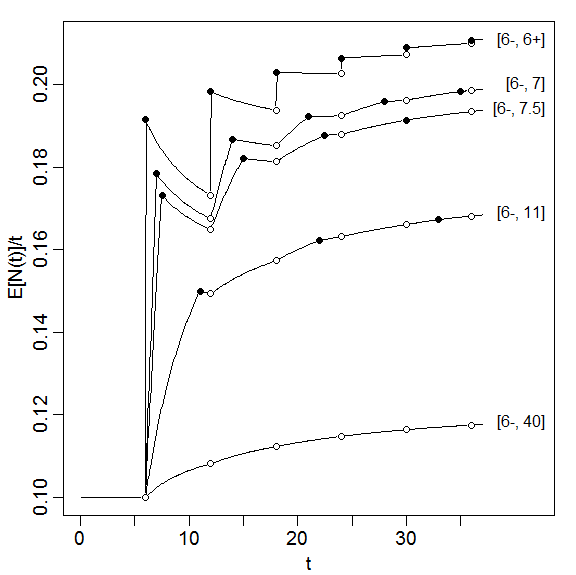 Figure 1
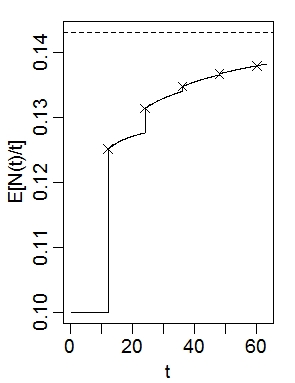 Figure 2
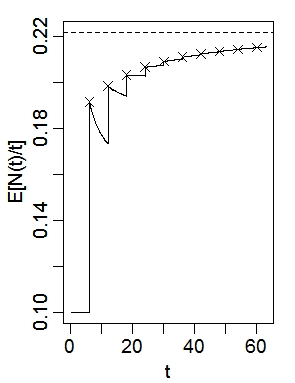 Figure 3
Peer Reviews
No public reviews on file for this paper yet. If you reviewed it on a platform where reviews are public (OpenReview, ICLR, NeurIPS, ICML), you can paste yours below so the community can read it here.
Videos
No videos yet. Explain this paper in a talk, walkthrough, or lecture? Add one.
Taxonomy
TopicsReliability and Maintenance Optimization · Advanced Statistical Process Monitoring · Probabilistic and Robust Engineering Design
Replace-after-Fixed-or-Random-Time Extensions
of the Poisson Process
James E. Marengo*
Joseph G. Voelkel*
David L. Farnsworth*
Kimberlee S. M. Keithley**
- Rochester Institute of Technology
** University of California, Santa Barbara
Abstract
We analyze extensions of the Poisson process in which any interarrival time that exceeds a fixed value is counted as an interarrival of duration . In the engineering application that initiated this work, one part is tested at a time, and is the number of parts that, by time , have either failed, or if they have reached age while still functioning, have been replaced. We refer to as a replace-after-fixed-time process. We extend this idea to the case where the replacement time for the process is itself random, and refer to the resulting doubly stochastic process as a replace-after-random-time process.
Keywords: Doubly-stochastic process; replacement-after-fixed-time process;
replacement-after-random-time process; expected value of a sum; renewal process.
1 Introduction
In engineering tests, parts may be tested one at a time on a test stand; in some cases, parts may be removed after a fixed amount of time so that the properties of the part at that time may be studied, or out of concern that the part may fail shortly. Here, is the number of parts in that have either failed or, if they were still working at age , have been replaced. We study the behavior of such a process when each part is subject to a constant hazard rate . For this reason, we call replace-after-fixed-time (RaFT) extension of the Poisson process. We also extend this process to the case where the replacement time for the process is itself random, leading to the doubly-stochastic replace-after-random-time (RaRT) process. RaRT processes might arise if, for example, different service locations replace parts but each location uses a different replacement time.
Because it spans many disciplines and includes diverse applications and theory, the literature on renewal processes is vast. See [6] for minimal or perfect repairs or replacements. For more general models in which the environment is changing, situations are deteriorating because of aging machinery, for example, and replacement parts may not be as good as new, see [1], [5], [8], [9], and [13]. Multiple modes of failure are discussed in [12]. The detection of changes in the arrival distribution or rate, which has an impact on all of these issues, is investigated in [4]. Many models are compared in [2] and [7]. General references for these topics are [3], [7], and [11].
2 Fixed Replacement Times: the RaFT Process
Suppose are independent random variables, each having the exponential distribution with failure rate and probability density function given by
[TABLE]
Fix and let min for . For , define . Then is a renewal process with interarrival times . There are two types of renewals for this process, because , where is the number of components that have been replaced by time while they are still functioning (alive) and is the number of components that have been replaced by time because they have failed.
Our purpose is to compute the joint probability distribution of . This is of interest in its own right, and from this joint distribution one can derive the distribution of . We start with a lemma.
Lemma 1**.**
Suppose , and . Then
[TABLE]
Proof.
It is an easy (but lengthy) exercise to show that for , and for , that equals
[TABLE]
and that the value of this integral is
[TABLE]
The proof now proceeds by inclusion-exclusion as follows:
[TABLE]
Substitution of (1) into (2) completes the proof. ∎
Theorem 1** (Main Theorem).**
For and
[TABLE]
Proof.
If , then by conditioning on which of the first renewals are “alive” we see that
[TABLE]
Now,
[TABLE]
and by conditioning on whether or not we see that this last probability is
[TABLE]
Apply Lemma 1 to each of the last three probabilities to see that
[TABLE]
Substitution of (4) into (3) completes the proof. ∎
Before proceeding further we need another lemma.
Lemma 2**.**
For and
[TABLE]
Proof.
Because Lemma 2 follows immediately from the binomial theorem if , we assume in what follows that is positive. Observe that for ,
[TABLE]
where the third equation follows from the binomial theorem.
For any positive integer , the factorial powers , ,…, are a basis for the vector space of real polynomials of degree at most , so there are unique real constants (with = 1) such that
[TABLE]
Hence
[TABLE]
and it follows from 5 that
[TABLE]
∎
We close this section with three corollaries.
Corollary 1**.**
For all , .
Proof.
Let so that . For
[TABLE]
[TABLE]
Letting , we see that this sum is
[TABLE]
[TABLE]
Because is a polynomial in of degree , it follows from Lemma 2 that
[TABLE]
Hence and so . ∎
Note that this result is not surprising in light of the fact that the exponential distribution is memoryless. Given that an exponential random variable with failure rate has “survived” for an amount of time which is a multiple of , the conditional distribution of its remaining life is still exponential with failure rate . Hence a used component is as good as a new one and the act of replacing a functioning component does not change the distribution of time until the next failure. That is, the times at which failed components are replaced form an ordinary Poisson process with rate , even though one or more replacements of still functioning components may have taken place between any pair of consecutive failures or before the first failure.
The distribution of is in general quite complicated. However, our next corollary gives its expectation.
Corollary 2**.**
For ,
[TABLE]
Proof.
From Theorem 1 it follows that
[TABLE]
[TABLE]
Now let to conclude that
[TABLE]
Because is a polynomial in of degree with leading coefficient , it follows from Lemma 2 that
[TABLE]
Substitution into (6) yields
[TABLE]
[TABLE]
[TABLE]
∎
Next we consider the behavior of .
Corollary 3**.**
If , then is strictly increasing for . 2. 2.
For every and , there is a positive integer such that is strictly increasing on
Proof.
For statement 1, it follows from Corollaries 1 and 2 that for and that
[TABLE]
where
[TABLE]
and
[TABLE]
If , then because and for , we see that for and conclude that is strictly increasing for .
Next, fix and and suppose that . To prove statement 2 it will suffice to show that for sufficiently large , , or equivalently, . But
[TABLE]
as , so statement 2 follows. ∎
It should be noted that, because the and sequences are both convergent and because as , it follows that as , as guaranteed by the Elementary Renewal Theorem (see [2] or [10]).
Examples of Corollary 3 and the limiting behavior of are shown in Figure 1 where in both figures the jump points of , that is , are indicated by ’s. In (a), is increasing for as guaranteed by the first statement in the Corollary; in (b), is at first decreasing for (except at the jumps), but eventually is increasing, as guaranteed by the second statement.
3 Random Replacement Times: the RaRT Process
Next we consider the situation in which the replacement time is a realization of an associated random variable , resulting in a doubly-stochastic process that we denote as a replace-after-random-time (RaRT) process. In what follows, we assume that has an absolutely continuous distribution on with probability density function (pdf) , and that for , min, where, as before, are independent random variables, each having the exponential distribution with failure rate . Finally, we assume that is independent of .
The following theorem expresses the expectation of in terms of the pdf of the replacement time.
Theorem 2**.**
[TABLE]
Proof.
By conditioning on the value of and using the fact that is independent of , we see from Corollaries 1 and 2 that
[TABLE]
where the fourth equation follows by an application of Fubini’s Theorem. ∎
In the next two corollaries, we consider the behavior of based on the behavior of near 0.
Corollary 4** (of Theorem 2).**
If for some and , for , then .
Proof.
For sufficiently large, , and hence
[TABLE]
It follows from Theorem 2 that . ∎
Corollary 5** (of Theorem 2).**
If for some and , for , then .
Proof.
For sufficiently large, , and hence
[TABLE]
It follows from Theorem 2 that . ∎
We next consider in (7) for some particular families of distributions of . We restrict ourselves to two families of distributions of for which closed-form solutions exist: the exponential distribution with hazard rate and location shift , and the uniform distribution on for .
For the exponential replacement case, the integrand in (7) is, for ,
[TABLE]
whose indefinite integral is
[TABLE]
For the uniform replacement case, for , the integrand is
[TABLE]
whose indefinite integral is
[TABLE]
From Corollary 4, we see that for a replacement distribution that is either exponential with , or uniform with , that .
To illustrate the effects of a random replacement time, we consider and five uniform distributions for . We let and . See Figure 2, and note that is equivalent to the RaFT process shown in Figure 1(b). The open symbols are the values of at ; the solid symbols correspond to the -value increments; for example, for , they appear at . The values from 12 to 14, for example, indicate regions where two consecutive replacements are possible.
Acknowledgement The authors would like to acknowledge Mr. Robert Moses, a Reliability Engineer at General Motors, for motivating this research.
Reference
- [1]
Asfaw, Z. G. and Lindqvist, B. (2015). Extending minimal repair models for repairable systems: a comparison of dynamic and heterogeneous extensions of a nonhomogeneous Poisson process. Reliab. Eng. Syst. Safe. 140, 53–58.
- [2]
Barlow, R. E. and Proschan, F. (1975). Statistical Theory of Reliability and Life Testing: Probability Models. Holt, Rinehart and Winston, New York.
- [3]
Birolini, A. (2017). Reliability Engineering: Theory and Practice, 8th edn. Springer, Berlin, Germany.
- [4]
Brown, M. and Proschan, F. (1983). Imperfect repair. J. Appl. Prob. 20, 851–862.
- [5]
Brown, M. (2008). Monitoring a Poisson process in several categories subject to changes in the arrival rates. Stat. Prob. Lett. 78, 2637–2643.
- [6]
Cha, J. H. and Finkelstein, M. (2018). On preventive maintenance under different assumptions on the failure/repair processes. Qual. Reliab. Engng. Int. 34, 66-77.
- [7]
Cha, J. H. and Finkelstein M. (2018). Point Processes for Reliability Analysis: Shocks and Repairable Systems. Springer, Cham, Switzerland.
- [8]
Cha, J. H. and Mi, J. (2007). Study of a stochastic failure model in a random environment. J. Appl. Prob. 44, 151–163.
- [9]
Chukova, S., Dimitrov, B., and Garrido, J. (1993). Renewal and nonhomogeneous Poisson processes generated by distributions with periodic failure rate. Stat. Prob. Lett. 17, 19–25.
- [10]
Ross, S. M. (2014). Introduction to Probability Models, 11th edn. Academic Press, Boston.
- [11]
Sánchez-Silva, M. and Klutke, G. A. (2016). Reliability and Life-Cycle Analysis of Deteriorating Systems, Springer, Cham, Switzerland.
- [12]
Wang, G. J. and Zhang Y. L. (2013). Optimal repair-replacement policies for a system with two types of failures. Eur. J. Oper. Res. 226, 500–506.
- [13]
Yeh, L. (1988). A note on the optimal replacement problem. Adv. Appl. Prob. 20, 479–482.
The reference list from the paper itself. Each links out to its DOI / PubMed record.
- 1[1] Asfaw, Z. G. and Lindqvist, B. (2015). Extending minimal repair models for repairable systems: a comparison of dynamic and heterogeneous extensions of a nonhomogeneous Poisson process. Reliab. Eng. Syst. Safe. 140, 53–58.
- 2[2] Barlow, R. E. and Proschan, F. (1975). Statistical Theory of Reliability and Life Testing: Probability Models . Holt, Rinehart and Winston, New York.
- 3[3] Birolini, A. (2017). Reliability Engineering: Theory and Practice , 8th edn. Springer, Berlin, Germany.
- 4[4] Brown, M. and Proschan, F. (1983). Imperfect repair. J. Appl. Prob. 20, 851–862.
- 5[5] Brown, M. (2008). Monitoring a Poisson process in several categories subject to changes in the arrival rates. Stat. Prob. Lett. 78, 2637–2643.
- 6[6] Cha, J. H. and Finkelstein, M. (2018). On preventive maintenance under different assumptions on the failure/repair processes. Qual. Reliab. Engng. Int. 34, 66-77.
- 7[7] Cha, J. H. and Finkelstein M. (2018). Point Processes for Reliability Analysis: Shocks and Repairable Systems . Springer, Cham, Switzerland.
- 8[8] Cha, J. H. and Mi, J. (2007). Study of a stochastic failure model in a random environment. J. Appl. Prob. 44, 151–163.