Polarisabilities from Compton Scattering on 3He
Harald W. Griesshammer (George Washington U.), Judith A. McGovern, (U. of Manchester)

TL;DR
This paper reviews recent theoretical advances in Compton scattering on helium-3 to extract neutron polarisabilities, highlighting new methods and results in understanding neutron structure through scattering experiments.
Contribution
It presents updated theoretical calculations for neutron polarisabilities from Compton scattering on 3He, offering improved analysis techniques and insights.
Findings
Enhanced theoretical models for neutron polarisabilities
Refined extraction methods from 3He scattering data
Comparison with previous experimental results
Abstract
This executive summary of recent theory progress in Compton scattering off 3He focuses on determining neutron polarisabilities; see ref. [2] and references therein for details and a better bibliography. Prepared for the Proceedings of the 22nd International Conference on Few-Body Problems in Physics, Caen 9-13 July 2018.
Click any figure to enlarge with its caption.
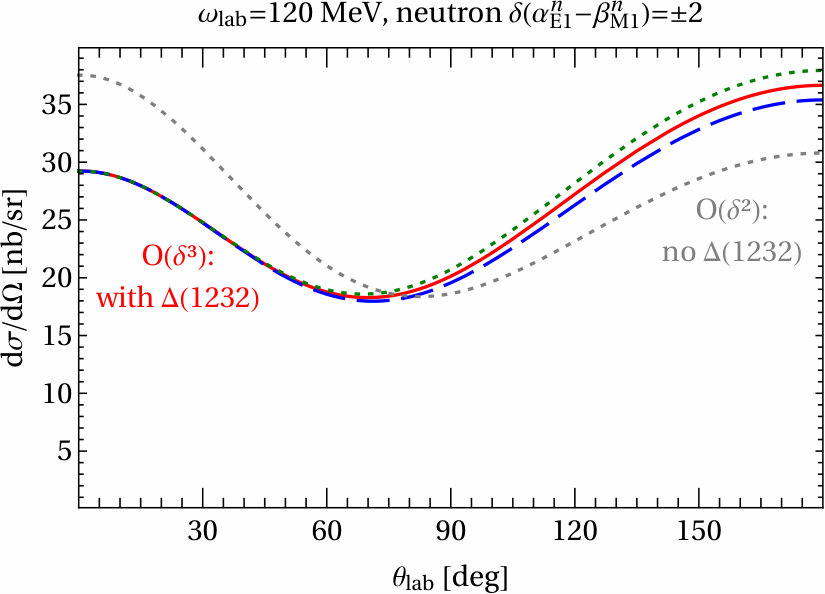 Figure 1
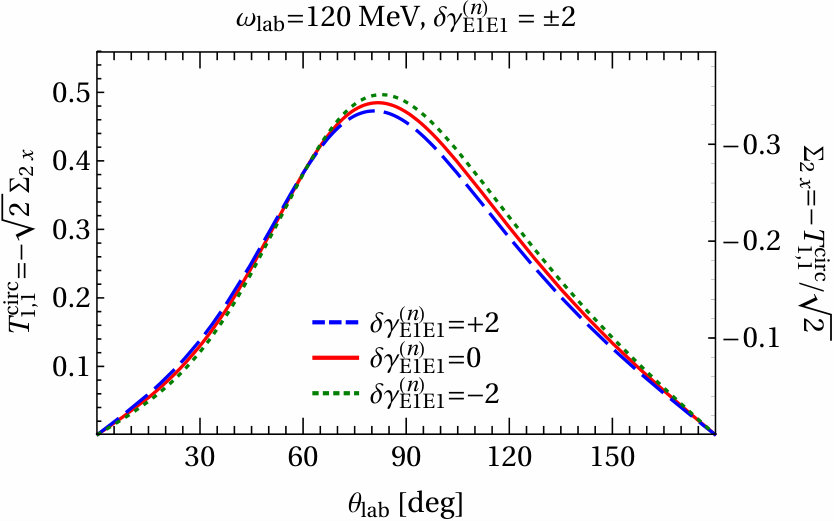 Figure 2
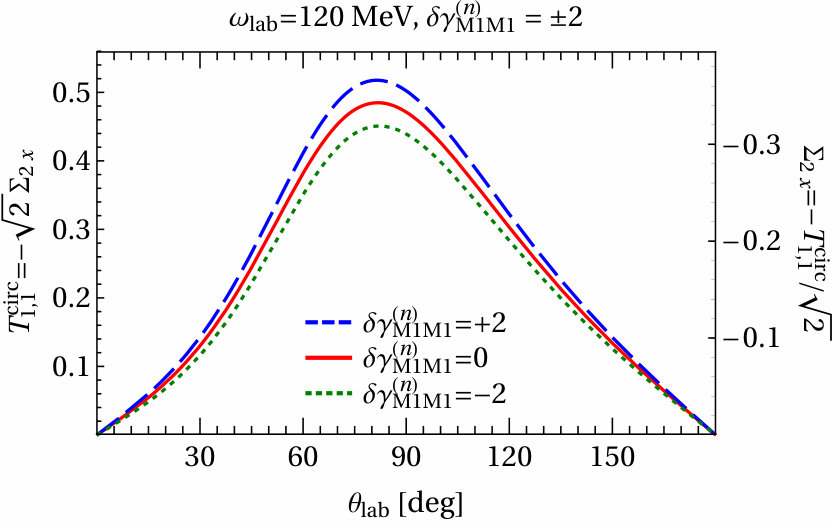 Figure 3
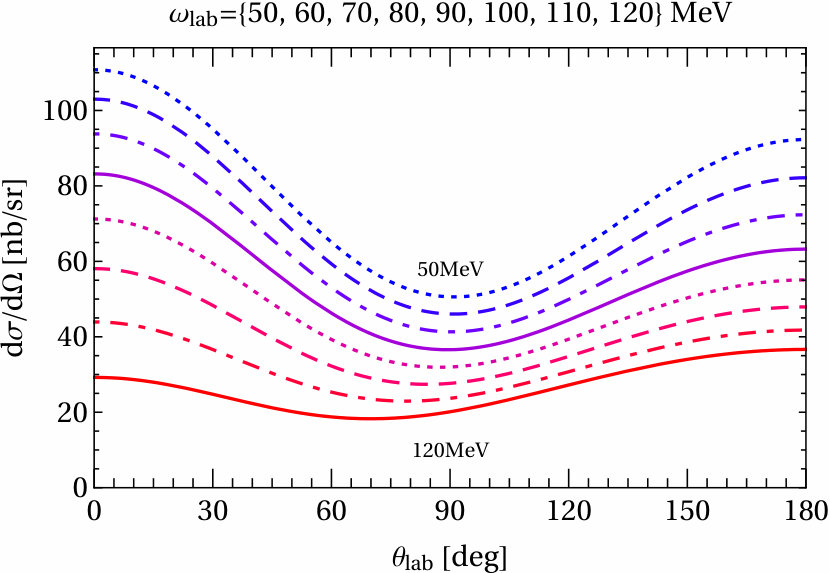 Figure 4
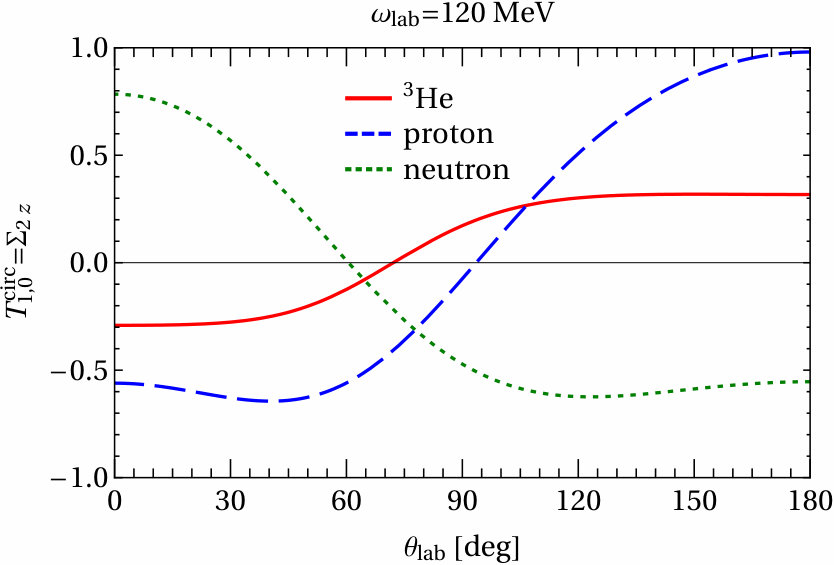 Figure 5
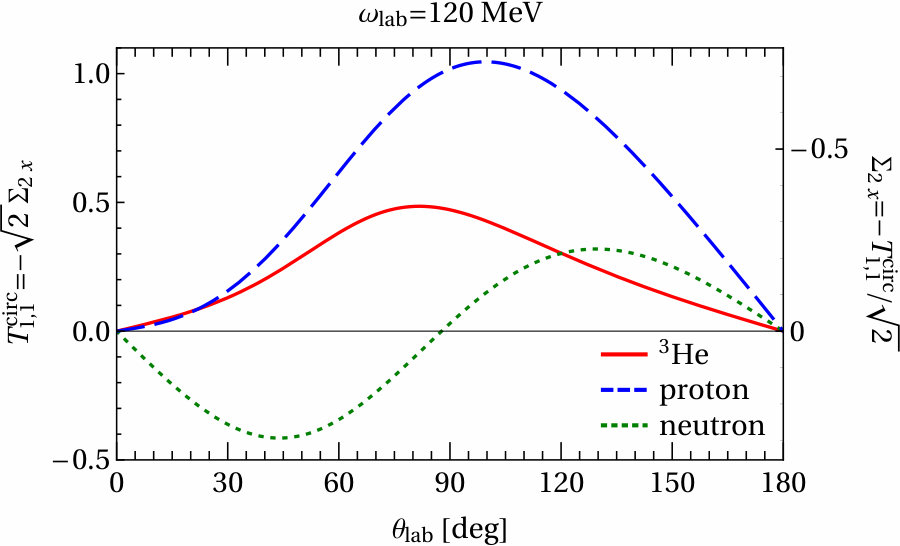 Figure 6
Peer Reviews
No public reviews on file for this paper yet. If you reviewed it on a platform where reviews are public (OpenReview, ICLR, NeurIPS, ICML), you can paste yours below so the community can read it here.
Videos
No videos yet. Explain this paper in a talk, walkthrough, or lecture? Add one.
Taxonomy
TopicsNuclear physics research studies · Quantum Chromodynamics and Particle Interactions · High-pressure geophysics and materials
\floatpagestyle
plain
\tocauthorHarald W. Grießhammer and Judith A. McGovern 11institutetext: Department of Physics, The George Washington University, Washington DC, USA 11email: [email protected] 22institutetext: School of Physics and Astronomy, The University of Manchester, Manchester, UK
Polarisabilities from Compton Scattering on 3He
Harald W. Grießhammer 11
Judith A. McGovern 22
Abstract
This executive summary of recent theory progress in Compton scattering off 3He focuses on determining neutron polarisabilities; see ref. [2] and references therein for details and a better bibliography111Prepared for the Proceedings of the 22nd International Conference on Few-Body Problems in Physics, Caen 9-13 July 2018..
keywords:
Compton scattering, Helium-3, Effective Field Theory, neutron polarisabilities, spin polarisabilities, resonance
Two plenaries discuss the large-scale international effort, gains and goals of a new generation of high-precision facilities to extract nucleon polarisabilities from Compton scattering experiments, and show that determining them by experiments takes years of planning, execution and analysis — and commensurate theory support. Others highlight the importance of electromagnetic polarisabilities in many contexts. We thus refer to all these contributions [1] for motivation and context, and concentrate on theory progress for one target nucleus: 3He.
Setting the Stage
Low-energy Compton scattering probes a target’s internal degrees of freedom in the electric and magnetic fields of a real photon. These fields induce radiation multipoles by displacing the target constituents. The angular and energy dependence of the emitted radiation encodes information from the symmetries and strengths which govern the interactions of the constituents with each other and with photons. After subtracting the “Born contributions” (known from one-photon data like form factors), its multipoles parametrise the stiffness of a nucleon (spin ) against transitions at frequency (; ; ; ):
[TABLE]
Six two-photon response functions suffice up to about : two scalar polarisabilities and for electric and magnetic dipole transitions; and the four dipole spin-polarisabilities , , , . These test the nucleon-spin structure and complement information from Jefferson Lab’s spin programme. Intuitively, the electromagnetic field of the spin degrees causes bi-refringence in the nucleon, like in the classical Faraday-effect.
The static values, etc., are often just called “the” polarisabilities and condense the rich information on the pion cloud, on the excitation, and on the interplay between chiral symmetry breaking and short-distance interactions. These fundamental quantities provide stringent tests for theoretical descriptions of hadron structure. Moreover, they are ingredients to the neutron-proton mass difference, the proton charge-radius puzzle, and the Lamb shift of muonic hydrogen. To extract them, one must reliably extrapolate from data to . Since pure neutron targets are unfeasible, nuclear binding and meson-exchange effects must also be subtracted with reliable theory uncertainties. Fortunately, Chiral Effective Field Theory (EFT) provides model-independent estimates of higher-order corrections and encodes the correct low-energy dynamics of QCD. For few-nucleon systems, it consistently incorporates hadronic and nuclear currents, rescattering effects and wave functions. The photon’s interaction with the charged pion-exchange between nucleons also probes few-nucleon binding. Even if scattering on a free neutron were feasible, cross sections and signals for coherent scattering from nuclei are markedly larger.
Elastic Compton scattering from 3He
is a promising means to access neutron polarisabilities. In ref. [3] and subsequent publications, Shukla *et al.*showed that the differential cross section between and is sensitive to the electric and magnetic dipole polarisabilities of the neutron, and , and that scattering on polarised 3He provides good sensitivity to the neutron spin polarisabilities. This triggered several approved proposals at MAMI and HIS.
We recently extended these EFT predictions by one order to N3LO [] by adding a dynamical Delta degree of freedom, and provided results for photon lab energies between and for the differential cross section, for the beam asymmetry , and for the two double asymmetries with circularly polarised photons and transversely or longitudinally polarised targets, and . These are the only non-zero observables below pion-production threshold in our formulation. We also found that the pioneering results were obtained from a computer code which contained mistakes, triggering an erratum to ref. [3].
At such energies, the complete photonuclear operator at N3LO [] is: the Thomson and other minimal-substitution terms; magnetic-moment couplings; dynamical single-nucleon effects such as virtual pion loops and the Delta excitation; and couplings of photons to the charged-pion exchange. All terms are evaluated with 3He wave functions found from the same EFT expansion.
Results
The dynamical Delta effects are obvious in all observables for ; see fig. 1. They markedly invert the fore-aft asymmetry of the cross section and increase the magnitude of double asymmetries and their sensitivity to spin polarisabilities, echoing similar findings for the deuteron. The chiral expansion converges in this energy range quite well; see e.g. fig. 1. The dependence on the choice of the 3He wave function is small and can usually be distinguished from the effects of polarisabilities by a different angular dependence.
We found that can be extracted from the cross section; has a non-degenerate sensitivity to around ; and to and ; see fig. 2. The beam asymmetry is dominated by the single-nucleon Thomson term and not very useful to directly determine polarisabilities. Ultimately, the most accurate polarisabilities will be inferred from data of all four observables. For the spin polarisabilities, data at will be crucial.
This exploration is part of an ongoing dialogue with our experimental colleagues on the best kinematics and observables to extract neutron polarisabilities. An interactive Mathematica notebook is available from [email protected]. Results are quite robust. Varying the single-nucleon amplitudes of complementary approaches like dispersion relations will lead to sensitivities which are hardly discernible from ours. Once data exist, a polarisability extraction will of course need to address residual uncertainties with more diligence; see e.g. ref. [4].
Nuclear Binding
EFT also quantifies the angle- and energy-dependent corrective to the naïve 3He picture as the sum of two protons with antiparallel spins and one neutron. Sensitivity to the scalar polarisabilities enters indeed approximately via and , and the double-asymmetries are -to- times more sensitive to the spin polarisabilities of the neutron than of the proton. However, fig. 3 confirms that there is no energy where polarised 3He simply acts as a “free neutron-spin target”. The sensitivities to neutron spin polarisabilities closely mimic those of free-neutron observables. But their magnitudes do not.
An impulse approximation would thus omit a key mechanism: charged pion-exchange currents. Without their large interference with the polarisabilities, results are severely distorted. The EFT expansion provides quantitative predictions of the two-body currents, with reliable theory uncertainties. Detailed checks of the convergence of the expansion for exchange currents and for the other pieces of the 3He-Compton amplitude by performing a N4LO [] calculation and extending the applicable energy range are under way. They will allow for even more accurate extractions of polarisabilities from upcoming data.
Acknowledgements
HWG is particularly indebted to JMcG for filling in at the oral presentation on very short notice. We are also grateful to the other co-authors of ref. [2]. This work was supported in part by the US Department of Energy under contract DE-SC0015393 (HWG), and by UK Science and Technology Facilities Council grants ST/L005794/1 and ST/P004423/1 (JMcG).
The reference list from the paper itself. Each links out to its DOI / PubMed record.
- 1[1] See the contributions to these proceedings by J. Mc Govern and C. Howell, as well as by M. Elihau, R. Higa, R. Pohl and M. S. Safronova.
- 2[2] A. Margaryan, B. Strandberg, H. W. Grießhammer, J. A. Mc Govern D. R. Phillips and D. Shukla, Eur. Phys. J. A 54 (2018), 125 doi:10.1140/epja/i 2018-12554-x [ ar Xiv:1804.00956 [nucl-th]].
- 3[3] D. Choudhury, A. Nogga and D. R. Phillips, Phys. Rev. Lett. 98 (2007) 232303 doi:10.1103/Phys Rev Lett.120.249901 [ nucl-th/0701078 ]; erratum ibid. 120 (2018) 249901 doi:10.1103/Phys Rev Lett.98.232303 [ ar Xiv:1804.01206 [nucl-th]].
- 4[4] H. W. Grießhammer, J. A. Mc Govern and D. R. Phillips, Eur. Phys. J. A 52 (2016) 139 doi:10.1140/epja/i 2016-16139-5 [ ar Xiv:1511.01952 [nucl-th]].