Competing superconducting phases in interacting two-dimensional electron gas with strong Rashba spin-orbit coupling
Rasoul Ghadimi, Mehdi Kargarian, S. Akbar Jafari

TL;DR
This paper investigates how strong Rashba spin-orbit coupling influences superconducting phases in an interacting two-dimensional electron gas, revealing competing pairing symmetries and potential topological superconductivity.
Contribution
It provides a detailed phase diagram showing the interplay of charge and spin fluctuations in determining pairing symmetries in a Rashba-coupled extended Hubbard model.
Findings
$d_{xy}$ and $d_{x^2-y^2}$ pairing symmetries are prominent
Higher angular momentum pairings emerge due to strong fluctuations
Potential for topological and triplet superconductivity is discussed
Abstract
In this work we study interacting electrons on square lattice in the presence of strong Rashba spin-orbit interaction. The spin-orbit term forces the time-reversal electron states to be paired in even Cooper channels. For concreteness, we only consider the repulsive onsite Hubbard and nearest-neighbor coulomb interactions, the so called extended Hubbard model. To examine the superconducting instability we obtain the effective interaction between electrons within the random phase approximation and treat the pairing instabilities driven by charge and spin fluctuations and their combined effects. We mapped out the phase diagram of the model in terms of interactions and electron fillings, and found that while the and symmetries are the most likely pairing symmetries driven by charge and spin fluctuations, respectively, the strong effect of both fluctuations yields…
Click any figure to enlarge with its caption.
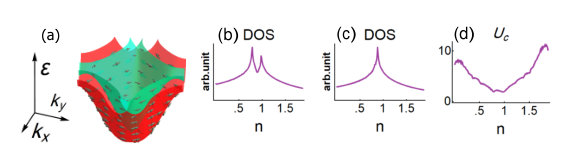 Figure 0
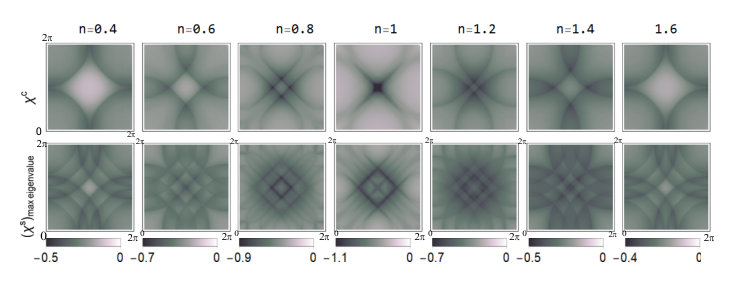 Figure 1
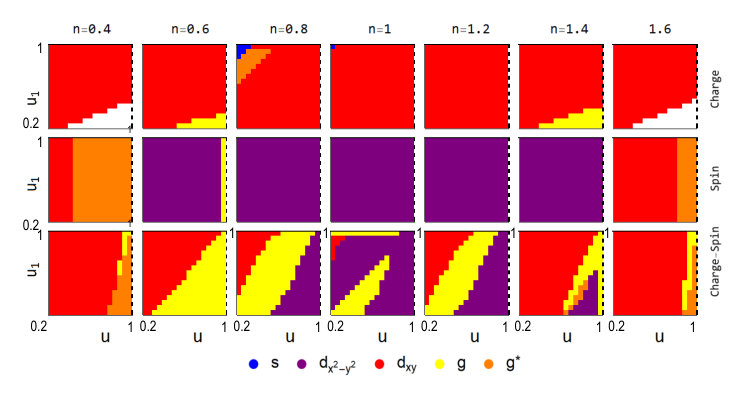 Figure 2
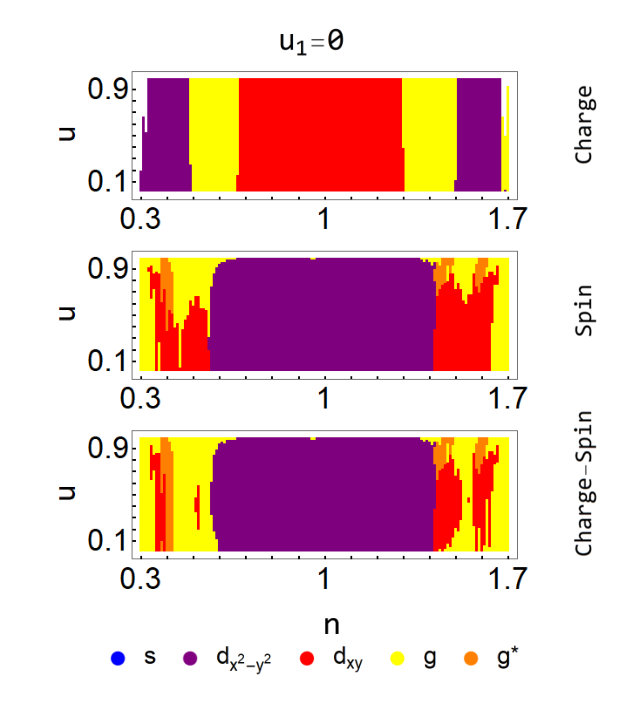 Figure 3
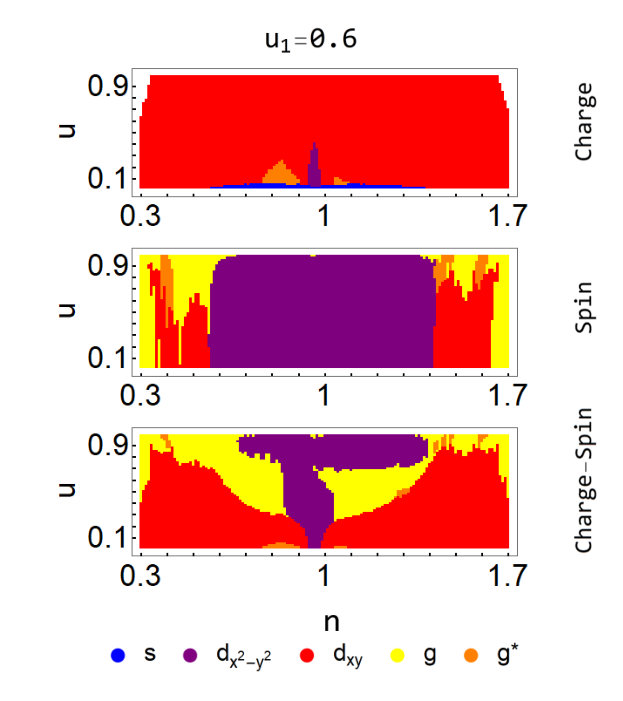 Figure 4
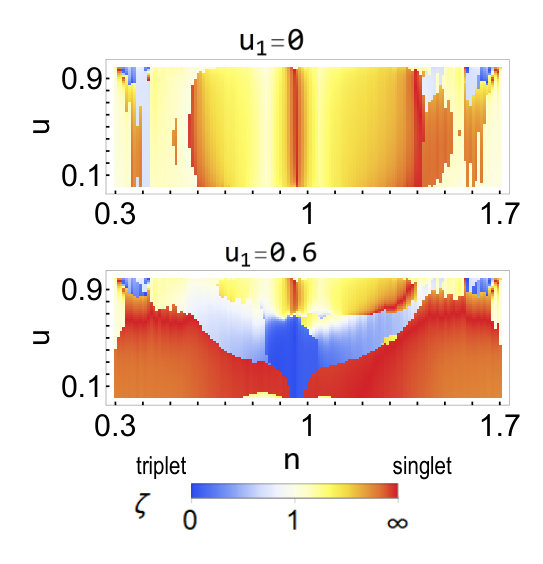 Figure 6
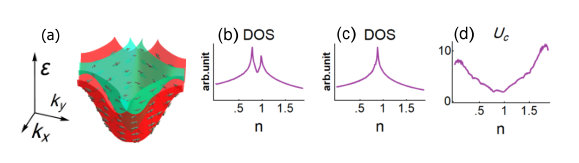 Figure 0
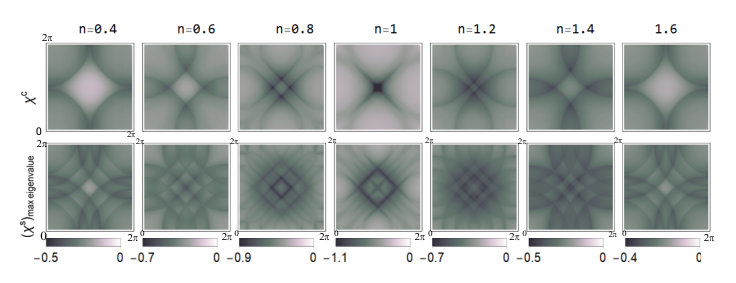 Figure 1
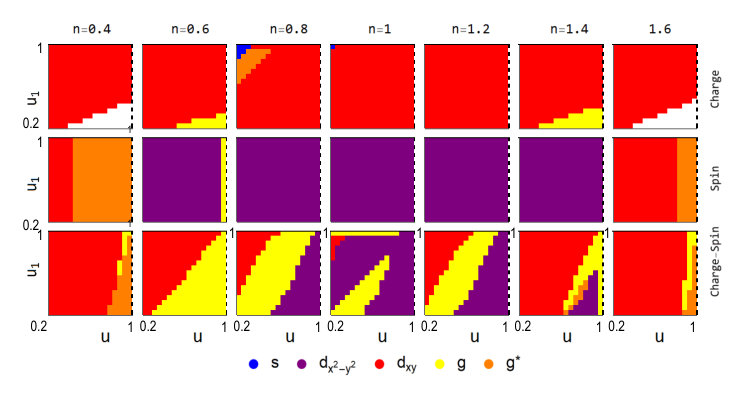 Figure 2
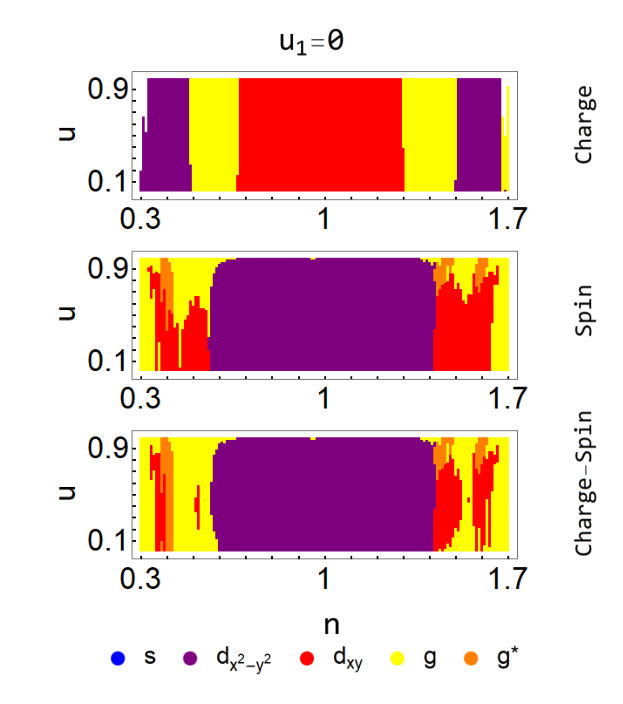 Figure 3
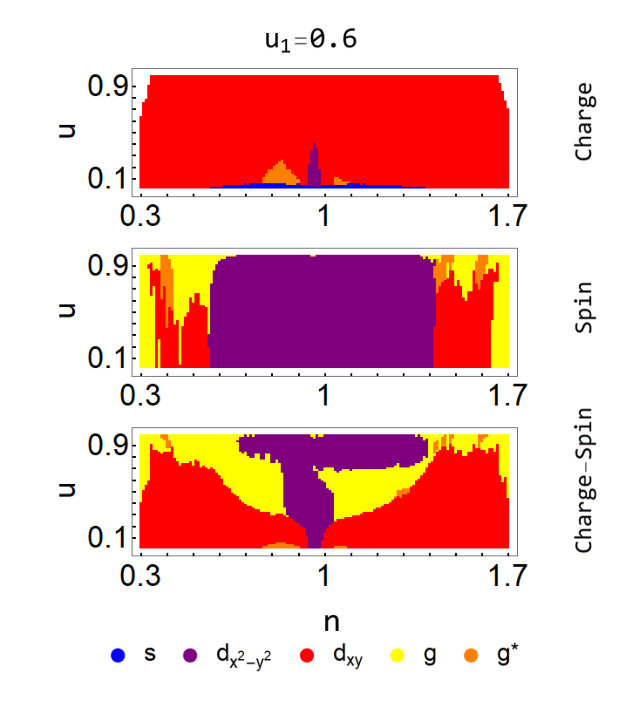 Figure 4
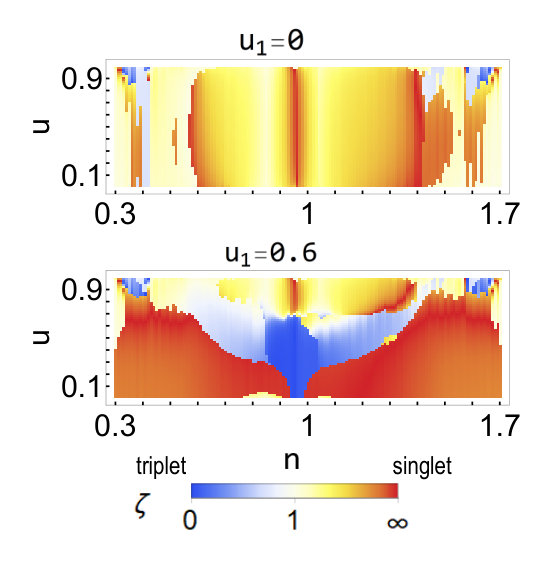 Figure 6
Peer Reviews
No public reviews on file for this paper yet. If you reviewed it on a platform where reviews are public (OpenReview, ICLR, NeurIPS, ICML), you can paste yours below so the community can read it here.
Videos
No videos yet. Explain this paper in a talk, walkthrough, or lecture? Add one.
Competing superconducting phases in interacting two-dimensional electron gas with strong Rashba spin-orbit coupling
Rasoul Ghadimi
Department of Physics, Sharif University of Technology, Tehran 14588-89694, Iran
Mehdi Kargarian
Department of Physics, Sharif University of Technology, Tehran 14588-89694, Iran
S. Akbar Jafari
Department of Physics, Sharif University of Technology, Tehran 14588-89694, Iran
Abstract
In this work we study interacting electrons on square lattice in the presence of strong Rashba spin-orbit interaction. The spin-orbit term forces the time-reversal electron states to be paired in even Cooper channels. For concreteness, we only consider the repulsive onsite Hubbard and nearest-neighbor coulomb interactions, the so called extended Hubbard model. To examine the superconducting instability we obtain the effective interaction between electrons within the random phase approximation and treat the pairing instabilities driven by charge and spin fluctuations and their combined effects. We mapped out the phase diagram of the model in terms of interactions and electron fillings, and found that while the and symmetries are the most likely pairing symmetries driven by charge and spin fluctuations, respectively, the strong effect of both fluctuations yields higher angular momentum Cooper instability. The possibility of topological superconductivity and triplet pairing is also discussed.
I Introduction
Despite the ongoing tremendous efforts in the past decades to understand the unconventional superconductors, the pairing mechanisms and symmetry of the paired states continue to be important questions and, yet, in many cases remained to be unknown. In most cases the experimental evidences point to the existence of nontrivial pairings not caused by phonons, giving rise to complicated structures for the gap function Mineev et al. (1999); Sigrist (2005); Schrieffer et al. (1989). For instance, the electronic spin density fluctuations may develop Cooper pairs with higher angular momentum such as -wave, as opposed to fully symmetric and isotropic -wave pairings Scalapino (2012); Scalapino et al. (1986), e.g. in the high- superconductors as prime examples of unconventional superconductivity.
Beside the pairing mechanisms, the spatial crystal symmetry may also influence the symmetry of the gap wave functions. In noncentrosymmetric superconductors Bauer and Sigrist (2012); Yokoyama et al. (2007); Samokhin (2015), due to the lack of inversion symmetry in the bulk of the underlying crystal, pairing states with mixed parities are expected to constitute the condensate. For example in CePt3Si, the -wave Cooper pairs may be realized Yokoyama et al. (2007), though in this particular case a more careful study of the phase of the Cooper pairs by Samokhin, et. al., indicates that the order parameter in this system is an odd function of momentum that supports line of zero energy modes in the excitation spectrum Samokhin et al. (2004).
The two-dimensional electron gas (2DEG) confined at the interfaces between two insulators, which is the focus of this work, may also become a superconductor at low temperatures. One famous example of such 2DEG is the interface of LaAlOSrTiO3 system He et al. (2014); Matetskiy et al. (2015); Biscaras et al. (2010); Richter et al. (2013); Khalsa and MacDonald (2012); Fernandes et al. (2013); Smink et al. (2018), where the interfacial superconductivity offers an interesting playground for realizing the unconventional superconductivity Reyren et al. (2007); Yada et al. (2009); Nakamura and Yanase (2013); Nakosai et al. (2012a); Gariglio et al. (2015); Mannhart et al. (2008); Ohtomo and Hwang (2004); Saito et al. (2017). At the interface the inversion and mirror symmetries are broken and consequently an interfacial Rashba spin-orbit coupling emerges giving rise to mixed singlet-triplet and multi-orbital superconductivities Gor’kov and Rashba (2001); Scheurer and Schmalian (2015); Samokhin (2015). In the presence of spin-orbit interaction the Cooper pairs acquire more robustness against dephasing in the magnetic fields beyond the Pauli paramagnetic limit Frigeri et al. (2004); Takimoto (2012); Bauer et al. (2005); Wang et al. (2016); Nakamura and Yanase (2013); Nishiguchi et al. (2017). Perhaps, the main advantage of studying superconductivity in heterostructures relies on its tunability by charge carriers or electric field Biscaras et al. (2012); Ye et al. (2012); Parendo et al. (2005); Ueno et al. (2008). The spin-orbit coupling can be externally induced to tune the critical temperature of the system Ptok et al. (2018); Caviglia et al. (2010). In the proximity to a conventional superconductor and in the presence of a Zeeman coupling or a magnetic field, the spin-orbit coupled 2DEG may host a topological superconductor Sau et al. (2010a, b). The emergence of the latter in heterostructures made of stacked 2DEGs with Rashba spin-orbit coupling has been studied theoretically Nakosai et al. (2012b). In the presence of strong disorder, a finite-momentum paired state, the so-called Fulde-Ferrell-Larkin-Ovchinnikov (FFLO) state can be established Michaeli et al. (2012). The in-plane magnetic field can also generate an FFLO state Lake et al. (2016); Larkin and Ovchinnikov (1965); Fulde and Ferrell (1964). While the out-of-plane magnetic fields may establish a superconductor, for in-plane fields a nodal p-wave pairing is predicted Lake et al. (2016); Hugdal and Sudbø (2018). Further, the in-plane field can induce a supercurrent Yip (2002). As a function of charge carrier, the behavior of the in the interface of LaAlOSrTiO3 is found to be nonmonotonic Klimin et al. (2014), and the pairing symmetry in this system can be controlled by an applied electric field Yada et al. (2009).
Hence, the ability to tune the parameters of 2DEGs, which are by now within the experimental reach and controllability, provide a fertile ground enabling us to study the interplay between strong correlations and spin-orbit interaction. It is shown that the strong Hubbard interaction and spin-orbit coupling give rise not only to superconducting instabilities Vafek and Wang (2011); Shigeta et al. (2013), but also to time-reversal symmetry-breaking superconducting states with even angular momenta Vafek and Wang (2011) and topological superconductivity Scheurer and Schmalian (2015). In the absence of spin-orbit coupling the Hubbard model treated within the random phase approximation (RPA) on a square lattice yields a chiral p-wave superconducting state that breaks the time-reversal symmetry Rømer et al. (2015). It is attributed to the enhancement of the spin susceptibility near . A phase transition from the -wave state at very low filling to -wave symmetry close to half-filling is also reported. The same system including the Rashba spin-orbit interaction has been studied in Ref. [Greco and Schnyder, 2018]. It’s shown that the ferromagnetic fluctuations are dominant for values of chemical potentials lying between the van-Hove singularities resulting in a possible -wave triplet pairing.
In this work we consider the extended Hubbard model, including both onsite and nearest-neighbor Coulomb interactions, on the square lattice in the presence of strong Rashba spin-orbit coupling. Our goal is to envisage the role of strong correlations, spin-rotational symmetry-breaking effects, and the electron fillings on the formation of the Cooper pairs. In particular, we (i) derive the effective interaction between electrons dressed by spin and charge fluctuations within the RPA, (ii) use the even-parity pairing states between time-reversed states on the Fermi contours, dictated by strong spin-orbit coupling, to investigate the superconducting instability, (iii) obtain the superconducting phase diagram and the phase transition between different superconducting states over a wide range of interactions and fillings, and (iv) discuss the origin of the triplet superconductivity in this system.
The paper is organized as follows. We start by describing the model in section II. In Sec. III we will derive the effective interaction between the electrons. The Sec. IV is devoted to the pairing instabilities and their symmetries. In Sec. V we present our results and finally we conclude in Sec. VI.
II interacting 2DEG Model
The model we consider consists of a kinetic term and an interaction between electrons, . We assume that the noninteracting electrons on a square lattice are described by a single-particle Hamiltonian
[TABLE]
where with () as the annihilation(creation) of electron with spin and momentum . In the Hamiltonian (1) is the 2D energy dispersion in the absence of spin-orbit interaction, where are the nearest, next-nearest hopping amplitudes, and the Fermi energy, respectively. In the following we set lattice constant to be unity . The spin-rotational and inversion symmetries are broken by adding the spin-orbit Rashba interaction with strength , where is unit vector perpendicular to the interface. Also is identity matrix with dimension two and is a vector of Pauli matrices.
The Hamiltonian (1) can be diagonalized by introducing band basis creation and annihilation operators as
[TABLE]
It then follows that
[TABLE]
where label non-degenerate bands with dispersion
[TABLE]
In Fig. (1a) we show the energy dispersion of the bands for a given set of parameters. It is clearly seen that the lift the spin degeneracy resulting in two non-degenerate bands throughout the Brillouin zone except for a few exceptional points, the so-called Kramers’ degeneracy at the time-reversal invariant momenta, where . Also, one notes that the spin is locked to the momentum as shown by arrows. Given a fixed generic value for Fermi energy , two separate Fermi contours can be distinguished with opposite helicity define by , where is eigenvector of the Hamiltonian and hat denotes the unit vector.
For describing the repulsive interaction between electrons we use on site Hubbard and nearest-neighbor repulsive interactions
[TABLE]
where is the electron occupation number operator with spin at site . Here and are the strength of Hubbard and nearest-neighbor interactions, respectively. In the next section, we obtain an effective interaction between electrons within the random phase approximation (RPA) before turning to the Cooper instability of the Fermi contours in the following sections.
III Effective Interaction
In this section we derive effective interaction between electrons using (RPA). To begin, we rewrite the Hubbard interaction (5) in the momentum space (see appendix A for details of derivation)
[TABLE]
where and
[TABLE]
where and is the total number of sites. The charge () and the spin () density operators are expressed as
[TABLE]
Within the RPA, the effective interaction is given by
[TABLE]
where and denote the frequency and momentum, respectively, and is the retarded charge and spin density susceptibility matrix
[TABLE]
The Fermi Dirac distribution is give by and form factor matrix isPletyukhov and Konschuh (2007)
[TABLE]
with the projection operator defined as . In the static limit, , the hermiticity of the interaction implies that the spin and charge components of the susceptibilities, and consequently effective interaction, decouple from each other (see appendix C for more details). In the spin (charge) channel at a critical value of () the determinant of the denominator of (9) vanishes, , implying an instability of the system to spin-density wave (charge-density wave) state denoted by SDW (CDW).
IV Superconductivity and PAIRING SYMMETRY
IV.1 BCS-like superconductivity and even-parity condensate
In this work, we only analyze the case of Bardeen-Cooper-Schrieffer (BCS) - like superconductivity which means that the Cooper pairs have a vanishing center of mass momentum. BCS pairing occurs between two electron states with opposite momenta residing on the Fermi contours. Since the Fermi contours are single-degenerate due to the spin-rotational symmetry breaking nature of the Rashba coupling, it is more convenient to rewrite the interaction in the band basis Samokhin and Mineev (2008); Samokhin (2015).
Inverting Eq. (2), we can express the electron operators in terms of band operators as
[TABLE]
where which is odd under since . Note that in writing (12), in the sum we use () for spin up (down).
In following, because we are only interested in finding the paring symmetry, we just consider the static limit of the effective interaction . We use (12) to rewrite the effective interaction
[TABLE]
in terms of band basis operators as
[TABLE]
Since we are interested in the pairing between electrons with opposite momenta, we restrict the momentum summation in (14) to the Cooper channel. Moreover, we consider the pairing between an electron in the state and its time-reversal partner , where with as complex conjugate operatorGong et al. (2017); Samokhin and Mineev (2008). Consequently, the corresponding electron operators are related to each other by the following relations:
[TABLE]
Hence the effective interaction in the Cooper channel becomesSamokhin and Mineev (2008)
[TABLE]
where
[TABLE]
Note that, because of decoupling of the charge and spin susceptibilities we can decompose Eq. (IV.1) into the charge and spin sectors as
[TABLE]
by restricting the summation in Eq. (IV.1) to () for charge (spin) sectors of effective interaction.
By inspection we can see that in the above interaction, due to the relations , only the even channels of , survive. The reason is as follows. The Cooper pair annihilation operator is an even function of momentumSamokhin and Mineev (2008), since . Consequently, we can decompose the interaction in terms of only even basis functions of the irreducible representations of the point group symmetry of the underlying lattice. That isSamokhin and Mineev (2008)
[TABLE]
where labels -dimensional irreducible representations and is symmetric part of the interaction. Here are even basis functions.
Using the mean field theory we decompose the interaction (16) as
[TABLE]
where we ignored an unimportant constant term and the gap function is given by
[TABLE]
Including the single particle Hamiltonian , the full BCS Hamiltonian becomes
[TABLE]
Using the Bogoliubov transformation, the energy dispersion of quasi-particle reads
[TABLE]
The gap function (21) can be determined self consistently as follows:
[TABLE]
IV.2 Determination of the gap function
Near the critical temperature , the gap equation can be linearized. Converting the sum in (24) to an energy integral about the Fermi contours with energy cut off and the momentum integration along the Fermi contours, we obtainRømer et al. (2015)
[TABLE]
where stands for Fermi contour and is the -dependent Fermi velocity.
To obtain the pairing symmetry, we convert the gap equation (25) to an eigenvalue problem by inserting Eq. (19) into (25) and projecting into basis function which gives,
[TABLE]
The eigenvector corresponding to the maximum eigenvalue determines the pairing symmetry, where critical temperature is related to as . This relation justifies that maximum positive eigenvalue , has a higher critical temperature and therefore by lowering the temperature the superconducting instability occurs in the corresponding symmetry channel. The point group symmetry of the square lattice allows the following lowest-order even basis functions
[TABLE]
that we use to find the maximum eigenvalue and the corresponding pairing symmetry.
V Results
In this section we present our results for the susceptibilities and pairing instability of the lattice model.
V.1 Density of states and susceptibilities
For the square lattice we use the parameters , , and . With this choice for the Rashba spin-orbit coupling, the Fermi contours are largely separated in momentum space in most fillings. We plot the density of states (DOS) for this set of parameters in Fig. 1b. Near the half-filling there are two van Hove singularities due to the spin-split bands, while at there is only one singularity for each spin species (up and down) as shown in Fig. 1c.
Now we turn to the bare susceptibilities. As described in Sec. (III), the spin and charge channel in the static limit () are decoupled allowing one to study the instability in each channel separately. That is, we can write , where is the charge susceptibility and () is the spin susceptibility tensor. For numerical calculation of susceptibilities we mesh grid the Brillouin zone into points. At each wave vector we evaluate and three eigenvalues of the matrix . We found in the entire Brillouin zone for all fillings as shown in first row of Fig. 2. For spin channel we only show the maximum eigenvalue of in second row of Fig. 2. For the spin channel we found all the eigenvalues are always negative. Therefore, there will be some critical value of () at which the value of det vanishes in the spin (charge) channel signaling an spin-density wave (charge-density wave) instability. In Fig. 1d we show the value of the critical Hubbard interaction in different fillings for . It is clearly seen that the critical is small near the half-filling, where the DOS is large. Note that the values of critical (not shown here) generally depends on .
For values of in the vicinity of the SDW (CDW) critical points, as we will describe in the next subsection, the fluctuations of spin (charge) channel play a decisive role in determining the pairing symmetry. However, for generic values far away from the critical points, both spin and charge fluctuations conspire to form the pairing symmetry which is different from the symmetry expected from individual channels.
V.2 Pairing symmetry
We follow the procedure outlined in Sec. (IV.2) to determine the pairing symmetry. We begin by considering (, ) phase diagram for the filling factors presented in the Fig. 3. We take the effective interaction into account first in separate charge-only (top panels) and spin-only (middle panels) channels. Then in order to investigate the competition between the fluctuations in the two channels, we contrast those separate channels with the situation where both spin and charge channels are taken into account (bottom panels). As a general rule, close to () boundary the dominant role is played by the spin (charge) fluctuations. Further increasing of () beyond () derive the system to the spin (charge) density wave and the ground state will be ordered. Therefore we focus on the square region where and look for superconducting instability in the disordered metallic phase.
The relevant pairings in the plane of (,) at different filling factors are also indicated in Fig. 3. Different colors stand for pairing symmetry indicated below the panels. In the white region no positive eigenvalue has been found for the angular momenta (note that is an even function of ). As we can see from the first row of the Fig. 3, when we consider the charge fluctuations only, the phase diagram is dominated by the pairing at and around half-filling. By heavily doping away from half-filling, at , a -wave pairing for small and large enough Hubbard appears. By further doping away from half-filling, no solution up to angular momentum is found which is by the white color. This may correspond to possible higher angular momentum pairing.
There is a small blue region for small and large corresponding to s-wave profile of . The blue (s-wave) and white regions are artifact of overemphasizing the charge fluctuations. To see this, let us focus on the second row of Fig. 3 which takes only spin fluctuations into account. As can be seen at and around the half-filling, the dominant pairing is (purple region). Doping further away from half-filling by either holes or electrons stabilizes the pairing (red region) for values of far below the SDW instability. By approaching the SDW instability, a higher angular momentum, -family pairing kicks in. For , still the dominant pairing is which eventually gives way to -wave pairing by approaching the SDW instability . For lower electron (hole) density , the phase diagram is divided between the and pairing. The division is almost independent of as in the spin-only channel, does not play any role. Note that in the charge-only channel, both and affect the phase diagram. That is why in the first row, the phase boundaries are not horizontal (i.e. -independent).
Now let us focus on the third row of Fig. 3 where we let both spin and charge fluctuations to renormalize the interaction at RPA level. At and around half-filling, when is not large, the purple region conquers particularly larger region. That is why in this region the red region (due to charge fluctuations) is completely washed out. This can be understood in terms of enhancement of spin fluctuations as one approaches SDW critical point. Quite generally in the Hubbard model, at half-filling and large enough , the charge degrees of freedom tend to be frozen and the dominant low-energy fluctuations are those of spin degrees of freedom. At half-filling the charge fluctuations find a chance to stabilize a small region corresponding to and Hubbard is small. Slight deviation from half-filling expands the red region.
When the strength of and are comparable, the fluctuations in both charge (red region) and spin (purple region) will have comparable strength in such a way that they both loose and give way to -wave pairing indicated by yellow region. This is because the basis function corresponding to the second largest eigenvalue of Eq. (26) is generically dominated by -wave (yellow) pairing. That is how the yellow region can take over once the spin (purple) and charge (red) fluctuations can not favor a wave pairing. By doping away from half-filling with either electrons or holes, the red region arising from charge fluctuations expands. The expansion of the charge fluctuations dominated region starts from smaller when the system is close to half-filling, and eventually occupies larger region when is strong enough.
When the doping crosses the quarter-filling, a lot of phase-space for the charge fluctuations will be created. That is why in both second and third row, we obtain qualitatively similar phase diagram where the major competition is taking place between the red (charge fluctuation dominated phase) and yellow (-wave pairing).
To focus on the dependence of the pairing symmetry on electron density, in Fig. 4 (5) we plot the - phase diagram for fixed nearest neighbor value of interaction . Let us begin with the case shown in Fig 4. In this figure, we present the pairing symmetry resulting from the fluctuations in charge only, spin only and charge-spin together in the first, second and third rows, respectively. As can be seen by comparison of the second and third rows, for case, the purple area surrounding the half-filling and region around it is quite similar in both cases. This means that the spin channel plays the dominant role in determining the pairing symmetry. By moving to low carrier density (in either electron or hole sides), the pairing looses, and the main competition will be between and -wave family pairing. This family consists in the standard -wave (yellow) and and -wave pairing (orange). In these regimes, when is large enough, again the second and third rows in Fig. 4 are similar, which is natural, as the spin fluctuations are the most strong for . Upon lowering , the third row phase diagram starts to deviate from the second row, and the -wave and -wave pairing will win. Again as discussed before, when one plots a similar phase diagram with the second largest eigenvalue, the major parts of the phase diagram, and in particular the low-carrier density regime turns out to be -family (yellow/orange) dominated. Hence the -family pairing sets in, in the case of comparable strength between the purple and red regions. In such situation both purple and red loose, and yellow/orange region takes over. This can be clearly seen by comparison of the first and second rows in Fig. 4.
Similarly, in Fig. 5 we have plotted the phase diagram in the plane for the fixed value of . Again in first (second) row we have only considered the charge (spin) fluctuations, while in the third row we have considered spin and charge fluctuations together. The difference between this figure, and Fig. 4 is the value of . As can be seen from Eq. (7), the nearest neighbor interaction affects only the charge component of the effective interaction. That is why the second row in both Figs. 4 and 5 are identical. However, the first row in these two figures are drastically different. As a result of overemphasizing the charge fluctuations (by choosing to focus only on the charge channel), major parts of the phase diagram is dominated by (red region) pairing. Small region of -wave (blue) pairing also appears. Such a blue region is entirely absent in the second and third rows. This is actually artifact of limiting the total energy minimization to few lowest angular momentum basis functions. Indeed, allowing for higher angular momentum basis such as , they will become dominant over the -wave pairing. Therefore the -wave pairing is artifact of limited number of basis functions, and can be removed by including more and more basis functions. After all, in second and third rows of Fig. 5 there are no -wave pairing which simply means that the spin fluctuations do not favor -wave pairing.
It is instructive to compare third rows of Figs. 4 and 5. As can be seen, for large in both and cases, the spin fluctuations play the dominant role, and the resulting pairing (purple) region conquers the half-filling and region around it. By reducing to smaller values, the situation in case of Fig. 4 does not change much, while in Fig. 5 first a -wave (yellow) pairing kicks in. Then by further reduction in , the -wave pairing dominates. For slightly hole doped case, the purple region continues to win. Needless to say, the drastic difference between the second and third rows in Fig. 5 signifies the importance of the charge fluctuations. When they are included, they drastically change the picture arising from spin-only fluctuations.
V.3 Degeneracy of the solutions and possible topological superconductivity
So far we have determined the relevant pairing function for different filling and interaction parameters . However we have not yet considered the degeneracy of the solution. The relation between the degeneracy of the eigenvalues of Eq. (26) and topological superconductivity is as follows: Suppose the two largest positive eigenvalues of Eq. (26) are . Their relative difference can be quantified by . indicates nearly degenerate solutions. In Ref. [Cheng et al., 2010] it is shown that the degenerate pairings belonging to two-dimensional irreducible representation can spontaneously break the time-reversal symmetry and a pairing with nontrivial winding number develops in the system. Even if the pairing symmetries do not belong to higher-dimensional representations, but with the same angular momentum, upon lowering the temperature a phase transition to a complex pairing state occurs, e.g. in UPt3 Schemm et al. (2014) . For nearly degenerate channels and a complex combination is favored as it avoids the nodes Gong et al. (2017). The latter state has been realized in epitaxial Bi/Ni bilayer system Gong et al. (2017). Such a combination gives rise to non-trivial topology in the form of a non-zero winding number Samokhin (2015). Thus generically when two solutions with the same angular momentum are degenerate, a time-reversal symmetry breaking chiral superconducting order can be established. We anticipate the degeneracies to happen at the phase boundaries between superconducting orders with different symmetries. Of particular interest is the degenerate boundaries between (red) and (purple) near the half-filing in Fig. 5. Therefore we expect a superconducting state with non-zero winding number Gong et al. (2017). We have to emphasize that such superconducting instability may change the phase diagram near the boundaries, but the exact determination of the phase diagram is beyond the scope of current study, and we leave it for future study.
V.4 Gap structure in original spin basis
In general, in the presence of Rashba spin-orbit coupling and inversion symmetry breaking, the pairing wave function is a mixture of spin singlet and triplet components.Gor’kov and Rashba (2001) Therefore, the total spin is not a good quantum number to label the pairing wave functions, nor is parity. However, for a multi-component superconductor arising from different Fermi contours, the superconducting wave function can have purely singlet or triplet character as described below. We rewrite the pairing Hamiltonian (20) in terms of original spin degrees of freedom asSamokhin (2007)
[TABLE]
where,
[TABLE]
The above equation can be written explicitly in terms of singlet and triplet components as
[TABLE]
where
[TABLE]
is the singlet amplitude and
[TABLE]
is the triplet one. Note that is an even function and is an odd one, since and . Therefore if the pairing symmetry on both Fermi contours are the same, i.e. , at special phases where () the singlet (triplet) component vanishes and consequently the pairing become purely triplet (singlet). In order to compare the triplet and singlet component of the gap functions we define . Obviously indicates the dominance of the triplet pairing while the opposite limit corresponds to the singlet pairing.
In Fig. 6, the top and bottom panels, respectively, show the values of for and . As we can see in the case of the phase diagram is dominated by , and therefore the pairing is more inclined towards the singlet character. Note that due to Rashba spin-orbit coupling, it can not be a pure singlet which only happens when . There is also a small light blue (, triplet dominated) region in Fig. 6 which corresponds to the the -family region of Fig. 4. Note however that the -wave pairing also appears in light yellow regions which means that far away from half-filling their singlet character can become slightly stronger than the triplet.
Now let us discuss the panel of Fig. 6. The large part of this panel is generally similar to the panel. However, it turns out that the singlet (triplet) component become sharper as indicated by the colors intensity. Comparison with third row of Fig. 5 shows that the singlet dominated region in the panel of Fig. 6 corresponds to pairing. Around there is strong triplet component (darker blue) which corresponds to region. This region extends over a larger region by increasing but with lower color intensity. Therefor the nearest-neighbor interaction can stabilize the triplet pairing near the half filling.
Recently Greco and Schneyder in Ref. Greco and Schnyder, 2018 have found the triplet solution for and chemical potentials that lie between two van Hove singularities. However as seen from the upper panel of Fig. 6 corresponding to , we find singlet-dominated pairing near the half filling which takes place in the channel. There can be two possible reasons for this discrepancy. First, we worked out the pairing symmetry in the band basis which are appropriate basis in the presence of the strong spin-orbit coupling. The second and perhaps more important reason is that in computation of the effective interaction, rather than limiting ourselves to transverse or longitudinal portions of the susceptibility matrix, we have considered the full tensorial structure of the susceptibility in the spin-charge basis. Comparing our results with Ref. Shigeta et al., 2013, we see that the phase diagram presented in Fig. 3 for filling is qualitatively similar to the results presented in this reference.
VI Conclusions
In conclusion, we have studied the effect of the large Rashba spin-orbit interaction on the interaction driven superconducting instability on the square lattice with on-site (Hubbard ) and nearest neighbor interaction (). We developed a complete RPA effective interaction by taking into account the full tensorial structure of the susceptibility in the spin-charge channels, rather than picking the singlet or triplet channels only. We focused on a range of interactions where the system is metallic with no magnetic and/or charge orderings. We mapped out superconducting phase diagrams in the parameter space spanned by interactions and fillings. In the absence of the nearest neighbor Coulomb interaction , generically the dominant pairing is in channel, and the pairing interaction mainly arises from the spin-fluctuations. The nearest-neighbor interaction, however, increases the charge fluctuations and favors the symmetry at small . In the regime where both interactions are comparable spin and charge fluctuations are strong and higher angular momentum pairing states are favored. We also pointed out by evaluating the degenerate solutions near the phase boundaries the system can possibly break the time-reversal symmetry spontaneously and a topological superconductor can take over. We also showed that the nearest-neighbor interaction can stabilize a triplet pairing symmetry near the half filling, where the amplitude of the singlet component almost vanishes.
VII Acknowledgements
M. K. acknowledges the support from the Sharif University of Technology under Grant No. G690208. S. A. J. acknowledges Sharif Univ. of Tech. and Science Elites Federation of Iran.
Appendix A Interaction matrix
We can rewrite interaction matrix (5) in terms of density operators (8),
[TABLE]
where if , otherwise vanishes. By Fourier transformation and replacing with adding the last term of Eq. (33) to the chemical potential we can rewrite Eq. (5) as follows,
[TABLE]
Consequently, we can rewrite in the compact form presented in Eq. (6).
Appendix B Derivation of the effective interaction
The effective interaction can be decomposed into charge and spin channels. The matrix elements of the interaction are written in the basis of charge () and spin (). Therefore will be the charge density, while with corresponds to three components of the spin density. The RPA effective interaction reads as follows
[TABLE]
which can be written in a compact form as
[TABLE]
Appendix C Vanishing of the spin-charge cross term in the static susceptibility matrix
By using the definition of the form factor (11) it follows that Pletyukhov and Gritsev (2006); Pletyukhov and Konschuh (2007)
[TABLE]
where if either or . Otherwise it equals to one. By changing integration variable and using Eq. (38) we can rewrite Eq. (10) as
[TABLE]
However, for by help of Eq. (38) we can write
[TABLE]
The hermiticity of the effective interaction requires . Therefore, Eqs. (39) and (40) force the cross terms of the between charge and spin sectors vanish.
The reference list from the paper itself. Each links out to its DOI / PubMed record.
- 1Mineev et al. (1999) V. P. Mineev, K. Samokhin, and L. Landau, Introduction to unconventional superconductivity (CRC Press, 1999).
- 2Sigrist (2005) M. Sigrist, in AIP Conference Proceedings , Vol. 789 (AIP, 2005) pp. 165–243. · doi ↗
- 3Schrieffer et al. (1989) J. R. Schrieffer, X. G. Wen, and S. C. Zhang, Phys. Rev. B 39 , 11663 (1989) . · doi ↗
- 4Scalapino (2012) D. J. Scalapino, Rev. Mod. Phys. 84 , 1383 (2012) . · doi ↗
- 5Scalapino et al. (1986) D. J. Scalapino, E. Loh, and J. E. Hirsch, Phys. Rev. B 34 , 8190 (1986) . · doi ↗
- 6Bauer and Sigrist (2012) E. Bauer and M. Sigrist, Non-centrosymmetric superconductors: introduction and overview , Vol. 847 (Springer Science & Business Media, 2012).
- 7Yokoyama et al. (2007) T. Yokoyama, S. Onari, and Y. Tanaka, Physical Review B 75 , 172511 (2007).
- 8Samokhin (2015) K. Samokhin, Physical Review B 92 , 174517 (2015).