Resolution-induced anisotropy in LES
Sigfried Haering, Myoungkyu Lee, and Robert D. Moser

TL;DR
This paper investigates how anisotropic resolution in LES affects turbulence modeling, revealing that common models perform poorly under such conditions, and introduces a new anisotropic eddy diffusivity model that depends only on turbulence statistics.
Contribution
The paper demonstrates the impact of resolution-induced anisotropy on LES turbulence statistics and proposes a novel anisotropic eddy diffusivity model based solely on turbulence dissipation rate.
Findings
Anisotropic resolution induces Reynolds stress and velocity gradient anisotropy.
Most existing subgrid models perform poorly with anisotropic resolution.
The proposed model performs well and depends only on turbulence dissipation rate.
Abstract
Large eddy simulation (LES) of turbulence in complex geometries and domains is often conducted with high aspect ratio resolution cells of varying shapes and orientations. The effects of such anisotropic resolution are often simplified or neglected in subgrid model formulation. Here, we examine resolution induced anisotropy and demonstrate that, even for isotropic turbulence, anisotropic resolution induces mild resolved Reynolds stress anisotropy and significant anisotropy in second-order resolved velocity gradient statistics. In large eddy simulations of homogeneous isotropic turbulence with anisotropic resolution, it is shown that commonly used subgrid models, including those that consider resolution anisotropy in their formulation, perform poorly. The one exception is the anisotropic minimum dissipation model proposed by Rozema et al. (Phys. of Fluids 27, 085107, 2015). A simple new…
Click any figure to enlarge with its caption.
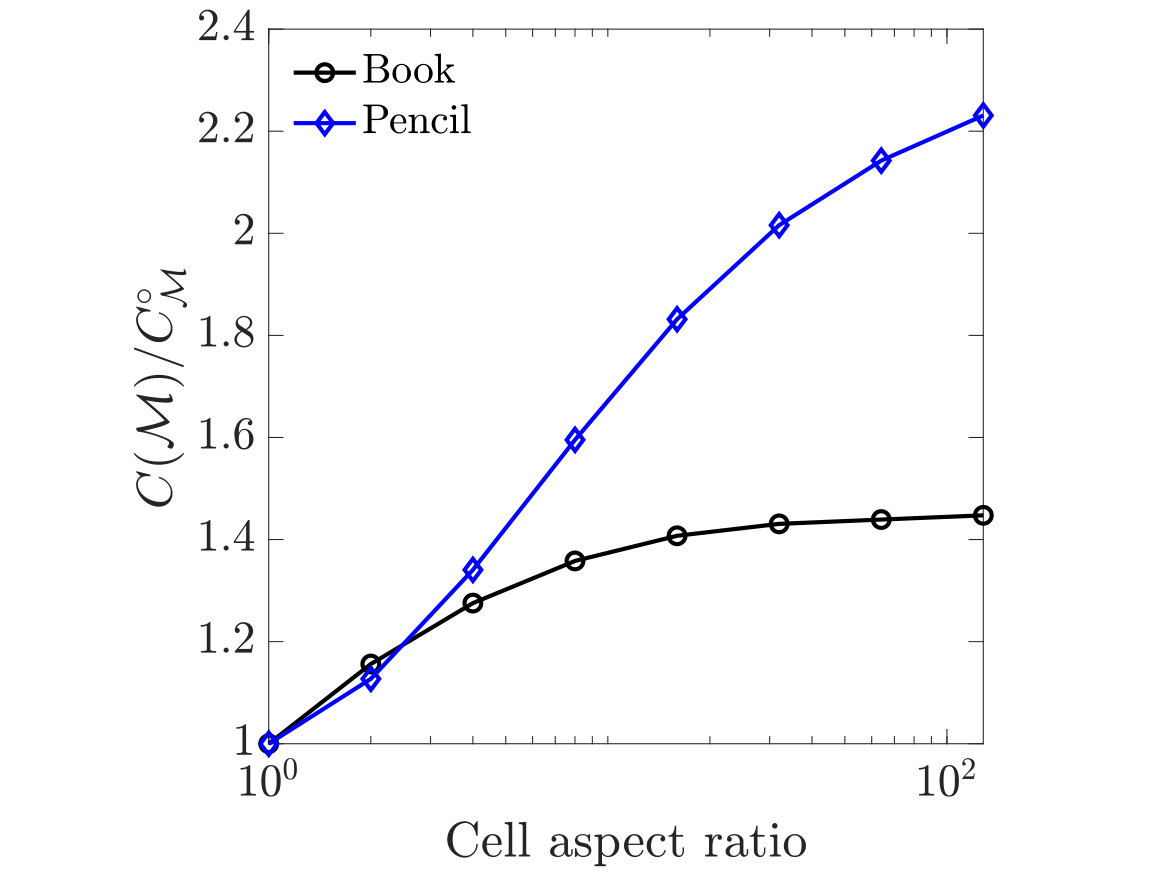 Figure 1
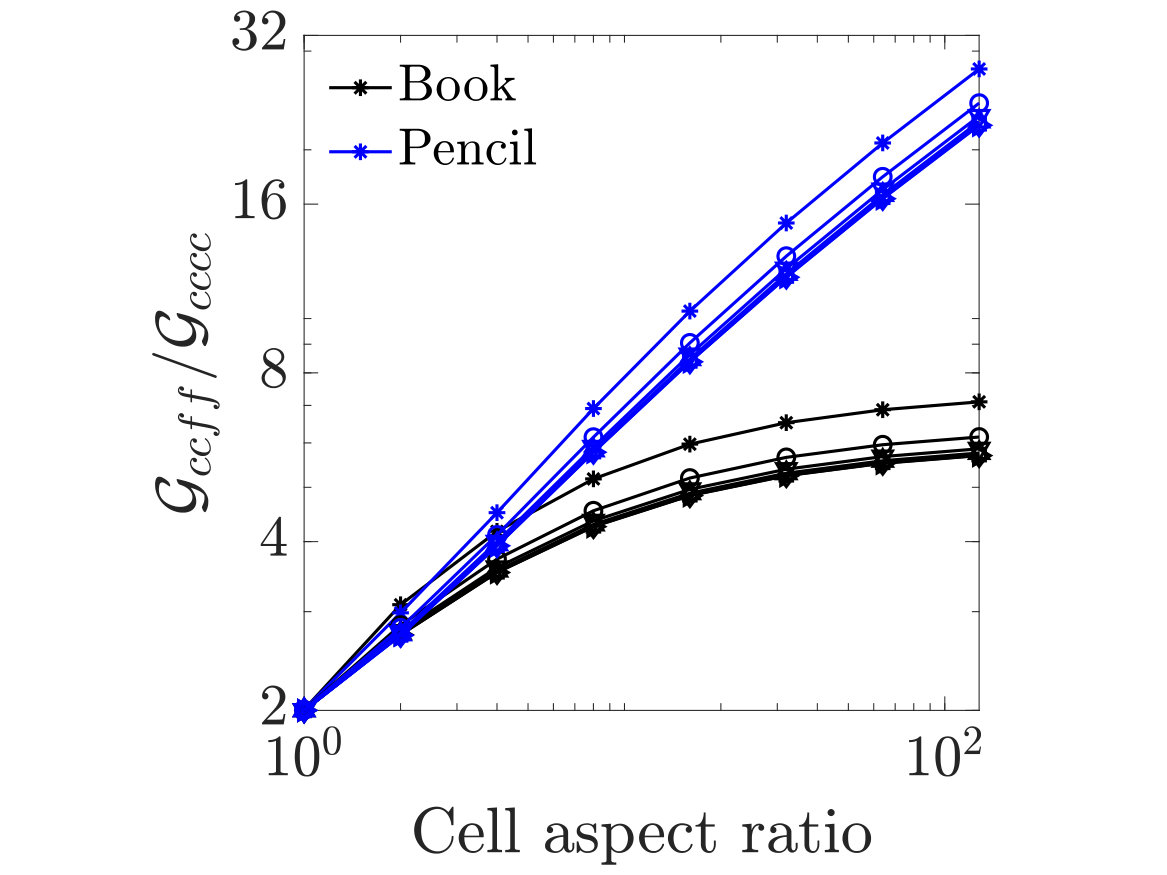 Figure 2
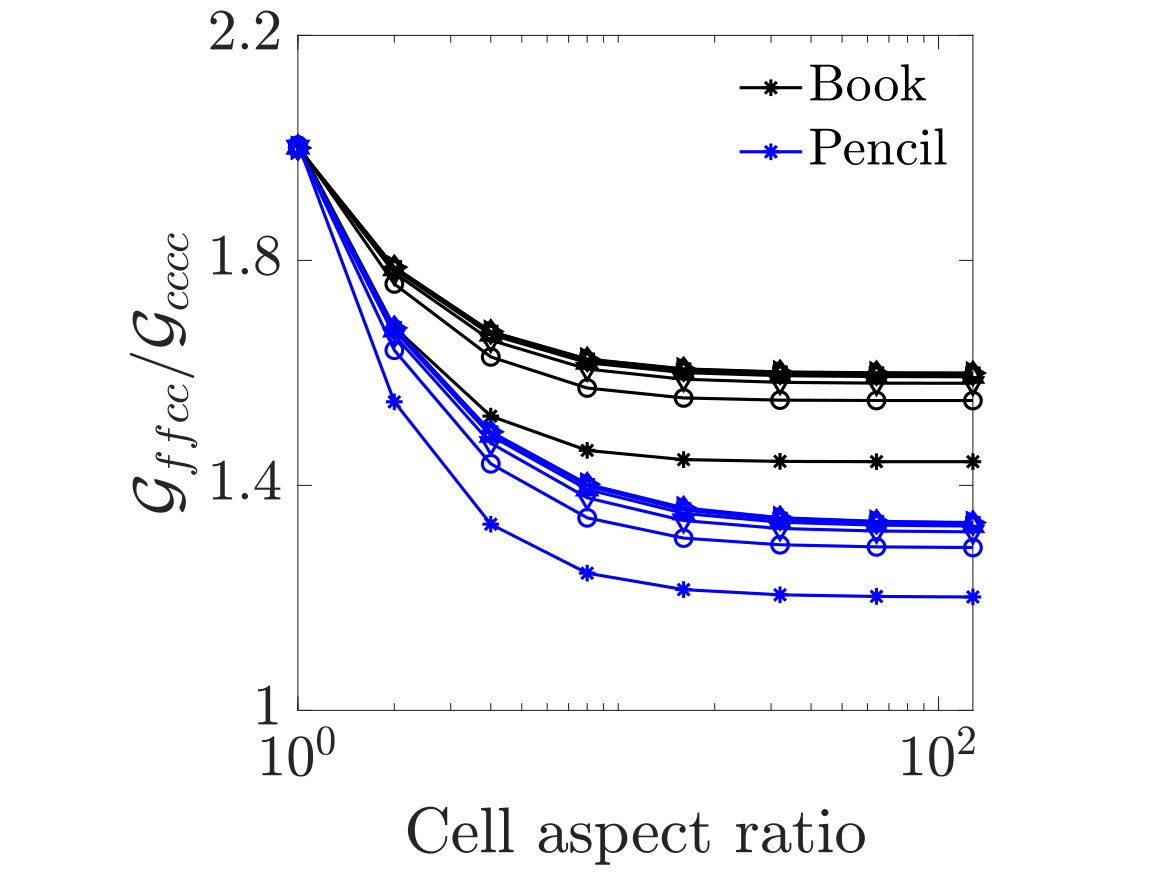 Figure 3
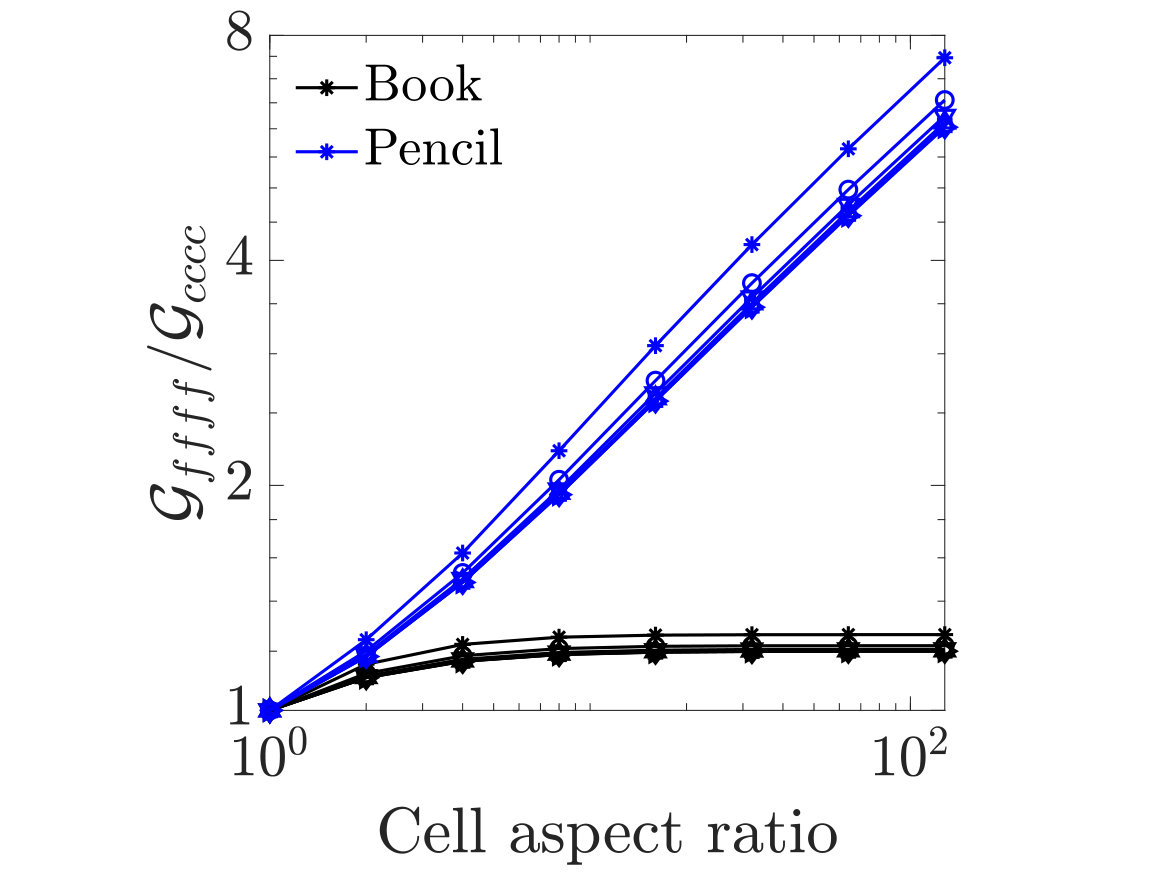 Figure 4
 Figure 5
 Figure 6
 Figure 7
 Figure 8
 Figure 9
 Figure 10
 Figure 11
 Figure 12
 Figure 13
 Figure 14
 Figure 15
 Figure 16
 Figure 17
 Figure 18
 Figure 19
 Figure 20
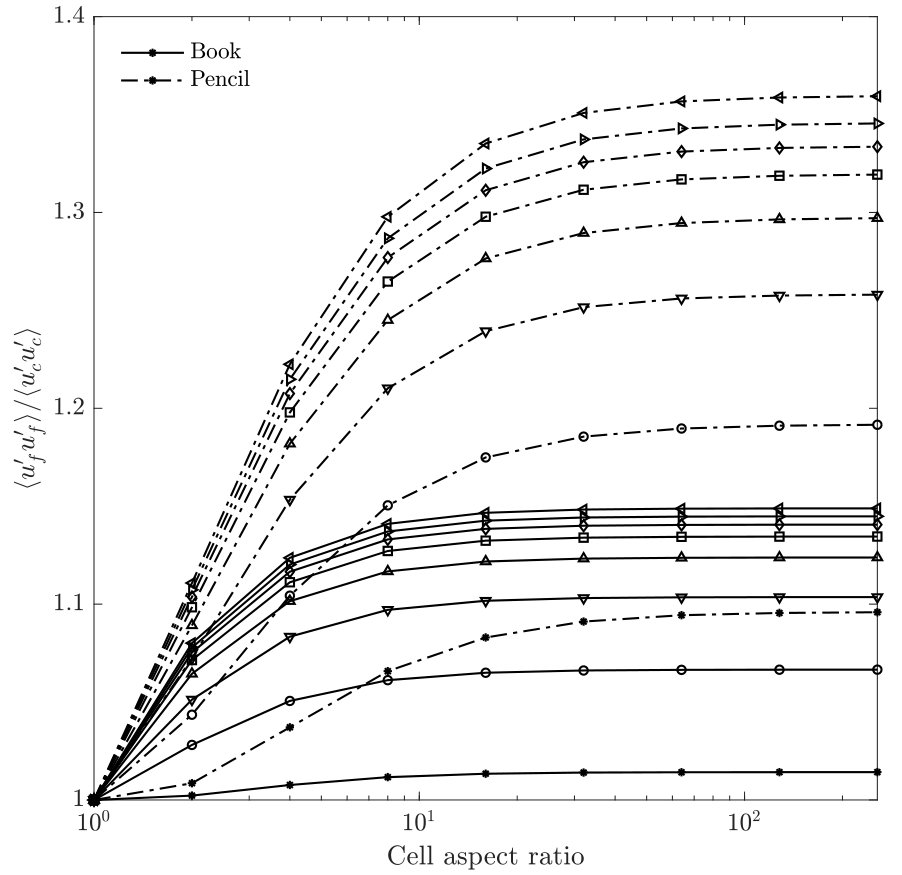 Figure 21
 Figure 22
 Figure 23
 Figure 24
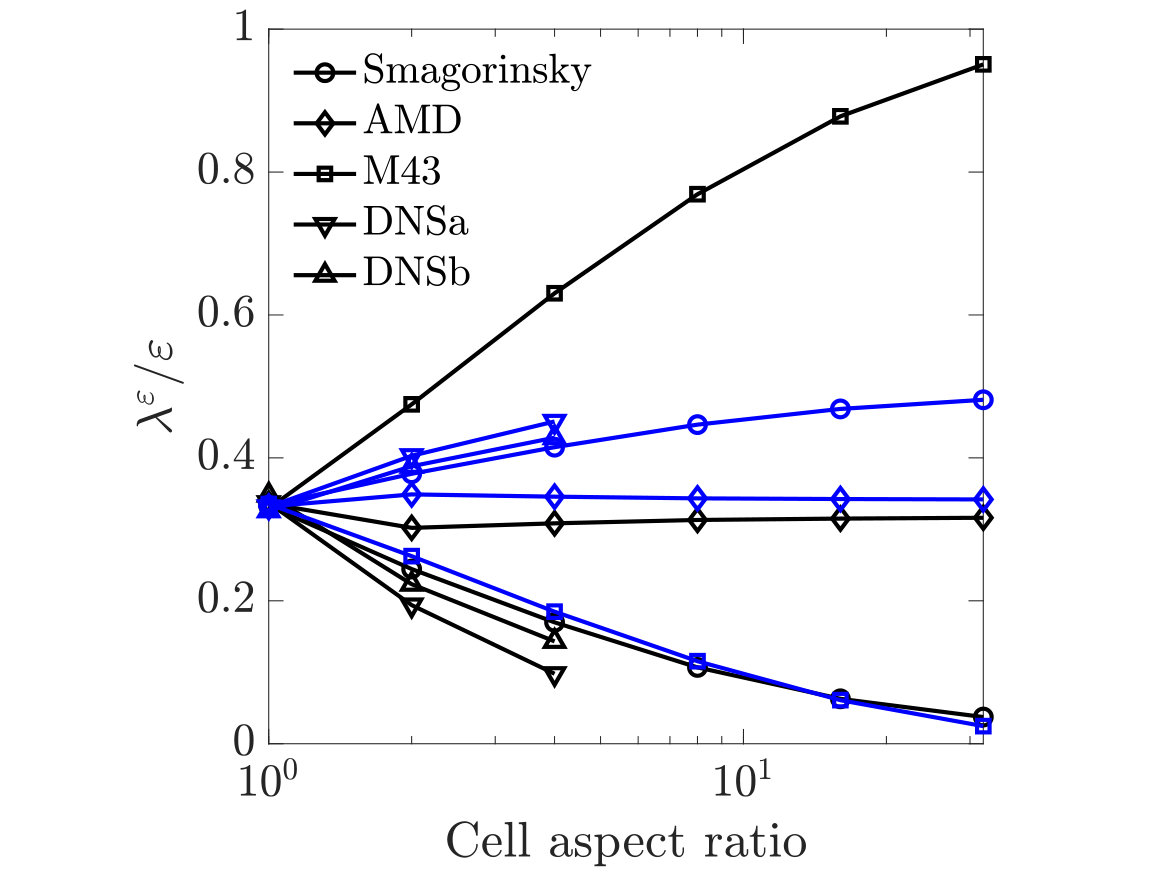 Figure 25
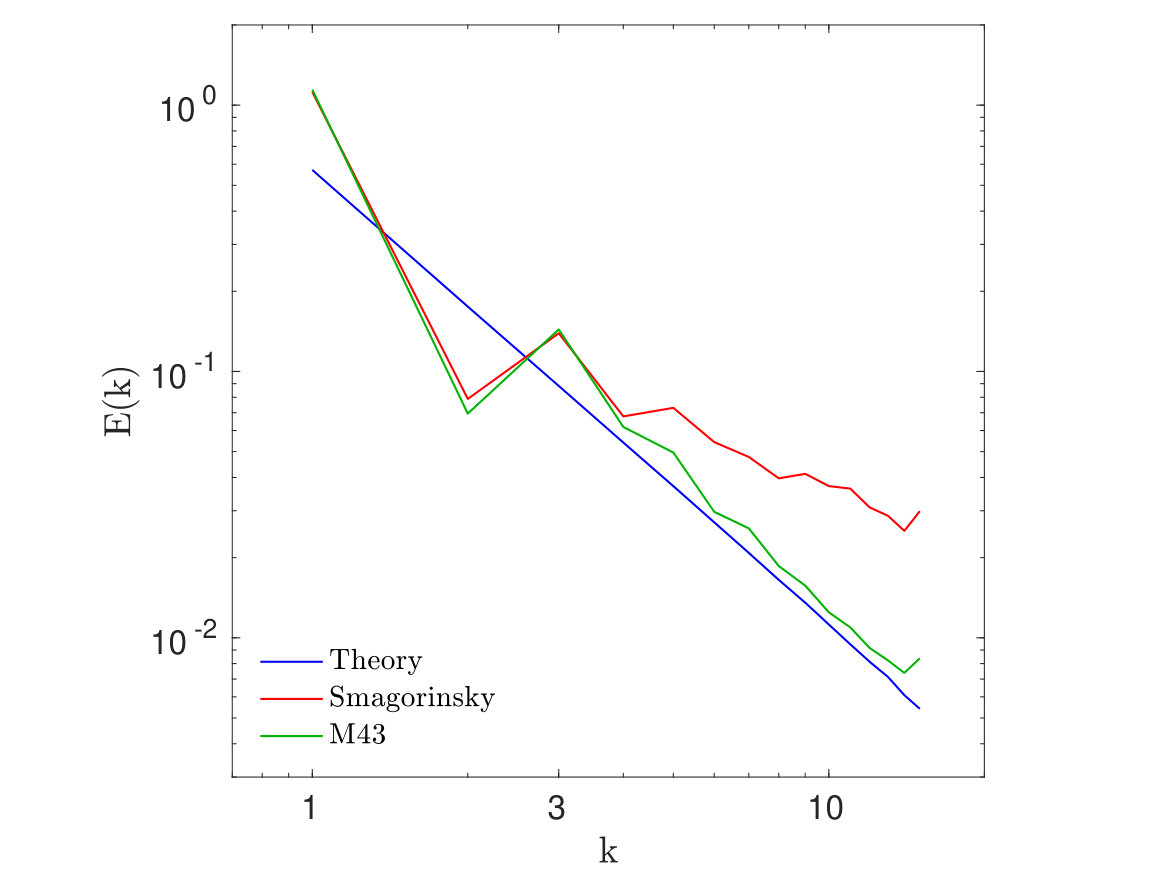 Figure 26
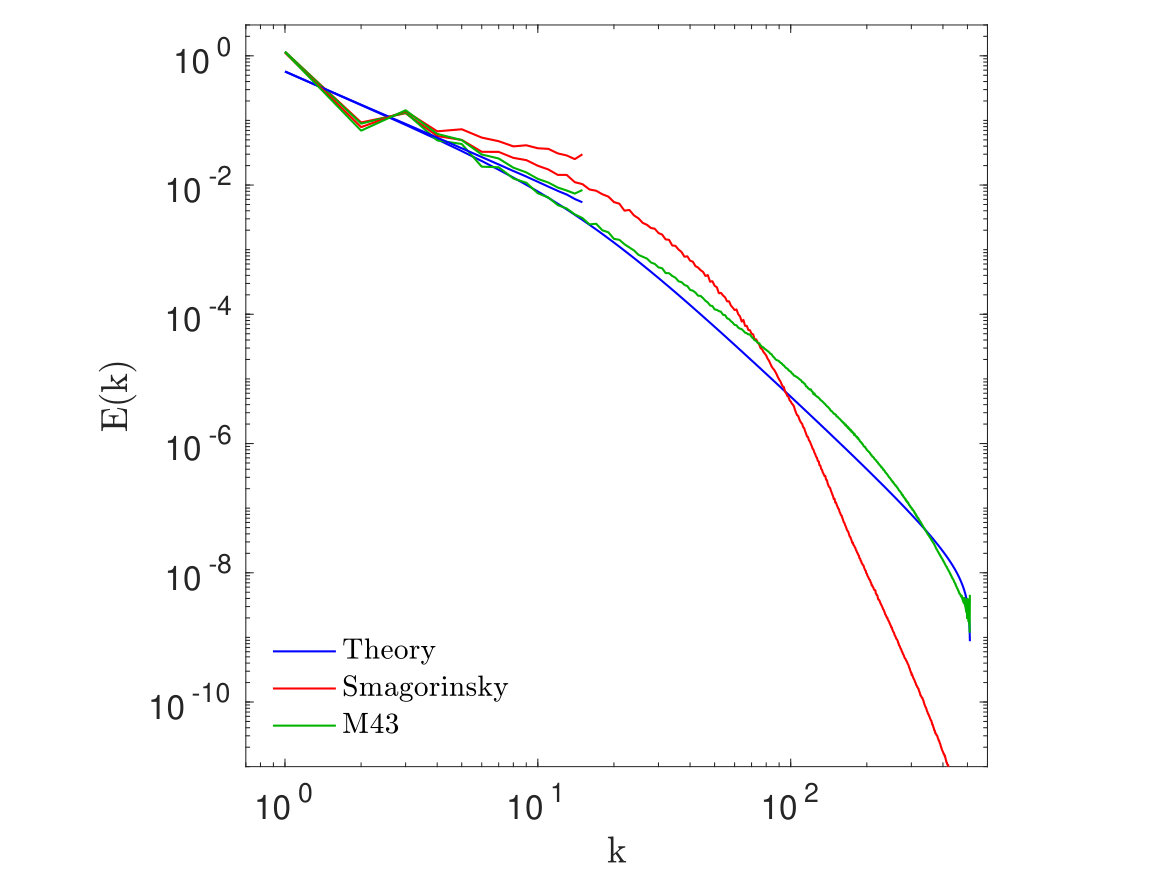 Figure 27
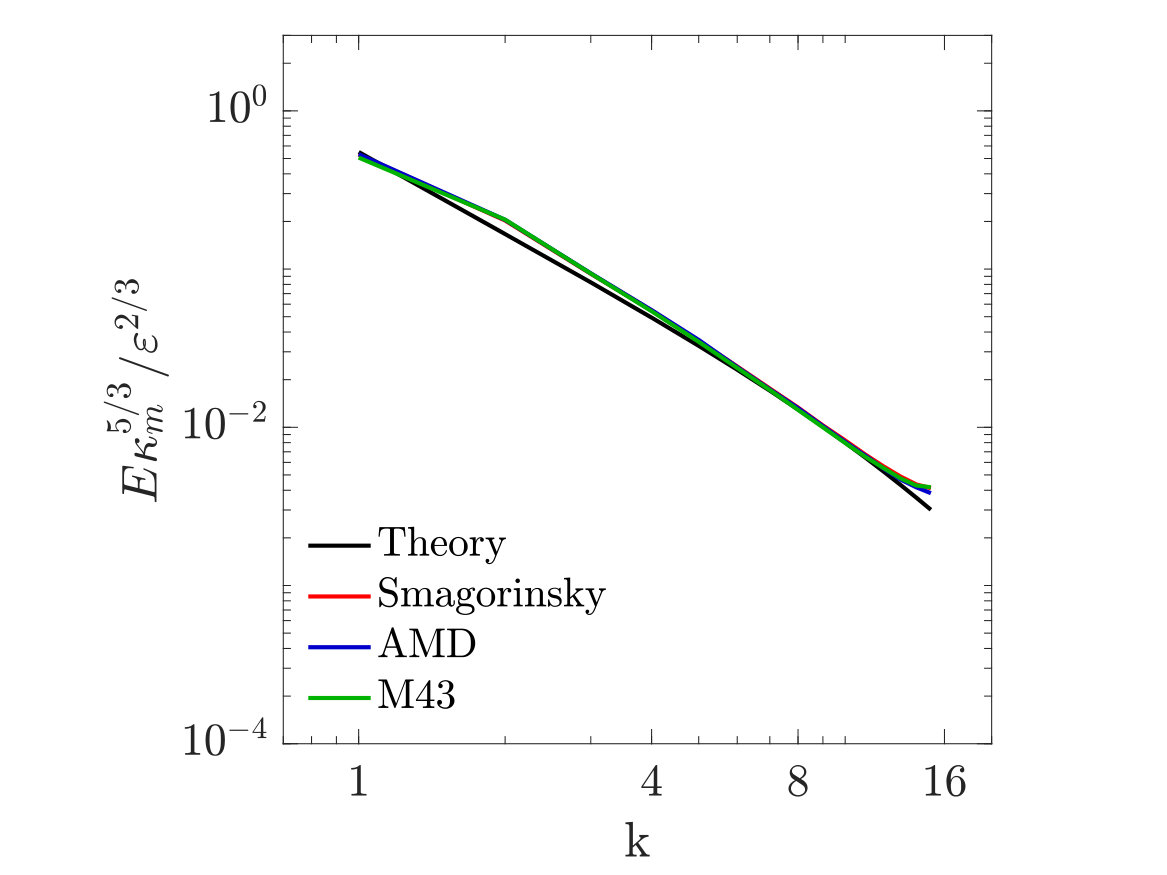 Figure 28
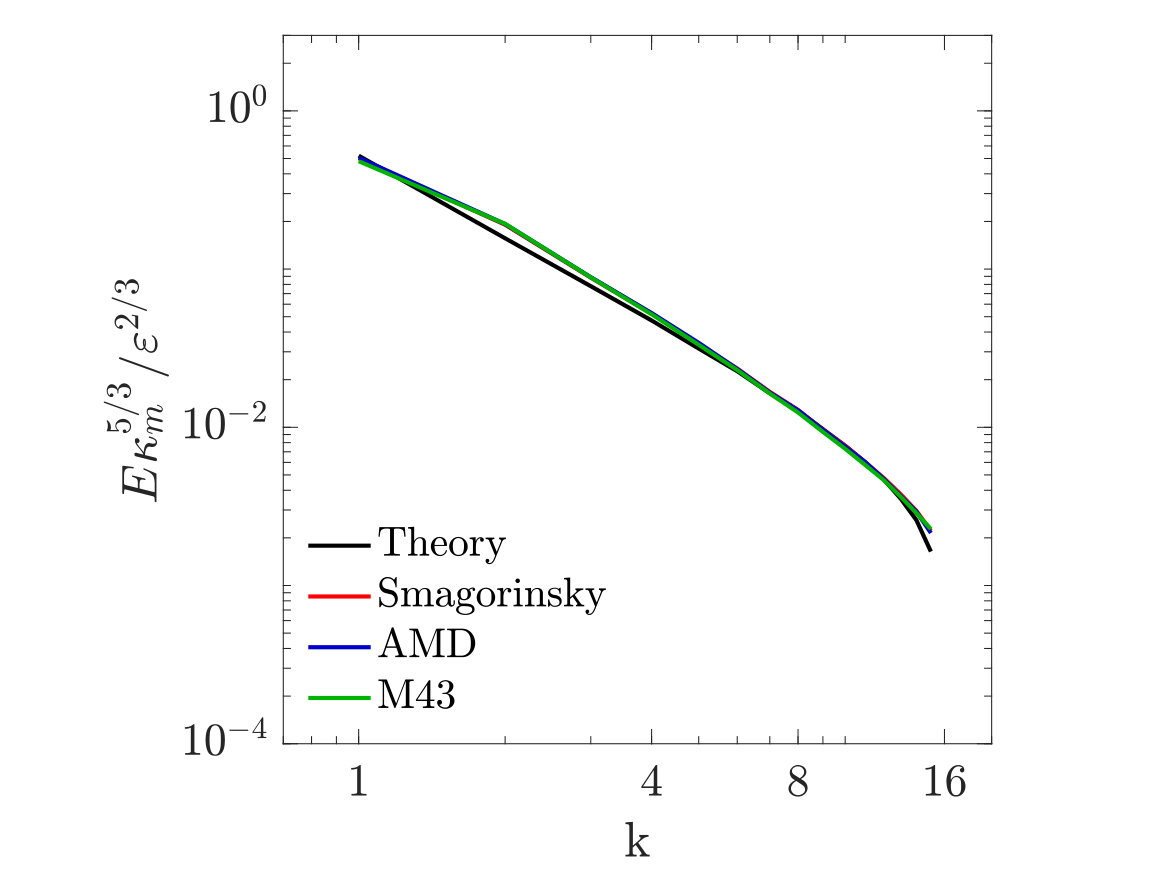 Figure 29
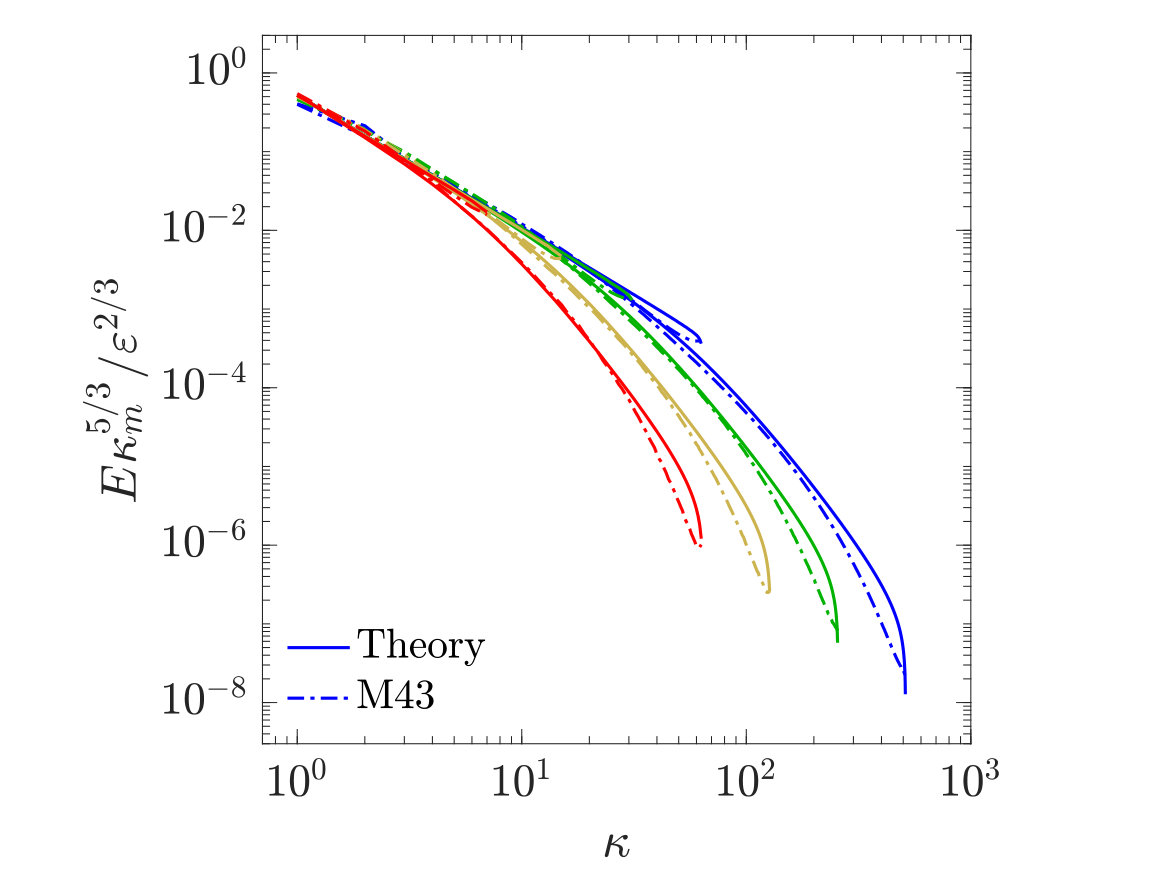 Figure 30
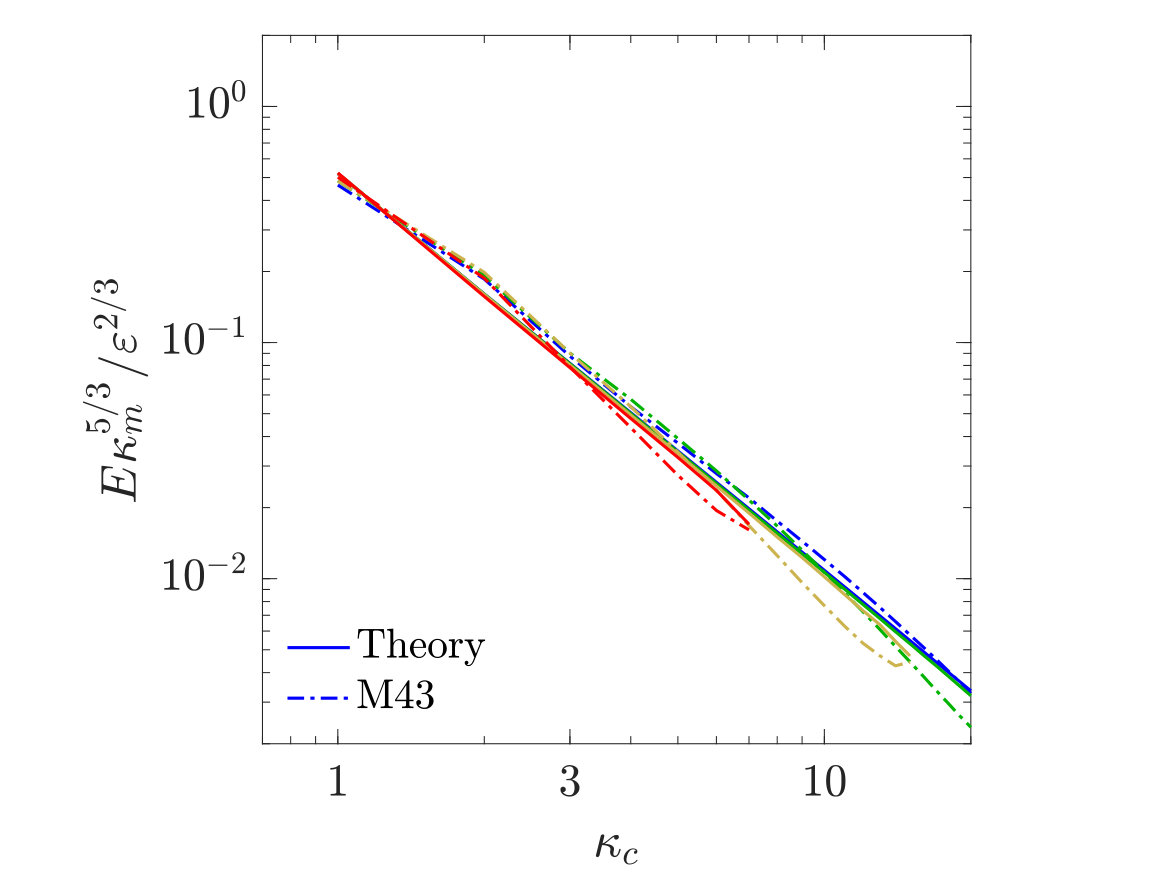 Figure 31
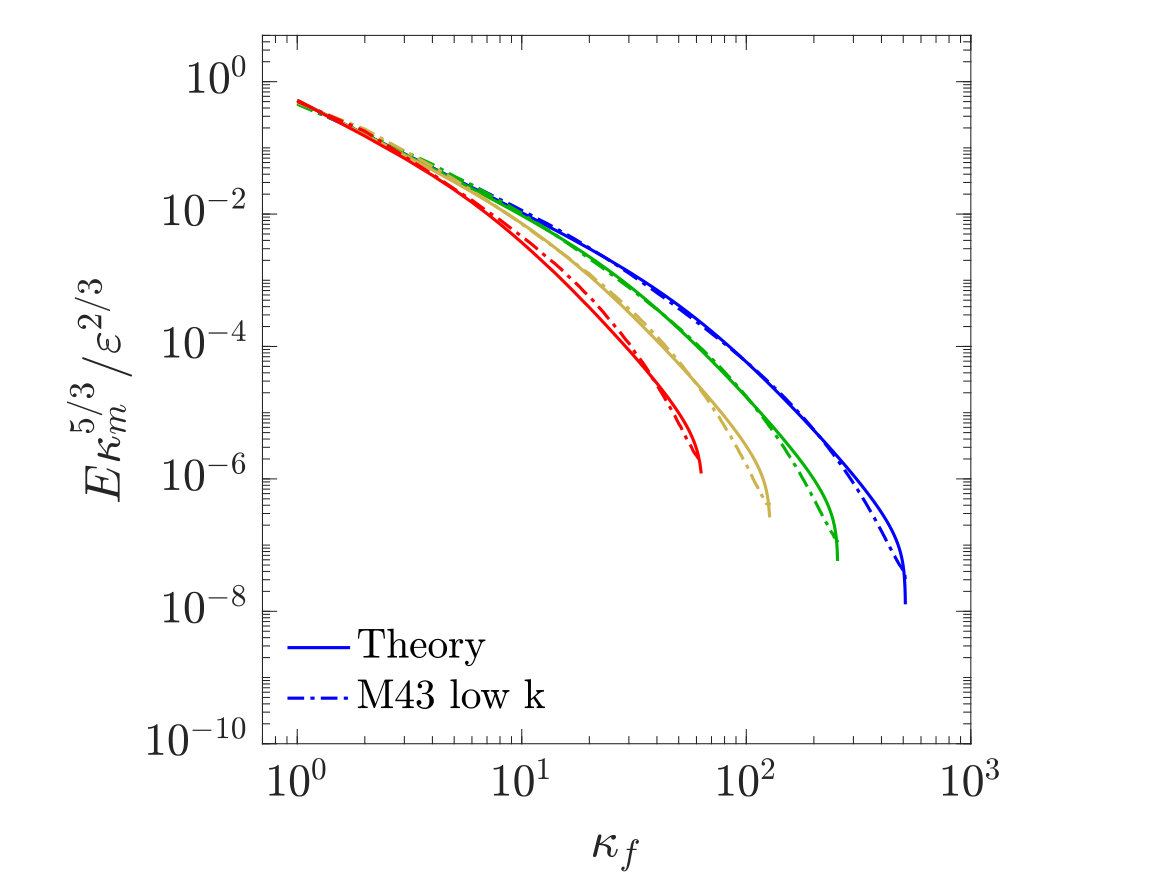 Figure 32
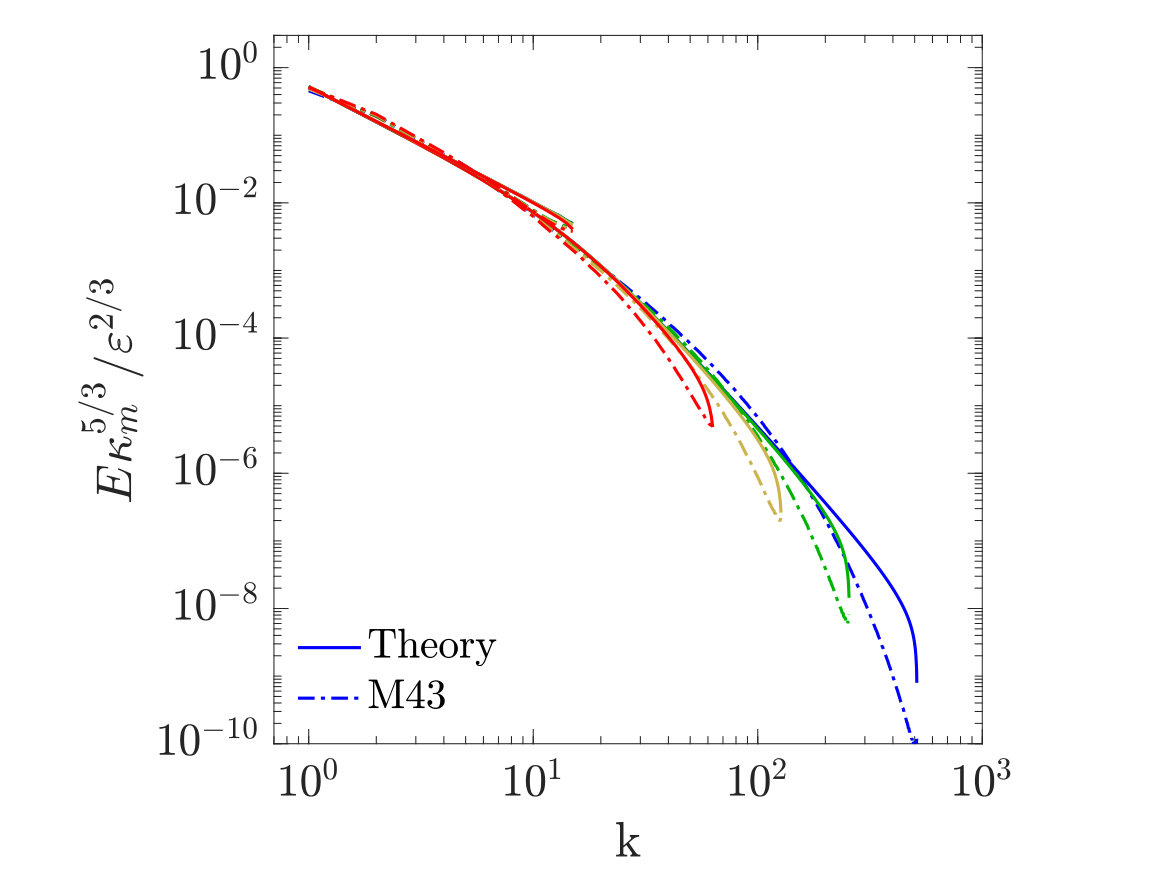 Figure 33
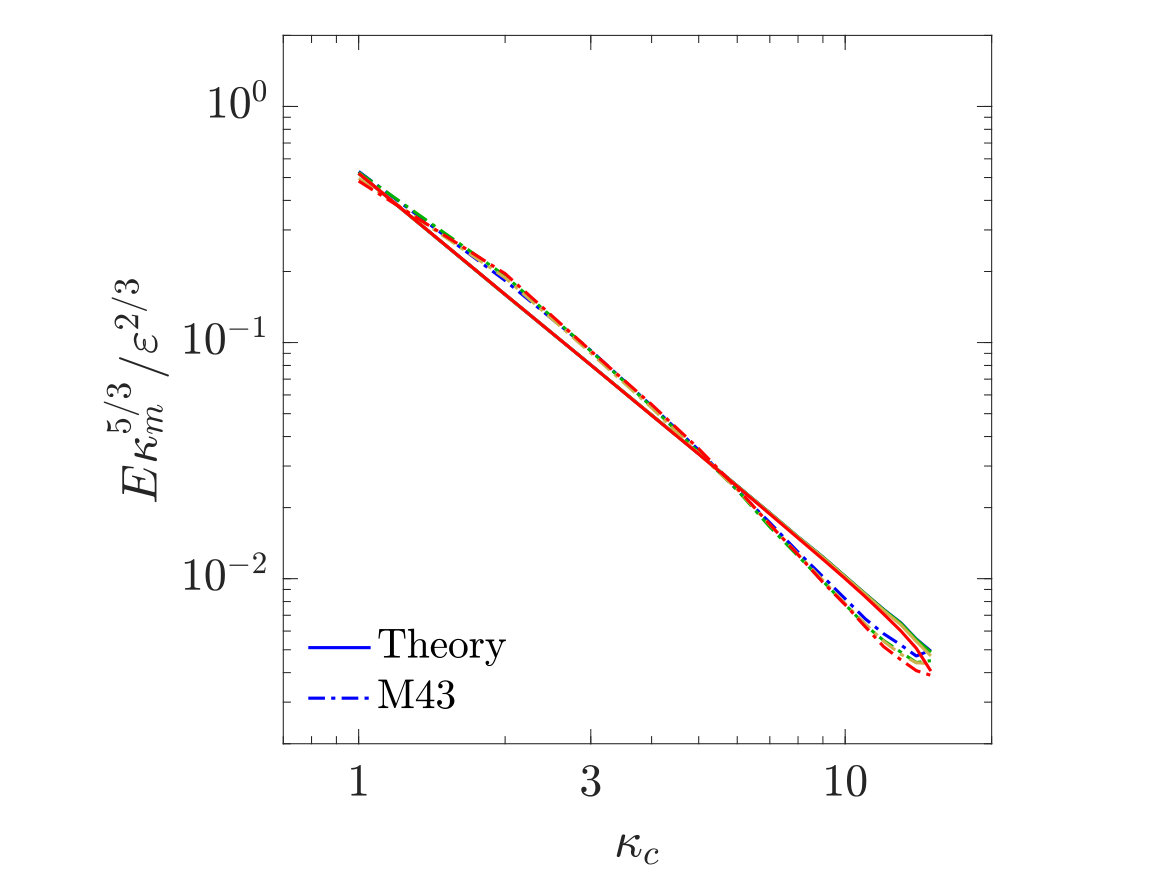 Figure 34
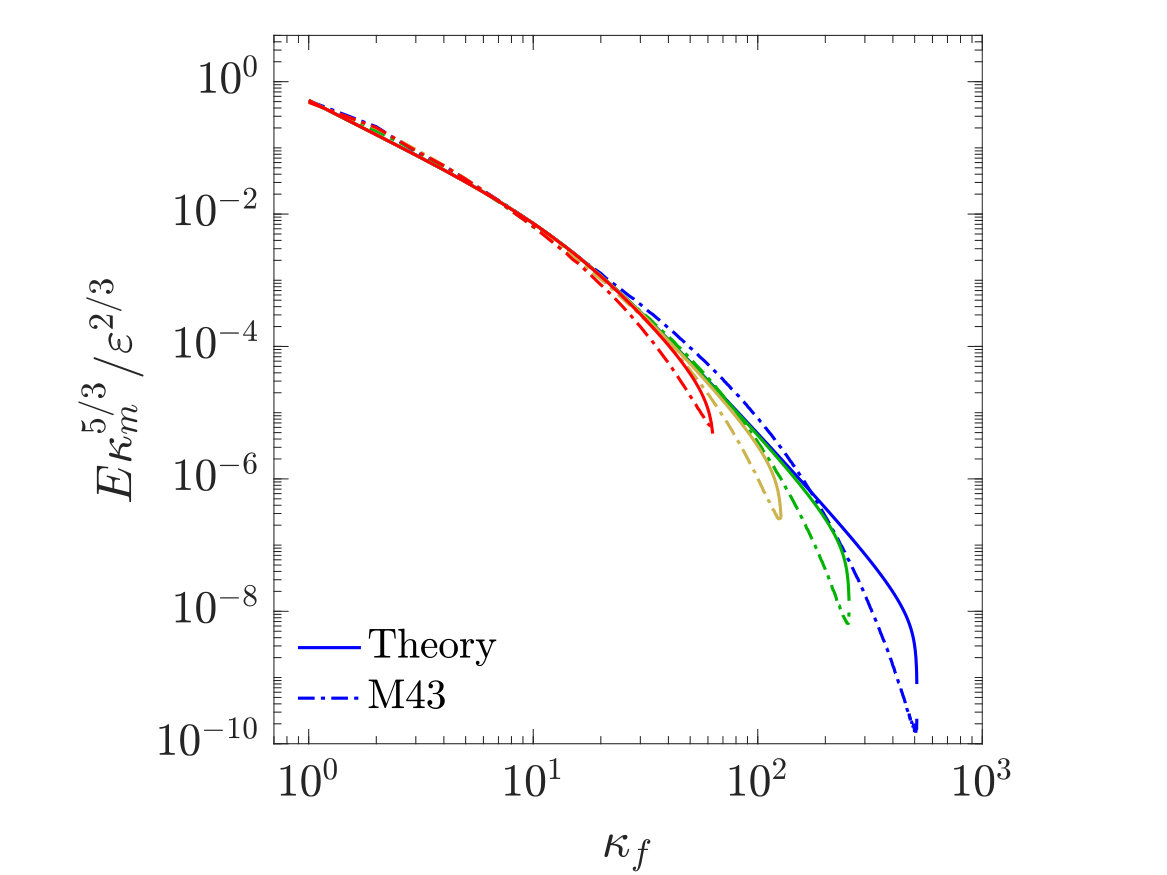 Figure 35
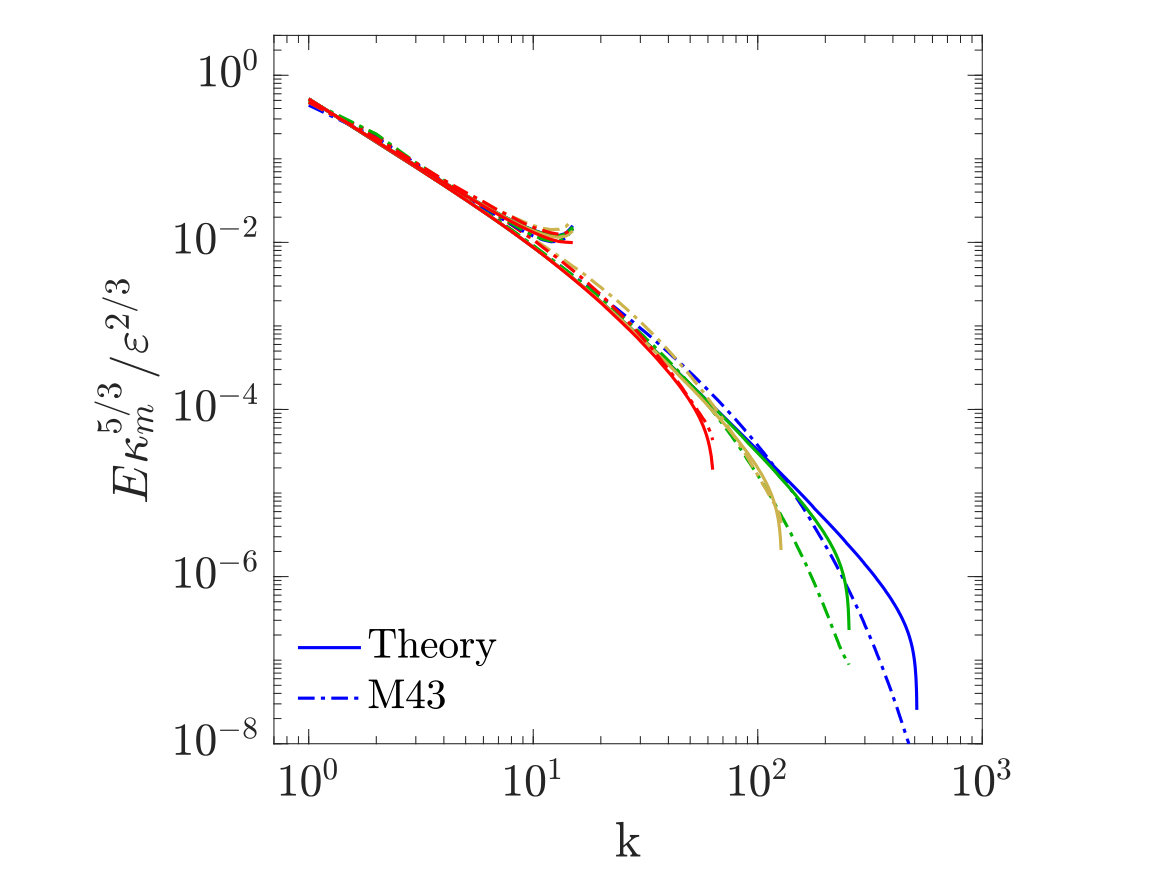 Figure 36
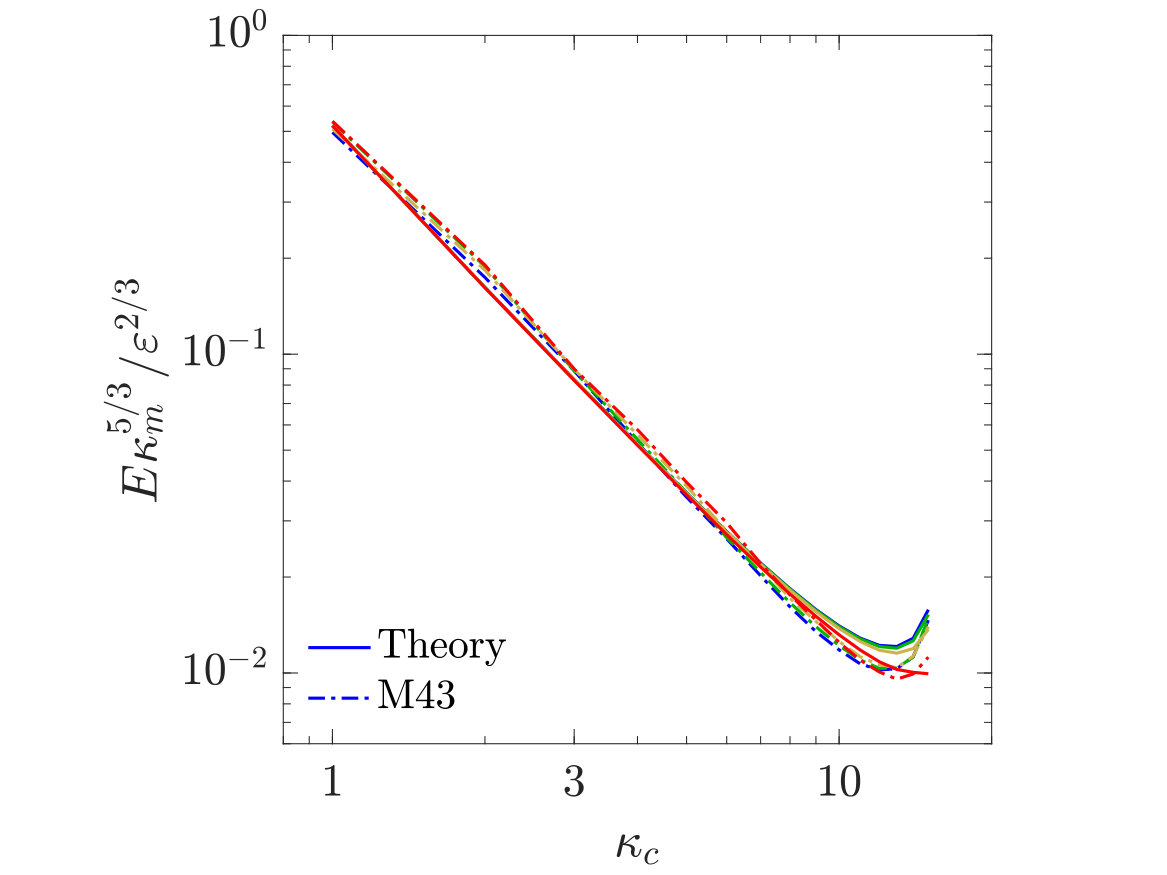 Figure 37
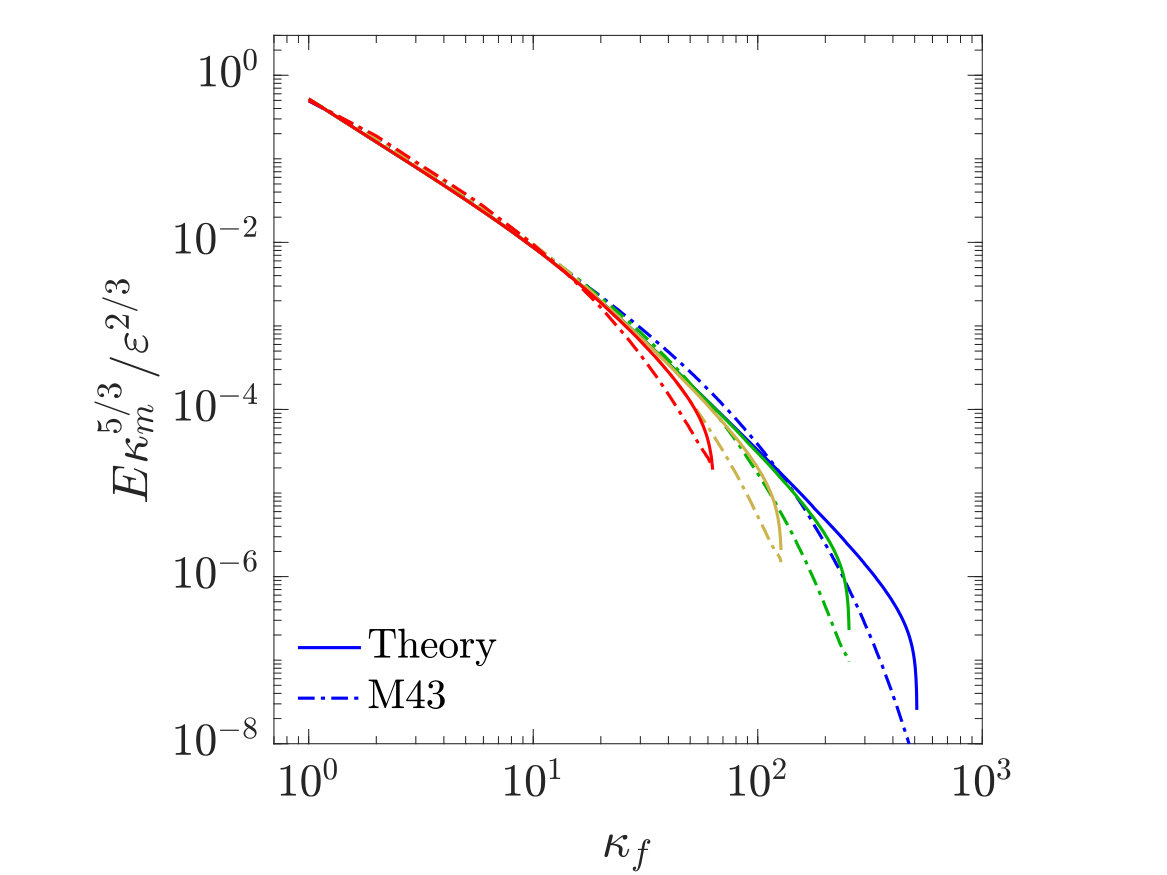 Figure 38
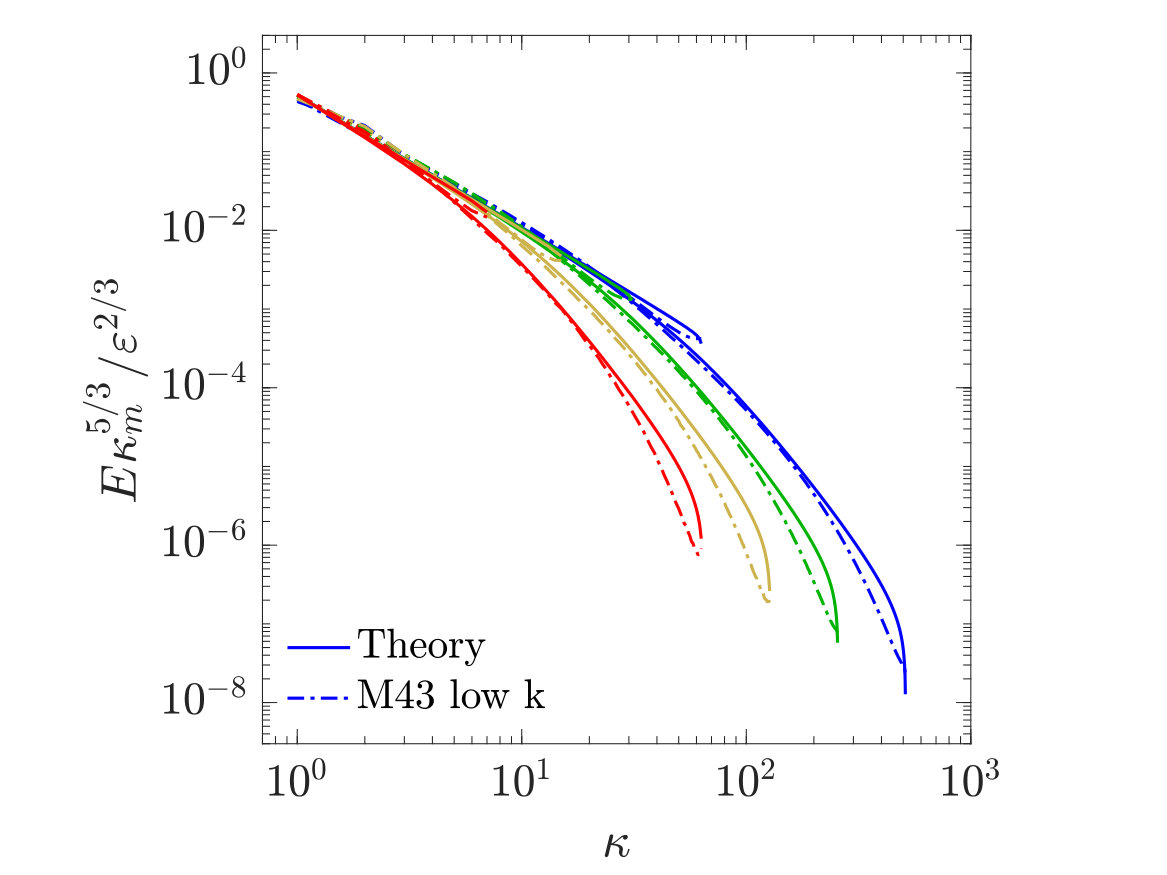 Figure 39
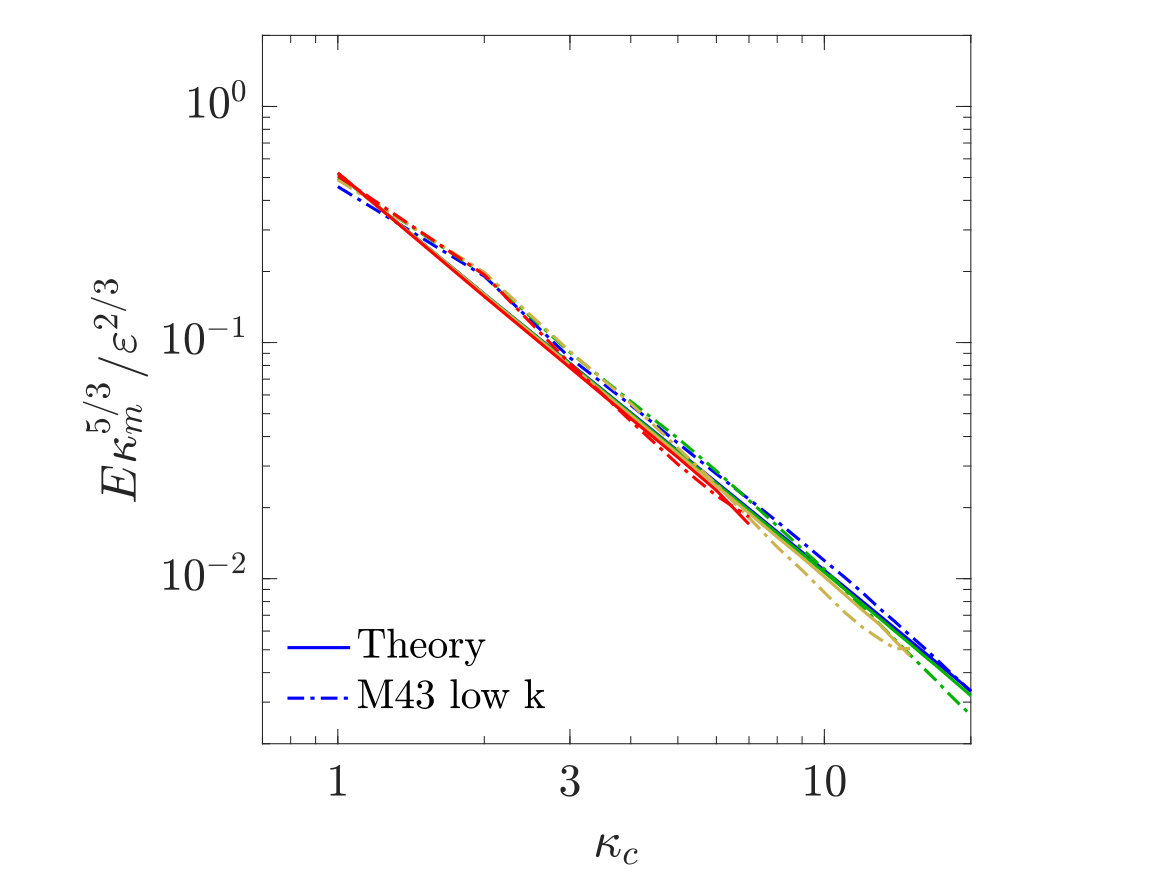 Figure 40
| M43 | M43 low-k | |
|---|---|---|
Peer Reviews
No public reviews on file for this paper yet. If you reviewed it on a platform where reviews are public (OpenReview, ICLR, NeurIPS, ICML), you can paste yours below so the community can read it here.
Videos
No videos yet. Explain this paper in a talk, walkthrough, or lecture? Add one.
Resolution-induced anisotropy in LES
Sigfried W. Haering
The Oden Institute for Computational Engineering and Science,
The University of Texas at Austin
Myoungkyu Lee
Sandia National Laboratories, Livermore
Robert D. Moser
Department of Mechanical Engineering,
The Oden Institute for Computational Engineering and Science, The University of Texas at Austin
Abstract
Large eddy simulation (LES) of turbulence in complex geometries and domains is often conducted with high aspect ratio resolution cells of varying shapes and orientations. The effects of such anisotropic resolution are often simplified or neglected in subgrid model formulation. Here, we examine resolution induced anisotropy and demonstrate that, even for isotropic turbulence, anisotropic resolution induces mild resolved Reynolds stress anisotropy and significant anisotropy in second-order resolved velocity gradient statistics. In large eddy simulations of homogeneous isotropic turbulence with anisotropic resolution, it is shown that commonly used subgrid models, including those that consider resolution anisotropy in their formulation, perform poorly. The one exception is the anisotropic minimum dissipation model proposed by Rozema et al. (Phys. of Fluids 27, 085107, 2015). A simple new model is presented here that is formulated with an anisotropic eddy diffusivity that depends explicitly on the anisotropy of the resolution. It also performs well, and is remarkable because unlike other LES subgrid models, the eddy diffusivity only depends on statistical characteristics of the turbulence (in this case the dissipation rate), not on fluctuating quantities. In other subgrid modeling formulations, such as the dynamic procedure, limiting flow dependence to statistical quantities in this way could have advantages.
pacs:
I Introduction
The expansion of available computing power has led to an increasing reliance on numerical simulation of complex systems in engineering, science and decision making. With this increased reliance comes a demand for modeling accuracy and reliability in general and specifically in turbulent fluid flows. The increased resolution enabled by advances in computing hardware, and increased numerical accuracy that has arisen from advances in numerical algorithms has improved the reliability of computational models of turbulent flows, but improvements in turbulence models have lagged behind. It has long been expected that large eddy simulation (LES) would address the need for improved modeling fidelity in engineering flows. However, numerous challenges remain before LES can become a robust tool capable of reliable predictions of complex turbulent flows for use in research and development. Since the advent of the dynamic modeling approach Germano et al. (1991); Lilly (1992), wall modeling has been considered the greatest impediment to reliable LES, and this has been the focus of much LES research Piomelli and Balaras (2002); Larsson et al. (2016); Bose and Park (2018). While this is certainly a critical issue, there are also other challenges. One such is considered here.
In practical flows of engineering interest, the combination of high Reynolds number, complex geometry and limited computational resources often dictates discretization with relatively coarse, highly anisotropic and spatially varying resolution. In such cases, the common assumptions of isotropic unresolved turbulence in equilibrium with the large scales and homogeneous filtering will generally be violated. In this work, we focus in particular on the consequences of anisotropic numerical resolution and the associated anisotropic definition of the large (and small) scales. We will refer to this simply as anisotropic resolution.
Though the issue of anisotropic resolution has been acknowledged in many SGS models Scotti et al. (1993); Vreman (2004); Rozema et al. (2015), the specific issue has not been examined in detail. In this work, we examine the implications of anisotropic resolution in LES and propose a simple modeling treatment which has potential to be integrated into existing models. Before continuing, we briefly review existing resolution anisotropy treatments in the literature. Some of the models mentioned below are evaluated in Sec. IV.
In most cases, resolution anisotropy has been acknowledged through the definition of a scalar resolved length scale in terms of anisotropic resolution parameters. This resolved scale is then used in the formulation of subgrid models, such as the Smagorinsky model. However, scalar measures discard all the information about resolution anisotropy. For instance, consider the commonly used cube-root of a cell volume given by , where are the resolution scales in each direction in an orthogonal grid. This length scale will favor the smallest dimension of the grid and will thus provide an unresolvable model scale in coarse directions. Such a simplification results in LES turbulence that is essentially under resolved in these directions and causing spectral energy pile ups at the resolved scale. Conversely, scalar resolution measures based on the cell diagonal favor the largest dimension of the grid resulting in LES turbulence that is smoother in fine directions than could be resolved. This is essentially a waste of resolution. Further, without explicit filtering corresponding to the cell diagonal scale, the spectral energy distribution will be effected with finer grid scales present. In short, the LES turbulence is inconsistent with the with anisotropic filtering of real turbulence.
In an attempt to alleviate under-resolution in coarse directions, Scotti et.al. Scotti et al. (1993) introduced a scalar correction to in the standard Smagorinsky model, based on the ratio of the refined to most coarse grid dimensions in an attempt to ensure the correct total dissipation. While an improvement over the basic Smagorinsky model because it reduces artifacts of under-resolution in the course directions, it is at the cost of even worse under-utilization of available resolution in the fine directions. It appears that these simple model forms preclude LES that produce spectra consistent with anisotropic resolution.
The Vreman model Vreman (2004), which was primarily designed to ensure that the eddy viscosity vanishes in laminar regions, was the first to directly consider resolution anisotropy in its formulation. In this model, the eddy viscosity scales with the square root of the second invariant of the velocity gradient tensor with gradient components weighted by the corresponding grid length scale where the cells are assumed to be aligned with the global coordinate system. The magnitude of the resulting eddy viscosity is reduced in regions where high gradients are aligned with fine resolution directions and vice-versa. However, in the end, resolution anisotropy information is again discarded in favor of maintaining a scalar eddy viscosity. As shown in Sec. IV, the result with anisotropic resolution is similar to basic Smagorinsky.
Rozema et al. have more recently extended minimal dissipation models Verstappen (2011) to account for grid anisotropy (AMD), without making a scalar filter width approximation like that described above Rozema et al. (2015). Their model is motivated by the Poncàire inequality applied to anisotropic (rectilinear) grid cells, and is formulated to ensure that the eddy viscosity is sufficient to dissipate energy at the estimated rate of small-scale energy production. Here the anisotropy of the resolution enters into the estimate of the small-scale production. The AMD model performs quite well with anisotropic resolution and it is also examined in some detail in Sec. IV.
Here, we pursue an evaluation of the impact of resolution anisotropy on large eddy simulation models by simulating isotropic turbulence with anisotropic resolution. The subgrid models described above that consider resolution anisotropy, along with Smagorinsky, are evaluated. Furthermore, we develop and evaluate a simple anisotropic tensor eddy viscosity model. The model is particularly simple in that the eddy viscosity does not fluctuate, though it does depend on statistical properties of the turbulence being simulated, in this case the dissipation.
In the remainder of the paper, the characteristics of resolution-induced anisotropies in LES are discussed in Sec. II; our simple anisotropic subgrid model is introduced in Sec. III; and, the performance of subgrid models in isotropic turbulence simulated with anisotropic resolution is explored in Sec. IV. Finally, discussion and conclusions are offered in Sec. V.
II Resolution-induced anisotropies
In a large eddy simulation with anisotropic resolution, the anisotropy of the resolution is expected to produce anisotropy of the resolved and the subgrid Reynolds stresses. Of course, in homogeneous isotropic turbulence (HIT), the Reynolds stress is dynamically insignificant. However, in an LES of HIT with anisotropic resolution, the resolved and subgrid Reynolds stress can be anisotropic, though their sum is still isotropic and homogeneous. To examine how the resolved and subgrid Reynolds stress anisotropy depend on resolution anisotropy, consider an idealized infinite Reynolds number isotropic turbulence with a inertial range spectrum starting at minimum wavenumber . The Reynolds stress anisotropy can be determined by integrating the inertial range energy spectrum over an anisotropic domain of resolved wavenumbers . That is, the resolved and unresolved Reynolds stresses ( and , respectively) are given by
[TABLE]
and
[TABLE]
where is the domain of unresolved wavenumbers.
In this paper, we consider two anisotropic definitions of the resolved wavenumber domain. The first is an ellipsoidal wavenumber domain, with major axes determined by the cutoff wavenumber in each direction, where is the Nyquist grid spacing in the direction. An ellipsoidal wavenumber domain is analogouos to the spherical wavenumber cut-off commonly used in LES of isotropic turbulence. Arguably ellipsoidally filtered turbulence is the most meaningful target of an isotropic turbulence LES with anisotropic resolution. The ellipsoidal resolved domain and the associated domain of unresolved wavenumbers are given by
[TABLE]
where is the minimum wavenumber characterizing the largest represented scale. Note that non-tensor indices are indicated by Greek letters; here because neither nor are index representations of vectors. No summation will be implied on repeated Greek indices. The other anisotropic wavenumber domain considered here is consistent with a Cartesian tensor product representation of the LES solution in physical space, where the resolution is different in each of the Cartesian basis directions. This Cartesian domain is defined by
[TABLE]
This definition of is anisotropic both because of the Cartesian representation and because the are not in general equal. The latter is most significant, and is of primary interest here.
The reference list from the paper itself. Each links out to its DOI / PubMed record.
- 1Germano et al. (1991) M. Germano, U. Piomelli, P. Moin, and W. H. Cabot, A dynamic subgrid-scale eddy viscosity model, Physics of Fluids A: Fluid Dynamics 3 , 1760 (1991).
- 2Lilly (1992) D. K. Lilly, A proposed modification of the germano subgrid scale closure method, Physics of Fluids A: Fluid Dynamics 4 , 633 (1992).
- 3Piomelli and Balaras (2002) U. Piomelli and E. Balaras, Wall-layer models for large-eddy simulations, Annual Review of Fluid Mechanics 34 , 349 (2002).
- 4Larsson et al. (2016) J. Larsson, S. Kawai, J. Bodart, and I. Bermejo-Moreno, Large eddy simulation with modeled wall-stress: recent progress and future directions, Bulletin of JSME 3 (2016).
- 5Bose and Park (2018) S. T. Bose and G. I. Park, Wall-modeled large-eddy simulation for complex turbulent flows, Annual Review of Fluid Mechanics 50 , 535 (2018).
- 6Scotti et al. (1993) A. Scotti, C. Meneveau, and D. K. Lilly, Generalized Smagorinsky model for anisotropic grids, Physics of Fluids A 5 , 2306 (1993).
- 7Vreman (2004) A. Vreman, An eddy-viscosity subgrid-scale model for turbulent shear flow, Physics of Fluids 16 , 3670 (2004).
- 8Rozema et al. (2015) W. Rozema, H. J. Bae, P. Moin, and R. Verstappen, Minimum-dissipation models for large-eddy simulation, Physics of Fluids 27 , 085107 (2015).