Entanglement Suppression and Emergent Symmetries of Strong Interactions
Silas R. Beane, David B. Kaplan, Natalie Klco, and Martin J. Savage

TL;DR
This paper explores how entanglement suppression in the strong interaction $S$-matrix correlates with emergent spin-flavor symmetries, suggesting a fundamental link that constrains nuclear forces in dense matter.
Contribution
It proposes that dynamical entanglement suppression underlies the emergence of approximate symmetries in low-energy baryon interactions, offering new insights into strong force behavior.
Findings
Entanglement suppression correlates with approximate spin-flavor symmetries.
Emergent symmetries include Wigner $SU(4)$ and $SU(16)$ for different flavors.
Suggests entanglement suppression constrains nuclear and hypernuclear forces.
Abstract
Entanglement suppression in the strong interaction -matrix is shown to be correlated with approximate spin-flavor symmetries that are observed in low-energy baryon interactions, the Wigner symmetry for two flavors and an symmetry for three flavors. We conjecture that dynamical entanglement suppression is a property of the strong interactions in the infrared, giving rise to these emergent symmetries and providing powerful constraints on the nature of nuclear and hypernuclear forces in dense matter.
Click any figure to enlarge with its caption.
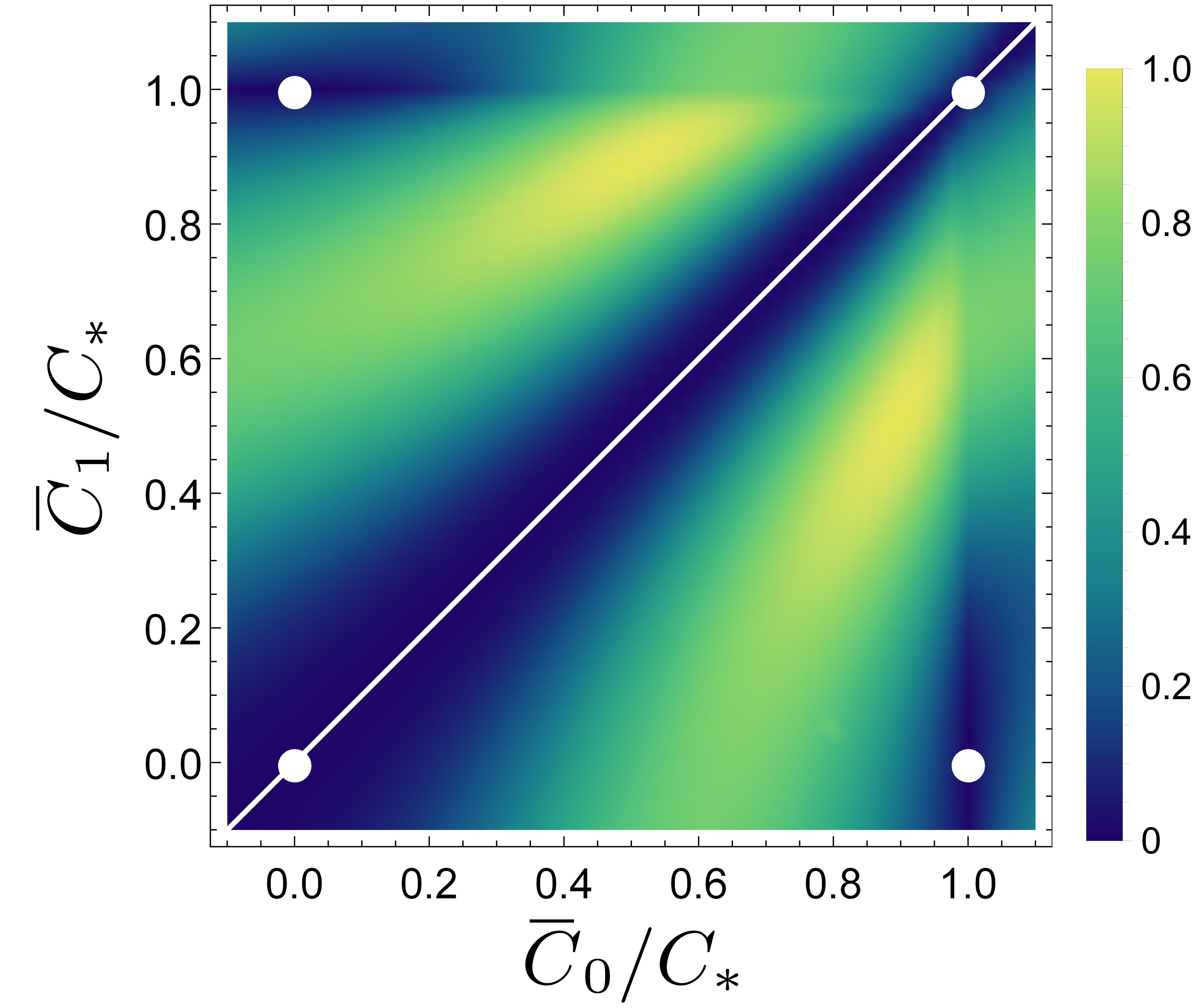 Figure 1
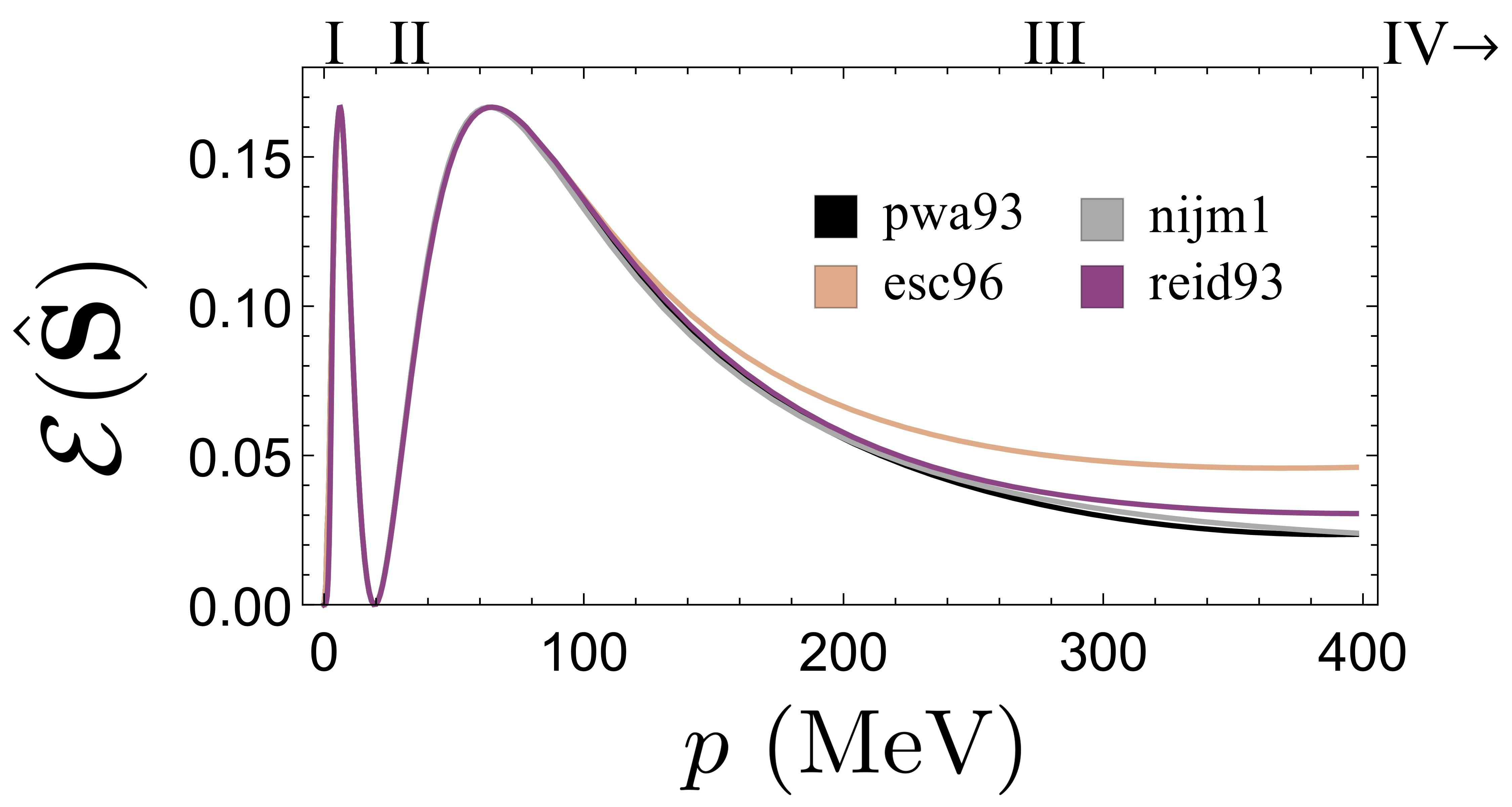 Figure 2
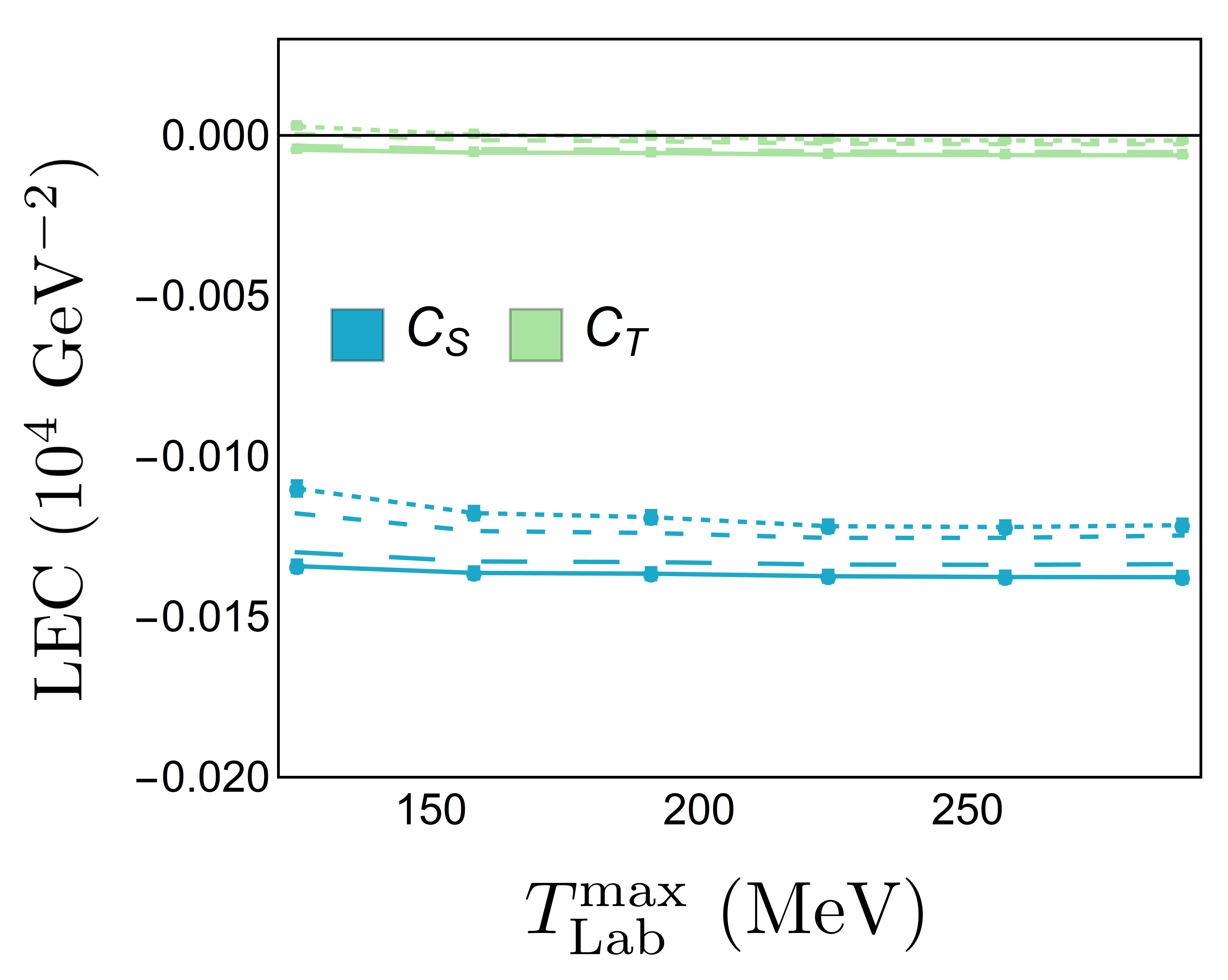 Figure 3
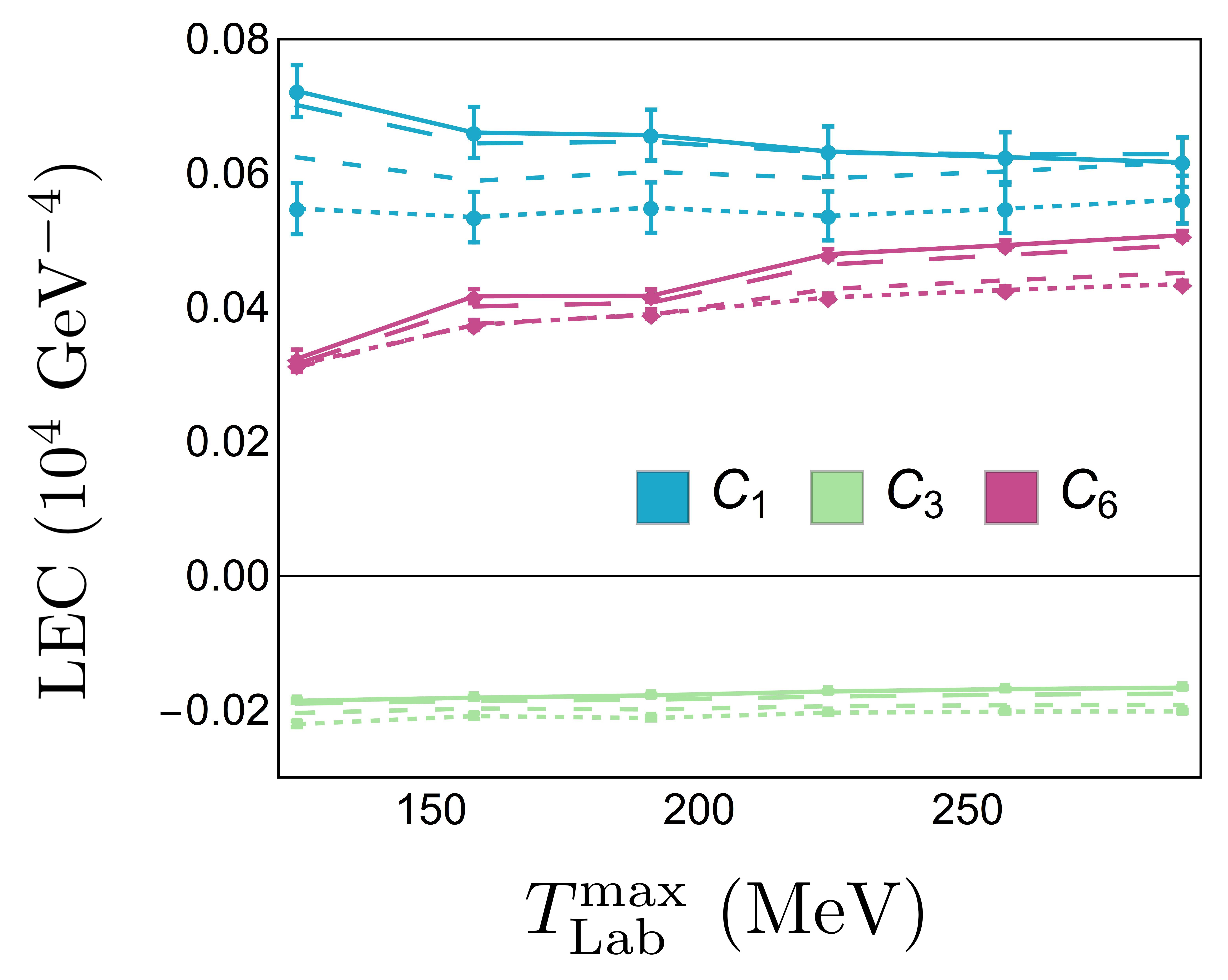 Figure 4
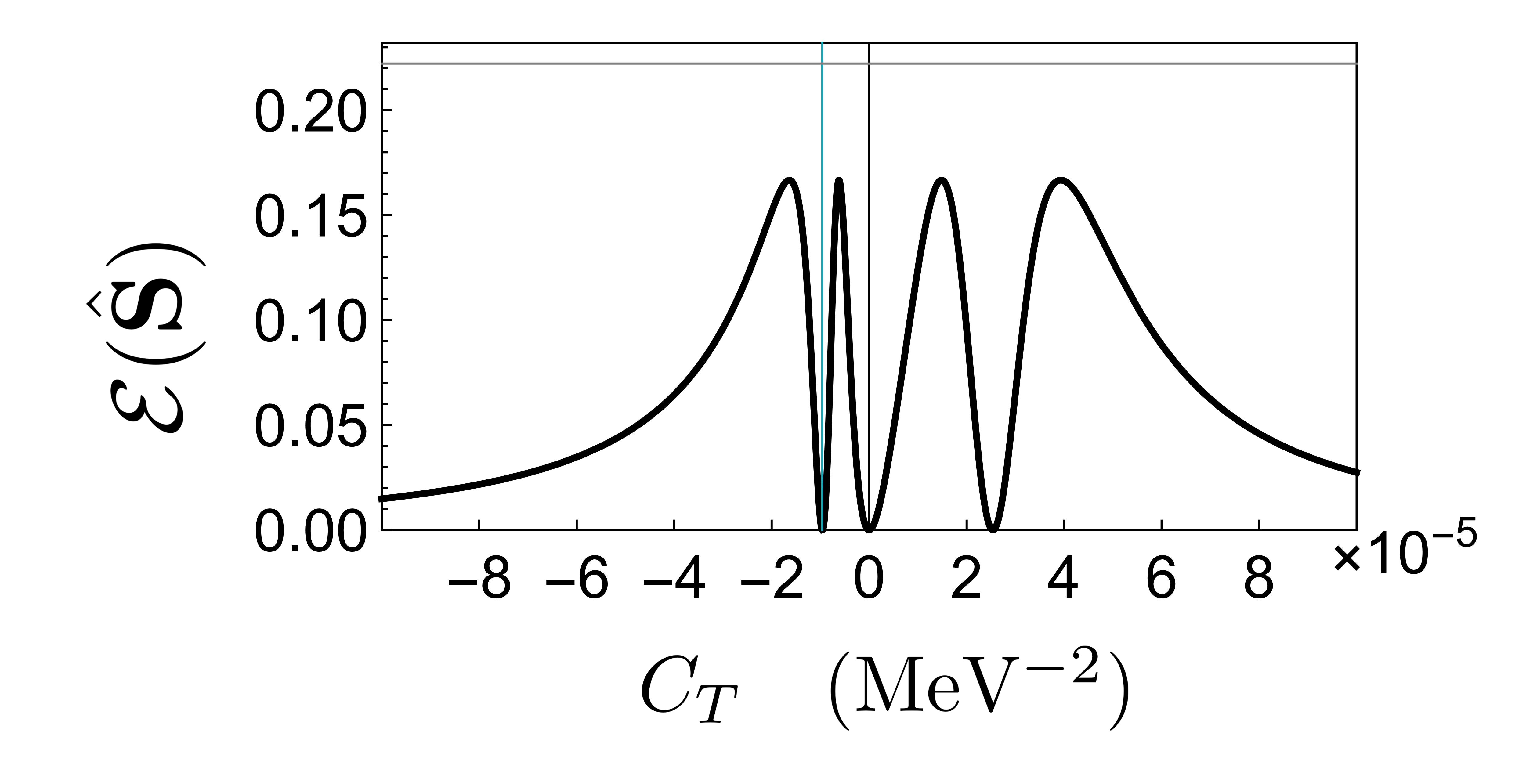 Figure 5
| 125 | 158 | 191 | 224 | 257 | 290 | |
| -0.01342(17) | -0.01363(17) | -0.01366(17) | -0.01374(17) | -0.01376(17) | -0.01377(16) | |
| -0.00045(2) | -0.00053(2) | -0.00055(2) | -0.00060(2) | -0.00061(1) | -0.00062(1) | |
| 0.0723(39) | 0.0661(38) | 0.0657(38) | 0.0633(37) | 0.0624(37) | 0.0617(37) | |
| -0.0186(3) | -0.0181(3) | -0.0178(2) | -0.0172(2) | -0.0169(2) | -0.0167(2) | |
| 0.0324(14) | 0.0417(10) | 0.0418(9) | 0.0480(8) | 0.0493(7) | 0.0508(7) | |
| 125 | 158 | 191 | 224 | 257 | 290 | |
| -0.01299(18) | -0.01328(17) | -0.01330(17) | -0.01337(17) | -0.01338(17) | -0.01336(16) | |
| -0.00032(2) | -0.00043(2) | -0.00045(2) | -0.00050(2) | -0.00051(2) | -0.00052(2) | |
| 0.0702(39) | 0.0645(38) | 0.0647(38) | 0.0630(37) | 0.0629(37) | 0.0629(37) | |
| -0.0190(3) | -0.0186(3) | -0.0184(2) | -0.0180(2) | -0.0177(2) | -0.0175(2) | |
| 0.0316(13) | 0.0402(10) | 0.0407(9) | 0.0464(7) | 0.0478(7) | 0.0493(6) | |
| 125 | 158 | 191 | 224 | 257 | 290 | |
| -0.01178(19) | -0.01233(18) | -0.01239(18) | -0.01254(17) | -0.01254(17) | -0.01247(17) | |
| 0.00004(4) | -0.00014(3) | -0.00018(3) | -0.00025(2) | -0.00027(2) | -0.00027(2) | |
| 0.0624(38) | 0.0589(38) | 0.0602(37) | 0.0593(37) | 0.0603(36) | 0.0617(36) | |
| -0.0204(4) | -0.0198(3) | -0.0199(3) | -0.0194(2) | -0.0193(2) | -0.0192(2) | |
| 0.0311(11) | 0.0376(8) | 0.0389(7) | 0.0428(6) | 0.0441(6) | 0.0452(5) | |
| 125 | 158 | 191 | 224 | 257 | 290 | |
| -0.01100(22) | -0.01177(19) | -0.01189(19) | -0.01218(18) | -0.01220(17) | -0.01214(17) | |
| 0.00028(5) | 0.00002(3) | -0.00003(3) | -0.00013(3) | -0.00016(3) | -0.00016(2) | |
| 0.0548(38) | 0.0535(38) | 0.0549(38) | 0.0537(36) | 0.0547(36) | 0.0561(36) | |
| -0.0221(4) | -0.0209(4) | -0.0212(3) | -0.0204(3) | -0.0202(3) | -0.0202(2) | |
| 0.0315(11) | 0.0374(8) | 0.0390(7) | 0.0415(6) | 0.0426(5) | 0.0435(5) |
| Stoks et al. (1993) | Rijken and Stoks (1996a, b) | Stoks et al. (1994) | Stoks et al. (1994) | |
| 0.0000 | ||||
| 0.6852 | ||||
| 1.1868 | ||||
| 1.5322 | ||||
| 1.9380 | ||||
| 2.2726 | ||||
| 2.6538 | ||||
| 2.9867 | ||||
| 3.3568 | ||||
| 3.6899 | ||||
| 3.9954 | ||||
| 4.3336 | ||||
| 4.6473 | ||||
| 4.9883 | ||||
| 5.3075 | ||||
| 5.6086 | ||||
| 5.9340 | ||||
| 6.2425 | ||||
| 6.5722 | ||||
| 6.8862 | ||||
| 7.1864 | ||||
| 7.5060 | ||||
| 7.8125 | ||||
| 8.3920 | ||||
| 8.9339 | ||||
| 9.4448 | ||||
| 9.9295 | ||||
| 10.3916 | ||||
| 10.3916 | ||||
| 11.2590 | ||||
| 12.0642 | ||||
| 13.0008 | ||||
| 13.8743 | ||||
| 14.6959 | ||||
| 15.6250 | ||||
| 16.5018 | ||||
| 17.3344 | ||||
| 18.2577 | ||||
| 19.1366 | ||||
| 19.9769 | ||||
| 20.7832 | ||||
| 21.6679 | ||||
| 22.5180 | ||||
| 23.3371 | ||||
| 24.2255 | ||||
| 25.0825 | ||||
| 25.9111 | ||||
| 26.7140 | ||||
| 27.5788 | ||||
| 28.4172 | ||||
| 29.2317 | ||||
| 33.5678 | ||||
| 36.8992 | ||||
| 39.9537 | ||||
| 42.7908 | ||||
| 45.4511 | ||||
| 47.9640 | ||||
| 50.3518 | ||||
| 52.6313 | ||||
| 54.8161 | ||||
| 56.9170 | ||||
| 58.9432 | ||||
| 60.9020 | ||||
| 62.7997 | ||||
| 64.6417 | ||||
| 66.4327 | ||||
| 68.1766 | ||||
| 69.8770 | ||||
| 71.5371 | ||||
| 73.1594 | ||||
| 74.7466 | ||||
| 76.3007 | ||||
| 77.8238 | ||||
| 89.0761 | ||||
| 100.2362 | ||||
| 110.2726 | ||||
| 120.4473 | ||||
| 130.7280 | ||||
| 141.0915 | ||||
| 151.5208 | ||||
| 162.0032 | ||||
| 172.5291 | ||||
| 183.0910 | ||||
| 193.6829 | ||||
| 203.7248 | ||||
| 213.8441 | ||||
| 224.0302 | ||||
| 234.2745 | ||||
| 244.5696 | ||||
| 254.9094 | ||||
| 265.2886 | ||||
| 275.7028 | ||||
| 285.7377 | ||||
| 295.8290 | ||||
| 305.9711 | ||||
| 316.1591 | ||||
| 326.3886 | ||||
| 336.6561 | ||||
| 346.9579 | ||||
| 356.9626 | ||||
| 367.0144 | ||||
| 377.1095 | ||||
| 387.2445 |
Peer Reviews
No public reviews on file for this paper yet. If you reviewed it on a platform where reviews are public (OpenReview, ICLR, NeurIPS, ICML), you can paste yours below so the community can read it here.
Videos
No videos yet. Explain this paper in a talk, walkthrough, or lecture? Add one.
Entanglement Suppression and Emergent Symmetries of Strong Interactions
Silas R. Beane
Department of Physics, University of Washington, Seattle, WA 98195-1560, USA
David B. Kaplan
Institute for Nuclear Theory, University of Washington, Seattle, WA 98195-1550, USA
Natalie Klco
Department of Physics, University of Washington, Seattle, WA 98195-1560, USA
Institute for Nuclear Theory, University of Washington, Seattle, WA 98195-1550, USA
Martin J. Savage
Institute for Nuclear Theory, University of Washington, Seattle, WA 98195-1550, USA
( - 20:25)
Abstract
Entanglement suppression in the strong interaction -matrix is shown to be correlated with approximate spin-flavor symmetries that are observed in low-energy baryon interactions, the Wigner symmetry for two flavors and an symmetry for three flavors. We conjecture that dynamical entanglement suppression is a property of the strong interactions in the infrared, giving rise to these emergent symmetries and providing powerful constraints on the nature of nuclear and hypernuclear forces in dense matter.
††preprint: INT-PUB-18-056††preprint: NT@UW-18-19
Understanding approximate global symmetries in the strong interactions has played an important historical role in the development of the theory of Quantum Chromodynamics (QCD). Baryon number symmetry arises in QCD because it is impossible to include a marginal or relevant interaction consistent with Lorentz and gauge symmetry which violates baryon number, while the axial and vector flavor symmetries are understood to be due to the small ratio of quark masses (and their differences) to the QCD scale. The approximate low-energy spin-flavor symmetry for flavors which relates spin-1/2 and spin-3/2 baryons can be understood as arising at leading order (LO) in the large- expansion, where is the number of colors ’t Hooft (1974); Witten (1980). In low-energy nuclear physics, a different spin-flavor symmetry is observed in the structure of light-nuclei and their -decay rates, namely Wigner’s symmetry, where the two spin states of the two nucleons transform as the 4-dimensional fundamental representation Wigner (1937a, b, 1939). It has been shown that this symmetry also arises from the large- expansion at energies below the mass Kaplan and Savage (1996); Kaplan and Manohar (1997); Calle Cordon and Ruiz Arriola (2008). The agreement of large- predictions with nuclear phenomenology has been extended to higher-order interactions Liu et al. (2017); Schindler et al. (2018); Savage and Wise (1996); Polinder et al. (2006), three-nucleon systems Phillips and Schat (2013); Epelbaum et al. (2015a); Vanasse and Phillips (2017), and to studies of hadronic parity violation Phillips et al. (2015); Schindler et al. (2016); Savage (2001). Recently, however, lattice QCD computations for have revealed an emergent symmetry in low-energy interactions of the baryon octet—analogous to Wigner’s , but with the two spin states of the eight baryons transforming as the 16-dimensional representation of Wagman et al. (2017). This low energy symmetry has been lacking an explanation from QCD. In this Letter, we show that both Wigner’s symmetry for and for correspond to fixed lines of minimal quantum entanglement in the -matrix for baryon-baryon scattering, and we propose entanglement suppression to be a dynamical property of QCD and the origin of these emergent symmetries 111 A principle of maximum entanglement has been previously proposed to constrain quantum electrodynamics in Ref. Cervera-Lierta et al. (2017). .
Of the many features of quantum mechanics and quantum field theory (QFT) that dictate the behavior of subatomic particles, entanglement and its associated non-locality are perhaps the most striking in their contrast to everyday experience. The degree to which a system is entangled, or its deviation from tensor-product structure, provides a measure of how “non-classical” it is. The importance of entanglement as a feature of quantum theory has been known since the work of Einstein, Podolsky and Rosen Einstein et al. (1935) and later pioneering papers Bell (1964); Aspect et al. (1981); Freedman and Clauser (1972), and has become a core ingredient in quantum information science, communication and perhaps in understanding the very fabric of spacetime Ryu and Takayanagi (2006a, b); Maldacena and Susskind (2013). Despite this long history, the implications of entanglement in QFTs, e.g., Refs. Buividovich and Polikarpov (2008a, b); Nakagawa et al. (2009); Donnelly (2012); Casini et al. (2014); Radicevic (2014); Ghosh et al. (2015); Itou et al. (2016); Aoki et al. (2015); Soni and Trivedi (2016); Van Acoleyen et al. (2016); Witten (2018), and in particular for experimental observables in high-energy and heavy-ion collisions are only now starting to be explored Rogers and Mulders (2010); Ho and Hsu (2016); Kharzeev and Levin (2017); Berges et al. (2018a); Shuryak and Zahed (2018); Baker and Kharzeev (2018); Berges et al. (2018b); Hagiwara et al. (2018); Liu and Zahed (2018); Kovner et al. (2018); Cervera-Lierta et al. (2017). Here we study the role of entanglement in low-energy nuclear interactions.
In general, a low-energy scattering event can entangle position, spin, and flavor quantum numbers, and it is therefore natural to assign an entanglement power to the -matrix for nucleon-nucleon scattering. We choose to define the entanglement power of the -matrix in a two-particle spin space Zanardi (2001); Ballard and Wu (2011), noting that this choice is not unique and that others will be explored elsewhere Beane et al. . This is determined by the action of the -matrix on an incoming two-particle tensor product state with randomly-oriented spins, , where is the rotation operator acting in the spin- space, and all other quantum numbers associated with the states have been suppressed. For low-energy processes, this random spin pair projects onto the two states with total spin , and associated phase shifts , in the and channels, respectively, with projections onto higher angular momentum states suppressed by powers of the nucleon momenta. The entanglement power, , of the -matrix, , is defined as
[TABLE]
where is the reduced density matrix for particle 1 of the two-particle density matrix with . By describing the average action of to transition a tensor-product state to an entangled state, the entanglement power expresses a state-independent entanglement measure that vanishes when remains a tensor product state for any .
Following the analysis of Ref. Cervera-Lierta et al. (2017), we consider the spin-space entanglement of two distinguishable particles, the proton and neutron for QCD. Neglecting the small tensor-force-induced mixing of the channel with the channel, the -matrix for low-energy scattering below inelastic threshold in these sectors can be decomposed as
[TABLE]
where and . It follows that the entanglement power of is
[TABLE]
which vanishes when for any integer . This includes the symmetric case where the coefficient of vanishes. Special fixed points where the entanglement power vanishes occur when the phase shifts both vanish, , or are both at unitarity, , or when , or , . The S-matrices at these fixed points with vanishing entanglement power are and 222The S-matrices at the four fixed points realize a representation of the Klein four-group, ..
The entanglement power in nature is plotted in Fig. 1 as a function of the center-of-mass nucleon momentum, , up to pion production threshold, making use of the and phase shifts derived from the analyses of Refs. Stoks et al. (1993, 1994); Rijken and Stoks (1996a, b).
The four regions indicated are distinguished by the role of non-perturbative physics. Region I shows that entanglement power approaches zero in the limit , as will be the case for any finite range interaction not at unitarity. At momenta around the scale of the inverse scattering lengths, region II, poles and resonances of produce highly-entangling interactions. This non-perturbative structure could be considered a source of ultra-low-momentum entanglement power; experimental evidence for this is expected to be found in the vanishing modification of -scattering quantum correlations at 19.465(42) MeV where the phase shifts differ by and scatters into . In region IV, where energies are of order the chiral symmetry breaking scale, the entangling interactions of quark and gluon degrees of freedom become prominent. It is region III that is the main focus of this paper—away from the far-infrared structure but with nucleons as fundamental degrees of freedom, the entanglement power is suppressed. Once relativistic corrections and - mixing—parametrically suppressed at low-energy—are included in Eq. (19), is expected to remain suppressed but non-zero, indicating that the entanglement suppression in nature is only partial.
Much progress has been made in nuclear physics in recent years by considering low-energy effective field theories (EFTs), constrained by data from nucleon scattering. The phase shifts can be computed for energies below the pion mass, from the pionless EFT for nucleon-nucleon interactions. The leading interaction in the effective Lagrangian is
[TABLE]
where represents both spin states of the proton and neutron fields. These interactions can be re-expressed as contact interactions in the and channels with couplings and respectively, where the two couplings are fit to reproduce the and scattering lengths. The coefficients both run with the renormalization group as described in Ref. Kaplan et al. (1998a, b) with a stable IR fixed point at , corresponding to free particles, and a nontrivial, unstable IR fixed point at corresponding to a divergent scattering length and constant phase shift of (the “unitary” fixed point). At the four fixed points (described above), where take the values [math] or , the theory has a conformal (“Schrödinger”) symmetry; there is also a fixed line of enhanced symmetry at , or equivalently , where the theory possesses the Wigner symmetry, as apparent from the form of Eq. (4) with . When fitting to the scattering lengths one finds , since scattering lengths are unnaturally large in both channels. Therefore, low-energy QCD has approximate symmetry and sits close to the conformal fixed point Mehen et al. (1999). The emergence of symmetry (but not necessarily conformal symmetry) follows from the large- expansion where Kaplan and Savage (1996).
The symmetry points of the EFT can be related to minimization of the entanglement power of the -matrix. Fig. 2 shows a density plot of as computed from Eq. (4) averaged over momenta , as a function of the couplings renormalized at and rescaled by . Superimposed in white are the four conformal fixed points, as well as as the Wigner fixed line. The minima of the entanglement power of the -matrix () coincide with the points of enhanced symmetry in the EFT; the line corresponds to for all momenta, while the conformal points off the line correspond to .
In the case, the large- expansion gives a similar expectation for symmetry as does a principle of entanglement suppression. However, an analogous equivalence does not hold for , as the large- expansion predicts the conventional approximate spin-flavor symmetry, while entanglement suppression predicts a much larger symmetry under which the two spin states of the baryon octet transform as a 16-dimensional representation. To see this, consider the EFT in the flavor symmetry limit of QCD, where six independent contact operators contribute at LO Savage and Wise (1996),
[TABLE]
where denotes a trace in flavor space, and is the octet-baryon matrix where the subscript denotes spin. is invariant under rotations and the transformation where is an matrix. In the large- limit of QCD, an spin-flavor symmetry emerges relating the six coefficients in Eq. (5) to two independent coefficients Kaplan and Savage (1996) in the invariant Lagrange density,
[TABLE]
A comprehensive set of lattice QCD calculations of light nuclei, hypernuclei and low-energy baryon-baryon scattering in the limit of flavor symmetry by the NPLQCD collaboration Beane et al. (2013a, b); Wagman et al. (2017) demonstrates that the are consistent with this predicted spin-flavor symmetry Wagman et al. (2017). The two-baryon sector calculated with is found to be unnatural Beane et al. (2013a, b); Wagman et al. (2017), with a scattering length that is larger than the range of the interaction, and hence better described by the power-counting of van Kolck van Kolck (1999) and KSW Kaplan et al. (1998a, b); Chen et al. (1999). Further, the values of and are calculated to be much smaller than , indicating that Beane et al. (2013a, b); Wagman et al. (2017). When , the is enlarged to an emergent spin-flavor symmetry Wagman et al. (2017), where the baryon states populate the fundamental of ,
[TABLE]
with .
The existence of symmetry and does not follow from the large- expansion, but does follow from entanglement suppression. The entanglement power of the -matrix in spin-space from the interactions in Eq. (5) can be addressed by considering its action on states of distinguishable baryons. Computing the entanglement power for more than six distinct two-baryon channels with nonidentical particles—e.g., , —shows that zero entanglement power occurs at the point where all the couplings vanish except for , which is unconstrained (and all LO scattering matrices in the and mixed-flavor sectors are diagonal Savage and Wise (1996); Wagman et al. (2017)). Thus, the principle of entanglement suppression gives rise to an approximate symmetry, apparent in lattice QCD calculations Beane et al. (2013a, b); Wagman et al. (2017), that does not follow from the large- limit. We conclude that the large- limit of QCD does not provide a sufficiently stringent constraint to produce a low-energy EFT that does not entangle, which could not be deduced from the sector alone Kaplan and Savage (1996). Thus, the entanglement power of the -matrix appears to be a dominant ingredient in dictating the properties and relative size of interactions in low-energy nuclear and hypernuclear systems.
While in nuclei and hypernuclei contributions to binding from three-body forces between nucleons and hyperons are small compared with those from two-baryon forces, they cannot be neglected and become more important with increasing density. To understand whether entanglement suppression dictates approximate symmetry in these interactions as well, we take a more general approach rather than computing the multi-baryon -matrix in various channels to constrain couplings. We begin by assuming exact symmetry, where corrections due to violation from quark mass differences can be incorporated in the usual way. Even in the degenerate quark mass limit, this means restricting ourselves to considering only interactions that do not couple spin to orbital angular momentum. While such spin-orbit and tensor interactions can be important in heavy nuclei, they are suppressed by powers of the baryon momenta and do not enter the IR limit of the effective theory. It is then argued that entanglement suppression requires the interactions to respect a symmetry, conserving particle number individually for each of the octet baryon spin states. To see why this is a reasonable assumption, consider a 1-body operator (which need not be local) that violates the symmetry, e.g.,
[TABLE]
where are annihilation operators for components of with , and are spatial coordinates and is a form factor. This operator implements the transformation, e.g.,
[TABLE]
producing an entangled state, even if , from which it can be concluded that the symmetry is a necessary condition to forbid entangling interactions 333 The converse is not true: it is possible to show that there exist entangling interactions which preserve symmetry Beane et al. . . It follows from simultaneous exact and symmetries that the LO EFT must respect the full symmetry by the following argument. The charges that by assumption commute with the Hamiltonian consist of
[TABLE]
where are the fundamental generators of , with for are the generators of the adjoint representation with structure constants , and the for are a set of independent diagonal traceless matrices generating , the ignored symmetry being baryon number. Since all of the above are assumed to commute with , it follows that their commutators do as well. The full symmetry of will be the symmetry group generated by the closure of the under commutation. By making use of the fact that the generate an irreducible representation of the Lie algebra and invoking Schur’s Lemma, it is possible to show that this full symmetry algebra is Beane et al. .
Conjecturing that the guiding principle for low-energy nuclear and hypernuclear forces is the suppression of entanglement fluctuations provides important theoretical constraints on dense matter systems. The Lagrange density describing the sector with vanishing entanglement power, and therefore spin-flavor symmetry, is
[TABLE]
while for with spin-flavor symmetry,
[TABLE]
Calculations of hypernuclei and hyperon-nucleon interactions imposing spin-flavor symmetry on the low-energy forces are now in progress Lonardoni and Roggero (2018). Our work suggests that such calculations could probe the nature of entanglement in strong interactions.
The Pauli exclusion principle’s requirement of anti-symmetrization produces a natural tendency for highly entangled states of identical particles in the -channels. It is somewhat perplexing how to understand the result that the -matrix for baryon-baryon scattering exhibits screening of entanglement power when the quarks and gluons that form the nucleon are highly entangled. It may be the case that the nonperturbative mechanisms of confinement and chiral symmetry breaking together strongly screen entanglement fluctuations in the low-energy sector of QCD beyond what can be identified in the large- limit of QCD.
While our work has focused on low-energy interactions, preliminary evidence for entanglement suppression at higher orders in a derivative expansion is seen in the low-energy constants (LECs) for operators up to NNLO. The contact terms of the two-nucleon potential in the center-of-mass frame are Epelbaum et al. (2005)
[TABLE]
with and the initial and final nucleon momenta. Calculating their entanglement power, it is expected that and will be suppressed at low energies. Numerical values of these potential coefficients are determined from the values of the spectroscopic LECs Carlsson et al. (2016); Epelbaum et al. (2002, 2015b) (see Fig. 1 of the supplementary material). At small values of the maximum scattering energy, , the coefficients of the non-entangling operators, and , are found to be larger in magnitude than their entangling counterparts. Furthermore, as is increased and shorter distances scales are probed, the suppression lessens and grows. While these observations are consistent with entanglement-suppressed LECs, work remains to be done in understanding the mechanism that suppresses entanglement power in the transition from QCD to low-energy effective interactions, and the full consequences of this mechanism.
Nuclear physics, with its rich theoretical structure and phenomenology emerging from QCD and QED in the infrared, provides a unique forum for the study of fundamental properties of quantum entanglement. We conjecture that the suppression of entanglement is an important element of strong-interaction physics that is correlated with enhanced emergent symmetries.
We would like to thank A. Cervera-Lierta, D. Lonardoni, A. Murran, and A. Roggero for inspiring discussions and A. Ekström for providing additional details for the LEC correlations in Ref. Carlsson et al. (2016). SRB was supported in part by the U. S. Department of Energy grant DE-SC001347. DBK, NK and MJS were supported by DOE grant No. DE-FG02-00ER41132, and NK was supported in part by a Microsoft Research PhD Fellowship.
The reference list from the paper itself. Each links out to its DOI / PubMed record.
- 1’t Hooft (1974) G. ’t Hooft, Nucl. Phys. B 72 , 461 (1974) , [,337(1973)]. · doi ↗
- 2Witten (1980) E. Witten, Annals Phys. 128 , 363 (1980) . · doi ↗
- 3Wigner (1937 a) E. Wigner, Phys. Rev. 51 , 106 (1937 a) . · doi ↗
- 4Wigner (1937 b) E. Wigner, Phys. Rev. 51 , 947 (1937 b) . · doi ↗
- 5Wigner (1939) E. P. Wigner, Phys. Rev. 56 , 519 (1939) . · doi ↗
- 6Kaplan and Savage (1996) D. B. Kaplan and M. J. Savage, Phys. Lett. B 365 , 244 (1996) , ar Xiv:hep-ph/9509371 [hep-ph] . · doi ↗
- 7Kaplan and Manohar (1997) D. B. Kaplan and A. V. Manohar, Phys. Rev. C 56 , 76 (1997) , ar Xiv:nucl-th/9612021 [nucl-th] . · doi ↗
- 8Calle Cordon and Ruiz Arriola (2008) A. Calle Cordon and E. Ruiz Arriola, Phys. Rev. C 78 , 054002 (2008) , ar Xiv:0807.2918 [nucl-th] . · doi ↗