Quantum Incompatibility Witnesses
Claudio Carmeli, Teiko Heinosaari, Alessandro Toigo

TL;DR
This paper introduces a method to detect quantum measurement incompatibility using state discrimination tasks with partial information, linking incompatibility to improved guessing probabilities.
Contribution
It shows that all linear incompatibility witnesses can be realized through state discrimination protocols with partial information.
Findings
Incompatibility can be witnessed via guessing probability gaps.
All linear incompatibility witnesses are implementable as state discrimination schemes.
Characterization of joint measurability regions for noisy mutually unbiased bases.
Abstract
We demonstrate that quantum incompatibility can always be detected by means of a state discrimination task with partial intermediate information. This is done by showing that only incompatible measurements allow for an efficient use of premeasurement information in order to improve the probability of guessing the correct state. Thus, the gap between the guessing probabilities with pre- and postmeasurement information is a witness of the incompatibility of a given collection of measurements. We prove that all linear incompatibility witnesses can be implemented as some state discrimination protocol according to this scheme. As an application, we characterize the joint measurability region of two noisy mutually unbiased bases.
Click any figure to enlarge with its caption.
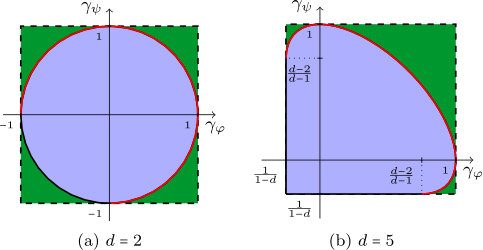 Figure 1
 Figure 1
Peer Reviews
No public reviews on file for this paper yet. If you reviewed it on a platform where reviews are public (OpenReview, ICLR, NeurIPS, ICML), you can paste yours below so the community can read it here.
Videos
No videos yet. Explain this paper in a talk, walkthrough, or lecture? Add one.