Comment on "Revision of Bubble Bursting: Universal Scaling Laws of Top Jet Drop Size and Speed"
Jos\'e Manuel Gordillo, Javier Rodr\'iguez-Rodr\'iguez

TL;DR
This paper provides a critical commentary on the recent revision of universal scaling laws governing the size and speed of jet drops produced during bubble bursting, highlighting key points of agreement and contention.
Contribution
It offers a detailed analysis and critique of the proposed scaling laws, clarifying their applicability and limitations in bubble bursting phenomena.
Findings
Identifies strengths and weaknesses of the revised scaling laws
Highlights conditions where the laws accurately predict jet drop characteristics
Suggests areas for further experimental validation
Abstract
Comment on "Revision of Bubble Bursting: Universal Scaling Laws of Top Jet Drop Size and Speed"
Click any figure to enlarge with its caption.
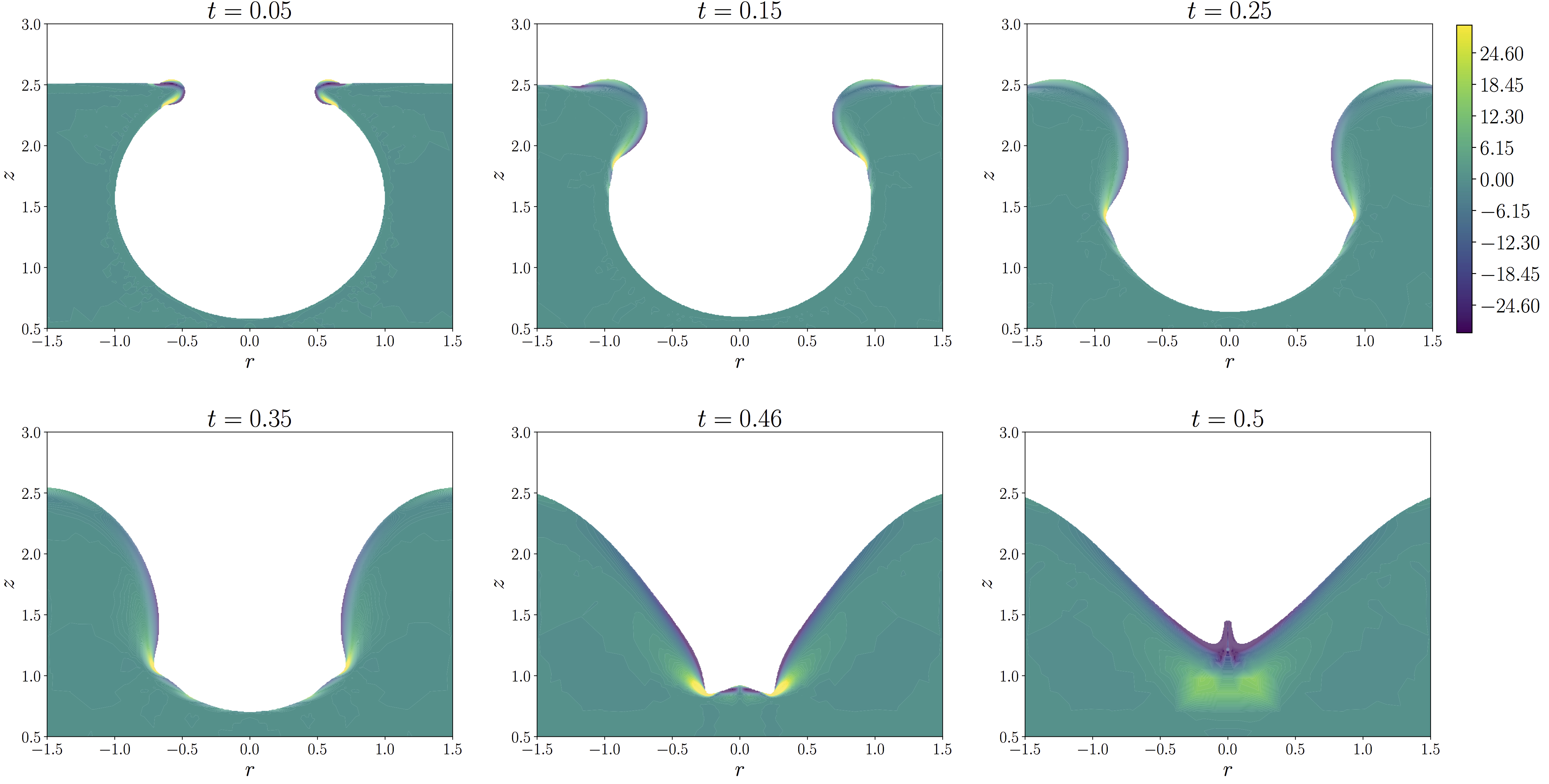 Figure 1
Peer Reviews
No public reviews on file for this paper yet. If you reviewed it on a platform where reviews are public (OpenReview, ICLR, NeurIPS, ICML), you can paste yours below so the community can read it here.
Videos
No videos yet. Explain this paper in a talk, walkthrough, or lecture? Add one.
Comment on “Revision of Bubble Bursting: Universal Scaling Laws of Top Jet Drop Size and Speed”
J.M. Gordillo, Departamento de Ingenería Aeroespacial y Mecánica de Fluidos, Universidad de Sevilla, Spain
J. Rodríguez-Rodríguez, Grupo de Mecánica de Fluidos, Universidad Carlos III de Madrid, 28911, Leganés, Spain
In a recent Letter Ganan-Calvo (2017) Gañán-Calvo presents scalings, in very good agreement with experiments, for the velocities and diameters of the first jet drops produced after bubble bursting. It is the purpose of this comment to show that the physical arguments given to explain such scalings are not consistent with theoretical, experimental and numerical evidences reported in the literature, and confirmed by our own simulations. Indeed, the low-Oh limit of Eq. (7) in Ganan-Calvo (2017) expresses that the jet velocity is , with the capillary velocity and the Ohnesorge number. This result, combined with Eq. (4) in Ganan-Calvo (2017) yields . In addition, the justification of the scalings in Ganan-Calvo (2017) rests on the assumption that all terms in the momentum equation are of the same order of magnitude at the instant of jet ejection, from which, since and , it is deduced that the unknown length coincides with the initial radius of the bubble, namely, . In Ganan-Calvo (2017), the jet velocity is deduced from the mass balance , a fact meaning that the proposed physical mechanism assumes that the fluid entering the jet comes from a region of width of velocity . Thus, it is hypothesized in Ganan-Calvo (2017) that viscosity sets in motion a region of width comparable to the initial radius of the bubble with a velocity comparable with the capillary velocity , a fact which is in contradiction with the well known results by Moore (1963), where it is shown that the width of the region where vorticity produced by viscous effects to comply with the shear-free condition at the interface is concentrated in a boundary layer region of width much smaller than . Indeed, the numerical results in figure 1 illustrate that the thickness of the boundary layer formed in the high curvature region located at the base of the ejected jet, which depends on the Ohnesorge number, is far smaller than .
Contrarily to the physical mechanism presented in Ganan-Calvo (2017), which attributes to viscosity the origin of the jet generated after the bursting of a bubble resting on a free interface, in Gordillo and Rodriguez-Rodriguez (2018) we reveal that such jet emerges as a consequence of a purely inertial mechanism, triggered by the presence of the fastest capillary wave which, once generated during the rim retraction process, propagates towards the apex of the air cavity Duchemin et al. (2002), breaking the self similarity of the inertio-capillary collapse of the void Zeff et al. (2000); Sierou and Lister (2004); Deike et al. (2018); Thoroddsen et al. (2018). However, viscosity plays a role in the selection of the wavelength breaking the self-similarity, and thus in the modulation of the jet’s initial velocity.
Funding from MINECO under Projects DPI2017-88201-C3-1-R and DPI2017-88201-C3-3-R is acknowledged. We thank our colleagues and friends for useful suggestions.
The reference list from the paper itself. Each links out to its DOI / PubMed record.
- 1Ganan-Calvo (2017) A. M. Gañán-Calvo, Phys. Rev. Lett. 119 , 204502 (2017).
- 2Moore (1963) D. Moore, J. Fluid Mech. 16 , 161 (1963).
- 3Gordillo and Rodriguez-Rodriguez (2018) J. M. Gordillo and J. Rodríguez-Rodríguez, J. Fluid Mech. , Under review (2018).
- 4Duchemin et al. (2002) L. Duchemin, S. Popinet, C. Josserand, and S. Zaleski, Phys. Fluids 14 , 3000 (2002).
- 5Zeff et al. (2000) B. Zeff, B. Kleber, J. Fineberg, and D. Lathrop, Nature 403 , 401 (2000).
- 6Sierou and Lister (2004) A. Sierou and J. Lister, Phys. Fluids 16 , 1379 (2004).
- 7Deike et al. (2018) L. Deike, E. Ghabache, G. Liger-Belair, A. Das, S. Zaleski, S. Popinet, and T. Seon, Phys. Rev. Fluids 3 , 013603 (2018).
- 8Thoroddsen et al. (2018) S. T. Thoroddsen, K. Takehara, H. D. Nguyen, and T. G. Etoh, Journal of Fluid Mechanics 848 , R 3 (2018).