Multistep Bloch-line-mediated Walker breakdown in ferromagnetic strips
Johanna H\"utner, Touko Herranen, Lasse Laurson

TL;DR
This paper uses micromagnetic simulations to reveal that in wide ferromagnetic strips, Walker breakdown occurs as a multistep process involving multiple velocity drops caused by the nucleation and annihilation of Bloch lines within the domain wall.
Contribution
It introduces the concept of multistep Walker breakdown driven by Bloch line dynamics in wide ferromagnetic strips with perpendicular magnetic anisotropy.
Findings
Walker breakdown is multistep in wide strips.
Multiple velocity drops correspond to Bloch line events.
Magnetostatic effects break symmetry and enable this mechanism.
Abstract
A well-known feature of magnetic field driven dynamics of domain walls in ferromagnets is the existence of a threshold driving force at which the internal magnetization of the domain wall starts to precess -- a phenomenon known as the Walker breakdown -- resulting in an abrupt drop of the domain wall propagation velocity. Here, we report on micromagnetic simulations of magnetic field driven domain wall dynamics in thin ferromagnetic strips with perpendicular magnetic anisotropy which demonstrate that in wide enough strips Walker breakdown is a multistep process: It consists of several distinct velocity drops separated by short linear parts of the velocity vs field curve. These features originate from the repeated nucleation, propagation and annihilation of an increasing number of Bloch lines within the domain wall as the driving field magnitude is increased. This mechanism arises due to…
Click any figure to enlarge with its caption.
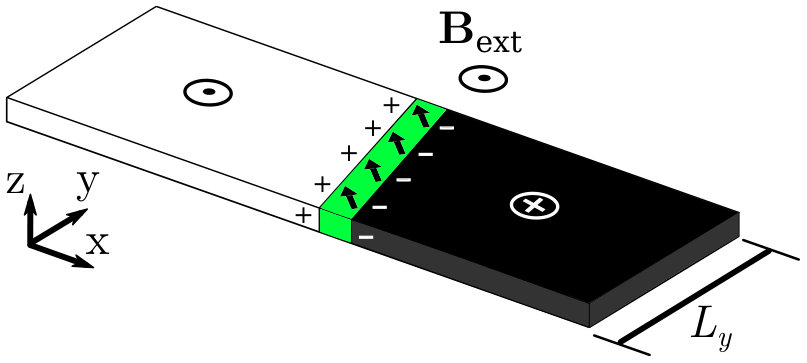 Figure 1
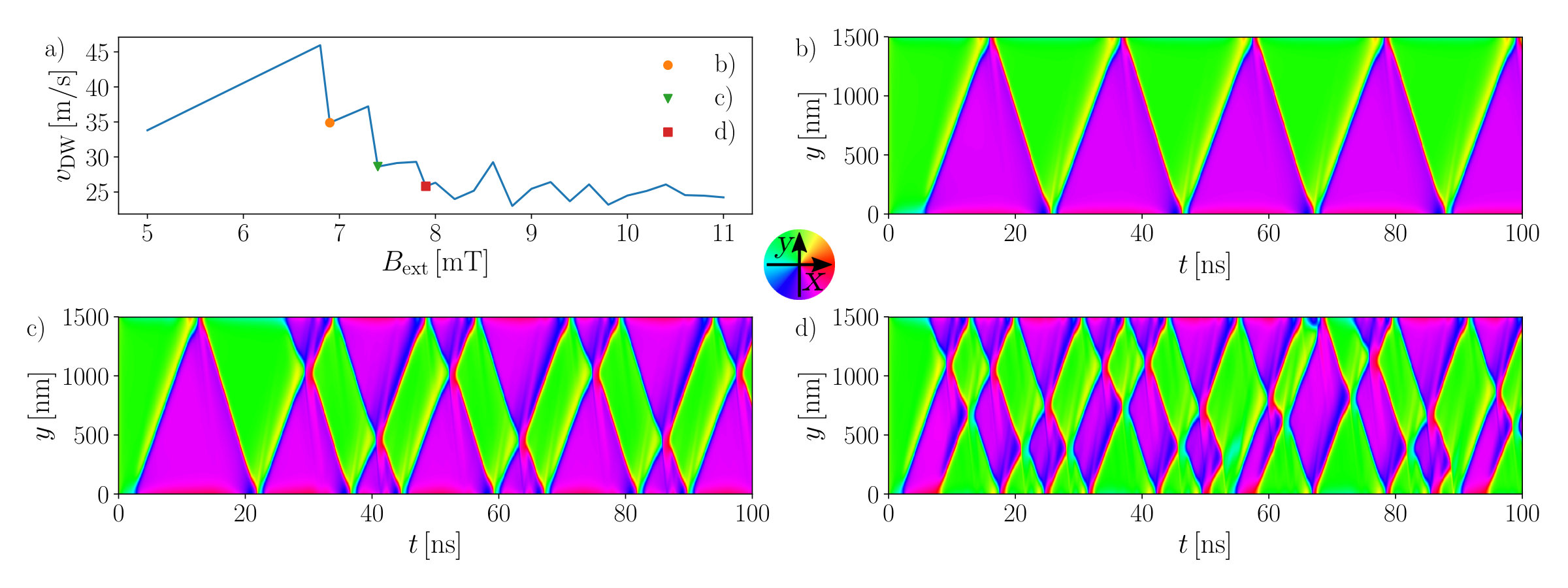 Figure 2
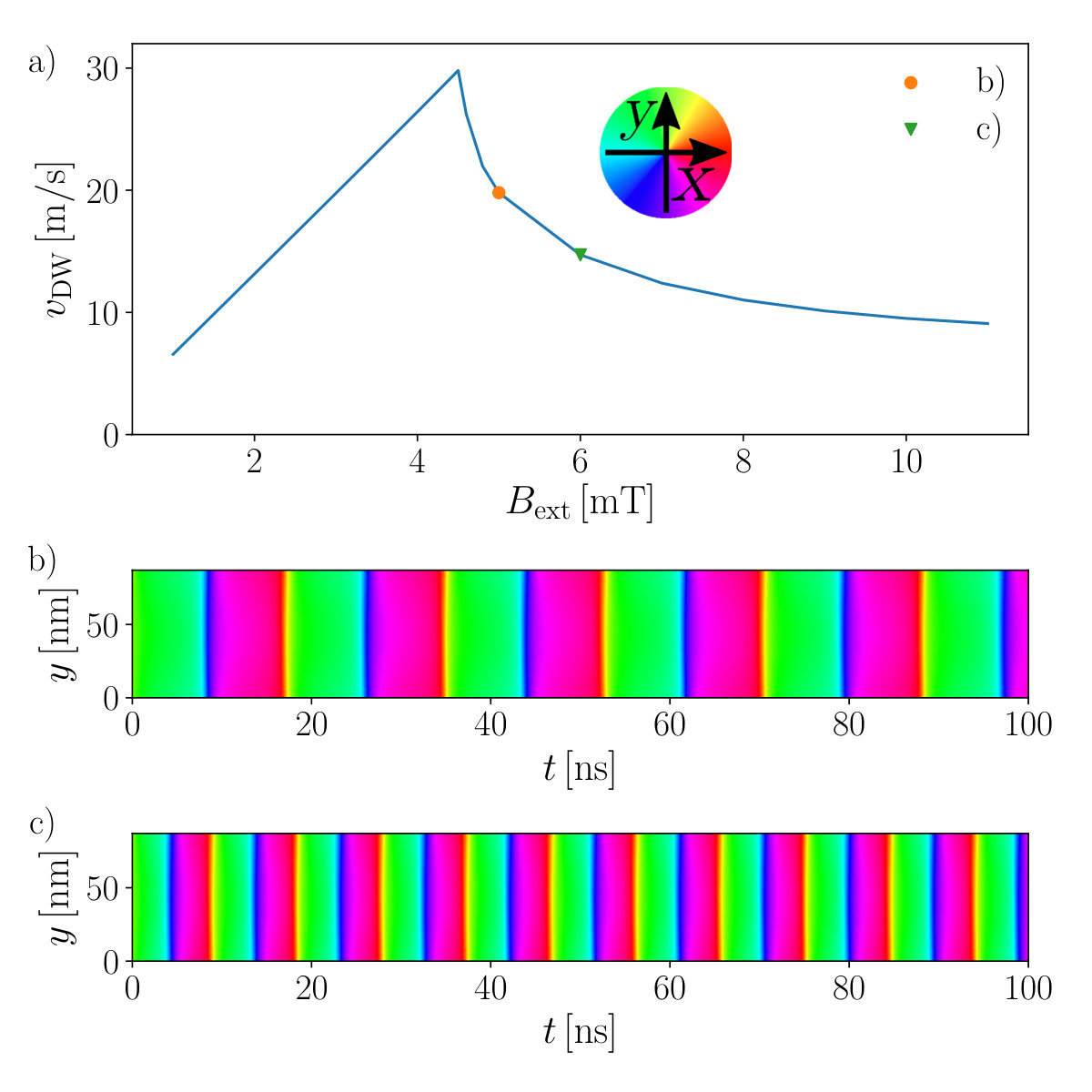 Figure 3
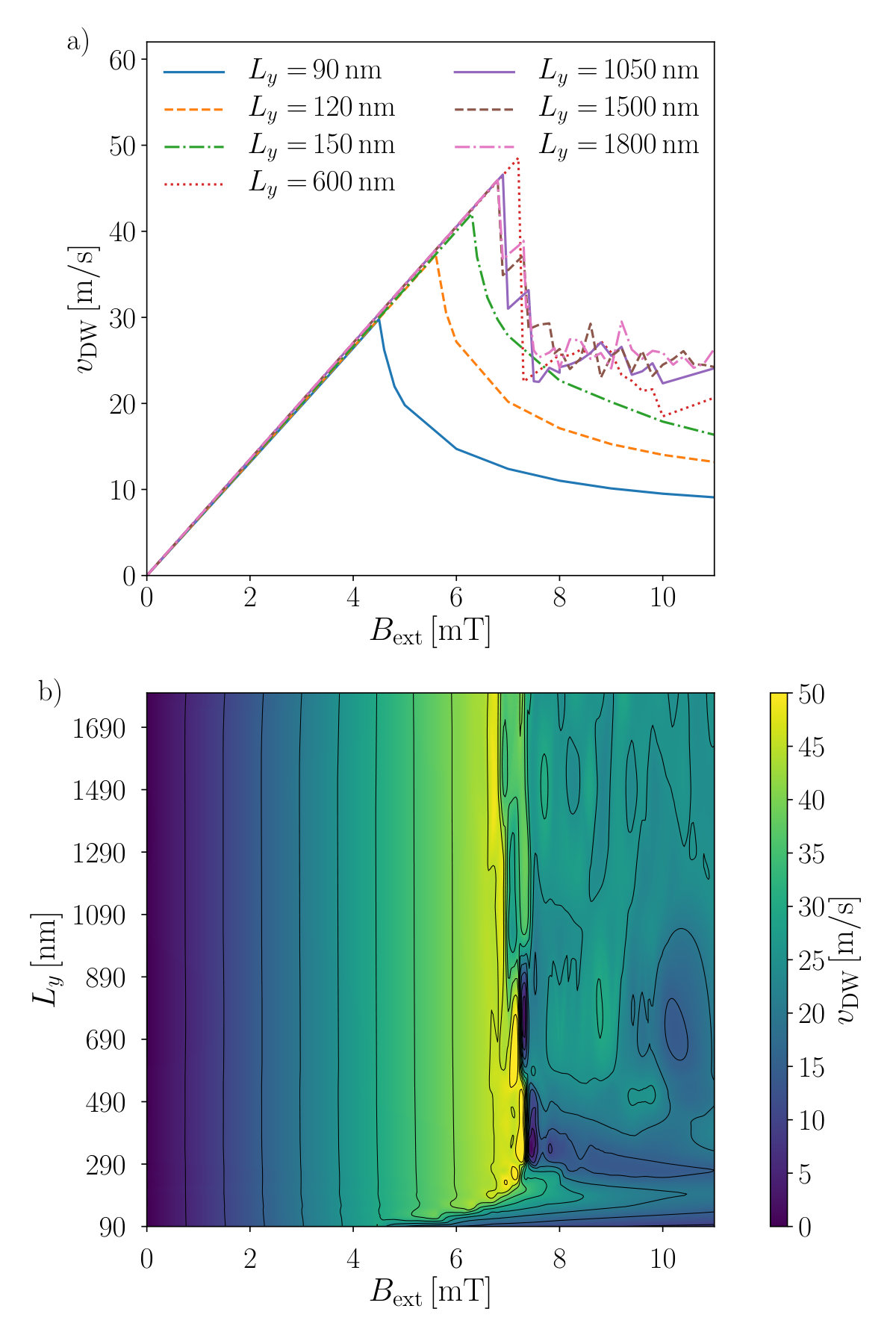 Figure 4
Peer Reviews
No public reviews on file for this paper yet. If you reviewed it on a platform where reviews are public (OpenReview, ICLR, NeurIPS, ICML), you can paste yours below so the community can read it here.
Videos
No videos yet. Explain this paper in a talk, walkthrough, or lecture? Add one.
Multistep Bloch-line-mediated Walker breakdown in ferromagnetic strips
Johanna Hütner1,2
Touko Herranen1
Lasse Laurson1,3
1Helsinki Institute of Physics and Department of Applied Physics, Aalto University, P.O.Box 11100, FI-00076 Aalto, Espoo, Finland
2Aalto Science Institute, Aalto University, P.O.Box 11100, FI-00076 Aalto, Espoo, Finland
3Computational Physics Laboratory, Tampere University, P.O. Box 692, FI-33014 Tampere, Finland
Abstract
A well-known feature of magnetic field driven dynamics of domain walls in ferromagnets is the existence of a threshold driving force at which the internal magnetization of the domain wall starts to precess – a phenomenon known as the Walker breakdown – resulting in an abrupt drop of the domain wall propagation velocity. Here, we report on micromagnetic simulations of magnetic field driven domain wall dynamics in thin ferromagnetic strips with perpendicular magnetic anisotropy which demonstrate that in wide enough strips Walker breakdown is a multistep process: It consists of several distinct velocity drops separated by short linear parts of the velocity vs field curve. These features originate from the repeated nucleation, propagation and annihilation of an increasing number of Bloch lines within the domain wall as the driving field magnitude is increased. This mechanism arises due to magnetostatic effects breaking the symmetry between the two ends of the domain wall.
I Introduction
Domain wall (DW) dynamics driven by applied magnetic fields Beach et al. (2005); Metaxas et al. (2007); Schryer and Walker (1974) or spin-polarized electric currents Parkin et al. (2008); Thiaville et al. (2005); Moore et al. (2008) is an active field of research catalyzed by both fundamental physics interests as well as promising applications in technology. One of the most striking features of DW dynamics is that one typically observes a non-monotonic driving force dependence of the DW propagation velocity . Considering field-driven DW dynamics, for small applied fields , first increases with , followed by a sudden drop of . The latter originates from an instability known as the Walker breakdown Schryer and Walker (1974), where the internal DW magnetization starts precessing at , with known as the Walker field. This leads to a reduced for as part of the energy of the driving field is dissipated by the precessional magnetization dynamics within the DW.
The widely used one-dimensional (1) models Thiaville and Nakatani (2006) describe this precession by a single angular variable, and have been demonstrated to successfully capture the DW dynamics in nanowire geometries Mougin et al. (2007). However, this simple description fails in wide enough strips. In such systems an instability analogous to the Walker breakdown in nanowires is known to proceed in a spatially non-uniform fashion via repeated nucleation and propagation of Bloch lines (BLs) within the DW Herranen and Laurson (2015, 2017); Thiaville and Miltat (2018). BLs are topologically stable magnetization textures corresponding to localized transition regions separating different chiralities of the Bloch DW. In the case of thin strips considered here, BLs are lines threading the strip in the thickness direction, and are hence referred to as vertical Bloch lines (VBLs) Thiaville and Miltat (2018); Garanin et al. (2017). Even if the study of BLs especially in the context of bubble materials has a long history dating back to the 1970’s Malozemoff and Slonczewski (1979); Konishi (1983), the various BL excitation modes responsible for the velocity drop in strips of different geometries remain to be understood.
Hence, we perform here extensive micromagnetic simulations of field-driven DW dynamics considering thin CoPtCr strips with strong perpendicular magnetic anisotropy as example systems (see Fig. 1). We study in detail the dependence of the DW propagation velocity on the applied field , as well as the onset of precessional dynamics at for a wide range of strip widths . Remarkably, by carefully inspecting the “fine structure” of the Walker breakdown, we find that for wide enough strips the large velocity drop in the curve observed previously Herranen and Laurson (2015) actually consists of several distinct, smaller velocity drops, separated by short linearly increasing parts of . Our analysis of the corresponding VBL dynamics within the DW shows that this behaviour arises due to a sequence of distinct excitations of the DW magnetization. Thereby, the number of VBLs present within the DW increases with in discrete steps at specific -values. We show that these features are a consequence of DW tilting due to magnetostatic effects, breaking the symmetry between the two ends of the DW.
The paper is organized as follows: In Sec. II we go through the details of our micromagnetic simulations, while in Sec. III we present our results, focusing on the multistep nature of the Walker breakdown in wide strips. Sec. IV finishes the paper with conclusions.
II Simulations
Our micromagnetic simulations are performed using the GPU-accelerated micromagnetic simulation program MuMax3 Vansteenkiste et al. (2014). It solves the space and time-dependent reduced magnetization [with and the magnetization and saturation magnetization, respectively] from the Landau-Lifshitz-Gilbert (LLG) equation,
[TABLE]
using a finite-difference discretization. In Eq. (1), is the gyromagnetic ratio, the dimensionless damping parameter and the effective field having contributions from the externally applied field , magnetostatic field, Heisenberg exchange field as well as the anisotropy field. As a test system, we consider CoPtCr strips of thickness nm and widths ranging from 90 nm to 1800 nm. The length of the moving simulation window centered around the DW (implying that the dipolar fields due to the two domains cancel at the domain wall) is nm. The system is discretized using cubic discretization cells with a side length of 3 nm. The typical material parameters of CoPtCr Weller et al. (2000); Herranen and Laurson (2015) used here are uniaxial magnetic anisotropy , exchange constant J/m, damping parameter , and saturation magnetization A/m, corresponding to the stray field energy constant of , where is the vacuum permeability. These values result in the Bloch wall width parameter nm and the Bloch line width parameter (or the exchange length) nm.
The system is initialized in a configuration with two antiparallel out-of-plane () domains separated by a straight Bloch DW with the DW internal magnetization in the positive -direction. The DW spans the strip width along the -direction and is located in the middle of the sample. Upon sharp application of an external magnetic field along the positive -direction, the DW is displaced in the positive -direction. The steady state time-averaged DW velocities are then estimated from the slopes of the DW position vs time graphs, averaging over several cycles of the precessional DW dynamics for and excluding any initial transients.
At this point we note a crucial feature of field-driven DW dynamics in the strip geometry, illustrated in Fig. 1: A smaller than the Walker field tends to rotate the DW magnetization counterclockwise away from the positive -direction (i.e., away from a pure Bloch wall configuration), such that the moving steady state DW acquires a Néel component (a finite -component of the DW magnetization). This results in magnetic charges on the DW surfaces, with an associated cost in demagnetization energy. To minimize this energy, the DW tends to tilt in an attempt to align itself with the DW magnetization. A balance between the DW energy (proportional to the DW length) and the magnetostatic energy leads to a finite steady state DW tilt angle (see Fig. 1). This mechanism will be crucial for understanding the properties of the Walker breakdown in the case of wide strips, discussed later in this paper.
III Results
We start by considering the relation between DW propagation velocity and for strips of different widths. Fig. 2a shows examples of curves, illustrating the key aspects of the observed DW dynamics. For all strip widths the usual linear dependence of on for small is terminated at an -dependent Walker field . This is also depicted in the contour plot shown in Fig. 2b. first increases rapidly with , reaches a maximum for nm, after which slowly decreases, possibly reaching a plateau for the largest -values considered. This non-monotonic -dependence is reminiscent of our recent results on thickness-dependent Walker breakdown in garnet strips Herranen and Laurson (2017), and will be analyzed further below.
The shape of the curve displaying the velocity drop crucially depends on . For small , corresponding to the regime where increases with (Fig 2b), decreases smoothly and gradually with increasing (Figs. 2a and 3a). Figs. 3b and 3c display space-time maps of the DW internal in-plane magnetization during the dynamics; for each -coordinate along the DW the magnetization shown is that of the mid-point of the DW where changes sign when moving along the -direction. These maps show that above the internal dynamics within the DW display the typical periodic switching of the DW magnetization Martinez (2011), with the frequency of the switching events increasing with . Notably, for the rather narrow system with nm (i.e., not much wider than the BL width 42 nm) studied in Fig. 3, these switching events are to a very good approximation spatially uniform, such that the magnetization of the entire DW rotates synchronously, and no VBLs are observed.
This is in strong contrast to the behaviour in wider strips [ and beyond the maximum of ]: First, when increasing , a single, quite steep velocity drop is observed; an example is given by the nm curve in Fig. 2a. For even wider strips, a remarkable feature is observed: Our simulations where we consider a finer sampling of the values than previous studies Herranen and Laurson (2015) reveal that the Walker breakdown actually consists of multiple distinct velocity drops, separated by short linear parts of the curve. First, for nm (Fig. 2a), we observe two velocity drops, and further increasing to 1500 nm leads to the appearence of three of these steps. All velocity drops take place within a rather narrow field range of less than 1 mT (they all occur between 6.9 and 7.9 mT). Thus, they were not clearly observed in previous work Herranen and Laurson (2015), where the sampling of the -values was much more coarse.
To account for these distinct velocity drops, it is again instructive to consider the details of the underlying DW magnetization dynamics. Fig. 4a shows an example of a curve exhibiting three velocity drops, followed by a more irregular structure for larger ( nm). Subsequent to the first velocity drop (for 6.9 mT), as illustrated in the space-time map of DW internal magnetization in Fig. 4b, a single VBL nucleates from the bottom edge of the strip, propagates along the DW across the strip width, exits the strip, after which another VBL of opposite -magnetization (shown in red instead of blue in Fig. 4b) enters the strip/DW and propagates to the opposite strip edge, before the process repeats. Upon increasing to 7.4 mT, a second velocity drop occurs. Fig. 4c shows that this second drop is due to more complex VBL dynamics within the DW: After an initial transient, the system finds a steady state where another VBL is nucleated from the top strip edge before the VBL nucleated from the bottom edge reaches the top edge. Subsequently, the two VBLs annihilate within the strip, and a new pair of VBLs is created in the same DW segment. These two VBLs then propagate towards the bottom and top edges of the strip, respectively, and exit the strip. Thereafter, the process is repeated. A third velocity drop is observed for 7.9 mT, with the corresponding DW magnetization dynamics shown in Fig. 4d: In this case, three VBLs are present within the DW for most of the time. Upon further increasing , the VBL dynamics become increasingly complex (not shown) and no further clear, distinct velocity drops can be resolved (Fig. 4a). Movies illustrating the DW dynamics shown in Fig. 4b, c and d are included as Supplemental Material SM . Notice that while Figs. 4 b, c and d describe the VBL dynamics along the DWs, the movies show in addition that DWs containing VBLs are not straight lines but tend to exhibit significant curvature especially at the locations of the VBLs.
The described dynamics of VBLs responsible for the distinct velocity drops crucially depend on a broken symmetry between the two ends of the DW (bottom vs top strip edges). As illustrated in Fig. 1, for , the driving field rotates the magnetization of the moving DW away from a pure Bloch wall configuration to a steady DW structure with a finite Néel component. The Néel nature of the DW gives rise to magnetic charges at the DW surfaces (Fig. 1). To reduce the resulting energy, the DW develops a tilt as it attempts to minimize the charges by aligning with its internal magnetization. Thus, the leading end of the DW effectively experiences a larger driving force (sum of and the demagnetizing fields due to the DW surface charges) than the trailing one. Hence, when incresing over the Walker threshold, the leading end of the DW experiences the breakdown first, i.e., at a lower , while the trailing end is still below its (local) Walker breakdown field. This means that the first VBL is always nucleated from the leading end of the DW (bottom edge in Figs. 4b-d), and that the first velocity drop corresponds to a single VBL moving back and forth along the DW (Fig. 4b).
When is increased to reach the second velocity drop, also the trailing end of the DW exceeds its local Walker threshold, and VBLs are nucleated from both ends of the DW. The leading end of the DW still experiences a larger effective driving force, and hence, the first VBL is nucleated from this edge. However, before it reaches the other end of the DW, a second VBL is nucleated from the trailing end, and subsequently the two Bloch lines annihilate inside the strip, followed by creation of a new pair of VBLs in the same location (Fig. 4c). Increasing even more to reach the third velocity drop leads to nucleation of a third VBL, while the two first ones are still inside the strip, resulting in the simultaneous presence of three VBLs along the DW (Fig. 4d). We note that all creation and annihilation reactions in Fig. 4 respect the conservation of the magnetic charge and chirality of the four-fold degenerate VBLs Yoshimura et al. (2016).
Finally, we address the non-monotonic dependence of the Walker field (defined as the value where the first velocity drop takes place) on (see Fig. 2). As found by Mougin et al. Mougin et al. (2007), in confined geometries with uniform magnetization along the DW , where and denote the demagnetizing factors of the DW along and , respectively. Employing the elliptic approximation leads to and Mougin et al. (2007); Boulle et al. (2011). Notice that the DW width nm used above can be obtained by integrating the Bloch wall profile Hubert and Schäfer (2008), and the approximate expressions for and utilized are valid for and , respectively. Thus, we obtain the approximate result that , suggesting that increases with , in agreement with our observations for narrow strips (small ), where the magnetization of the entire DW precesses in phase above the breakdown (see Fig. 3). However, the above expression also predicts a saturation of in the limit , at odds with our observation in Fig. 2 where, after reaching a maximum, is slowly decreasing with . Indeed, the calculation in Mougin et al. (2007) is valid for uniform DW magnetization only. In particular, it does not take into account the possibility of nucleation of VBLs within the DW which is the mechanism underlying the Walker breakdown for large . The energy barrier for VBL nucleation should depend on , such that it is lower for longer DWs (larger ). However, for the very largest strip widths considered (1500 and 1800 nm), appears to saturate to a value of mT.
IV Conclusions
Thus, we have established that precessional DW dynamics in PMA strips undergo a transition from spatially homogeneous precession of the DW magnetization to a VBL-dominated regime as the strip width is increased. The latter regime is characterized by multiple distinct velocity drops in the curve, originating from asymmetric nucleation of VBLs from the strip edges due to DW tilting. This closer look at the well-studied phenomenon of Walker breakdown thus reveals its multistep nature for DWs with lengths well above the VBL width. These features should lend themselves to experimental verification in future studies. It would also be of interest to extend our study to systems with structural disorder or inhomogeneities interacting with the DW Leliaert et al. (2014a, b), to consider the possible effects of a small tilt of the applied field, as well as to investigate other materials characterized by different micromagnetic parameters; considering such details numerically would be helpful in better understanding the experimental conditions where the mechanism reported here could be observed. We would expect that the multi-step nature of Walker breakdown should be experimentally observable whenever the disorder-induced depinning field is well below the Walker field. Another future avenue of research of considerable current interest would be to address the effect of a finite Dzyaloshinskii-Moriya interaction (DMI) Thiaville et al. (2012), resulting in a scenario where the degeneracy of the different VBL configurations is lifted due to DMI-induced splitting of the energy levels Yoshimura et al. (2016).
Acknowledgements.
This work has been supported by the Academy of Finland through an Academy Research Fellowship (LL, project no. 268302). We acknowledge the computational resources provided by the Aalto University School of Science “Science-IT” project, as well as those provided by CSC (Finland).
The reference list from the paper itself. Each links out to its DOI / PubMed record.
- 1Beach et al. (2005) G. S. Beach, C. Nistor, C. Knutson, M. Tsoi, and J. L. Erskine, Nat. Mater. 4 , 741 (2005).
- 2Metaxas et al. (2007) P. Metaxas, J. Jamet, A. Mougin, M. Cormier, J. Ferré, V. Baltz, B. Rodmacq, B. Dieny, and R. Stamps, Phys. Rev. Lett. 99 , 217208 (2007).
- 3Schryer and Walker (1974) N. L. Schryer and L. R. Walker, J. Appl. Phys. 45 , 5406 (1974).
- 4Parkin et al. (2008) S. S. Parkin, M. Hayashi, and L. Thomas, Science 320 , 190 (2008).
- 5Thiaville et al. (2005) A. Thiaville, Y. Nakatani, J. Miltat, and Y. Suzuki, EPL 69 , 990 (2005).
- 6Moore et al. (2008) T. A. Moore, I. Miron, G. Gaudin, G. Serret, S. Auffret, B. Rodmacq, A. Schuhl, S. Pizzini, J. Vogel, and M. Bonfim, Appl. Phys. Lett. 93 , 262504 (2008).
- 7Thiaville and Nakatani (2006) A. Thiaville and Y. Nakatani, in Spin dynamics in confined magnetic structures III (Springer, 2006) pp. 161–205.
- 8Mougin et al. (2007) A. Mougin, M. Cormier, J. Adam, P. Metaxas, and J. Ferré, EPL 78 , 57007 (2007).