Metal or Insulator? Dirac operator spectrum in holographic QCD
A. Gorsky, M. Litvinov

TL;DR
This paper explores the localization properties of Dirac operator eigenmodes in QCD using holographic models, linking confinement phases to delocalization and deconfinement to localization phenomena.
Contribution
It provides a holographic explanation for the localization behavior of Dirac eigenmodes in QCD, connecting confinement phases to delocalization and deconfinement to localization.
Findings
Delocalization in confined phase linked to $ heta=\pi$ phenomena.
Localized modes in deconfined phase associated with near-horizon holographic regions.
Holographic perspective offers a conjectural explanation for lattice QCD observations.
Abstract
The lattice studies in QCD demonstrate the nontrivial localization behavior of the eigenmodes of the 4D Euclidean Dirac operator considered as Hamiltonian of dimensional disordered system. We use the holographic viewpoint to provide the conjectural explanation of these properties. The delocalization of all modes in the confined phase is related to the - like phenomena when the domain walls between degenerated vacua are possible. It is conjectured that the localized modes separated by mobility edge from the rest of the spectrum in deconfined QCD correspond to the near-horizon region in the holographic dual.
Click any figure to enlarge with its caption.
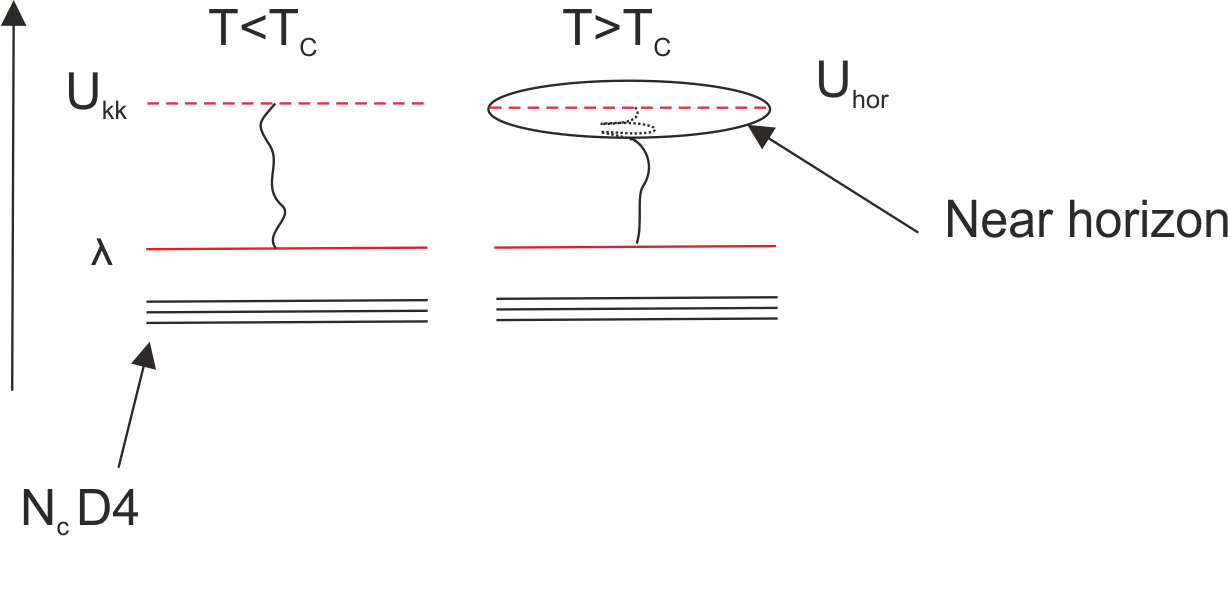 Figure 1
Peer Reviews
No public reviews on file for this paper yet. If you reviewed it on a platform where reviews are public (OpenReview, ICLR, NeurIPS, ICML), you can paste yours below so the community can read it here.
Videos
No videos yet. Explain this paper in a talk, walkthrough, or lecture? Add one.
Metal or Insulator? Dirac operator spectrum
in holographic QCD
A. Gorsky2,3, M. Litvinov1,3
1 Skolkovo Institute of Science and Technology, Moscow, Russia 121205
2 Institute for Information Transmission Problems of the Russian Academy of Sciences, Moscow, Russia 127051
3 Moscow Institute of Physics and Technology, Dolgoprudny 141700, Russia
Abstract
The lattice studies in QCD demonstrate the nontrivial localization behavior of the eigenmodes of the 4D Euclidean Dirac operator considered as Hamiltonian of dimensional disordered system. We use the holographic viewpoint to provide the conjectural explanation of these properties. The delocalization of all modes in the confined phase is related to the - like phenomena when the fermions are delocalized on domain walls. It is conjectured that the localized modes separated by mobility edge from the rest of the spectrum in deconfined QCD correspond to the near-horizon region in the holographic dual.
I Introduction
The 4D Euclidean Dirac operator spectrum in QCD is the important observable both in the confined and deconfined phases. For instance, the Casher-Banks relation casher relating the chiral condensate with the spectral density reads as
[TABLE]
where is the current quark mass and is the four-volume. Two matrix models are useful for a investigation of the Dirac operator spectral properties in confined phase (see matrix for review). One of them corresponds to zero momentum sector of the Chiral Lagrangian while the second model mimics the fermion determinant integrated over the moduli space of a instanton-antiinstanton ensemble presumably relevant for QCD ground state.
The spectral problem for the Dirac operator has been treated in stern by the tools familiar in a theory of disordered systems. The Euclidean Dirac operator in 4D was considered as the disordered Hamiltonian providing evolution in the additional fifth time coordinate identified as the Schwinger proper time stern . On the other hand the proper time is related with the radial coordinate in the ADS-like geometry in Poincare metric gopakumar ; gl . This is the starting point for our analysis of the holographic treatment of the Dirac operator spectrum. Since the radial evolution can be identified with the RG flow deboer our consideration to some extend deals with specific aspects of the RG flows in QCD.
We consider the disordered (4+1) Hamiltonian hence the immediate standard question concerning the localization properties of the eigenmodes of the Dirac operator in Euclidean 4D space arises. The delocalized modes are subject to the level interaction and obey the Wigner-Dyson statistics, while the localized modes do not interact at all and obey the Poisson statistics. There can be a mobility edge separating localized and delocalized modes in the , where is dimension of space. In and dimensions the most of modes are localized, however, there could be a few delocalized modes if the topological terms are present in the action khmel ; pruisken ; furusaki ; kamenev . For instance, these distinguished delocalized modes are responsible for the Hall conductivity in case.
The properties of the Dirac operator spectrum have been investigated in the lattice QCD and the results found were a bit surprising. They can be summarized as follows:
- •
All modes are delocalized in the confined phase osborn
- •
There is the mobility edge in the deconfined phase osborn ; kovacs . Low energy modes in the deconfined phase are localized while high energy part of the spectrum is delocalized.
- •
The mobility edge at grows as the function of the temperature near the deconfinement phase transition approximately as temperature with come constant . The fractal dimension at the localization phase transition coincides with the fractal dimension of 3D unitary Anderson model uam .
The brief summary of these results can be found in giordano .
In this Letter we consider the localization properties of the Dirac operator spectrum from the holographic viewpoint. The deconfinement transition holographically corresponds to the change of the bulk geometry which involves the thermal AdS at and AdS-like black hole (BH) at witten98 ; aharonydec . We assume that the delocalization of all modes in the confined phase is related to the existence of the domain walls at . The relevance of this regime follows from the fact that the eigenfunction of the Dirac operator corresponds to the quark with imaginary mass and the phase of the mass is traded by the axial anomaly to the non-vanishing -term. The quarks are deconfined at the domain wall zohar hence this interpretation implies that the quark propagation in 5-th time occurs along the - dimensional subspace of 4d Euclidean space. This qualitatively fits the lattice results qcdOLD . It is also natural to question how the emergence of BH in the deconfined phase and the mobility edge in the Euclidean 4D Dirac operator spectrum are correlated. We have found the evidences that the mobility edge corresponds to the near-horizon region.
It is worth to make one more comment. It was argued in fradkin that the disorder driven transition for the Dirac operator differs from the Anderson transition for the non-relativistic Schrodinger operator. The key difference concerns the role of spectral density as the order parameter. In the usual Anderson transition the spectral density does not play any essential role and only a spectral formfactor and higher spectral correlators matter. We shall be interested in the Dirac operator spectrum in Euclidean space hence the non-Anderson transition can be expected.
The Letter is organized as follows. In Section 2 we collect relevant properties concerning the Dirac operator in QCD. In Section 3 we briefly review the holographic model of QCD. In Section 4 we consider the different approaches familiar in the theory of disordered systems to diagnose the localization properties of Hamiltonian with disorder of different nature. In Section 5 we relate the delocalization of all modes in the confined phase with the - like phenomena and assume that the quarks propagate along the domain wall where they are deconfined. In Section 6 we conjecture that the localized modes separated by mobility edge from the rest of the spectrum in the deconfined phase correspond to the near-horizon region in the holographically dual black hole. Some open questions are formulated in the Discussion.
II Dirac operator in QCD
Let us recall some results concerning the Dirac operator spectrum. The partition function of QCD reads as
[TABLE]
We shall deal with the eigenvalue equation for the 4D Euclidean Dirac operator
[TABLE]
which coincides with the Dirac equation for the imaginary fermion mass . The spectral density is defined as
[TABLE]
and near the origin in the confined phase it behaves as casher ; smilga
[TABLE]
where smilga
[TABLE]
The spectral density can be derived from the discontinuity of the resolvent across the imaginary axis
[TABLE]
III Holographic preliminaries
Turn now to the holographic QCD and consider the Witten-Sakai-Sugimoto geometry witten98 ; ss
[TABLE]
It involves the D4 branes wrapped around the cylinder with the boundary conditions for fermions breaking SUSY. At large the D4 branes pinch the cylinder which turns into a cigar. The total 10D geometry looks as at small temperature. In the confined phase the cigar in coordinates reads as
[TABLE]
where is periodic variable. We insert D8-branes extended in radial coordinate r and localized at and D0 instantons localized in radial coordinate in this background geometry and extended along . The D8 branes are connected at the tip of the cigar and are placed at on the circle. The D8 branes carry flavor gauge group at the worldvolume and matrix of the pseudoscalar mesons is defined in terms of holonomy of radial component of the flavor gauge field
[TABLE]
Above the critical temperature the metric involves BH witten98 and the phase transition in QCD qualitatively corresponds to the Hawking-Page transition. At the and Euclidean time coordinates get interchanged.
It is worth also to comment on the holographic origin of the mass term in the Chiral Lagrangian. It was argued in aharony2 ; hashimoto that it comes from the worldsheet instanton that is the open string with worldsheet coordinates which is stretched between left and right D8 branes and spans some area on the cigar. The mass comes from the Nambu-Goto string action while the factor comes from the interaction of the open string end with D8 brane. We are interested in the Dirac operator eigenvalues that is purely imaginary masses. The imaginary masses can be obtained if the term is taken into account which holographically corresponds to the holonomy of the RR 1-form field along KK circle wittentheta . With the proper value of we get purely imaginary masses. The early discussion on the Dirac operator spectral density in holographic QCD can be found in kopnin .
IV Critical regime
IV.1 Diagnostics of the critical behavior
In what follows we shall be interested in the spectral properties of the disordered Hamiltonian near the mobility edge . There are several specific features intrinsic for this regime supporting the multifractal behavior.
- •
First, the level spacing distribution is the key indicator of the localization/delocalization transition. It behaves as
[TABLE]
where for unfolded spectrum , . The mean level spacing is . Let us take a window of the width , , in the energy space centered at and calculate the number of levels inside the window at some realization of disorder. The parameter in the Poisson tail is the level compressibility defined as
[TABLE]
- •
The second indicator is the spectral correlator which develops a fractal behavior at the mobility edge which differs both from Wigner-Dyson and Poisson statistics edge
[TABLE]
where is the fractal dimension defined as
[TABLE]
in the volume , is dimension of space. The level number variance
[TABLE]
behaves as in the multifractal case, where the level compressibility reads as
[TABLE]
IV.2 Matrix models for localization transition
There are several critical matrix models crit1 ; crit2 ; crit3 describing the localization transition in 3D which are qualitatively unified in muttalib . All of them works only nearby the mobility edge (see kravtsovrev for review). Let us summarize their main features
- •
The two-matrix model crit1 involves the following probability function
[TABLE]
where is parameter and is the fixed unitary matrix . The critical regime in this model implies that unitary symmetry breaking parameter behaves as at .
- •
The second one-matrix model involves the potential providing the weak confinement crit2 of eigenvalues. Asymptotically potential behaves as
[TABLE]
where - is some parameter and the probability measure in the matrix integral reads as
[TABLE]
The similar critical model for the chiral ensembles has been considered in vercrit .
- •
The third model was suggested in crit3 and involves the Gaussian ensemble of independent random entries
[TABLE]
where is parameter of the model, for it gets mapped into supersymmetric sigma model. This model also manifests the multifractal behavior crit3 at the mobility edge.
The spectral correlators in all three critical models are the same
[TABLE]
where at small
[TABLE]
The parameter is related with the parameters of the matrix ensembles if we assume . The spectral correlator in this regime is identical to the density-density correlator for the free fermion gas at finite temperature proportional to . The parameter is related with the fractal dimension as . Similarly at small regime the spectral compressibility reads as
[TABLE]
and is consistent with the general relation (19).
Let us remark that formulas above are valid only for small multifractality. At large there is the power-tail which knows about the fractal dimension as well. According to our conjecture the small regime corresponds to the near horizon IR region while the large regime captures the information about the UV scale. Since we are dealing with a kind of anomaly phenomena the information about the fractal dimension can be captured both in UV and IR regions.
V Spectral statistics in the confined phase
V.1 Towards the mechanism for delocalization
The lattice studies demonstrate osborn ; kovacs that all eigenmodes of 4d Euclidean Dirac operator in the confined phase are delocalized, and hence it behaves as 4d metal. The metallic property of the Dirac operator in confined phase of QCD is quite counterintuitive since quark is assumed to be confined in 3d space. The only supporting argument of Parisi parisi claims that the eigenvalues of the Dirac operator in confined phase have to interact to provide the finite density at the origin. Hence they obey the Wigner-Dyson statistics and therefore the eigenfunctions are delocalized. Let us emphasize once again that we mean transport not in the physical time but in RG radial time.
We suggest the qualitative explanation of the delocalization in confined phase in terms of the topological defects. The starting remark concerns the identification of the Dirac operator eigenvalue with the imaginary quark mass. Due to the axial anomaly the mass dependence goes through hence to get imaginary masses as required for eigenvalues of the Dirac operator we can introduce the value of which depends on the number of flavors. In particular for , when the Dirac operator plays the role of probe, while generically .
It is known for a while that at there are degenerate vacua; hence, the theory enjoys the domain walls. Recently it was argued that theory on the domain wall is in the deconfined phase zohar . For instance, if the spectral correlator of the probe Dirac operator tells how quark could propagate along the domain wall in the pure YM theory in the radial time evolution.
This picture qualitatively agrees with the relatively old lattice studies qcdOLD where it was found that the delocalized chiral modes of the Dirac operator in confined phase are suited at the surfaces in the 4d Euclidean space which have some rigid topological properties. Note that in this scenario we have a kind of fracton picture (see fractons for review). Indeed we have the restricted mobility of the percolation type for elementary degrees of freedom in 4d space while the composite particles - mesons can propagate freely.
On the top of this conjectured mechanism of eigenmode delocalization on ”domain wall”, there can be additional mechanism due to the topological delocalization similar to the phenomena found in khmel ; pruisken ; furusaki ; kamenev for low dimensional cases. It would be a kind of version of the quantum Hall effect. However, such additional mechanism potentially can explain only the delocalization of a single mode and can not explain the delocalization of the all modes of the Dirac operator in the confined phase.
V.2 Worldsheet arguments
In confined phase quark is represented by the fundamental string extended from the probe flavor brane located at radial coordinate fixed by till the effective IR wall (Fig.1) that is worldsheet coordinates are . The relevant target space geometry involves the cygar in coordinated and the thermal circle.
Let us first explain the holographic interpretation of the Dirac operator eigenvalue. It was argued in stern that the Euclidean 4D Dirac operator serves as the Hamiltonian with respect to the Schwinger proper time. On the other hand, it was shown in gopakumar ; gl in certain situations that the Schwinger proper time is related with the radial coordinate as in the Poincare coordinates
[TABLE]
for the Euclidean space. This relation holds in the pure boundary conformal theory gopakumar and in the non-SUSY boundary theory in the constant external field gl . Hence we suggest that the Dirac operator eigenvalue is conjugated to the radial coordinate in the AdS-like geometry. This is also consistent with the well known identification of the radial position of the flavor brane corresponding to the quark with mass.
How the spectral statistics in the boundary theory gets translated into the worldsheet framework? Using the conjectured Dirac operator spectrum - radial worldsheet coordinate correspondence the question of the localization/delocalization of the energy spectrum gets reformulated as the question if neighbor ”string bits” are correlated(Wigner-Dyson) or independent(Poisson). In the confined phase the string has finite effective tension at all values of radial coordinate
[TABLE]
therefore tensionful string does not have any reason for uncorrelated neighbor bits. It is qualitatively consistent with the Wigner-Dyson level statistics observed in lattice QCD in confined phase. According to the Wigner-Dyson statistics the neighbor string bits are repulsive implying that the string tends to be straight.
We conjecture that using the ”radial coordinate - Dirac operator eigenvalue” correspondence the spectral correlator in the boundary theory gets mapped into correlator of the collective fields on the string worldsheet
[TABLE]
More arguments supporting this conjecture read as follows
- •
The mapping (29) is known for a while. It was demonstrated in simons that the spectral correlator in RMT is equivalent to the correlator of the densities in the 2d collective field theory for the Calogero model describing the fermions in the harmonic confining potential simons . The Hamiltonian of the model reads as
[TABLE]
and is described in terms of the two-dimensional scalar field as follows kravtsovrev
[TABLE]
Hence the density-density correlator can be expressed in terms of the conventional Green function of the scalar in .
- •
We suggest that collective field in the worldsheet theory with potential term appears similarly to the case of the string in the cigar background kostov from the condensation of vortices near the tip of the cygar. The vortices are due to the non-singlet sector in the matrix model klebanov ; boulatov ; maldacenanon . It is these vortices or more generically holes in the worldsheet which presumably yield the Calogero model and the Luttinger effective collective field description on the string worldsheet.
- •
To some extent, we are looking for the correlator of two Wilson loops. The relation between the correlators of the Wilson loops and the spectral formfactor has been noted in sonner in the context of the matrix model. In the confined phase the RMT works well hence the interpretation of spectral correlator in terms of two Wilson loops or their Laplace transforms - resolvents is natural. Two Wilson loops correspond to two boundaries of the worldsheet which could be boundaries of holes or boundary of one hole and the external boundary. Potentially, we could wonder about the Gross-Ooguri phase transition gross when the connected surface with two Wilson loop boundaries no longer exists.
- •
The spectral statistics is most transparent in terms of the level spacing distribution. The duality we are looking at implies the identification of the distribution of the distance between the neighbor levels and the distribution of ”‘sizes of the holes”’ on the worldsheet . We know that in the delocalized phase hence we wonder if has the similar behavior. Remarkably it turns out that is the leading approximation the distribution of the hole sizes obey this law indeed abanov .
Let us make a few comments on the spectral density itself. In the confined phase we have to explain the Casher-Banks relation from the worldsheet viewpoint. This has been done to some extend in the kiritsis ; sonnen where the quark condensate was related to the tachyon field in the spectrum of open string connecting D8 brane and antibrane. The emerges from the tachyon mode of the short open string placed near the tip of the cigar. This viewpoint is useful for identification position of value as the tip of the cigar. The linear term in the spectral density is proportional to the (5) which presumably implies the cusp in the string shape; however, the special analysis of this non-analyticity is certainly required. Moreover, the coefficient in front of the linear term is proportional to the two-point correlator of the scalar currents smilga which hopefully could help in a holographic explanation of the non-analyticity of the spectral density.
VI Spectral statistics in the deconfined phase
VI.1 Field theory arguments
The key question in the deconfined phase concerns the holographic interpretation of the mobility edge in the spectrum found in the lattice studies osborn . Let us present a few qualitative arguments supporting the identification of the near-horizon region in the holographic dual and the localized modes in the Dirac operator spectrum.
- •
At the critical metal-insulator transition in the Dirac operator spectrum one could expect the jump of the chiral conductivity in the thermal QCD. The corresponding Kubo-like formula for the correlator of the Noether currents generated left and right chiral rotations reads as
[TABLE]
Comparison of this QCD low-energy theorem with the formulas known in the transport phenomena provides the identification of the as the diffusion coefficient in the chiral matter zahed . Hence we could question when the jump of chiral conductivity is expected in the holographic setup. To be as model independent as possible consider the anomaly matching Son-Yamamoto condition in holographic QCD son which yields the relation between the 2- and 3-point functions and is diagonal with respect to the holographic RG flows in the hard wall model dgm . The Son-Yamamoto relation amounts to the following expression for the ”running”
[TABLE]
which is valid for any reasonable holographic metric.
[TABLE]
Taking the derivative of this expression we see immediately that the criticality for the conductivity takes place exactly at the BH horizon when .
- •
The lattice QCD studies demonstrate that the position of mobility edge at grows as the function of the temperature near the deconfinement phase transition approximately as temperature
[TABLE]
with come constant . The possible holographic explanation of this behavior goes as follows. For the near-extremal BH the following relation between the radial coordinate and the temperature
[TABLE]
where is the radius of the extremal BH. This behavior is qualitatively consistent with the observed linear temperature dependence of the mobility edge if we assume that . Let us emphasize that the precise holographic metric in the deconfined QCD is unknown; however, the presence of the horizon is well established. The detailed lattice study of the dependence could provide some information concerning the holographic metric.
- •
At the transition point the cigar involving the Euclidean time emerges in the bulk which means that effectively the time circle is shrinkable and the theory behaves as 3d theory in the deconfinement phase. This fits with the fact that the fractal dimension obtained near the mobility edge in lattice QCD corresponds to the 3d unitary Anderson model. On the other hand, the Polyakov loops which wrap the thermal circle get condensed and presumably can serve as the source of disorder kovacs .
- •
Recently, the interesting relation for the spectral correlator has been found kanazawa . The analogue of the Casher-Banks relation for the spectral formfactor reads as follows
[TABLE]
where - is the spectral correlator of the Dirac operator in the deconfined phase and is defined as the coefficient in front of symmetry breaking term in the expansion of the partition function in terms of the fermion mass matrix
[TABLE]
The (37) measures the difference between the spectral correlator in QCD and spectral correlator in the case of Poisson statistics. We know from the lattice studies that near the the statistics is Poissonian hence this observation implies that and unbroken symmetry. This issue is quite controversial and there are lattice results contradicting and supporting this statement in the literature. This point certainly deserves further study.
VI.2 Mobility edge and BH near-horizon region. Worldsheet perspective
Turn now to the identification of the mobility edge in terms of the worldsheet theory of the string embedded into the target space involving BH. The bulk BH metrics induces the thermal metric on the worldsheet. The target and worldsheet temperatures coincide for the static quark. Hence, we could question what is the natural scale in the worldsheet theory which separates two parts of the string worldsheet? We suggested above that the mobility edge lies in a near-horizon region.
Worldsheet arguments go as follows,
- •
Far from the horizon the string tension is finite and the neighbor elementary string bits interact repulsively yielding Wigner-Dyson statistics while in the near-horizon region the effective tension vanishes and the elementary string bits obey the Poisson statistics. Similar to confined phase we have to identify the Poisson statistics of the energy levels with the distribution of the hole sizes. When the tension tends to zero there are no preferable sizes of holes on the worldsheet hence they indeed enjoy the Poisson statistics.
- •
According to our conjecture exactly at the deconfinement transition temperature the critical statistics of the levels in the boundary theory is expected and is the same at all energies being a mixture of the Wigner-Dyson and Poisson statistics shklov . What does it mean for the string worldsheet picture? First, it implies that the level spacing distribution does not depend on the radial worldsheet coordinate and therefore is RG invariant. Secondly, the radial distance between two neighbor levels at the boundary corresponds to the distance between two neighbor string bits on the worldsheet. The distance is measured with the worldsheet metric; hence, naively we could assume that the worldsheet metric has very peculiar form exactly at the transition point. There is the transition from the Wigner-Dyson to Poisson at some value of the level spacing . This means that the finite localization length proportional to is expected at string worldsheet at the critical point.
- •
Contrary to the confined phase the cygar geometry involves now coordinates and the string extended along the radial coordinate evolves in the angular coordinate . Thus, the thermal effective field theory for Calogero system is the proper starting point. Remarkably, it turns out ggverba2003 that the RMT-Calogero correspondence at zero temperature gets generalized to the relation between the Calogero model at finite temperature and the critical matrix model crit2 . Now the spectral correlator in the critical RMT gets mapped into the density-density correlator in the Calogero model at finite temperature upon the identification deformation parameter in the matrix model as ggverba2003
[TABLE]
Let us remind that coordinates of particles in Calogero model are identified as radial holographic coordinates while is the Euclidean time identified with the angular coordinate at the hyperbolic plane. The density-density correlator is taken at the same Euclidean time. The Calogero model is considered at the fixed coupling constant which corresponds to the fermion statistics.
- •
It was observed in kravtsovbh that the 2d collective field theory yielding the proper criticality for the density-density correlators can be curiously identified with the effective 2d ”acoustic BH”. The fractal dimension derived in the worldsheet theory is induced from the bulk involving BH kravtsovbh and is related to the Hawking effective temperature T as
[TABLE]
VII Conclusion
In this Letter we have presented few conjectures concerning the localization properties of the Euclidean 4D Dirac operator spectrum in QCD in confined and deconfined phases. We suggest that the delocalization of all modes in the confined phase is related with the - like phenomena. The quarks are delocalized on the domain walls and can propagate along them if we treat radial coordinate as time. This fits with the lattice observations concerning the location of delocalized modes on the submanifolds in the Euclidean 4D space qcdOLD . It was conjectured that in the deconfined phase the localized modes correspond to the BH near-horizon region in the holographic dual. Almost all of our arguments are qualitative hence further quantitative clarification is certainly required.
Our conjecture can be compared with the example of the emergent mobility edge in the SYK model perturbed by quadratic term which has been found recently in garcia . It is believed that 2d BH in the dilaton JT gravity is dual to the boundary SYK model syk (see rosenhaus for review and references). The AdS2 geometry has two boundaries and the perturbing term corresponding to the fermion mass in (0+1) boundary theory induces the interaction between boundaries hosting the left and right sectors. If the strength of interaction is strong enough the mobility edge in the spectrum gets emerged garcia . This phenomena has many similarities with our study in (4+1) since the eigenvalue of the Dirac operator corresponds to the imaginary mass term, therefore it involves the interaction between left and right sectors. If the eigenvalue is large enough the mobility edge can be identified.
It would be also interesting to match our study with the discussion in Lee . It was argued there that quite generically criticality in the ungapped phase of boundary Euclidean theory appears at the holographic horizon. Its origin is the lack of possibility to match the initial UV state with the particular state in IR through the holographic RG flow. Our study suggests that the corresponding criticality at horizon is expected to be the metal-insulator type transition in the spectrum of the boundary Euclidean theory.
It would be very important to investigate in the lattice QCD framework the low-energy eigenmodes of the Dirac operator in the deconfined phase. It would provide the important information concerning the near-horizon region of the BH in 5D. Another interesting issue concerns the analysis of deconfinement transition induced by the baryonic density from the viewpoint of Dirac operator spectrum.
VIII Acknowledgments
We are grateful to N.Sopenko for collaboration at the early stage of this study and to V. Braguta, A. Kamenev, D. Kharzeev, A. Kitaev, V. Kravtsov, A. Milekhin, S. Nechaev, N. Prokof’ev, B. Shklovskii for the useful discussions. The work of A.G. and M.L. was supported by Basis Foundation Fellowship 17-11-122-21 and RFBR grant 19-02-00214. A.G. thanks SCGP at Stony Brook University and KITP at University of California, Santa Barbara, for the hospitality.
The reference list from the paper itself. Each links out to its DOI / PubMed record.
- 1(1) T. Banks and A. Casher, “Chiral Symmetry Breaking in Confining Theories,” Nucl. Phys. B 169 , 103 (1980). doi:10.1016/0550-3213(80)90255-2
- 2(2) J. J. M. Verbaarschot and T. Wettig, Ann. Rev. Nucl. Part. Sci. 50, 343 (2000) [ar Xiv:hep-ph/0003017] R. A. Janik, M. A. Nowak, G. Papp and I. Zahed, “Chiral random matrix models in QCD,” Acta Phys. Polon. B 29 , 3957 (1998) [hep-ph/9812376]. G. Akemann, “Random Matrix Theory and Quantum Chromodynamics,” ar Xiv:1603.06011 [math-ph].
- 3(3) J. Stern, “Two alternatives of spontaneous chiral symmetry breaking in QCD,” [hep-ph/9801282]. R. A. Janik, M. A. Nowak, G. Papp and I. Zahed, “Chiral disorder in QCD,” Phys. Rev. Lett. 81 , 264 (1998) doi:10.1103/Phys Rev Lett.81.264 J.C. Osborn and J.J.M. Verbaarschot, Phys. Rev. Lett. 8 1 (1998) 268, Nucl.Phys. B 525 (1998) 738
- 4(4) R. Gopakumar, “From free fields to Ad S,” Phys. Rev. D 70 , 025009 (2004) doi:10.1103/Phys Rev D.70.025009 [hep-th/0308184].
- 5(5) A. Gorsky and V. Lysov, “From effective actions to the background geometry,” Nucl. Phys. B 718 , 293 (2005) doi:10.1016/j.nuclphysb.2005.04.020 [hep-th/0411063].
- 6(6) J. de Boer, E. P. Verlinde and H. L. Verlinde, “On the holographic renormalization group,” JHEP 0008 , 003 (2000) doi:10.1088/1126-6708/2000/08/003 [hep-th/9912012].
- 7(7) Anderson localization and the topology of classifying spaces T. Morimoto, A. Furusaki, C. Mudry Phys. Rev. B 91, 235111 (2015)
- 8(8) Topology vs. Anderson localization: non-perturbative solutions in one dimension A. Altland, D. Bagrets, A. Kamenev Phys. Rev. B 91, 085429 (2015)