Scalar Dark Matter Probes the Scale of Non-locality
Anish Ghoshal

TL;DR
This paper demonstrates that a non-local scalar dark matter model can predict the dark matter mass and coupling, linking the scale of non-locality to experimental detection prospects and addressing hierarchy issues.
Contribution
It introduces a minimal scalar dark matter model with infinite derivatives that predicts DM mass and coupling, connecting non-locality scale to observable phenomena.
Findings
DM mass predicted around TeV scale
Coupling with Higgs approximately 10^{-2}
Detection experiments constrain non-locality scale
Abstract
Scalar dark matter (DM) in a theory introduces hierarchy problems, and suffers from the inability to predict the preferred mass range for the DM. In a WIMP-like minimal scalar DM set-up we show that the infinite derivative theory can predict DM mass and its coupling. The scale of non-locality (M) in such a theory in its lower-most limit (constrained by LHC) implies a DM mass TeV and a coupling with the Standard Model (SM) Higgs . Planned DM direct detection experiments reaching such sensitivity in the DM will effectively translate into lower bounds on the scale at which the non-locality comes into the play. Self-interactions of DM and its impact on vacuum stability in this model are also discussed in the context.
Click any figure to enlarge with its caption.
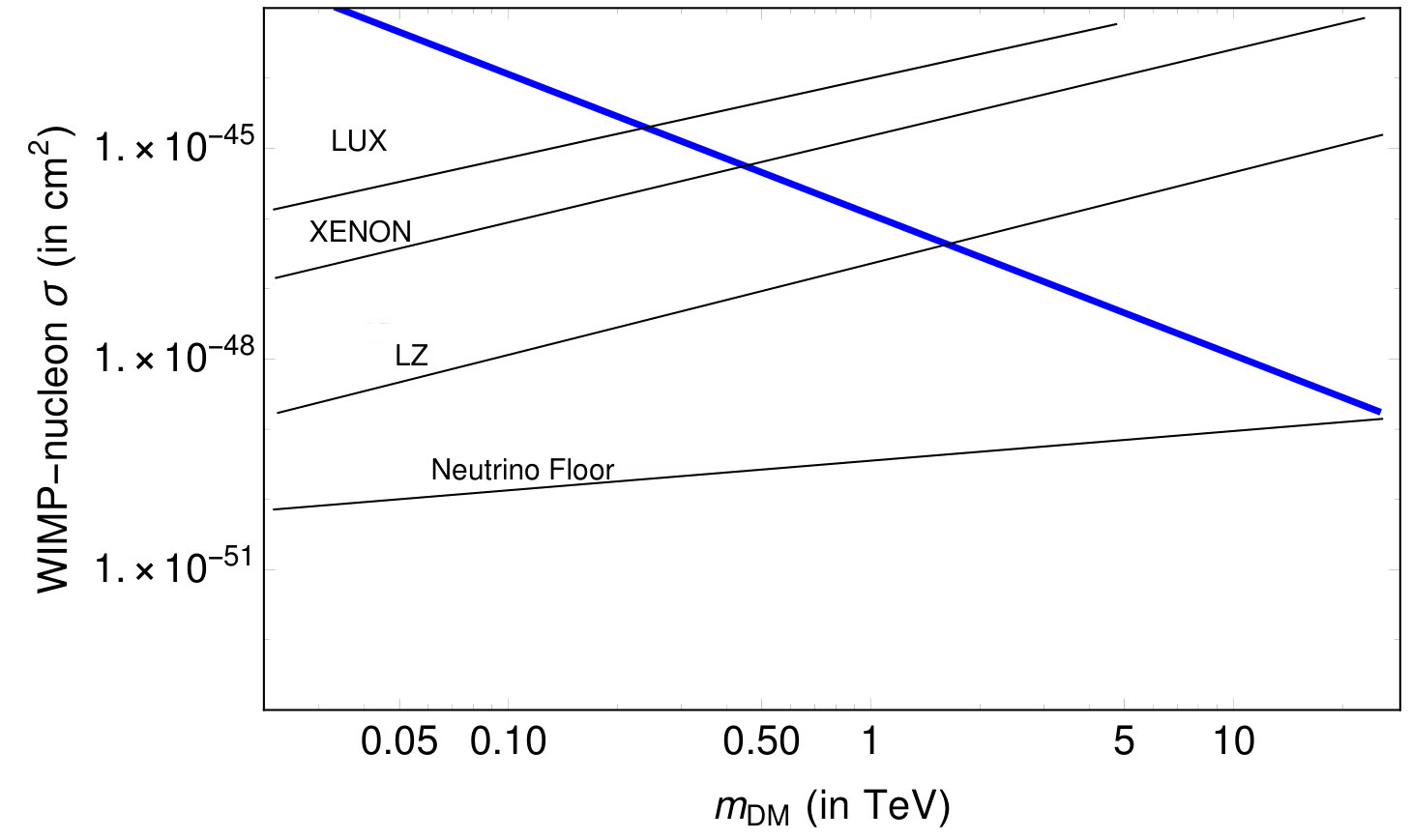 Figure 1
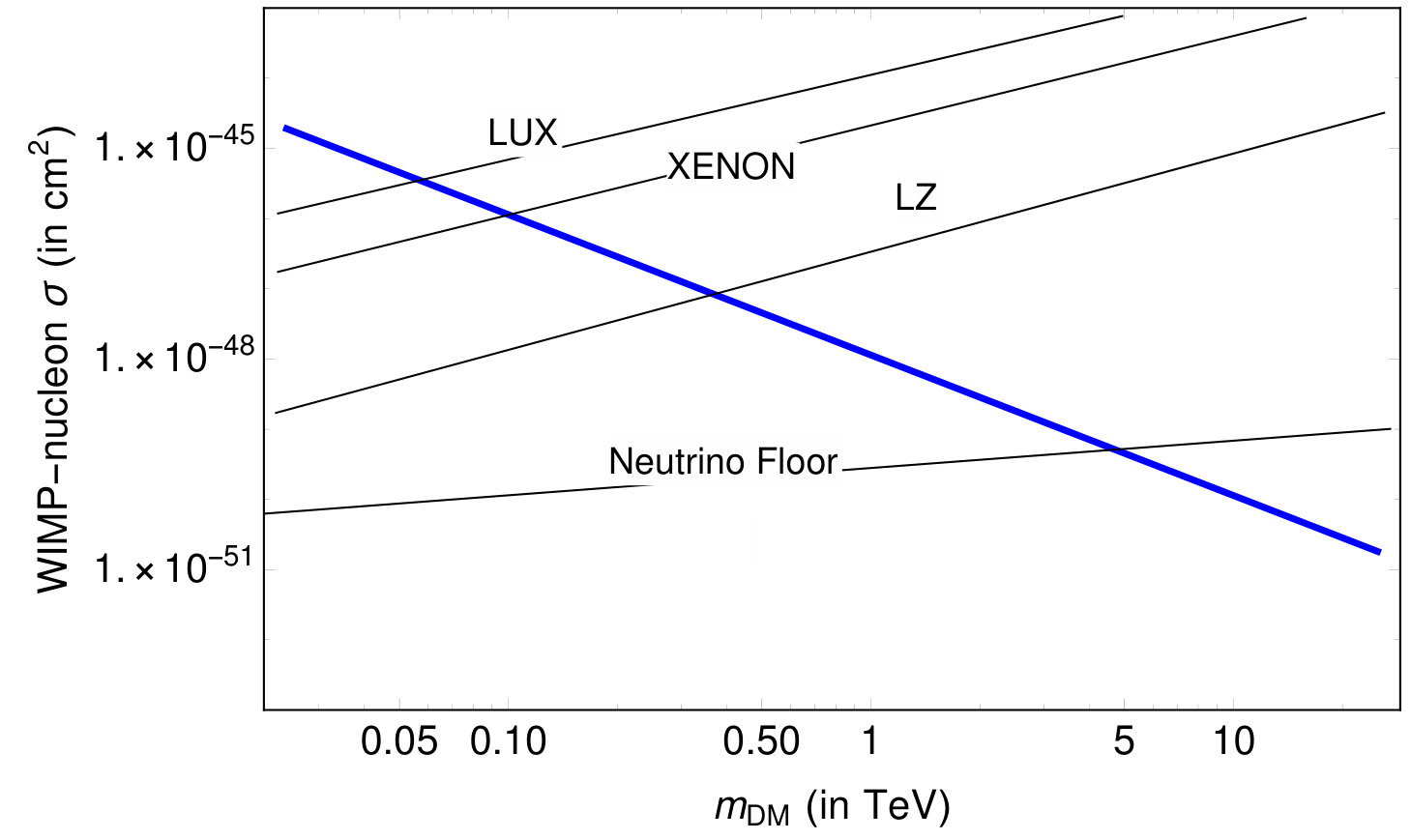 Figure 2
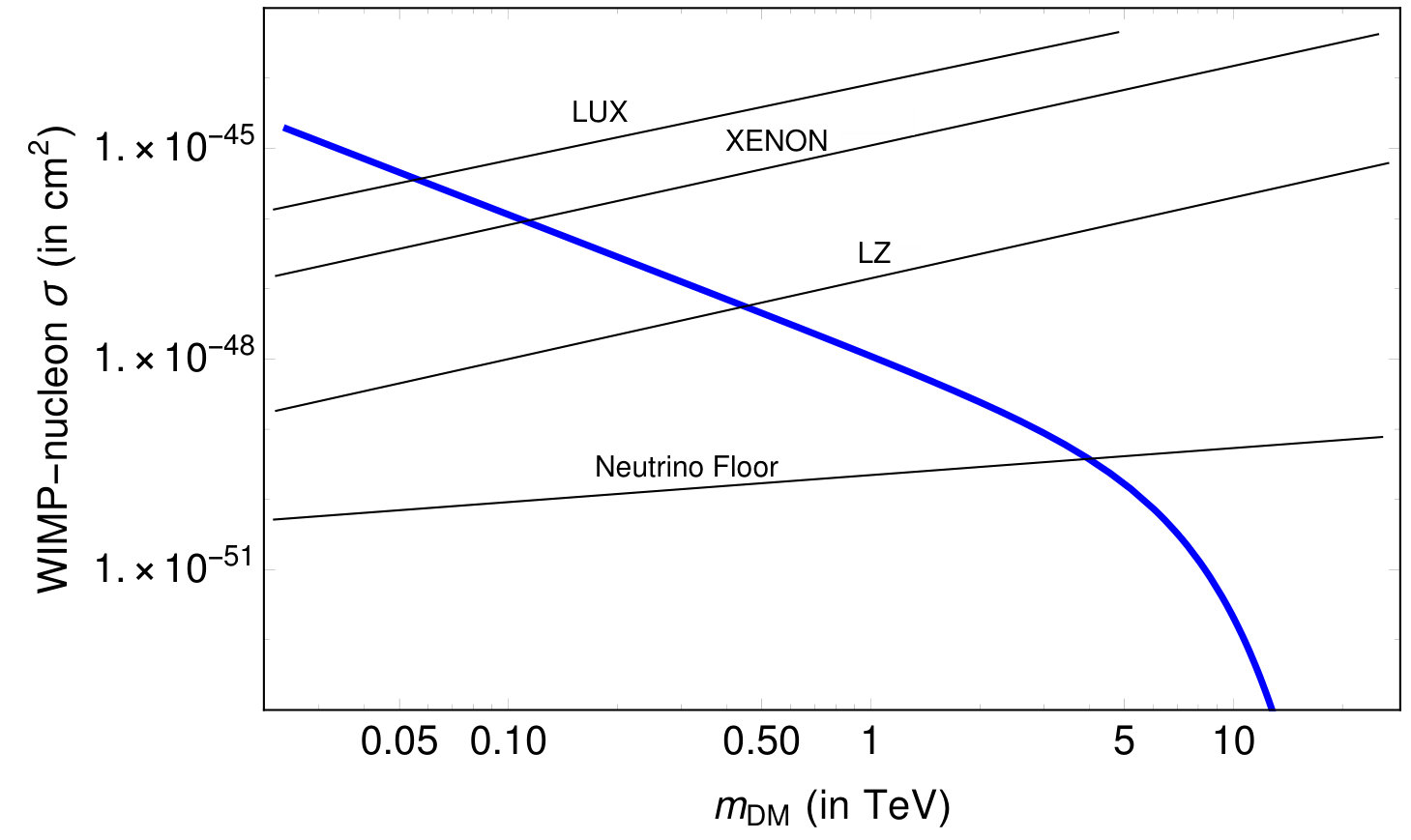 Figure 3
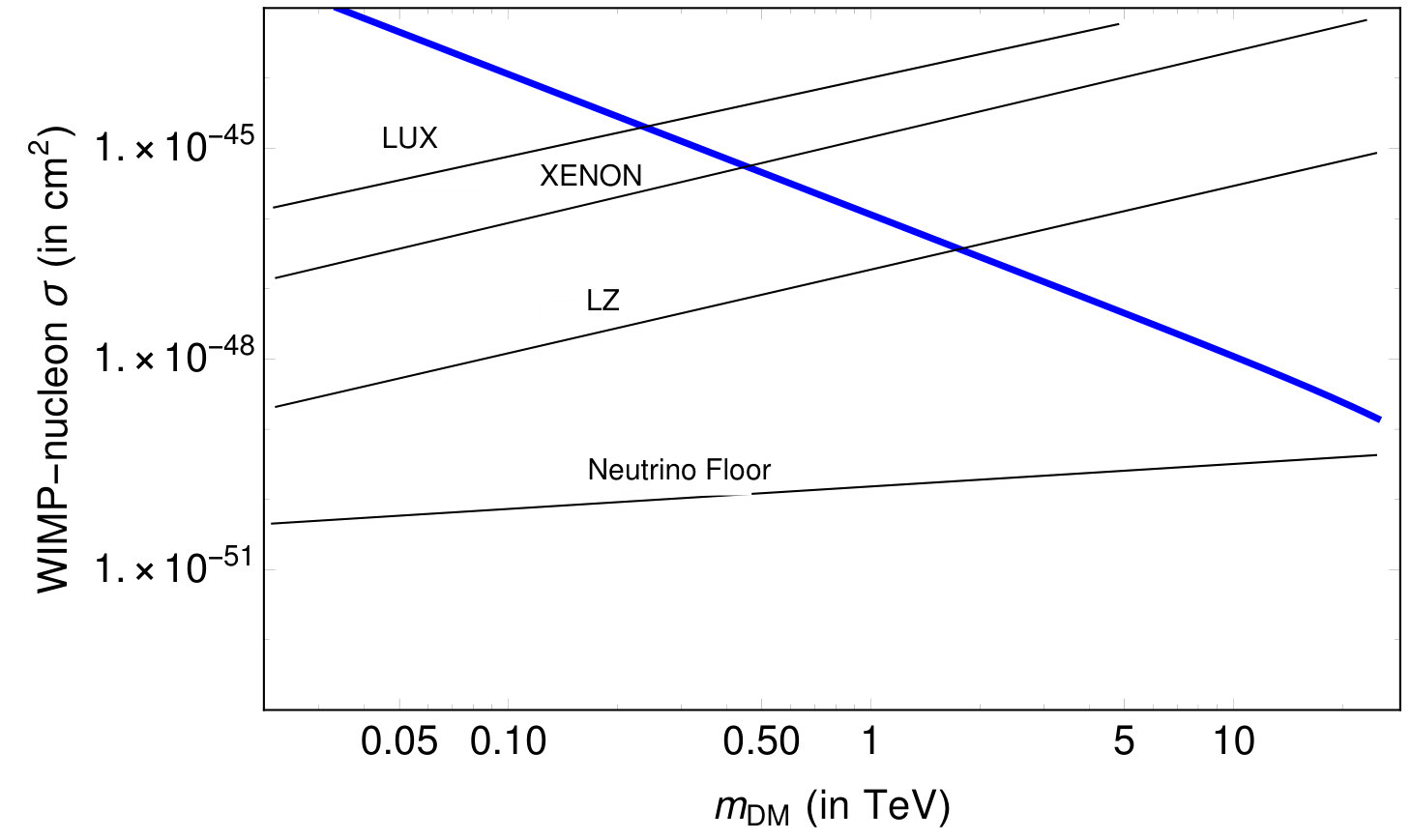 Figure 4
Peer Reviews
No public reviews on file for this paper yet. If you reviewed it on a platform where reviews are public (OpenReview, ICLR, NeurIPS, ICML), you can paste yours below so the community can read it here.
Videos
No videos yet. Explain this paper in a talk, walkthrough, or lecture? Add one.
Scalar Dark Matter Probes the Scale of Non-locality
Anish Ghoshal
Dipartimento di Matematica e Fisica, Università Roma Tre, 00146 Rome, Italy
Laboratori Nazionale di Frascati-INFN, C.P. 13, 100044, Frascati, Italy
Abstract
Scalar dark matter (DM) in a theory introduces hierarchy problems, and suffers from the inability to predict the preferred mass range for the DM. In a WIMP-like minimal scalar DM set-up we show that the infinite derivative theory can predict DM mass and its coupling. The scale of non-locality (M) in such a theory in its lower-most limit (constrained by LHC) implies a DM mass TeV and a coupling with the Standard Model (SM) Higgs . Planned DM direct detection experiments reaching such sensitivity in the DM will effectively translate into lower bounds on the scale at which the non-locality comes into the play.
I Introduction
Renormalization in quantum field theory deals to remove the ultraviolet (UV) divergences as in the case of quantum electrodynamics. In the context to the Standard Model (SM), however, this leads to the well-known hierarchy problem for the SM Higgs, which is basically the huge seventeen order of magnitude difference between the Planck and the electroweak (EW) scales Haber:1984rc . Solutions of this problem exist aplenty, most of which go by including a plethora of new particles at the or near the (EW) scale, including that of supersymmetry (SUSY) where the bosonic and their fermionic loop corrections to the Higgs mass exactly cancel each other due to the presence of the super-partners. With no hint of BSM particles whatsoever at the LHC or other experiments 111None at level at least. The 8Be anomaly Krasznahorkay:2015iga is an exception to this but it still needs to confirmed (see Ref. Nardi:2018cxi and the references therein, for future prospects to confirm this)., alternative solutions to this problem by other means have gained serious momentum in recent times, namely the relaxion Graham:2015cka , Higgsplosion Khoze:2017tjt , Clockwork Giudice:2016yja and No-scale theories Salvio:2014soa , to name a selected few.
Motivated by string field theory sft1 ; sft2 ; sft3 ; padic1 ; padic2 ; padic3 ; Frampton-padic ; Tseytlin:1995uq ; marc ; Siegel:2003vt , infinite derivatives provide a diligent approach to address this divergence problem by generalizing the kinetic energy operators of the Standard Model (SM) to an infinite series of higher order derivatives suppressed by the scale of non-locality (M) at which the higher order derivatives come into play Biswas:2014yia . Furthermore, the negative running of the self-interacting term for the SM Higgs which gives to rise to a metastable vacuum Olive:2016xmw was also cured by investigating the RGE of the theory Ghoshal:2017egr . It was discovered that the -functions at the scale of non-locality, and the wavefunction renormalization meant the fields are frozen beyond M. To be precise, capturing the infinite derivatives by exponential of an entire function softened UV behaviour in the desirable manner without introducing any new degrees of freedom in the particle spectrum, as they contain no new poles in the propagators. They have been explicitly shown to be ghost-free Buoninfante:2018mre and provides unique scattering phenomenology rendering transmutation of energy scale which has its own cosmological implications Buoninfante:2018gce .
On the gravity side, Ref.Biswas:2011ar showed the most general quadratic curvature gravitational action (parity-invariant and torsion-free), with infinite covariant derivatives can make the gravitational sector free from the Weyl ghost and, is free from classical singularities, such as blackhole ones Biswas:2011ar ; Biswas:2013cha ; Frolov:2015bia ; Frolov:2015usa ; Koshelev:2018hpt ; Koshelev:2017bxd ; Buoninfante:2018xiw ; Cornell:2017irh ; Buoninfante:2018rlq ; Buoninfante:2018stt 222Previously, arguments were provided regarding non-singular solutions in Refs. Tseytlin:1995uq ; Siegel:2003vt . and cosmological ones Biswas:2005qr ; Biswas:2006bs ; Biswas:2010zk ; Biswas:2012bp ; Koshelev:2012qn ; Koshelev:2018rau .
Now on one hand, it remains to build a non-Abelian aspects of the theory Anish2 and on the other investigate if the theory may provide solutions to some other problems that engulf the SM currently. The non-baryonic matter component of the universe, the non-luminous dark matter (DM), constitutes about a fifth of the total energy density of our universe – fact now well established courtsey to several evidences in cosmology and astrophysics at different scales Bertone:2010zza . The observation of DM in the universe has no explanation in the SM. Despite the several experimental searches and the impressive efforts of the community, all the evidence for DM has only been of gravitational nature and the widely considered non-gravitational nature of DM is still unknown Jungman:1995df . There are many candidates postulated for this Bertone:2004pz ; Mazumdar:2011zd , and a lot of attention was devoted to the class of beyond Standard Model (SM) theories which can provide a weakly interacting massive particle (WIMP) DM candidate, which, as the name suggests, weakly interact with SM particles and contains an appealing connection between the dark sector and the electroweak scale Arcadi:2017kky . Colorless, electrically neutral and weakly interacting massive particles with mass in the GeV-TeV range are ubiquitous in new physics models, and appear to be well suited to reproduce quantitatively the measured DM energy density if their stability on cosmological time scales can be ensured. Moreover, WIMP DM particles were in thermal equilibrium with the SM in the early Universe; and thus, were produced via the standard freeze-out mechanism. This provided several avenues to search for DM: direct detection Akerib:2016vxi ; Cui:2017nnn ; Aprile:2018dbl and indirect detection Aguilar:2016kjl ; Fermi-LAT:2016uux , as well as the collider searches for DM Aaboud:2016obm ; Sirunyan:2017hnk . But none of them have found any such interactions hitherto. The most constraining limits for WIMP DM come from the direct detection experiments, especially for DM masses in the GeV ballpark.
In particular we consider WIMP-like scalar DM models and follow the same idea as in Ref. Khoze:2018bwa which relates the properties of scalar DM to the Higgsplosion scale. Any fundamental scalar has the same naturalness problem like that of the SM Higgs, described earlier. Thus the situation renders the DM mass (or DM mass range) to be unpredictable. Here we show that infinite derivative model not only solves this problem but also provides a relation between observation (DM reslic density), DM mass, its coupling to SM and the non-local scale (M). Thus the DM phenomenology is dictated at the non-local scale. 333From the non-local gravity side, there exists a treatment of DM in Ref. Boos:2018bxf ; Hehl:2008eu . Furthermore, M which is constrained by collider experiments 444The authors of Ref. Biswas:2014yia had only roughly estimated for the production processes at the LHC. Here, on the contrary we perform explicit cross-section calculations and put impeccable bounds on M. maybe probed from existing and planned DM direct and indirect detection experiments Biswas:2014yia . Such probes of the parameter space regions are far better than that from the colliders, going upto 30 TeV or so.
The paper is organized as follows: we describe scalar infinite derivative model in section 1. In the next section we study the freeze-out mechanism of the DM. This is followed direct detection section. In the final section, we conclude by discussing some of the impactful aspects of our study.
II Infinite Derivative Scalar Theory
The action for the infinite derivative theory is given by Biswas:2014yia :
[TABLE]
Here the normalization of is so chosen that the residue at the pole is unity. ) with the convention of the metric signature , are the masses of the scalar, and is the scale of the non-locality which is taken to be below Planck scale. In our non-local field theory, the kinetic terms are generalized with higher derivatives suppressed by non-local scale , while the scalar self-interaction is the standard one. The theory is reduced into the standard local field theory in the limit of . In Eucleadian space () the propagator is given by,
[TABLE]
while the vertex factor is, as usual, given by . Note that the non-local extension of the theory leads to the exponential suppression of the propagators for , and this fact indicates that quantum corrections will be frozen at energies higher than .
Although the action in Eqn. 1 shows a modification in the kinetic term, however, note that an equivalent description can be done with the usual local Klein-Gordon kinetic operator by making the following field re-definition Buoninfante:2018mre :
[TABLE]
where . However, the real fields of the theory are , and not . With the field redefinition into the action becomes:
[TABLE]
Eq.(4) shows the form factor appears in the interaction term, thereby non-locality is significant only when the interaction is switched on as the free-part remains just the standard local Klein-Gordon kinetic term. So, this can be cosidered as an interaction-level theory only.
We use the former description using the field definition throughout the paper. For momenta k and p, and notations are used.
III Scalar Particle Dark Matter
III.1 Model
We take the simplest possible extension to the SM of particle physics, precisely, a singlet real scalar, , with a symmetry (well studied in the literature, see Refs. McDonald:1993ex ; Arcadi:2017kky for a selected few). The symmetry makes the DM stable, and maybe a bi-product of breaking chains from higher GUT groups.
For this simple scenario, SM sector and the DM sectors are in contact only via a Higgs-portal coupling, ,
[TABLE]
with,
[TABLE]
We generalize the kinetic terms and introduce M as the scale of non-locality at which the higher derivatives come into play. Thus
[TABLE]
Coonsidering will be in the lines of Section RGE where we present the renormalization group equation (RGE) flow of the masses and the coupling. Bare mass term in the dark sector is ignored in order to not introduce any other energy scale in the model. the BSM scalar mass when corrected with RGE contributions, consists of the quadratically divergent contribution from loops of the SM Higgs particle. In case for the standard local field theory, the renormalised mass is given by:
[TABLE]
where is the UV cut-off of the theory. In the infinite derivative scalar theory, as discussed in Ref. Biswas:2014yia , the mass corrections will be dominated by the Gaussian correction coming from the non-local propagator 2. The renormalization cut-off is governed by M basically and in the UV, the theory remains finite. The mass correction is given by:
[TABLE]
where is the exponential-integral function defined by:
[TABLE]
The function has a mild divergence as , but as . Thus we see that when
[TABLE]
Therefore, in this region of the parameter space, the BSM scalar has mass
[TABLE]
If the non-local scale is known, the the parameter space is bounded from this particular relation.
III.2 RGE – Mass
In SM, the Higgs bare-mass needs to be fine-tuned in the UV so that the measured Higgs mass is in agreement in the electroweak scale Aad:2012tfa ; Chatrchyan:2012xdj . In case of the infinite derivative theory, the Higgs bare mass depends on Biswas:2014yia :
[TABLE]
where the first term is the Higgs mass and the rest of the terms belong to quantum self-energy corrections, with being the no. of colors of quarks. In the limit , we recover the SM , and for scales M, the function vanishes thereby rendering the theory scale invarianct Anish2 . Here, one can say the Higgs mass is fine-tuned to the extent of , which in comparison to fine-tuning of order is pretty less fined-tuned, for M.
In order to keep the self-energy contribution dominant we assume, the bare S mass,
[TABLE]
III.3 RGE – Quartic and a Stable Vacuum
In SM, the Higgs quartic runs to become negative at GeV energy scales, depending on the top quark mass uncertainty. Consequently this makes the vacuum metastable. Such a vacuum is not compatible with the observable universe and especially when inflation is considered, which nonetheless would drive the vacuum to instability due to evolving Higgs fluctuations East:2016anr . This being a serious problem, was studied in the infinite derivative context and it was shown that Higgs quartic does not run to be negative in the UV Anish2 .
IV Dark Matter formation by Freeze-Out
DM if thermally produced in the early the procudure of DM formation follows the standard freeze-out scenario. Following Ref. Burgess:2000yq , the thermally-averaged dark matter annihilation cross-section , in the region of the paprameter space , where is the Standard Model Higgs vacuum expectation value, and that couple to through the operator. The DM annihilation cross-section in this case is given by:
[TABLE]
the exponential factor coming from the RGE & the croos-section calculation Biswas:2014yia ; Ghoshal:2017egr . For values for the M scale that are too, low therefore the low-mass regime is not considered. Subsequently, the approximation of Eqn. 15 will be considered henceforth.
The standard Boltzmann Equation for DM relic will be slightly modified due to the presence of the infinite derivatives in the scalar kinetic operators but the final exact answer will differ only by a factor in the exponential thus giving us an opportunity to present an approximate result using our present considerations. A detailed Boltmann solution including relic, direct, indirect and LHC production of scalar, fermionic and vector DM scenarios is being considered in another publication Anish3 . The relic density of dark matter today is constrained by the Planck satellite Aghanim:2018eyx to . Our prediction for the present day density of particles is Khoze:2018bwa :
[TABLE]
where is the current temperature, is the number of degrees of freedom in equilibrium during annihilation, km s*-1* Mpc*-1*, and the Newton’s gravitational constant. We note , also known as the inverse freeze-out temperature is given as logarithmic functions of the thermally averaged cross-section.
Solving the above equation for a perturbative range of yields the usual values in the range 20-30, the freeze-out condition in Eqn. (16) gives a salient relationship between , & M as:
[TABLE]
Thus we see that the combinations of a coupling perturbative (-4 ) and ensuring the correct relic density greatly limits the DM mass range which maybe allowed in the non-local infinite derivative scenario.
We do not consider any fine-tuning between the bare mass term and the loop contribution.
V Direct detection of DM
In this section we consider the phenomenology involving DM crossing the earth being scattered by nucleons in direct detection experiments. These consist of directly measuring their scattering off a detector’s target material, for massive particles producing recoil energies in the keV energy scale.
When estimating the cross-sections in direct detection experiments, values of and that are allowed by the relic density are kept in mind, while we consider DM-nucleon cross-sections as in Cline:2013gha ; Khoze:2017tjt :
[TABLE]
where is the mass of a nucleon and Alarcon:2011zs ; Alarcon:2012nr is an effective Higgs-nucleon-nucleon coupling.
The DM mass mS gives us for which Planck relic density is satisfied in case of a given non-local scale M, and so we can see how the direct detection elastic cross-section, , varies ( plotted in Figs. (1-4)). We have varied the non-local scale M, and the associated quartic coupling, ; the blue line indicates the points which suit the values. Constraints from LUX Akerib:2016vxi , Xenon-1T Aprile:2017iyp and LZ Mount:2017qzi are shown for reference, which are current and are projected bounds. We see that current constraints exclude DM masses below TeV for M at GeV. Future searches for dark matter such as LZ will probe rest of the parameter space further and further.
VI Discussion and conclusions
We studied an introductory version of a scalar DM theory and found it presents interesting phenomenology on one hand and predicts specific DM mass which is otherwise not possible in standard theory. To list, we may have the following conclusions:
The non-local infinite derivative theory results in a definite prediction for mass of a real scalar dark matter candidate, as well as a definite prediction of its coupling to the Standard Model fields. In particular, the lowest value for M scale theoretically preferred, i.e. TeV, implies a dark matter mass of TeV and a Higgs portal coupling , which remains safe from all current particle physics and cosmological constraints. 2. 2.
Even WIMP-like candidates with large coupling may form thermal DM. The observed small relic is due to the suppression due to presence the non-local scale and is used to constrain it. 3. 3.
DM direct detection experiments are probing the scale of non-locality () in the O(10) TeV range. This is better than the current LHC reach as shown in Ref. Biswas:2014yia .
Though we show this in a simple abelian set-up the prediction for DM direct detection in infinite-derivative field theory, one may look to extend this to non-Abelian processes and perform the calculations for other dark matter portals. Including psedoscalar or psedo-vector portals will give us spin-dependent cross-sections as well. However, in all these cases, our conclusion that the direct detection phenomenology probes the scale of non-locality much better than the standard LHC production processes. We will show infinite derivative is useful to rescue the Higgs and fermion portal DM models in the regions of the parameter space, otherwise heavily constrained, or even ruled out in standard theory in Ref. Anish3 . Production of DM in infinite derivative theory is beyond the scope of our current study and will be taken up in future. To end we will also like to comment on other kinds of DM in the infinite derivative context. This can be treated as a general structure of the infinite derivative DM theory: DM with large coupling to SM sector today may not be in contradiction with current direct detection searches (in the ruled out parameter space regions) as the running in the theory dictates small coupling during the DM formation which occurs at a higher energy scale ( TeV) than that of the direct detection experiment ( 200 MeV) which is a low-energy scattering phenomenon.
Acknowledgements
The author thanks Anupam Mazumdar for discussions and comments to improve the work. Besides, he also thanks the phD grant of LNF-INFN and Universita Roma Tre, along with its logistics support. He is grateful to Enrico Nardi for learning order-of-magnitude estimations beside some discussions on cosmology.
The reference list from the paper itself. Each links out to its DOI / PubMed record.
- 1(1) H. E. Haber and G. L. Kane, Phys. Rept. 117 , 75 (1985). doi:10.1016/0370-1573(85)90051-1
- 2(2) A. J. Krasznahorkay et al. , Phys. Rev. Lett. 116 , no. 4, 042501 (2016) doi:10.1103/Phys Rev Lett.116.042501 [ar Xiv:1504.01527 [nucl-ex]].
- 3(3) E. Nardi, C. D. R. Carvajal, A. Ghoshal, D. Meloni and M. Raggi, Phys. Rev. D 97 , no. 9, 095004 (2018) doi:10.1103/Phys Rev D.97.095004 [ar Xiv:1802.04756 [hep-ph]].
- 4(4) P. W. Graham, D. E. Kaplan and S. Rajendran, Phys. Rev. Lett. 115 , no. 22, 221801 (2015) doi:10.1103/Phys Rev Lett.115.221801 [ar Xiv:1504.07551 [hep-ph]].
- 5(5) V. V. Khoze and M. Spannowsky, Nucl. Phys. B 926 , 95 (2018) doi:10.1016/j.nuclphysb.2017.11.002 [ar Xiv:1704.03447 [hep-ph]].
- 6(6) G. F. Giudice and M. Mc Cullough, JHEP 1702 , 036 (2017) doi:10.1007/JHEP 02(2017)036 [ar Xiv:1610.07962 [hep-ph]].
- 7(7) A. Salvio and A. Strumia, JHEP 1406 , 080 (2014) doi:10.1007/JHEP 06(2014)080 [ar Xiv:1403.4226 [hep-ph]].
- 8(8) E. Witten, “Noncommutative Geometry and String Field Theory,” Nucl.Phys. , vol. B 268, p. 253, 1986.