Predicting Alignment in a Two Higgs Doublet Model
Karim Benakli, Yifan Chen, Ga\"etan Lafforgue-Marmet

TL;DR
This paper demonstrates that a non-abelian $SU(2)_R$ symmetry in the two Higgs doublet model naturally leads to alignment at tree level, with minimal radiative correction, relevant for supersymmetric theories.
Contribution
It introduces a novel symmetry-based mechanism for alignment in 2HDMs, connecting it to $SU(2)_R$ and supersymmetry, and discusses its phenomenological implications.
Findings
Tree-level alignment achieved via $SU(2)_R$ symmetry.
Minimal radiative misalignment in the model.
Connection between $SU(2)_R$ and $N=2$ supersymmetry.
Abstract
We show that a non-abelian global acting on the quartic part of the two Higgs Doublet Model leads, at tree-level, to an automatic alignment without decoupling. An example of phenomenologically viable model with this feature is the the low energy effective field theory of the Minimal Dirac Gaugino Supersymmetric Model in the limit where the adjoint scalars are decoupled. We discuss here how the can be identified with the R-symmetry of the supersymmetry in the gauge and Higgs sectors. We also review how the radiative corrections lead to a very small misalignment.
Click any figure to enlarge with its caption.
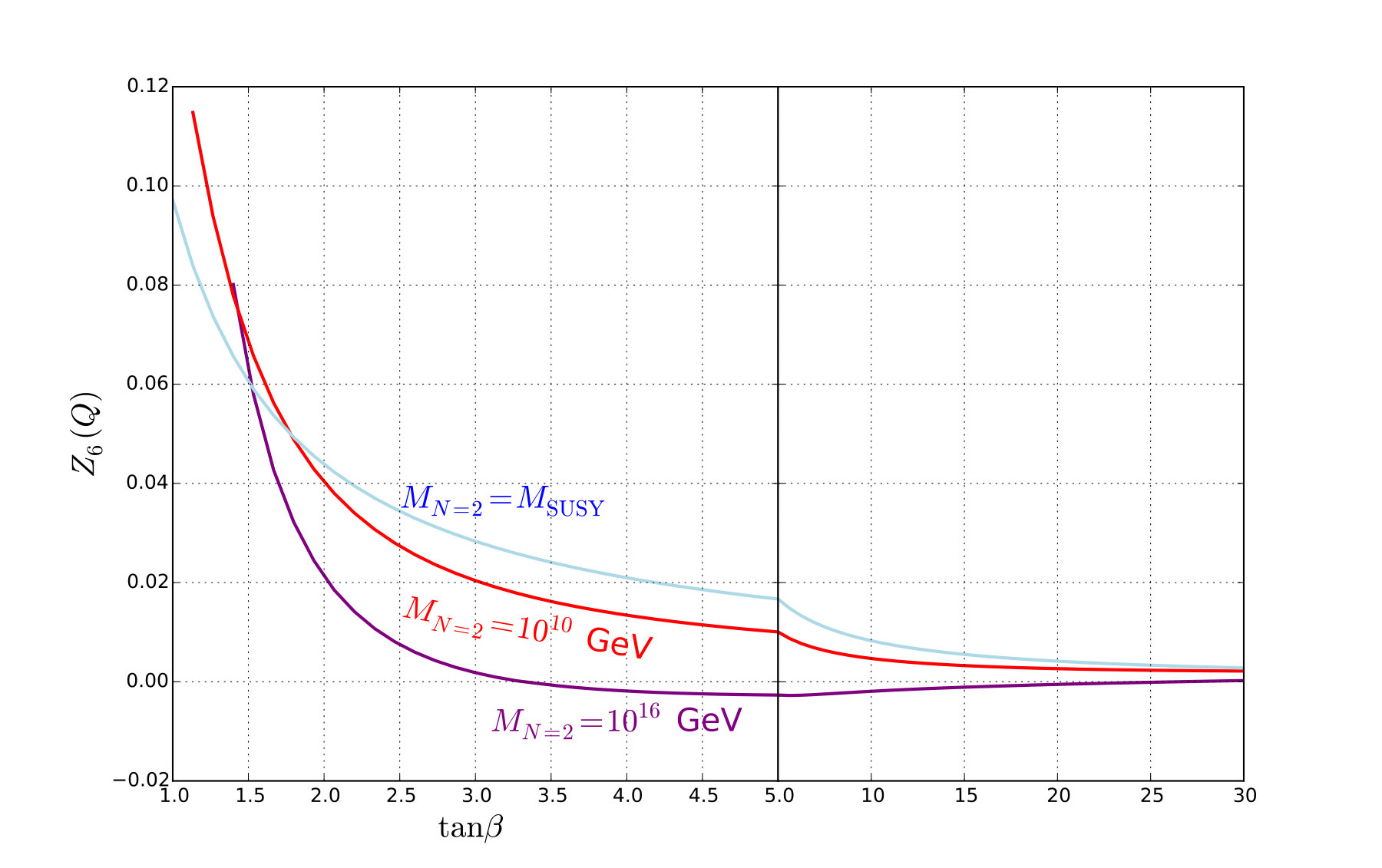 Figure 1
Peer Reviews
No public reviews on file for this paper yet. If you reviewed it on a platform where reviews are public (OpenReview, ICLR, NeurIPS, ICML), you can paste yours below so the community can read it here.
Videos
No videos yet. Explain this paper in a talk, walkthrough, or lecture? Add one.
Predicting Alignment in a Two Higgs Doublet Model †
Abstract
We show that a non-abelian global R-symmetry acting on the quartic part of the two Higgs Doublet Model leads, at tree-level, to an automatic alignment without decoupling. An example of phenomenologically viable model with this feature is the the low energy effective field theory of the Minimal Dirac Gaugino Supersymmetric Model in the limit where the adjoint scalars are decoupled. We discuss here how the can be identified with the R-symmetry of the supersymmetry in the gauge and Higgs sectors. We also review how the radiative corrections lead to a very small misalignment.
Predicting Alignment in a Two Higgs Doublet Model††Presented at the 7th International Conference on New Frontiers in Physics (ICNFP 2018), Crete, Greece, 4–12 July 2018.
**Karim Benakli♠ ††♠[email protected] Yifan Chen ††[email protected] Gaëtan Lafforgue-Marmet♣ ††♣[email protected]
**
Laboratoire de Physique Théorique et Hautes Energies (LPTHE),
UMR 7589, Sorbonne Université et CNRS, 4 place Jussieu, 75252 Paris Cedex 05, France.
1 Introduction
The Standard Model Higgs is the only known fundamental spin zero particle in Nature. The existence of additional fundamental scalars is not excluded and happens in Early Universe cosmological and supersymmetric models. Such additional scalars could mix with the observable Higgs. This leads to strong constraints from existing experimental data. In particular, this requires that the observed Higgs is aligned with the direction acquiring a non-zero vacuum expectation value (v.e.v). This can be achieved by decoupling the additional scalars by making them heavy enough. However, the alignment can also be a consequence of a symmetry of the model in with case the new scalar masses could lie in a range within the reach of future searches at the LHC . Such an alignment without decoupling [1] was realized in [2] ( see the discussion of the spectrum in Section 3 of [2], the model was not engineered for this purpose but as a scenario for supersymmetry breaking, and therefore we can consider the alignment there as a ”prediction” of the model) and discussed later in [3, 4]. In particular, it was shown in [4] that the alignment survives with an impressive precision when radiative corrections are taken into account. The mechanisms behind this successful alignment are a combination of a global symmetry of the quartic potential and diverse cancellations due to supersymmetry as discussed in [5] and will be reviewed here.
The scalar potential of [2], studied in [6], is that of a Two Higgs Doublet Model (2HDM) ( for an introduction to 2HDM, see for example [7, 8, 9]). Alignment is not necessarily due to symmetries. Viable cases have been discussed for example in [10, 11, 12, 13, 14] for the MSSM and NMSSM. However this looks as an ad-hoc specific choice of the model parameters. One could search for symmetries of the 2HDM (e.g., [15, 16, 17]) that imply alignment without decoupling [18, 19]. Quite often they lead to problematic phenomenological consequences, as massless quarks [20]. In the supersymmetric model of [2], the alignment at tree-level is also a prediction of a symmetry: a non abelian R-symmetry. However, this symmetry acts only on part of the Lagrangian and does not lead to phenomenological issues.
In [2], the (non-chiral) gauge and Higgs states appear in an supersymmetry sector while the matter states, quarks and leptons, appear in an sector. Early models suffered from the non-chiral nature of quarks and leptons [21, 22] as they have required that supersymmetry acts on the whole SM states. An important feature of [23, 24, 2, 25, 6] is that gauginos have Dirac masses [26, 27, 28, 29, 30]. The extension have implication for Higgs boson physics as discussed in [6, 31, 32, 33, 34, 35, 36, 37, 38, 39, 40, 41, 42, 43, 44, 45, 46, 47, 48]. We will review here how this alignment emerges and how higher order corrections induce a small misalignment.
2 Higgs Alignment from an Symmetry
We review here how to obtain alignment as a consequence of an symmetry acting on the quartic potential. Alignment as consequence of these relations between the different dimensionless coupling is trivial and has been discussed by many authors, for example in [1, 18]. However, these works looked at symmetries of the whole Lagrangian and therefore they explicitly associate the obtained alignment with equalities or vanishing squared-mass parameters. Here, the situation is a bit different. By construction as we will discuss below, our symmetry does not, and can not, act on the quadratic part of the potential in contrast with previous works assumptions. We need to explain why, still, this is enough to imply alignment. However, most useful to us, we want to read the amount of misalignment as function of the decomposition under of the quartic potential [5].
The standard parametrization of a generic 2HDM is ( Here, for simplicity, we assume CP conservation. All couplings and vacuum expectation values are assumed to be real.):
[TABLE]
where
[TABLE]
We expect the parameters to contain leading order tree-level values with corrections from loops but also at tree-level from threshold corrections due to integration of heavy states:
[TABLE]
Now, put the two Higgs doublets together in a bi-doublet where and can be represented as columns with two entries. We then consider the symmetry that rotates the two doublets among themselves, therefore acting horizontally. We denote this group as (R stands for R-symmetry as we will see below) and the two fields appear now in the fundamental representation of the .
A potential that is invariant under will contain only singlets of and can be written as:
[TABLE]
where are the spin representation of in the standard notation. It is easy to check that:
[TABLE]
and
[TABLE]
while comparing with (2.2) gives:
[TABLE]
and
[TABLE]
The absence of other ’s can be enforced by choosing
[TABLE]
For the case of CP conserving Lagrangian under consideration, there are two CP even scalars with squared-mass matrix in the Higgs basis (e.g., [15])
[TABLE]
These are given by
[TABLE]
where , while the pseudo-scalar mass is given by
[TABLE]
Here, we have defined :
[TABLE]
where:
[TABLE]
The off-diagonal squared-mass matrix element measures the displacement from alignment. It can be written in the basis as
[TABLE]
where we used the notation (see [16]):
[TABLE]
The coefficients appearing in (2.16) are given by:
[TABLE]
We see that the invariance under implies alignment. The breaking of even just to its abelian sub-group spoils the alignment. Also, note that we have , there is no contribution from .
The quadratic part of the scalar potential can be written as:
[TABLE]
where the only invariant part is given by the first line. The minimization of the potential leads to (e.g., [49]):
[TABLE]
Using that (2.22) implies and , the equations (2.24) become:
[TABLE]
which subtracted one of the other give (for )
[TABLE]
Thus the constraint of invariance of the quartic part of the potential implies an automatic alignment without decoupling.
3 A Model with Symmetry
In the context of supersymmetric theories, one way to obtain the described above is to make of the two Higgs doublets one hypermultiplet , the becomes an R-symmetry and supersymmetry is extended to in the Higgs sector. Now the R-symmetry will act here as an Higgs family symmetry [15, 16], but now only on the quartic potential contains only terms that are invariant (singlet) under . As the Higgs doublets quartic potential receives contributions from -terms, we must also extend the supersymmetry to the gauge sector. This implies the presence of chiral superfields in the adjoint representations of SM gauge group. These are a singlet and an triplet . We define
[TABLE]
They contribute to the superpotential by promoting the gauginos to Dirac fermions, but also by generating new Higgs interactions through:
[TABLE]
where the Dirac masses are parametrized by spurion superfields where are the Grassmannian superspace coordinates. The are not arbitrary as supersymmetry implies
[TABLE]
where and stand for the hyper-charge and gauge couplings, respectively. The Higgs potential gets also contributions from soft supersymmetry breaking terms. We chose for simplicity the parameters to be real and we write
[TABLE]
A peculiar 2HDM, with an extended set of light charginos and neutralinos, is obtained by integrating out of the adjoint scalars. The details of this potential were discussed in [6]. The result can be mapped to (2.2) after the identification
[TABLE]
from which we can now read
[TABLE]
and
[TABLE]
Again, restricting to the case of CP conserving Lagrangian, the two CP even scalars have squared-mass matrix (2.12) with
[TABLE]
We use:
[TABLE]
Now is given by
[TABLE]
and squared-mass matrix has eigenvalues:
[TABLE]
while the charged Higgs has a mass
[TABLE]
Also, the leading-order squared-masses for the real part of the adjoint fields are [36]:
[TABLE]
where we have taken .
Let us turn now to the quadratic part of the potential. It can be written as (2.23). Imposing a Higgs family symmetry would have required that both coefficients of the two non-singlets operators to vanish, therefore and . First, this would imply which is not a viable feature. Second, the mass parameters in the quadratic potential under are controlled by the supersymmetry breaking mechanism and this is not expected to preserve the -symmetry. It was shown in [30] that absence of tachyonic directions in the adjoint fields scalar potential implies that in a gauge mediation scenario that either breaking or messenger sectors should not be invariant. Thus, the quadratic potential can not be invariant under .
4 -Symmetry Breaking and Misalignment
We have found above that invariance under symmetry of the quartic scalar potential is sufficient to insure the Higgs alignment. This is because the symmetry relates different dimensionless couplings and forces others to vanish in such a way that itself vanishes. However, this symmetry will be broken at least by quantum corrections to the mentioned set of couplings from sectors of the theory that do not respect the symmetry. Unexpectedly, it was found in [4] that these corrections are very small. This was checked numerically including all threshold and two-loop effects when they are known. Here, we would like to exhibit the structure of these corrections with respect to group theoretical organization of the scalar potential in representations of .
We start by writing the quartic scalar potential as:
[TABLE]
where are the irreducible representations of .
Here , thus the misalignment is parametrized by
[TABLE]
We see that the conservation of the subgroup of is not sufficient for alignment as the presence of either of or leads to misalignment.
In our model are corrections generated by higher order corrections to the tree-level . First, there are tree-level corrections corresponding to thresholds when integrating out adjoint scalars. Note that the Higgs -term and the Dirac masses are kept small , in the sub-TeV region. We have:
[TABLE]
These induce
[TABLE]
The corrections to the two singlet coefficients
[TABLE]
do not contribute to a misalignment. The misalignment arises from the appearance of new terms in the scalar potential:
[TABLE]
These preserve the subgroup . This is because the scalar potential results from integrating out the adjoints which have zero charge. For a numerical estimate, we take TeV, GeV, and . This gives
[TABLE]
This shows that this contribution to can be neglected.
We consider now the misalignment from quantum corrections. Supersymmetry breaking induces mass splitting between scalars and fermionic partners that lead to radiative corrections.
Loops of the adjoint scalar fields and do not lead to any contribution as long as their couplings and are given by their values, which is the leading order approximation. This is a consequence of the facts that these scalars are singlets under the symmetry and at leading order and their interactions with the two Higgs doublets preserve . The absence of a contribution to was obtained by explicit calculations of the loop diagrams in Equation (3.5) of [4]. It was found that when summed up different contributions to cancel out. This result is now easily understood as a consequence of the symmetry.
Let’s denote by for the gauge fields and the auxiliary fields for the adjoint scalars of and respectively. The set:
[TABLE]
constitutes a triplet of thus implying the equalities and in Equation (3.4). The violation of these relations by quantum effects translates into breaking of . The correction due to running of the couplings and leads to a violation of relations (3.4). This arises first from the radiative corrections from chiral matter. As and are affected in the same way, we have , and using (2.22), we get:
[TABLE]
In addition to the misalignment from the described above, there is a contribution from the mass splitting in chiral superfields. The difference in Yukawa couplings to the two Higgs doublets breaks the symmetry. For , the biggest contribution is to from stop loops due to their large Yukawa coupling:
[TABLE]
Here , , are the renormalisation scale, the top Yukawa coupling and the stop mass, respectively. At the end we get:
[TABLE]
We find that the misalignment comes from the squark corrections are compensated by the effect of running . The numerical results are shown in Figure 1, taken from [4].
Acknowledgments
We are grateful to M. Goodsell for collaboration on part of the material presented here and P. Slavich for useful discussions. We acknowledge the support of the Agence Nationale de Recherche under grant ANR-15-CE31-0002 “HiggsAutomator”. This work is also supported by the Labex “Institut Lagrange de Paris” (ANR-11-IDEX-0004-02, ANR-10-LABX-63).
The reference list from the paper itself. Each links out to its DOI / PubMed record.
- 1[1] Gunion, J.F., Haber, H.E. The CP conserving two Higgs doublet model: The Approach to the decoupling limit? Phys. Rev. D 2003 , 67 , 075019,
- 2[2] Antoniadis, I., Benakli, K., Delgado, A., Quiros, M. A New gauge mediation theory. Adv. Stud. Theor. Phys. 2008 , 2 , 645–672.
- 3[3] Ellis, J., Quevillon, J., Sanz, V. Doubling Up on Supersymmetry in the Higgs Sector. J. High Energy Phys. 2016 , 10 , 086,
- 4[4] Benakli, K., Goodsell, M.D., Williamson, S.L. Higgs alignment from extended supersymmetry. Eur. Phys. J. C 2018 , 78 , 658,
- 5[5] Benakli, K., Chen, Y., Lafforgue-Marmet, G. R-symmetry for Higgs alignment without decoupling. ar Xiv 2018 , ar Xiv:1811.08435.
- 6[6] Belanger, G., Benakli, K., Goodsell, M., Moura, C., Pukhov, A. Dark Matter with Dirac and Majorana Gaugino Masses. J. Cosmol. Astropart. Phys. 2009 ,
- 7[7] Gunion, J.F., Haber, H.E., Kane, G.L., Dawson, S. The Higgs Hunter’s Guide. Front. Phys. 2000 , 80 , 1–404.
- 8[8] Branco, G.C., Ferreira, P.M., Lavoura, L., Rebelo, M.N., Sher, M., Silva, J.P. Theory and phenomenology of two-Higgs-doublet models. Phys. Rept. 2012 , 516 ,