First Measurements of the Double-Polarization Observables $F$, $P$, and $H$ in $\omega$ Photoproduction off Transversely Polarized Protons in the $N^\ast$ Resonance Region
P. Roy, S. Park, V. Crede, A. V. Anisovich, E. Klempt, V. A. Nikonov,, A. V. Sarantsev, N. C. Wei, F. Huang, K. Nakayama, K. P. Adhikari, S., Adhikari, G. Angelini, H. Avakian, L. Barion, M. Battaglieri, I. Bedlinskiy,, A. S. Biselli, S. Boiarinov, W. J. Briscoe, J. Brock

TL;DR
This paper reports the first measurements of double-polarization observables in omega photoproduction off protons, providing new data that reveal contributions from multiple nucleon resonances and help map the nucleon resonance spectrum.
Contribution
It presents novel measurements of polarization observables in omega photoproduction using polarized photons and transversely polarized protons, expanding the experimental database.
Findings
Significant contributions from several $N^*$ resonances.
Observation of new $N^*$ resonances listed in the Review of Particle Properties.
Results incorporated into partial-wave analyses to improve resonance understanding.
Abstract
First measurements of double-polarization observables in photoproduction off the proton are presented using transverse target polarization and data from the CEBAF Large Acceptance Spectrometer (CLAS) FROST experiment at Jefferson Lab. The beam-target asymmetry has been measured using circularly polarized, tagged photons in the energy range 1200 - 2700 MeV, and the beam-target asymmetries and have been measured using linearly polarized tagged photons in the energy range 1200 - 2000 MeV. These measurements significantly increase the database on polarization observables. The results are included in two partial-wave analyses and reveal significant contributions from several nucleon () resonances. In particular, contributions from new resonances listed in the Review of Particle Properties are observed, which aid in reaching the goal of mapping out the…
Click any figure to enlarge with its caption.
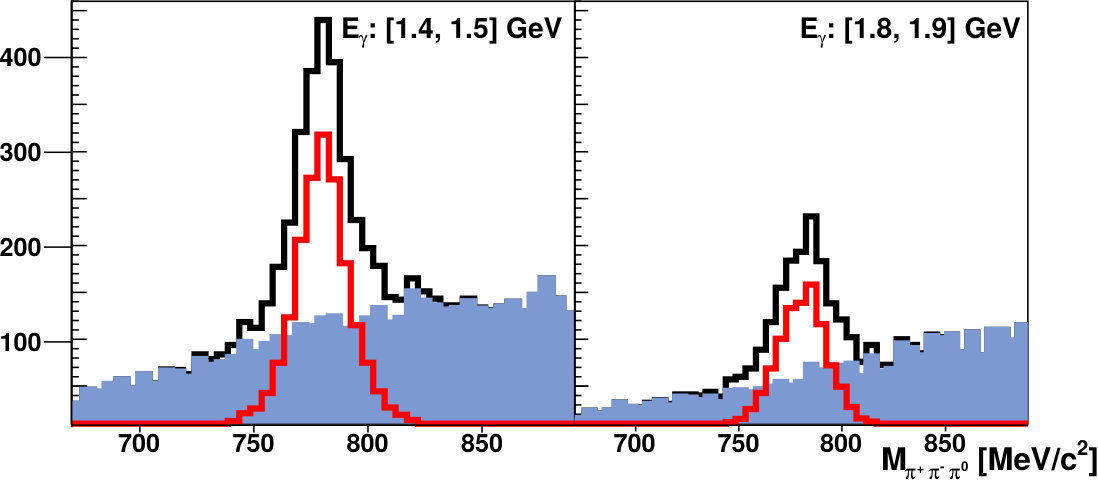 Figure 1
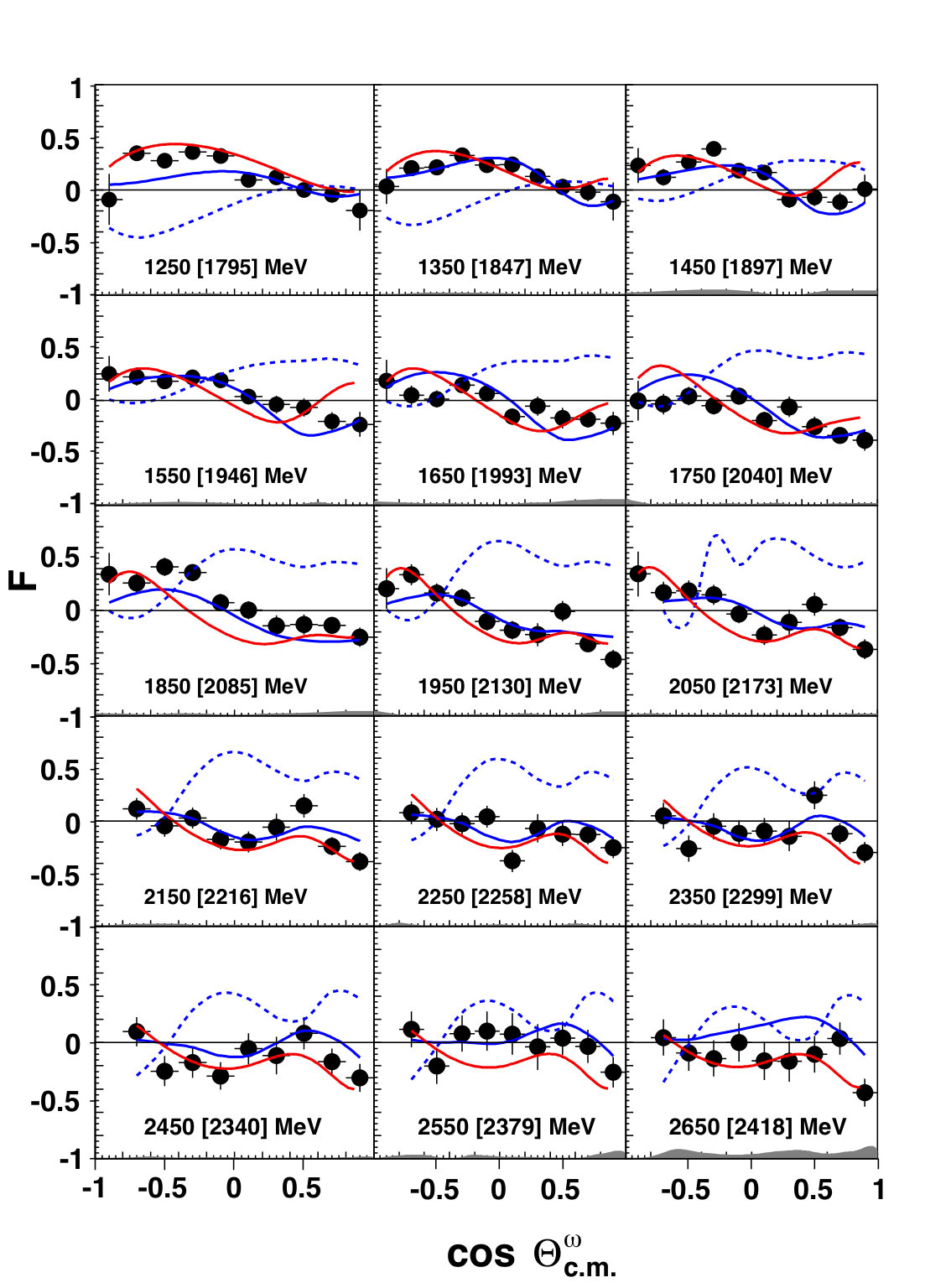 Figure 2
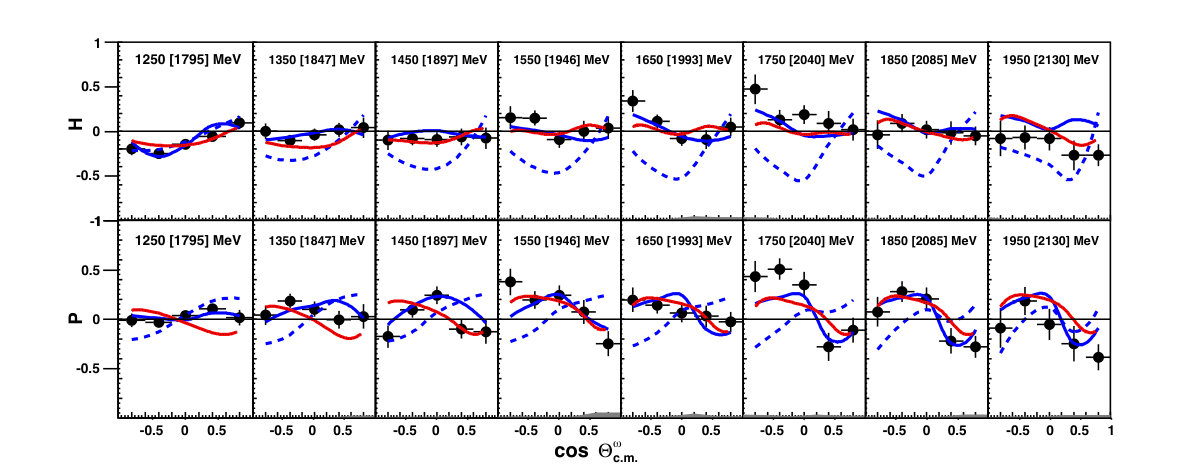 Figure 3
Peer Reviews
No public reviews on file for this paper yet. If you reviewed it on a platform where reviews are public (OpenReview, ICLR, NeurIPS, ICML), you can paste yours below so the community can read it here.
Videos
No videos yet. Explain this paper in a talk, walkthrough, or lecture? Add one.
Present address: ]Department of Physics, University of Michigan, Ann Arbor, Michigan 48109,USA Present address: ]Korea Atomic Energy Research Institute, Gyeongju-si, 38180, South Korea Corresponding author: ][email protected]
Present address: ]Mississippi State University, Mississippi State, MS 39762-5167, USA
Present address: ]Imam Abdulrahman Bin Faisal University, Industrial Jubail 31961, Saudi Arabia
Present address: ]Idaho State University, Pocatello, Idaho 83209, USA
Present address: ]Oak Ridge National Laboratory, Oak Ridge, TN 37831, USA
Present address: ]INFN, Sezione di Genova, 16146 Genova, Italy
CLAS Collaboration at Jefferson Lab
First Measurements of the Double-Polarization Observables , , and in
Photoproduction off Transversely Polarized Protons in the Resonance Region
P. Roy
[
Florida State University, Tallahassee, Florida 32306, USA
S. Park
[
Florida State University, Tallahassee, Florida 32306, USA
V. Crede
[
Florida State University, Tallahassee, Florida 32306, USA
A. V. Anisovich
Helmholtz-Institut für Strahlen- und Kernphysik, Universität Bonn, 53115 Bonn, Germany
NRC “Kurchatov Institute”, PNPI, 188300, Gatchina, Russia
E. Klempt
Helmholtz-Institut für Strahlen- und Kernphysik, Universität Bonn, 53115 Bonn, Germany
V. A. Nikonov
Helmholtz-Institut für Strahlen- und Kernphysik, Universität Bonn, 53115 Bonn, Germany
NRC “Kurchatov Institute”, PNPI, 188300, Gatchina, Russia
A. V. Sarantsev
Helmholtz-Institut für Strahlen- und Kernphysik, Universität Bonn, 53115 Bonn, Germany
NRC “Kurchatov Institute”, PNPI, 188300, Gatchina, Russia
N. C. Wei
Zhengzhou University, Zhengzhou, Henan 450001, China
School of Nuclear Science and Technology, University of Chinese Academy of Sciences, Beijing 100049, China
F. Huang
School of Nuclear Science and Technology, University of Chinese Academy of Sciences, Beijing 100049, China
K. Nakayama
University of Georgia, Athens, GA30602, USA
K. P. Adhikari
[
Old Dominion University, Norfolk, Virginia 23529, USA
S. Adhikari
Florida International University, Miami, Florida 33199, USA
G. Angelini
The George Washington University, Washington, DC 20052, USA
H. Avakian
Thomas Jefferson National Accelerator Facility, Newport News, Virginia 23606, USA
L. Barion
INFN, Sezione di Ferrara, 44100 Ferrara, Italy
M. Battaglieri
INFN, Sezione di Genova, 16146 Genova, Italy
I. Bedlinskiy
Institute of Theoretical and Experimental Physics, Moscow, 117259, Russia
A. S. Biselli
Fairfield University, Fairfield CT 06824, USA
S. Boiarinov
Thomas Jefferson National Accelerator Facility, Newport News, Virginia 23606, USA
W. J. Briscoe
The George Washington University, Washington, DC 20052, USA
J. Brock
Thomas Jefferson National Accelerator Facility, Newport News, Virginia 23606, USA
W. K. Brooks
Universidad Técnica Federico Santa María, Casilla 110-V Valparaíso, Chile
V. D. Burkert
Thomas Jefferson National Accelerator Facility, Newport News, Virginia 23606, USA
F. Cao
University of Connecticut, Storrs, Connecticut 06269, USA
C. Carlin
Thomas Jefferson National Accelerator Facility, Newport News, Virginia 23606, USA
D. S. Carman
Thomas Jefferson National Accelerator Facility, Newport News, Virginia 23606, USA
A. Celentano
INFN, Sezione di Genova, 16146 Genova, Italy
P. Chatagnon
Institut de Physique Nucléaire, IN2P3-CNRS, Université Paris-Sud, Université Paris-Saclay, F-91406 Orsay, France
T. Chetry
Ohio University, Athens, Ohio 45701, USA
G. Ciullo
Università di Ferrara, 44121 Ferrara, Italy
INFN, Sezione di Ferrara, 44100 Ferrara, Italy
P. L. Cole
Idaho State University, Pocatello, Idaho 83209, USA
Lamar University, 4400 MLK Blvd, PO Box 10009, Beaumont, Texas 77710, USA
M. Contalbrigo
INFN, Sezione di Ferrara, 44100 Ferrara, Italy
O. Cortes
The George Washington University, Washington, DC 20052, USA
A. D’Angelo
INFN, Sezione di Roma Tor Vergata, 00133 Rome, Italy
Università di Roma Tor Vergata, 00133 Rome, Italy
N. Dashyan
Yerevan Physics Institute, 375036 Yerevan, Armenia
R. De Vita
INFN, Sezione di Genova, 16146 Genova, Italy
E. De Sanctis
INFN, Laboratori Nazionali di Frascati, 00044 Frascati, Italy
A. Deur
Thomas Jefferson National Accelerator Facility, Newport News, Virginia 23606, USA
S. Diehl
University of Connecticut, Storrs, Connecticut 06269, USA
C. Djalali
Ohio University, Athens, Ohio 45701, USA
University of South Carolina, Columbia, South Carolina 29208, USA
M. Dugger
Arizona State University, Tempe, Arizona 85287-1504, USA
R. Dupre
Argonne National Laboratory, Argonne, Illinois 60439, USA
Institut de Physique Nucléaire, IN2P3-CNRS, Université Paris-Sud, Université Paris-Saclay, F-91406 Orsay, France
B. Duran
Temple University, Philadelphia, PA 19122, USA
H. Egiyan
University of New Hampshire, Durham, New Hampshire 03824-3568, USA
Thomas Jefferson National Accelerator Facility, Newport News, Virginia 23606, USA
M. Ehrhart
Institut de Physique Nucléaire, IN2P3-CNRS, Université Paris-Sud, Université Paris-Saclay, F-91406 Orsay, France
A. El Alaoui
Universidad Técnica Federico Santa María, Casilla 110-V Valparaíso, Chile
L. El Fassi
Mississippi State University, Mississippi State, MS 39762-5167, USA
P. Eugenio
Florida State University, Tallahassee, Florida 32306, USA
S. Fegan
University of Glasgow, Glasgow G12 8QQ, United Kingdom
A. Filippi
INFN, Sezione di Torino, 10125 Torino, Italy
A. Fradi
[
Institut de Physique Nucléaire, IN2P3-CNRS, Université Paris-Sud, Université Paris-Saclay, F-91406 Orsay, France
G. P. Gilfoyle
University of Richmond, Richmond, Virginia 23173, USA
F. X. Girod
IRFU, CEA, Université Paris-Saclay, F-91191 Gif-sur-Yvette, France
Thomas Jefferson National Accelerator Facility, Newport News, Virginia 23606, USA
E. Golovatch
Skobeltsyn Institute of Nuclear Physics, Lomonosov Moscow State University, 119234 Moscow, Russia
R. W. Gothe
University of South Carolina, Columbia, South Carolina 29208, USA
K. A. Griffioen
College of William and Mary, Williamsburg, Virginia 23187-8795, USA
M. Guidal
Institut de Physique Nucléaire, IN2P3-CNRS, Université Paris-Sud, Université Paris-Saclay, F-91406 Orsay, France
L. Guo
Florida International University, Miami, Florida 33199, USA
Thomas Jefferson National Accelerator Facility, Newport News, Virginia 23606, USA
K. Hafidi
Argonne National Laboratory, Argonne, Illinois 60439, USA
C. Hanretty
Florida State University, Tallahassee, Florida 32306, USA
Thomas Jefferson National Accelerator Facility, Newport News, Virginia 23606, USA
N. Harrison
Thomas Jefferson National Accelerator Facility, Newport News, Virginia 23606, USA
M. Hattawy
Old Dominion University, Norfolk, Virginia 23529, USA
T. B. Hayward
College of William and Mary, Williamsburg, Virginia 23187-8795, USA
D. Heddle
Christopher Newport University, Newport News, Virginia 23606, USA
Thomas Jefferson National Accelerator Facility, Newport News, Virginia 23606, USA
K. Hicks
Ohio University, Athens, Ohio 45701, USA
M. Holtrop
University of New Hampshire, Durham, New Hampshire 03824-3568, USA
Y. Ilieva
The George Washington University, Washington, DC 20052, USA
University of South Carolina, Columbia, South Carolina 29208, USA
D. G. Ireland
University of Glasgow, Glasgow G12 8QQ, United Kingdom
B. S. Ishkhanov
Skobeltsyn Institute of Nuclear Physics, Lomonosov Moscow State University, 119234 Moscow, Russia
E. L. Isupov
Skobeltsyn Institute of Nuclear Physics, Lomonosov Moscow State University, 119234 Moscow, Russia
D. Jenkins
Virginia Tech, Blacksburg, Virginia 24061-0435, USA
H. S. Jo
Kyungpook National University, Daegu 41566, Republic of Korea
S. Johnston
Argonne National Laboratory, Argonne, Illinois 60439, USA
S. Joosten
Temple University, Philadelphia, PA 19122, USA
M. L. Kabir
Mississippi State University, Mississippi State, MS 39762-5167, USA
C. D. Keith
Thomas Jefferson National Accelerator Facility, Newport News, Virginia 23606, USA
D. Keller
University of Virginia, Charlottesville, Virginia 22901, USA
G. Khachatryan
Yerevan Physics Institute, 375036 Yerevan, Armenia
M. Khachatryan
Old Dominion University, Norfolk, Virginia 23529, USA
A. Khanal
Florida International University, Miami, Florida 33199, USA
M. Khandaker
[
Norfolk State University, Norfolk, Virginia 23504, USA
A. Kim
University of Connecticut, Storrs, Connecticut 06269, USA
W. Kim
Kyungpook National University, Daegu 41566, Republic of Korea
F. J. Klein
Catholic University of America, Washington, D.C. 20064, USA
V. Kubarovsky
Thomas Jefferson National Accelerator Facility, Newport News, Virginia 23606, USA
S. V. Kuleshov
Institute of Theoretical and Experimental Physics, Moscow, 117259, Russia
Universidad Técnica Federico Santa María, Casilla 110-V Valparaíso, Chile
M. C. Kunkel
Institute für Kernphysik, 52425 Jülich, Germany
L. Lanza
INFN, Sezione di Roma Tor Vergata, 00133 Rome, Italy
P. Lenisa
INFN, Sezione di Ferrara, 44100 Ferrara, Italy
K. Livingston
University of Glasgow, Glasgow G12 8QQ, United Kingdom
I. J. D. MacGregor
University of Glasgow, Glasgow G12 8QQ, United Kingdom
D. Marchand
Institut de Physique Nucléaire, IN2P3-CNRS, Université Paris-Sud, Université Paris-Saclay, F-91406 Orsay, France
B. McKinnon
University of Glasgow, Glasgow G12 8QQ, United Kingdom
D. G. Meekins
Thomas Jefferson National Accelerator Facility, Newport News, Virginia 23606, USA
C. A. Meyer
Carnegie Mellon University, Pittsburgh, Pennsylvania 15213, USA
T. Mineeva
Universidad Técnica Federico Santa María, Casilla 110-V Valparaíso, Chile
V. Mokeev
Skobeltsyn Institute of Nuclear Physics, Lomonosov Moscow State University, 119234 Moscow, Russia
Thomas Jefferson National Accelerator Facility, Newport News, Virginia 23606, USA
R. A. Montgomery
University of Glasgow, Glasgow G12 8QQ, United Kingdom
A Movsisyan
INFN, Sezione di Ferrara, 44100 Ferrara, Italy
C. Munoz Camacho
Institut de Physique Nucléaire, IN2P3-CNRS, Université Paris-Sud, Université Paris-Saclay, F-91406 Orsay, France
P. Nadel-Turonski
Thomas Jefferson National Accelerator Facility, Newport News, Virginia 23606, USA
S. Niccolai
Institut de Physique Nucléaire, IN2P3-CNRS, Université Paris-Sud, Université Paris-Saclay, F-91406 Orsay, France
G. Niculescu
James Madison University, Harrisonburg, Virginia 22807, USA
M. Osipenko
INFN, Sezione di Genova, 16146 Genova, Italy
A. I. Ostrovidov
Florida State University, Tallahassee, Florida 32306, USA
M. Paolone
Temple University, Philadelphia, PA 19122, USA
University of South Carolina, Columbia, South Carolina 29208, USA
L. L. Pappalardo
INFN, Sezione di Ferrara, 44100 Ferrara, Italy
R. Paremuzyan
University of New Hampshire, Durham, New Hampshire 03824-3568, USA
Yerevan Physics Institute, 375036 Yerevan, Armenia
E. Pasyuk
Thomas Jefferson National Accelerator Facility, Newport News, Virginia 23606, USA
D. Payette
Old Dominion University, Norfolk, Virginia 23529, USA
W. Phelps
The George Washington University, Washington, DC 20052, USA
J. Pierce
[
University of Virginia, Charlottesville, Virginia 22901, USA
O. Pogorelko
Institute of Theoretical and Experimental Physics, Moscow, 117259, Russia
Y. Prok
Christopher Newport University, Newport News, Virginia 23606, USA
Old Dominion University, Norfolk, Virginia 23529, USA
University of Virginia, Charlottesville, Virginia 22901, USA
D. Protopopescu
University of Glasgow, Glasgow G12 8QQ, United Kingdom
B. A. Raue
Florida International University, Miami, Florida 33199, USA
Thomas Jefferson National Accelerator Facility, Newport News, Virginia 23606, USA
M. Ripani
INFN, Sezione di Genova, 16146 Genova, Italy
D. Riser
University of Connecticut, Storrs, Connecticut 06269, USA
B. G. Ritchie
Arizona State University, Tempe, Arizona 85287-1504, USA
A. Rizzo
INFN, Sezione di Roma Tor Vergata, 00133 Rome, Italy
Università di Roma Tor Vergata, 00133 Rome, Italy
G. Rosner
University of Glasgow, Glasgow G12 8QQ, United Kingdom
F. Sabatié
IRFU, CEA, Université Paris-Saclay, F-91191 Gif-sur-Yvette, France
C. Salgado
Norfolk State University, Norfolk, Virginia 23504, USA
R. A. Schumacher
Carnegie Mellon University, Pittsburgh, Pennsylvania 15213, USA
M. L. Seely
Thomas Jefferson National Accelerator Facility, Newport News, Virginia 23606, USA
Y. G. Sharabian
Thomas Jefferson National Accelerator Facility, Newport News, Virginia 23606, USA
U. Shrestha
Ohio University, Athens, Ohio 45701, USA
Iu. Skorodumina
Skobeltsyn Institute of Nuclear Physics, Lomonosov Moscow State University, 119234 Moscow, Russia
University of South Carolina, Columbia, South Carolina 29208, USA
D. Sokhan
University of Glasgow, Glasgow G12 8QQ, United Kingdom
O. Soto
Universidad Técnica Federico Santa María, Casilla 110-V Valparaíso, Chile
N. Sparveris
Temple University, Philadelphia, PA 19122, USA
I. I. Strakovsky
The George Washington University, Washington, DC 20052, USA
S. Strauch
University of South Carolina, Columbia, South Carolina 29208, USA
M. Taiuti
[
Università di Genova, 16146 Genova, Italy
J. A. Tan
Kyungpook National University, Daegu 41566, Republic of Korea
B. Torayev
Old Dominion University, Norfolk, Virginia 23529, USA
N. Tyler
University of South Carolina, Columbia, South Carolina 29208, USA
M. Ungaro
University of Connecticut, Storrs, Connecticut 06269, USA
Thomas Jefferson National Accelerator Facility, Newport News, Virginia 23606, USA
H. Voskanyan
Yerevan Physics Institute, 375036 Yerevan, Armenia
E. Voutier
Institut de Physique Nucléaire, IN2P3-CNRS, Université Paris-Sud, Université Paris-Saclay, F-91406 Orsay, France
N. K. Walford
Catholic University of America, Washington, D.C. 20064, USA
R. Wang
Institut de Physique Nucléaire, IN2P3-CNRS, Université Paris-Sud, Université Paris-Saclay, F-91406 Orsay, France
D. P. Watts
University of York, York YO10, United Kingdom
X. Wei
Thomas Jefferson National Accelerator Facility, Newport News, Virginia 23606, USA
M. H. Wood
Canisius College, Buffalo, New York 14208, USA
N. Zachariou
The George Washington University, Washington, DC 20052, USA
University of York, York YO10, United Kingdom
J. Zhang
Old Dominion University, Norfolk, Virginia 23529, USA
University of Virginia, Charlottesville, Virginia 22901, USA
Z. W. Zhao
Duke University, Durham, North Carolina 27708-0305, USA
University of South Carolina, Columbia, South Carolina 29208, USA
University of Virginia, Charlottesville, Virginia 22901, USA
(Received: / Revised version:)
Abstract
First measurements of double-polarization observables in photoproduction off the proton are presented using transverse target polarization and data from the CEBAF Large Acceptance Spectrometer (CLAS) FROST experiment at Jefferson Lab. The beam-target asymmetry has been measured using circularly polarized, tagged photons in the energy range 1200–2700 MeV, and the beam-target asymmetries and have been measured using linearly polarized, tagged photons in the energy range 1200–2000 MeV. These measurements significantly increase the database on polarization observables. The results are included in two partial-wave analyses and reveal significant contributions from several nucleon () resonances. In particular, contributions from new resonances listed in the Review of Particle Properties are observed, which aid in reaching the goal of mapping out the nucleon resonance spectrum.
pacs:
13.60.Le, 13.60.-r, 14.20.Gk, 25.20.Lj
Photoproduction of the isoscalar vector mesons and off the proton plays an important role in our understanding of many hadronic physics phenomena in the non-perturbative regime. Photoproduction of an meson at lower energies provides unique information on the mechanism of nucleon resonance excitation and on the strength of the coupling, which aids in shedding light on the structure of baryon resonances.
The study of -meson photoproduction is particularly interesting in the search for new, hitherto unknown nucleon resonances. The reaction threshold lies above the thresholds for and photoproduction and therefore, photoproduction probes the higher-mass nucleon states above MeV. At these center-of-mass energies, the and photoproduction cross sections are significantly smaller. Moreover, the meson is an isoscalar particle and is sensitive only to (nucleon) resonances which reduces the complexity of the contributing intermediate states. A discussion of recent progress toward understanding the nucleon resonance spectrum can be found in recent reviews, e.g. Refs. Klempt:2009pi ; Crede:2013sze .
In this letter, we report on the first measurements of the polarization observables , , and for the reaction
[TABLE]
using linearly as well as circularly polarized tagged photons and transversely polarized protons. Without measuring any recoil polarization, the differential cross section for this combination is given by Barker:1975bp ; Fasano:1992es ; Pichowsky:1994gh
[TABLE]
where () denotes the degree of linear (circular) beam polarization and denotes the degree of target polarization. For transverse target polarization, the available polarization observables are the target asymmetry , the beam-target asymmetry using a circularly polarized beam, and the beam-target asymmetries and using a linearly polarized beam. The angle () describes the inclination of the linear-beam (transverse-target) polarization with respect to the center-of-mass plane spanned by the beam axis and the recoil proton.
The FROzen-Spin Target (FROST) experiment, conducted at the Thomas Jefferson National Accelerator Facility, was designed to perform measurements with polarized beams and targets. The details of the experiment are discussed in Refs. Akbar:2017uuk ; Roy:2017qwv ; Keith:2012ad .
The CEBAF accelerator facility at Jefferson Lab delivered longitudinally polarized electrons with energies up to 2.4 GeV and a polarization of about 87 % Roy:Thesis . Circularly polarized photons were then obtained by transferring the polarization from the electrons to the photons in a bremsstrahlung process when the electrons scattered off an amorphous gold radiator. The larger the fractional energy carried by the photon with respect to the electron energy, the greater the degree of polarization Akbar:2017uuk ; Olsen:1959zz .
Linearly polarized photons were created via coherent bremsstrahlung by scattering unpolarized electrons off a diamond crystal. These polarized photons typically covered a 200-MeV-wide energy range below the sharp coherent edge. Data were recorded with the position of the coherent edge ranging from 700 MeV to 2100 MeV, in steps of 200 MeV. The degree of linear polarization was determined by fitting the energy distributions of the incident photons and was observed to vary between 40–60 %. The polarized photons were energy and time tagged with resolutions of 0.1 % and 100 ps, respectively, using a photon tagging system Sober:2000we .
A state-of-the-art component of the experiment was the polarized target, described in detail in Ref. Keith:2012ad . It was placed at the center of the CLAS spectrometer, and provided an average degree of polarization of 81 %. The direction of the polarization was reversed every 5–7 days. To study background originating from unpolarized protons of the carbon and oxygen atoms in the butanol target, carbon and polyethylene disks were placed at approximately 9 cm and 16 cm downstream of the butanol target. The vertex distribution shows distinct peaks from each target, allowing for a clean separation of events.
The CLAS detector, with its six-fold symmetry about the beamline, was capable of detecting charged particles with a laboratory polar-angle coverage of and almost coverage in the azimuthal angle. The final-state particles traversed several layers of sub-detectors, including drift chambers (DC) and time-of-flight (TOF) scintillators. A start counter (SC) provided the initial time information of the events. Full details of the CLAS detector are provided in Ref. Mecking:2003zu . For an event to be recorded, the trigger conditions required at least one charged particle in the final state.
In this analysis, the was reconstructed from its decay, which has the highest branching ratio (89 %) among all decay modes. Events were selected to have exactly one incident-photon candidate with a timing (using the photon tagger) at the event vertex within 1 ns of the event time provided by the SC. Only those events that had exactly one proton, plus one positively charged and one negatively charged pion track in the final state were retained. To further improve the particle identification, each final-state particle’s value was calculated separately from its measured momentum using the DC, , and from its measured velocity using the TOF system and the SC, . Events were selected based on good agreement of and Roy:2017qwv ; Roy:Thesis . The momenta of the final-state particles were corrected for energy losses using standard CLAS techniques. Additional corrections of a few MeV were required for the momentum magnitudes, which are discussed in detail in Refs. Akbar:2017uuk ; Roy:2017qwv ; Roy:Thesis .
A four-constraint (4C) kinematic fit to the exclusive reaction imposing energy and momentum conservation aided in tuning the full covariance matrix. The reaction was next kinematically fit, and events with a confidence level below were rejected, removing most of the background. The remaining background consisted mostly of events originating from unpolarized bound protons in the butanol (C4H9OH) target and non- events resulting in a final state. These were accounted for using the -factor technique, which determines the probability for an event to be a signal event (as opposed to background) on the basis of a sample of its nearest kinematic neighbors in a very small region of the multi-dimensional phase space around the candidate event Roy:2017qwv ; Williams:2008sh . The method assumes that the signal and background distributions do not vary rapidly in the selected region. The mass distribution of each event and its nearest kinematic neighbors was fit using a Voigtian for the signal probability function (pdf) and a third-order Chebychev polynomial for the background pdf. The value of is then defined as the ratio of signal amplitude to total amplitude at the mass of the candidate event. Figure 1 shows examples of signal and background distributions in the invariant mass obtained by weighting each event with and , respectively.
For each bin in incident-photon energy and meson center-of-mass angle (, cos), an event-based maximum-likelihood technique was applied to fit the azimuthal angular distributions of the recoil proton in the lab frame to extract the polarization observables Paterson:2016vmc . The likelihood function in each kinematic bin is
[TABLE]
and denotes the asymmetry in the azimuthal angular distributions of events with different orientations of the beam-target polarization. The sign of depends on the corresponding relative orientation of the beam-target polarization in the th event. The weights, , depend on the factors and additional normalization factors. More details and a complete list of definitions are given in Refs. Roy:2017qwv ; Roy:Thesis .
The asymmetry depends on the differential cross section (Eqn. 2) and hence, on the polarization observables. Maximizing the likelihood gives the most likely values for the observables. Owing to statistical limitations, a simultaneous fit to all polarization observables did not converge. Different data sets, corresponding to the different orientations of the beam-target polarization, were combined with appropriate normalization factors to reduce the number of unknown parameters in the likelihood expression. The observable was determined separately using circular beam polarization, whereas the observables and were determined from simultaneous fits using linear beam polarization (see Eqn. 2).
A major contribution to the overall systematic uncertainty came from the background subtraction. This factor uncertainty was determined for all observables in each (, cos ) bin by modifying each factor by its corresponding fit uncertainty , and re-extracting the observable. The absolute difference was taken as the systematic uncertainty and averaged about 8 % for incident-photon energies GeV. Other sources of uncertainty included the degree of linear- (circular-) beam polarization ( ()), the degree of transverse-target polarization (), the direction of the target polarization () and the flux normalization. The latter was for data with linear-beam polarization, and for data with circular-beam polarization since the beam helicity flipped rapidly leading to the same photon flux for opposite beam helicities. Gray bands in the figures show only absolute systematic uncertainties due to the background subtraction; scale-type uncertainties are not included.
The polarization observables presented here are first-time measurements, representing a substantial increase in the world database for photoproduction. Figure 2 shows the beam-target asymmetry and Fig. 3 shows the beam-target asymmetries and for the incident-photon energy range 1200–2000 MeV in 100-MeV-wide bins and 10 and 5 cos bins in the center-of-mass frame, respectively. The asymmetries are substantial and vary significantly with energy, indicative of strong contributions from nucleon resonances.
The role of resonances in photoproduction has long been discussed in the literature, e. g., using effective Lagrangian Oh:2000zi ; Zhao:2000tb ; Titov:2002iv and coupled-channel K-matrix approaches Penner:2002md ; Shklyar:2004ba . Given the scarcity of data at the time, most of these studies were based only on the differential cross section data, and not surprisingly disagree on the contribution of resonances.
The data presented here, and further data from the FROST experiment on the helicity asymmetry Akbar:2017uuk and on the single-polarization observables Collins:2017vev ; Roy:2017qwv and T Roy:2017qwv (beam and target asymmetries, respectively) were included in two independent analyses: A partial-wave analysis (PWA) within the Bonn-Gatchina (BnGa) coupled-channel framework Anisovich:2006bc based on a large database of pion- and photon-induced reactions BnGa:Database , and a tree-level-based effective Lagrangian approach Wei:2018 , shown in Figs. 2 and 3 as the solid and dashed lines, respectively. In contrast to the coupled, multi-channel BnGa analysis, the effective Lagrangian approach of Ref. Wei:2018 considers only the channel. The reaction amplitude consists of -, -, and -channel Feynman diagrams combined with a phenomenological contact current which accounts for effects not explicitly included and is required for local gauge invariance of the overall amplitude. More details are given in Refs. Wang:2017tpe ; Wang:2018vlv .
The BnGa description of these new data started with a PWA solution of an earlier analysis that is discussed in Ref. Denisenko:2016ugz . This initial analysis was based on results in obtained by the CBELSA/TAPS Collaboration on differential cross sections Wilson:2015uoa , the double-polarization observables G, Gπ Eberhardt:2015lwa , the beam asymmetry Klein:2008aa and a variety of spin-density matrix elements (SDMEs): , , , , , (using linear-beam polarization) as well as , , (unpolarized beam) Wilson:2015uoa .
The earlier analysis revealed significant -channel contributions from the exchange of pomerons, which increase with energy and account for about 50 % of the total cross section at about GeV. Moreover, the polarization observables and SDMEs revealed notable contributions from as many as 12 nucleon resonances, and several branching ratios were determined for the first time Denisenko:2016ugz . Evidence was found for the poorly known states , , , and . Small contributions were also revealed from several weaker partial waves. However, this solution provided a poor description of the new CLAS polarization observables (see Figs. 2 and 3): , , , and . Particularly, the predicted target asymmetry appeared to have the wrong sign using the definitions for these observables from Ref. Fasano:1992es .
The BnGa solution for the new CLAS data presented here confirms the five dominant partial wave amplitudes that were reported in Ref. Denisenko:2016ugz . The partial wave exhibits a significant peak close to MeV that is identified with the resonance. A notable contribution from the partial wave is observed above 2 GeV and identified with the . Compared with earlier findings, the coupling of the to has decreased by about . The intensity appears to have shifted to the partial wave above MeV, where the contribution of the state has been observed to increase by about 50 %. The partial wave exhibits a smoother behavior, but the analysis found that the coupling to has not significantly changed. This smoother behavior is a result of a sign change in the contribution of the non-resonant amplitudes. The dominant contributions, in particular of the state, are consistent with the results of a single-channel PWA by the CLAS Collaboration Williams:2009aa .
The effective Lagrangian approach by Wei et al. Wei:2018 is based on all published data from the CLAS Collaboration, including the new double-polarization observables discussed here. To achieve a good description of the data, seven nucleon resonances have been added in the analysis. A significant peak in the wave around MeV is confirmed, which originates from the . The partial wave shows important contributions, which mainly stem from the and resonances ( GeV), in agreement with the BnGa analysis. The latter two resonances prove to be important in the description of the new and observables. This analysis also identifies significant contributions from the partial wave, again consistent with the findings of the BnGa group.
In summary, the beam-target double-polarization observables , , and in the reaction have been measured for the first time across the resonance region. Convergence among different groups on the leading resonance contributions appears imminent based on these new measurements. Several poorly known states have been identified in photoproduction. Particularly noteworthy are contributions from the new states that have been listed in the Review of Particle Properties since 2014 based on photoproduction experiments. In the partial wave for example, contributions from the recently added and states are observed. Also identified in photoproduction is the new state which, together with the and states, and the poorly established state, is considered to form a quartet of nucleon states in the supermultiplet with quark spin and positive parity. Some open questions remain, including the relative strength of -channel contributions close to the reaction threshold from the exchange of either pomerons or pions. A full discussion of the contributing resonances, their couplings, and the impact of particular observables will be available in forthcoming papers Anisovich:2018 ; Wei:2018 .
The authors gratefully acknowledge the excellent support of the technical staff at Jefferson Lab and all participating institutions. This research is based on work supported by the U. S. Department of Energy, Office of Science, Office of Nuclear Physics, under Contract No. DE-AC05-06OR23177. The group at Florida State University acknowledges additional support from the U.S. Department of Energy, Office of Science, Office of Nuclear Physics, under Contract No. DE-FG02-92ER40735. This work was also supported by the U. S. National Science Foundation, the State Committee of Science of Republic of Armenia, the Chilean Comisión Nacional de Investigación Cientifica y Tecnológica, the Italian Istituto Nazionale di Fisica Nucleare, the French Centre National de la Recherche Scientifique, the French Commissariat a l’Energie Atomique, the Scottish Universities Physics Alliance (SUPA), the United Kingdom Science and Technology Facilities Council (STFC), the National Research Foundation of Korea, the Deutsche Forschungsgemeinschaft (SFB/TR110), the Russian Science Foundation under Grant No. 16-12-10267, and the National Natural Science Foundation of China under Grants No. 11475181 and No. 11635009.
The reference list from the paper itself. Each links out to its DOI / PubMed record.
- 1(1) E. Klempt and J. M. Richard, Rev. Mod. Phys. 82 , 1095 (2010).
- 2(2) V. Crede and W. Roberts, Rept. Prog. Phys. 76 , 076301 (2013).
- 3(3) I. S. Barker, A. Donnachie and J. K. Storrow, Nucl. Phys. B 95 , 347 (1975).
- 4(4) C. G. Fasano, F. Tabakin and B. Saghai, Phys. Rev. C 46 , 2430 (1992).
- 5(5) M. Pichowsky, C. Savkli and F. Tabakin, Phys. Rev. C 53 , 593 (1996).
- 6(6) Z. Akbar et al. [CLAS Collaboration], Phys. Rev. C 96 , no. 6, 065209 (2017).
- 7(7) P. Roy et al. [CLAS Collaboration], Phys. Rev. C 97 , no. 5, 055202 (2018).
- 8(8) C. D. Keith et al. , Nucl. Instrum. Meth. A 684 , 27 (2012).