Pion-cloud contribution to the $N\rightarrow \Delta$ transition form factors
Ju-Hyun Jung, Wolfgang Schweiger

TL;DR
This paper investigates how the pion cloud influences the electromagnetic transition form factors between the nucleon and Delta resonance using a relativistic hybrid constituent-quark model that includes non-valence components.
Contribution
It introduces a relativistic model incorporating pion cloud effects in the $N ightarrow riangle$ transition form factors, providing predictions for sensitive ratios.
Findings
Predictions for $R_{EM}$ and $R_{SM}$ ratios.
Pion cloud significantly affects transition form factors.
Relativistic invariance achieved via point-form quantum mechanics.
Abstract
We examine the contribution of the pion cloud to the electromagnetic transition form factors within a relativistic hybrid constituent-quark model. In this model baryons consist not only of the valence component, but contain, in addition, a non-valence component. We start with constituent quarks which are subject to a scalar, isoscalar confining force. This leads to an spin-flavor symmetric spectrum with degenerate nucleon and Delta masses. Mass splitting is caused by pions which are assumed to couple directly to the quarks. The point-form of relativistic quantum mechanics is employed to achieve a relativistically invariant description of this system. The transition current is then determined from the one-photon exchange contribution to the electroproduction amplitude. We will give predictions for the ratios…
Click any figure to enlarge with its caption.
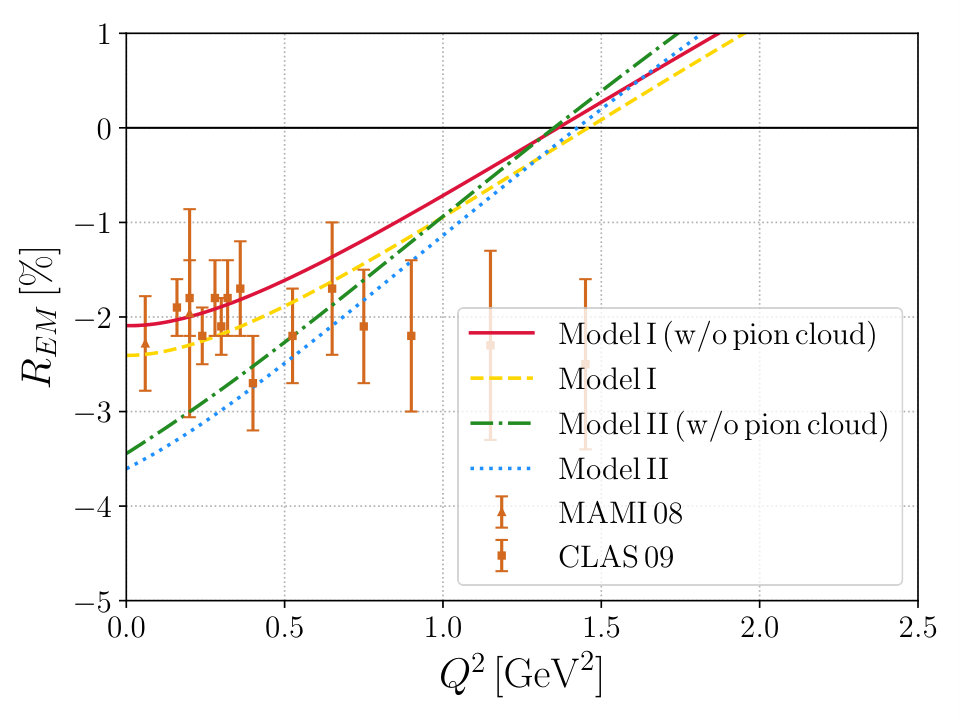 Figure 1
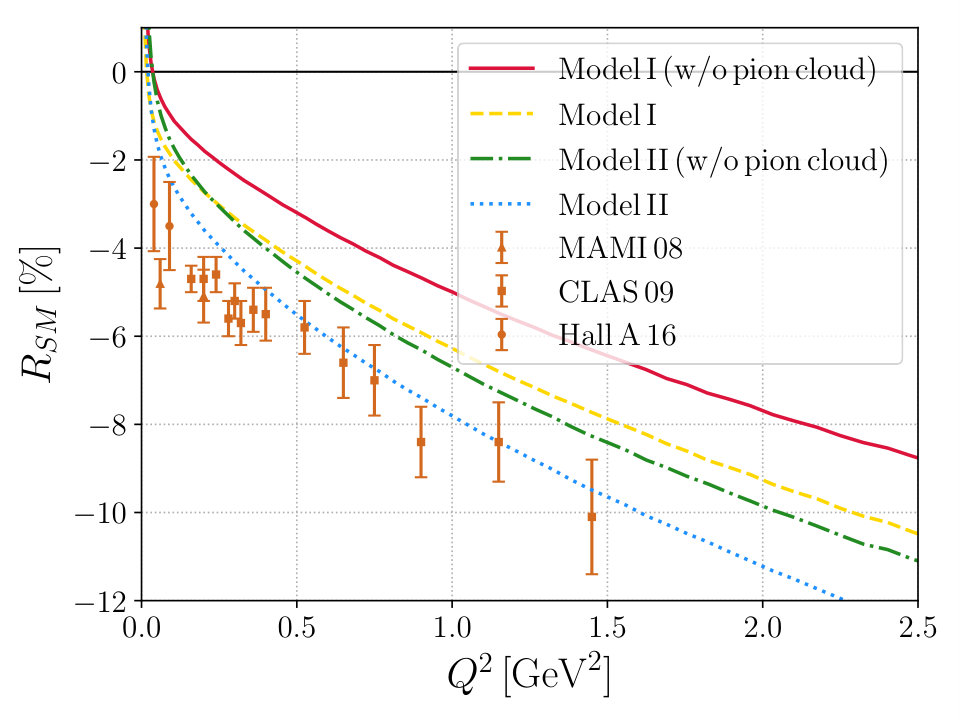 Figure 2
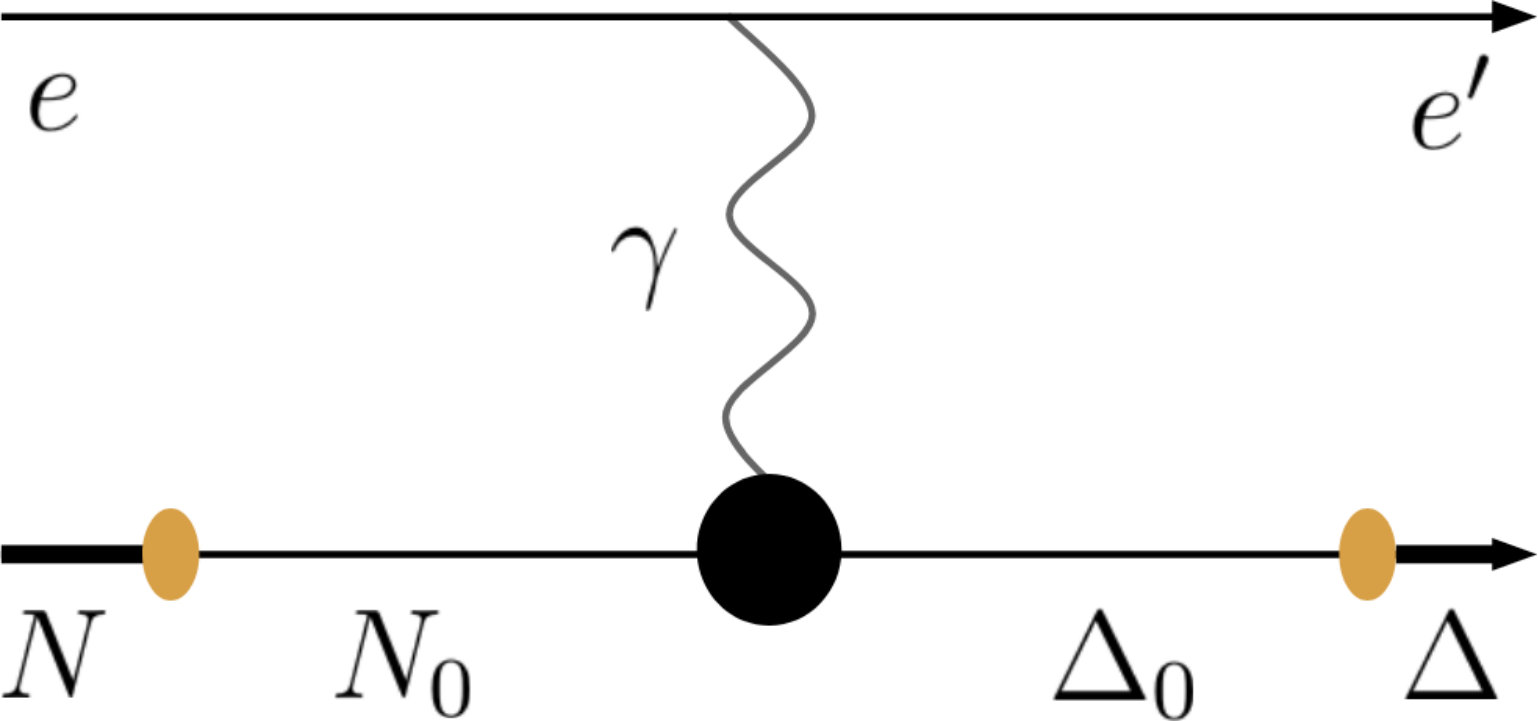 Figure 1
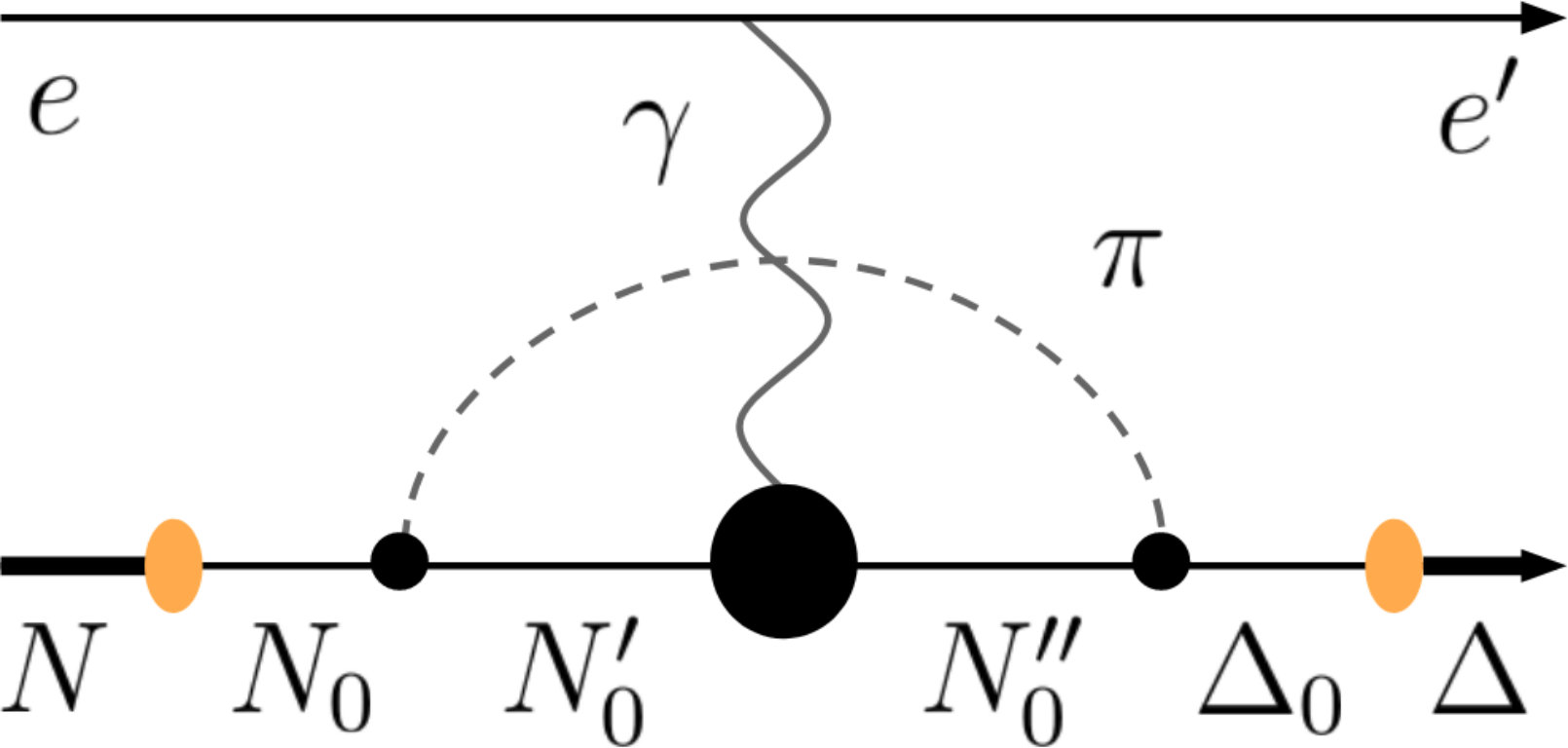 Figure 1
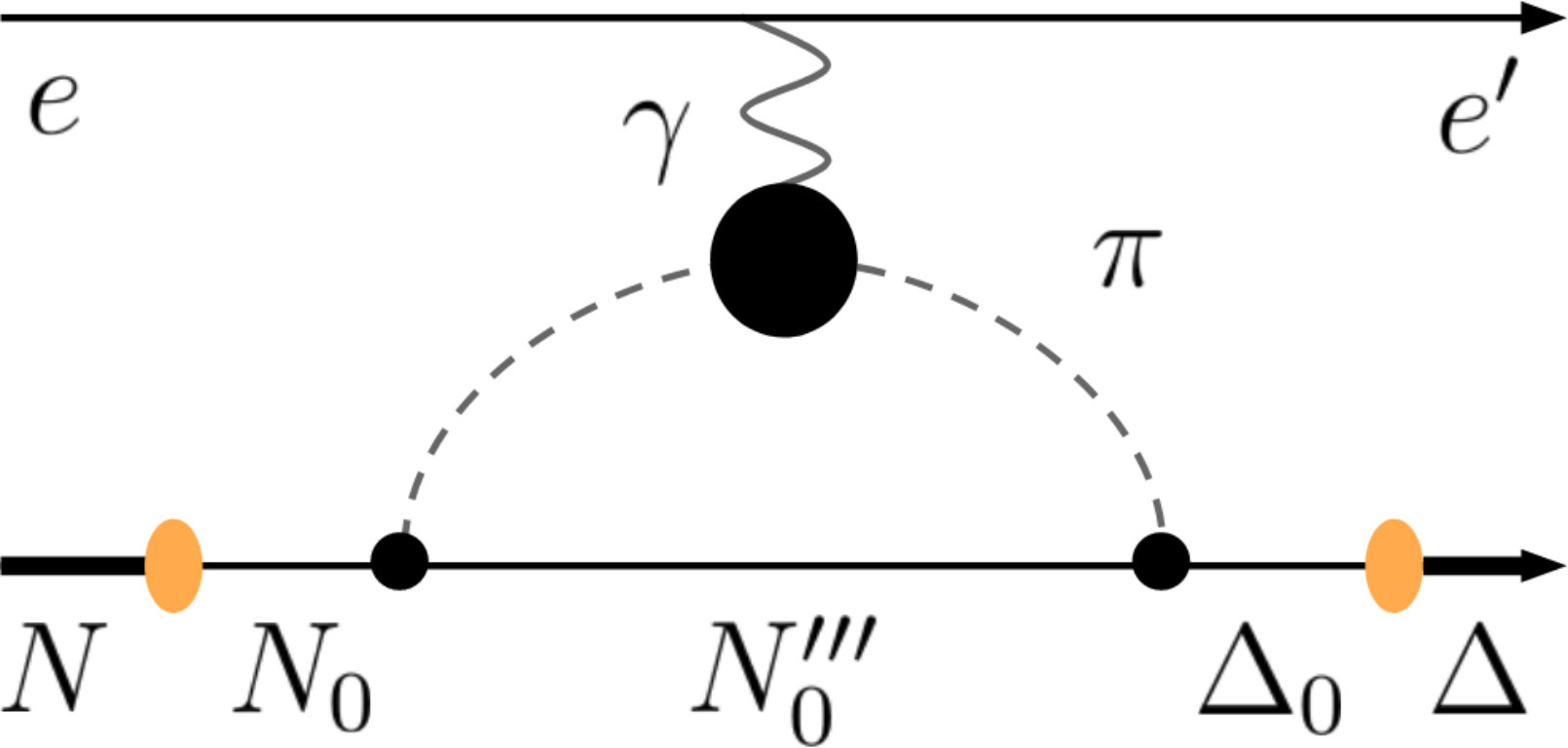 Figure 1
| [GeV] | [GeV] | |||
|---|---|---|---|---|
| Model I | 0.263 | 0.8067 | 1.380 | 2.660 |
| Model II | 0.340 | 0.7565 | 1.390 | 2.585 |
Peer Reviews
No public reviews on file for this paper yet. If you reviewed it on a platform where reviews are public (OpenReview, ICLR, NeurIPS, ICML), you can paste yours below so the community can read it here.
Videos
No videos yet. Explain this paper in a talk, walkthrough, or lecture? Add one.
Taxonomy
TopicsQuantum Chromodynamics and Particle Interactions · Pulsars and Gravitational Waves Research · Particle physics theoretical and experimental studies
11institutetext: Institute of Physics, University of Graz, A-8010 Graz, Austria,
11email: [email protected]
Pion-cloud contribution to the transition form factors
Ju-Hyun Jung
Wolfgang Schweiger
Abstract
We examine the contribution of the pion cloud to the electromagnetic transition form factors within a relativistic hybrid constituent-quark model. In this model baryons consist not only of the valence component, but contain, in addition, a non-valence component. We start with constituent quarks which are subject to a scalar, isoscalar confining force. This leads to an spin-flavor symmetric spectrum with degenerate nucleon and Delta masses. Mass splitting is caused by pions which are assumed to couple directly to the quarks. The point-form of relativistic quantum mechanics is employed to achieve a relativistically invariant description of this system. The transition current is then determined from the one-photon exchange contribution to the electroproduction amplitude. We will give predictions for the ratios and of electric to magnetic and Coulomb to magnetic form factors, which are supposed to be most sensitive to pion-cloud effects.
keywords:
electromagnetic baryon structure, hybrid constituent-quark model, relativistic quantum mechanics
1 Formalism
For a proper relativistic description of the transition form factors we make use of point-form relativistic quantum mechanics in connection with the Bakamjian-Thomas construction [1]. Like in previous work [2, 3] we use this framework to determine the one-photon-exchange amplitude for scattering. From this scattering amplitude we extract the electromagnetic transition current and determine the form factors by means of a covariant analysis of the transition current. Thereby both, the nucleon and the Delta are assumed to consist of a and a + component and, in addition to the dynamics of electron and quarks, the dynamics of the photon and the pion are fully taken into account. This is accomplished by means of a multichannel formulation that comprises all states which can occur during the scattering process (i.e. , , , ). After reducing the mass eigenvalue equation for this system of coupled states to the -component, one ends up with an eigenvalue equation of the form
[TABLE]
where is the 1-exchange optical potential, the invariant mass of the scattering system and the vertex operator. We assume an instantaneous scalar and isoscalar confining force between the quarks, which enters . The invariant 1-exchange amplitude for electroproduction of the Delta is now obtained by sandwiching between (the valence component of) physical electron-nucleon and electron-Delta states , i.e. eigenstates of . The crucial point is now to observe that, due to instantaneous confinement, propagating intermediate states do not contain free quarks, they rather contain bare nucleons or bare Deltas (or corresponding excitations, which are neglected in our calculations). The bare particles are eigenstates of the pure confinement problem. This allows us to rewrite the scattering amplitude in terms of pure hadronic degrees of freedom with the quark substructure being hidden in strong and electromagnetic vertex form factors of the bare baryons. This is graphically represented in Fig. 1.
For scalar, isoscalar confinement the masses of the bare nucleon and Delta are the same, , and also the three-quark wave functions coincide due to spin-flavor symmetry. Instead of choosing a particular confining interaction we therefore rather parameterize the three-quark wave function of and by means of a Gaussian. Knowing the bare mass , the (pseudovector) pion-quark coupling and the constituent-quark masses , one can first calculate the strong couplings and form factors at the , and vertices and in the sequel the renormalization effect of pion loops on the nucleon and Delta mass. Fixing the constituent-quark mass in advance, we have varied the remaining three parameters (, and ) by means of a self-consistent procedure such that the solution of a mass-eigenvalue problem analogous to Eq. (1) (just without electron and photon) gives the physical nucleon and Delta masses. Our resulting parameters for two common choices of the constituent-quark mass are given in Tab. 1. A more detailed account of the parameter fixing can be found in Ref. [4].
What is still necessary to calculate the leading-order electroproduction amplitude, as depicted in Fig. 1, are the electromagnetic (transition) form factors of the bare baryons. These are obtained from the first graph in Fig. 1 by identifying the bare and the physical baryons. As one would expect, the one-photon exchange amplitude for scattering can be written as (covariant) photon propagator times electron current contracted with the baryonic current, . This allows to extract a microscopic expression for the baryonic current . The form factors are then obtained by means of a general covariant decomposition of . The resulting model current , however,can be afflicted by unphysical contributions (depending on the electron momentum) which are partly eliminated by extracting the form factors in the infinite momentum frame. But problems with the “angular condition” may still persist. This deficiency can be traced back to problems with cluster separability inherent in the Bakajian-Thomas construction [1]. A more detailed account of how we deal with these problems in case of the transition current can be found in Ref. [5].
2 Results and Discussion
With the strong and electromagnetic form factors of the bare baryons we are now able to calculate the pion-loop contributions to the electromagnetic transition form factors. We account only for the component in the physical nucleon and Delta, but neglect the component. There is some evidence from phenomenological hadronic models that an spin-flavor symmetric model like ours would overestimates the component considerably. A common choice for electromagnetic transition form factors is the one suggested by Jones and Scadron [6]. Pion-cloud effects are most visible in the small form factors and . What is often plotted are the ratios and , where . These are shown in Fig. 2 for the two parameterizations of our model given in Tab. 1. Our results compare with the outcome of other theoretical predictions coming from constituent-quark models [10, 11, 12]. For GeV2 our predictions for agree well with the data, for vanishing , however, we underestimate the data by about for model I and about for model II. Model I works also better for , whereas a better reproduction of is achieved with model II. The pion-cloud contribution is clearly visible in both ratios and it goes into the right direction.
There is, of course, room left for improvement. One should keep in mind that our starting point was spin-flavor symmetry for the bare baryons. One could, e.g., think of introducing symmetry-breaking effects right from the beginning, which lead to different masses and wave functions for the bare nucleon and Delta. This perhaps will also lead to a more reasonable probability for finding the component in the physical nucleon and Delta. Contributions from intermediate states could then also help to improve agreement with data. It is the topic of future work to find out, whether -symmetry breaking effects on the bare baryon level (in addition to pion-cloud effects) suffice to improve the agreement with data, or whether, e.g., an explicit -wave contribution to the wave function, as it is asserted by several authors (see, e.g., [11]), will be necessary to achieve a satisfactory reproduction of data.
Acknowledgement: J.-H. Jung acknowledges the support of the Fonds zur Förderung der wissenschaftlichen Forschung in Österreich (Grant No. FWF DK W1203-N16).
The reference list from the paper itself. Each links out to its DOI / PubMed record.
- 1[1] Klink, W.H., Schweiger, W.: Relativity, Symmetry, and the Structure of Quantum Theory: Volume 2 (Point Form Relativistic Quantum Mechanics) , Morgan & Claypool Publishers, Bristol (2018).
- 2[2] Biernat, E.P., Schweiger, W., Fuchsberger, K., Klink, W.H.: Phys. Rev. C 79 , 055203 (2009).
- 3[3] Biernat, E.P., Schweiger, W.: Phys. Rev. C 89 , 055205 (2014).
- 4[4] Jung, J.-H., Schweiger, W.:Few Body Syst. 58 , 73(2017)
- 5[5] Jung, J.-H., Schweiger, W., Biernat, E.P.: ar Xiv:1804.01750 [nucl-th].
- 6[6] Jones, H.F., Scadron, M.D.: Annals Phys. 81 , 1 (1973).
- 7[7] Sparveris, N.F. et al. : Phys. Rev. C 78 , 018201 (2008).
- 8[8] Aznauryan, I.G. et al. [CLAS Collaboration]: Phys. Rev. C 80 , 055203 (2009).