Recent developments in small-x resummation
Marco Bonvini

TL;DR
This paper reviews recent progress in small-x resummation techniques, highlighting their success in describing HERA data without non-perturbative corrections, and discusses new theoretical developments.
Contribution
It provides an overview of recent advances in small-x resummation, emphasizing improvements and new methods in the field.
Findings
Enhanced description of HERA data at small-x
Development of new resummation techniques
Reduction of non-perturbative correction reliance
Abstract
There has been a revived interest in small-x resummation in recent times. The main motivation was its success in describing small-x HERA data without the inclusion of non-perturbative corrections. In this contribution I will review the recent developments in the field.
Click any figure to enlarge with its caption.
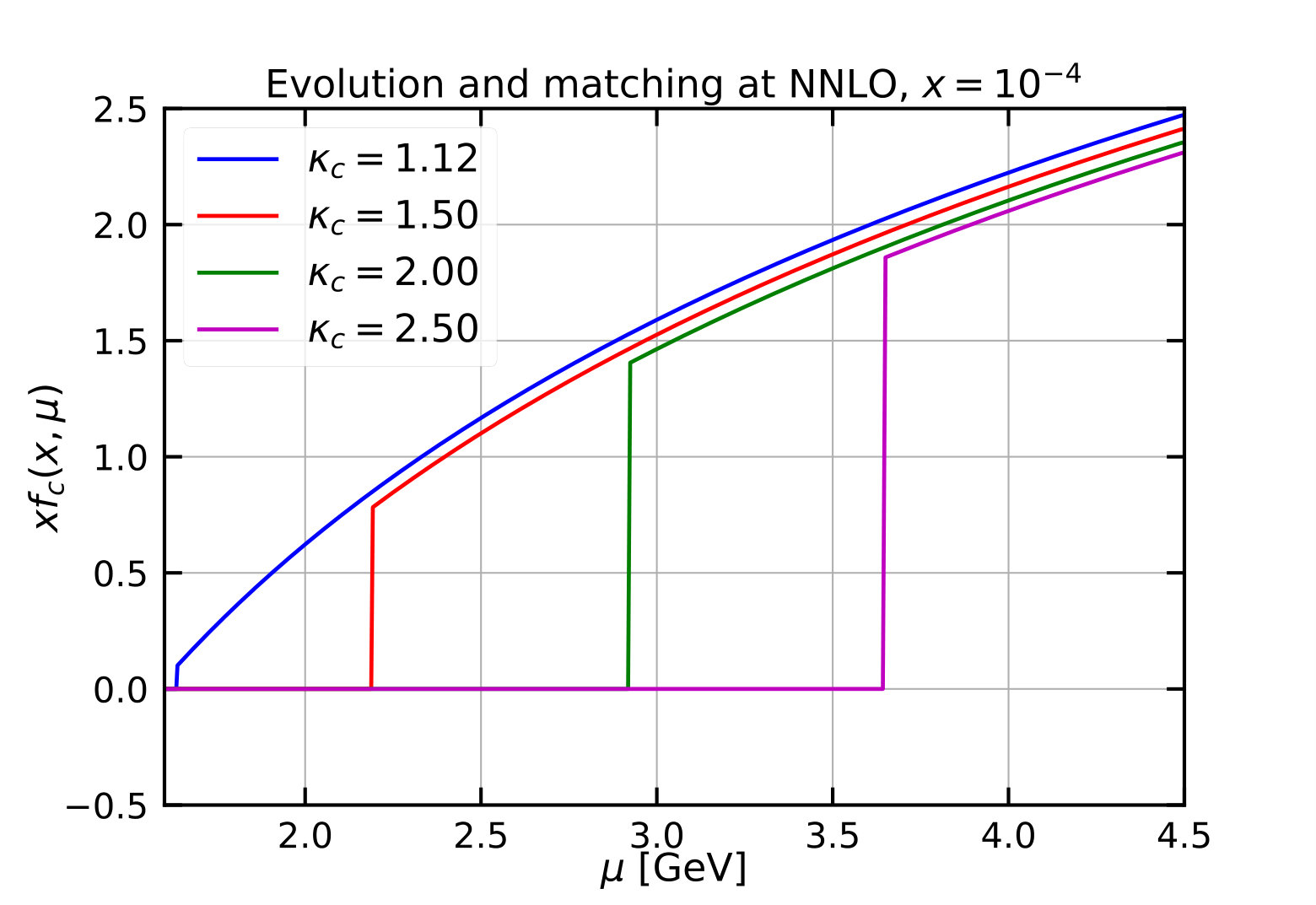 Figure 1
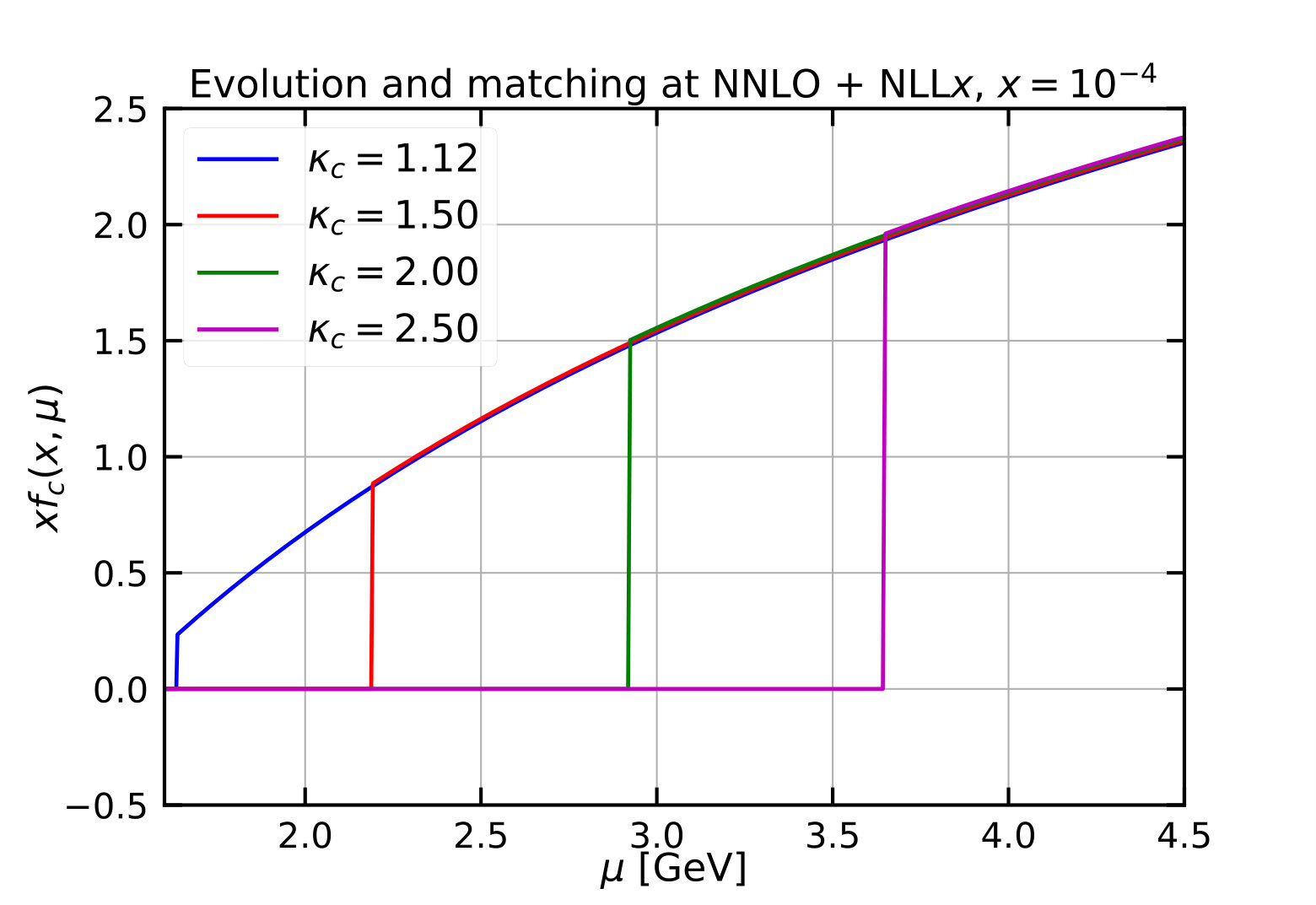 Figure 2
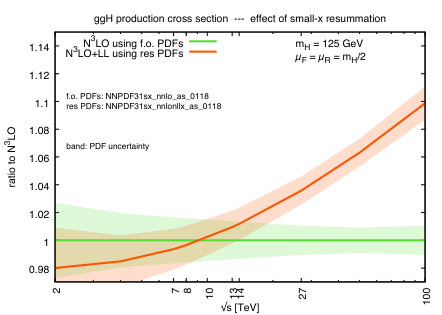 Figure 3
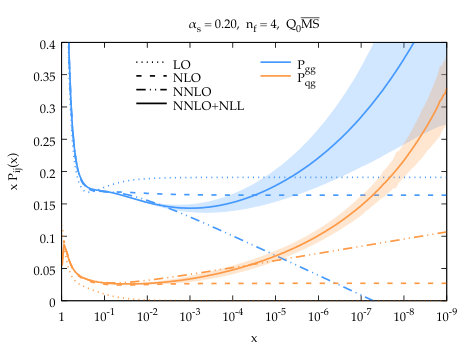 Figure 4
Peer Reviews
No public reviews on file for this paper yet. If you reviewed it on a platform where reviews are public (OpenReview, ICLR, NeurIPS, ICML), you can paste yours below so the community can read it here.
Videos
No videos yet. Explain this paper in a talk, walkthrough, or lecture? Add one.
Taxonomy
TopicsParticle physics theoretical and experimental studies · Particle Accelerators and Free-Electron Lasers · High-Energy Particle Collisions Research
Recent developments in small- resummation††thanks: Presented at Diffraction and Low-x 2018
Marco Bonvini
INFN, Sezione di Roma 1, Piazzale Aldo Moro 5, 00185 Roma, Italy
Abstract
There has been a revived interest in small- resummation in recent times. The main motivation was its success in describing small- HERA data without the inclusion of non-perturbative corrections. In this contribution I will review the recent developments in the field.
Let us consider an observable , e.g. a DIS structure function, within the context of the collinear QCD factorization theorem. It can be written in general as
[TABLE]
where are perturbative coefficient functions and are parton distribution functions (PDFs) satisfying the DGLAP evolution equation
[TABLE]
where are splitting functions and the sums extend over all partons. It is well known that perturbative quantities computed in QCD may contain logarithmic enhancements in some regions. This is for instance the case of terms, which appear in both splitting and coefficient functions in the singlet sector, and become large at small-, spoiling the perturbativity of the expansion. Resumming the small- logarithms cures the instability of the fixed-order perturbative results. Small- resummation is based on the interplay of the previous two equations with the factorization theorem
[TABLE]
where are coefficient functions with off-shell initial-state partons (with off-shellness given by ), and are unintegrated -dependent PDFs. In the small- limit, the unintegrated gluon PDF is related to the integrated integrated PDF by
[TABLE]
where is a scheme-dependent function. In the variant of the scheme usually adopted in small- resummation, denoted scheme, . The unintegrated gluon PDF satisfies the BFKL evolution equation
[TABLE]
where is the BFKL kernel. Using Eq. (4) to transalte the BFKL equation into an equation for the integrated PDF, it is then possible to require consistency between its solution and that of the DGLAP evolution Eq. (2) to find constraints between the splitting functions and the BFKL kernel, called duality relation, that allow to resum the small- logarithms in splitting functions. Practically, the procedure is more complicated due to the perturbative instability of the BFKL kernel, that requires a number of operations to be performed before obtaining a perturbatively stable result. On top of this, the resummation of a class of subleading contributions originating from the running of the strong coupling turns out to be very important, as it changes the nature of the small- behaviour. Resummation at next-to-leading logarithmic (NLL) level matched to fixed next-to-leading order (NLO) has been achieved by various groups (see e.g. [1, 2, 3]).
In the recent Refs. [4, 5, 6, 7], the formalism for small- resummation, in the approach of Altarelli-Ball-Forte (ABF), has been extended in many respects. On top of (several) technical improvements, the main novelties that have been introduced are:
- •
matching the resummation to NNLO, to be able to construct DGLAP evolution at NNLO+NLL;
- •
making a prediction of the (yet unknown [8, 9]) N3LO splitting functions at small , and preparing all the ingredients to be able to match NLL resummation to N3LO once available;
- •
providing an uncertainty on resummed results from subleading logarithmic contributions;
- •
releasing a public code, HELL [10], that implements the resummation and delivers resummed results for applications.
The first item of the list is particularly important, because the instability induced by small- logarithms gets larger increasing the order. This is seen in Fig. 1 (left), where the and splitting functions are shown at a low scale: the term at NNLO starts to grow for and invalidate the perturbative expansion.
Once resummation is turned on, the behaviour changes substantially, and the NNLO+NLL result deviates significantly from the fixed-order result. A stronger effect is expected when matching the resummation to N3LO, because at this order extra powers of the log appear. A prediction (based on the expansion of the resummed result) is shown in Fig. 1 (right). The perturbative instability is apparent, especially when going to very small values of . However, subleading logarithmic contributions which cannot be fixed by NLL resummation are potentially sizeable (difference between “N3LO approx” and “N3LO asympt” curves in the plot), so this prediction carries a huge uncertainty and it may be useful only combined with other information on the N3LO result [8, 9].
The resummation of coefficient functions is based on the direct comparison of the collinear and factorization formulae Eqs. (1), (3), making use of a generalization of the relation Eq. (4). Moving to the Mellin space, and introducing the DGLAP evolution factors from a scale to a scale , we can rewrite Eq. (4) generalized to all flavours as
[TABLE]
so that by comparison between the two factorization formulae we get
[TABLE]
which encodes the small- resummation provided the DGLAP evolution factors are themselves computed with resummed splitting functions. This formulation of the resummation (introduced for the first time in Ref. [4]) is equivalent to previous approaches [11, 2, 12], but it is very convenient from a numerical point of view, and it allows for a simpler implementation of new processes in the resummation code HELL [10]. Also thanks to this new formulation, there have been a number of developments also in the context of coefficient functions resummation [5, 7]:
- •
resummation of all neutral- and charged-current DIS structure functions , and , both in the massless limit and including mass effects;
- •
implementation of a variable flavour number scheme at small in -like schemes;
- •
resummation of heavy-quark matching conditions which give the initial conditions for the PDFs when transitioning from a scheme with active flavours to a scheme with active flavours;
- •
resummation of LHC observables (only Higgs production in gluon fusion so far, Drell-Yan is under investigation).
The third item turns out to be particularly interesting. Indeed, the transition from the to the scheme happens at a (unphysical) matching scale, that can be varied to assess the impact of unknown higher order contributions to the matching procedure. Once resummation is included in the matching and in DGLAP evolution, the matching scale uncertainty is drastically reduced at small , thereby showing a stabilization of the perturbative expansion. This is shown for the charm PDF in Fig. 2. The gap between the various curves at large scale (i.e. in the scheme) almost disappears once resummation is included.
Thanks to all these recent developments, and importantly to the availability of the public code HELL [10] that delivers resummed splitting and coefficient functions, it has been possible to perform two PDF fits including small- resummation, one in the context of the NNPDF methodology [14] and the other one using the xFitter toolkit [13]. The striking effect of small- resummation is a dramatic improvement in the description of the low- low- HERA data, leading to a significantly different gluon (and quark-singlet) PDF at NNLO+NLL with respect to the NNLO fit at small .
To appreciate the importance of such effect, we show in Fig. 3 the comparison of the fixed-order and resummed predictions for the production of Higgs in gluon fusion at hadron colliders as a function of the collider energy [16, 7]. The effect of resummation (mostly coming from the use of resummed PDFs) is small and compatible within PDF uncertainty with the fixed-order result up to approximately the current LHC energy. For higher energies, the effect of resummation is a significant increase of the cross section, rising with the energy, and reaching up to at a future circular collider of TeV. This conclusion holds unchanged if using a different NNLO PDF set for the comparison, for instance the state-of-the-art NNPDF3.1 set of Ref. [15] (right plot), which has been fitted using a larger dataset. Subleading logarithmic contributions may have sizeable effects [7] and reduce (or enhance) the overall effect of resummation, but the significance of the effect is likely independent of them.
Acknowledgments
This work is supported by the Marie Skłodowska-Curie grant HiPPiE@LHC, number 746159.
The reference list from the paper itself. Each links out to its DOI / PubMed record.
- 1[1] M. Ciafaloni, D. Colferai, G. Salam and A. Stasto, A Matrix formulation for small- x 𝑥 x singlet evolution , JHEP 0708 (2007) 046 [ 0707.1453 ]. · doi ↗
- 2[2] G. Altarelli, R. D. Ball and S. Forte, Small x Resummation with Quarks: Deep-Inelastic Scattering , Nucl.Phys. B 799 (2008) 199 [ 0802.0032 ]. · doi ↗
- 3[3] C. D. White and R. S. Thorne, A Global Fit to Scattering Data with NLL BFKL Resummations , Phys. Rev. D 75 (2007) 034005 [ hep-ph/0611204 ]. · doi ↗
- 4[4] M. Bonvini, S. Marzani and T. Peraro, Small- x 𝑥 x resummation from HELL , Eur. Phys. J. C 76 (2016) 597 [ 1607.02153 ]. · doi ↗
- 5[5] M. Bonvini, S. Marzani and C. Muselli, Towards parton distribution functions with small- x 𝑥 x resummation: HELL 2.0 , JHEP 12 (2017) 117 [ 1708.07510 ]. · doi ↗
- 6[6] M. Bonvini and S. Marzani, Four-loop splitting functions at small x 𝑥 x , JHEP 06 (2018) 145 [ 1805.06460 ]. · doi ↗
- 7[7] M. Bonvini, Small- x 𝑥 x phenomenology at the LHC and beyond: HELL 3.0 and the case of the Higgs cross section , Eur. Phys. J. C 78 (2018) 834 [ 1805.08785 ]. · doi ↗
- 8[8] J. Davies, A. Vogt, B. Ruijl, T. Ueda and J. A. M. Vermaseren, Large- n f subscript 𝑛 𝑓 n_{f} contributions to the four-loop splitting functions in QCD , Nucl. Phys. B 915 (2017) 335 [ 1610.07477 ]. · doi ↗