Magnetic control of polariton spin transport
Davide Caputo, Evgeny Sedov, Dario Ballarini, Mikhail Glazov, Alexey, Kavokin, Daniele Sanvitto

TL;DR
This paper demonstrates how a magnetic field can fully control the polarization dynamics of exciton-polariton condensates in microcavities, affecting spin-beat frequency, spin Hall effect, and polarization patterns.
Contribution
It introduces a theoretical model showing magnetic control over polariton spin transport, including effects on spin-beat frequency and polarization rotation.
Findings
Magnetic field alters spin-beat frequency.
Suppression of optical spin Hall effect observed.
Polarization pattern rotation achieved theoretically.
Abstract
We show the full control of the polarization dynamics of a propagating exciton-polariton condensate in a planar microcavity by using a magnetic field applied in the Voigt geometry. The change of the spin-beat frequency, the suppression of the optical spin Hall effect and the rotation of the polarization pattern by the magnetic field are theoretically reproduced by accounting for the magneto-induced mixing of exciton-polariton and dark, spin forbidden, exciton states.
Click any figure to enlarge with its caption.
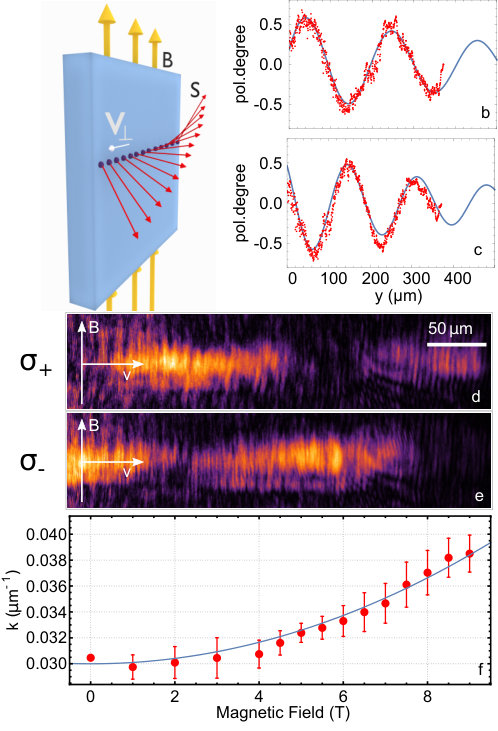 Figure 1
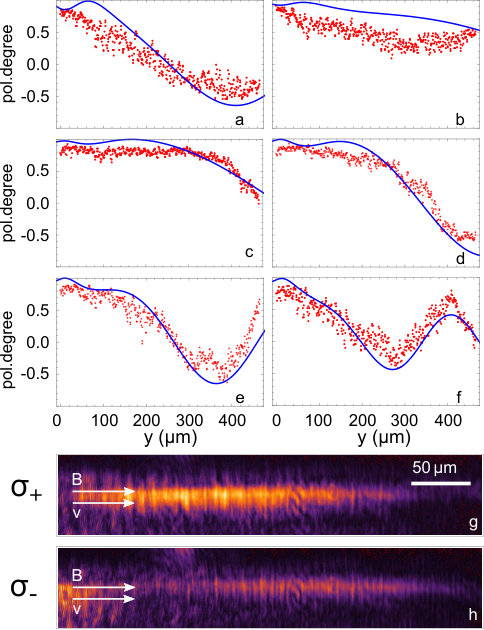 Figure 2
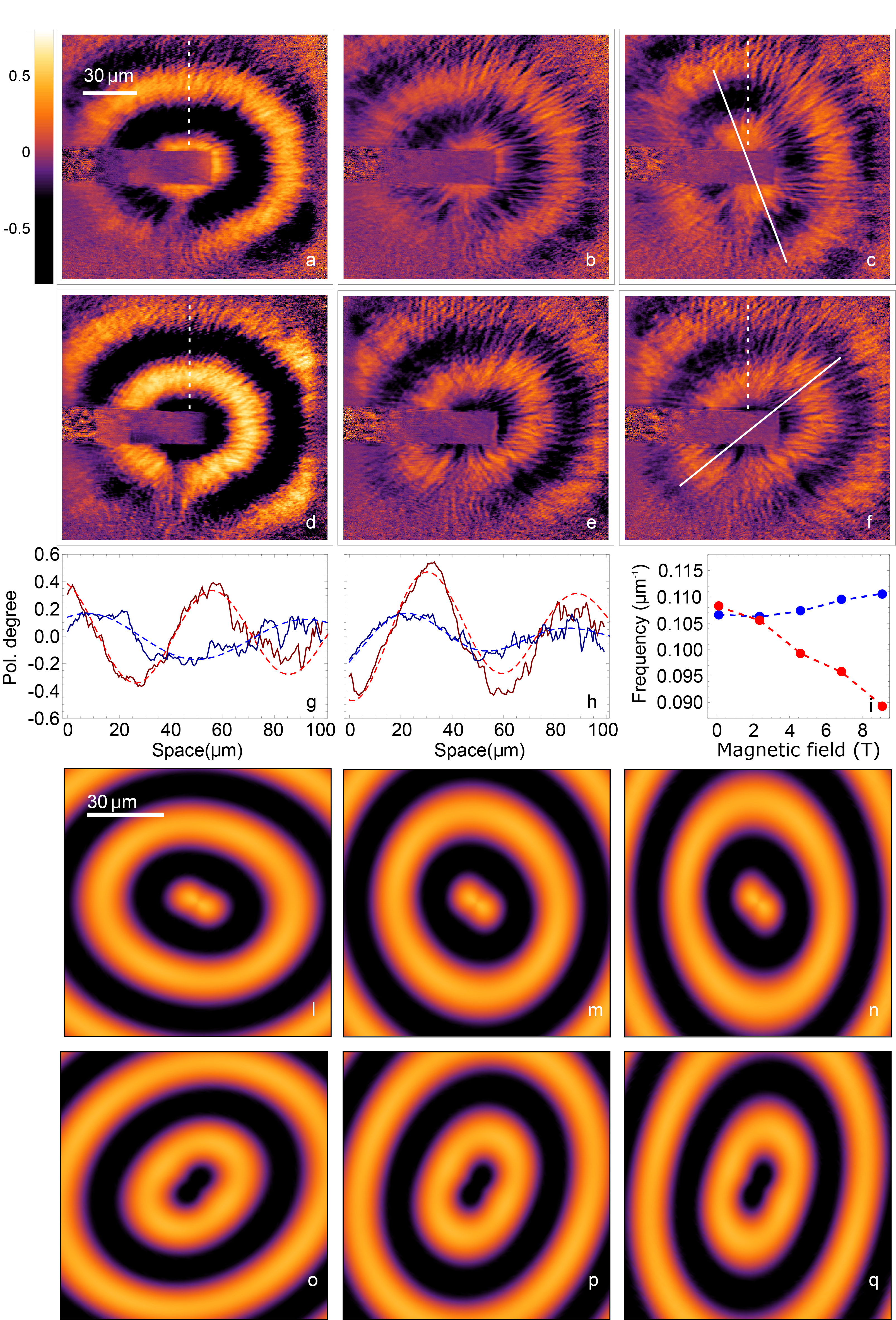 Figure 3
Peer Reviews
No public reviews on file for this paper yet. If you reviewed it on a platform where reviews are public (OpenReview, ICLR, NeurIPS, ICML), you can paste yours below so the community can read it here.
Videos
No videos yet. Explain this paper in a talk, walkthrough, or lecture? Add one.
Magnetic control of polariton spin transport
D. Caputo
CNR-NANOTEC, Istituto di Nanotecnologia, Via Monteroni, 73100 Lecce, Italy
University of Salento, Via Arnesano, 73100 Lecce, Italy
E. S. Sedov
School of Physics and Astronomy, University of Southampton, SO17 1NJ Southampton, United Kingdom
Department of Physics and Applied Mathematics, Vladimir State University named after A. G. and N. G. Stoletovs, Gorky str. 87, 600000, Vladimir, Russia
D. Ballarini
CNR-NANOTEC, Istituto di Nanotecnologia, Via Monteroni, 73100 Lecce, Italy
M.M. Glazov
Ioffe Institute, 26 Polytechnicheskaya, 194021 St. Petersburg, Russia
Spin Optics Laboratory, St. Petersburg State University, Ul’anovskaya 1, Peterhof, St. Petersburg 198504, Russia
Alexey Kavokin
Institute of Natural Sciences, Westlake Institute for Advanced Study, Westlake University, Hangzhou, China
D. Sanvitto
CNR-NANOTEC, Istituto di Nanotecnologia, Via Monteroni, 73100 Lecce, Italy
INFN, Sez. Lecce, 73100 Lecce, Italy
Abstract
We show the full control of the polarization dynamics of a propagating exciton-polariton condensate in a planar microcavity by using a magnetic field applied in the Voigt geometry. The change of the spin-beat frequency, the suppression of the optical spin Hall effect and the rotation of the polarization pattern by the magnetic field are theoretically reproduced by accounting for the magneto-induced mixing of exciton-polariton and dark, spin forbidden, exciton states.
The remarkable progresses in the control of matter-light interaction in semiconductor optical microcavities have made it possible to design a new generation of optoelectronic devices Imamoḡlu and Ram (1996); Gao et al. (2012); Ballarini et al. (2013); Bajoni et al. (2008); Johne et al. (2010); Shelykh et al. (2009); Amo et al. (2010). These are based on the peculiar properties of exciton-polaritons, half-light half-matter bosonic quasiparticles arising from the strong coupling between photonic cavity modes and excitons in quantum wells placed inside the cavity. One of the most remarkable properties of polaritons is that they have a spin degree of freedom inherited from the photon chirality and exciton spin angular momentum that shows long coherence time and the possibility to be actively manipulated by external fields through the excitonic component Shelykh et al. (2005); Mirek et al. (2017). This additional feature of polaritons significantly broadens the range of their possible applications to include what is known under the name of spinoptronics. By now, there are already several implemented concepts in the form of spinoptronics devices such as the “Datta and Das” spin transistor Johne et al. (2010); Espinosa-Ortega and Liew (2013), the polaritonic analogue of a Berry-phase interferometer Shelykh et al. (2009) and the exciton-polariton spin switch Amo et al. (2010); Ballarini et al. (2007). In all these works a central aspect is the ability to control the spin of polaritons using internal as well as external factors to affect their polarization properties.
From a fundamental point of view, the dominant effect on the polariton spin dynamics is the optical spin Hall effect (OSHE) Kavokin et al. (2005); Kammann et al. (2012); Schmidt et al. (2017). Basically, it originates from the longitudinal-transverse (LT) splitting of exciton polariton states. The effect of this splitting can be described by an effective magnetic field, strongly dependent on the direction of the quasi-particle propagation and its velocity, giving rise to the polariton spin precession as it propagates in the cavity plane. One of the main problem, in particular when polarization is a key parameter in polariton devices, is the control of such an effective magnetic field which in turn directly affects the polariton state. Usually, the Faraday geometry with the magnetic field directed along the cavity normal is used. In this configuration the studies of the influence of the magnetic field on the polariton dispersion Piȩtka et al. (2015), coherence properties Chernenko et al. (2016) as well as on the spin textures in excitonic High et al. (2013) and polaritonic Morina et al. (2013) systems have been reported. Hovewer, such geometry cannot be effective on the control of the OSHE Rubo et al. (2006); Larionov et al. (2010); Walker et al. (2011); Sedov and Kavokin (2017).
By contrast, the effect on exciton-polariton spin dynamics in the Voigt geometry, with the external magnetic field within the plane of the quantum well, has not been studied so far. This is because the in-plane field does not directly couple with the polariton pseudospin and one may expect its effect to be quite minor. In this Letter we demonstrate that this is not the case by reporting for the first time the direct control of the polariton spin transport both in a confined one-dimensional (1D) geometry and in the whole two-dimensional (2D) plane of the cavity through the application of an external magnetic field directed in the cavity plane. In this context, we show the possibility to control and even totally suppress the OSHE for polaritons propagating in a given direction by properly choosing the magnitude and the direction of the applied field. Moreover the application of the external magnetic field causes a stretching of the circular pseudospin patterns in the axis normal to the magnetic field direction and a contraction in the same direction of the external field. From the point of view of applications, the possibility to completely control the OSHE related intensity oscillations allows one to remove the residual density modulations that appear during polaritons propagation and that would be detrimental for the elaboration of the signal inside the devices Espinosa-Ortega and Liew (2013). All the experimentally observed phenomena can be described within an analytical model taking into account both the field-induced mixing of bright polariton doublet with dark excitonic states and nonlinear effects originating from the polariton-polariton interactions.
The sample studied in this work is a high finesse 3/2 GaAs/AlGaAs planar microcavity grown along axis with a state-of-the-art polariton lifetime of about 100 ps. The high quality factor and the low density of defects allow ballistic propagation of polaritons to cover several hundreds of micron, as recently demonstrated by different groups Caputo et al. (2018); Steger et al. (2013). The microcavity contains 12 GaAs quantum wells (7 nm-wide) placed at three anti-node positions of the electric field, providing a vacuum Rabi splitting of . The front (back) mirror consists of 34 (40) pair of AlAs/Al0.2Ga0.8As layers and cavity-exciton detuning is slightly negative, about . Polaritons are injected both resonantly and nonresonantly using a low-noise, narrow-linewidth Ti:sapphire laser with stabilized output frequency in a continuous wave operation mode. The sample is kept at a temperature of around 10 K. The sample emission is collected, filtered in polarization and sent to the entrance slit of a spectrometer coupled with a charge coupled device camera.
In order to study the 1D case, we resonantly inject circularly polarised polaritons with a finite momentum into natural misfits dislocations present along the axis of the sample. The 1D confinement is shallow but allows to observe the polariton propagation up to 400 from the laser injection point with a negligible spread in the perpendicular direction (see Fig. 1). The coherent spin oscillations during the propagation of polaritons are measured by selectively detecting the emission intensity co- () and cross-polarised () with respect to the exciting laser, as shown in Fig. 1d and Fig. 1e, respectively. The circular polarization degree, , is then obtained as . For data shown in Fig. 1, polaritons are injected with a speed of and the magnetic field, applied in the plane of polariton propagation normally to the propagation direction, spans a range from [math] to T. The pronounced oscillations of the circular polarization degree as a function of coordinate are observed being a signature of the polariton pseudospin precession in the course of propagation. Interestingly and somewhat unexpectedly, the magnetic field affects the frequency of the spatial oscillations in that increases quadratically with the intensity of the magnetic field, as shown in Fig. 1(g). Figure 2 shows the results of measurement performed with the sample rotated by with respect to the orientation shown in Fig. 1, in order to have the external magnetic field oriented parallel to the dislocation and, hence, to the polariton propagation direction. A deeper dislocation is considered in this case, showing a non-trivial polarization pattern along propagation. Indeed, increasing the magnetic field intensity, the spatial oscillations frequency first decreases (up to 5 T) and then increases with a constant positive offset in the co-polarised component.
The observed effects can be quantitatively described within a pseudospin model parametrizing the polariton spin density matrix through the vector whose component describes the circular polarization degree of the particles and the in-plane components characterize the linear polarization degree in two sets of axes. The equation of motion for the pseudospin of polaritons in the state is written as Kavokin et al. (2005)
[TABLE]
Hereafter we assume ballistic propagation of polaritons, use the set of axes with , and , is the effective pseudospin precession frequency and the last term accounts for the spin relaxation processes with the rate . The effective precession frequency components read
[TABLE]
and contain contributions from the LT splitting of polariton modes, Panzarini et al. (1999), in the linear polarization components due to the applied external magnetic field in the cavity plane , and the so-called self-induced Larmor precession of the polariton pseudospin due to the polariton-polariton interactions () treated here within the mean-field approach Shelykh et al. (2005); Cao et al. (2008); Glazov and Kavokin (2015). Importantly, the in-plane components of the effective field contain the quadratic magnetic field contributions. The form of these terms follows from the symmetry arguments since the quadratic combinations and with transform in the same way already in the isotropic approximation and the effects of point symmetry of the studied structure on the magnetic-field induced terms are disregarded. Microscopically, the parameter results from magneto-induced mixing of polariton states and dark (spin-forbidden) excitons with the additional contribution from the diamagnetic effect, just like for excitons in quantum wells and quantum dots Stevenson et al. (2006); Glazov et al. (2007), see Supplementary material Sup for the details.
Equation (1) can be solved analytically for various experimentally relevant configurations. Let us first set , i.e., neglect the effect of the polariton-polariton interactions and assume that the polaritons propagate along the -axis and is either parallel or perpendicular to the polariton velocity. From Eqs. (2) it follows that and
[TABLE]
Here the propagation constant of the oscillatory distribution of pseudospin is:
[TABLE]
and the pseudospin decay length , where (with being the polariton effective mass) is the polariton velocity. For positive and , Eq. (4) predicts a monotonic increase of the propagation constant with the square of the magnetic field magnitude , in full agreement with the experimental results shown in Fig. 1(g). By contrast, with the dependence is more complicated: from Eq. (4), it follows that is a nonmonotonic function of . First it decreases for and then increases for higher field intensities. Under the condition the complete stop of oscillations is expected due to the suppression of the LT-splitting by the magnetic field similarly to the field-induces suppression of exciton anisotropic splitting in quantum dots Stevenson et al. (2006); Glazov et al. (2007). Qualitatively, these results are in agreement with the experimental data presented in Fig. 2, with 4\text{,}\mathrm{T}$$.
While Eqs. (3) and (4) quantitatively fit the data in Fig. 1, see solid lines in the panels (b,c), the linear model is not sufficient to describe all the peculiarities of the polariton polarization dynamics shown in Fig. 2. This is because the nonlinearity due to spin-dependent polariton-polariton interactions becomes of particular importance in the situation of . Also, in the experimental geometry with , the polariton propagation velocity is relatively small, , that results in the weaker manifestation of the LT-splitting effect. Indeed, one of the peculiarities seen in Fig. 2 is the positive offset in the -dependence. This effect is the manifestation of the presence of the third component of the effective magnetic field , which tilts the pseudospin precession axis towards the -axis and suppresses partially the effect of the LT-splitting Morina et al. (2013); Lafont et al. (2017). The results of calculations for this configuration are shown by blue curves in Fig. 2 and closely match the experimental points. Note that, as expected, the self-induced Zeeman splitting due to the polariton-polariton interactions decreases at lower densities and the dynamics of returns to the harmonic character at the distance of about 300 m, Fig. 2.
In order to understand how the complete two dimensional polarization spatial distribution is affected by the application of an in-plane magnetic field, we performed a different experiment using a free, high velocity, radially expanding polariton condensate in a clean region of the sample. Even though obtained with a nonresonant circularly polarized pumping scheme, polaritons, in our case, inherit about of circular polarization from the pump Kammann et al. (2012). With the aim of efficiently injecting polaritons, the energy of the pump is tuned at the first minimum of the reflection stop band making it possible to reach the condensation density threshold in a region within the laser spot, blueshifted of about 4 meV from the bottom of the lower polariton branch. From this central region, a polariton flow is ballistically expelled and is free to radially propagate in the plane of the cavity outside the excitation spot region, with an acceleration due to the gradient in the potential resulting from the blueshift under the excitation spot Ballarini et al. (2017). This configuration enables polaritons to ballistically propagate with a speed of about 2 .
Figure 3(a–f) shows the for different magnetic field intensities. A small asymmetry in the distribution function already present at T is initially compensated, and then enhanced by the external magnetic field, see Fig. 3(a–c). Indeed, the pattern was at T elliptical with the horizontal axis greater than the vertical but, by increasing the applied magnetic field, these axes become inverted and the ellipse gets rotated. This is confirmed by the opposite behaviour of the spatial frequency respect to the vertical and horizontal axes as reported in the inset of Fig. 3. By changing the polarisation degree of the exciting laser from right-circular to left-circular, we change the relative orientation of the polariton spin with respect to the magnetic field. In Fig. 3(d–f), we show that in this case the long eccentricity axis at T is oriented roughly perpendicularly to Fig. 3(c).
The resulting circular polarization degree of polaritons during the expansion in the two-dimensional plane can be qualitatively described by the same equation (1) applied to all on the elastic circle of the radius . Figure 3(l–q) illustrates the 2D expansion of the theoretically predicted from the model. The values of the effective magnetic field magnitude in this figure correspond to those in Fig. 3(a)–(f). In order to distinguish the influence of different effects on the shape of the polarization pattern it is possible to consider the following. At the pure circular initial polarisaton, in the presence of only the LT-splitting, the circular polarization degree patterns in real space are rotationally invariant. A slight tilt and the squeezing of the patterns in direction even in the absence of the external magnetic field are due to the fact that the initial polarization is not pure circular but it contains a small admixture of the linear components, see caption to Fig. 3. Moreover, the external magnetic field tends to change the spatial frequency with, as shown above, a different effect depending on the relative direction of the external field and the propagation. According to Eq. (4), the absolute value of the propagation constant decreases with increasing (directed along the y-axis) until the magnetic field compensates the effect of the LT splitting while a further increase in leads to the increase of the spatial frequency. In the propagation direction orthogonal to B, the propagation constant monotonically increases with the increase of on all extent.
In conclusions, we have experimentally demonstrated the control of the optical spin Hall effect by tuning an external magnetic field applied in the direction of propagation of polaritons. This can be useful to avoid unwanted rotation of the polarization in polariton devices or by controlling the spin degree at a given position. In fact, if the spin precession is instead required Kammann et al. (2012), the spin beat frequency can be tuned by the external magnetic field applied perpendicularly to the propagation direction of polaritons. In the 2D expansion the in-plane magnetic field induces an additional polarization anisotropy in the structure that manifests itself as a deformation of the pseudospin patterns in real space. We have developed a theoretical model that qualitatively explains the observed effects.
Acknowledgments
E.S. acknowledges support from the RFBR grant No. 16-32-60104. A.K. and E.S. acknowledge support from the EPSRC Programme grant on Hybrid Polaritonics No. EP/M025330/1. A.K. acknowledges the partial support from the HORIZON 2020 RISE project CoExAn (Grant No. 644076). M.M.G. was partially supported by RF President grant MD-1555.2017.2, RFBR project 17-02-00383, SPSU and DFG Project 40.65.62.2017, and SPSU research grant 11.34.2.2012. D.C., D.B and D.S. acknowledge the ERC project POLAFLOW (Grant N. 308136) and the ERC project ElecOpteR (grant number 780757).
The reference list from the paper itself. Each links out to its DOI / PubMed record.
- 1Imamoḡlu and Ram (1996) A. Imamoḡlu and R. Ram, Phys. Lett. A 214 , 193 (1996) . · doi ↗
- 2Gao et al. (2012) T. Gao, P. S. Eldridge, T. C. H. Liew, S. I. Tsintzos, G. Stavrinidis, G. Deligeorgis, Z. Hatzopoulos, and P. G. Savvidis, Phys. Rev. B 85 , 235102 (2012) . · doi ↗
- 3Ballarini et al. (2013) D. Ballarini, M. De Giorgi, E. Cancellieri, R. Houdré, E. Giacobino, R. Cingolani, A. Bramati, G. G., and D. Sanvitto, Nature Commun. 4 , 1778 (2013) . · doi ↗
- 4Bajoni et al. (2008) D. Bajoni, E. Semenova, A. Lemaître, S. Bouchoule, E. Wertz, P. Senellart, S. Barbay, R. Kuszelewicz, and J. Bloch, Phys. Rev. Lett. 101 , 266402 (2008) . · doi ↗
- 5Johne et al. (2010) R. Johne, I. A. Shelykh, D. D. Solnyshkov, and G. Malpuech, Phys. Rev. B 81 , 125327 (2010) . · doi ↗
- 6Shelykh et al. (2009) I. A. Shelykh, G. Pavlovic, D. D. Solnyshkov, and G. Malpuech, Phys. Rev. Lett. 102 , 046407 (2009) . · doi ↗
- 7Amo et al. (2010) A. Amo, T. C. H. Liew, C. Adrados, R. Houdré, E. Giacobino, A. V. Kavokin, and A. Bramati, Nature Photonics 4 , 361 (2010) . · doi ↗
- 8Shelykh et al. (2005) I. A. Shelykh, A. V. Kavokin, and G. Malpuech, Phys. Status Solidi B 242 , 2271 (2005).