Doily as Subgeometry of a Set of Nonunimodular Free Cyclic Submodules
Metod Saniga, Edyta Bartnicka

TL;DR
This paper demonstrates a specific associative ring of order 16 where the relations among nonunimodular free cyclic submodules form a geometric structure called a doily, which may have implications for quantum information theory.
Contribution
It introduces a new connection between algebraic structures of a particular ring and geometric configurations relevant to quantum information.
Findings
Existence of a ring of order 16 with specific submodule relations
Relations form a structure isomorphic to a generalized quadrangle of order two
Potential relevance of the geometric structure for quantum information
Abstract
It is shown that there exists a particular associative ring with unity of order 16 such that the relations between nonunimodular free cyclic submodules of its two-dimensional free left module can be expressed in terms of the structure of the generalized quadrangle of order two. Such a doily-centered geometric structure is surmised to be of relevance for quantum information.
Click any figure to enlarge with its caption.
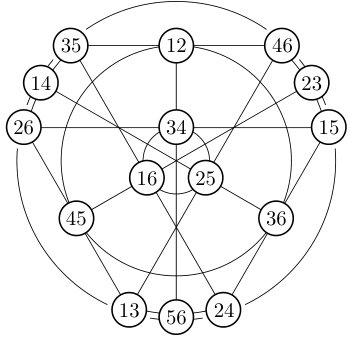 Figure 1
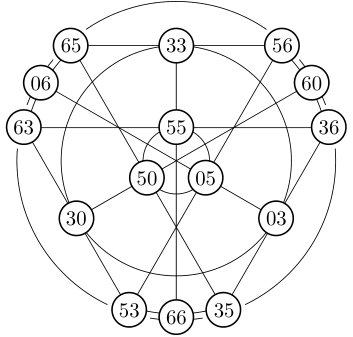 Figure 1
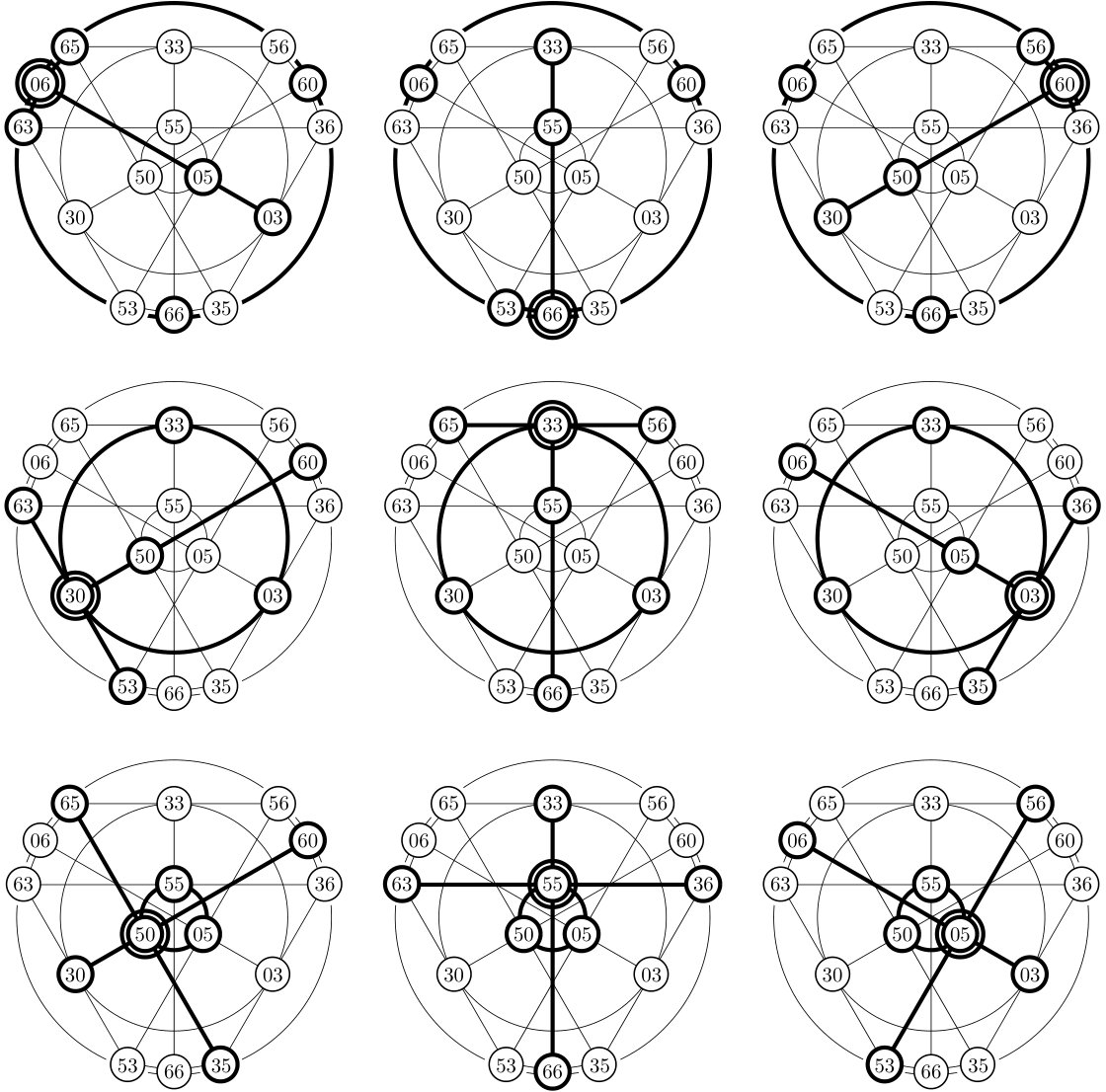 Figure 2
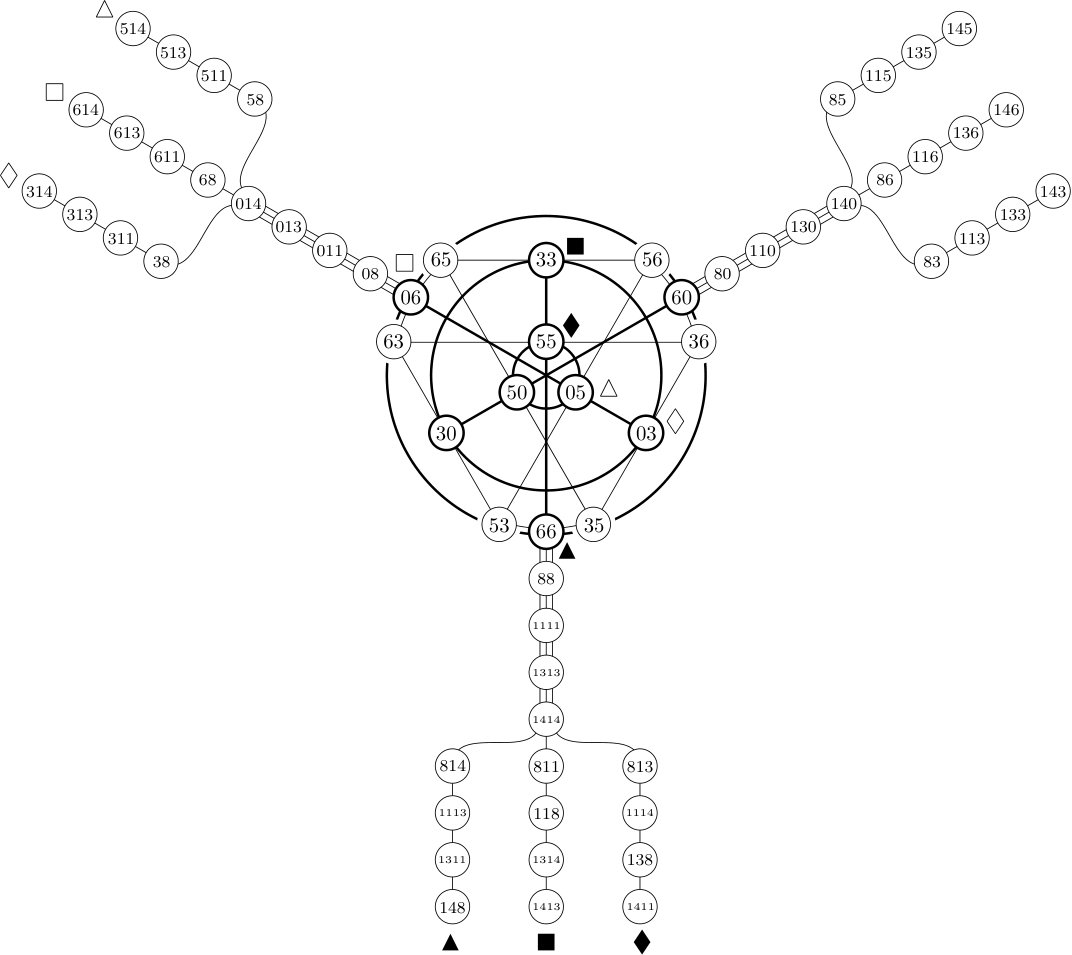 Figure 3
| 0 | |||||||||
|---|---|---|---|---|---|---|---|---|---|
| 1 | |||||||||
| 2 | |||||||||
| 3 | |||||||||
| 4 | |||||||||
| 5 | |||||||||
| 6 | |||||||||
| 7 | |||||||||
| 8 | |||||||||
| 9 | |||||||||
| 10 | |||||||||
| 11 | |||||||||
| 12 | |||||||||
| 13 | |||||||||
| 14 | |||||||||
| 15 |
Peer Reviews
No public reviews on file for this paper yet. If you reviewed it on a platform where reviews are public (OpenReview, ICLR, NeurIPS, ICML), you can paste yours below so the community can read it here.
Videos
No videos yet. Explain this paper in a talk, walkthrough, or lecture? Add one.
**Doily as Subgeometry of a Set of Nonunimodular
Free Cyclic Submodules**
Metod Saniga1 and Edyta Bartnicka2
1Astronomical Institute of the Slovak Academy of Sciences,
SK-05960 Tatranská Lomnica, Slovak Republic
and
2University of Warmia and Mazury, Faculty of Mathematics and Computer Science, Słoneczna 54 Street, P-10710 Olsztyn, Poland
Abstract
It is shown that there exists a particular associative ring with unity of order 16 such that the relations between nonunimodular free cyclic submodules of its two-dimensional free left module can be expressed in terms of the structure of the generalized quadrangle of order two. Such a doily-centered geometric structure is surmised to be of relevance for quantum information.
Keywords: associative ring with unity – free cyclic submodules – generalized quadrangle
Let be a finite associative ring with unity () and its free left module. The set is called a cyclic submodule of . is called free if the mapping is injective. A pair/vector () is called unimodular over if there exist such that . It is well known (see, for example, [1]) that if is unimodular, then is free. A great majority of finite rings have the property that all their free ’s are generated by unimodular vectors. Here we shall consider a specific ring where this is not true, that is, a ring that also features free ’s containing no unimodular vector; in what follows we shall call such free cyclic submodules nonunimodular. Our ring is a non-commutative one of order 16, defined as follows:
[TABLE]
Labeling the 16 matrices as follows
[TABLE]
[TABLE]
[TABLE]
[TABLE]
we see that 0 is the additive identity, 1 is the multiplicative identity and the only invertible elements are 1, 2, 4 and 7. The ring features two (two-sided) maximal ideals, namely
[TABLE]
and
[TABLE]
and its Jacobson radical reads
[TABLE]
From the above-given matrix representation of we find that contains nine distinct free cyclic submodules generated by nonunimodular vectors, which are listed in Table 1.
We shall show that the way how these free cyclic submodules are interwoven is intricately related to the structure of the generalized quadrangle of order two, the doily. To this end we employ a duad-syntheme model of the latter (see, for example, [2]). Take a six-element set . Let us call a two-element subset of a duad and a set of three duads forming a partition of a syntheme. Then the point-line incidence structure whose points are 15 duads and whose lines are 15 synthemes, with incidence being containment, is isomorphic to the doily. The structure of the doily is illustrated in Figure 1 – left. Here, the points of the doily are represented by circles, labeled by duads, and its lines are represented by nine straight segments, three concentric circles and three arcs of circles; one can readily check that each line corresponds to a syntheme. Next, we employ the following bijection between the 15 duads and 15 nontrivial vectors , where and :
[TABLE]
We thus get a new labeling of the points of the doily in terms of these particular nonunimodular vectors of , as illustrated in Figure 1 – right. From comparison of the latter figure with Table 1 it follows that each submodule shares with the doily seven vectors forming three concurrent lines – as depicted in Figure 2. From this figure one can easily discern that six lines of the doily have a different status than the other nine, as each of them belongs to three submodules. Given the fact that each point of concurrence belongs to two such lines, the nine points and the six lines are found to form inside the doily a point-line incidence structure isomorphic to the generalized quadrangle of type GQ(2,1) (see [2]).
A complete view of the relation between individual submodules is outlined in Figure 3. The pronounced automorphism of order three of the figure stems from the fact that the submodules form three disjoint triples according to the number of shared vectors. One further observes that all vectors lying on our submodules acquire values from the ideal . It can readily be verified that a completely analogous geometric structure is obtained if we take the free right module, in which case the corresponding vectors have entries from the ideal . Obviously, the two structures share the same doily, as its points are labeled by vectors from . At this point it is well worth recalling the existence of a similar geometrical structure in the case of the smallest ring of ternions and its three-dimensional free left (and also right) module [3]. There the associated geometry, referred to as the ‘Fano-snowflake,’ has its center isomorphic to the Fano plane, a generalized triangle of order two (see also [4] for generalization to an arbitrary ring of ternions).
The occurrence of the doily in this remarkable nonunimodular ring-theoretic setting is quite intriguing also in view of possible physical applications. For example, among the finite geometric concepts relevant for the theory of quantum information, the doily – though in various disguises – has been recognized to play the foremost role. First, being isomorphic to the symplectic polar space of type , it underlies the commutation relations between the elements of the two-qubit Pauli group [5] and provides us with simplest settings (namely GQ(2, 1)’s) for observable proofs of quantum contextuality. Second, being isomorphic to a non-singular quadric of type , it also lies in the heart of a remarkable magic three-qubit Veldkamp line of form theories of gravity and its four-qubit extensions [6]. Finally, being a subquadrangle of a generalized quadrangle of type GQ(2, 4), it enters in an essential way certain black-hole entropy formulas and the so-called black-hole/qubit correspondence [7]. We, therefore, believe that the above-described doily-based geometry as a whole will eventually find its way into (quantum) physics as well.
Acknowledgments
This work was supported, in part, by the Slovak VEGA Grant Agency, Project 2/0003/16, and by the National Scholarship Programme of the Slovak Republic. We are extremely grateful to Zsolt Szabó for electronic versions of the figures.
The reference list from the paper itself. Each links out to its DOI / PubMed record.
- 1[1] F. D. Veldkamp, Geometry over Rings, Handbook of Incidence Geometry (edited by F. Buekenhout), Elsevier, Amsterdam, 1995, 1033–1084.
- 2[2] S. E. Payne and J. A. Thas, Finite Generalized Quadrangles, Pitman, Boston–London–Melbourne, 1984.
- 3[3] M. Saniga, H. Havlicek, M. Planat and P. Pracna, Twin “Fano-Snowflakes” over the Smallest Ring of Ternions, SIGMA 4 (2008) Art. No. 050.
- 4[4] H. Havlicek and M. Saniga, Vectors, Cyclic Submodules and Projective Spaces Linked with Ternions, Journal of Geometry 92 (2009) 79–90.
- 5[5] M. Saniga and M. Planat, Multiple Qubits as Symplectic Polar Spaces of Order Two, Adv. Stud. Theor. Physics 1 (2007) 1–4.
- 6[6] P. Lévay, F. Holweck and M. Saniga, Magic Three-Qubit Veldkamp Line: A finite Geometric Underpinning for Form Theories of Gravity and Black Hole Entropy, Phys. Rev. D 96 (2017) Art. No. 026018.
- 7[7] L. Borsten, M. J. Duff and P. Lévay, The Black-Hole/Qubit Correspondence: An Up-To-Date Review, Class. Quant. Gravity 29 (2012) Art. No. 224008.