New reducible configurations for graph multicoloring with application to the experimental resolution of McDiarmid-Reed’s Conjecture
(extended version)
Jean-Christophe Godin a
Olivier Togni b
Abstract
A (a,b)-coloring of a graph G associates to each vertex a b-subset of a set of a colors in such a way that the color-sets of adjacent vertices are disjoint.
We define general reduction tools for (a,b)-coloring of graphs for 2≤a/b≤3.
In particular, using necessary and sufficient conditions for the existence of a (a,b)-coloring of a path with prescribed color-sets on its end-vertices, more complex (a,b)-colorability reductions are presented. The utility of these tools is exemplified on finite triangle-free induced subgraphs of the triangular lattice for which McDiarmid-Reed’s conjecture asserts that they are all (9,4)-colorable. Computations on millions of such graphs generated randomly show that our tools allow to find a (9,4)-coloring for each of them except for one specific regular shape of graphs (that can be (9,4)-colored by an easy ad-hoc process). We thus obtain computational evidence towards the conjecture of McDiarmid&Reed.
a Institut de Mathématiques de Toulon, Université de Toulon, France
[email protected]
b Laboratoire LIB, Université de Bourgogne, France
[email protected]
1 Introduction
For two integers a and b, a (a,b)-coloring of a graph G is a mapping that associates to each vertex a set of b colors from a set of a colors in such a way that adjacent vertices get disjoints sets of colors. In particular, a (a,1)-coloring is simply a proper coloring.
Equivalently, a (a,b)-coloring of G is a homomorphism to the Kneser graph Ka,b. This type of coloring is also in relation with fractional colorings: the fractional chromatic number of a graph G can be defined as χf(G)=min{a/b,G is (a,b)-colorable}.
Since the introductory paper of Stahl [14], multicoloring attracted much research, one of the most recent results being the one of Cranston and Rabern [2] showing that planar graphs are (9,2)-colorable (without using the four color theorem).
An associated problem is weighted coloring, in which the number of colors to assign can vary from vertex to vertex. Weighted coloring has a natural application for frequency allocation in cellular networks [6]. In particular, since the equidistant placement of transmitters induces a triangular lattice, weighted coloring of triangular lattices has been the subject of many studies [6, 8, 9, 12]. In most of these works, the aim is to bound the weighted chromatic number by a constant times the weighted clique number. Multicoloring is a particular case of weighted coloring; however, the fact that a graph is (a,b)-colorable can be translated into a bound for weighted chromatic number in terms of weighted clique, see [16] for instance.
Any graph with at least one edge is not (a,b)-colorable for a<2b, so it is useful to introduce e=a−2b, e symbolizing the entropy of the (a,b)-coloring. Note also that a graph is (2b,b)-colorable if and only if it is bipartite. In this paper we concentrate on the pairs (a,b) such that 2<ba≤3, thus e∈{1,…,b}. It is easy to observe that if a graph is (a,b)-colorable, then it is also (am,bm)-colorable for any m≥1. Moreover, the following decomposition property also holds: for any integer y≥1, if G is (2x+1,x)-colorable for any x∈{1,…,y}, then G is (a,b)-colorable for any a,b such that ba≥y2y+1. Hence (2b+1,b)-colorings are the extremal objectives for non-bipartite graphs.
For finite triangle-free induced subgraphs of the triangular lattice, called hexagonal graphs in this paper, it is easy to observe that they are (3,1)-colorable, and it has been proven by Havet [5] that such graphs are also (5,2)-colorable and (7,3)-colorable. Sudeep and Vishwanathan [15] then presented a simpler (14,6)-coloring algorithm and later, Sau et al. [11] a simpler (7,3)-coloring, but using the four colors theorem as a subroutine. The list version has been considered by Aubry et al. [1]. They showed that hexagonal graphs are (5m,2m)-choosable. Of course, as a hexagonal graph can have an induced 9-cycle, the best we can hope is to find a (9,4)-coloring. In 1999, McDiarmid and Reed proposed the following conjecture (initially stated in terms of weighted coloring):
Conjecture 1** (McDiarmid-Reed [8]).**
Every hexagonal graph is (9,4)-colorable.
This paper aims to define general reducible configurations for (a,b)-coloring when 2<a/b≤3, which may allow one to prove that some graphs are (a,b)-colorable. In particular, we will apply our reduction tools on triangle-free induced subgraphs of the triangular lattice, in order to solve Conjecture 1.
A part of the results is based on the Ph.D. thesis of Godin [4] that also contains reducibility results for (a,b)-choosability, even when a/b≥3.
Searching for reducible configurations is common when dealing with graph (multi)coloring. It is, for instance, a part of the discharging method, extensively used for proving colorability properties on planar or bounded maximum average degree graphs.
In the case 2<a/b≤3, reducible configurations for (a,b)-coloring take the form of induced paths in which interior vertices have degree 2 in the graph, called handles. In order to get sharper results, we have also to define more sophisticated handles by looking at the lengths of the induced paths that start at one or both of the end-vertices of the handle (in which cases we speak about S-handle and H-handle, respectively).
The paper is organized as follows: In Section 2, we define the different types of handles we will consider and present the general handle-reducibility results. As the associated proofs are technical and quite long, we postpone them to the last sections of the paper. In Section 3, we apply our reduction tools on finite triangle-free induced subgraphs of the triangular lattice, in order to try to solve Conjecture 1. We also present the results of our computations, giving empirical evidence towards the conjecture and listing some possible extensions of this work and a conjecture generalizing Conjecture 1. In Section 4, the necessary and sufficient conditions under which a path is (a,b)-colorable when its end-vertices are already precolored are determined. These results constitute the basic tools we will use to prove the results presented in Section 2. Section 5 is devoted to finding special (2b+1,b)-colorings of a path in order to prove handle-reducibility in the next section. In Section 6, we prove the reducibility results for S-handles and H-handles.
2 Handle reductions
The path Pn+1 of length n is the graph with vertex set {0,…,n} and edge set {i(i+1),i=0,1,…,n−1}.
A handle P(n) of length n in a graph G is a path of length n that is an induced subgraph of G with vertices of degree two in P(n) having the same degree in G. The interior int(H) of a handle H is the set of vertices of degree 2 of H.
A parity handle (or P-handle) PP(n) in a graph G is a handle P(n) with the additional property that there exists another path of length m≤n, of the same parity than n in G−int(P(n)), between the two end-vertices of P(n).
An S-handle S(n1,n2,n3) in a graph G is a handle of length n1 such that one of its end-vertices has degree 3 in G and is also the end-vertex of two other handles of length n2 and n3.
An H-handle H(n1,n2,n,n3,n4) in a graph G is a handle of length n such that its two end-vertices are of degree three in G and one of them is also the end-vertex of two other handles of length n1 and n2 and the other end-vertex is also the end-vertex of two handles of length n3 and n4.
Examples of handles are illustrated in Figure 1.
For a handle H=S(n1,n2,n3), the two end-vertices of the paths of length n2,n3 of H are called the ports of H and similarly for H=H(n1,n2,n,n3,n4), the four end-vertices of the paths of length n1,n2,n,n3,n4 of H are called its ports.
Due to symmetry reasons, we will consider only S-handles with n1≥n2≥n3 and H-handles with n1≤n2≤n and n4≤n3≤n.
Note that (some of) the ports of a handle may be the same vertices (hence a handle may induce a cycle in the graph).
A handle H is (a,b)-reducible in a graph G if any (a,b)-coloring of G−int(H) can be extended to a (a,b)-coloring of G, possibly, for S- and H-handles, by modifying the color sets of some vertices of degree 2 of H (other than those of int(H)).
In order to characterize graphs of list chromatic number 2, Erdös, Rubin and Taylor [3] defined the core of a graph as the graph obtained after iteratively removing vertices of degree 1.
In the same vein, for a graph G and a family F of handles in G, we define coreF(G) as any (induced) subgraph obtained after successively removing vertices of degree 0 and 1 and vertices of int(H) for each handle H∈F until no more degree 0 or 1 vertex nor handle of F remains.
By the definition of reducibility, we immediately have the following result:
Theorem 2**.**
For any graph G and any family F of (a,b)-reducible handles in G,
[TABLE]
The proofs of the following results, necessitating long case analysis, are presented in Sections 4 and 6.
Theorem 3**.**
For any graph G and any integers b,e such that b≥2 and e<b, any handle P(n) with n≥Even(2b/e) is (2b+e,b)-reducible in G and any parity handle PP(n) with n≥2 is (2b+e,b)-reducible in G.
In order to present our reducibility results on S-handles and H-handles, we first need to define an ordering among them.
For two integer vectors v=(v1,v2,…,vk),v′=(v1′,v2′,…,vk′) of Nk we consider the natural order: v≤v′ if and only if ∀i∈{1,…,k}, vi≤vi′. Therefore, we will say that an S-handle S(n1,n2,n3) is smaller than (or equal to) an S-handle S(n1′,n2′,n3′) if (n1′,n2′,n3′)≥(n1,n2,n3) and similarly for H-handles.
Theorem 4**.**
For any graph G and any integers b,e,k such that b≥max{2,e+1,k},
S(Even(2b/e)−1,2,1) is a smallest (2b+e,b)-reducible S-handle and S(2b−k,k,k) is a smallest (2b+1,b)-reducible S-handle in G.
Theorem 5**.**
For any graph G and any integers b,e such that b≥2 and e<b,
H(1,2,Even(2b/e)−2,2,1) is a smallest (2b+e,b)-reducible H-handle and the following H-handles are smallest (2b+1,b)-reducible H-handles in G:
H(2,2,2b−3,2,2), H(1,2,2b−3,3,2), H(1,4,2b−3,2,2);
H(1,2,2b−4,4,3), H(1,4,2b−4,3,3).
Remark that the above Theorem may be completed with the handle H(2,2,2b−4,3,2) that seems to be the smallest (2b+1,b)-reducible H-handle with n1=2 and n=2b−4. Its reducibility was checked by computer for b=4 but a general proof for any b seems to necessitate a very long case analysis and, as the case b=4 is sufficient for Conjecture 1, we decided to skip this proof.
Remark also that we do not try to go below 2b−4 for the third parameter of a H-handle since these results will be mainly used for the case (a,b)=(9,4) in Section 3, and for these values, we have 2b−4=4. Hence, going below 4 will result in a H-handle with n≤n3 (i.e., the handle is not ’centered’ on the longest path). Nevertheless, similar results can be obtained for lower values of n (and greater values of b). For instance, we have found by computer these complementary reducible H-handles for (a,b)=(9,4):
Proposition 6**.**
For any graph G, the H-handles H(2,2,4,3,2), H(2,3,3,4,3) and H(2,4,3,3,3) are all three (9,4)-reducible in G.
Proof.
By computer or straightforward (but long) case analysis.
∎
It can be shown (but the proof is tedious) that for the above handles, the core is in fact unique, i.e., whatever the order of the reductions made, the process will end with the same graph.
Remark 7** (Unicity of the core).**
For any graph G and the family F of all handles from Theorems 3, 4, 5 for fixed b≥2 and e<b in G, coreF(G) is unique.
3 Multicoloring triangle-free induced subgraphs of the triangular lattice
A finite triangle-free induced subgraph of the triangular grid will be called a hexagonal graph.
In a similar way to the method used by Havet [5], i.e., starting from a degree 3 vertex in a ’corner’ of the graph and exploring the configurations around it to prove that a handle from F is present, we can prove the following:
Theorem 8**.**
labelhandle
Let G be a hexagonal graph. For each of the following three families of handles we have coreF(G)=∅:
-
F={P(2)};
2. 2.
F={P(4),PP(3)};
3. 3.
F={P(6),PP(3),PP(4),PP(5),S(5,2,1),H(1,2,4,2,1)}.
This theorem along with Theorems 3, 4, 5 allow to prove the known results [5] for (a,b)-colorability of hexagonal graphs for b=1,2 and 3 in a unified way:
Corollary 9**.**
Any hexagonal graph is (3,1)-colorable, (5,2)-colorable and (7,3)-colorable.
Note that (7,3)-colorability is enough as it implies (5,2)-colorability and (3,1)-colorability.
Now, we turn our attention to (9,4)-colorings.
Consider the set of handles F9,4=P∪S∪H, with
P={P(8),PP(3),PP(4),PP(5),PP(6),PP(7)},
S={S(7,2,1),S(6,2,2),S(5,3,3),S(4,4,4)}, and
H={H(1,2,6,2,1),H(1,2,5,3,2),H(1,4,5,2,2),H(2,2,5,2,2),H(2,2,4,3,2),
H(1,2,4,4,3),H(1,4,4,3,3),H(2,3,3,4,3),H(2,4,3,3,3)}.
Note that, by Theorems 3, 4, 5 and Proposition 6, the handles of F9,4 are all (9,4)-reducible in any graph. Moreover, all the handles of F9,4 are necessary to reduce hexagonal graphs since we have examples of hexagonal graphs for which the core is not empty if we remove one of the handles from F9,4. Figure 2 shows three examples of hexagonal graphs that only possess handles from H (the graph on the left contains only handles H(2,4,4,4,2) (hence also H(2,2,4,3,2)), the one on the center only handles H(1,2,6,2,1) and the one on the right only handles H(2,2,4,4,2).
3.1 More (9,4)-reducible handles
In order to (try to) prove Conjecture 1, the computational experiments we made lead us to find a set F9,4′ of more sophisticated (9,4)-reducible configurations that we call Cyclic H-handles. The 25 configurations of F9,4′ are presented in Figure 3. These configurations are in fact H-handles with some additional constraints (other paths of prescribed length between some ports). Note that each of these configurations is reduced by removing the interior of the central path (between big white vertices). Note also that sometimes the distance between two ports along this central path may be lower than 8, meaning that if the central path is removed, there will be no more constraints on the 4-color sets of the two ports (like for the top left configuration of Figure 3 where the bottom left and bottom right ports are at distance 7). But in this case, it can be observed that there is always a second path between the two ports of the same parity and with lower than or equal length than the one going through the central path.
Proposition 10**.**
For any graph G, every handle from F9,4′ from Figure 3 is (9,4)-reducible in G.
Proof.
By computer (see Section 3.2 for the method and link to the code).
∎
As we will see in Section 3.3, we experimentally observed that the reducible configurations from F9,4∪F9,4′ are sufficient to obtain an empty core starting from any hexagonal graph, i.e., to completely (9,4)-color it, except if the graph contains the graph of Figure 4 as a subgraph.
However, we further present in Table 6 of Appendix References a new set F9,4′′ of (more complex) (9,4)-reducible configurations obtained by extending S-handles and H-handles on one or two ports. The (9,4)-reducibility of each of these configurations has been tested with the computer.
3.2 Testing configurations with the computer
In order to test that the configurations of F9,4′ and F9,4′′ are each (9,4)-reducible, we used the computer.
The general process was to test that by assigning any 4-color-set on each of the ports of the configuration, it is always possible to complete the (9,4)-coloring of the other vertices of the configuration.
To reduce the complexity (and running time), we take into account the symmetry in colors. Let us illustrate on an example of a H-handle (with 4 ports and possibly with cycles, like the ones of Figure 3). There are (49)=126 4-color-sets and 4 ports, hence 1265=252047376 assignments to test. However, by permuting the colors, we can always consider that the first port is given the color set C1={1,2,3,4}, which we write as C1=1234 for short. For the second port, we can restrict to 5 4-color-sets given by the vectors v=(i,4−i),i∈[0−4] where i is the number of colors shared with C1 (and 4−i is the number of colors in [5−9]). Hence we can assign to Port 2 the color-sets from C2={1234,1235,1256,1567,5678} for instance.
Then for the third port, depending on the number of shared colors between the color-sets of Port 1 and Port 2, there can be 5, 9, 19, 14, or 22 4-color-sets:
C_{3}=\left\{\begin{array}[]{ll}C_{2},&ifc(v_{2})=1234,\\
\{1234,1235,1236,1245,1246,1256,1267,1456,1467,1567,1678,&\\
4567,4678,5678,6789\}&ifc(v_{2})=1235,\\
\{1234,1235,1237,1256,1257,1278,1345,1347,1356,1357,1378,&\\
1567,1578,1789,3456,3457,3478,3567,3578,3789,5678,5789\}&ifc(v_{2})=1256,\\
\{1234,1235,1238,1256,1258,1289,1567,1568,1589,2345,2348,&\\
2356,2358,2389,2567,2568,2589,5678,5689\}&ifc(v_{2})=1567,\\
\{1234,1235,1239,1256,1259,1567,1569,5678,5679\}&ifc(v_{2})=5678.\\
\end{array}\right.
For the fourth port, we then test the 126 color-sets (this could also be optimized by looking at the sets chosen in C2 and C3 but we do not do it).
Thus, in total, we have reduced the total number of assignments to test from 1265 to (5+15+22+19+9)126=8820.
The Python program TestReducibility.py developed for checking reducibility of a configuration of type S,H,S′,S′′,H′,H′′ and those of Figure 3 can be accessed at https://github.com/otogni/MCD-coloring.git.
3.3 Computational reducibility experiments
We have performed computational experiments for testing the reduction tools defined in the previous section on hexagonal graphs for finding a (9,4)-coloring. The algorithms were coded in C++ and ran on an Intel Xeon CPU at 2.67 GHz and 24 GB of memory. The C++ source code can be accessed at https://github.com/otogni/MCD-coloring.git.
Experiment 1: Random generation
**Graph generation: ** The graphs are generated randomly on a grid of size ℓ×h (the triangular lattice is considered as a square lattice with diagonals) by choosing randomly the coordinates of a point and testing if the corresponding vertex can be added to the graph without creating a triangle (repeated 5ℓh times). In order to obtain the ’harder’ instances of random hexagonal graphs, we then do a final pass in which we consider the points of the grid in sequence and test if they can be added to the graph. Hence the graphs obtained are maximal triangle-free subgraphs of the triangular lattice, i.e., no point in the area can be added without creating a triangle.
**Reduction algorithm: ** it consists in testing, for each vertex x in sequence, if x is the end-vertex of a handle from F9,4 or F9,4′.
Table 1 presents some measures of Experiment 1: the mean number of nodes (degree-3 vertices) and time needed to generate and completely reduce the graph depending on the side-length of the grid n (the square root of the grid’ size). One can observe that even for a hexagonal graph with hundreds of thousands degree-3 vertices (and around 2M vertices in total), our reduction algorithm can still construct a (9,4)-coloring in a reasonable time, even if it is far from being optimized.
Since the graphs generated in Experiment 1 have all been reduced, we tried to build more complex and ’hard’ to reduce hexagonal graphs. For this, our intuition tells us that hexagonal graphs with many 9-cycles will be harder to reduce. Experiments in this direction lead us to generate semi-random hexagonal graphs with many 9-cycles by using the flower graph depicted on the left of Figure 2, as explained in the following experiment.
Experiment 2: Semi-random generation
**Graph generation: ** The graphs Gp,d are generated by starting from an empty grid of size ℓ×h and then first putting flower graphs isomorphic to the graph depicted on the left of Figure 2 in a quasi-regular pavement, i.e., a flower is positioned in coordinates (pi+rij1+5,pj+rij2+5), for 0≤i<h/15 and 0≤j<ℓ/15, with p≥10 being a parameter for controlling the distance between flowers (observing that p=11 produces a maximum number of hard instances) and rij1,rij2 being random integers between 0 and d. Note that d has to be small enough compared to p in order to avoid triangles. The obtained graph is then completed randomly in order to obtain a maximal induced triangle-free subgraph of the triangular grid, as described in Experiment 1.
Reduction algorithm: it consists in testing, for each vertex x in sequence, if x is the end-vertex of a handle from F9,4 or F9,4′.
Again, the Reduction algorithm has been tested on hundreds of millions of semi-random graphs (mainly for grid size 50×50) and it allows to reduce completely all the graphs except for G9,0 which is always a subgraph of the regular lattice containing faces of length 6 and 9 obtained by translating the graph of Figure 4. For such a graph, the reduction process always falls into a non-reducible configuration. However, this tilling can be easily (9,4)-colored using only 9 4-subsets of {0,…,8} by extending the precoloring of Figure 4.
Note that our reduction algorithm is very basic and could be improved in many ways, for instance by searching first for reducible configurations on its boundary instead of looking at each node in sequence.
3.4 Possible Extensions
Even if we were not able to completely solve Conjecture 1 by hand, we made a progress by providing many new reducible configurations that may be used to obtain a proof of the conjecture in a similar way as for proving such graphs are (7,3)-colorable, i.e., showing that in any hexagonal graph, there always exists one of these (9,4)-reducible configurations somewhere in (the periphery of) the graph. Maybe these new configurations are not enough for such a proof and one will have to find other reducible configurations. In particular, we believe that there are many (9,4)-reducible configurations with a cycle and 3 or 4 paths of prescribed lengths going outside the cycle, other than the 25 configurations of Figure 3 but we did not try to find them exhaustively.
Another possible direction is to restrict to subclasses of hexagonal graphs, for instance we can ask: is any hexagonal graph with odd-girth 11 (9,4)-colorable? or even (11,5)-colorable?
We thus propose the following conjecture that generalizes Conjecture 1:
Conjecture 11**.**
For any k≥1, any hexagonal graph G of odd-girth at least 2k+1 is (2k+1,k)-colorable.
The conjecture is true for k≤3 and for k=4 for hexagonal graphs G such that coreF9,4∪F9,4′∪F9,4′′(G)=∅.
A more general (but weaker) result in this direction is the one of Klostermeyer and Zhang [7] proving that any planar graph with odd girth at least 10k−7 (and k≥2) is (2k+1,k)-colorable.
The three-dimensional generalization (called cannonball graph [13]) also seems interesting. One question could be: Is any triangle-free subgraph of the 3D triangular grid (5,2)-colorable?
4 Path multicoloring
In this section we present general results about (a,b)-colorings of a path with precolored end-vertices. As a corollary, we will obtain Theorem 3.
Recall that a,b,e are three integers such that a=2b+e.
We say that X is a good set if ∣X∣=b and X⊂{1,…,a}.
Definition 12**.**
Let X,Y be good sets and k be an integer. The sets X and Y are said to be k-compatible if :
[TABLE]
[TABLE]
Moreover, if the above two inequalities are equalities, we say that X and Y are k-exactly-compatible.
The following result is already proven in [6, Lemma 4] in a different way.
Theorem 13**.**
For any integer n≥0, if φ is a (a,b)-coloring of the path Pn+1, then
φ(0) and φ(n) are n-compatible.
Proof.
Let φ be a (a,b)-coloring of the path Pn+1. The assertion trivially holds for n=0. If n=1 then since v0 and v1 are neighbors, we have φ(0)∩φ(1)=∅ then ∣φ(0)∩φ(1)∣=0≤0. If n=2 then we have φ(0)∩φ(1)=φ(1)∩φ(2)=∅, so b+e=a−b=∣{1,…,a}∖φ(1)∣≥∣φ(0)∪φ(2)∣=2b−∣φ(0)∩φ(2)∣, then ∣φ(0)∩φ(2)∣≥b−e.
Assume that the property is true for n≥2 even. Let φ be a (a,b)-coloring of Pn+2, then φ(0) and φ(n) are n-compatible, i.e. ∣φ(0)∩φ(n)∣≥b−e2n and φ(n) and φ(n+2) are 2-compatible, i.e., ∣φ(n)∩φ(n+2)∣≥b−e. So ∣φ(0)∩φ(n+2)∣≥∣φ(0)∩φ(n)∩φ(n+2)∣≥∣φ(0)∩φ(n)∣−∣(φ(0)∩φ(n))∖φ(n+2)∣≥(b−e2n)−e=b−e2n+2.
Assume now that the property is true for n≥1 odd. Let φ be a (a,b)-coloring of Pn+2, then since φ(0), φ(n) are n-compatible and φ(n), φ(n+2) are 2-compatible, we have ∣φ(0)∩φ(n)∣≤e2n−1, and ∣φ(n)∩φ(n+2)∣≥b−e. So ∣φ(0)∩φ(n+2)∣=∣φ(0)∩φ(n)∩φ(n+2)∣+∣(φ(0)∩φ(n+2))∖φ(n)∣≤∣φ(0)∩φ(n)∣+∣φ(n+2)∖φ(n)∣≤e2n−1+e≤e2(n+2)−1.
∎
For any two good sets C0,Cn, we define the canonical decomposition of subsets:
[TABLE]
For an (a,b)-coloring φ of the path Pn+1, we define ∀j∈{1,2,3,4} and ∀k∈{0,…,n} :
[TABLE]
[TABLE]
Therefore ∀j∈{1,2,3,4} and ∀k∈{0,…,n−1}, we have the property:
[TABLE]
Proposition 14**.**
If φ is a (a,b)-coloring of the path Pn+1 such that n=2m is an even integer and b≥em and φ(0) and φ(n) are n-exactly-compatible, then ∀k∈{0,…,n}:
[TABLE]
Proof.
Let n=2m be an even integer such that b≥em and let C0,Cn be two n-exactly-compatible good sets. Then we have by construction ∣C(1)∣=b−em, ∣C(2)∣=∣C(3)∣=em, and ∣C(4)∣=a−∣C(1)∣−∣C(2)∣−∣C(3)∣=b−e(m−1).
If φ is a (a,b)-coloring of the path Pn+1 such that φ(0)=C0 and φ(n)=Cn, then ∀k∈{0,…,n}:
If k=2s is even, then by Theorem 13, φ(k) and φ(n) are (n−k)-compatible and thus ∣φ(k)∩φ(n)∣≥b−e2n−k=b−e(m−s); φ(k) and φ(0) are k-compatible and thus ∣φ(k)∩φ(0)∣≥b−e2k=b−es.
So ∣φ(k)∖φ(0)∣≤es and thus c(3,k)≤es. Since ∣C(1)∣=b−em and ∣φ(k)∩φ(n)∣≥b−e(m−s) then c(3,k)≥es, so c(3,k)=es. Since c(1,k)+c(2,k)=∣φ(k)∩φ(0)∣≥b−es, and c(1,k)+c(2,k)+c(3,k)+c(4,k)=b, then c(4,k)=0 and c(1,k)+c(2,k)=b−es. Since c(1,k)+c(3,k)=∣φ(k)∩φ(n)∣≥b−e(m−s), we have c(1,k)≥b−em=∣C(1)∣, and thus c(1,k)=b−em and c(2,k)=e(m−s).
If k=2s+1 is odd, by the above, we have c(2s)=(b−em,e(m−s),es,0) and c(2s+2)=(b−em,e(m−s−1),e(s+1),0). Since ∣C(1)∣=b−em=c(1,2s) then c(1,k)=0. Since ∣C(2)∣=em and c(2,2s)=e(m−s) then c(2,k)≤es. Since ∣C(3)∣=em and c(3,2s+2)=e(s+1) then c(3,k)≤e(m−s−1). Since ∣C(4)∣=b−e(m−1) then c(4,k)≤b−e(m−1). But c(1,k)+c(2,k)+c(3,k)+c(4,k)=b, therefore all the inequalities are equalities.
∎
Proposition 15**.**
If φ is a (2b+1,b)-coloring of the path Pn+1 such that n=2m+1 is an odd integer and b≥em and φ(0) and φ(n) are n-exactly-compatible, then ∀k∈{0,…,n}:
[TABLE]
Proof.
Let n=2m+1 be an odd integer such that b≥em and let C0,Cn be two n-exactly-compatible good sets. Then we have by construction ∣C(1)∣=em, since ∣C0∣=∣Cn∣=b then ∣C(2)∣=∣C(3)∣=b−em , since ∣C(1)∣+∣C(2)∣+∣C(3)∣+∣C(4)∣=a then ∣C(4)∣=e(m+1).
If φ is a (a,b)-coloring of the path Pn+1 such that φ(0)=C0 and φ(n)=Cn, then ∀k∈{0,…,n} :
If k=2s is even, then by Theorem 13, then φ(k) and φ(n) are (n−k)-compatible and thus ∣φ(k)∩φ(n)∣≤e2n−k−1=e(m−s); φ(k) and φ(0) are k-compatible and thus ∣φ(k)∩φ(0)∣≥b−e2k=b−es. We have c(1,k)=∣φ(0)∩φ(k)∣−c(2,k)≥b−es−∣φ(2)∣=e(m−s). Since ∣φ(k)∩φ(n)∣≤e(m−s) we have c(1,k)≤e(m−s), then c(1,k)=e(m−s). Therefore c(2,k)=b−em and c(3,k)=0. Since c(1,k)+c(2,k)+c(3,k)+c(4,k)=b, then c(4,k)=es.
If k=2s+1 is odd, by the above properties, we have c(2s)=(e(m−s),b−em,0,es) and c(2s+2)=(e(m−s−1),b−em,0,e(s+1)). Since ∣C(2)∣=b−em, then c(2,k)=0. Since ∣C(1)∣=em, then c(1,k)≤es. Since ∣C(4)∣=e(m+1), then c(4,k)≤e(m−s). Since c(1,k)+c(2,k)+c(3,k)+c(4,k)=b, then c(3,k)≥b−em=∣C(3)∣, therefore all the inequalities are equalities.
∎
In order to obtain a reciprocal result of Theorem 13, we define, for any ordered set I={x1,…,xf} (with x1<x2⋯<xf),
First(k,I)={x1,…,xk}, and Last(k,I)={xf−k+1,…,xf}. We have the following easy useful fact:
[TABLE]
Lemma 16**.**
If C0,Cn are good sets such that C0 and Cn are n-exactly-compatible, then a (a,b)-coloring φ of the path Pn+1 such that φ(0)=C0 and φ(n)=Cn can be computed in linear time.
Proof.
Let C0,Cn be good n-exactly-compatible sets.
If n=2m is even, then by Proposition 14, ∀k∈{0,…,n} we set:
[TABLE]
If n=2m+1 is odd, then by Proposition 15, ∀k∈{0,…,n} we set:
[TABLE]
Therefore we obtain in both cases in linear time a (a,b)-coloring φ of Pn+1 such that φ(0)=C0 and φ(n)=Cn.
∎
Lemma 17**.**
If C0,C2n are good sets such that ∣C0∩C2n∣≥b−e, then a (a,b)-coloring φ of the path P2n+1 such that φ(0)=C0 and φ(2n)=C2n can be computed in linear time.
Proof.
Let C0,C2n be good sets such that ∣C0∩C2n∣≥b−e, then ∣C0∪C2n∣≤2b−(b−e)=b+e. Hence there exists a good set X⊂{1,…,a}−C0−C2n. We set φ(0)=C0, and ∀k∈{1,…,2n}, φ(k)=C2n if k is even, and φ(k)=X otherwise. Therefore this linear time algorithm computes a (2b+e,b)-coloring φ of the path P2n+1 such that φ(0)=C0 and φ(2n)=C2n.
∎
These lemmas allow to prove the next result which is central in this paper as it will be used several times in the next sections.
Theorem 18**.**
If C0,Cn are n-compatible sets, then a (a,b)-coloring φ of the path Pn+1 such that φ(0)=C0 and φ(n)=Cn can be computed in linear time.
Proof.
Let C0,Cn be good n-compatible sets.
If n is even, let k=2s∈{0,…,n} be an even integer such that b−es≤∣C0∩Cn∣<b−es+e. Let X⊂C0∩Cn such that ∣X∣=b−es ; and Y=Cn−C0, then es≥∣Y∣>es−e. Let Z⊂{1,…,a}−C0−Cn such that ∣Z∣=es−∣Y∣. We choose Ck=X∪Y∪Z, then Ck is a good set and ∣C0∩Ck∣=b−es, therefore by Lemma 16, a (a,b)-coloring φ of the path Pk such that φ(0)=C0 and φ(k)=Ck can be computed in linear time. By construction ∣Ck∩Cn∣>b−e and n−k is even, then by Lemma 17, we can complete the coloring for the rest of the path (between vk and vn) in linear time.
If n is odd, let k=2s+1∈{0,…,n} be an odd integer such that es≤∣C0∩Cn∣<es+e. Let X⊂C0∩Cn such that ∣X∣=es; and Y⊂Cn−C0 such that ∣Y∣=b−es−e. Let Z⊂{1,…,a}−C0−Cn such that ∣Z∣=e. We choose Ck=X∪Y∪Z, then Ck is a good set and ∣C0∩Ck∣=es, therefore by Lemma 16, a (a,b)-coloring φ of a path Pk such that φ(0)=C0 and φ(k)=Ck can be computed in linear time. By construction ∣Ck∩Cn∣=b−e and n−k is even, then by Lemma 17, we can complete the coloring for the rest of the path (between vk and vn) in linear time.
∎
If C0,Cn are good sets such that n≥Even(e2b), then they are n-compatible and therefore we have the following result:
Corollary 19**.**
If C0,Cn are good sets such that n≥Even(e2b), then a (a,b)-coloring φ of the path Pn+1 such that φ(0)=C0 and φ(n)=Cn can be computed in linear time.
Proposition 20**.**
If a graph G contains a parity handle H and G−int(H) is (a,b)-colorable, then G is (a,b)-colorable.
Proof.
Let H=(v0,…,vn) be a parity handle of length n in G such that there exists a (a,b)-coloring φ of G−int(H).
Then, by definition, there exists another path P′=(v0′=v0,v1′,…,vn′′=vn) in G−int(H) with n≥n′ and n and n′ having the same parity.
We extend the coloring φ by setting ∀k∈{0,…,n′},φ(vk)=φ(vk′), and ∀k∈{n′+1,…,n}, φ(vk)=φ(vn′′) if k−n′ is even and φ(vk)=φ(vn′−1′) otherwise. ∎
This proposition along with Corollary 19 allows to prove Theorem 3.
5 Properties of (2b+1,b)-colorings of a path
This section contains a series of lemmas presenting properties on the color sets of some interior vertices of a path with a given (2b+1,b)-coloring. These lemmas will be used in Section 6 to reduce the number of cases to consider when proving the reducibility of some H-handles.
Remember that the vertices of a path Pn+1 are denoted by v0,v1,…,vn and that for any two good sets C0,Cn,
C(1)=C0∩Cn , C(2)=C0−Cn , C(3)=Cn−C0 , C(4)={1,…,a}−C0−Cn.
Lemma 21**.**
For any (2b+1,b)-coloring φ of P5, there exist four distinct good sets X1, X2, X3 and X4, such that
(i)
∣X1∩X2∣=∣X1∩X3∣=b−1, ∣X1∩X4∣=b−2, and
(ii)
for each i∈{1,2,3,4}, there exists a (2b+1,b)-coloring φ′ of P5 such that φ′(v0)=φ(v0), φ′(v4)=φ(v4) and φ′(v2)=Xi.
Proof.
Let φ be a (2b+1,b)-coloring of P5 and let C0=φ(v0) and C4=φ(v4). By Theorem 13, ∣C(1)∣=∣C0∩C4∣≥b−2. Thus we have three cases to consider:
Case 1:
∣C(1)∣=b. We choose any Y⊂C(1), any Y1⊂C0−Y, Y2=C0−Y−Y1, any Z,Z′⊂{1,…,a}−C0, such that ∣Y∣=b−2, and ∣Z∣=∣Z′∣=∣Y1∣=∣Y2∣=1. Then we set X1=Y∪Y1∪Z, X2=C0, X3=Y∪Y1∪Z′, and X4=Y∪Y2∪Z′.
Case 2:
∣C(1)∣=b−1. We choose any Y⊂C(1), and any Z,Z′⊂{1,…,a}−C0−C4, such that ∣Y∣=b−2, and ∣Z∣=∣Z′∣=1, and we set X1=C(1)∪Z, X2=C0, X3=C(1)∪Z′ and X4=Y∪(C0−C(1))∪(C4−C(1)).
Case 3:
∣C(1)∣=b−2. Then we note C(2)=Y2∪Y2′ and C(3)=Y3∪Y3′, with ∣Yi∣Yi′∣=∣=1, for i=1,2, and we set X1=D1∪Y2∪Y3, X2=C(1)∪Y2∪Y3′, X3=C(1)∪Y2′∪Y3, and X4=C(1)∪Y2′∪Y3′.
For each case and each i∈{1,2,3,4}, the pairs (C0,Xi) and (Xi,C4) are both 2-compatible and thus Theorem 18 allows to conclude.
∎
Lemma 22**.**
For any (2b+1,b)-coloring φ of P6, there exist two distinct sets X and Y such that ∣X∣=∣Y∣=2 and for any x∈X and y∈Y there exists a (2b+1,b)-coloring φ′ of P5 such that φ′(v0)=φ(v0), φ′(v5)=φ(v5) and {x,y}⊂φ′(v2).
Proof.
Let φ be a (2b+1,b)-coloring of P6 and let C0=φ(v0) and C5=φ(v5). By Theorem 13, ∣C(1)∣≤2 and thus ∣C(2)∣≥b−2.
Case 1:
∣C(1)∣=0. We choose any I⊂C0, X=C0−I and any Y⊂{1,…,a}−C0, such that ∣I∣=b−2, and ∣Y∣=2.
Case 2:
∣C(1)∣≥1. We choose any I⊂C(2), X=C0−I and Y⊂C(4) such that ∣I∣=b−2 and ∣Y∣=2.
For each case and each x∈X,y∈Y, by construction, C0,I∪{x,y} are 2-compatible and I∪{x,y},C5 are 3-compatible, hence Theorem 18 allows to conclude.
∎
Lemma 23**.**
For any (2b+1,b)-coloring φ of P2n+2 with n≤b−1, there exist two distinct sets X and Y, such that ∣X∣=b−n and ∣Y∣=n+1, and for any Y′⊂Y such that ∣Y′∣=n, there exists a (2b+1,b)-coloring φ′ of P2n+2 such that φ′(v0)=φ(v0), φ′(v2n+1)=φ(v2n+1) and φ′(v1)=X∪Y′.
Proof.
Let n≤b−1 and φ be a (2b+1,b)-coloring of P2n+2 and let C0=φ(v0) and C2n+1=φ(v2n+1). We have ∣C(1)∣≤n and thus ∣C(3)∣≥b−n. We choose any X⊂C(3) with ∣X∣=b−n and Y={1,…,a}−X−C0. For any Y′⊂Y such that ∣Y′∣=n, we let C1=X∪Y′. Then ∣C0∩C1∣=0 and ∣C2n+1∩C1∣≥b−n, therefore Theorem 18 allows to conclude.
∎
Lemma 24**.**
For any (2b+1,b)-coloring φ of P4n+1 with 2n≤b, there exists a set X⊂{1,…,a} such that ∣X∣=b+2n, and for any X′⊂X with ∣X′∣=n, there exists a (2b+1,b)-coloring φ′ of P4n+1 such that φ′(v0)=φ(v0), φ′(v4n)=φ(v4n) and X′⊂φ′(v2n).
Proof.
Let 2n≤b and φ be a (2b+1,b)-coloring of P4n+1. Let C0=φ(0) and C4n=φ(4n).
Case 1:
∣C(1)∣≥b−n. We choose any set X⊂{1,…,a} with ∣X∣=b+2n, and for any X′⊂X such that ∣X′∣=n, we choose any I⊂C(1) such that ∣I∣=b−n, and we choose any Y⊂C(4) such that ∣Y∣=∣I∩X′∣. We then set C2n=I∪X′∪Y.
Case 2:
∣C(1)∣≤b−n−1. Let i=b−n−∣C(1)∣. We choose any set X with C0∪C4n⊂X⊂{1,…,a} and ∣X∣=b+2n, and for any X′⊂X such that ∣X′∣=n, we choose any Y2 with X′∩C(2)⊂Y2⊂C(2) and ∣Y2∣=max(i,∣C(2)∩X′∣), and we choose any Y3 with X′∩C(3)⊂Y3⊂C(3) and ∣Y3∣=max(i,∣C(3)∩X′∣), and we choose any Z with X′∩C(4)⊂Z⊂X−C(1)−Y2−Y3 and ∣Z∣=b−∣C(1)∣−∣Y2∣−∣Y3∣. Such choice is always possible since ∣X′∩C(4)∣≤∣X−C0−C4n∣=b+2n−(b+n+i)=n−i. We then set C2n=C(1)∪Y2∪Y3∪Z.
In both cases, the pairs (C0,C2n) and (C2n,C4n) are both 2n-compatible and thus Theorem 18 allows to conclude.
∎
Lemma 25**.**
For any (2b+1,b)-coloring φ of P4n+3 with 3≤2n+1≤b, there exists a set X⊂{1,…,a} with ∣X∣=b+2n+1, and for any X′⊂X such that ∣X′∣=n+1, there exists a (2b+1,b)-coloring φ′ of P4n+3 such that φ′(v0)=φ(v0), φ′(v4n+2)=φ(v4n+2) and X′∩φ′(v2n+1)=∅.
Proof.
Let φ be a (2b+1,b)-coloring of P4n+3 and 3≤2n+1≤b. Let C0=φ(v0) and C4n+2=φ(v4n+2).
Case 1:
∣C(1)∣≥b−n. Let i=b−∣C(1)∣. We choose any set X⊂{1,…,a} such that ∣X∣=b+2n+1. For any X′⊂X such that ∣X′∣=n+1, if ∣C(4)−X′∣≥b then we choose any good set I⊂C(4)−X′ and we set C2n+1=I; otherwise we choose I=C(4)−X′, so ∣I∣=b−i+1−∣X′∩C(4)∣. If ∣I∣≥b−n, then we choose any Y⊂C0−X′ such that ∣Y∣=b−∣I∣ and we set C2n+1=I∪Y. Else (∣I∣<b−n), we let Y2=C(2)−X′. If ∣C(3)−X′∣≥b−∣I∣−∣Y2∣, then we choose Y3⊂C(3)−X′ such that ∣Y3∣=b−∣I∣−∣Y2∣ and we set C2n+1=I∪Y2∪Y3. Otherwise, ∣C(3)−X′∣<b−∣I∣−∣Y2∣, and then we choose Y3=C(3)−X′. By construction we have ∣I∣+∣Y2∣+∣Y3∣=∣C(4)∣+∣C(2)∣+∣C(3)∣−(n+1)+∣X′∩C(1)∣≥b+i−n, then we choose any Z⊂C(1)−X′ such that ∣Z∣=b−∣I∣−∣Y2∣−∣Y3∣ and we set C2n+1=I∪Y2∪Y3∪Z.
Case 2 :
∣C(1)∣≤b−n−1. Let i=b−n−∣C(1)∣. We choose any set C0∪C4n⊂X⊂{1,…,a} such that ∣X∣=b+2n+1, and for any X′⊂X such that ∣X′∣=n+1, we choose I=C(4)−X′. If ∣C(2)−X′∣≥n, then we choose Y2⊂C(2)−X′ such that ∣Y2∣=n. If ∣C(3)−X′∣≥b−∣I∣−∣Y2∣ then we choose Y3⊂C(3)−X′ such that ∣Y3∣=b−∣I∣−∣Y2∣ and we set C2n+1=I∪Y2∪Y3. Otherwise, ∣C(3)−X′∣<b−∣I∣−∣Y2∣, so b−n=∣C(3)∣+∣C(4)∣−∣X′∣<b−∣Y2∣=b−n, a contradiction. We do the same with ∣C(3)−X′∣≥n. Else ∣C(2)−X′∣<n and ∣C(3)−X′∣<n, then we choose Y2=C(2)−X′. If ∣C(3)−X′∣≥b−∣I∣−∣Y2∣, then we choose Y3⊂C(3)−X′ such that ∣Y3∣=b−∣I∣−∣Y2∣ and we set C2n+1=I∪Y2∪Y3. Otherwise, ∣C(3)−X′∣<b−∣I∣−∣Y2∣, so b+1≤b+∣C(3)∣−n=∣C(3)∣+∣C(4)∣+∣C(2)∣−∣X′∣<b, a contradiction.
Therefore by Theorem 18, the lemma is proved.
∎
6 S-handle and H-handle reductions
The purpose of this section is to prove Theorems 4 and 5 of Section 2.
For an S-handle S(n,n1,n2), let P=h0,h1,⋯,hn be the central path and let v1 and v2 be the end-vertices of the paths of lengths n1 and n2, respectively. Similarly, for a H-handle H(n1,n2,n,n3,n4), P=h0,h1,⋯,hn is the central path and v1 and v2, v3 and v4 are the end-vertices of the paths of lengths n1, n2, n3 and n4, respectively. See Figure 5 for an illustration.
Proposition 26**.**
For any b,e with b≥e and any graph G, S(Even(e2b)−1,2,1) is a smallest (2b+e,b)-reducible S-handle in G.
Proof.
Let n=Even(e2b)−1.
For the minimality, we present a counter-example showing that S(Even(e2b)−1,1,1) is not reducible: if C(v1)={1,…,b}, C(v2)={e+1,…,b+e}, C(hn)={b+e+1,…,2b+e}, then the color set of h0 must be {b+e+1,…,2b+e} but then the color sets of h0 and hn are not n-compatible, hence a contradiction. Also, the handle S(Even(e2b)−2,2,1) is not reducible since in this case there is a path between v2 and hn of length e2b−2+1<e2b, hence the coloring cannot be extended to the interior vertices of the handle if these two vertices have the same color set.
In order to prove reducibility, let G be a graph containing a handle H=S(n,2,1) and φ be a (2b+e,b)-coloring of G−int(H). Let X=φ(hn). We have ∣φ(v1)∩φ(v2)∣≤e, thus there exists I⊂φ(v2)−φ(v1) such that ∣I∣=b−e. If ∣X∩({1,…,a}−I−φ(v1))∣≤e, then there exists Y⊂{1,…,a}−I−φ(v1)−X such that ∣Y∣=e. Otherwise, ∣X∩({1,…,a}−I−φ(v1))∣>e, and there exists Y′⊂({1,…,a}−I−φ(v1))∩X such that ∣Y′∣=e−∣{1,…,a}−I−φ(v1)−X∣. We then choose Y=({1,…,a}−I−φ(v1)−X)∪Y′. By construction, ∣X∩(I∪Y)∣≤b−e≤e2Even(e2b)−2, hence by Theorem 18, there exists a (2b+e,b)-coloring φ′ of H such that φ′(v1)=φ(v1), φ′(v2)=φ(v2), φ′(hn)=X and φ′(h0)=I∪Y.
∎
Proposition 27**.**
For any graph G and any integer k with 2≤k≤b, S(2b−k,k,k) is a smallest (2b+1,b)-reducible S-handle in G.
Proof.
Let n=2b−k.
The minimality follows from the fact that the handles S(2b−k,k,k−1) and S(2b−k−1,k,k) are both not reducible since in both of them there is a path of length 2b−1 between v2 and hn, hence the color sets of these two vertices must share at least b−1 common colors.
Let G be a graph containing a handle H=S(2b−k,k,k), with k an integer such that 2≤k≤b, and let φ be a (2b+1,b)-coloring of G−int(H).
Let φ(v1)=C0 and φ(v2)=C2k. Then C0,C2k are 2k-compatible. We are going to construct a good set Ck such that Ck,C0 and Ck,C2k are both k-compatible and Ck,φ(hn) are (2b−k)-compatible. Then, Theorem 18 will assert that there exists a (2b+1,b)-coloring φ′ of H, such that φ′(hn)=φ(hn), φ′(v1)=φ(v1)=C0 and φ′(v2)=φ(v2)=C2k.
Case 1 :
k=2m is even. By Lemma 24 there exists X such that ∣X∣=b+2m, then ∣X∩φ(vn)∣≥b+2m+b−a=2m−1≥m, so there exists X′⊂X∩φ(hn) such that ∣X′∣=m and X′⊂Ck. Therefore ∣Ck∩φ(hn)∣≥m=b−22b−k.
Case 2 :
k=2m+1 is odd. By Lemma 25 there exists X such that ∣X∣=b+2m+1, then ∣X∩φ(hn)∣≥b+2m+1+b−a=2m≥m+1, so there exists X′⊂X∩φ(hn) such that ∣X′∣=m+1 and X′∩Ck=∅. Therefore ∣Ck∩φ(hn)∣≤b−(m+1)=2(2b−k)−1.
∎
6.1 H-handle reductions
Proposition 28**.**
For any b,e with b≥e and any graph G, H(1,2,Even(e2b)−2,2,1) is a smallest (2b+e,b)-reducible H-handle in G.
Proof.
Let n=Even(e2b)−2.
For the minimality, it can be observed that H(1,1,n,2,1) and H(1,2,n−1,2,1) are both not reducible since the first one is in fact an S-handle S(n,2,1) and is not reducible by Proposition 26 and the second one has a path of length 1+n−1+1=n+1<Even(e2b) between two of its extremities and thus is not reducible.
Now let G be a graph containing a handle H=H(1,2,n,2,1) and let φ be a (2b+e,b)-coloring of G−int(H). Let v2′ be the common neighbor of h0 and v2 and v3′ be the common neighbor of hn and v3.
By hypothesis, ∣φ(v1)∩φ(v2)∣≤e and ∣φ(v3)∩φ(v4)∣≤e, hence ∣φ(v2)−φ(v1)∣≥b−e and ∣φ(v3)−φ(v4)∣≥b−e. Let X⊂φ(v2)−φ(v1) and X′⊂φ(v3)−φ(v4) such that ∣X∣=∣X′∣=b−e. We are going to show that sets Y⊂{1,…,a}−φ(v1) and Y′⊂{1,…,a}−φ(v4) can be chosen in such a way that C0=X∪Y and Cn=X′∪Y′ are n-compatible, i.e., ∣C0∩Cn∣≥e. Then, Theorem 18 will assert that there exists a (2b+e,b)-coloring φ′ of H, such that φ′(h0)=C0, φ′(hn)=Cn.
Let L(hn)={1,…,a}−φ(v4) and L(h0)={1,…,a}−φ(v1). If ∣X∩X′∣≥e, then ∣C0∩Cn∣≥e. Hence assume ∣X∩X′∣=z<e.
If ∣(L(hn)−X′)∩X∣≥e−z, then we choose Y′ such that ∣Y′∩X∣≥e−z, therefore ∣C0∩Cn∣≥e. Otherwise ∣(L(hn)−X′)∩X∣=t<e−z. If ∣(L(v0)−X)∩X′∣≥e−z−t, then we choose Y such that ∣Y∩X′∣≥e−z−t, therefore ∣C0∩Cn∣≥e. Otherwise ∣(L(v0)−X)∩X′∣=t′<e−z−t. We note z′=∣(L(v0)−X)∩(L(hn)−X′)∣. Since a≥∣L(v0)∪L(hn)∣=2b+2e−z−z′−t−t′, we have z+z′+t+t′≥e. We choose Y0⊂(L(v0)−X)∩(L(hn)−X′) such that ∣Y0∣=e−z−t−t′. We choose Y,Y′ such that Y_{0}\cup\big{(}(L(h_{n})-X^{\prime})\cap X\big{)}\subset Y^{\prime} and Y_{0}\cup\big{(}(L(v_{0})-X)\cap X^{\prime}\big{)}\subset Y, therefore ∣C0∩Cn∣≥e.
∎
In order to shorten some proofs for H-reducibility, we will use the two following lemmas.
Lemma 29**.**
Let n≥1 and G be a graph. If H(n1,n2,n,n3,n4) is (a,b)-reducible in G and H(n1,n2,n−1,n3+1,n4+1) is (a,b)-reducible in G when the color-sets of v3,v4 are (n3+n4+2)-exactly-compatible, then H(n1,n2,n−1,n3+1,n4+1) is (a,b)-reducible in G.
Proof.
Let n≥1. Let H be a handle H(n1,n2,n−1,n3+1,n4+1) in G and φ be a (a,b)-coloring of G−int(H). Assume H(n1,n2,n,n3,n4) is (a,b)-reducible in G, and H(n1,n2,n−1,n3+1,n4+1) is (a,b)-reducible in G for φ(v3),φ(v4) being (n3+n4+2)-exactly-compatible. If φ(v3),φ(v4) are (n3+n4+2)-exactly-compatible then it is true by hypothesis. Otherwise φ(v3),φ(v4) are (n3+n4)-compatible. Then, by hypothesis, there exists a (a,b)-coloring φ′ of H′=H(n1,n2,n,n3,n4) with φ′(vi′)=φ(vi), where vi′ is the end-vertex of the path of length ni of H′, i=1,…,4. Now we complete the coloring of G:
to each vertex of the paths of H of length n1,n2, and n−1 starting at h0 we associate the color of the corresponding vertex in H′; for the two neighbors of hn−1 along the paths towards v3 and v4 we assign the color φ′(hn′); for the remaining subpaths of lengths n3 and n4 of H, we use the colors of the corresponding paths of the same lengths in H′.
We obtain a (a,b)-coloring of H that completes the (a,b)-coloring φ of G, hence H is (a,b)-reducible in G.
∎
By symmetry and adding the new condition n1<n4 in order to fulfill our convention, we have this lemma:
Lemma 30**.**
Let n≥1 and n1<n4. If H(n1,n2,n,n3,n4) is (a,b)-reducible in G and H(n1+1,n2+1,n−1,n3,n4) is (a,b)-reducible in G when the color-sets of v1,v2 are (n1+n2+2)-exactly-compatible, then H(n1+1,n2+1,n−1,n3,n4) is (a,b)-reducible in G.
Proposition 31**.**
For any graph G, the H-handles H(2,2,2b−3,2,2), H(1,2,2b−3,3,2) and H(1,4,2b−3,2,2) are the smallest (2b+1,b)-reducible H-handles H(n1,n2,n,n3,n4) with n=2b−3 in G.
Proof.
For proving minimality, we have the necessary condition n1+n4≥2b−(2b−3)=3. Moreover, we have n4<3. If n1=1 then n3≥n4=2. Therefore H(1,2,2b−3,2,2) could be the smallest (2b+1,b)-reducible handle. However there exists a counter example even for H(1,3,2b−3,2,2): C(v1)={1,…,b}, C(v2)={1,…,b−2}∪{2b,2b+1}, C(v4)={b+1,…,2b−1}∪{2b+1}, C(v3)={b+1,…,2b}. Therefore, there remain only three configurations to be tested: H(1,2,2b−3,3,2), H(1,4,2b−3,2,2), and H(2,2,2b−3,2,2).
We now consider each of these three H-handles in turn and prove that it is (2b+1,b)-reducible. Let n=2b−3.
H=H(2,2,2b−3,2,2).
Let φ be a (2b+1,b)-coloring of G−int(H).
We are going to show that there exist two (2b−3)-compatible sets C and C′ that can be given to vertices h0 and hn. By Lemma 21 there exist four sets Xi′,i∈{1,2,3,4} for the vertex hn with ∣X1′∩X4′∣=b−2. Let I=φ(v1)∩φ(v2) and I′=φ(v3)∩φ(v4).
By hypothesis, both φ(v1) and φ(v2) and φ(v3) and φ(v4) are 4-compatible. Hence the size of both I and I′ is between b−2 and b. We then consider three cases depending on the values of ∣I∣ and ∣I′∣.
Case 1.
∣I∣=b or ∣I′∣=b. Assume without loss of generality that ∣I∣=b. Then either there exists i∈{1,4} such that ∣I∩Xi′∣≤b−2 and thus we can set C=I and C′=Xi′ or we have ∣I∩Xi′∣≥b−1 for all i∈{1,2,3,4}. In this case, we can set C=X1′ and C′=X4′.
Case 2.
∣I∣=b−1 or ∣I′∣=b−1. Assume without loss of generality that ∣I∣=b−1. Since ∣X1∩X4∣=b−2, then there exists i∈{1,4} such that ∣I∩Xi′∣≤b−2 and thus we can set C=I∪{x} and C′=Xi′, with x∈{1,…,a}−I−Xi′.
Case 3.
∣I∣=∣I′∣=b−2. If there exist x∈φ(v1)−I, y∈φ(v2)−I and i∈{1,4} such that ∣(I∪{x,y})∩Xi′∣≤b−2 then we can set C=I∪{x,y} and C′=Xi′. Otherwise ∣(I∪{x,y})∩Xi′∣=b−1, then X1′=φ(v1) and X4′=φ(v2) then φ(v1)=I∪{x,x′},φ(v2)=I∪{y,y′},φ(v3)=I∪{x,y} and φ(v4)=I∪{x′,y′}. In this case we can choose C=I∪{x,y′} and C′=I∪{x′,y}.
H=H(1,2,2b−3,3,2).
Let φ be a (2b+1,b)-coloring of G−int(H).
If ∣φ(h0)∩φ(hn)∣≤b−2, then φ(h0) and φ(hn) are (2b−3)-compatible, therefore by Theorem 18 we conclude. Else ∣φ(h0)∩φ(hn)∣>b−2. By Lemma 22 there exists I,Y and Z such that ∣I∣=b−2 and ∣Y∣=∣Z∣=2. Let Y=Y1∪Y2 and Z=Z1∪Z2, with ∣Yi∣=∣Zi∣=1, i=1,2. If there exists i,j∈{1,2} such that ∣φ(h0)∩(I∪Yi∪Zj)∣≤b−2, then we conclude. Otherwise for any i,j∈{1,2}, ∣φ(h0)∩(I∪Yi∪Zj)∣>b−2, then without loss of generality, φ(h0)=I∪Y. But Lemma 23 allows to construct another coloring φ′ with ∣φ′(h0)∩φ(h0)∣=b−1 and thus I∪Z=φ′(h0)=I∪Y.
Hence there exists i,j∈{1,2} such that ∣φ′(h0)∩(I∪Yi∪Zj)∣≤b−2, allowing to conclude.
H=H(1,4,2b−3,2,2).
Let φ be a (2b+1,b)-coloring of G−int(H). Then φ(v1) and φ(v2) are 5-compatible and φ(v3) and φ(v4) are 4-compatible. If ∣φ(h0)∩φ(hn)∣≤b−2, then φ(h0) and φ(hn) are (2b−3)-compatible, therefore by Theorem 18 we conclude. Else ∣φ(h0)∩φ(hn)∣>b−2. By Lemma 21 we have 4 good sets X1′, X2′, X3′ and X4′ for the vertex hn, and by Lemma 23, there exists a set X such that ∣X∣=b−2 and a set Y={y1,y2,y3} such that the three good sets C1=X∪{y1,y2}, C2=X∪{y1,y3} and C3=X∪{y2,y3} can be given to vertex h0. If there exists i,j∈{1,2,3,4} with i=4, such that ∣Xj′∩Ci∣≤b−2, then we conclude. Else ∀i,j∈{1,2,3,4} with i=4, we have b≥∣Xj′∩Ci∣>b−2, and since ∣X1′∩X4′∣=b−2, then for all j∈{1,4} and for all i∈{1,2,3} we have the formula ∣Xj′∩Ci∣=b−1, so X1′∩X4′⊂Ci⊂X1′∪X4′. Without loss of generality, y1∈X1′, thus by the formula with i=1,j=1 we have y2∈/X1′. Therefore by the formula with i=3,j=1 we have y3∈X1′, a contradiction with the formula with i=2,j=1.
∎
Proposition 32**.**
For any graph G, the H-handles H(1,2,2b−4,4,3), and H(1,4,2b−4,3,3) are the smallest (2b+1,b)-reducible H-handles H(n1,n2,n,n3,n4) with n1=1 and n=2b−4 in G.
Proof.
For proving minimality, we have the necessary condition n1+n4≥2b−(2b−4)=4. Hence, as n1=1, then n3≥n4=3. If n2≤3 then we can construct a simple counter example for H(1,3,2b−4,3,3): C(v1)={1,…,b}, C(v2)={3,…,b+2}, C(v4)={b+3,…,2b+1}∪{b+1}, C(v3)={b+2,…,2b+1}.
Therefore there remain two possibilities in total: H(1,2,2b−4,4,3) and H(1,4,2b−4,3,3).
We consider each of these two H-handles in turn and prove that it is (2b+1,b)-reducible in G.
H=H(1,2,2b−4,4,3).
Let φ be a (2b+1,b)-coloring of G−int(H). We note C0=φ(v1), C3=φ(v2), C0′=φ(v4) and C7′=φ(v3), then C0,C3 are 3-compatible, and C0′,C7′ are 7-compatible. By Proposition 31, H(1,2,2b−3,3,2) is (2b+1,b)-reducible, and by Lemma 29, there only remains to prove that H is reducible in the case C0′,C7′ are 7-exactly-compatible.
We are going to show that there exist two sets of b colors C1 and C3′ that can be given to vertices h0 and hn, respectively.
We note C0′∩C7′=Y1′∪Y2′∪Y3′, I′=C7′−C0′, I′′={1,…,2b+1}−C7′−C0′=Z1′∪Z2′∪Z3′∪Z4′, D1′=I′∪Y1′∪Z1′∪Z2′, D2′=I′∪Y2′∪Z3′∪Z4′, D3′=I′∪Y3′∪Z1′∪Z4′ and D4′=I′∪Y2′∪Z2′∪Z3′.
By Lemma 23 there exist two (distinct) good sets D1 and D2, for C1. If there exists i∈{1,2} and j∈{1,2,3,4} such that ∣Dj′∩Di∣≥2, then we set C1=Di and C3′=Dj′. Else for any i∈{1,2} and j∈{1,2,3,4} we have ∣Dj′∩Di∣≤1. However ∣(D1′∪D2′∪D3′)∩Di∣≥b+4+b−a=3 and ∣(D1′∪D4′∪D3′)∩Di∣≥3. Thus ∣Dj′∩Di∣=1 and ∣(D1′∪D2′∪D3′)∩Di∣=∣(D1′∪D4′∪D3′)∩Di∣=3. Then for any i=1,2, C0′∩C7′⊂Di and Di∩(I′∪I′′)=∅, and therefore Di=C0′, a contradiction with D1=D2.
H=H(1,4,2b−4,3,3).
Let φ be a (2b+1,b)-coloring of G−int(H), we note C0=φ(v1), C5=φ(v2), C0′=φ(v4) and C6′=φ(vn), then C0,C5 are 5-compatible and C0′,C6′ are 6-compatible. By Proposition 31, H(1,4,2b−3,2,2) is (2b+1,b)-reducible and, by Lemma 29, there only remains to prove the reduction for the case C0′,C6′ are 6-exactly-compatible.
We are going to show that there exist two sets of b colors C1 and C3′ that can be given to vertices h0 and hn, respectively.
We note C0′−C6′=Y1′∪Y2′∪Y3′, C6′−C0′=Z1′∪Z2′∪Z3′, I′={1,…,2b+1}−C6′−C0′, D1′=I′∪Y1′∪Z1′, D2′=I′∪Y2′∪Z2′ and D3′=I′∪Y3′∪Z3′. By Lemma 23 there exist I such that ∣I∣=b−2, and X=X1∪X2∪X3 such that D1=I∪X1∪X2, D2=I∪X1∪X3 and D3=I∪X2∪X3. For any i,j∈{1,2,3}, if ∣Dj′∩Di∣≥2, then we set C1=Di and C3′=Dj′. Else for any i,j∈{1,2,3} we have ∣Dj′∩Di∣≤1. However ∣(D1′∪D2′∪D3′)∩Di∣≥b+3+b−a=2. Thus I∩I′=∅ and if X1⊂I′ then (I∪X2∪X3)∩(D1′∪D2′∪D3′)=∅, a contradiction. Proceeding similarly for X2,X3, we are in the case that X∩I′=∅ and thus ∣(I∪X)∩((C0′−C6′)∪(C6′−C0′))∣≥b+1+6+b−2−a=4. Hence, without lost of generality, (C0′−C6′)∪Z1′⊂I∪X, a contradiction with ∣D1′∩Di∣≤1.
∎
Appendix A Other reducible (9,4)-configurations

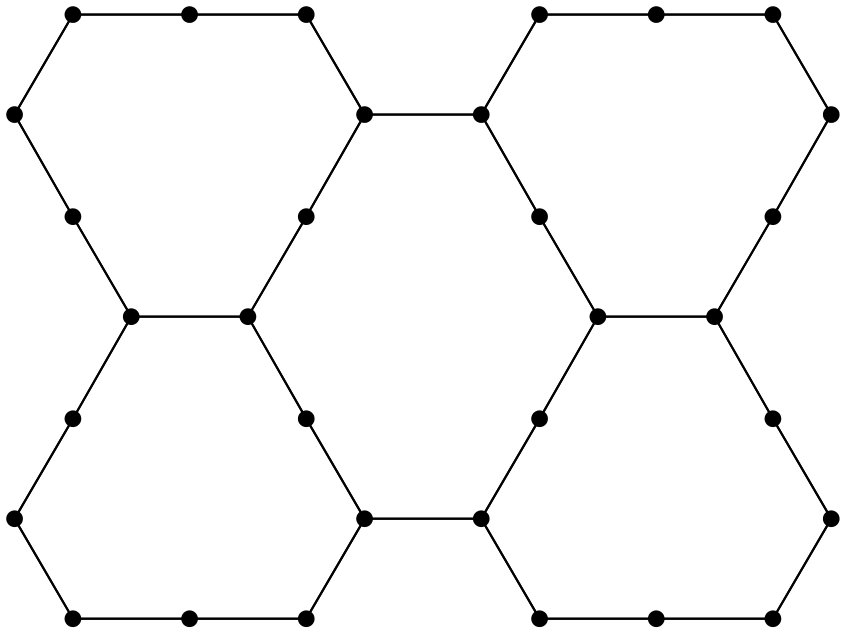 Figure 1
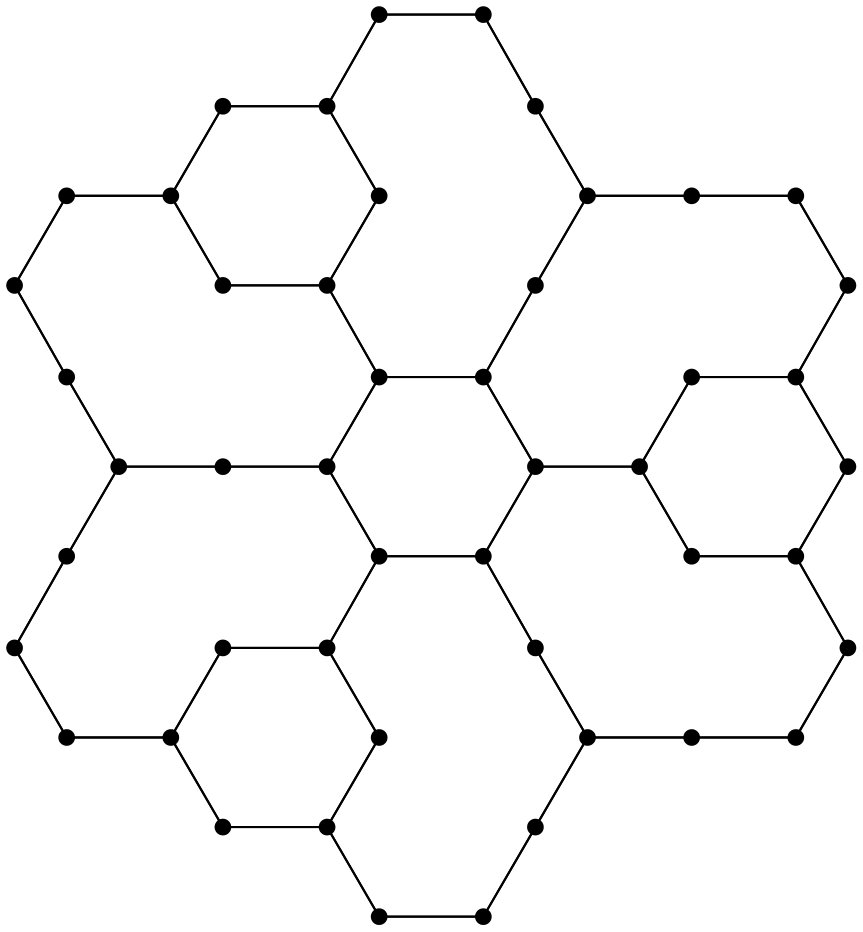 Figure 2
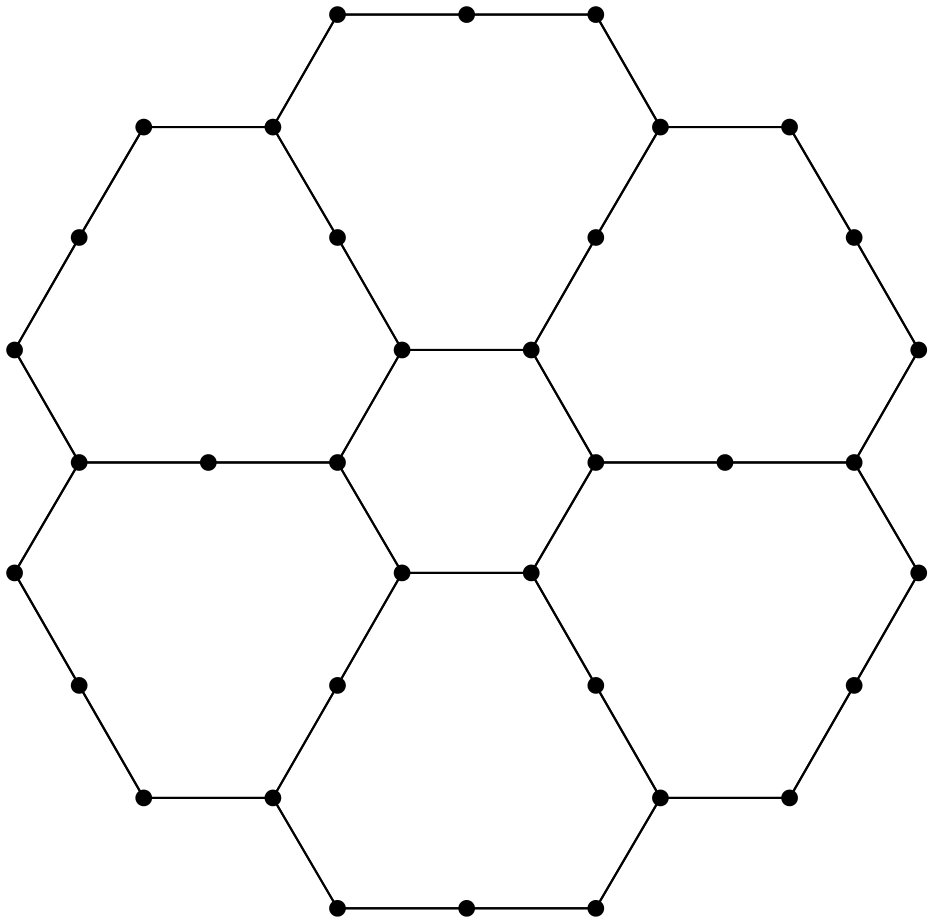 Figure 3
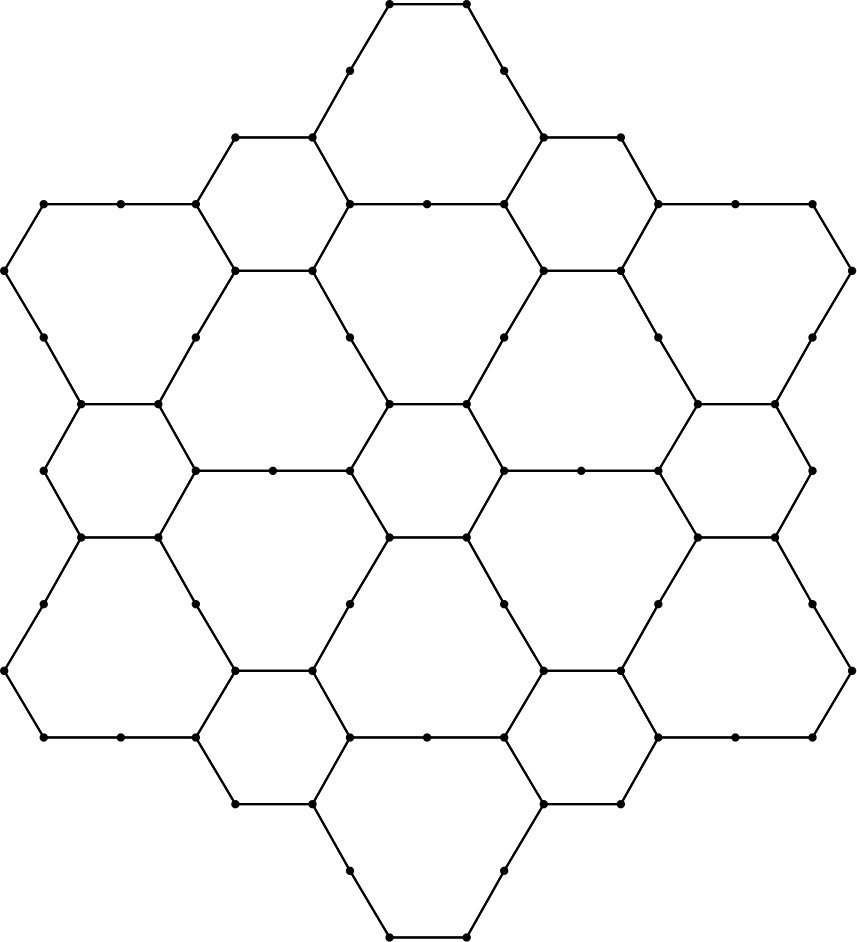 Figure 4
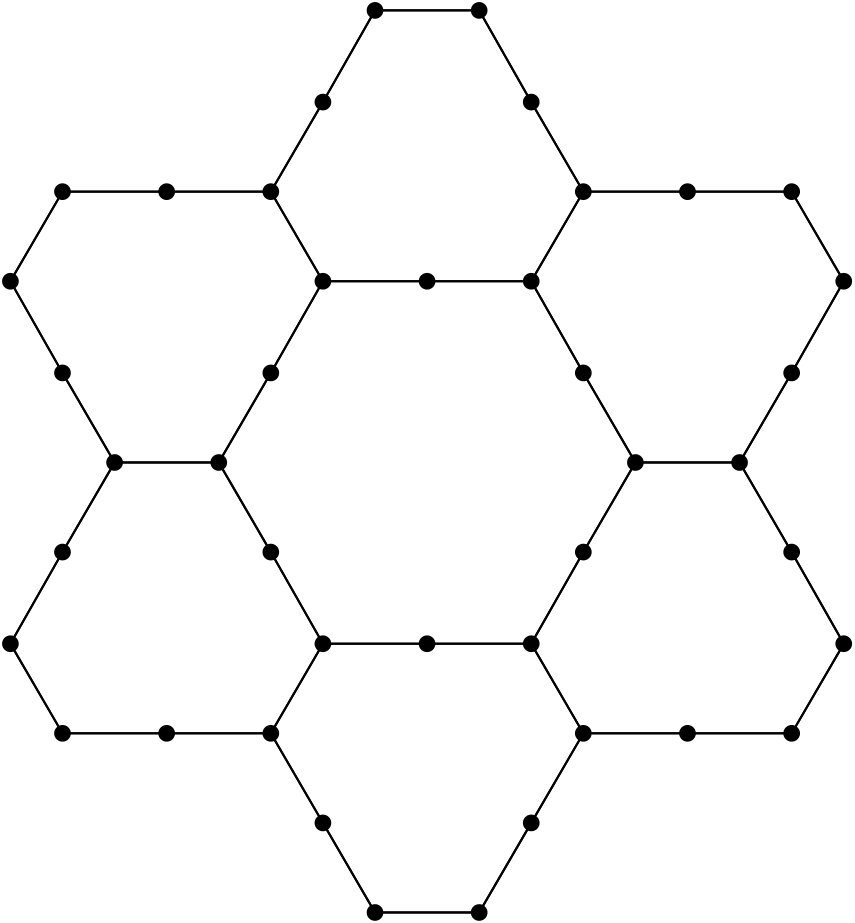 Figure 5