Revealing the nature of non-equilibrium phase transitions with quantum trajectories
Valentin Link, Kimmo Luoma, Walter T. Strunz

TL;DR
This paper uses quantum state diffusion to analytically study non-equilibrium phase transitions in a driven, damped collective spin system, providing exact results and insights into phase behavior and critical phenomena.
Contribution
It offers a mostly analytical, finite-size defect-free analysis of non-equilibrium quantum phase transitions using quantum trajectories, revealing phase symmetry breaking and critical exponents.
Findings
Exact critical exponents determined
Finite size scaling analyzed
Non-algebraic transition behavior explained
Abstract
A damped and driven collective spin system is analyzed by using quantum state diffusion. This approach allows for a mostly analytical treatment of the investigated non-equilibrium quantum many body dynamics, which features a phase transition in the thermodynamical limit. The exact results obtained in this work, which are free of any finite size defects, provide a complete understanding of the model. Moreover, the trajectory framework gives an intuitive picture of the two phases occurring, revealing a spontaneously broken symmetry and allowing for a qualitative and quantitative characterization of the phases. We determine exact critical exponents, investigate finite size scaling, and explain a remarkable non-algebraic behaviour at the transition in terms of torus hopping.
Click any figure to enlarge with its caption.
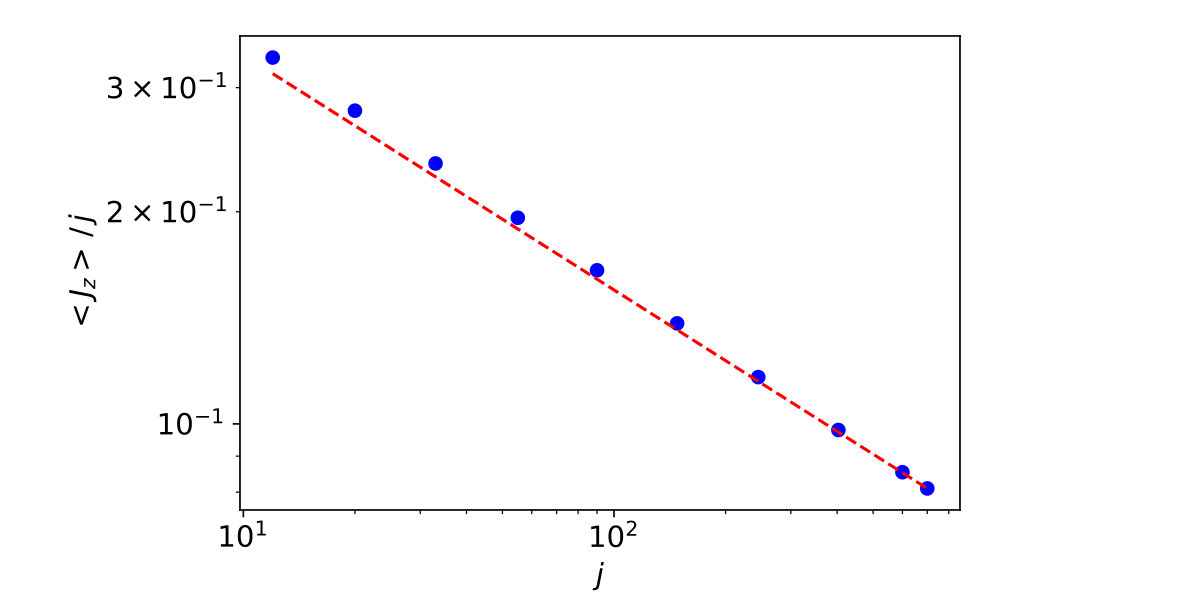 Figure 1
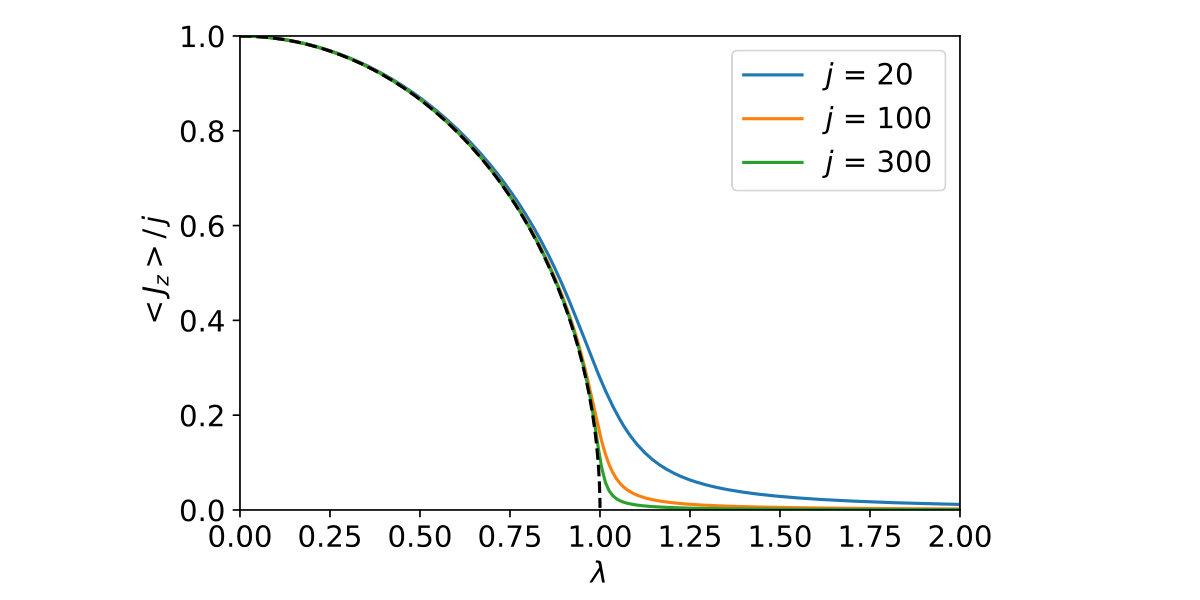 Figure 2
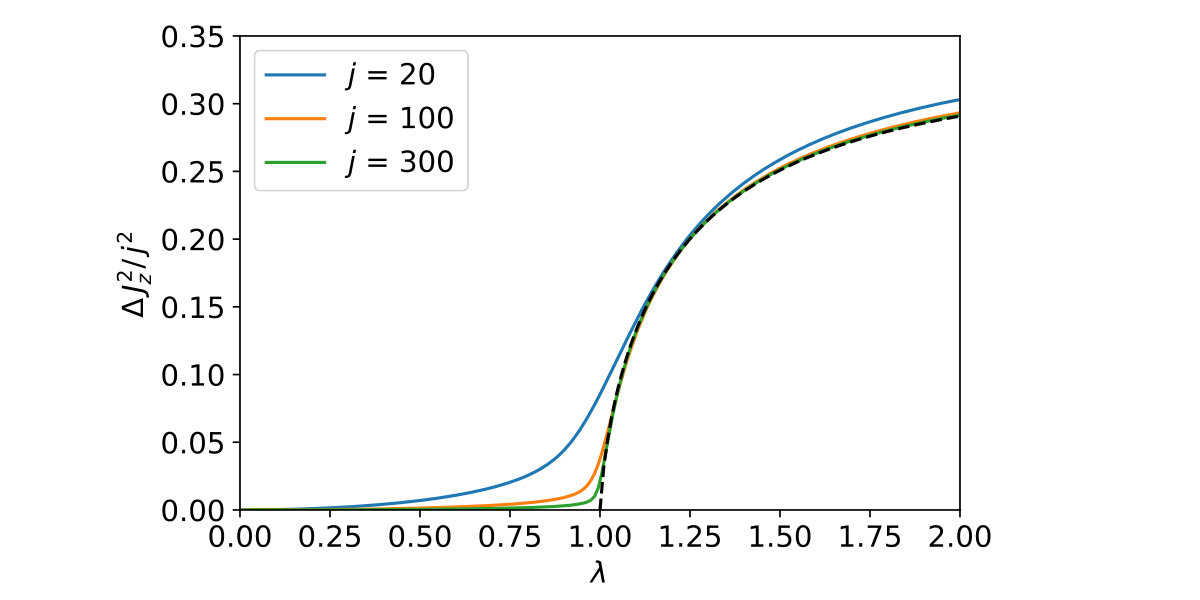 Figure 3
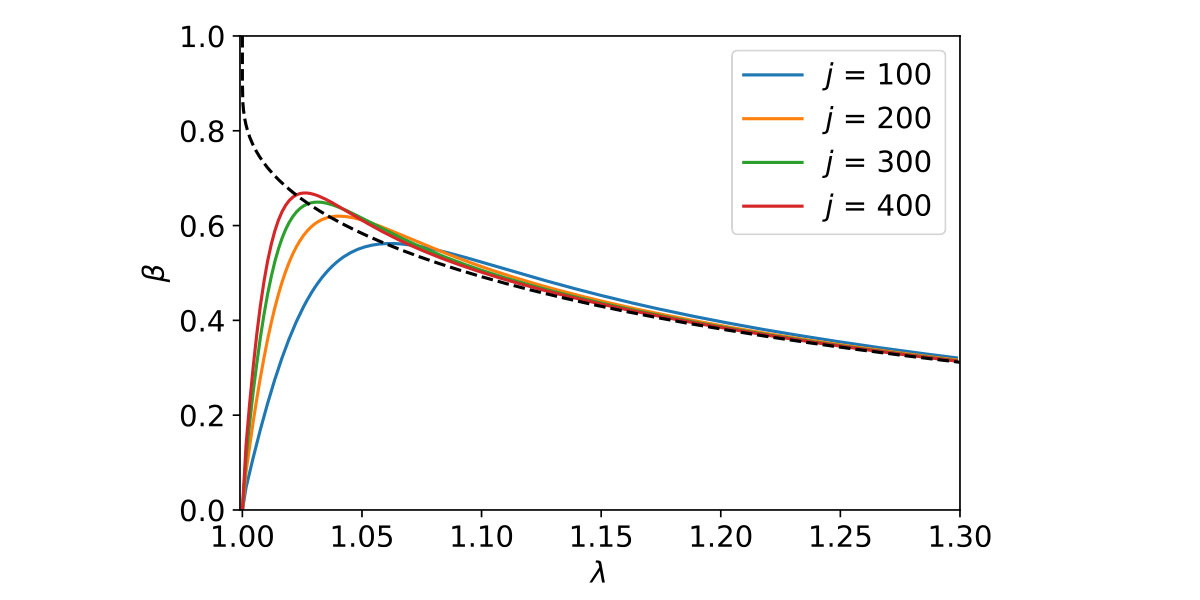 Figure 4
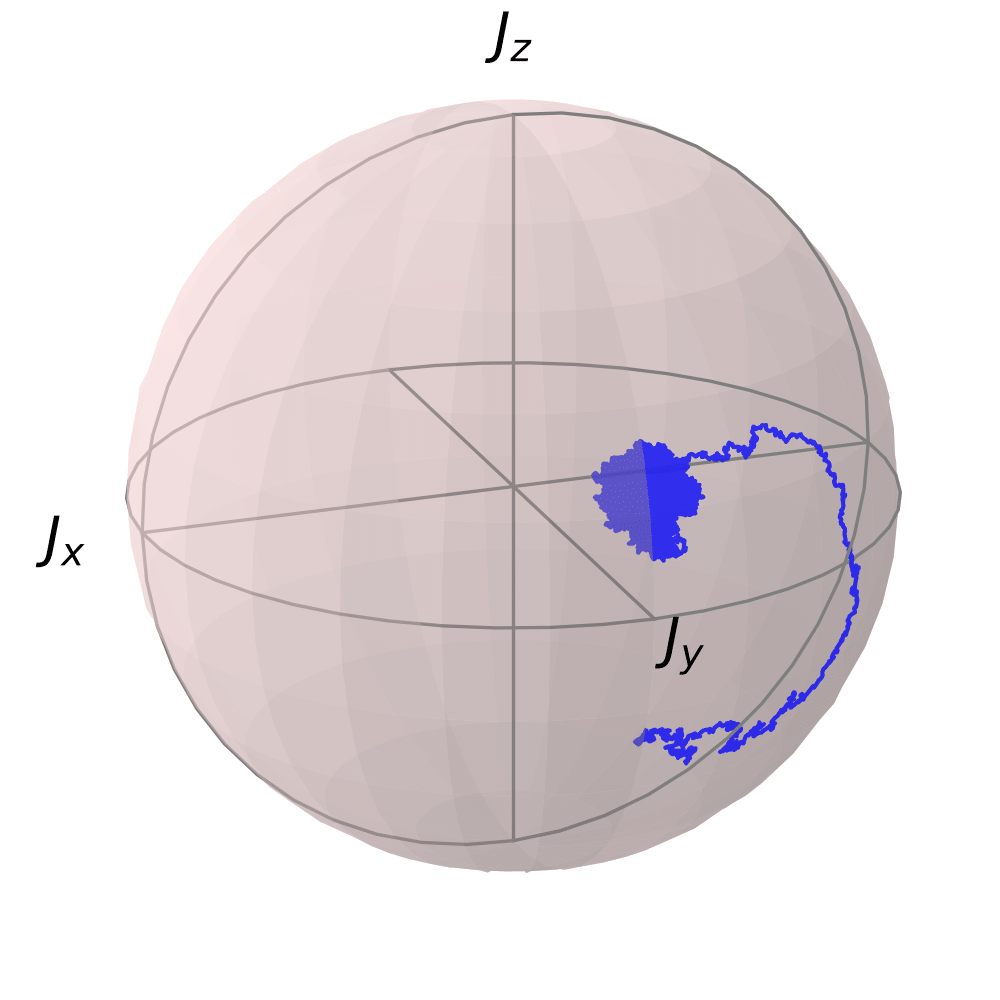 Figure 5
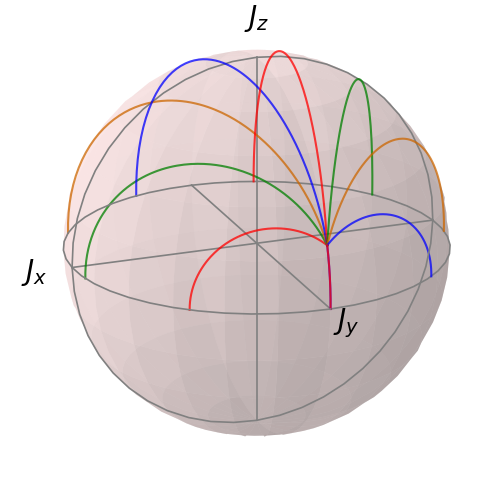 Figure 6
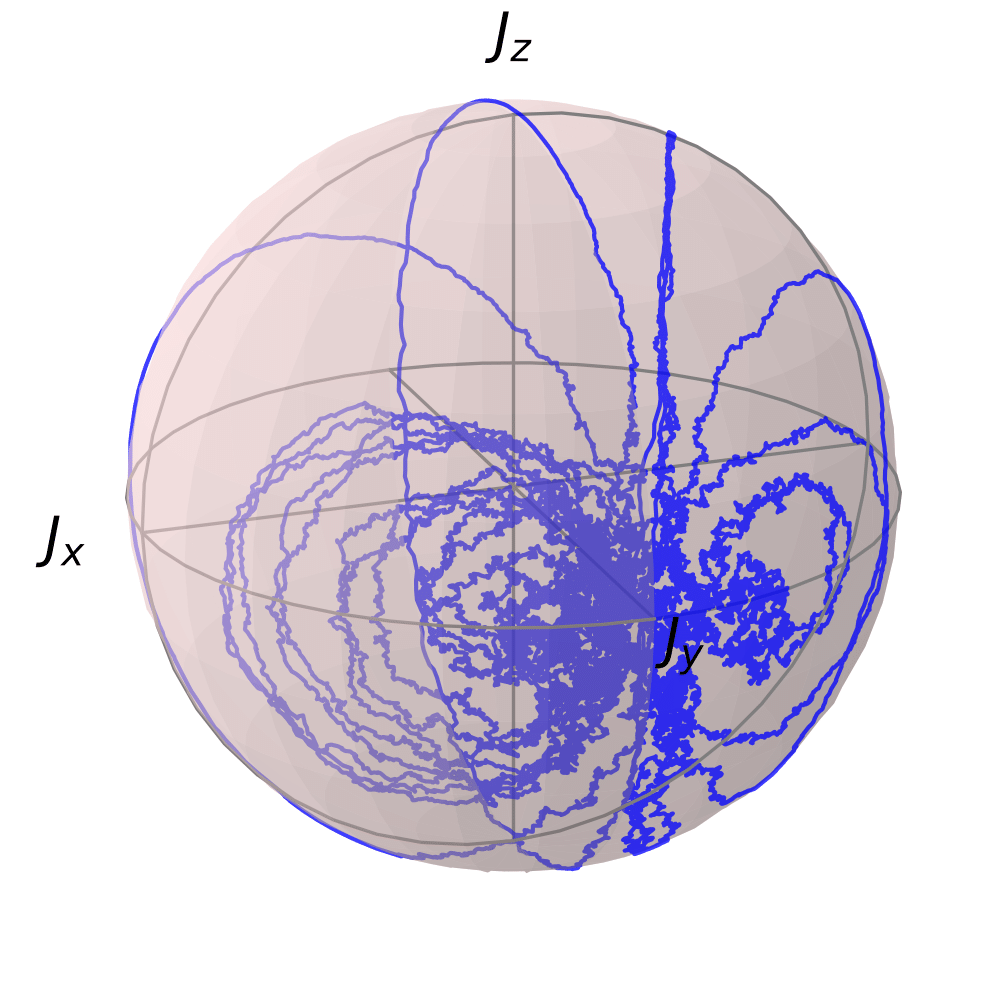 Figure 7
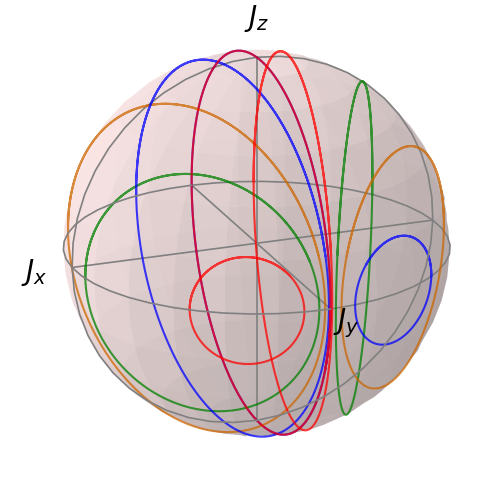 Figure 8
Peer Reviews
No public reviews on file for this paper yet. If you reviewed it on a platform where reviews are public (OpenReview, ICLR, NeurIPS, ICML), you can paste yours below so the community can read it here.
Videos
No videos yet. Explain this paper in a talk, walkthrough, or lecture? Add one.
Revealing the nature of non-equilibrium phase transitions
with quantum trajectories
Valentin Link
Institut für Theoretische Physik, Technische Universität Dresden, D-01062,Dresden, Germany
Kimmo Luoma
Institut für Theoretische Physik, Technische Universität Dresden, D-01062,Dresden, Germany
Walter T. Strunz
Institut für Theoretische Physik, Technische Universität Dresden, D-01062,Dresden, Germany
Abstract
A damped and driven collective spin system is analyzed by using quantum state diffusion. This approach allows for a mostly analytical treatment of the investigated non-equilibrium quantum many body dynamics, which features a phase transition in the thermodynamical limit. The exact results obtained in this work, which are free of any finite size defects, provide a complete understanding of the model. Moreover, the trajectory framework gives an intuitive picture of the two phases occurring, revealing a spontaneously broken symmetry and allowing for a qualitative and quantitative characterization of the phases. We determine exact critical exponents, investigate finite size scaling, and explain a remarkable non-algebraic behaviour at the transition in terms of torus hopping.
pacs:
Introduction
Many important models from the early years of quantum optics, like the Dicke model Dicke (1954), have experienced renewed interest. The reason being the availability of new experimental platforms. First and foremost, the field of ultra cold atomic gases allows an unprecedented level of control and tunability, bringing relatively simple but physically rich quantum optical models within the reach of current state of the art experiments Dimer et al. (2007); Torre et al. (2013); Gutiérrez-Jáuregui and Carmichael (2018); Hwang et al. (2018). The Dicke model, for example, can be realized for a wide range of parameters covering different phases of the system Baumann et al. (2010); Greiner et al. (2002). Similar models are studied in the context of quantum magnetism Shakirov et al. (2016); Ferreira and Ribeiro (2018); Ribeiro and Prosen (2018). Experiments are often performed under interesting non-equilibrium conditions where the interplay of driving and dissipation determines a stationary state of the system in absence of detailed balance Sieberer et al. (2016, 2015); Raftery et al. (2014). The dissipation stems from interactions with an environment which in many cases cannot be avoided. If the driven open system exhibits a phase transition upon tuning the system parameters, the non-equilibrium stationary state, rather than the ground state of the Hamiltonian, undergoes a non-analytical change. This poses a formidable challenge for the theoretical treatment of such a system. The understanding of phase transitions in driven dissipative quantum many body systems is still developing Hannukainen and Larson (2018); Nagy and Domokos (2015); Dalla Torre et al. (2010), as such problems, in general, can be tackled only approximately Gelhausen and Buchhold (2018).
Analytically soluble models containing the relevant physics are highly desirable and of great value for exploring in great detail new phenomena arising in this field. A recent trend has been to describe driven dissipative systems in the language of non-equilibrium quantum field theory Sieberer et al. (2016); Torre et al. (2013). There, a path integral formalism for Gorini-Kossakowski-Sudarshan-Lindblad (GKSL) master equations Gorini et al. (1976); *Lindblad1976, conceptually similar to the Keldysh functional integrals, are used Sieberer et al. (2016). Such path integral representations of dissipative propagators were earlier studied in a quantum optics setting in Strunz (1997).
Alternatively, quantum trajectory methods from the field of quantum optics Gisin and Percival (1992); Plenio and Knight (1998), such as quantum state diffusion Gisin and Percival (1992), also provide an efficient and transparent theoretical framework. They can contribute to a detailed understanding of non-equilibrium quantum physics, as we will demonstrate in this Letter. In particular, the localization property of quantum state diffusion in the long time limit Strunz and Percival (1998) is useful for the qualitative and quantitative analysis of non-equilibrium phase transitions, since this allows a direct observation of the different character of distinct phases. Quantum trajectories have been used successfully in Gutiérrez-Jáuregui and Carmichael (2018) to analyze a generalization of the Dicke model. In the present Letter we consider a model similar to the so-called cooperative resonance fluorescence model introduced in the 1970s Walls et al. (1978); Walls (1980); Drummond and Carmichael (1978). The latter recently received attention because it features a particularly interesting phase transition which is difficult to characterize Iemini et al. (2018); Hannukainen and Larson (2018). We here show that our model can be treated exactly within a quantum trajectory approach. This gives a clear picture of the different phases, helps to identify a broken symmetry, allows for an analytical, rather than numerical, determination of critical exponents and explains the peculiar critical behaviour.
Model
We consider the following master equation of GKSL form Gorini et al. (1976); *Lindblad1976 for a driven damped spin- system
[TABLE]
where , are the spin operators. Apart from the additional dissipator this coincides with the cooperative resonance fluorescence model Walls et al. (1978); Walls (1980); Drummond and Carmichael (1978); Morrison and Parkins (2008); Schneider and Milburn (2002). It can describe spin- systems undergoing collective driving and collective damping. Following the proposals in Iemini et al. (2018); Hannukainen and Larson (2018) this model could be realized experimentally with cold atoms. Interestingly, in theoretical models for engineered atomic spin devices used to describe tunneling spectroscopy of atomic magnets on metallic surfaces, a similar GKSL dissipator appears naturally Shakirov et al. (2016); Ferreira and Ribeiro (2018); Ribeiro and Prosen (2018). A phase diagram of this model was examined in Ribeiro and Prosen (2018).
The stationary state of (1) features a phase transition in the thermodynamic limit as the parameter , measuring the relative strength of coherent drive to dissipation, is changed. For strong damping the steady state has a finite expectation value. If instead the expectation value is zero, see Fig. 1.
It is important to stress that Eq. (1) has a discrete symmetry. It is invariant under mirror reflection given by followed by complex conjugation. The crucial role of this symmetry for the phase transition becomes apparent when we add a symmetry breaking term of the form to the Hamiltonian. As shown in 111See Supplemental Material, the model then features only a first order transition.
Quantum state diffusion approach
We analyze the model (1) by unraveling the master equation with quantum state diffusion Note (1), that is we express the density operator as the average over stochastic pure states Gisin and Percival (1992); Plenio and Knight (1998). In contrast to the cooperative resonance fluorescence model, due to the additional dissipator, the resulting stochastic Schrödinger equation preserves spin coherent states for any , that is, for any system size Note (1); Gisin and Cibils (1992). The spin coherent states are defined as
[TABLE]
and the density operator is obtained by averaging over the stochastically evolving spin coherent states where the complex labels are stochastic trajectories obeying the classical Langevin equation
[TABLE]
with complex Ito increments , . A rescaled coupling is introduced as . That spin coherent states are preserved is remarkable Gisin and Cibils (1992), and reflects the localization property of quantum state diffusion Strunz and Percival (1998). It allows to solve this model particularly easy. Nevertheless, in the following we see that this model features qualitatively the same physics as the cooperative resonance fluorescence model. Unlike mean-field or semi-classical approaches, Eq. (3) provides the exact solution of the master equation (1) for any system size.
Solution in the thermodynamic limit
Neglecting the noise terms in Eq. (3) results in the deterministic equation
[TABLE]
Since the strength of fluctuations is this is valid for times much smaller than . In particular, it captures the thermodynamic limit . The resulting approximate solutions of Eq. (1) are coherent states with deterministic label obeying Eq. (4). These pure states are just the so called robust states of the master equation Strunz (2008). At this point we already note that for any finite the asymptotic state of Eq. (1) may nevertheless be highly mixed, as will be further elaborated later.
The solution of Eq. (4) can be found analytically Note (1)
[TABLE]
with the phase . () and are determined by the initial condition. There are two fixed points
[TABLE]
corresponding to . The most elegant way of displaying the trajectories is to map the complex label to a point on the sphere via the inverse stereographic projection given by
[TABLE]
Some of the deterministic trajectories are depicted in Fig. 2 for two values of . For all trajectories flow to the stable fixed point . In contrast, the solutions are periodic for , i.e. traverses a closed torus with period . As a consequence of the existence of periodic solutions, the spectrum of the Lindbladian becomes gapless and the imaginary parts of the eigenvalues are separated by the fundamental frequency , as observed in Iemini et al. (2018). Clearly, the existence of two distinct phases in the thermodynamic limit is evident. In the case there is a unique stable (unstable) steady state which is the coherent state (). For a steady state can be associated with each torus labeled with , by time averaging the cyclic evolution over one period
[TABLE]
The emergence of periodic solutions has led to the idea that such a phase transition can be associated with a spontaneous breaking of continuous time translation symmetry Iemini et al. (2018). Here, however, we can clearly see that the mirror symmetry of the Lindblad generator (1) is spontaneously broken in the phase. The steady states in Eq. (8) are not mirror symmetric, since the mirrored state is 222The mirror reflected state to a coherent state is .. Thus the phase transition happens in presence of an ordinary symmetry breaking Ribeiro and Prosen (2018). Note that all steady states have a vanishing expectation value and thus the steady state value of is well defined
[TABLE]
indicating a second order phase transition. When in the Hamiltonian an additional symmetry breaking term is present there are no cyclic solutions and a stable fixed point exists for all . The system is then no longer critical at Note (1).
Finite system size
If the system has a finite size there always exists a unique steady state which is the asymptotic solution of (1). The uniqueness is seemingly at odds with the previous investigation in the thermodynamic limit, where for we found a whole family of steady states. The explanation goes as follows. Neglecting the noise terms, as we did in Eq. (4), is only valid for times much shorter than . On longer timescales the noise will lead to a mixing process which results in a unique steady state. In Fig. 3 two quantum trajectories are displayed in the two regimes. For there exists a stable fixed point and a weak () noise will only cause small fluctuations around this point, see Fig. 3 (a). On the other hand, in the presence of cyclic solutions, when , the noise introduces a hopping between neighboring tori, see Fig. 3 (b). Torus hopping allows a single trajectory to eventually explore the entire phase space.
In Fig. 4 (a) the variance of the unique steady state is displayed for different values of . Clearly, the variance increases with and for large system sizes approaches a curve which is non-analytic at . With the trajectories displayed in Fig. 3 this can be understood in an intuitive way. Moreover, we can even compute analytically the asymptotic curve displayed in Fig. 4 (a). To this aim it is useful to switch to the “action-angle” variables used for the deterministic trajectories (5). As elaborated in Note (1), averaging over the fast dynamics of the angle variable Carmichael (1980); Drummond and Carmichael (1978); Kruscha et al. (2012) results in a one dimensional stochastic evolution for the torus label , reflecting the slow torus-hopping process. A stationary distribution for this process can be found analytically
[TABLE]
The unique steady state resulting from the mixing induced by the torus hopping is
[TABLE]
with from (8). Naturally, this unique state does have the same symmetries as the Lindblad generator, since is a symmetric distribution. We note in passing that the additional dissipator of the present model leads to a different distribution of tori compared to the one derived by Carmichael using a Glauber -distribution technique in Carmichael (1980). The variance of can be given in closed form,
[TABLE]
displayed as the dashed line in Fig. 4 (a). Interestingly, this function does not behave like a power law for close to one. With we find that the asymptotic curve behaves as Note (1). This behaviour is hard to find from extrapolating finite size calculations, as can be seen in Fig. 4 (b). There we plot “exponents” that one would associate to the limiting curve by assuming a power law, estimated for different values of . Clearly we see from the exact curve that close to no exponent can be associated, and the peculiar behaviour with an infinite negative slope at the critical point follows Note (1).
In the thermodynamic limit different steady states (8) do not have the same variance, and thus this quantity is not well defined. As a consequence, this observable does not have a universal power law scaling close to the transition point – see Note (1) for more details. Fig. 4 (b) manifests also the non-commutativity of the two types of limiting procedures involved. The non universal behaviour is a finite system size effect which emerges when first the stationary state is found and only afterwards the limit of large system size is taken. In order to correctly understand the phase transition, the order of limits has to be interchanged. Neglecting the -terms, as in (4), corresponds to first taking the strict thermodynamic limit leading to the family of steady states (8). Naively computing the steady state of (1) for finite results always in a unique steady state and the broken symmetry is not revealed.
Critical exponents and finite size scaling
Clearly, Eq. (9) gives the critical exponent for the expectation value. From the exact solution in the thermodynamic limit (5) we can just as easily read off the dynamical critical exponent. Since there is only a single time scale the dynamical exponent is also . With the exact Ito-equations at hand it is also possible to find finite size scaling exponents at by using a renormalization scheme as in Torre et al. (2013); Hwang et al. (2018). Numerically we observe a finite size power law scaling at the transition point, see Fig. 5. To obtain the exponent analytically we set and the evolution equation (3) is rewritten as
[TABLE]
Under a rescaling of time, close to the transition, has power law scaling.
Indeed, the noiseless equation is invariant under the transformation
[TABLE]
This transformation changes the evolution equation to 333Ito noise increments scale as
[TABLE]
For the theory (with fluctuations) to be scale invariant at low frequencies, must scale as Torre et al. (2013); Hwang et al. (2018)
[TABLE]
Then all noise terms containing become irrelevant under renormalization and the resulting low frequency theory with constant noise is scale invariant. The finite- scaling of is found to be . With , we conclude that for large
[TABLE]
As seen in Fig. 5, numerically accessible values match this law quite well.
Conclusions
Quantum state diffusion for non-equilibrium quantum dynamics allows us to obtain exact analytical results for a driven dissipative many body quantum system featuring a phase transition. We are able to identify the symmetries of the different phases emerging in the thermodynamical limit, and in this way we can reveal the symmetry breaking associated with the phase transition. For these findings the trajectory picture proves insightful. Moreover, it provides an elegant shortcut to an exact analytical treatment. The physics in the trajectory framework can be characterized by two time scales, and , which describe the deterministic evolution of the open system and the fluctuations, respectively. In the thermodynamic limit the relaxation time scale is infinitely large and the system does not relax, resulting in the degeneracy of the stationary state. Even though we here consider a solvable model in terms of spin coherent states, quantum state diffusion trajectories would reveal the underlying character of the phases also for finite and for non-linear Hamiltonians. These results strongly support the idea that quantum trajectories help to unravel non-equilibrium phenomena in many body quantum dynamics.
Acknowledgments
It is a pleasure to thank Holger Kantz and Konrad Merkel for discussions and advice. V.L. acknowledges support from the International Max Planck Research School (IMPRS) of MPIPKS Dresden.
The reference list from the paper itself. Each links out to its DOI / PubMed record.
- 1Dicke (1954) R. H. Dicke, Phys. Rev. 93 , 99 (1954) . · doi ↗
- 2Dimer et al. (2007) F. Dimer, B. Estienne, A. S. Parkins, and H. J. Carmichael, Phys. Rev. A 75 , 013804 (2007) . · doi ↗
- 3Torre et al. (2013) E. G. D. Torre, S. Diehl, M. D. Lukin, S. Sachdev, and P. Strack, Phys. Rev. A 87 , 023831 (2013) . · doi ↗
- 4Gutiérrez-Jáuregui and Carmichael (2018) R. Gutiérrez-Jáuregui and H. J. Carmichael, Phys. Rev. A 98 , 023804 (2018) . · doi ↗
- 5Hwang et al. (2018) M.-J. Hwang, P. Rabl, and M. B. Plenio, Phys. Rev. A 97 , 013825 (2018) . · doi ↗
- 6Baumann et al. (2010) K. Baumann, C. Guerlin, F. Brennecke, and T. Esslinger, Nature 464 , 1301 (2010) . · doi ↗
- 7Greiner et al. (2002) M. Greiner, O. Mandel, T. Esslinger, T. W. Hänsch, and I. Bloch, Nature 415 , 39 (2002) . · doi ↗
- 8Shakirov et al. (2016) A. M. Shakirov, Y. E. Shchadilova, A. N. Rubtsov, and P. Ribeiro, Phys. Rev. B 94 , 224425 (2016) . · doi ↗