PHENIX measurements of low momentum direct photon radiation
Vladimir Khachatryan (for the PHENIX Collaboration)

TL;DR
The PHENIX experiment measured low momentum direct photons across various collision systems at RHIC, revealing excess photon production in A+A and p+A collisions and a universal scaling with charged-particle multiplicity.
Contribution
This study provides the first comprehensive measurements of low momentum direct photons in small and large collision systems, uncovering universal scaling behaviors.
Findings
Large excess of direct photons in A+A collisions.
Non-zero excess in central p+A collisions.
Photon yield scales faster than charged-particle multiplicity.
Abstract
The versatility of RHIC allowed the PHENIX collaboration to measure low momentum direct photons from small systems, such as p+p, p+A, d+Au at 200 GeV as well as from large A+A systems, such as Au+Au and Cu+Cu at 200 GeV and Au+Au at 62.4 GeV and 39 GeV. In these measurements PHENIX has discovered a large excess over the scaled p+p yield of direct photons in A+A collisions, and a non-zero excess over the scaled p+p yield in central p+A collisions. Another PHENIX discovery is that at low- the integrated yield of direct photons, , from large systems follows a universal scaling as a function of the charged-particle multiplicity, , with . The observed scaling properties of direct photons from these systems show that the photon production yield increases faster than the charged-particle multiplicity.
Click any figure to enlarge with its caption.
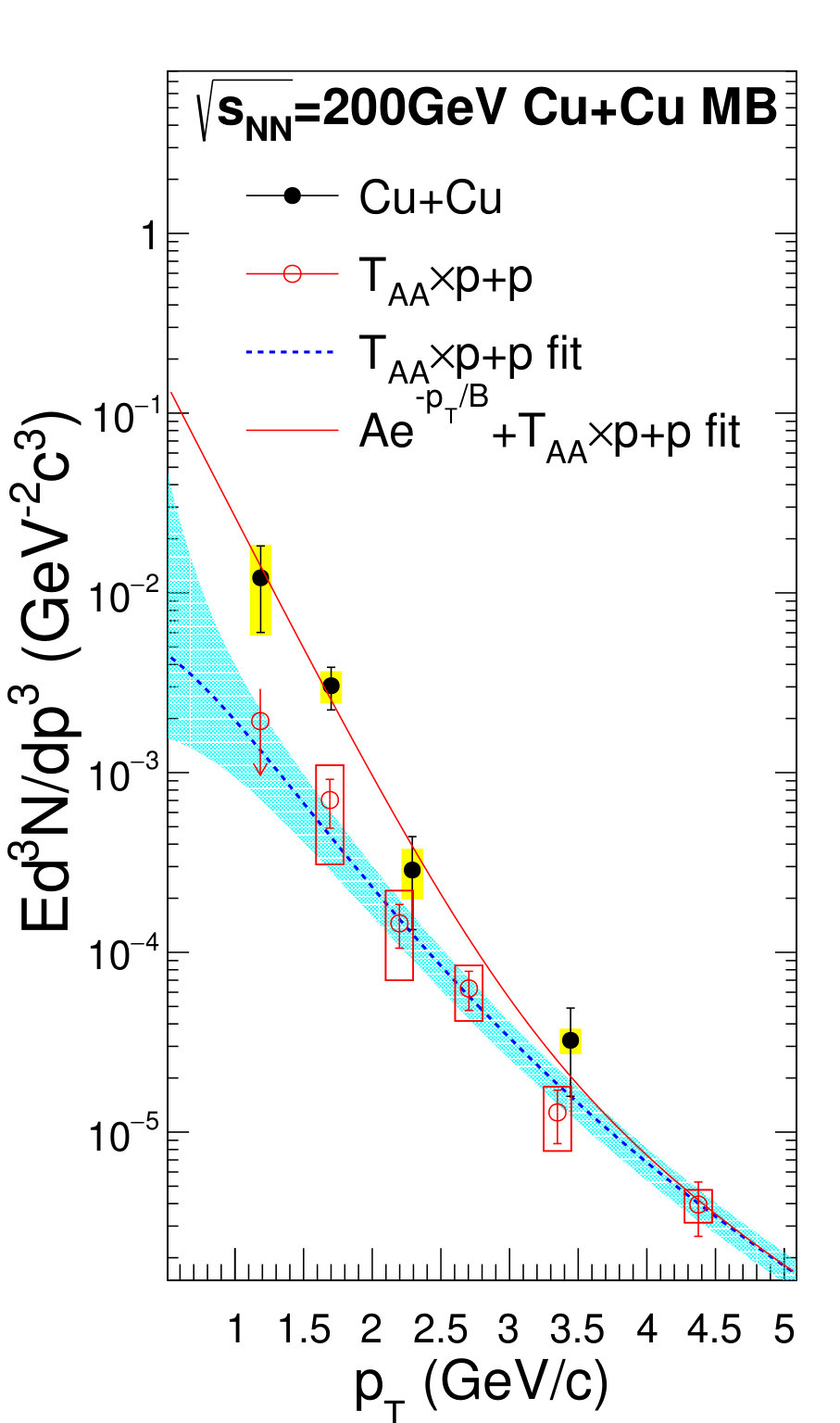 Figure 1
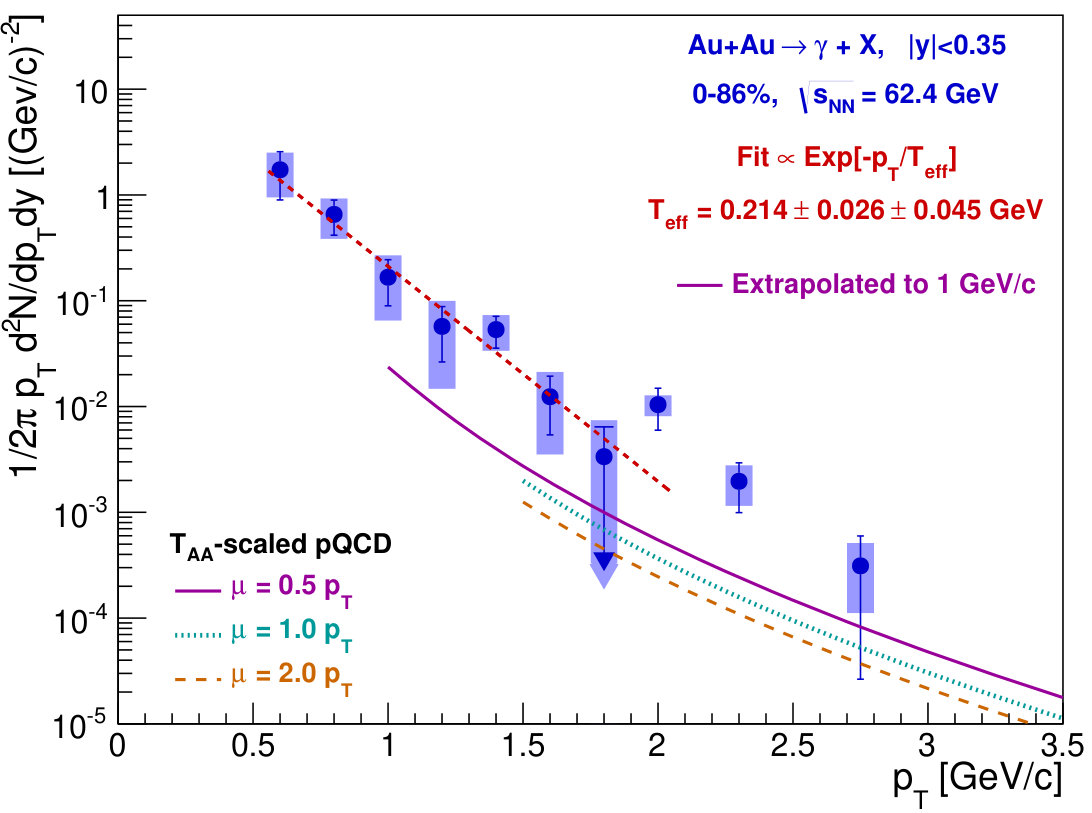 Figure 1
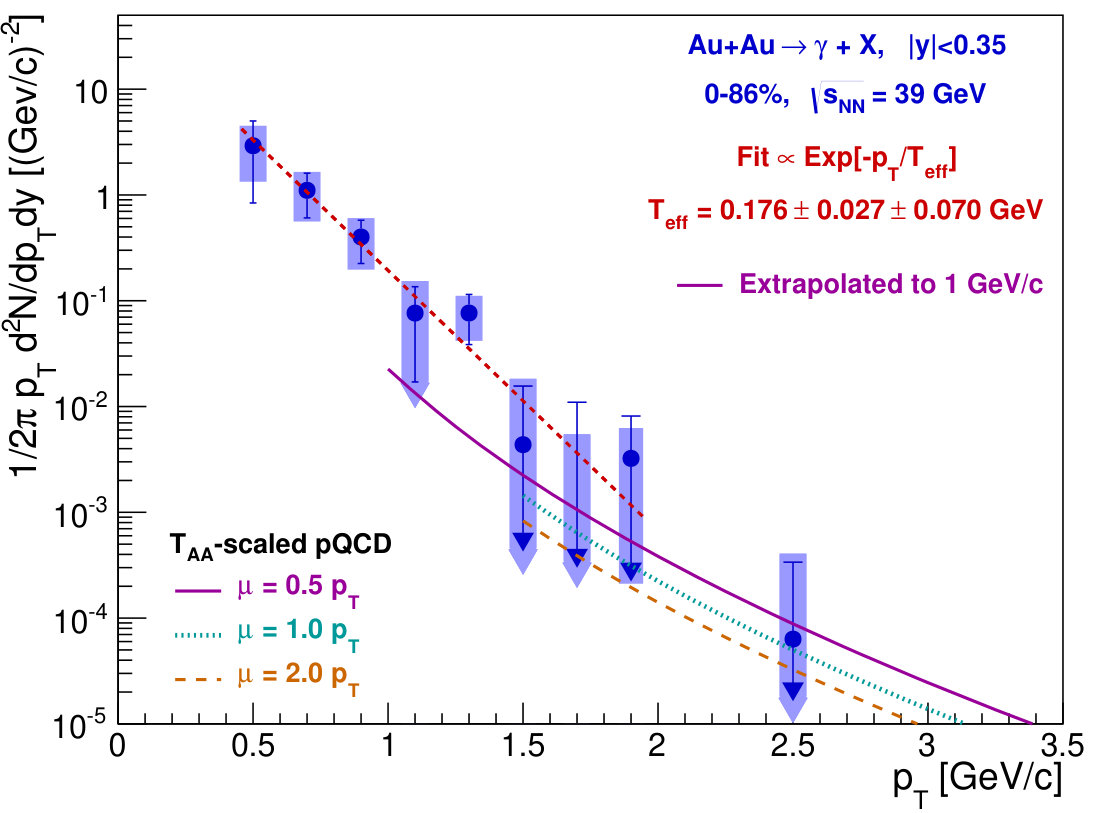 Figure 1
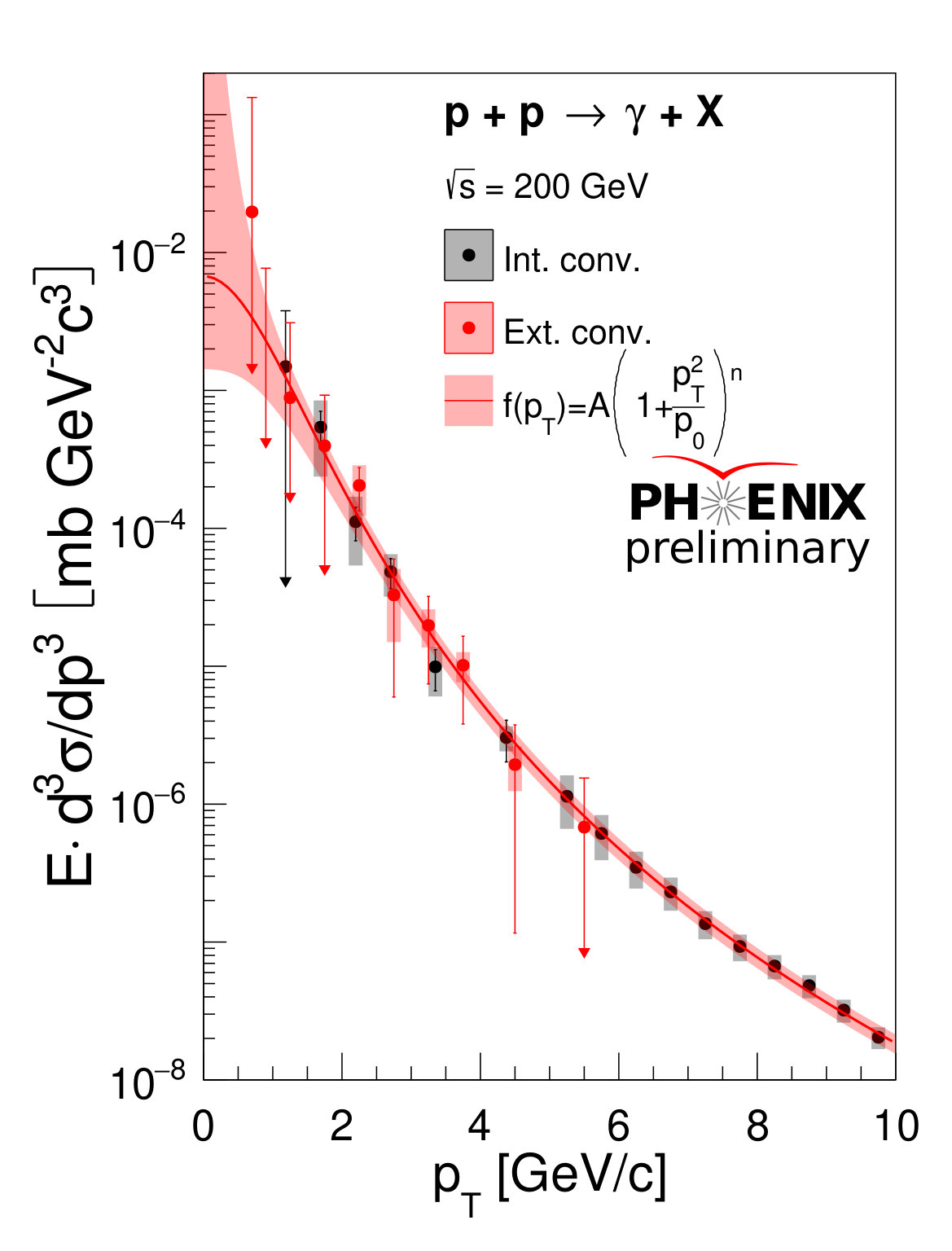 Figure 2
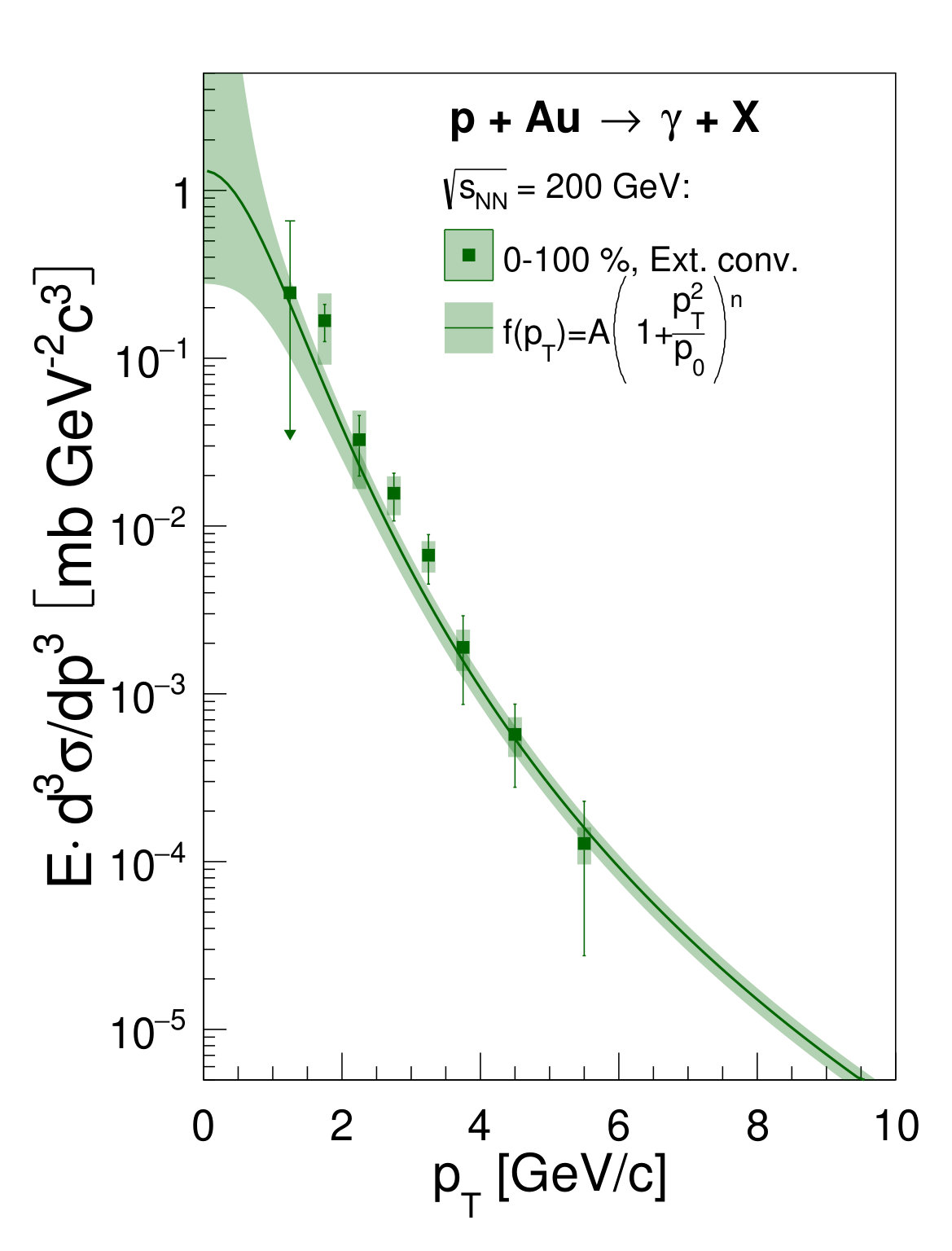 Figure 2
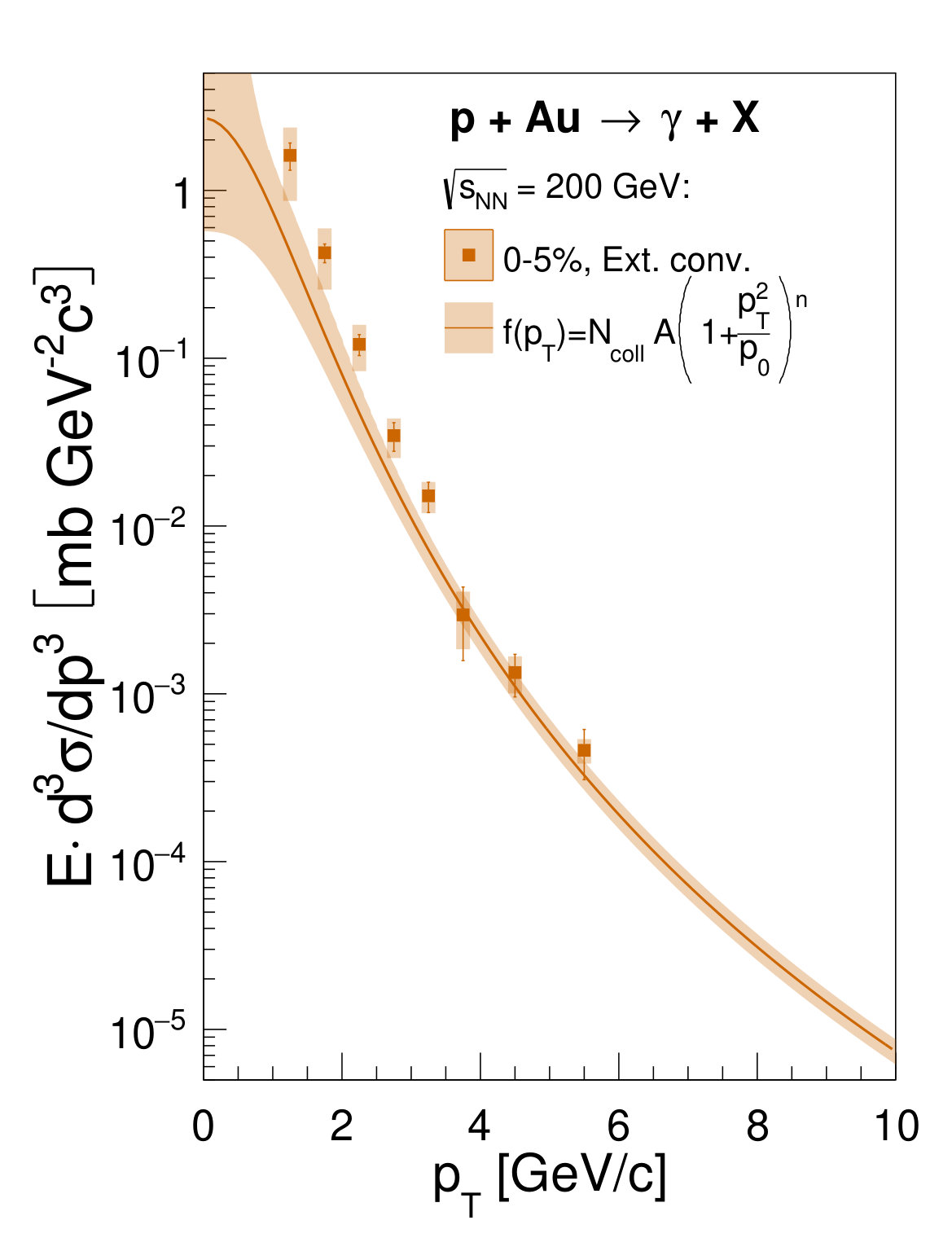 Figure 2
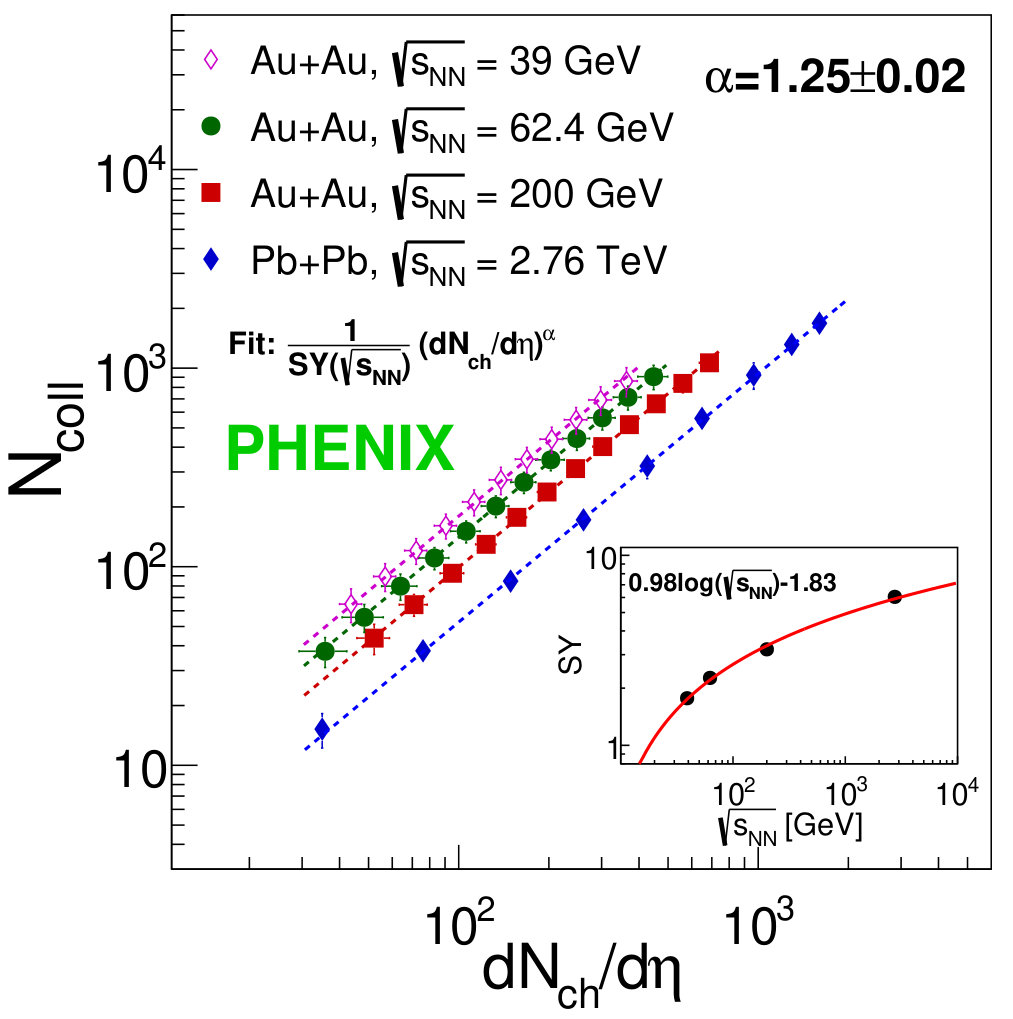 Figure 3
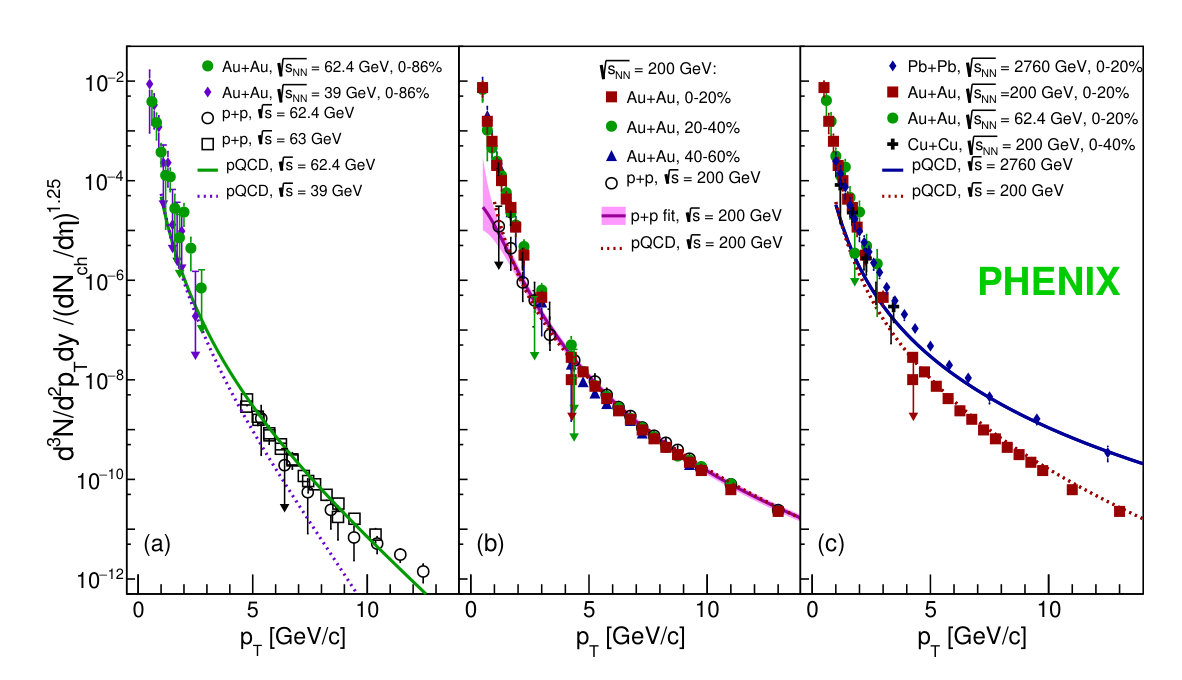 Figure 4
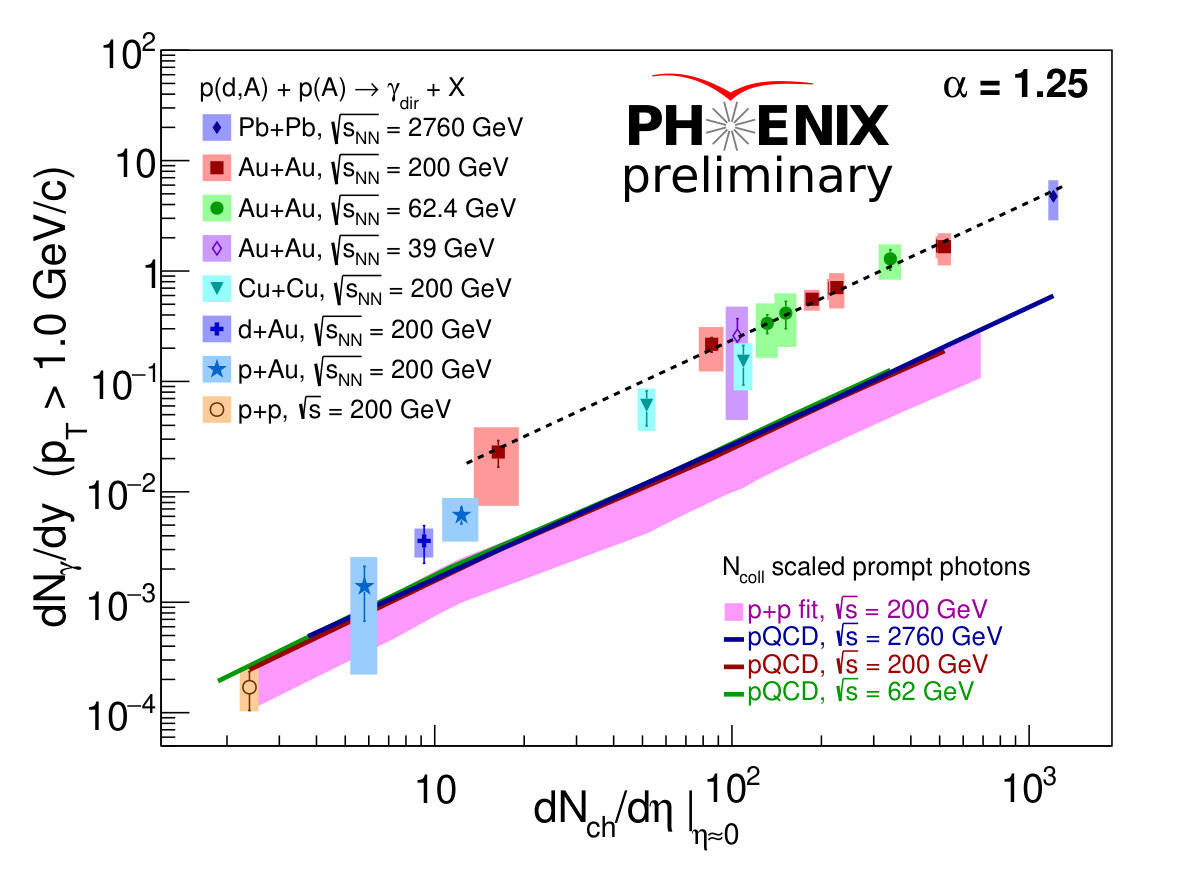 Figure 5
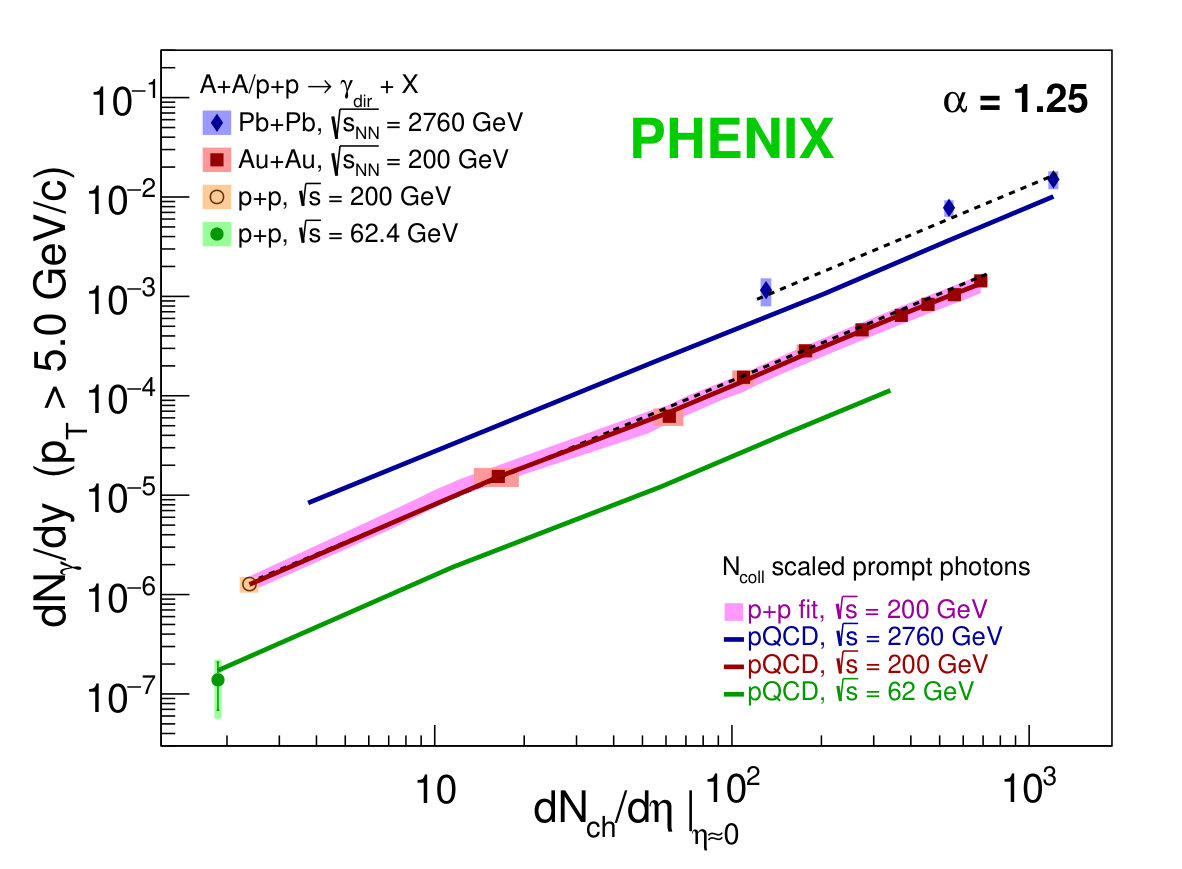 Figure 5
Peer Reviews
No public reviews on file for this paper yet. If you reviewed it on a platform where reviews are public (OpenReview, ICLR, NeurIPS, ICML), you can paste yours below so the community can read it here.
Videos
No videos yet. Explain this paper in a talk, walkthrough, or lecture? Add one.
PHENIX measurements of low momentum
direct photon radiation
Vladimir Khachatryan for the PHENIX Collaboration
Department of Physics and Astronomy, Stony Brook University, Stony Brook, New York 11794-3800, USA
Abstract
The versatility of RHIC allowed the PHENIX collaboration to measure low momentum direct photons from small systems, such as p+p, p+A, d+Au at 200 GeV as well as from large A+A systems, such as Au+Au and Cu+Cu at 200 GeV and Au+Au at 62.4 GeV and 39 GeV. In these measurements PHENIX has discovered a large excess over the scaled p+p yield of direct photons in A+A collisions, and a non-zero excess over the scaled p+p yield in central p+A collisions. Another PHENIX discovery is that at low- the integrated yield of direct photons, , from large systems follows a universal scaling as a function of the charged-particle multiplicity, , with . The observed scaling properties of direct photons from these systems show that the photon production yield increases faster than the charged-particle multiplicity.
keywords:
Heavy ion collisions, small/large collision systems, direct photons, charged-hadron multiplicities
1 Introduction
Direct photons are an important tool with unique capabilities to study the strongly interacting medium produced in (ultra)relativistic heavy ion collisions. By measuring these photons, one can gain information on the properties and dynamics of the produced matter integrated over space and time. By definition, the direct photons are the “remnants” of subtraction of a large number of hadronic decay photons (mostly from and decays) from the total observed yield. They originate from the hot fireball of the Quark-Gluon Plasma (QGP), late hadronic phase as well as from initial hard scattering processes like QCD Compton scattering among the incoming and outgoing partons.
A quite challenging problem, dubbed as “thermal photon puzzle”, emerged when PHENIX measured large invariant yield and large anisotropy (elliptic flow) of low momentum direct photons in Au+Au collisions at = 200 GeV [1]. Various theoretical models encounter difficulties when they are used to describe these two quantities simultaneously though there is also some progress [2, 3, 4]. In order to resolve this puzzle, PHENIX has measured low momentum direct photons in large and small collision systems. These measurements revealed very interesting findings reported in this article.
2 Large and small systems: recent results on low momentum direct photon spectra
Recently PHENIX accomplished low momentum direct photon measurements for large systems: Cu+Cu at = 200 GeV through their internal conversions, and Au+Au at = 62.4 GeV and 39 GeV with the external conversion method. In Fig. 1 one can see the results for minimum bias data samples. In the external conversion method the photons are measured through their conversions to electron-positron pairs at the HBD (or VTX) in the PHENIX detector system, and the fraction of direct photons is determined after tagging photons from neutral pion decays. Comparing these data to scaled p+p fit or pQCD calculations one finds a significant excess over the scaled p+p yield of low direct photons in all three systems.
With the external conversion method PHENIX recently also measured low momentum direct photons in p+p and p+A collisions (shown in Fig. 2). Within systematic uncertainties, the observed a non-zero excess yield ( one sigma) in central p+Au collisions above the scaled p+p fit may come from the possible production of QGP droplets in small central systems.
3 Direct photons scaling
For a given beam energy one can compare data from different centrality classes (or system size) using number of participants, , or the number of binary collisions, . However, this is not useful to compare data at different energies. We therefore use charged-particle multiplicity, , which itself has an interesting scaling behavior with shown in Fig. 3. Here scales like for all with a logarithmically slowly increasing function called specific yield. The exponent is found to be . The other details are given in the caption of Fig. 3.
Thereby, we scale the direct photon yield by , which for a given is equivalent to . For example, taking the photon spectra in minimum bias Au+Au collisions at 62.4 and 39 GeV with pQCD curves from Fig. 1, and normalizing them by , one can see that the data fall on top of each other at low- as shown in the panel (a) of Fig. 4. At high- the p+p data coincide with the pQCD calculations within the quoted uncertainties as expected. In the panel (b) all Au+Au data at 200 GeV are on top of each other at high- and low-, and at low- they are distinctly above the p+p data, fit and pQCD. In the panel (c) the data are compared for different from 62.4 GeV to 2760 GeV, scaled in the same way. And again all the data coincide at low-, while at high- we see the expected difference with and scaling.
In order to quantify the direct photon spectra, one can integrate the invariant yield over some threshold value. Then if we integrate above GeV/c, we obtain the left plot of Fig. 5. This plot is another representation of the direct photon scaling, where the integrated yield of the large systems scales with by the same power , meaning that grows faster than . It is interesting that the prompt photons described by the purple band and integrated pQCD curves have nearly the same slopes as that of the large systems. In the low multiplicity region one can see the gradually increasing trend of the integrated yield of the small systems, which seems to intersect with the trend from the large systems.
With the integration above high GeV/c, we get the right plot of Fig. 5. Here the observed scaling behavior is expected [12] (since ), though we see that the slopes are the same as those in the left plot.
4 Summary
The PHENIX collaboration has measured low momentum direct photons in Cu+Cu at = 200 GeV, Au+ Au at = 62.4 and = 39 GeV as well as in p+p and p+Au at = 200 GeV. By compiling all the available results on small and large systems at various energies, PHENIX has found a surprising scaling behavior of direct photons in large systems, namely: at a given center-of-mass energy the low- and high- direct photon invariant yields from A+A collisions scale with ; across different energies is proportional to ; meanwhile, for all energies the low- yield seems to scale like . PHENIX has also discovered direct photon excess yield at low- in central p+Au collisions above scaled p+p fit, which may originate from possibly existing QGP droplets in small central systems. Both trends described by the data seen in the left plot of Fig. 5, suggest the existence of a “transition point” between small and large systems.
The reference list from the paper itself. Each links out to its DOI / PubMed record.
- 1[1] A. Adare et al. (PHENIX Collaboration), Phys.Rev. C 94 , 064901 (2016) [ar Xiv:1509.07758 [nucl-ex]].
- 2[2] H. van Hees, M. He and R. Rapp, Nucl. Phys. A 933 , 256 (2015) [ar Xiv:1404.2846 [nucl-th]].
- 3[3] J. F. Paquet et al. , Phys. Rev. C 93 , no. 4, 044906 (2016) [ar Xiv:1509.06738 [hep-ph]].
- 4[4] Y. M. Kim, C. H. Lee, D. Teaney and I. Zahed, Phys. Rev. C 96 , no. 1, 015201 (2017) [ar Xiv:1610.06213 [nucl-th]].
- 5[5] A. Adare et al. (PHENIX Collaboration), [ar Xiv:1805.04066 [nucl-ex]].
- 6[6] A. Adare et al. (PHENIX Collaboration), [ar Xiv:1805.04084 [nucl-ex]].
- 7[7] A. Adare et al. (PHENIX Collaboration), Phys. Rev. C 87 , 054907 (2013) [ar Xiv:1208.1234 [nucl-ex]].
- 8[8] A. Adare et al. (PHENIX Collaboration), Phys. Rev. C 93 , 024901 (2016) [ar Xiv:1509.06727 [nucl-ex]].