Gate tuning from exciton superfluid to quantum anomalous Hall in van der Waals heterobilayer
Qizhong Zhu, Matisse Wei-Yuan Tu, Qingjun Tong, Wang Yao

TL;DR
This paper demonstrates how van der Waals heterobilayers of 2D valley semiconductors can be electrically tuned to exhibit exciton superfluid, quantum anomalous Hall, and quantum spin Hall phases, enabling versatile quantum phase control.
Contribution
It introduces a method to switch between different quantum phases in 2D heterobilayers using interlayer bias, revealing a new platform for quantum phase engineering.
Findings
Tuning between exciton superfluid, QAH, and QSH phases via bias.
Competition of Coulomb interaction and interlayer tunneling drives phase transitions.
Potential for electrically controlling topological and superfluid states.
Abstract
Van der Waals heterostructures of 2D materials provide a powerful approach towards engineering various quantum phases of matters. Examples include topological matters such as quantum spin Hall (QSH) insulator, and correlated matters such as exciton superfluid. It can be of great interest to realize these vastly different quantum matters on a common platform, however, their distinct origins tend to restrict them to material systems of incompatible characters. Here we show that heterobilayers of two-dimensional valley semiconductors can be tuned through interlayer bias between an exciton superfluid (ES), a quantum anomalous Hall (QAH) insulator, and a QSH insulator. The tunability between these distinct phases results from the competition of Coulomb interaction with the interlayer quantum tunnelling that has a chiral form in valley semiconductors. Our findings point to exciting…
Click any figure to enlarge with its caption.
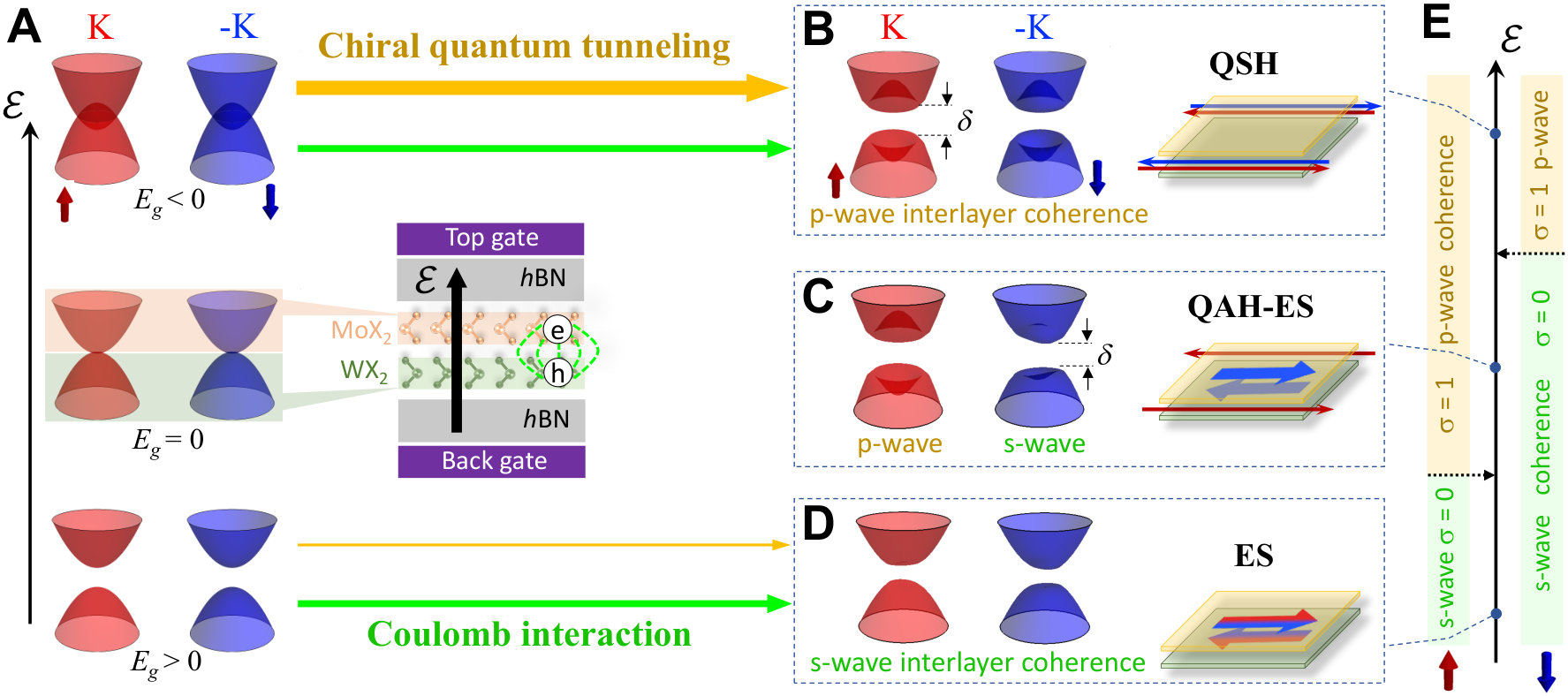 Figure 1
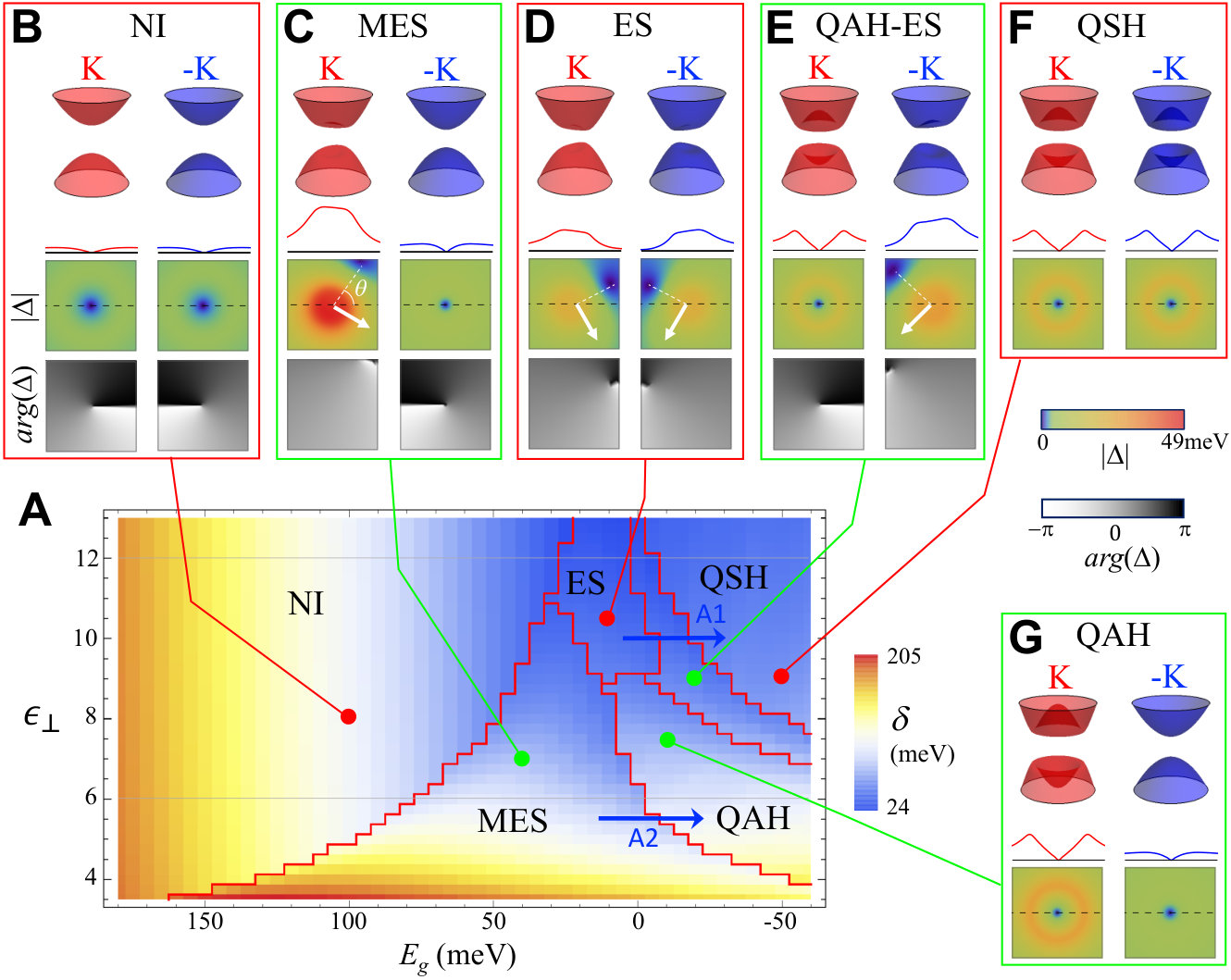 Figure 2
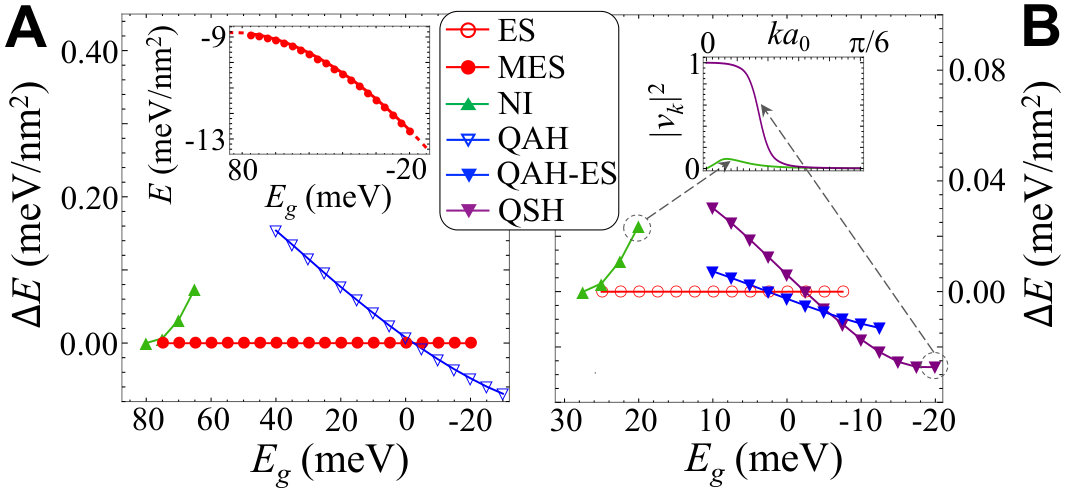 Figure 3
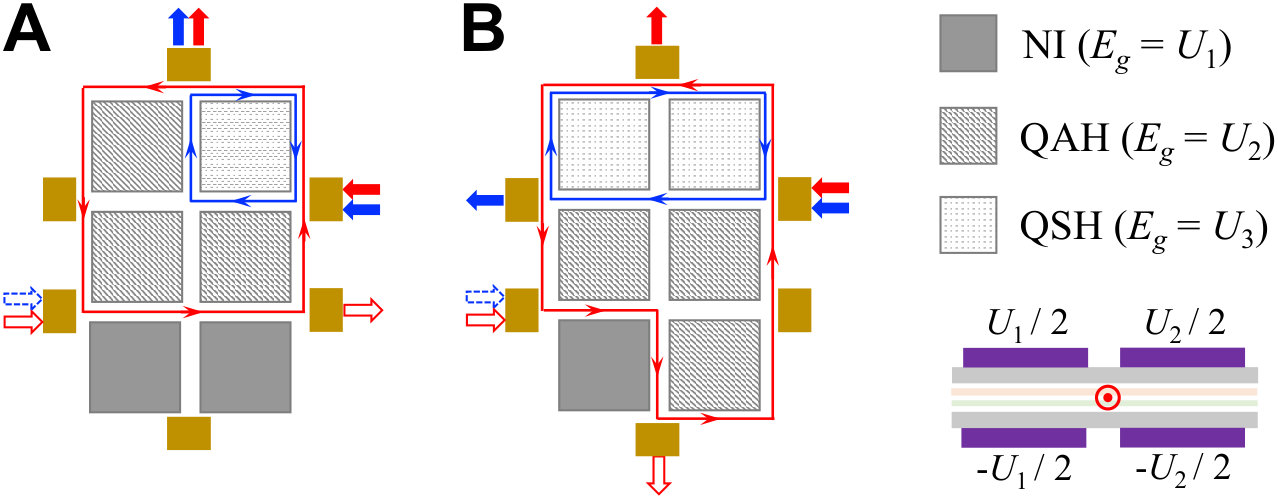 Figure 4
Peer Reviews
No public reviews on file for this paper yet. If you reviewed it on a platform where reviews are public (OpenReview, ICLR, NeurIPS, ICML), you can paste yours below so the community can read it here.
Videos
No videos yet. Explain this paper in a talk, walkthrough, or lecture? Add one.
Gate tuning from exciton superfluid to quantum anomalous Hall in van der Waals heterobilayer
Qizhong Zhu
Department of Physics and Center of Theoretical and Computational Physics, University of Hong Kong, Hong Kong, China
Matisse Wei-Yuan Tu
Department of Physics and Center of Theoretical and Computational Physics, University of Hong Kong, Hong Kong, China
Qingjun Tong
Department of Physics and Center of Theoretical and Computational Physics, University of Hong Kong, Hong Kong, China
Wang Yao
Department of Physics and Center of Theoretical and Computational Physics, University of Hong Kong, Hong Kong, China
(March 17, 2024)
Abstract
Van der Waals heterostructures of 2D materials provide a powerful approach towards engineering various quantum phases of matters. Examples include topological matters such as quantum spin Hall (QSH) insulator, and correlated matters such as exciton superfluid. It can be of great interest to realize these vastly different quantum matters on a common platform, however, their distinct origins tend to restrict them to material systems of incompatible characters. Here we show that heterobilayers of two-dimensional valley semiconductors can be tuned through interlayer bias between an exciton superfluid (ES), a quantum anomalous Hall (QAH) insulator, and a QSH insulator. The tunability between these distinct phases results from the competition of Coulomb interaction with the interlayer quantum tunnelling that has a chiral form in valley semiconductors. Our findings point to exciting opportunities for harnessing both protected topological edge channels and bulk superfluidity in an electrically configurable platform.
Introduction
In exciton Bose-Einstein condensate, an electron and a hole pair into an exciton that can flow without dissipation. Confining electron and hole into two separate layers allows the exciton superfluid to manifest as counter-flowing electrical supercurrents in the electron and hole layers eisenstein_2004 ; nandi_exciton_2012 . Van der Waals (vdW) heterostructures are ideal realisations of the double-layer geometry for exploring this correlated phase of matter driven by Coulomb interaction liu_quantum_2017 ; li_excitonic_2017 ; burg_strongly_2018 . Evidences of the counterflow supercurrents in the quantum Hall regime are recently reported in graphene double-bilayers liu_quantum_2017 ; li_excitonic_2017 . High-temperature exciton superfluid phases in absence of magnetic field are also predicted in graphene min_room-temperature_2008 and transition metal dichalcogenides (TMDs) double-layer heterostructures wu_theory_2015 ; fogler_high-temperature_2014 .
Quantum spin Hall (QSH) insulators are topological state of matter driven by the spin-orbit coupling, a single-particle relativistic effect qi_quantum_2009 ; hasan_textitcolloquium_2010 . In 2D crystals and their vdW heterostructures, the miniaturisation in thickness can lead to remarkable gate-tunable QSH phase, featuring helical edge states that can be electrically switched on/off inside the bulk gap qian_quantum_2014 ; liu_switching_2015 ; tong_topological_2017 ; wu_observation_2018 . Electron flow in the helical QSH edge channel is protected from backscattering, except by the spin-flip scatters. Coupling QSH insulator to local magnetic moment in ferromagnetism can suppress the topological order in one spin species weng_quantum_2015 ; chang_experimental_2013 , turning QSH into the quantum anomalous Hall (QAH) insulator. QAH features chiral edge state that is completely lossless with the absence of backward channel. The edge conducting channels of these topological matters, as well as the bulk supercurrents in the exciton superfluid, can have profound consequences in quantum electronics eisenstein_2004 ; nandi_exciton_2012 ; liu_quantum_2017 ; li_excitonic_2017 ; fei_edge_2017 ; tang_quantum_2017 .
Here we show the possibility of realizing these vastly different quantum matters with gate switchability on a single platform of TMDs heterobilayer. What makes this system unique is the coexistence of strong Coulomb interaction that favors spontaneous -wave interlayer electron-hole coherence, and a chiral interlayer tunnelling that creates/annihilates electron-hole pair in the -wave channel only. Their competition leads to a rich phase diagram when the heterobilayer band alignment is tuned towards the inverted regime through the interlayer potential difference induced by the gate (i.e. interlayer bias). At relatively strong dielectric screening, the bias drives transitions from a normal insulator to three nontrivial phases sequentially: (i) exciton superfluid (ES); (ii) coexistence of QAH in spin-up and ES in spin-down species (QAH-ES); and (iii) QSH insulator. At weak screening, magnetic order spontaneously develops along with the interlayer coherence, where the heterobilayer can be gate tuned between (iv) a magnetic ES (MES), and (v) a QAH phase. Remarkably, the topologically distinct phases are connected without gap closing, but through spontaneous symmetry breaking instead. The gate switchability, together with the sizable QSH/QAH gap that can exceed room temperature, point to practical spintronic highways at the electrically reconfigurable topological interfaces.
Results
Figure 1 schematically explains the gate-controlled phase transitions. TMD heterobilayers have the type-II band alignment where the conduction (valence) band edge consists of upper (lower) massive Dirac cones from the top (bottom) layer, at the K and -K corners of hexagonal Brillouin zone. Because of the spin-valley locking in TMDs monolayers, only the spin up (down) massive Dirac cones are relevant at the K (-K) valley tong_topological_2017 . At small or negative (bandgap), a pair of layer-separated electron and hole can be spontaneously generated by their Coulomb interaction, or by the interlayer quantum tunnelling. For several high symmetry stacking configurations, the rotational symmetry dictates the tunnelling to have a chiral dependence on the in-plane wavevector () tong_topological_2017 . In the inverted regime (), quantum tunnelling becomes resonant at , so its effective strength grows with , the latter becoming a knob to control the dominance between Coulomb interaction and quantum tunnelling. Major features of the phase diagram can then be intuitively anticipated.
When an interlayer bias tunes towards the inverted regime, the Coulomb interaction first drives the heterobilayer into exciton superfluid with spontaneous -wave interlayer coherence (Fig. 1D), as well-studied in TMDs double-layer designed with interlayer tunnelling quenched wu_theory_2015 ; fogler_high-temperature_2014 . In contrast to conventional double-layers where tunnelling will fix the phase of the interlayer coherence eisenstein_2004 ; nandi_exciton_2012 , here moderate tunnelling of the unique -wave form does not affect excitons condensed in the -wave channel. Instead, the chiral tunnelling induces a background coherence in the -wave channel, whose interference with the condensate in -wave channel enables in situ measurement on the condensate phase through an in-plane electrical polarization. In such case, the ES phase becomes nematic, with a spontaneous breaking of the rotational symmetry.
Only deep in the inverted regime, the eventual dominance of quantum tunnelling pins the interlayer coherence entirely in the -wave channel, and the heterobilayer becomes a QSH insulator. Helical edge states appear in the hybridization gap (Fig. 1B), the magnitude of which is significantly enhanced by Coulomb interaction compared to the non-interacting case tong_topological_2017 . The phase transition between ES and QSH does not happen simultaneously for spin up and down species (Fig. 1E), leaving a bias range for the coexistence of exciton superfluidity in one spin species, and quantum anomalous Hall in the other. This QAH-ES phase features both counterflow bulk supercurrent and chiral edge state in the bulk gap (Fig. 1C).
In the non-interacting limit, the effect of chiral quantum tunnelling in TMDs heterobilayer is well described by the two-band Hamiltonian tong_topological_2017 : \hat{H}_{0,\tau}=\sum_{\mathbf{k}}\left(\hat{a}_{\mathbf{k}}^{\dagger},\hat{b}_{\mathbf{k}}^{\dagger}\right)\big{[}\eta k^{2}+\varepsilon_{\mathbf{k}}\sigma_{z}+t_{\tau\mathbf{k}}\sigma_{+}+t^{*}_{\tau\mathbf{k}}\sigma_{-}\big{]}\left(\hat{a}_{\mathbf{k}},\hat{b}_{\mathbf{k}}\right)^{T}, where () creates electron (hole) in top (bottom) layer, the valley index, the Pauli matrices in layer pseudospin space, and . is twice the reduced mass of electron and hole, and the term accounts for their mass difference. The interlayer tunnelling has a stacking-dependent form. For the example of 2H-stacking for epitaxially grown heterobilayer hsu_negative_2018 , we have tong_topological_2017 . is the hopping amplitude between the valence band-edges of the two layers, the Dirac cone Fermi velocity and the band gap of monolayer TMD. The ground state then features a -wave interlayer coherence: , where the spin Hall conductivity jumps from [math] to at .
Coulomb interaction is well accounted for in double-layer geometry by the Hartree-Fock approximation, as adopted in various studies of quantum phases therein zhu_exciton_1995 ; seradjeh_exciton_2009 ; pikulin_interplay_2014 ; budich_time_2014 ; wu_theory_2015 ; xue_time-reversal_2018 . The electron energy is dressed by the interaction with the electron-hole pairs in the ground state . The effective interlayer tunnelling also gets renormalized by the Coulomb interaction, becoming dependent on the electron-hole coherence in . The mean-field interacting Hamiltonian reads: \hat{H}_{\tau}=\sum_{\mathbf{k}}\left(\hat{a}_{\mathbf{k}}^{\dagger},\hat{b}_{\mathbf{k}}^{\dagger}\right)\big{[}\eta k^{2}+\xi_{\tau\mathbf{k}}\sigma_{z}+\left((-\Delta_{\tau\mathbf{k}}+t_{\tau\mathbf{k}})\sigma_{+}+h.c.\right)\big{]}\left(\hat{a}_{\mathbf{k}},\hat{b}_{\mathbf{k}}\right)^{T}, with , and . Here and are the intra- and inter-layer Coulomb interactions respectively. The last term in is the classical charging energy of the bilayer as a parallel-plate capacitor, with being the capacitance per unit area. The ground state shall now be solved from the self-consistent gap equation,
[TABLE]
This mean-field approach describes well the exciton condensate in TMDs double-layers with interlayer tunnelling quenched wu_theory_2015 .
Figure 2 shows the phase diagram as a function of dielectric constant and band gap , calculated from Eq. (1) (see Materials and Methods). Different phases are identified from their distinct interlayer coherence and Hall conductance in the quasiparticle gap. At large and positive , a small electron-hole coherence is induced in the -wave channel by the quantum tunnelling at large detuning (Fig. 2B), where the bilayer is a normal insulator (NI). When is reduced below the exciton binding energy, there is a sudden switch-on of the -wave interlayer coherence by the Coulomb interaction. The bilayer is still topologically trivial, but developes the ES either with or without spontaneous magnetic order (Fig. 2C or 2D). Both ES phases have been predicted in TMDs double-layers with quenched tunnelling wu_theory_2015 , and the inclusion of chiral quantum tunnelling here introduces little change on the phase boundaries between them and the NI phase.
We find that the interlayer coherence in the ES ground state is a superposition of -wave and -wave components: , being the azimuth angle of , and are real and positive. The interference leads to a node in at azimuth angle equal to (c.f. Fig. 2C). The phase of the -wave component is unrestricted, so spontaneous symmetry breaking due to the Coulomb interaction still occurs. The order parameters corresponding to different values are related by the operation , that is, the gauge transformation plus a spacial rotation by angle . This is a U(1) symmetry possessed by both Coulomb interaction and chiral tunnelling. Consequently, superfluidity is unaffected even when tunnelling is quite significant. Remarkably, such ES features an in-plane electric polarization of azimuth angle (white arrows in Fig. 2C-E), from the interference between the -wave and -wave components of . This makes possible the direct observation of the condensate phase .
The spontaneous magnetic order in the exciton condensate arises from a negative exchange interaction between the interlayer excitons wu_theory_2015 ; combescot_effects_2015 . The intralayer and interlayer Coulomb interactions can be grouped into a repulsive dipole-dipole interaction, and an exchange interaction between excitons of same spin/valley only. The exciton exchange interaction is sensitive to the ratio between the interlayer distance and the exciton Bohr radius, and can have a sign change as a function of this ratio ciuti_role_1998 . The Bohr radius is proportional to the dielectric constant . At fixed interlayer distance , the exchange interaction can then change from a repulsive one at large that favors an unpolarized condensate, to an attractive one at small that favors a spin-polarized condensate wu_theory_2015 ; combescot_effects_2015 . The boundary between the spin polarized and unpolarized ES phases is consistent with that found in TMDs double-layer of quenched tunnelling wu_theory_2015 . Our calculations show that this boundary can be extrapolated to divide the rest part of the phase diagram at higher excitonic density. At large are phases with spin balanced electron-hole density, and at small are spin-polarized phases (Fig. 2).
With decreasing into the inverted regime, there is a general trend for the interlayer coherence to switch from the Coulomb favored -wave to the tunnelling favored -wave channel, which is a topological phase transition. In the spin balanced regime, this transition sequentially happens in spin up and down species (c.f. Fig. 1E), changing the bilayer from the ES, to the QAH-ES, and then to the QSH phase (arrow A1 in Fig. 2A). In the spin polarized regime, the topological phase transition in the majority spin species changes the bilayer from the magnetic ES to QAH (arrow A2 in Fig. 2A). The ES and QAH-ES phase regions both shrink with the increase of , showing the right trend towards a direct transition between NI and QSH phases in the infinite (non-interacting) limit.
Discussions
It is important to point out that a sizable quasiparticle gap remains across all phase regions in Fig. 2A, including the boundaries between topologically distinct phases. This is in contrast to the necessary gap closing in topological phase transitions in the non-interacting limit. Here the NI phase and the topological nontrivial QSH (QAH) phase is connected through the ES (MES) phase with the spontaneous symmetry breaking. The change of topological number in the ground state is accompanied by the symmetry change, and the gap-closing requirement therefore does not apply ezawa_topological_2013 ; yang_topological_2013 ; pikulin_interplay_2014 ; xue_time-reversal_2018 . Fig. 3 plots the relative energies of the stable solutions of the mean-field Hamiltonian. Both the discontinuity in the first derivative of energy and multiple stable states close to the transition point show that they are first-order quantum phase transitions. Towards the right end of the ES regions in Fig. 2A, the electron-hole pair density from our calculations is approaching the Mott density maezono_excitons_2013 , so likely other correlated phases such as electron-hole plasma can emerge, which is beyond the scope of the mean field approximation here.
The chiral form of the tunnelling, ensured here by the three-fold rotational symmetry of the heterobilayer lattice, is key to the gate tunable phases. When the stacking has some deviation from the high symmetry ones considered, the tunnelling can have an -wave component, which can shrink quantitatively the topological phase regions. Besides, in the presence of -wave tunnelling, as well as the weak trigonal warping effects in TMDs, the interlayer coherence in the ES phase is not completely spontaneous. These two effects can explicitly break the Hamiltonian’s U(1) symmetry under . Similar to the role of the interlayer tunnelling in conventional double-layer exciton superfluid su_how_2008 , they will lift the ground state degeneracy. Consequently, the Goldstone bosons will not be massless, but remain relatively light if the trigonal warping and the -wave tunnelling component are not large.
It is also interesting to note that the distinct topological orders of the NI and QSH (QAH) states are reflected in the electron-hole pair density , while their plots look the same (Fig. 2). As shown in Fig. 3B, plot of the NI state is of the character of BEC type state of tightly bound electron-hole pairs of -orbital relative motion. In contrast, of the QSH state is of the character of BCS state of weak-pairing. This is consistent with earlier work showing that the distinction between BEC and BCS in the -wave channel is topological read_paired_2000 .
The heterobilayers can be formed with a variety of semiconducting TMD compounds that feature similar band structures tong_topological_2017 , while their different work functions lead to choices on the bandgap. Heterobilayers of MoS2, MoSe2, WS2 and WSe2 have been extensively studied for interlayer excitons in the type-II band alignment rivera_interlayer_2018 . These heterobilayers have a gap of eV, which requires a large electric field to invert. First principle calculations show that using compounds such as 1H WTe2, CrS2, CrSe2 and CrTe2 as one or both building blocks leads to much smaller gap in the absence of electric field ras_com_2015 ; ozcelik_band_2016 ; tong_topological_2017 , which can be more favorable choices for device applications, allowing heterobilayers to be tuned in the desired regime by a small electric field.
The gate switchability and the sizeable gap that can exceed room temperature in the QSH and QAH phases point to exciting opportunity towards practical quantum spintronics exploring the protected edge states. Using the split top-bottom gate design that has been implemented in bilayer graphene to define valley channels martin_2008 ; li_gate-controlled_2016 ; qiao_electronic_2011 , topological boundaries between NI, QAH and QSH can be programmed on the heterobilayer for wiring the helical/chiral channels to conduct spin currents, as Fig. 4 illustrates. There also lies an intriguing possibility of integrating these topological channels with the counter-flow superfluidity when the top and bottom layers are separately contacted.
Materials and Methods
In the numerical calculation of the phase diagram and phase transitions presented in Fig. 2 and 3, we adopt the typical forms of the intra- and inter-layer Coulomb interactions wu_theory_2015 : and . , where () is the intralayer (interlayer) dielectric constant. , being the geometric interlayer distance. The chiral tunneling . The parameter values nm, , ( being electron bare mass), meV, eV, eV are used here, based on first principle calculations tong_topological_2017 ; wang_interlayer_2017 ; kumar_tunable_2012 ; xiao_coupled_2012 . The valley-coupled gap equation Eq. (1) is numerically solved by convergence to stable solutions with various initial trial .
Acknowledgment. We thank Shizhong Zhang and L.-A. Wu for helpful discussions. The work is supported by the Croucher Foundation (Croucher Innovation Award), the RGC (HKU17302617) and UGC (AoE/P-04/08) of HKSAR.
The reference list from the paper itself. Each links out to its DOI / PubMed record.
- 1(1) J. P. Eisenstein, A. H. Mac Donald, Bose-Einstein condensation of excitons in bilayer electron systems. Nature 432 , 691–694 (2004).
- 2(2) D. Nandi, A. D. K. Finck, J. P. Eisenstein, L. N. Pfeiffer, K. W. West, Exciton condensation and perfect Coulomb drag. Nature 488 , 481–484 (2012).
- 3(3) X. Liu, K. Watanabe, T. Taniguchi, B. I. Halperin, P. Kim, Quantum Hall drag of exciton condensate in graphene. Nat. Phys. 13 , 746–750 (2017).
- 4(4) J. I. A. Li, T. Taniguchi, K. Watanabe, J. Hone, C. R. Dean, Excitonic superfluid phase in double bilayer graphene. Nat. Phys. 13 , 751–755 (2017).
- 5(5) G. W. Burg, N. Prasad, K. Kim, T. Taniguchi, K. Watanabe, A. H. Mac Donald, L. F. Register, E. Tutuc, Strongly Enhanced Tunneling at Total Charge Neutrality in Double-Bilayer Graphene- W Se 2 subscript W Se 2 {\mathrm{W Se}}_{2} Heterostructures. Phys. Rev. Lett. 120 , 177702 (2018).
- 6(6) H. Min, R. Bistritzer, J.-J. Su, A. H. Mac Donald, Room-temperature superfluidity in graphene bilayers. Phys. Rev. B 78 , 121401(R) (2008).
- 7(7) F.-C. Wu, F. Xue, A. H. Mac Donald, Theory of two-dimensional spatially indirect equilibrium exciton condensates. Phys. Rev. B 92 , 165121 (2015).
- 8(8) M. M. Fogler, L. V. Butov, K. S. Novoselov, High-temperature superfluidity with indirect excitons in van der waals heterostructures. Nat. Commun. 5 , 4555 (2014).