Resonant electronic-bridge excitation of the U-235 nuclear transition in ions with chaotic spectra
J. C. Berengut

TL;DR
This paper demonstrates that electronic bridge excitation in U-235 ions with chaotic spectra can significantly enhance nuclear transition excitation, potentially enabling laser control of the uranium nucleus.
Contribution
The study introduces a quantum statistical theory based on many-body quantum chaos to quantify electronic bridge enhancement in U-235 ions.
Findings
Electronic spectrum has high level density near nuclear transition energy.
Electronic bridge rate in U$^{7+}$ is comparable to Yb$^+$ octupole transition.
Theoretical enhancement factors increase excitation probability by many orders of magnitude.
Abstract
Electronic bridge excitation of the 76 eV nuclear isomeric state in U is shown to be strongly enhanced in the U ion, potentially enabling laser excitation of this nucleus. This is because the electronic spectrum has a very high level density near the nuclear transition energy that ensures the resonance condition is fulfilled. We present a quantum statistical theory based on many-body quantum chaos to demonstrate that typical values for the electronic factor increase the probability of electronic bridge in U by many orders of magnitude. We also extract the nuclear matrix element by considering internal conversion from neutral uranium. The final electronic bridge rate is comparable to the rate of the Yb octupole transition currently used in precision spectroscopy.
Click any figure to enlarge with its caption.
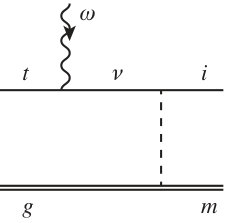 Figure 1
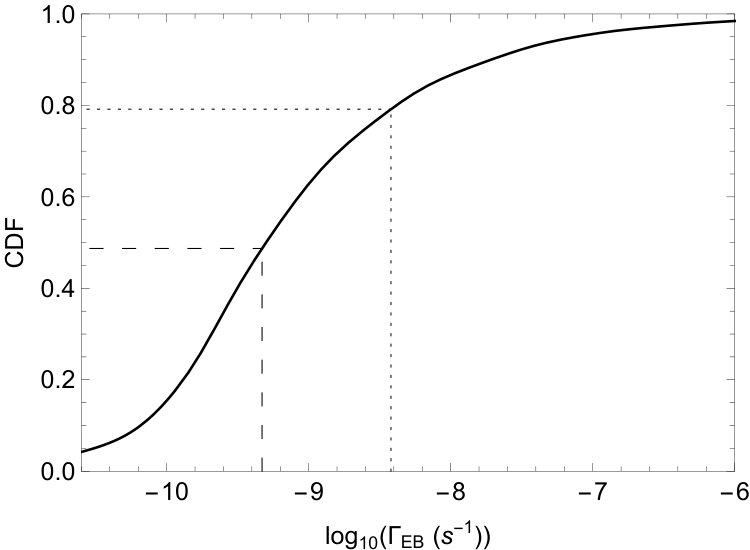 Figure 2
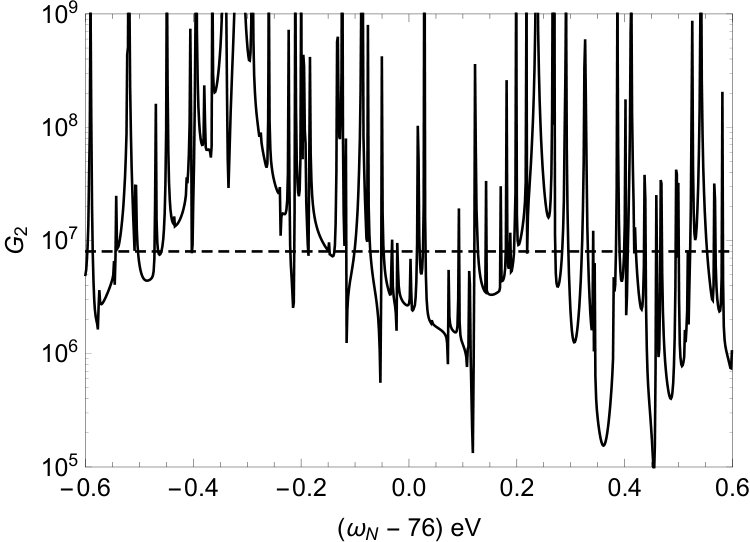 Figure 3
Peer Reviews
No public reviews on file for this paper yet. If you reviewed it on a platform where reviews are public (OpenReview, ICLR, NeurIPS, ICML), you can paste yours below so the community can read it here.
Videos
No videos yet. Explain this paper in a talk, walkthrough, or lecture? Add one.
Resonant electronic-bridge excitation of the 235U nuclear transition in ions with chaotic spectra
J. C. Berengut
School of Physics, University of New South Wales, NSW 2052, Australia
Max-Planck-Institut für Kernphysik, Saupfercheckweg 1, 69117 Heidelberg, Germany
(5 December 2018)
Abstract
Electronic bridge excitation of the 76 eV nuclear isomeric state in 235U is shown to be strongly enhanced in the U7+ ion, potentially enabling laser excitation of this nucleus. This is because the electronic spectrum has a very high level density near the nuclear transition energy that ensures the resonance condition is fulfilled. We present a quantum statistical theory based on many-body quantum chaos to demonstrate that typical values for the electronic factor increase the probability of electronic bridge in 235U7+ by many orders of magnitude. We also extract the nuclear matrix element by considering internal conversion from neutral uranium. The final electronic bridge rate is comparable to the rate of the Yb+ octupole transition currently used in precision spectroscopy.
I Introduction
Precision laser spectroscopy of nuclear transitions will allow an unprecedented probe of nuclear physics, bridging the fields of nuclear and atomic physics. Proposed applications include nuclear lasing Tkalya (2011), nuclear quantum optics Bürvenich et al. (2006), and extremely accurate nuclear clocks Peik and Tamm (2003); Campbell et al. (2012). Recent theoretical Campbell et al. (2012); Tkalya et al. (2015); Flambaum (2006); Litvinova et al. (2009); Berengut et al. (2009); Karpeshin and Trzhaskovskaya (2017); Porsev et al. (2010) and experimental Jeet et al. (2015); von der Wense et al. (2016); Thielking et al. (2018) work in this direction has focussed on the 229Th nucleus, which has the smallest known nuclear transition from the ground state — expected to be in the vicinity of 7.8 eV Beck et al. (2007), although the precise energy is still uncertain.
After 229Th the next lowest-energy nuclear excitation, and the only other known to lie below 1 keV, is the 76 eV nuclear transition of 235U. This transition has received far less attention because its energy is in the extreme ultraviolet (EUV) and it is a much weaker () transition than the 229Th () transition. However it also has some advantages: its location and properties are quite well known compared to the 229Th isomeric transition (to eV Browne and Tuli (2014)); 235U is more readily available than 229Th; 235U has a very long half-life; and chemical compounds of uranium are available to, for example, load atomic traps. It is also worth noting that the 235U transition involves a change in nuclear shell: the Nilsson quantum numbers of the ground and metastable states are and , respectively. Therefore the uranium EUV transition provides a very different probe of nuclear physics than the 229Th transition.
The major drawback of 235U for nuclear spectroscopy is that its frequency is huge by laser standards, and well outside the conventional range. Nevertheless there have been recent demonstrations of up-conversion of frequency combs using high-harmonic generation that can achieve EUV frequencies Kandula et al. (2010); Cingöz et al. (2012); Morgenweg et al. (2014); Porat et al. (2018).
The other issue is that with a natural transition lifetime of order seconds, the 235U nuclear transition is considered too weak for precision spectroscopy (see, e.g. von der Wense et al. (2016)). In this work we show that, by carefully selecting suitable ions and using the electrons to mediate the nuclear transition via electronic bridge (EB), the strength of this nuclear transition can be brought into the range of existing atomic transitions used as frequency standards.
In the electronic bridge process, a nuclear decay occurs not by the direct emission of a photon, but rather by the excitation of an electron, which in turn decays via photoemission. Despite being a third-order -radiation process in QED (see Fig. 1), the electronic bridge process can be the dominant channel for the decay of a nuclear isomer, particularly if a resonance channel is available Krutov and Fomenko (1968). This also applies to the inverse process, sometimes called “inverse electronic bridge” Tkalya (1990). The key point is that the nucleus only weakly couples to low-energy photons due to the small size of the nucleus in comparison to the wavelength of the radiation, while electrons can act as effective mediators of the interaction. EB has previously been studied in 235U Hinneburg et al. (1979); Hinneburg (1981); Tkalya (1990), 229Th Tkalya (1992a, b); Kálmán and Keszthelyi (1994); Karpeshin et al. (1999); Kálmán and Bükki (2001); Porsev and Flambaum (2010a, b), and for the 3.4 keV excited-state nuclear transition in 84Rb Tkalya et al. (2014). Laser-induced electronic bridge has been proposed to determine the excitation energy of the 229Th isomer in Karpeshin et al. (1992); Porsev et al. (2010); Bilous et al. (2018a). Nevertheless, as yet there is no clear experimental observation of the EB mechanism Tkalya (2004).
In this manuscript we envisage laser excitation of the 235U nucleus in a trapped ion via the EB mechanism. In any such attempt it is necessary to suppress further photoionisation by the 76 eV photons (as well as the internal conversion decay mode of the nuclear isomer). Therefore it is necessary to strip 235U of at least its six valence electrons. The spectral density at 76 eV drops rapidly with increasing ionisation stage. However, in this Letter we show that should be a very good candidate for nuclear excitation via the EB process because it has a very dense electronic spectrum that ensures the resonance condition is fulfilled. This density is due to having several active electrons and relatively low-energy excited orbitals. Precision spectroscopy of highly charged ions is currently being pursued Kozlov et al. (2018) and the sympathetic cooling of highly charged ions in a cryogenic Paul trap has already been demonstrated Schwarz et al. (2012); Schmöger et al. (2015).
II Nuclear properties
The 235U nuclear ground state has spin and parity , while the low-energy metastable state is . In order to calculate properties of the transition we require the reduced nuclear matrix element . This can be obtained by considering the internal conversion of the 235U atom, which has a half-life of approximately 26 min Browne and Tuli (2014). Following the conventions of Porsev and Flambaum (2010a) we define the hyperfine-interaction Hamiltonian between nuclear operators and usual electronic hyperfine-interaction operators as
[TABLE]
The reduced operators of are related to the usual nuclear matrix elements by
[TABLE]
where is the interaction multipolarity. is usually measured in Weisskopf units (see, e.g. Bohr and Mottelson (1998)). For transitions the Weisskopf unit is in atomic units (; ).
In this letter we neglect the hyperfine splitting of levels, therefore the total wavefunction can be factorised into nuclear and electronic parts (this is equivalent to averaging over the hyperfine structure). Internal conversion involves a relaxation of the nucleus () with a simultaneous emission of an electron from the shell . For uranium in the ground electronic state , the corresponding internal conversion rate is
[TABLE]
Here we have introduced the notation , is the initial occupancy of the shell , and the emitted electron has energy .
A configuration interaction calculation using the atomic code AMBiT Kahl and Berengut (2018) indicates initial shell occupancies for the uranium ground state of . With these values of , we calculate the electronic factor from (2)
[TABLE]
The internal conversion is dominated by the contribution of core shells with emission of a -wave electron Grechukhin and Soldatov (1976), unlike in thorium where internal conversion mainly comes from from the shell Bilous et al. (2018b). Using the measured internal conversion lifetime of 26 min we obtain W.u., consistent with previous calculations Grechukhin and Soldatov (1976).
At this point it is worthwhile to make a brief aside and calculate the natural linewidth of the transition. Using the standard formula Bohr and Mottelson (1998); Porsev and Flambaum (2010a) we obtain
[TABLE]
The natural lifetime is therefore much larger than the half-life of the 235U nucleus, and is even longer than the lifetime of the Universe. However, this longevity is only realised in special systems, such as a bare uranium nucleus: electronic bridge interactions will generally dominate. Indeed, the mere presence of atomic electrons may induce virtual internal conversion rates several orders of magnitude larger than suggested by (3) Hinneburg et al. (1979); Hinneburg (1981).
III Electronic spectrum
In order to overcome the smallness of (3), and enable laser spectroscopy of this nucleus, we seek an electronic structure which maximises the electronic bridge mechanism. In this work we concentrate on , which has ground state configuration [Hg] . The lowest excited states are the fine-structure partner and the levels, which are some 14 eV above the ground state. In order to excite the nuclear isomeric transition using EB we require an electronic hyperfine transition from the ground state. Therefore we require even-parity levels with in the region of 76 eV.
In our scheme, we would first populate the metastable state. This level has only a suppressed transition to the ground state (because it proceeds only via configuration mixing). This could be populated directly, or via the levels at around 27 eV. We would then excite the system with a 62 eV light source to an even parity level , which could in turn decay to the ground state with nuclear excitation (see Fig. 1). This scheme maximises the number of levels that participate in the EB process.
The even-parity spectrum of begins with the configurations and rapidly becomes very dense with increasing energy. At 76 eV above the ground state, the density is over 2000 levels per eV, or per eV for each subspace with even parity and fixed angular momentum and projection. At this energy the average mixing between states (i.e. the root-mean-square off-diagonal Hamiltonian matrix element Flambaum et al. (1994)) is around 5 times larger than the level spacing, which means that the levels are essentially completely mixed. Under these conditions we have many-body quantum chaos (MBQC), and a statistical description of the system becomes valid (see, e.g. Flambaum and Vorov (1993); Flambaum et al. (1994); Gribakin et al. (1999); Gribakin and Sahoo (2003); Dzuba et al. (2012, 2013) and references within). MBQC in electronic spectra has previously been predicted in near-neutral lanthanides Flambaum et al. (1994) and actinides Dzuba and Flambaum (2010), as well as at high excitation energies in highly charged ions with open -shells Flambaum et al. (2002); Gribakin and Sahoo (2003).
In the quantum statistical theory we express the chaotic even levels in the basis of principal components as
[TABLE]
where the coefficients behave as uncorrelated random variables with mean zero () and
[TABLE]
where is known as the spreading width, which depends only weakly on energy Gribakin and Sahoo (2003).
In a ‘configuration-averaged’ statistical theory the principal components can be configurations. However in order to preserve the exact angular properties of the levels and operators, in this Letter we use functions with definite values of and projection built by performing a configuration interaction calculation using all configuration state functions belonging to a single non-relativistic configuration. Previously we used this “level resolved” statistical theory to calculate electron-capture cross-sections in W20+ Berengut et al. (2015).
IV Electronic bridge
Again, we neglect the hyperfine splitting of levels and factorise the nuclear and electronic parts of the 235 wavefunction. Following the notation of Porsev et al. (2010); Porsev and Flambaum (2010b) we can write the rate of the spontaneous EB process as
[TABLE]
where is the frequency of the absorbed photon. The electronic factor is
[TABLE]
where and eV. is the rank-3 electronic hyperfine interaction operator (see, e.g. Appendix B of Beloy et al. (2008)), and is the electric dipole operator.
We now apply the statistical theory of MBQC to the EB process, substituting Eqs. (4) – (6) into (8). We obtain three terms which, following the nomenclature created for atomic processes in Flambaum et al. (2015), we call the coherent, independent resonance, and residual, respectively:
[TABLE]
In our case the independent-resonance (IR) contribution (10) is larger than the coherent and residual by two orders-of-magnitude, therefore we neglect the latter.
Expanding the , we obtain expressions that contain sums over which only manifest in the energy denominators, . Because of the energy conservation condition, the EB width is much smaller than the mean level spacing. Therefore the EB process will be dominated by only a few resonances near . We may estimate a typical “unlucky” case where lands exactly between two levels amongst a forest of levels separated by . Then
[TABLE]
and we obtain for the independent-resonance contribution
[TABLE]
Note that this procedure is different to that presented in Flambaum et al. (2015) for the calculation of atomic processes such as photoexcitation and photoionization. In that work the process of averaging over a photon energy with width containing a large number of resonances allowed the authors to replace the summation over with an integral over energy. In that case one obtains a prefactor in the IR and residual terms, which is not present in our very narrow EB process.
V Results and Discussion
We have calculated (12) using AMBiT. Core orbitals were calculated by solving the self-consistent Dirac-Hartree-Fock equations in the approximation, including core electrons up to . Excited orbitals were generated in the potential of the residue , and then orthogonalised to the core orbitals using a Gram-Schmidt procedure. Orbitals with principal quantum numbers up to 10 and (-wave) were included in the calculation.
Principal components were generated as follows. First, we generate configuration state functions (CSFs) from all possible configurations with configuration-averaged energy below 128 eV from the ground state. We then diagonalise Hamiltonian submatrices consisting of all CSFs belonging to a single non-relativistic configuration. The resulting eigenstates are our . These states still preserve the angular momentum and projection from the CSFs, but are more realistically distributed in energy space because they are spread out by the configuration mixing Berengut et al. (2015).
To determine the spreading width and level density we created Hamiltonian matrices for , , and including all principal components. We find eV, where is the Hamiltonian matrix element Flambaum et al. (1994).
Using these principal components and , our calculation of (12) yields . This value is not sensitive to the exact values of and since each term in (12) integrates over a dense set of principal components within of .
To check our statistical theory, we have used AMBiT to generate a “complete” calculation of the even levels near using configuration interaction (exact diagonalization of the Hamiltonian matrix). Due to MBQC, the resulting eigenstates and energies only represent the real spectrum in a statistical sense. That is, the generated matrix is an instance of the random matrix with correct average spacing and mixing, and the resulting spectral components are only a single instance of the random variables . Using the spectrum thus obtained in (8) we generated as a function of in the vicinity of 76 eV. The results are shown in Fig. 2. The positions of resonances and their strengths are only indicative; nevertheless the MBQC calculation falls near the median value of (see Fig. 3) supporting the validity of the statistical approach.
With our calculated values of and , we are now able to estimate the total electronic bridge rate of from (7):
[TABLE]
This rate is comparable to that of narrow atomic transitions used in precision spectroscopy, for example the atomic transition of Yb+ Godun et al. (2014); Huntemann et al. (2016). Of course, since we do not know the precise positions of either the nuclear transition or the electronic resonances, the real value of (and hence ) may be orders of magnitude larger. To quantify this uncertainty, in Fig. 3 we present a cumulative distribution function for based on the values of Fig. 2.
VI Conclusion
We have shown that by careful selection of ion stage and electronic bridge scheme, the effective strength of the nuclear transition in 235U can be increased by many orders of magnitude. This brings the transition width to within the range of current atomic experiments. Different ion stages will allow the electronic bridge to be adjusted further, depending on how close the nuclear transition is to an electronic resonance. Many-body quantum chaos is also be present at 76 eV in , and this may be useful if is not favorable (for example, if the nuclear resonance falls far from a suitable electronic level, suppressing ). Other charge stages may also allow for useful interplay between electrons and nuclei.
Acknowledgements.
I thank the following people for very useful discussions: P. Bilous, A. Pálffy, E. Peik, L. von der Wense, C. Schneider, P. Thirolf, P. O. Schmidt, V. Flambaum, O. Versolato, and J. Crespo López-Urrutia. This work was supported by the Alexander von Humboldt Foundation.
The reference list from the paper itself. Each links out to its DOI / PubMed record.
- 1Tkalya (2011) E. V. Tkalya, Phys. Rev. Lett. 106 , 162501 (2011).
- 2Bürvenich et al. (2006) T. J. Bürvenich, J. Evers, and C. H. Keitel, Phys. Rev. Lett. 96 , 142501 (2006).
- 3Peik and Tamm (2003) E. Peik and Chr. Tamm, Europhys. Lett. 61 , 181 (2003).
- 4Campbell et al. (2012) C. J. Campbell, A. G. Radnaev, A. Kuzmich, V. A. Dzuba, V. V. Flambaum, and A. Derevianko, Phys. Rev. Lett. 108 , 120802 (2012).
- 5Tkalya et al. (2015) E. V. Tkalya, C. Schneider, J. Jeet, and E. R. Hudson, Phys. Rev. C 92 , 054324 (2015).
- 6Flambaum (2006) V. V. Flambaum, Phys. Rev. Lett. 97 , 092502 (2006).
- 7Litvinova et al. (2009) E. Litvinova, H. Feldmeier, J. Dobaczewski, and V. V. Flambaum, Phys. Rev. C 79 , 064303 (2009).
- 8Berengut et al. (2009) J. C. Berengut, V. A. Dzuba, V. V. Flambaum, and S. G. Porsev, Phys. Rev. Lett. 102 , 210801 (2009) . · doi ↗