Paired parton quantum Hall states: a coupled wire construction
Alexander Sirota, Sharmistha Sahoo, Gil Young Cho, Jeffrey C. Y. Teo

TL;DR
This paper introduces a new family of non-Abelian fractional quantum Hall states at filling 1/6, derived from coupled wire models, supporting Ising-like anyons and connecting to topological insulator surface states.
Contribution
It proposes a novel paired parton fractional quantum Hall state at filling 1/6, derived from a coupled wire construction, and establishes a new particle-hole symmetry for partons.
Findings
Supports non-Abelian Pfaffian topological order for partons
Constructs exactly solvable wire models for these states
Links parton states to 3D fractional topological insulator surfaces
Abstract
The Pfaffian fractional quantum Hall (FQH) states are incompressible non-Abelian topological fluids present in a half-filled electron Landau level, where there is a balanced population of electrons and holes. They give rise to half-integral quantum Hall plateaus that divide critical transitions between integer quantum Hall (IQH) states. On the other hand, there are Abelian FQH states, such as the Laughlin state, that can be understood using partons, which are fermionic divisions of the electron. In this paper, we propose a new family of incompressible paired parton FQH states at filling (modulo 1) that emerge from critical transitions between IQH states and Abelian FQH states at filling (modulo 1). These paired parton states are originated from a half-filled parton Landau level, where there is an equal amount of partons and holes. They generically support Ising-like…
Click any figure to enlarge with its caption.
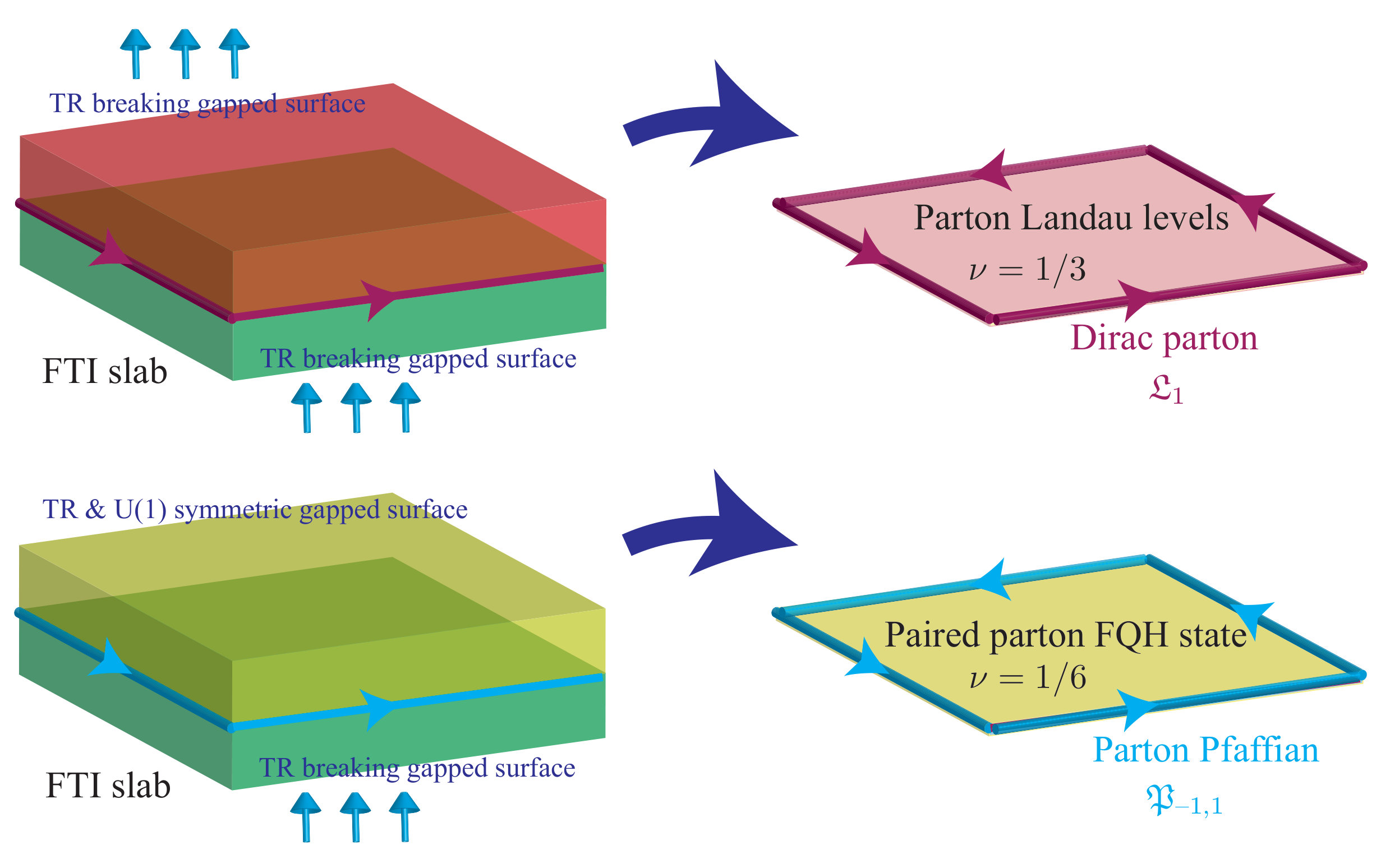 Figure 1
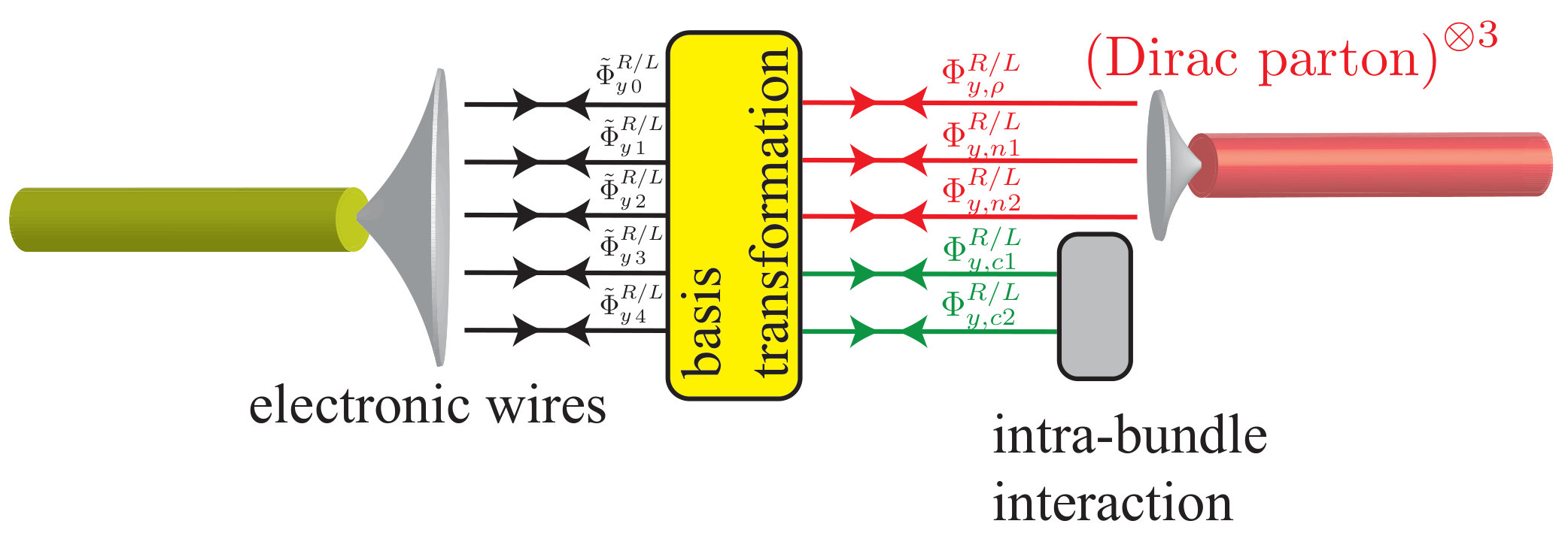 Figure 2
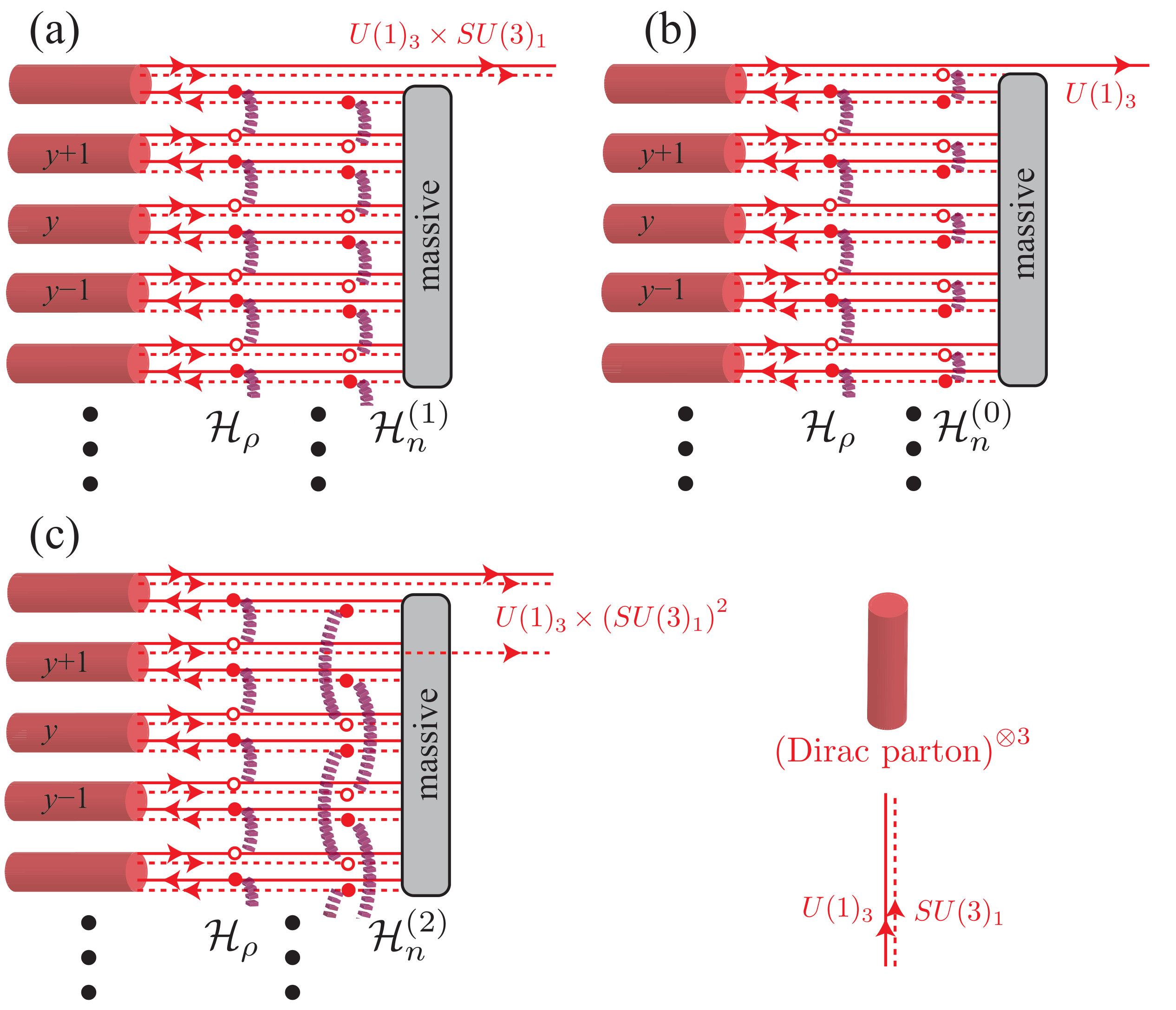 Figure 3
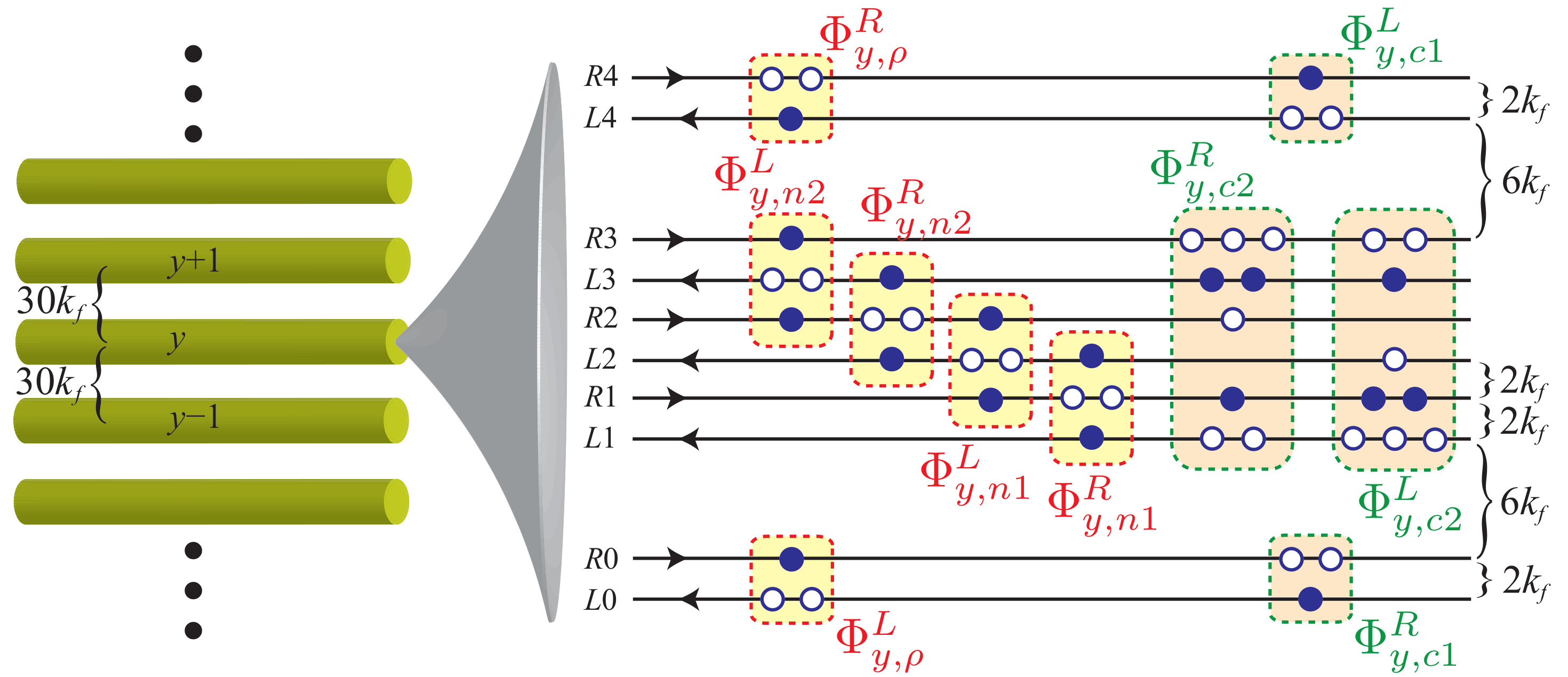 Figure 4
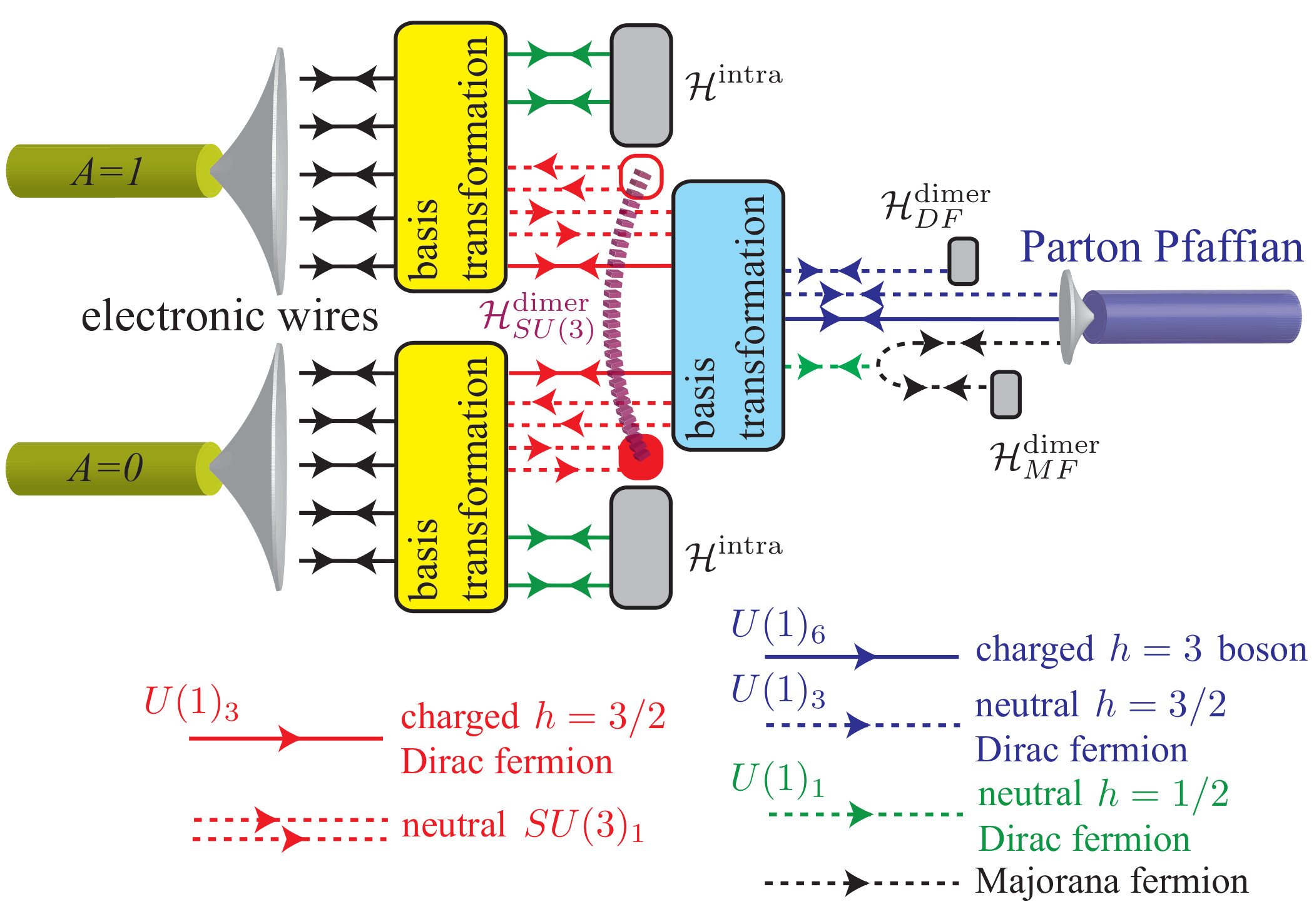 Figure 5
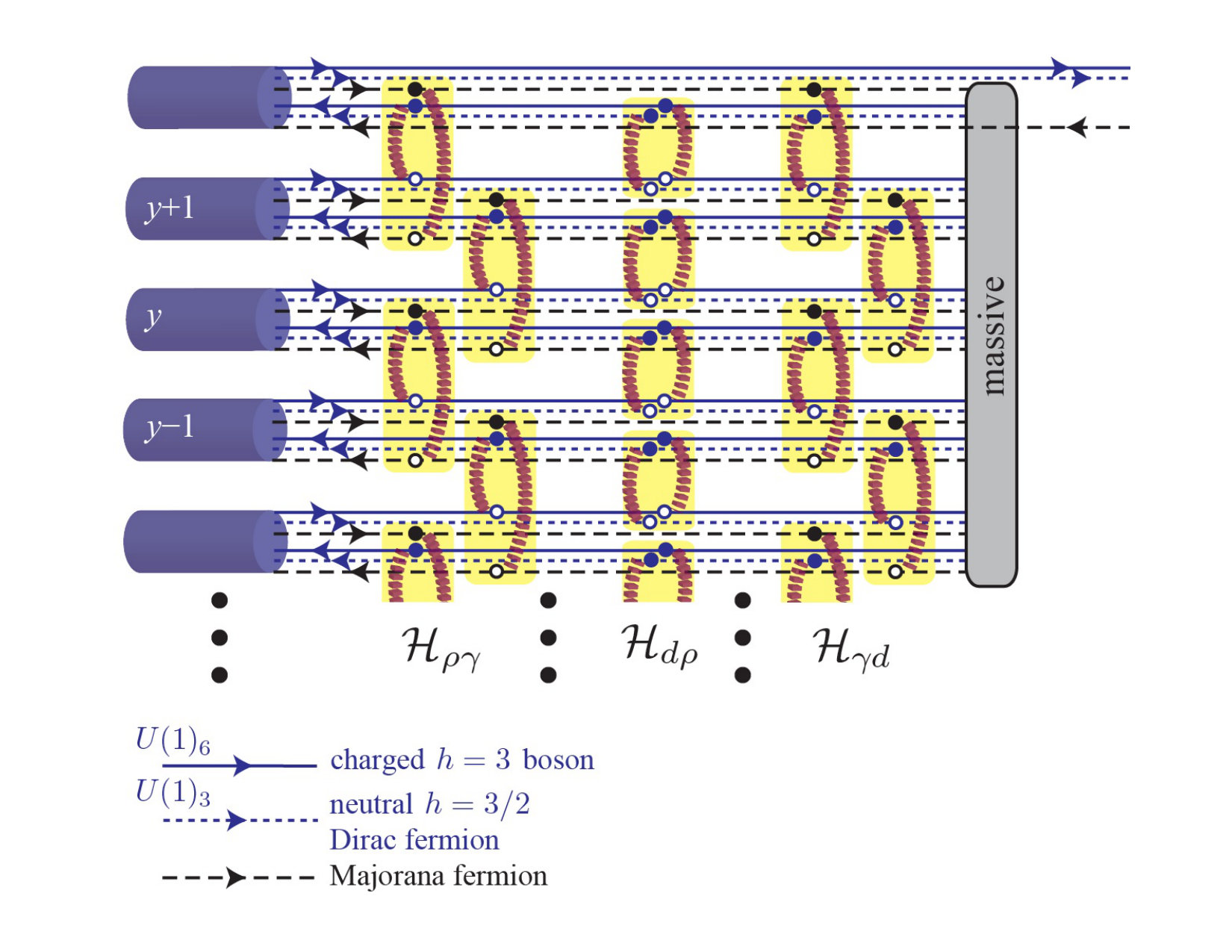 Figure 6
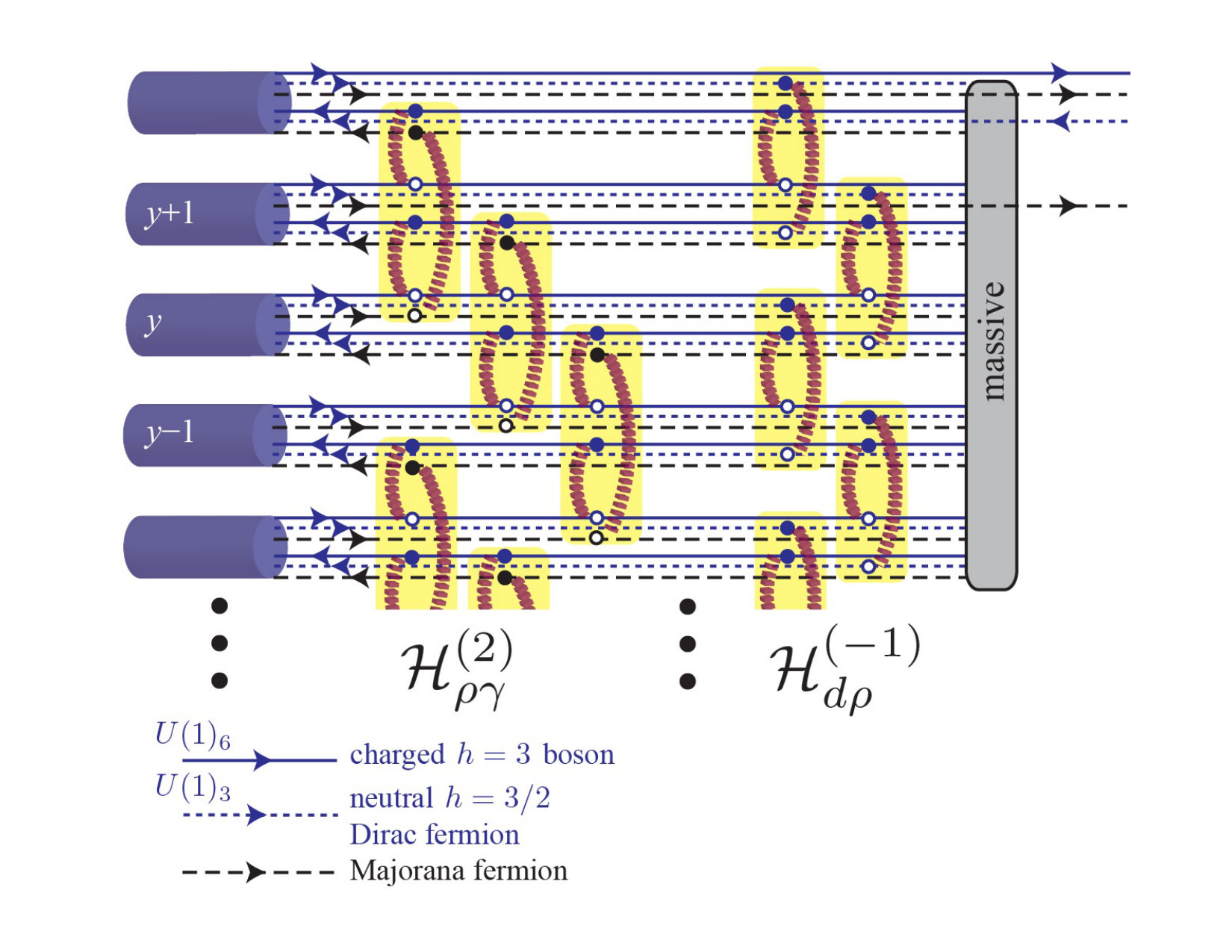 Figure 7
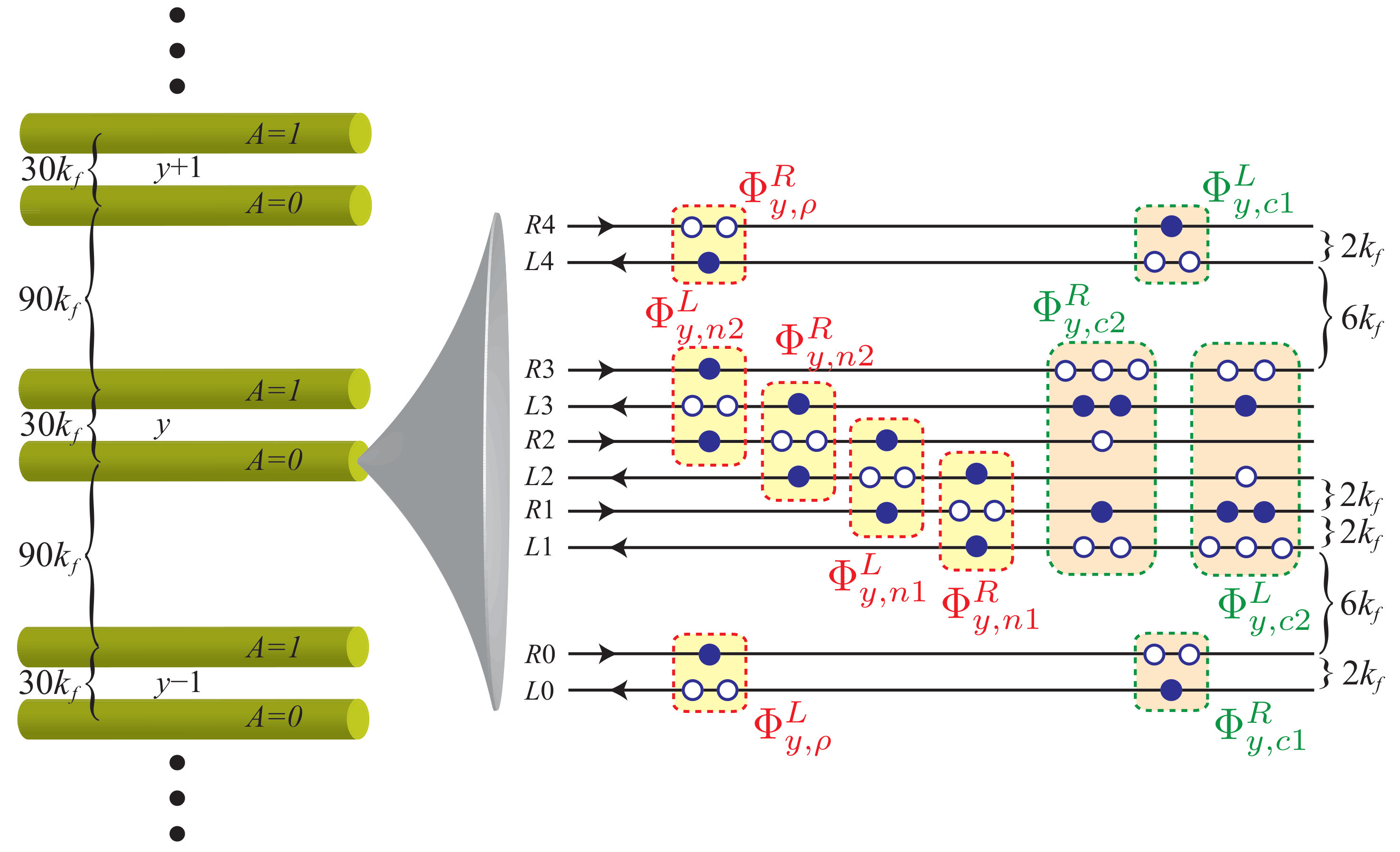 Figure 8
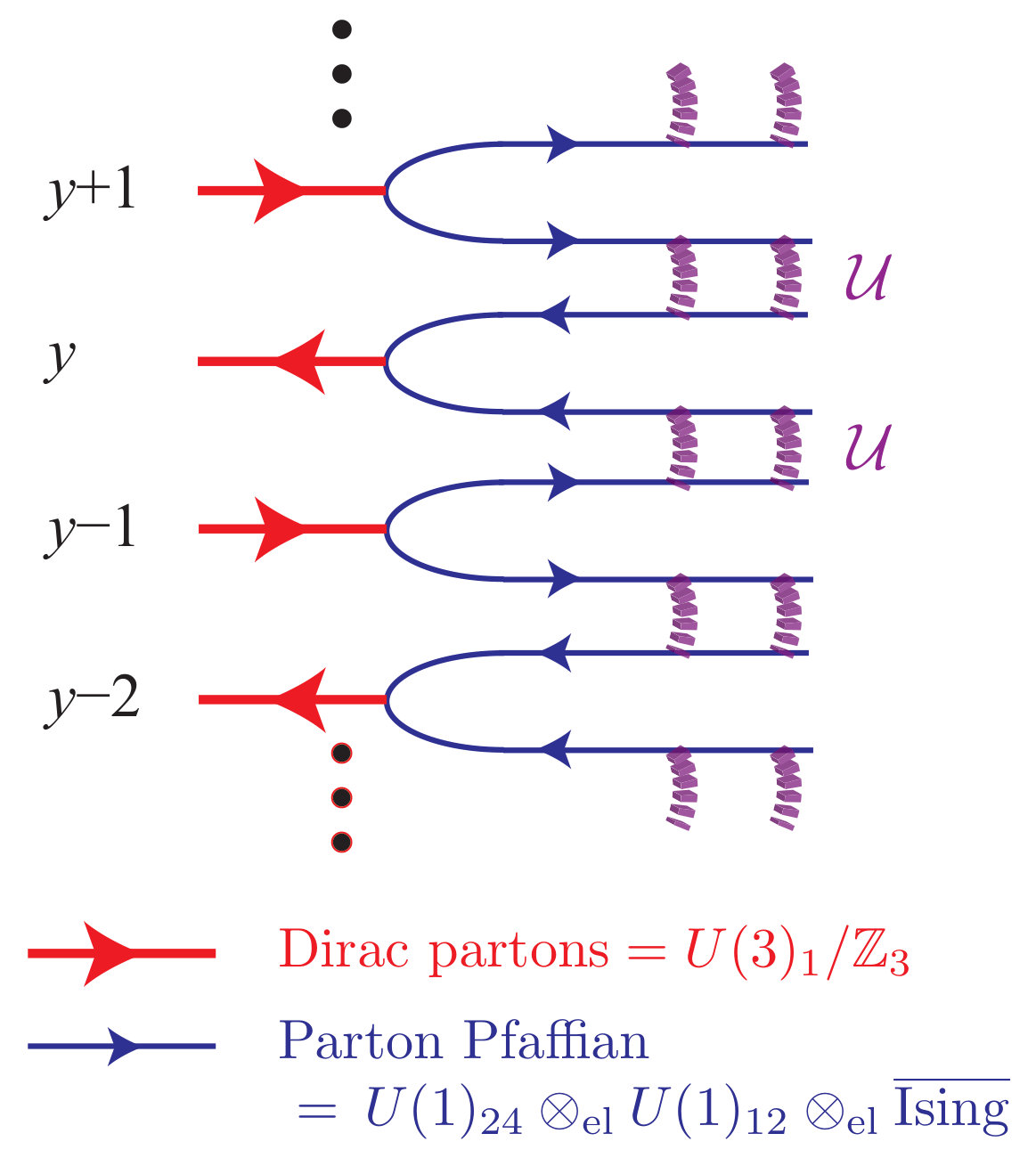 Figure 9
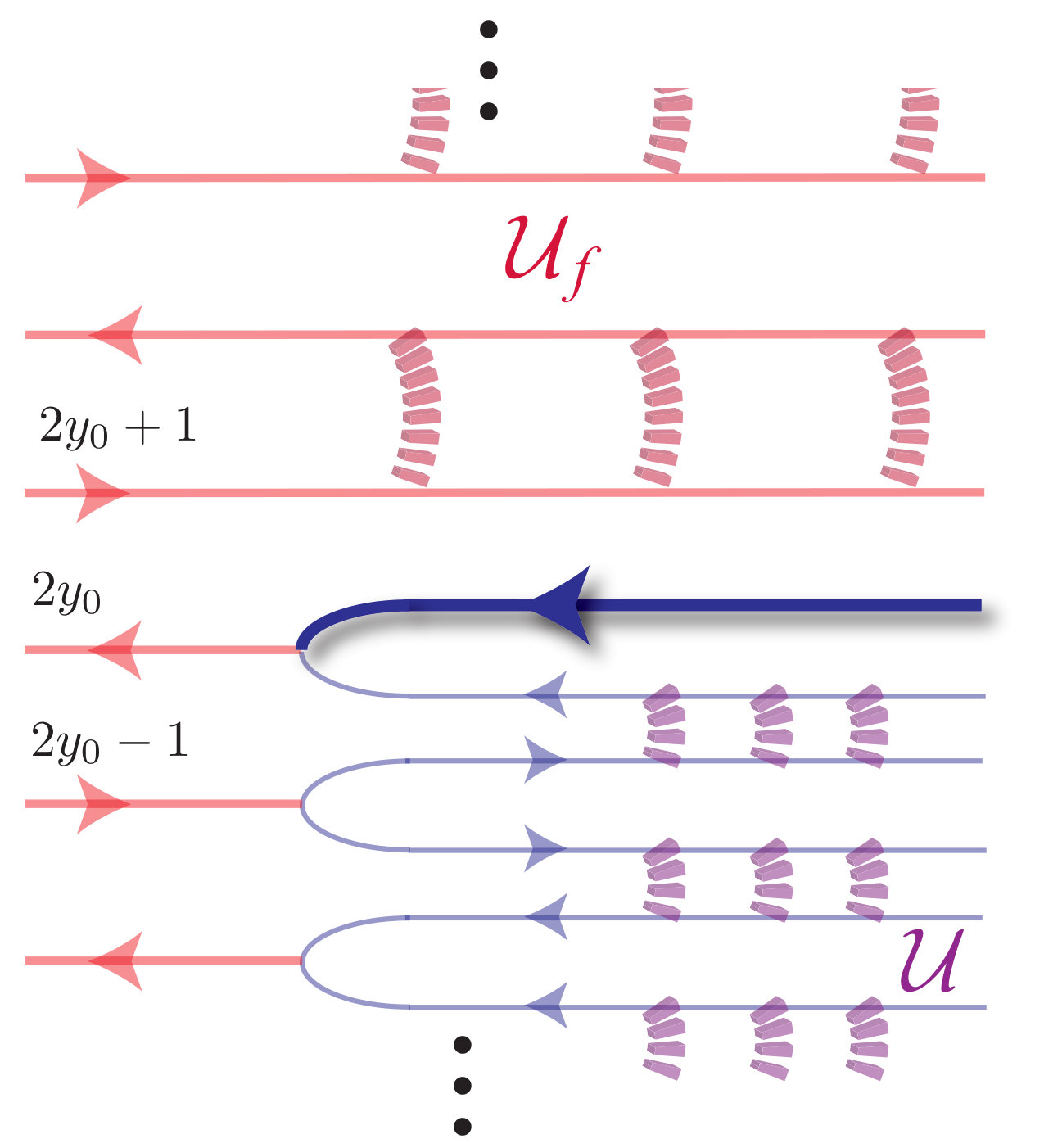 Figure 10
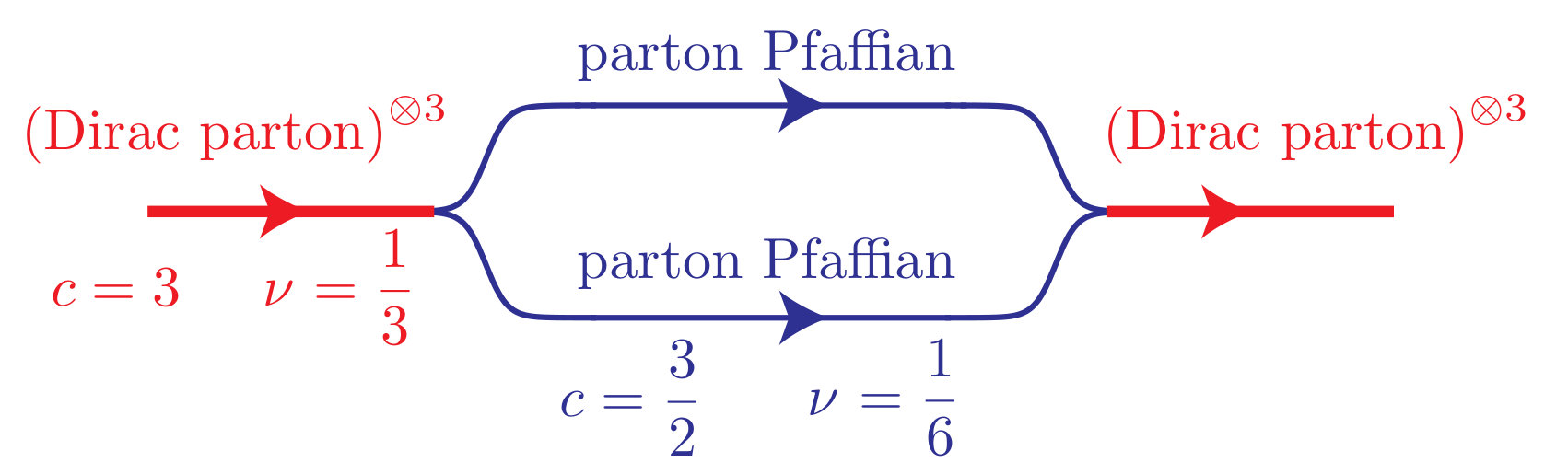 Figure 11
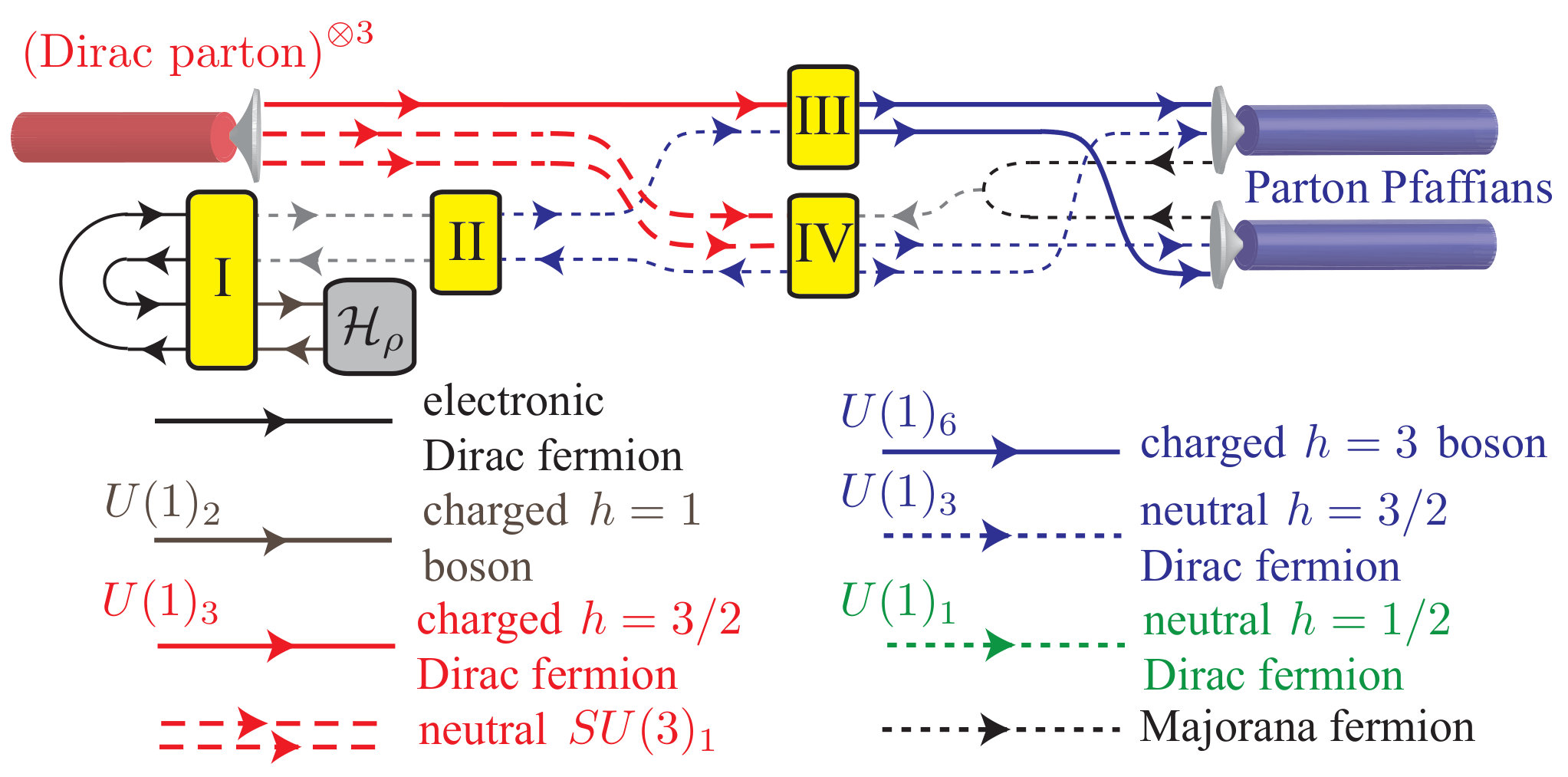 Figure 12
| Partons FQH | ||
|---|---|---|
| states | ||
| filling fraction | ||
| central charge | ||
| known examples | Laughlin state | Q-Pfaffian state |
| FTI-inspired | Dirac parton | Particle-hole symmetric |
| examples | parton Pfaffian |
Peer Reviews
No public reviews on file for this paper yet. If you reviewed it on a platform where reviews are public (OpenReview, ICLR, NeurIPS, ICML), you can paste yours below so the community can read it here.
Videos
No videos yet. Explain this paper in a talk, walkthrough, or lecture? Add one.
Paired parton quantum Hall states: a coupled wire construction
Alexander Sirota
Department of Physics, University of Virginia, Charlottesville, VA22904, USA
Sharmistha Sahoo
Department of Physics, University of Virginia, Charlottesville, VA22904, USA
Stewart Blusson Quantum Matter Institute, University of British Columbia, Vancouver, British Columbia, Canada V6T 1Z4
Gil Young Cho
Department of Physics, Korea Advanced Institute of Science and Technology, Daejeon 305-701, Korea
Department of Physics, Pohang University of Science and Technology (POSTECH), Pohang 37673, Republic of Korea
Jeffrey C. Y. Teo
Department of Physics, University of Virginia, Charlottesville, VA22904, USA
Abstract
The Pfaffian fractional quantum Hall (FQH) states are incompressible non-Abelian topological fluids present in a half-filled electron Landau level, where there is a balanced population of electrons and holes. They give rise to half-integral quantum Hall plateaus that divide critical transitions between integer quantum Hall (IQH) states. On the other hand, there are Abelian FQH states, such as the Laughlin state, that can be understood using partons, which are fermionic divisions of the electron. In this paper, we propose a new family of incompressible paired parton FQH states at filling (modulo 1) that emerge from critical transitions between IQH states and Abelian FQH states at filling (modulo 1). These paired parton states are originated from a half-filled parton Landau level, where there is an equal amount of partons and holes. They generically support Ising-like anyonic quasiparticle excitations and carry non-Abelian Pfaffian topological orders (TO) for partons. We prove the principle existence of these paired parton states using exactly solvable interacting arrays of electronic wires under a magnetic field. Moreover, we establish a new notion of particle-hole (PH) symmetry for partons and relate the PH symmetric parton Pfaffian TO with the gapped symmetric surface TO of a fractional topological insulator in three dimension.
I Introduction
Topological phases of matter Wen (2017) have been playing a pivotal role in the development of modern condensed matter physics. Several fundamental concepts such as fractionalization Laughlin (1983), topological order Wen (1990), and anyon Arovas et al. (1984); Wilczek (1990) have emerged from the studies of topological states and made striking experimental success. For example, the celebrated Laughlin state Laughlin (1983) and more general fractional quantum Hall (FQH) states Cage et al. (2012) are inarguably the most well-understood strongly-correlated electronic phases beyond one dimensional systems, and have been a ‘motif’ for many interesting quantum phases. On the other hand, another experimentally-observed ‘topological’ state, namely topological band insulator Hasan and Kane (2010); Qi and Zhang (2011); Chiu et al. (2016), embodies a remarkable interplay between symmetries and topologies of electronic wavefunctions. The topological insulator has made a broad impact on a number of disciplines of physics, from experimental and theoretical condensed matter physics to theoretical high-energy physics, and is still being actively investigated. In particular, physical properties of fractional topological insulators Maciejko et al. (2010); Swingle et al. (2011); Levin et al. (2011); Maciejko et al. (2012); Ye et al. (2016); Maciejko and Fiete (2015); Stern (2016); Ye et al. (2017) (FTI), which are fractional analogues of topological insulators, are largely unexplored.
Conventional topological insulators (TI) in three dimensions are intricately related to the quantum Hall effect in two dimensions. The massless surface Dirac fermions on the boundary of a TI inspired a new dual low-energy description Son (2015); Wang and Senthil (2015); Metlitski and Vishwanath (2016) of the compressible composite Fermi liquid at a half-filled Landau level Kalmeyer and Zhang (1992); Halperin et al. (1993) at the critical transition between adjacent integer quantum Hall plateaus. Under the duality, the role of time-reversal (TR) symmetry of the former is replaced by particle-hole symmetry Girvin (1984); Son (2015); Barkeshli et al. (2015); Wang and Senthil (2016); Balram and Jain (2017); Nguyen et al. (2018) of the latter. As a consequence, a thin TI slab with finite thickness and TR breaking massive top and bottom surfaces can be regarded as a quasi-2D system that is topologically equivalent to an incompressible quantum anomalous Hall state Liu et al. (2016) which violates the particle-hole symmetry. This is because the two systems share identical 2D Chern invariant Thouless et al. (1982) in the bulk as well as chiral charge and energy transport along their edges. Moreover, the symmetry-preserving many-body interacting gapped surface states Wang et al. (2013); Metlitski et al. (2015); Chen et al. (2014); Bonderson et al. (2013) of a TI exhibit similar topological orders to the incompressible Pfaffian quantum Hall state Read and Moore (1991) at half-filling. For instance, the T-Pfaffian TI surface state Chen et al. (2014) has an identical anyon structure to the particle-hole symmetric Pfaffian quantum Hall state Son (2015).
Similar correspondences hold between 3D FTI and 2D FQH states. The FTI considered in this article are electronic states where the electrons are divided into emergent charge fermionic components, referred to as partons. More precisely, we use the parton ansatz Jain (1989); WEN (1992); Maciejko et al. (2010)
[TABLE]
where , for , are the fermionic partons. The partons are coupled to a dynamical gauge field Maciejko et al. (2012). Each carries a unit gauge charge so that the electronic quasiparticle is neutral. Moreover, each parton species fills a topological band insulator spectrum. From the construction, the FTI surface must have the “fractional parity anomaly” , which is the same Hall conductivity as of a FQH state with filling . In previous works Sahoo et al. (2017); Cho et al. (2017), we showed that the FTI can host two types of charge-conserving and -symmetric surface states with a finite excitation energy gap. The first is a ferromagnetic surface state that breaks TR symmetry. The second is an anomalous symmetry-preserving surface state, referred to as the fractionalized T-Pfaffian state (denoted by - in our previous work). This state is topologically-ordered and supports further fractionalized surface quasiparticle excitations, such as the charge Ising anyon.
The three-dimensional FTI in a slab geometry with a finite thickness can be topologically regarded as a quasi-two-dimensional system (see figure 1). When the two horizontal dimensions are infinite or much longer than the vertical one, the third axis reduces to a finite set of local variables in long length scale. If the top and bottom surfaces are gapped, then the FTI slab is topologically equivalent to a 2D FQH state. While there is currently no confirmation of 3D FTI materials, the thin slab correspondence allows theoretical proposals and predictions of new FQH states, which may arise in existing 2D quantum Hall materials or heterostructures given the right conditions.
In this article, we propose two new classes of parton FQH states inspired by FTI slabs (see table 1 for a summary). Each FQH state is characterized by its filling fraction and chiral central charge that respectively specify the electric and thermal Hall conductance Kane and Fisher (1997); Cappelli et al. (2002); Kitaev (2006)
[TABLE]
where and are the transverse potential and temperature differences across sample. The first class is a series of Abelian FQH states with filling fraction and chiral central charge , where is an integer. For example, is the Laughlin FQH state where partons are confined. represents a deconfined parton FQH phase , where each of the three partons completely fills a Landau level and an electrically neutral sector emerges. This D phase is topologically equivalent to a thin FTI slab with TR breaking top and bottom surfaces Sahoo et al. (2017). The second class is a series of paired parton FQH states with filling and chiral central charge , where and are integers. They generically carry non-Abelian topological orders and support Ising anyons with charge . For example, is identical to one of the -Pfaffian states in ref. Read and Moore, 1991 where partons are confined. On the other hand, represents a FQH phase that extend the Pfaffian topological order by deconfined partons. We refer to this phase as the parton Pfaffian state and denote it by . It is topologically equivalent to a thin FTI slab where one of the two surfaces are TR preserving and the other is TR breaking Sahoo et al. (2017).
One of the most important issues in condensed matter theory is to design and find microscopic electronic Hamiltonians for the strongly-interacting topological states. The parton ansatz (1) that artificially divides an electron into fractional components is an adhoc theoretical construction for the purpose of providing an interpretation of a topological state. It is only valid when the emergence of partons is supported by a microscopic Hamiltonian of many-body interacting electrons. Instead of relying on the parton ansatz as a premise, in this article, we will use the exactly solvable model approach where Hamiltonians of interacting electrons are first designed and subsequently shown to carry gapped parton excitations in the D bulk and gapless parton D conformal field theories (CFT) along the boundary. These model Hamiltonians of parton FQH states will be constructed by the coupled wire method. It involves a highly anisotropic description where the low-energy electronic degrees of freedom are confined along an array of continuous one-dimensional wires and many-body interactions take the form of inter- and intra-wire electron backscatterings. The technique was derived from sliding Lutthinger liquids O’Hern et al. (1999); Emery et al. (2000); Vishwanath and Carpentier (2001); Sondhi and Yang (2001); Mukhopadhyay et al. (2001) and was first employed by Kane, Mukhopadhyay and Lubensky Kane et al. (2002) in the study of Laughlin Laughlin (1983) and Haldane-Halperin hierarchy Haldane (1983); Halperin (1984) FQH states. The method was later applied to more general FQH states Teo and Kane (2014); Klinovaja and Loss (2014); Meng et al. (2014); Sagi et al. (2015); Kane et al. (2017) such as the Moore-Read Pfaffian Read and Moore (1991, 1992) and Read-Rezayi Read and Rezayi (1999) FQH states. In particular, our article can be regarded as a parton generalization of Kane, Stern and Halperin’s work Kane et al. (2017), which provided a coupled-wire description of a sequence of “conventional” Pfaffian FQH states at filling .
Apart from being a tool to build exactly solvable models, the coupled wire construction has two more valuable features. First, the topological order of the D bulk can be inferred from the low-energy CFT that describes the system’s D boundary. The coupled wire Hamiltonian introduces an excitation energy gap in the bulk but leaves behind gapless degrees of freedom along the edge. The gapless boundary modes of the Abelian parton states and the paired parton states are effectively described by the D CFTs
[TABLE]
Second, the series of paired parton states exhibits a new notion of parton particle-hole (PH) symmetry, which applies to the half-filled parton Landau levels. These paired parton FQH states can be related to one another under the PH conjugation (to be defined in details in the main text)
[TABLE]
that “subtracts” from the parton Landau level . In particular, the parton Pfaffian state is PH symmetric. It is not a coincidence that the parton Pfaffian state contains the fractional - topological order that describes the symmetric gapped surface state of the FTI. A parallel analogy can be drawn at the half-filled electronic Landau level, where the PH symmetric Pfaffian state Son (2015) has identical topological order to the T-Pfaffian state Chen et al. (2014) of the symmetric gapped surface of a conventional TI. The exact correspondence between the symmetric FTI surface and the PH symmetric half-filled parton Landau levels is out of the scope of this article and we leave this implication for future studies.
This article will be presented in the following order. In section II, we describe (1+1)D chiral CFTs, which will serve as the building blocks for the (2+1)D parton FQH states and will emerge at the system edge. They also describe gapless modes at the domain walls between gapped regions on the surface of FTIs. We will introduce the Dirac parton CFT in section II.1, the parton Pfaffian CFT in section II.2, and their relationship through “gluing and splitting” in section II.3. In section III.1 and III.2, we present the models for the series of Abelian parton FQH states at filling one-third and the non-Abelian paired parton FQH state at filling one-sixth by coupling electron wires in the presence of magnetic field. In section III.3, we present a model for the surface topological order of the FTI that is closely-related to parton Pfaffian quantum Hall state at filling one-sixth. In section IV, we introduce the emergent notion of particle-hole conjugation and symmetry in the context of partons and demonstrate the PH action on the paired parton states with respect to each of the Abelian states that we found in the section III. Finally, in section V, we summarize our results and discuss open implications. For completeness, we provide in appendix A a review of the relevant Kac-Moody algebras.
II Parton conformal field theories
In this section, we present the relevant conformal field theories Di Francesco et al. (1999) (CFTs) that describe the low-energy degrees of freedom along the D edges of the parton fractional quantum Hall (FQH) states. In particular, in section II.1 and II.2, we focus on the Dirac parton triplet and the parton Pfaffian CFTs that live on the edge of the parton Landau levels and the particle-hole symmetric parton Pfaffian FQH state respectively. In addition to the local electron, these CFTs carry charge fermionic partons along with other fractional quasiparticles as primary fields. We will characterize the charge and energy transport in these CFTs, and show that the parton Pfaffian carries half the degrees of freedom in the Dirac parton triplet (see figure 2). This means a pair of parton Pfaffians can be glued into a Dirac parton triplet by a condensation Hamiltonian consists of many-body electron backscattering (see (53) in section II.3). On the other hand, a Dirac parton triplet can be split into a pair of parton Pfaffians by a fractional basis transformation (see figure 3 and eq.(72) in section II.3). The D parton FQH states that support these fractional boundary modes will be constructed in the next section, and their topological orders can be inferred from the edge CFTs through the bulk-boundary correspondence Read and Moore (1991).
II.1 The Dirac parton triplet
We begin with the triplet of chiral Dirac parton channels. It appears along the 1D interface separating two time-reversal symmetry breaking domains with opposite orientations on the surface of the fractional topological insulator (FTI). It also appears along the 1D boundary of the 2D parton FQH state where each of the three species of deconfined partons completely occupies a Landau level.
In low energy, the triplet is described by the orbifold Di Francesco et al. (1999) CFT (to be defined below). The theory consists of three copies of chiral Dirac parton channels, where the fermionic partons can be represented by normal-ordered bosonized vertex operators , for . In low-energy, the bosonized variables are described by the Lagrangian density
[TABLE]
up to non-universal kinetic velocity terms. They follow the equal-time commutation relation (ETCR)
[TABLE]
which is equivalent to the time-ordered correlation
[TABLE]
where are complex space-time parameters (or in a radially-ordered complex space-time geometry where is periodic and the Euclidean time parametrizes the radial direction). The non-singular second term containing
[TABLE]
is put in (7) to ensure anticommuting correlations between distinct fermions, . The particular form of is chosen to respect the cyclic threefold rotation of parton labels .
Each parton carries the electric charge , where is the charge of the electron. The diagonal combination is a local electronic quasiparticle with charge . In addition to , there are local spin 1 bosons generated by the electrically neutral and neutral combinations , for . They form the roots of a affine Kac-Moody current Lie algebra at level 1. It will become clear in section III.1 that these operators are integral combinations of electrons.
The symmetry rotates the phases of the partons , and leaves the electronic quasiparticle invariant. The orbifold construction allows additional twist fields that corresponds to twisted boundary conditions according to the symmetry when the D system is compactified on a torus where both the spatial and temporal directions are periodic. Physically, the orbifold construction addresses the issue of electron locality. If were local fermions, the CFT would not support any additional twist fields that carry non-trivial monodromy with . However, since the partons are fractional quasiparticles that carry a non-trivial gauge charge, they are non-local with respect to the gauge fluxes.
The orbifold theory includes twist field that carries a flux component, such as the Laughlin quasiparticle . It carries the electric charge and spin , and generate the charge sector. The bosonic twist fields , for , serve as representatives for the pure charge. This is because they obey the fractional mutual statistics with the Laughlin quasiparticle
[TABLE]
The fractional exponent corresponds to a branch cut in the correlation function and gives rise to the non-trivial monodromy after a braiding cycle, , where runs from 0 to . Electrically neutral combinations of the Laughlin quasiparticle and charges, such as , generate the primary fields for an emergent sector (see (17) below).
The charged and the electrically neutral sectors fully decouple from each other, and their mutual operator product expansions (OPEs) are non-singular. The decomposition
[TABLE]
can be summarized by the following fractional basis transformation of bosonized variables.
[TABLE]
where the above transformation matrix is the inverse of
[TABLE]
whose columns are the simple roots of . In (11), () are referred to as bosonized variables in the Cartan-Weyl (resp. Chevalley) basis. The Lagrangian density (5) turns into
[TABLE]
under the basis transformation. The -matrix in the Chevalley basis is given by
[TABLE]
and it governs the ETCR of the Chevalley bosonized variables
[TABLE]
The (1,1)-entry of (14) recovers the -matrix of the Laughlin FQH state. The lower block of (14) is identical to the Cartan matrix of . Primary fields are in general represented by vertex operators , where are vectors with integral entries. In particular, vectors that fall inside the image of , i.e. for some integral vector , correspond to local fields that have trivial monodromy with all primary fields and account for all integral electronic combinations. For example, is the smallest local electronic quasiparticle in the Laughlin charge sector. The neutral combinations , or , for , are local fields that form the 6 roots of the affine Kac-Moody current Lie algebra Di Francesco et al. (1999) at level 1. The currents obey the singular OPE
[TABLE]
where is the structure factor of where , and . The derivations of the current algebra (16) as well as OPEs between vertex operators in general are available in appendix A.1.
The Laughlin quasiparticle is the smallest non-trivial primary field in the charge sector. It decouples from the neutral sector and the OPE between and any of the roots is non-singular. The non-trivial primary fields of are given by the two fundamental representations of the Lie algebra. Linear combinations of primary fields in the super-selection sectors
[TABLE]
rotate according to the OPEs
[TABLE]
and form a conjugate pair of three dimensional irreducible representations of . For instance, the matrices and , for and , are the raising and lowering matrices for the off-diagonal Gell-Mann matrices and , for . All primary fields in and are electrically neutral and carry spin . Since the root operators are local electronic, the OPEs in (18) show that any two primary fields within the same sector or are equivalent up to local electrons. They obey the fusion rules
[TABLE]
which abbreviate the OPEs
[TABLE]
The Dirac parton triplet carries electric and energy transport. The external electromagntic gauge field is coupled to the theory through the transformation [or equivalently , where the charge vector is ], when the electronic quasiparticle transforms by . In particular, the differential conductance of the parton channel is given by
[TABLE]
which associates to the filling fraction of a FQH state that supports a boundary Dirac parton triplet CFT. As all three bosons propagate in the same direction, the channel carries a chiral central charge , which dictates the differential thermal conductance Kane and Fisher (1997); Cappelli et al. (2002); Kitaev (2006)
[TABLE]
in low temperature.
II.2 The parton Pfaffian
The parton Pfaffian CFT, denoted by , carries exactly half of the degrees of freedom of the Dirac parton triplet. It consists of an electrically charged sector and a neutral sector.
[TABLE]
Each sector is generated by a central “almost local” primary field that has non-trivial monodromy only with Ising anyons or -fluxes.
[TABLE]
The electrically charged and neutral sectors are Abelian and can be described by a two-component bosonized theory
[TABLE]
up to non-universal velocity terms, where the -matrices
[TABLE]
define the levels of the two sectors. The sector is generated by a Majorana fermions , which is described by the Lagrangian density
[TABLE]
The Majorana fermion propagates in the opposite direction to the two sectors.
The primary field content of the Abelian part of (23) can be represented by vertex operators , where are integers. The charged sector supports primary fields , denoted by , that carry charge (in units of the electric charge ) and spin . In particular, represents the “almost local” charge boson , where . The external that transforms shifts , where the charge vector is . This set the filling fraction
[TABLE]
that determines the differential conductance of the charge sector. The primary fields satisfy the fusion rule
[TABLE]
which is an abbreviation of the operator product expansion .
The neutral sector supports similar primary fields. The vertex operators are denoted by . They carry spin and follow similar fusion rules in (29). represents the “almost local” neutral spin- Dirac fermion , where . Both the charged and neutral sectors are graded with respect to their central elements and respectively. Each primary field is assigned a parity according its monodromy with the central element. The monodromy can be determined by the time-ordered correlations
[TABLE]
which carry branch cuts (i.e. odd monodromy) when are odd. Odd primary fields are also referred to as -fluxes.
The CFT supports two non-trivial primary fields. The first is the Majorana fermion . It carries spin and follows the fusion rule , which is an abbreviation for the operator product expansion . The second is the Ising twist field . It carries spin and following the non-Abelian fusion rules
[TABLE]
They corresponds to the OPEs and . Like the other two Abelian sectors, the CFT is also -graded with respect to the fermion . The 1 and primary fields are even, and the Ising twist field is odd as it has odd monodromy with .
We associate the three primary field combinations
[TABLE]
to be electronic. This means that they are treated as combinations of integral products of electronic operators. All of them are charge Dirac fermions. They carry spin and respectively. In general, a primary field in the parton Pfaffian CFT is local electronic if it can be expressed as combinations of , and . For example, is a spin 1 neutral boson, and is an integral combination of electrons. The locality of the electron forbids the presence of any twist field that exhibit non-trivial monodromy with any of the ’s. This includes all the fluxes to the electron, such as , and . The “confinement” of fluxes is indicated by the “electronic” tensor product in (23). A general physical primary field of the parton Pfaffian theory takes a tensor product form, and belong in one of the following types
[TABLE]
In other words, the three sector components must be either all even or all odd according to the grading. All other combinations are not allowed by electron locality.
The electric charges, spins and fusion rules of these primary fields can be deduced from that of the three components of in (23). carries the electric charge (in unit of the electric charge ), for . Their spins are given by
[TABLE]
They follow the fusion rule
[TABLE]
Within (33), and are charge spin fermions and serve as the deconfined partons that decompose the electronic quasiparticles
[TABLE]
By summing the contributions from the three components, the overall electric and thermal conductance and are specified by
[TABLE]
each of which is half of that of the parton Dirac triplet described in the previous subsection. This suggests the decomposition or conformal embedding
[TABLE]
which will be discussed in the following subsection.
Before doing so, it is worth noticing that within the parton Pfaffian theory, there is a subset of primary fields
[TABLE]
that are bosonic, fermionic, or semionic combinations with spins
[TABLE]
and are closed under fusion
[TABLE]
This sub-collection generates a theory, referred to as the parton -Pfaffian state and denoted by -, that describes the gapped time-reversal symmetric surface state of a fractional topological insulator Sahoo et al. (2017); Cho et al. (2017). The - state has a similar topological anyon content as the conventional T-Pfaffian Chen et al. (2014) surface state of a single-body topological insulator. Except the charge assignment of each anyon is of the conventional one. Also, there is a threefold increase of periodicity. In particular, the spin- quasiparticle in the - takes the role of the fermionic parton and carries electric charge . is the electronic quasiparticle and is the charge bosonic Cooper pair.
II.3 Gluing and splitting
A pair of parton Pfaffian channels can be glued into a parton Dirac channel through an anyon condensation Bais and Slingerland (2009) process
[TABLE]
which can be carried out explicitly by a sine-Gordon Hamiltonian. We begin with a pair of parton Pfaffian theories , each described by (23). First, we focus on the two neutral Ising sectors . By condensing the bosonic fermion pair , they becomes
[TABLE]
where the product notation here stands for a tensor product and the condensation of the fermion pair. We define the electrically neutral spin Dirac fermion
[TABLE]
The neutral fermion is fractional, however it can be made local electronic by combining with the charge boson from either one of the charge sectors or . The bosonized variable is described by the Lagrangian density
[TABLE]
up to non-universal velocity terms, where . The vertex operators are spin spinor fields that originated from the pair of Ising twist fields
[TABLE]
Similar to the Ising twist fields, these spinor fields have non-trivial monodromy with the electronic quasiparticles in (32) and are confined. However, they can be combined with the -fluxes in the Abelian sectors and to form deconfined excitations. The spin boson condenses because . This fixes the fusion rules
[TABLE]
Next, we take the rest of the Abelian components into account. The parton Pfaffian pair is now described by the five-component bosonized Lagrangian density
[TABLE]
up to non-universal velocity terms, where and for both the and sectors. The first three bosonzied variables represent the neutral degrees of freedom and are invariant under . The final two represent the charged sectors and transforms under when electron operators change by .
We define a new basis within the neutral sectors by the transformation
[TABLE]
where the matrix is unimodular and has the inverse
[TABLE]
The new bosonized variables are described by the Lagrangian density
[TABLE]
where the -matrix (suppressing all zeros) is
[TABLE]
Lastly, we introduce the gluing sine-Gordon potential
[TABLE]
It is straightforward to check that the angle variable satisfies the “Haldane’s nullity condition” Haldane (1995) . The factor of 24 makes sure is constructed by integral combinations of local electronic operators. The potential therefore introduces a finite excitation energy gap to a counter-propagating pair of boson modes and removes them from low-energy. It is charge preserving as is invariant under . The gapping potential pins a finite ground state expectation value for and condenses the bosonic combination
[TABLE]
This is because the Ising anyon (defined in (39)) is the product for both the and sectors, and from (46), the even spinor is originated from the product . Together with the bosonic fermion pair that was condensed previously in (43), they generate all the electrically neutral bosonic pairs in
[TABLE]
Bosons in have trivial mutual monodromy, and the sine-Gordon potential (53) condenses all bosons in . For example, the Ising pairs take non-vanishing ground state expectation values thanks to
[TABLE]
where the parity of the spinor field is fixed by the fusion rule (47), (or ) if is even (resp. odd). We denote the relative tensor product to be the remaining low-energy CFT that is unaffected by the condensation.
From the -matrix (52), it is clear that the two electrically neutral modes and are completely decoupled from the rest and therefore are unaffected by the sine-Gordon potential . It is also straightforward to check that the sum commutes with and thus decouples from as well. Here we normalizes with the factor of 2 because the odd vertices, such as , have non-trivial monodromy with the electronic quasiparticles and and are not allowed by electron locality. Grouping together, the bosonized variables generate the relative tensor product . They obey the same equal-time commutation relation in (15), and therefore are described by the same parton Lagrangian density (13).
Moreover, the bosonized variables respect the same charge assignment and electron locality as the Dirac parton triplet. is the only bosonized variable that transform under . The quasiparticle carries charge and represents the Laughlin quasiparticle. We now show the triple is an integral electronic combination. First, it can be changed into by absorbing the electronic combination . Second, we observe that is one of the boson in (57) that condensed to the ground state. This proves represents an electronic quasiparticle after the condensation. Furthermore, in the neutral sector, the simple roots and are also local electronic. Using the basis transformation (49), the roots are and , which are respectively identical to the electronic operators and up to the condensate .
This concludes the gluing procedure
[TABLE]
Similar gluing procedure was also presented by us in an earlier work Sahoo et al. (2017).
Next, we present the reversal – the splitting of the chiral Dirac parton triplet into a pair of decoupled parton Pfaffian CFTs. The fractionalization is facilitated by an extension of the Dirac partons that includes an additional counter-propagating pair of neutral spin- Dirac fermions, . We first show that the extension can be supported in a purely 1D setting, such as an edge reconstruction, and does not require additional 2D topological order. In other words, the non-chiral CFT can be realized in a 1D electronic wire without being holographically supported on the boundary of a 2D topological state. To achieve this, we start with two electronic wires that contains two counter-propagating pairs of Dirac electrons at Fermi level, where is the wire index and labels the propagating direction. They are represented by the solid black lines in figure 3. We will introduce a many-body interacting potential that leaves behind a pair of neutral Dirac modes in low-energy.
The interaction is based on the following fractional basis transformation of the bosonized variables
[TABLE]
This transformation will also be useful in the coupled wire construction in section III.2 (c.f. eq.(143)). We notice that the new bosonized variables contain half-integral combinations of the original ones. Consequently, the vertex operators are non-local and cannot be expressed as integral combination of electronic ones. On the other hand, the sum and differences , and are integral. The variables represent electrically charged sector and shift by under a transformation that change the phase of an electron . The other two variables represent electrically neutral modes and are invariant under . The bosonized variables are described by the Lagrangian density
[TABLE]
up to non-universal velocity terms.
We introduce the sine-Gordon potential
[TABLE]
which can be constructed from electron backscattering and preserves charge . This gives a finite excitation energy gap to the charged sector and removes it from low-energy, and leaves behind a counter-propagating pair of spin- neutral Dirac fermions . Next, we perform another fractional basis transformation
[TABLE]
The new variables are described by the Lagrangian density
[TABLE]
where . The composite vertices and are two decoupled counter-propagating spin neutral Dirac fermions, and generate the non-chiral CFT. They are represented by the dashed blue lines in figure 3.
Before proceeding, we notice that these neutral fermions are not integral combinations of the original electrons. Therefore, to be precise, the bosonic doubles should be regarded as the local fundamental constituents instead. This changes the compactification radius and the level of the CFT. In additional to the original primary fields , this also allows -fluxes to the neutral Dirac fermions, which are represented by half-vertex twist fields . We rescale , which turns (64) into
[TABLE]
where and matches the in (25) and (48). The rescaled bosonized variables generate the non-chiral CFT. The inclusion of the -fluxes allows additional characters that correspond to anti-periodic boundary conditions of the Dirac fermion in a closed D system. This process is known as -orbifolding Di Francesco et al. (1999) in the CFT context, and in this case, it extends to . Nevertheless, to simplify the notations, we suppress the rescaling/orbifolding and return back to the previous normalization in (64) until the subtlety of electron locality arises again.
We now combine this counter-propagating pair of neutral Dirac fermions with the Dirac parton triplet. To avoid confusion, we differentiate the auxiliary and the parton sectors by and . We denote the auxiliary neutral Dirac fermion sectors by and its bosonized variables by . We denote the the Dirac partons by , which we recall is identical to through a basis transformation (11), and its (right-moving) bosonzied variables by . The total Lagrangian density is the combination of (13) and (64). We first perform a basis transformation between
[TABLE]
Recall generates the charged Laughlin sector, and is the Laughlin quasiparticle. The and bosons here correspond to two decoupled charged sectors
[TABLE]
where which is identical to that of (25) and (48). The bosons are shifted by under a transformation that adds the phase to electrons. Each of the charged sectors carries the differential electric conductance , and the two add up to the conductance of the Laughlin channel.
There are three modes remaining and they correspond to the electrically neutral sectors . We rotate to a new basis
[TABLE]
using the unimodular transformation defined in (50). This turns the neutral sectors into
[TABLE]
where and , both of which match that of the previous Lagrangian densities (45) and (25) respectively, and is the Cartan matrix of defined in the lower block of in (52).
Lastly, we decompose the spin Dirac fermion into Majorana components (see eq.(44)). They generate two decoupled Ising sectors . This completes the splitting process, which can be summarized by the following flow chart.
[TABLE]
We conclude this subsection by addressing electron locality in the splitting process. First, we show that
[TABLE]
are electronic quasiparticles in both sectors (c.f. eq.(32)). Without loss of generality, we illustrate this on the sector. Written in terms of the basis of the original Dirac partons and the auxiliary electrons,
[TABLE]
The first piece is the combination of three Laughlin quasiparticles, and is identical to the electronic spin Dirac fermion . From the basis transformations (60) and (63), it is straightforward to check that the second pieces and are integral combination of the auxiliary electrons. Using the basis transformation (11), the third and last pieces are and , which are identical to the neutral local electronic combinations and respectively. The electron locality of and will be shown later in section III.1 when the Dirac parton triplet is constructed explicitly from electronic wires. In particular, , and can be expressed explicitly using (92) and (98) (also see figure 4) in terms of electronic operators. It is important to acknowledge that the parton Pfaffian channels descend from electronic degrees of freedom. Electron locality forbids excitations that have non-trivial monodromy to any electronic quasiparticle. This restriction was addressed in (33) and will not be repeated here.
III Coupled wire models of fractional quantum Hall states
In this section, we present the coupled wire models that represent the parton fractional quantum Hall (FQH) states and (see table 1 and (3)). In section III.1, we construct a sequence of Abelian FQH states at filling . Each of them carries a Laughlin charge sector and copies of neutral sectors that support the deconfinement of partons (except for , which corresponds to the Laughlin state where partons are confined). In particular, represents the FQH state where each of the three deconfined partons fills a Landau level. Its D boundary hosts the Dirac parton triplet conformal field theory (CFT) , which was discussed in detail in section II.1. This new parton FQH state is topologically equivalent to and inspired by a 3D fractional topological insulator (FTI) slab Sahoo et al. (2017) with finite thickness and time-reversal (TR) symmetry breaking surfaces (see figure 1).
In section III.2, we construct a sequence of incompressible FQH states at filling . We speculate that they may originate from the transition between an integral quantum Hall plateau and a plateau occupied by one of the states. The compressible parton liquid at the transition then gains a many-body excitation energy gap by a parton pairing mechanism. It is out of the scope of this paper to address the compressible parton liquid theory that may describe an integral to fractional quantum Hall plateau transition and relate to the surface state of a FTI. Instead, we focus on incompressible FQH states that exhibit parton pairing. The state carries a charge sector, which has three times the periodicity of the charge sector of the Moore-Read Pfaffian state Read and Moore (1991) due to the charge partons. Its neutral sector consists of copies of , each contains a neutral spin Dirac fermion, and Ising copies, each generated by a neutral spin Majorana fermion. In particular, the boundary of supports the parton Pfaffian CFT , which was presented in section II.2. Similar to , is also equivalent to a 3D FTI slab with a TR symmetric and a TR breaking surface (see figure 1). Moreover, as shown in section II.3, the parton Pfaffian CFT is exactly half of the Dirac parton triplet. This infers that the parton Landau levels can be split into a pair of parton Pfaffian FQH states . In other words, is symmetric under a parton “particle-hole” conjugation, because the “particle” state identical to the “hole” state, which is obtained from subtracting the parton Pfaffian from the parton Landau levels . This new notion of parton “particle-hole” conjugation will be discussed in the next section.
The construction of these exactly solvable FQH models relies on the coupled wire method. It was pioneered by Kane, Mukhopadhyay and Lubensky Kane et al. (2002) in modelling the Laughlin Laughlin (1983) and Haldane-Halperin hierarchy Haldane (1983); Halperin (1984) FQH states. The construction begins with a 2D array of parallel metallic electron wires under a magnetic field. Under the Lorentz gauge , the Fermi momenta of the wires are displaced . Many-body interactions are restricted only to momentum preserving combinations of inter-wire and intra-wire electron backscatterings. A combination with unbalanced momentum contains an oscillating factor and vanishes upon the integration of . These backscattering combinations may involve multiple electrons, and take the form of , where labels the propagating direction of the plane wave electron modes at Fermi level, and is some wire index. They can be generated by higher order corrections to the interacting action in the partition function , for some bare local interaction such as , where is the electron (annihilation) operator at position . The relevance of these backscattering combinations in the renormalization group sense depends on forward scattering interactions. In this paper, we do not address the origins and energetics of these backscattering terms. Instead, we take the strong coupling limit and study the gapped topological state associated to a given backscattering Hamiltonian. These models are exactly solvable in the sense that they consist of mutually commuting and non-competing terms. They freeze all low-energy degrees of freedom in the 2D bulk but leave behind chiral 1D boundary modes.
III.1 Filling one-third
We begin with an array of electronic bundles. Each bundle consists of five wires, and each wire carries a right () and a left () moving electronic Dirac fermion channel that are separated in momentum space by at Fermi level. We label each bundle by an integer which represents its vertical position. The wires within a bundle are labeled by . We bosonize the Dirac fermions so that the electron (annihilation) operator at , for , is represented by the vertex operator
[TABLE]
where is the -momentum of the Dirac fermion. The bosonized variables obey the equal-time commutation relation (ETCR)
[TABLE]
The complete commutation relation that includes the zero modes is presented in (253) in appendix A.2.
The filling fraction of the system under a perpendicular magnetic field is
[TABLE]
where is the number electrons per unit length in a bundle of 5 wires, is the number of fluxes (in units of the flux quantum ) between adjacent bundles per length, and is the bundle displacement in . Under the Lorentz gauge , the field shifts the -momentum
[TABLE]
of each electronic channel according to its vertical position . In the coupled wire model, we arrange the wires so that the channel momentums are given by
[TABLE]
This pattern of momentum shifting is shown in figure 4. In particular, the shift of -momentum between adjacent bundles in this configuration is
[TABLE]
This fixes the filling fraction to be by comparing with (79) and .
Next, within each bundle, we perform a basis transformation and group the electronic channels into three counter-propagating pairs of electrically charged sectors
[TABLE]
and a pair of electrically neutral ones
[TABLE]
These new local combinations are diagrammatically represented in figure 4. They obey the equal-time commutation relation
[TABLE]
where the -matrix (suppressing all 0’s) is
[TABLE]
and the bozonized variables are ordered in . The external electromagnetic gauge transformation, that rotates the phases of electronic operators by , shifts the new local bosonized variables by
[TABLE]
where the charge vector is . Each combination in (92) and (98) corresponds to a product of electronic operators that carries the net -momentum
[TABLE]
The basis transformations (92) and (98) were designed to facilitate the Dirac partons (10). To see this, we first introduce the intra-bundle interactions for each ,
[TABLE]
The two linearly independent angle variables , satisfy the “Haldane’s nullity” gapping condition Haldane (1995) . (See (269) in appendix A.2.) Thus, along each bundle , turns two (out of five) pairs of modes, , massive and removes them from low-energy. We also see that the interaction preserves charge and -momentum conservation. This is because the angle variables are invariant under the gauge transformation (101) and the two sine-Gordon terms are products of electronic operators that have trivial net -momenta, .
The intra-bundle interaction (107) leaves behind, along each bundle , three pairs of low-energy modes
[TABLE]
These modes are not affected by because the three bosonized variables commute with the sine-Gordon angle variables . (See (269) in appendix A.2.) It is important to acknowledge – from (92) and (98) – that the three associate to integral combinations of electronic operators which are local. Locality only allows excitations that have non-fractional mutual monodromy with these local electronic combinations. Let be the vertex operator that creates such an excitation, where is some non-integral combination . Locality requires the equal-time commutator
[TABLE]
to have integral value, where the -matrix was defined in (14) and
[TABLE]
is the number operator of the local electronic combination . The integrality of (112) comes from the fact that is a physical observable and can only take integral eigenvalues in the electronic many-body Hilbert space. Locality therefore only allows vertex excitations , where are integers.
Integral combinations of the local bosonized variables span the root lattice
[TABLE]
of the affine Kac-Moody algebra . We define the dual bosonized variables (in the Chevalley basis), which are fractional combinations of the local ones
[TABLE]
where . Integral combinations of these dual variables span a dual lattice, known as the weight lattice
[TABLE]
whose elements correspond to vertex excitations allowed by electron locality. The dual variables obey the equal-time commutation relation (15). They can be transformed into the Cartan-Weyl basis by (11) that gives the Dirac fermionic partons .
The basis transformation (92), (98) and the intra-bundle gapping interaction (107) now turn each bundle of five electronic wires into a counter-propagating pair of Dirac parton triplets . This process is summarized in figure 5. As promised in section II.1, it is now evident that the charge fermion as well as the six neutral bosonic roots , or are all integral combinations of local electrons. We notice in passing that this is not the simplest way in realizing the Dirac partons. For instance, similar procedure can be applied to a bundle of four electronic wires instead of five. The current method is presented so that the neutral sector carries zero -momentum (see eq.(106)). This will become useful in the next subsection in the discussion of the parton Pfaffian FQH state.
We now describe the coupled wire construction of the series of FQH state with filling . We introduce the interwire gapping interactions
[TABLE]
where is a fixed integer. The coupled wire model Hamiltonian density contains all three interactions from (107), (117) and (118)
[TABLE]
All the sine-Gordon potential preserves charge and -momentum conservation. This can be verified using the charge assignment (101) and momenta (106). The interactions introduce a finite excitation energy gap in the bulk but leaves behind gapless edge modes. See figure 6 for illustration when . In low energy, the gapless edge modes are described by the Kac-Moody CFT
[TABLE]
and carry the chiral central charge . We take the notation so that the neutral sector is right-moving if and is left-moving if . For example, corresponds to the Laughlin FQH state where the topological state has no non-trivial neutral sectors and all partons are confined. We focus on the case when that corresponds to the parton FQH state at filling and central charge . This has the identical topological order to a slab of fractional topological insulator with time reversal breaking and conjugate top and bottom surfaces Sahoo et al. (2017) (see figure 1).
We notice that the first line in (118) of alone can already introduce an energy gap for the neutral sectors in the bulk. The last term is included so that the interaction takes the form of Kac-Moody current backscattering
[TABLE]
where label the six roots of
[TABLE]
which are identical to the six current operators in the parton basis in (16) of section II.1 (or (243) in appendix A.1). In this case, the symmetric interaction (121) introduces a finite excitation energy gap if is negative, so that the additional sine-Gordon term on the second line of (118) does not compete with the two terms on the first line.
Lastly, we observe that the current operators have zero -momentum. This allows the backscattering interaction (121) of an arbitrary hopping range to preserve momentum conservation. The coupled wire model does not provide a preference towards a particular phase. While the charge sector is frozen by , current backscattering Hamiltonians with different ranges compete. A generalized coupled wire model that simultaneously includes multiple ’s could potentially describe a spin liquid with a complex phase diagram connected by a web of topological phase transitions.
III.2 Filling one-sixth
The model for filling one-sixth consists of half as many wires as in the one-third case. This is shown in figure 7 where half the bundles from figure 4 are taken out. The bundles now has a staggered and dimerized configuration where translation symmetry is broken and two bundles, labeled by , now form a super-unit cell. The electron (annihilation) operators are
[TABLE]
where is an integer that labels the vertical position of the 2-bundle super-unit cell, labels the five electronic wires in each bundle, and corresponds to the two counter-propagating electronic channels in each wire. The bosonized variables obey the equal-time commutation relation (ETCR)
[TABLE]
The model is under a perpendicular magnetic field so that the -momenta of the electronic channels are
[TABLE]
Similar to the case, we first perform the basis transformation (92) and (98) for each bundle . Then, we introduce the charge and momentum conserving intra-bundle gapping potential defined in (107) to turn each bundle into the Dirac parton triplet . (Also see figure 5.) We here repeat the transformed bosonized variables that are unaffected by .
[TABLE]
The bosonzied variabes obey the ETCR
[TABLE]
where the -matrix is
[TABLE]
and is ordered according to . The first bosonzied variable shifts by under the external transformation of an electron operator . The other two bosonized variables corresponds to neutral sectors and are invariant under . The vertices are integral combinations of electronic operators, which are diagramatically represented as the yellow boxes in figure 7. They carry the -momenta
[TABLE]
At this point, there are two counter-propagating pairs of Dirac parton triplets in each unit cell in low-energy. We introduce the intra-cell current backscattering
[TABLE]
where . It mirrors the neutral inter-bundle gapping potential (118) and (121) at for the case, except now it acts only within the dimerized super-unit cell. This leaves two counter-propagating pairs of charged modes and the two counter-propagating pairs of neutral modes and , for , unaffected.
Next, we perform a fractional basis transformation to the charged modes
[TABLE]
The () sectors are electrically charged (resp. neutral). They obey the ETCR
[TABLE]
where is the same as that in (138) and
[TABLE]
They carry the -momenta
[TABLE]
It should be noticed that and are half-integral combinations of electronic bosonized variables – previously referred to as “almost local” variables in section II.2 – and therefore they do not associate to local electronic vertex operators. On the other hand, their sums and differences , and correspond to integral electronic combinations.
It will be convenient later to perform a second unimodular basis transformation within the neutral sectors
[TABLE]
This changes the ETCR to
[TABLE]
where the -matrix is now diagonal
[TABLE]
The complete ETCR between the bosonized variables can be found in (285) in appendix A.2.2.
We introduce the neutral Dirac fermions
[TABLE]
The operator is a combination of local electronic number operators and is defined explicitly in (297) in appendix A.2.2. It is chosen in a way to ensure mutual commutativity between the sine-Gordon angle variables in the upcoming interactions (153), (155), (156),(157) as well as (LABEL:PfrhogammaHpq) and (LABEL:PfdrhoHpq). The fermion parity operator anticommutes with the vertex operators in the same unit-cell . Similar to the Jordan-Wigner Jordan (1927); Jordan and Wigner (1928) fermionization of the Ising model, the string of fermion parity operators in (150) ensures the mutual anticommutation relations between the neutral Dirac fermions in (150)
[TABLE]
for .
From (149), we see that is a spin fermion and have spin . The former can be decomposed into a pair of Majorana fermions
[TABLE]
We introduce the Dirac fermion backscattering dimerization
[TABLE]
and the Majorana fermion backscattering dimerization
[TABLE]
(The factors of appearing in (153) and (154) are consequences of the Baker-Campbell-Hausdorff formula and the constant terms in the complete ETCR (285) presented in appendix A.2.2.) These fermion bilinear potentials can be expressed as integral products of the original electron operators . These intra-unit cell interactions leave behind the following degrees of freedom unaffected: (a) the electrically charged spin bosons that generate a sector for each propagating direction , (b) the electrically neutral spin Dirac fermions that generate the counter-propagating pair of sectors, and (c) the electrically neutral spin counter-propagating pair of Majorana fermions . These combine into the non-chiral parton Pfaffian CFT. (See figure 8 for a summary.)
The remaining interactions in the model couple degrees of freedom between unit cells. They are
[TABLE]
The interwire potentials preserves the external as well as -momentum. The factors of and signs , in the interactions (155), (156) and (157) are consequences of the Baker-Campbell-Hausdorff formula and the constant terms in the complete ETCRs (285) and (298) in appendix A.2.2. Any two out of the three sets of interactions are enough to introduce a finite excitation energy gap in the bulk. When all three terms are present, they are not competing when the product is positive. They collectively pin the ground state expectation values of the order parameters
[TABLE]
to be either all positive or all negative. Figure 9 summarizes the three sets of interactions.
To summarize, the coupled wire model involves the following gapping potentials
[TABLE]
The first line consists of the inter-bundle terms (155), (156) and (157), which are also shown in figure 9. The second line contains the terms (142), (153) and (154) that act within a super-unit cell. The last line includes intra-bundle terms that were defined previously in (107). The intra-cell and intra-bundle terms are summarized in figure 8.
It is important to notice that these interactions are consistent with electron locality. Paradoxically, the potentials involve backscatterings of fractional fields. For example, , and backscatter Majorana and neutral Dirac fermions. and couples the fractional charge boson between wires. However, these potentials are specifically designed so that under a basis transformation of the bosonized variables, each of them can be expressed as integral combinations of local electrons. (See (307), (314) and (314) in appendix A.2.2.) In particular, each of the inter-bundle terms , and simultaneously backscatters two of the three fractional fields , and . The bosonized variables , are half-integral in the sense that any sum or difference between any pair is an integral combination of local electron variables. As a result, the inter-bundle potentials are local. On the other hand, potentials that backscatter a single fractional species cannot be constructed from integral combinations of electrons, and are not allowed by electron locality.
The gapping potential (159) leave behind the gapless edge mode
[TABLE]
Along the top edge in figure 9, the three sectors are generated by
[TABLE]
and are described by the Lagrangian densities (25) and (27). The CFT supports the charge Abelian primary fields
[TABLE]
for even integers (c.f. the notation from (33)). In the bulk, these operators create (or annihilate) gapped excitations in the form of vortices/kinks of the order parameters in (158) at . As a consequence of the pair backscattering structures of the inter-bundle interactions , and , they allow deconfined half-excitations that correspond to half-vortices/-kinks of all three sectors. They associate to the charge non-Abelian bosonic products
[TABLE]
for odd integers , where is the Ising twist field of the Majorana fermion . Each has monodromy with all three generators , and of , and . The parton Pfaffian state therefore has the extended product structure
[TABLE]
described in section II.2. Eq.(162) and (163) accounts for all primary fields. All other vortices – such as , for modulo 2, and , for modulo 2 – are non-local with respect to the electron and are confined. For example, the pair creates a -kink dipole for alone, and associates to a linearly diverging excitation energy . The confinement of these vortices is remembered by the “electronic tensor product” .
III.2.1 Variations
The coupled wire model (159) described the “particle-hole” symmetric parton Pfaffian state. By rearranging the inter-bundle terms , and , one can construct a sequence of paired parton states at the same filling fraction but with different edge modes and topological order. In section III.1, the coupled wire models (119) (see also figure 6) at filling generate a series of Abelian parton states by allowing nearest neighbor bundle backscatterings. A similar construction can be applied for the paired parton sequence
[TABLE]
where , are integers. Negative powers associate to counter propagating sectors. For example, and . For instance, the particular parton Pfaffian state described previously in (164) is . The chiral central charge of (165) depends on its neutral sectors, and is given by
[TABLE]
The case when both powers are trivial is special. It corresponds to an Abelian state with strong electronic quasiparticle pairing. It has a strongly-paired topological order and edge CFT
[TABLE]
There is no gapless charge electronic quasiparticles on the boundary. Instead the smallest local electronic primary field is a charge Cooper pair.
We first consider the variations when the powers and are not both trivial. The general coupled wire model is
[TABLE]
The intra-cell and intra-bundle terms in the second and third line are identical to that of (159), and were defined in (107), (142), (153) and (154) (see also figure 8). The first two terms and involve and nearest neighbor backscattering. We ignore terms like in (157) that couple only neutral modes because they are redundant for the bulk energy gap.
The generalized inter-bundle terms are defined by
[TABLE]
These interactions conserve charge and -momentum. They can be re-expressed as integral combinations of electron operators (see (307), (314) and (314) in appendix A.2.2), and are therefore consistent with electron locality. They introduce a finite excitation energy in the bulk and leave behind the edge CFT (165) in low-energy. An example for and is illustrated in figure 10.
Special care is needed for the trivial case when . This is because and in (LABEL:PfrhogammaHpq) and (LABEL:PfdrhoHpq) only backscatter the Majorana and Dirac fermions and within a super-cell. They do not involve the charge boson , which still remains massless in the bulk. The charge sector can be turned massive by the boson backscattering
[TABLE]
where the factor of 2 ensures that is an integral combination of electron operators. By including (169) in the coupled wire model (168) for , removes all low-energy degrees of freedom in the bulk and leave behind the strongly-paired edge CFT (167).
III.3 The parton T-Pfaffian surface state of a fractional topological insulator
In previous works Sahoo et al. (2017); Cho et al. (2017), we proposed the symmetry-preserving surface topological order of a fractional topological insulator (FTI) Maciejko et al. (2010); Swingle et al. (2011); Levin et al. (2011); Maciejko et al. (2012); Ye et al. (2016); Maciejko and Fiete (2015); Stern (2016); Ye et al. (2017). The FTI consists of deconfined partons coupled to a discrete gauge theory. Each of the three parton species occupies a time-reversal (TR) symmetric fermionic topological band and hosts a parton Dirac surface state. The surface can be turned massive without breaking TR symmetry or charge conservation, and similar to the T-Pfaffian surface state Chen et al. (2014), the parton version admits a fractional anyonic excitation structure and hosts an Ising-like topological order. The surface quasiparticle structure was introduced in ref. Sahoo et al., 2017; Cho et al., 2017 and was reviewed in (39) in section II.2. In this section, we propose a coupled wire description to this surface topological order. The construction parallels the coupled wire description by Mross, Essin and Alicea Mross et al. (2015) of the T-Pfaffian surface state of a conventional topological insulator.
The massless parton Dirac fermions on the surface of the FTI can be mimicked by a 2D array of chiral parton Dirac channels, labeled by their vertical position , with alternating propagating directions . These channels are represented by the red wires in figure 11. Each channel carries a parton Dirac CFT described in section II.1. It consists of three parton Dirac fermions that propagate in a single-direction. The emergence of these parton channels can be facilitated by an antiferromagnetic stripe order on the FTI surface. It introduces a time-reversal symmetry-breaking parton energy gap on each stripe, where the Dirac mass flips sign across adjacent stripes. This removes the 2D parton Dirac surface fermions and leaves behind a chiral Dirac channel along each 1D interface. The unbalanced chirality is allowed by TR symmetry-breaking. On the other hand, the 2D array collectively recovers an antiferromagnetic time-reversal (AFTR) symmetry, which combines the local TR conjugation with the half-translation .
The chiral parton Dirac fermion at wire can be bosonized into , for . The bosonized variables fields satisfy the equal-time commutation relation (ETCR)
[TABLE]
The symmetry-preserving many-body gapping interaction relies on the bipartition of each parton Dirac channel into a pair of parton Pfaffians, . The splitting allows the parton Pfaffian channels to be backscattered independently in opposite directions (see figure 11). This splitting basis transformation was introduced in section II.3 (see figure 3 for a summary). It requires a channel reconstruction that extends the parton Dirac CFT by two counter-propagating pairs of electron modes, , for and . The electronic bosonized variables obey the ETCR
[TABLE]
The AFTR symmetry, represented by the anti-unitary operator , sends the partons and the auxiliary electrons from the wire to the one
[TABLE]
The AFTR operator squares to
[TABLE]
where is the total fermion parity operator. The additional phases to the AFTR transformation are included so that and similarly for the electronic bosonized variables .
The basis transformations (60), (63), (68) and (70) together with the backscattering (62) split the chiral parton Dirac CFT along each interface into a pair of parton Pfaffians . The bosonized variables , and in , and are described by the Lagrangian densities (up to non-universal velocity terms)
[TABLE]
The neutral Dirac fermion can be split into Majorana components
[TABLE]
where the Jordon-Wigner string is a product of some electronic number operators similar to that in (152) and it ensures the mutual anti-commutation relations between Majorana fermions in different wires. The bosonized variables and Majorana fermions transform according to the antiferromagnetic time-reversal symmetry (172)
[TABLE]
There are three primitive electronic quasiparticles , in each parton Pfaffian channel. They all carries electric charge and were defined in (32) in section II.2 and (73) in section II.3. The inter-wire gapping interactions in figure 11 consists of the backscatterings of these electronic quasiparticles.
[TABLE]
where the interactions between each pair of wires are
[TABLE]
The sine-Gordon angle variables are and . They transform according to the AFTR symmetry and . Together with the AFTR transformation (176) that sends , this shows the collection of inter-wire backscatterings (177) preserves the antiferromagnetic time-reversal symmetry. Moreover, they all preserve charge conservation because each term simply brings a charge electronic quasiparticle from one wire to the next.
The coupled wire model (177) resembles the one that defines the paired parton Pfaffian state in (155), (156) and (157). The model is exactly solvable and the three gapping interactions are non-competing when and so that they pin the ground state expectation values and , , where and . Therefore they freeze all low-energy degrees of freedom on the surface and introduce a finite excitation energy gap in strong coupling.
The array of parton Dirac channels can also model a gapped FTI surface that violates the AFTR symmetry. The “ferrimagnetic” interaction is given by
[TABLE]
where is the electronic bosonized variable of the charge sector and are the roots of the neutral sector (see section II.1). The last line consists of intra-wire electronic backscatterings that removes the two pairs of counter-propagating auxiliary electrons from low-energy. (179) dimerizes the array of parton Dirac channels and introduces a finite excitation energy gap on the surface.
When the AFTR symmetry-breaking surface is juxtaposed with the parton surface enabled with interaction in (177), they leave behind a parton Pfaffian CFT at the domain wall interface (see figure 12). This verifies one of the propositions in our previous work Sahoo et al. (2017) that a FTI slab with a symmetry-preserving top surface and a time-reversal breaking bottom surface hosts a parton Pfaffian CFT along the boundary (see figure 1). The bulk-boundary correspondence implies the topological equivalence between the FTI thin film (treated as a quasi-2D topological phase) and the particle-hole symmetric paired parton FQH state .
IV Particle-hole symmetry for partons
Particle-hole (PH) conjugation Girvin (1984); Son (2015); Barkeshli et al. (2015); Wang and Senthil (2016); Balram and Jain (2017); Nguyen et al. (2018) inverts a FQH state of electrons to a FQH state of holes in the lowest Landau level (LLL). The PH conjugate of a FQH state is a new FQH state obtained by subtracting from the LLL. The “subtraction” is topologically captured by a product
[TABLE]
between the lowest Landau level and the time-reversal conjugate of . This product describes the bulk topological order as well as the gapless edge conformal field theory (CFT). For instance, the time-reversal conjugate refers to the same edge CFT as except with the opposite propagating direction. The LLL’s electric and thermal Hall transport, which are specified by the filling fraction and edge chiral central charge in (2), are reduced by the subtraction
[TABLE]
For example, this relates FQH states in the Jain’s sequence Jain (1990) with filling and central charge to another sequence with filling and central charge . The former (latter) has an effective Chern-Simons description with the -matrix [resp. -matrix ]. The two are related by (180) which identifies
[TABLE]
where 1 is the -matrix of the lowest Landau level and can be chosen to be the transformation
[TABLE]
Particle-hole symmetry acts within the half-filled Landau level. It flips between FQH states that shares the same filling at . For example, (180) conjugates the Read-Moore Pfaffian state Read and Moore (1991) to the anti-Pfaffian state Levin et al. (2007); Lee et al. (2007) , which is equivalent to up to anyon condensation Bais and Slingerland (2009). The equivalence can be explicitly demonstrated by the basis transformation
[TABLE]
where is the edge chiral Dirac electron of the LLL, and are the charge spin 1 bosons in and , and is a spin neutral Dirac fermion, which can be split into a pair of Majorana fermions and correspond to a pair of CFTs. More recently, a particle-hole symmetric Pfaffian state was proposed by Son Son (2015) that is invariant under the particle-hole conjugation (180), and has the identical topological structure of anyon excitations as the time-reversal symmetric T-Pfaffian surface state Chen et al. (2014) of a 3D topological insulator. The equivalence between and its conjugate can be shown by a basis transformation similar to (184), which leaves behind a -moving neutral Dirac fermion that reduces to a single Majorana fermion upon removing from low-energy by backscattering to the -moving Ising sector. Later, Kane, Stern and Halperin Kane et al. (2017) generalized a sequence of Pfaffian FQH states at filling with chiral central charge using the coupled wire construction. Particle-hole symmetry acts closely as an involution
[TABLE]
In this section, we discuss the topological aspects of a speculative emergent particle-hole symmetry based on partons. In this case, the analogue of a filled Landau level, which defines the base of the conventional PH symmetry (180), is one of the parton FQH states at filling described in section III.1. In particular, the Dirac parton triplet consists of filled Landau levels of the three deconfined partons that constitute the electron, . The parton particle-hole conjugate is a FQH state of parton quasi-hole excitations in . The PH conjugation of a FQH state can be topologically captured by its subtraction from
[TABLE]
where is the time-reversal of , and is some reduced tensor product that involves the identification of partons in and through an anyon condensation Bais and Slingerland (2009) process described below. Eq.(186) dictates the relationships of electric and energy transport between a conjugate pair (c.f. (181) for the conventional case)
[TABLE]
We speculate that there may be an underlying microscopic description of the parton PH conjugation that support (186). It would involve an antiunitary PH conjugation operator that flips between parton particles and holes. In the coupled wire mdoel, the operator would transform the bosonized variables from wires to wires . A similar construction has been proposed recently by Fuji and Furusaki Fuji and Furusaki (2018) that applies to the conventional PH conjugation.
In this section, we focus on the topological aspects of parton PH conjugation instead of its microscopic origin. In particular, we focus on the conjugation among the paired parton FQH states at the PH-symmetric filling described in section III.2. We will show that the parton PH conjugation defined in (186) acts as an involution within the paired parton sequence
[TABLE]
We will demonstrate the PH action on the edge CFT and infer its effect on topological order through the bulk-boundary correspondence.
The general structure of the conjugation can be illustrated by two special cases, or [math]. The first is based on Dirac parton triplet
[TABLE]
which describes the completely filled Landau levels for the three deconfined partons (see section II.1 for the edge CFT content). The second is based on the Laughlin state
[TABLE]
which is the phase where partons are confined. Both were constructed as coupled wire models with filling fraction in section III.1. The former has central charge and the latter has on the boundary. The PH conjugate of a paired parton state is the subtraction of from the parton Landau levels (192) or from the Laughlin state (193),
[TABLE]
where () stands for parton (resp. Laughlin). The gapless edge of the FQH state consists of a forward propagating (or ) CFT and a backward propagating . They can be turned into (resp. ) via basis transformations and electron backscatterings. A paired parton state is PH symmetric if it is topologically equivalent to its conjugate.
We first illustrate the particle-hole action of the parton Pfaffian state with respect to the parton Landau levels (192). We saw in section II.3 that a pair of parton Pfaffian states can be glued into the parton Landau levels, . By formally subtracting a parton Pfaffian state from both sides of the equation, we expect the parton Pfaffian state to be PH symmetric, i.e. . Here we demonstrate the equality explicity.
The edge CFT of the particle-hole conjugate is described by the Lagrangian density (suppressing non-universal velocity terms)
[TABLE]
The first three bosonized variables generate the parton Dirac triplet in the Chevalley basis (c.f. Lagrangian density (13)), where is the Cartan matrix of given by the lower block of (14). The remaining degrees of freedom associates to the counter-propagating parton Pfaffian CFT (c.f. Lagrangian densities (25) and (27)). The external shifts and when a charge electronic quasiparticle is transformed under , and leaves the other neutral fields unchanged.
We first perform a basis transformation among the charged Laughlin sector and the paired sector ,
[TABLE]
This turns the charged sectors into ,
[TABLE]
Under the external transformation that changes for a charge electronic quasiparticle, is shifted by while is unaltered and thus is electrically neutral.
Next, we combine the neutral sectors and – generated by and respectively – together, and perform the basis transformation
[TABLE]
using the unimodular transformation defined in (50). This turns the neutral sectors into ,
[TABLE]
for , where we have decomposed the spin- neutral Dirac fermion in into Majorana components .
The basis transformations (196) and (198) can be applied not only to the parton Pfaffian state but also to any paired parton state . For the conjugate of , the total Lagrangian density is now . Here each of the sectors carries a spin Dirac fermion , and and carry Majorana fermions. We consider the gapping potentials
[TABLE]
to cancel unprotected counter-propagating modes.
backscatters the pair of Dirac fermions and to the two current operators and , where are the deconfined partons in the filled parton Landau levels. (The identification can be shown from the basis transformation (11).) The current operators can be expressed as integral combinations of electron operators. On the other hand, the neutral Dirac fermions and are non-local as they both involve half-electronic operators. However, when combined together, is an integral electronic combination. This is because is just the charge electronic quasiparticle in (73), and is also the electronic combination that is backscattered by in (156). Moreover, is simply the charge electronic quasiparticle in the Laughlin sector. The Dirac fermion backscattering (200) can be rewritten as
[TABLE]
where from (11), is the bosonized variable of the parton in the parton Landau levels . Eq.(202) therefore condenses the electrically neutral bosonic parton pair
[TABLE]
where is the charge fermionic parton in .
in (201) backscatters between the Majorana fermions and . Neither of the Majorana’s is local electronic, but the combination is. This is because is the charge electronic quasiparticle in (see (73)), and is also the electronic combination backscattered by in (155). The remaining can be decomposed into the electronic quasiparticles in the Laughlin sector and the current operator in the neutral sector. Hence, (201) can be rewritten in the form of the backscattering
[TABLE]
between the electronic quasiparticles and in the parton Pfaffian and the parton Landau level .
Eq.(200) and (201) leaves behind the low-energy degrees of freedom , where is the Lagrangian density for the remaining Majorana fermion in in (199). This matches exactly with the Lagrangian densities (25) and (27) for the parton Pfaffian state. This completes the proof of the particle-hole symmetry
[TABLE]
In the process, the gapping potential (200) and (201) remove unprotected low-energy degrees of freedom, namely , , and , along the boundary. The reduced tensor product notation reminds the cancellation of unprotected boundary modes. Equivalently, it signifies the condensation of (203), which identifies the partons in and .
Similar procedure can be carried out for a general paired parton state in (165) and the particle-hole conjugation with respect to the parton Landau levels (192) is
[TABLE]
The edge CFT reconstruction and bulk condensation can be summarized by
[TABLE]
The PH conjugation is consistent with the chiral central charge (166) of
[TABLE]
where the parton Landau levels has the net central charge .
Particle-hole conjugation can also be defined with respect to the Laughlin FQH state, where the partons are confined and the neutral sector does not appear. It relates
[TABLE]
The procedure can be carried out similar to the previous case and is summarized below.
[TABLE]
Again, the conjugation is consistent with the chiral central charge
[TABLE]
where the Laughlin FQH state has central charge .
From (206) and (209), we see that the parton Pfaffian state is the only PH symmetric state with respect to the parton Landau levels, and there is no paired parton state that is PH symmetric with respect to the Laughlin state given integer . With the hindsight from the T-Pfaffian surface state Chen et al. (2014) of a topological insulator and its relationship with the PH symmetric Pfaffian FQH state Son (2015), it is perhaps not a surprise that the parton Pfaffian state is PH symmetric. In previous works Sahoo et al. (2017); Cho et al. (2017) (reviewed in (39) in section II.2 as well as in section III.3), we proposed the symmetry preserving gapped surface topological order, , of a 3D fractional topological insulator, which host deconfined Dirac parton excitations in the bulk. The anyon content has three times the periodicity and one-third the charge assignment as the conventional T-Pfaffian state. It is a subset of the parton Pfaffian topological order, which can be supported by a thin slab of fractional topological insulator with a top surface and a time-reversal breaking gapped bottom surface. It is therefore not a coincidence that when the parton Pfaffian topological order is supported by a FQH state in 2D, it exhibits a PH symmetry in the context of partons. This example may be one of many dualities between 2D FQH states with a generalized notion of PH symmetry and 3D symmetry enriched topological phases.
We conclude this section by generalizing the particle-hole conjugations and in (194) to the arbitrary base
[TABLE]
We now show that the PH symmetry acts as the involution (188) within the paired parton FQH sequence . Like in (207) and (210), the topological action that turns into involves a series of basis transformations and condensations (or edge backscatterings). We begin with . This process can be summarized by
[TABLE]
where the sequence of basis transformation
[TABLE]
is defined by the following. The first transformation is identical to (198), which used the unimodular matrix defined in (50). It turns and one of the ’s into
[TABLE]
Next, the transformation takes the sector – which is generated by in the Lagrangian density in (199) – and another into
[TABLE]
where generate with the Lagrangian densities
[TABLE]
The transformation equates
[TABLE]
The sequence of basis transformation (214) composes of series
[TABLE]
where the backscattering Hamiltonian
[TABLE]
introduces a mass gap for the counter-propagating pair or and removes them from low-energy. Similar to (200) and (201), (225) can be expressed as integral combination of electronic operators.
The last arrow in (213) involves backscattering interactions similar to (200) and (201) that introduce a mass gap for the counter-propagating conjugate pairs ’s and ’s along the system edge, where the forward moving sectors are provided by splitting the spin neutral Dirac fermion in each into a pair of Majorana fermions. Analogous to (203), the edge backscattering is equivalent to condensing electrically neutral parton pairs between and in the bulk. This completes the proof for the particle-hole symmetry action (188) for .
When is negative, the center arrow in (213) needs to be modified. This is because the sequence of basis transformation (219) relies on the presence of counter-propagating sectors, and consists entirely of backward propagating sectors when . In this case, one can first introduce the additional counter-propagating pair to the system edge. This can be achieved by turning off the Dirac fermion backscattering in (153) along the wire at the system boundary. Next, one can apply the sequence (219) of and transformations to turn
[TABLE]
After condensing/backscattering counter-propagating pairs, the PH conjugate becomes where
[TABLE]
which is identical to (188) when is even. When is odd, (229) and (188) differs by , which can be described by a bosonized Lagrangian density with the -matrix . A mass gap can be introduced by the sine-Gordon potential
[TABLE]
where the null-vectors can be chosen to be
[TABLE]
Equivalently, can be reduced to by condensing the following collection of mutually local bosons
[TABLE]
Lastly, we noticed that the general PH conjugation (188) admits a symmetric paired partonFQH state when is odd
[TABLE]
It would be interesting to associate each of these PH symmetric FQH states to the symmetry-preserving surface state of a fractional topological insulator.
V Conclusion and discussion
We theoretically proposed two new sequences of electronic fractional quantum Hall (FQH) states, one at filling fractions and another at . They were summarized in table 1. The first sequence consists of the Abelian states that are characterized by the bulk topological order and edge conformal field theories (CFTs) . The charged sector is responsible for the electric Hall transport and is identical to the Laughlin Laughlin (1983) FQH state. The electrically neutral sectors allow the deconfinement of partons, which are fermionic quasiparticle excitations that carry the fractional electric charge . The presence of these chiral neutral sectors causes an imbalance between electric and thermal Hall transport, and leads to the violation of the Wiedemann-Franz law, . The parton Abelian states can be distinguished by their chiral central charge , which specifies the thermal Hall conductance, .
The second sequence generically consists of non-Abelian FQH states at filling that support charge Ising anyons. They are characterized by the bulk topological order and edge CFT . The sector couples to the external electromagnetic symmetry and is responsible for the electric Hall transport . The sectors are electrically neutral and each carries a spin Dirac fermion, which is an emergent fractional excitation. The Ising sectors are generated by spin Majorana fermions. The neutral Dirac and Majorana fermions can be combined with the charge boson in to represent the local electronic quasiparticles. Deconfined Ising anyons are products of -fluxes (also referred to as twist fields) of all sectors. The sequence generalizes one of the -Pfaffian states, which is identical to , proposed by Read and Moore Read and Moore (1991). Like the Abelian sequence at , the generalization here also supports deconfined parton quasiparticles (see eq.(36)). These paired parton FQH states have distinct thermal Hall transports, which are specified by the chiral central charge .
Contrary to the more common phenomenological slave-fermion mean-field approach, we presented an exact description of partons. In section II, we introduced the CFTs that described the gapless low-energy parton degrees of freedom, which appeared on the D edges of the FQH states and serve as the building blocks of the coupled wire FQH models. Through the bulk-boundary correspondence, these CFTs dictate the anyon excitation structures and the topological orders of the D FQH states that host them as boundary modes. The anyon types in the 2D bulk has a one-to-one correspondence to the primary fields of the 1D edge CFT. The fusion rules between bulk anyons are identical to those that describe the operator product expansions between edge primary fields. Anyons’ spins equate to primary fields’ conformal scaling dimensions modulo 1. The topological -matrix Kitaev (2006), which encodes the quantum dimensions as well as the mutual monodromy of bulk anyons, is identical to the modular -matrix that represents the modular transformation Di Francesco et al. (1999) of the characters in the CFT partition function. The fusion and spin data of the Dirac parton CFT and the parton Pfaffian CFT were presented in section II.1 and II.2. In section II.3, we demonstrated the gluing and splitting of these parton degrees of freedom. They were summarized by the reduced tensor product . This was the parton generalization of the splitting and gluing of the electronic Dirac fermion and the PH symmetric Pfaffian pair, , where . The gluing of the pair of parton Pfaffian theories was carried out by a sine-Gordon Hamiltonian (53) that facilitated the condensation of the bosonic collection (57) of anyon pairs. The bipartitioning of the Dirac parton triplet was enabled by a sequence of fractional basis transformations, which were summarized in figure 3.
Understanding the parton CFTs allowed the coupled wire model construction Kane et al. (2002) of the D parton FQH states and , which were presented in section III.1 and III.2. These models were constructed from a 2D interacting array of metallic electron wires. The ballistic wires were arranged in a particular periodic spatial configuration (see figure 4 and 7) so that in the presence of a perpendicular magnetic field and at the filling fraction and , certain combinations of many-body inter-wire backscattering interactions became favorable as they preserved momentum conservation. In strong coupling, these interactions opened a finite excitation energy gap that froze all low-energy electronic degrees of freedom in the 2D bulk. At the same time, they left behind gapless parton degrees of freedom along system edges that were described by the aforementioned CFTs. A summary can be found in figure 6, 9 and 10. The backscattering interactions were designed so that the model Hamiltonians were all exactly solvable. They consisted of mutually commuting interaction terms, which independently froze mutually decoupled order parameters. Following a similar coupled wire construction Mross et al. (2015) that described the T-Pfaffian surface state of a conventional topological insulator, we presented a model in section III.3 that illustrated the symmetry-preserving many-body gapping of the surface of a fractional topological insulator. We conjectured that the surface model should carry a parton T-Pfaffian () topological order, which was discussed in our previous works Sahoo et al. (2017); Cho et al. (2017) and was reviewed in (39) in section II.2 as well as in section III.3. In particular, the parton surface topological order is a subset of the parton Pfaffian topological order , which exhibits an emergent parton particle-hole symmetry.
In section IV, we presented the emergent parton particle-hole (PH) conjugations among the paired parton FQH state at filling . The PH conjugations were defined by “subtracting” any one of the paired parton FQH state from an arbitrarily given Abelian parton FQH state at filling . The “subtraction” was topologically defined by taking a reduced tensor product between the Abelian state with the time-reversal conjugate of the paired parton state, . The conjugation action produced another paired parton state and was summarized in (188). In particular, since represented the filled parton Landau levels, the PH conjugation based on naturally generalized the notion of particle-hole symmetry from the context of electrons to partons. We also showed that the parton Pfaffian state is PH symmetric in the basis of the parton Landau levels .
We conclude this paper by identifying some unaddressed issues, speculations and implications. First, the many-body interacting coupled wire models were topologically oriented without paying attention to energetics. The inter-wire backscatterings were introduced to demonstrate the structure of the ground state and how the low-energy electronic degrees of freedom can be frozen out in the bulk while leaving behind gapless edge modes. The many-body interacting terms, although allowed by charge and momentum conservation, are generically irrelevant in the renormalization group sense. They can become energetically favorable in the presence of forward electron scatterings that modify the velocities of the bosonized variables, i.e. the Luttinger liquid parameters. In a more realistic setting, these intricate inter-wire backscattering interactions may emerge as higher-order correction terms to a more conventional interacting action, such as an array of two-body interacting chains or ladders. However, such approaches generically generate competing backscattering interactions that render the model unsolvable. On the other hand, we anticipate our topological construction to inspire lattice or continuum models that can be numerically analyzed and address naturally occurring interactions in materials.
Second, the topological order of the presented coupled wire models relies heavily on the bulk-boundary correspondence. It can also be addressed in a closed toric geometry with no edges by the algebra of Wilson loops, which can be generated by strings of electron intra- and inter-wire tunneling in the vertical direction and sliding operators in the horizontal direction. The degenerate ground states form an irreducible representation of the Wilson algebra. Anyon excitations manifest as kinks in the order parameters pinns by the backscattering interactions can be created by open Wilson strings. Their spin and braiding statistics can be determined by the intersection phases from interchanging string operators. These derivations are omitted in the scope of this paper and we defer the continuation of this discussion to future works.
Third, the presentation of the particle-hole conjugation and symmetry lacks a microscopic description, which involves the short-range non-local anti-unitary charge conjugation action on the wire bosonized variables , where is the PH operator and , are c-numbers. Related description of electronic PH symmetry and particle-vortex duality in the coupled wire setting has been discussed by Mross, Alicea and Motrunich Mross et al. (2016a, b, 2017) and by Fuji and Furusaki Fuji and Furusaki (2018). We anticipate a similar microscopic description can be applied in the context of partons. In addition, we expect a general correspondence to hold between PH symmetric paired parton FQH states in two dimensions and time-reversal symmetric fractional topological insulators (FTIs) in three dimensions. For instance, the previously proposed Sahoo et al. (2017); Cho et al. (2017) correspondence between the parton Pfaffian state and a particular FTI Maciejko et al. (2012), which hosts bulk partons coupled with a gauge theory, is one existing example.
The proposed parton FQH states could in principle be verified in materials. The chiral central charges for the Abelian states and for the paired parton states corresponds to distinct thermal Hall signatures Kane and Fisher (1997); Cappelli et al. (2002); Kitaev (2006); Mross et al. (2018) (see (2)). Recently, thermal Hall conductance has been measured Banerjee et al. (2017, 2018) in the Laughlin particle state at filling and hole state at as well as the Pfaffian state at , suggesting PH symmetry Son (2015) at the plateau. Similar thermal Hall observations at filling and , if such plateau exists, may provide indications to one of these parton FQH states.
Acknowledgements.
GYC thank the support from BK 21 plus project at POSTECH in Korea. JCYT is supported by the National Science Foundation under Grant No. DMR-1653535.
Appendix A Kac-Moody algebra
In this appendix, we review the algebraic properties of bosonized variables. We demonstrate the basic arithmetic principles in carrying out operator product expansions (OPEs) of vertex operators and derive the Kac-Moody algebra (also known as an affine Lie algebra or a Wess-Zumino-Witten (WZW) algebra) encountered in section II.1. We present the equal-time commutation relations (ETCRs) between bosonized variables in the coupled wire setting in section III, and pay special attention to the commutation relations between zero modes.
A.1 The parton algebra
The bosonization of the three parton Dirac fermions , for , described in section II.1 is based on the time-ordered correlation (7) between the three bosonized variables.
[TABLE]
where are complex space-time parameter in a radially ordered geometry, and the constant factor
[TABLE]
is set to ensure anticommutation relations between mutual parton fermions. The correlation (236) is equivalent to the equal-time commutation relation (ETCR)
[TABLE]
which implies (6) upon differentiation with respect to , where when or [math] when .
The operator product expansions (OPE) between a general pair of normal ordered vertex operators can be evaluated according to
[TABLE]
where are linear combinations of the bosonized variables . At equal time, this is equivalent to the Baker-Campbell-Hausdorff formula
[TABLE]
where all higher-order commutators vanish because is a -number. For instance, the OPE between a pair of parton Dirac fermions is
[TABLE]
where higher-order non-singular pieces are suppressed in the limit . The factor ensures fermions with distinct flavors anticommutes
[TABLE]
The affine Lie algebra that generate the parton triplet (10) is generated by the normal ordered current operators
[TABLE]
where . The Cartan generators of can be rotated into the Cartan generators of the diagonal charge sector and the neutral sector and . They obey the OPEs
[TABLE]
The six roots are raising and lowering operators and follow the singular OPEs with the Cartan generators
[TABLE]
A pair of raising and lowering operators obey the OPEs
[TABLE]
where is the structure factor of where , and . Here the constant “cocycle” factor at the first equality in (246) originates from the constant non-singular term in the time-ordered correlation (236). It is responsible for the antisymmetry of the structure factor, . Eq.(244), (245) and (246) recover the current algebra OPE in (16) if keeping only singular terms. The two Cartan generators , and the six roots form the current algebra at level 1
[TABLE]
where are the eight current generators and is the full structure factor of .
The conformal embedding of into is demonstrated by the splitting of the energy-momentum tensor
[TABLE]
The full energy-momentum tensor of the parton triplet is the normal ordered product
[TABLE]
The energy-momentum tensor of the Laughlin sector is
[TABLE]
and the energy-momentum tensor of the neutral sector is given by the Sugawara form
[TABLE]
where is the dual Coxeter number. The mutual OPE between and is non-singular, and therefore the two sectors decouple.
A.2 Equal-time commutation relations and Klein factors
In this appendix, we set the equal-time commutation relations (ETCR) between the bosonized variables in the coupled wire models in section III. In particular, we present the commutation relations between zero modes that correspond to constant terms in
[TABLE]
these terms drop out upon differentiation and are absent in the canonical ETCR set by the “” term of the Lagrangian density . However, they are necessary for a consistent multi-component bosonization scheme. For example, the constant piece involving the antisymmetric matrix in the ETCR (238) for parton bosonized variables ensures the anticommutation relations between fermionic parton operators of distinct flavors. The constant term is also essential to the antisymmetry of the structure factor in the current algebra (245). In the coupled wire construction, similar constant terms must be carefully instated to the ETCR of bosonized variables to uphold the appropriate algebraic relations between physical operators.
A.2.1 The Abelian parton sequence
Here we define the ETCR for the bosonized variables in the coupled wire model for the sequence of Abelian FQH states at filling one-third described in section III.1. The model is based on an array of electronic bundles, each labeled by an integer that reflects its vertical position, and each consists of 5 counter-propagating pairs of electronic channels, labeled by the wire index and propagation direction . The electronic operators are bosonized according to . The bosonized variables obey the ETCR
[TABLE]
The first term corresponds to the canonical ETCR (77) upon differentiation with respect to , and the constant term on the second line is antisymmetric,
[TABLE]
because of the antisymmetry of the commutator. In order for the electron operators to obey mutual fermionic statistics, the constant must be an odd integer whenever so that, from the Baker-Campbell-Hausdorff formula (240),
[TABLE]
between electronic vertex operators with distinct channel labels.
The bosonization of the electronic channels can alternatively be carried out by using the bare bosonized variables that obey the decoupled ETCR
[TABLE]
They are related to the previous bosonized variables by
[TABLE]
Here, is the electron number operator for the fermion channel
[TABLE]
and the constant operators
[TABLE]
are referred to as Klein factors.
The constant terms are chosen to be
[TABLE]
are decomposed into the matrices
[TABLE]
with their rows, columns ordered according to respectively. The constant factor (263) can also be expressed as
[TABLE]
The antisymmtry relation (254) is satisfied because
[TABLE]
The anticommutation relation (255) between mutual electron operators holds because so that for . In addition to the antisymmetries, the Kac-Moody algebra (253) also respects the time-reversal symmetry
[TABLE]
although the symmetry is eventually broken by the backscattering interactions. Here, the time-reversal operator is antiunitary and transforms the bosonized variables according to
[TABLE]
where are constant real numbers that satisfy so that the transformation is in agreement with , where is the total electron number operator.
The signs of the matrix entries in (264) are chosen so that the sine-Gordon angle variables involved in the coupled wire models (119) mutually commute. This ensures the Hamiltonians (119) for the Abelian parton FQH states are exactly solvable. In (92) and (98), we transformed the bosonized variables from to the new basis . The Dirac fermion channels become massive under the intra-bundle backscattering interactions (107), which pins the two sine-Gordon angle variables . The ETCR (253) with the choice of the constant terms presented in (263) and (264) warrants the commutation relations
[TABLE]
for .
The remaining three bosonized variables corresponding to the parton Dirac triplet obey the commutation relations
[TABLE]
where is the Cartan matrix of . The constant terms in the neutral sector are
[TABLE]
and the constants are grouped into the matrices Equivalently, the constant terms in the neutral sector can also be expressed as
[TABLE]
The ETCR (270) guarantees the commutativity
[TABLE]
of the sine-Gordon angle variables
[TABLE]
in the inter-bundle backscattering interactions (117) and (118).
A.2.2 The paired parton sequence
Here we define the equal-time commutation relation (ETCR) for the bosonized variables in the coupled wire model for the sequence of paired parton FQH states at filling one-sixth presented in section III.2. The model is based on an array of bundles, each consists of five electronic wires. The bundles are arranged in a 2-bundle unit cell (see figure 7). The electron (annihilation) operators are bosonized according to , where the integer labels the unit cell, labels the two bundles, designates the five electronic wires, and denotes the forward and backward channels along a wire. The ETCR for the electronic bosonized variables can be deduced directly from the previous appendix A.2.1, which applies to the model at filling one-third that contains twice as many wires (see figure 4). Restricting to the current system,
[TABLE]
[TABLE]
where the and constants were defined in (263) and (264).
We first observe that the intra-cell sine-Gordon terms and defined in (107) and (142) (see also figure 8) are contained in the previous coupled wire model (119) at filling one-third. The commutativity between the sine-Gordon angle variables were confirmed in appendix A.2.1. These gapping terms leave behind two counter-propagating pairs of charge (neutral) channels (resp. , for ). From (270), they obey the ETCR
[TABLE]
where was given in (276).
Next, we performed the basis transformations (143) and (147) (also see figure 8) to change to , where is a charge boson, and are neutral Dirac fermions. The new bosonized variables obey the ETCR
[TABLE]
where is the diagonal matrix (149), and . The constant terms and are
[TABLE]
and the constants are grouped into the rank 3 matrices and vectors
Having establishing the ETCRs, we now move on to the definition of the number operator that was used in (150) for the definition of the neutral Dirac fermions
[TABLE]
Within the same unit-cell , the odd off-diagonal entries of and the odd entries of in (LABEL:appSigmaMcV) guarantee the mutual anticommutation relations between vertex operators
[TABLE]
However, the vertex operators commute when they occupy different unit-cells because the entries of and in (LABEL:appSigmaMcV) are even. To facilitate the mutual fermionic anticommutation relations between the operators in (295), we choose the number operator to be
[TABLE]
It is a linear combination of the local electronic number operators and , where are the number operators for the electrons in (123) that constitute the coupled wire model. The number operator obeys the following ETCR with the bosonized variables
[TABLE]
where , for , is the same vector given in (LABEL:appSigmaMcV). In particular, the odd commutator in the second line ensures
[TABLE]
for . The particular combination of (297) is chosen so that the sine-Gordon angle variables appearing in the interactions (155), (156), (LABEL:PfrhogammaHpq) and (LABEL:PfdrhoHpq) commutes with the neutral Dirac fermions
[TABLE]
The intra-bundle Dirac/Majorana fermion backscatterings (153), (154) and the inter-bundle interactions (155), (156) and (157) as well as (LABEL:PfrhogammaHpq) and (LABEL:PfdrhoHpq) can be expressed using local electronic operators. This can be verified by using the basis transformations (143) and (147) that relates the local electronic bosonized variables , for , to the fractional bosonized variables , , for . The fractional variables are half-integral in the sense that any sum or difference between any pair of and is an integral combination of local electronic ones. Here, for concreteness, we express the interactions in terms of the local variables , , which in turn are integral combinations of the fundamental electrons , for , that constitute the coupled wire model as shown in (131) and (136). Intra-bundle Dirac/Majorana fermion backscatterings, such as (154) and (154), depend on the bosonized variables
[TABLE]
Inter-bundle interactions, such as (155), (156) and (157) as well as (LABEL:PfrhogammaHpq) and (LABEL:PfdrhoHpq), can be broken down using the following integral combinations of electronic variables
[TABLE]
[TABLE]
The reference list from the paper itself. Each links out to its DOI / PubMed record.
- 1Wen (2017) X.-G. Wen, Rev. Mod. Phys. 89 , 041004 (2017) . · doi ↗
- 2Laughlin (1983) R. B. Laughlin, Phys. Rev. Lett. 50 , 1395 (1983) . · doi ↗
- 3Wen (1990) X.-G. Wen, Int. J. Mod. Phys. B 04 , 239 (1990) . · doi ↗
- 4Arovas et al. (1984) D. Arovas, J. R. Schrieffer, and F. Wilczek, Phys. Rev. Lett. 53 , 722 (1984) . · doi ↗
- 5Wilczek (1990) F. Wilczek, Fractional Statistics and Anyon Superconductivity (World Scientific, 1990).
- 6Cage et al. (2012) M. E. Cage, K. Klitzing, A. Chang, F. Duncan, M. Haldane, R. Laughlin, A. Pruisken, D. Thouless, R. E. Prange, and S. M. Girvin, The Quantum Hall Effect (Springer Science & Business Media, Berlin, 2012).
- 7Hasan and Kane (2010) M. Z. Hasan and C. L. Kane, Rev. Mod. Phys. 82 , 3045 (2010) . · doi ↗
- 8Qi and Zhang (2011) X.-L. Qi and S.-C. Zhang, Rev. Mod. Phys. 83 , 1057 (2011) . · doi ↗