Left-Right SU(4) Vector Leptoquark Model for Flavor Anomalies
Bartosz Fornal, Sri Aditya Gadam, Benjamin Grinstein

TL;DR
This paper develops a realistic Pati-Salam based model with a vector leptoquark to explain B meson decay anomalies, suppressing lepton flavor violation and allowing a leptoquark mass as low as 10 TeV, consistent with experimental constraints.
Contribution
It constructs a novel SU(4)_L x SU(4)_R x SU(2)_L x U(1)' model that explains flavor anomalies while evading lepton flavor violation bounds.
Findings
Leptoquark mass can be as low as 10 TeV.
Model consistent with all current experimental constraints.
Potential signals in meson decays and future collider searches.
Abstract
Building on our recent proposal to explain the experimental hints of new physics in meson decays within the framework of Pati-Salam quark-lepton unification, through the interactions of the vector leptoquark, we construct a realistic model of this type based on the gauge group and consistent with all experimental constraints. The key feature of the model is that is broken at a high scale, which suppresses right-handed lepton flavor changing currents at the low scale and evades the stringent bounds from searches for lepton flavor violation. The mass of the leptoquark can be as low as without the need to introduce mixing of quarks or leptons with new vector-like fermions. We provide a comprehensive list of model-independent bounds from low energy processes on the…
Click any figure to enlarge with its caption.
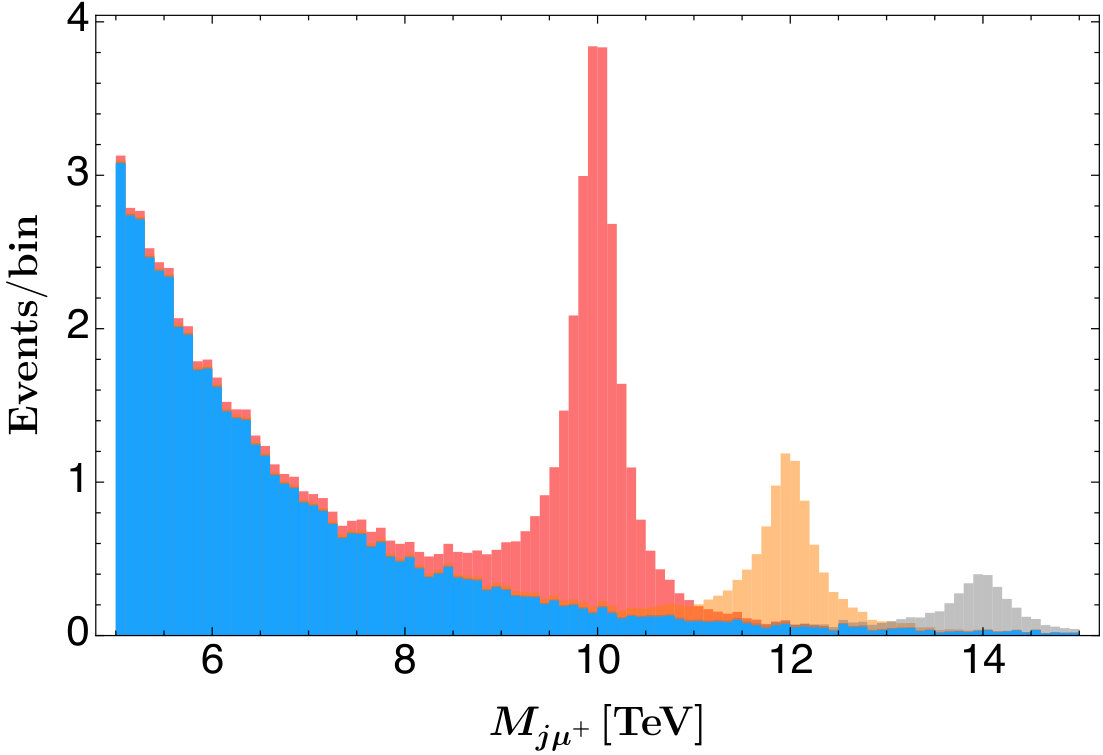 Figure 1
Peer Reviews
No public reviews on file for this paper yet. If you reviewed it on a platform where reviews are public (OpenReview, ICLR, NeurIPS, ICML), you can paste yours below so the community can read it here.
Videos
No videos yet. Explain this paper in a talk, walkthrough, or lecture? Add one.